
G26 — Agape (Love)
Greek agape, with New Testament and Septuagint usage links where indexed.
The Early Christian Study Bible · Free to use
Study the word. Hear its pronunciation.
Search 14,298 Greek and Hebrew entries—free. Explore definitions, indexed occurrences, and pronunciation audio where available, then follow the words back into your Bible.
Click a word. Hear its pronunciation. Open the early Christian writings. Then see how to present and teach.
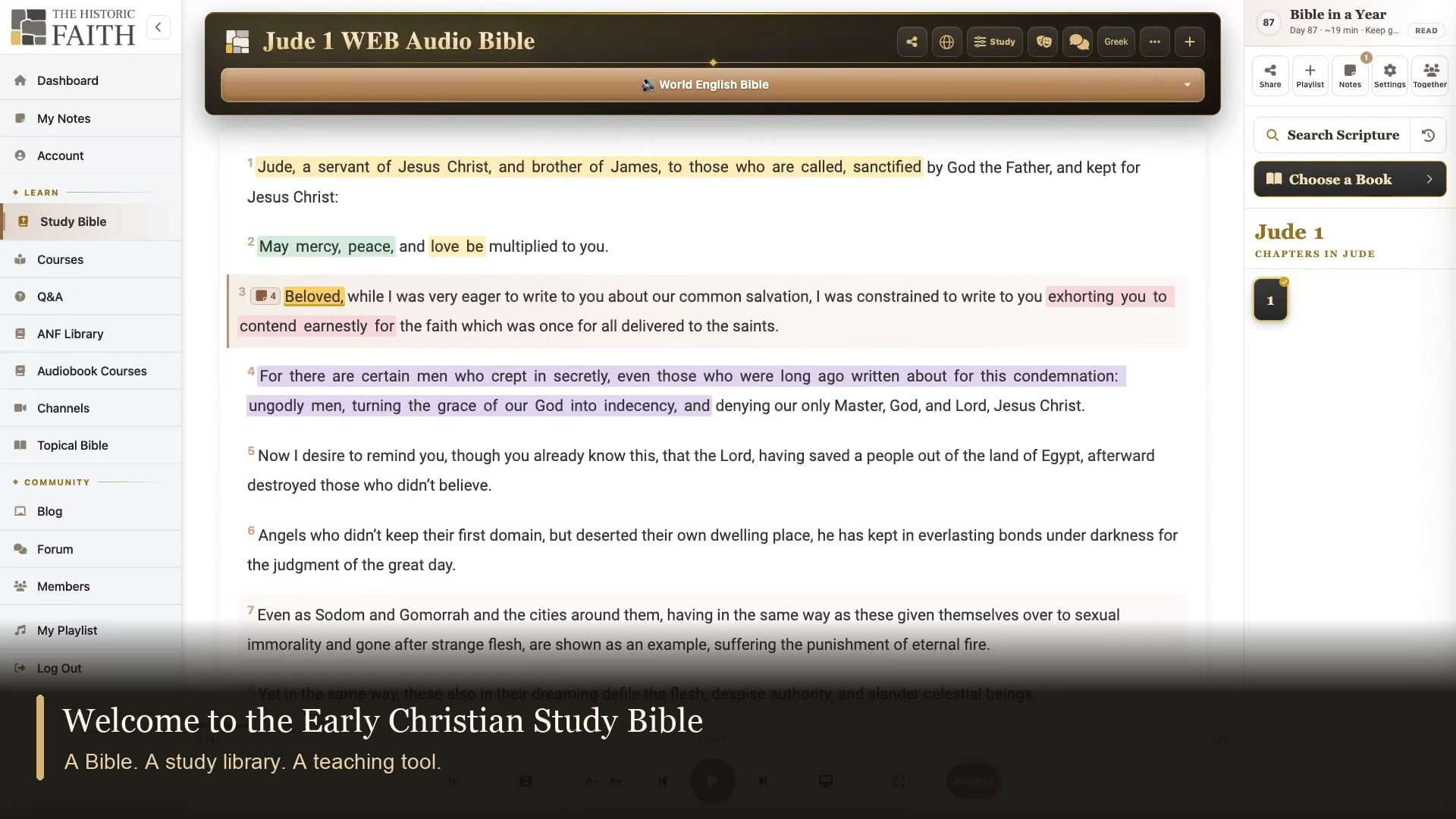 Words. Writings.
Guided tour · 21:50 · Several Bible editions.
See the phone experience · 5:31
Strong's Exhaustive Concordance, first published by James Strong in 1890, indexes every word of the King James Version and assigns each underlying original-language word a number — G1–G5624 for the Greek New Testament and H1–H8674 for the Hebrew Old Testament. Look up any English word, find its Strong's number, and see the Greek or Hebrew word behind it, its definition, and the verses where it occurs. This free online edition covers 14,298 entries with 767,764 indexed occurrences — including the Septuagint, deuterocanonical books, and 1 Enoch, which no print edition of Strong's includes.
These entry points are the quickest way to see how a Strong's number opens into a word, meaning, and Bible usage.
Greek agape, with New Testament and Septuagint usage links where indexed.
Greek kyrios, a major New Testament and Septuagint word-study bridge.
Hebrew reshith, the word behind “beginning” in Genesis 1:1 and other Old Testament usages.
Browse the local Greek and Hebrew Strong's entries in fast pages, open an exact number, or narrow the index by language, range, and usage count.
| Number | Word | Definition | Usages | Range |
|---|---|---|---|---|
|
G1201 — desmoterion
Greek
|
δεσμωτήριον (desmoterion)
desmoterion
|
desmoterion (des-mo-tay'-ree-on) n. 1. a place of bondage, i.e. a dungeon [from a derivative of G1199 (equivalent to G1196)] | 13 | G1001-G2000 |
|
G1202 — desmotes
Greek
|
δεσμώτης (desmotes)
desmotes
|
desmotes (des-mo'-tace) n. 1. (passively) a captive [from a derivative of G1199 (equivalent to G1196)] | 6 | G1001-G2000 |
|
G1203 — despotes
Greek
|
δεσπότης (despotes)
despotes
|
despotes (des-pot'-ace) n. 1. an absolute ruler ("despot") [perhaps from G1210 and posis (a husband)] | 60 | G1001-G2000 |
|
G1204 — deuro
Greek
|
δεῦρο (deuro)
deuro
|
deuro (dyoo`-roh) adv. 1. here {used also imperative hither!; and of time, hitherto} | 78 | G1001-G2000 |
|
G1205 — deute
Greek
|
δεῦτε (deute)
deute
|
deute (dyoo`-teh) v. 1. come hither! [from G1204 and an imperative form of eimi "to go"] | 53 | G1001-G2000 |
|
G1206 — deuteraios
Greek
|
δευτεραῖος (deuteraios)
deuteraios
|
deuteraios (dyoo-ter-ai`-os) adj. 1. secondary 2. (specially) on the second day | 1 | G1001-G2000 |
|
G1207 — deuteroprotos
Greek
|
δευτερόπρωτος (deuteroprotos)
deuteroprotos
|
deuteroprotos (dyoo-ter-op'-ro-tos) adj. 1. second-first 2. (specially) a designation of the Sabbath immediately after the Paschal week (being the second after Passover day, and the first of the seven Sabbaths intervening before Pentecost) | 1 | G1001-G2000 |
|
G1208 — deuteros
Greek
|
δεύτερος (deuteros)
deuteros
|
deuteros (dyoo'-ter-os) adj. 1. second (in time, place, or rank) 2. (also adverb) secondly | 256 | G1001-G2000 |
|
G1209 — dechomai
Greek
|
δέχομαι (dechomai)
dechomai
|
dechomai (dekh'-om-ai) v. 1. to receive {(in various applications, literally or figuratively)} | 106 | G1001-G2000 |
|
G1210 — deo
Greek
|
δέω (deo)
deo
|
deo (deh'-o) v. 1. to bind 2. (regarding marriage) to be bethrothed, to pledge to give oneself in marriage | 158 | G1001-G2000 |
|
G1211 — de
Greek
|
δή (de)
de
|
de (day') prt. 1. now, then, etc. [probably akin to G1161, a particle of emphasis or explicitness] | 293 | G1001-G2000 |
|
G1212 — delos
Greek
|
δῆλος (delos)
delos
|
delos (day`-los) adj. 1. clear [of uncertain derivation] | 12 | G1001-G2000 |
|
G1213 — deloo
Greek
|
δηλόω (deloo)
deloo
|
deloo (day-loh'-o) v. 1. to make plain (by words) [from G1212] | 31 | G1001-G2000 |
|
G1214 — Demas
Greek
|
Δημᾶς (Demas)
Demas
|
Demas (day-mas`) n/p. 1. Demas, a Christian [probably for G1216] | 3 | G1001-G2000 |
|
G1215 — demegoreo
Greek
|
δημηγορέω (demegoreo)
demegoreo
|
demegoreo (day-may-gor-eh'-o) v. 1. to be a people-gatherer, i.e. to address a public assembly [from a compound of G1218 and G58] | 3 | G1001-G2000 |
|
G1216 — Demetrios
Greek
|
Δημήτριος (Demetrios)
Demetrios
|
Demetrios (day-may'-tree-os) n/p. 1. Demetrius, the name of an Ephesian and of a Christian [from Demeter (Ceres)] | 48 | G1001-G2000 |
|
G1217 — demiourgos
Greek
|
δημιουργός (demiourgos)
demiourgos
|
demiourgos (day-mee-our-gos') n. 1. a worker for the people, i.e. mechanic (spoken of the Creator) [from G1218 and G2041] | 3 | G1001-G2000 |
|
G1218 — demos
Greek
|
δῆμος (demos)
demos
|
demos (day`-mos) n. 1. the public (as bound together socially) [from G1210] | 146 | G1001-G2000 |
|
G1219 — demosios
Greek
|
δημόσιος (demosios)
demosios
|
demosios (day-mos'-ee-os) adj. 1. public 2. (feminine singular dative case as adverb) in public | 7 | G1001-G2000 |
|
G1220 — denarion
Greek
|
δηνάριον (denarion)
denarion
|
denarion (day-nar'-ee-on) n. 1. a denarius (or ten asses) [of Latin origin] | 15 | G1001-G2000 |
|
G1221 — depote
Greek
|
δήποτε (depote)
depote
|
depote (day'-pot-eh) prt. 1. indeed, at any time [from G1211 and G4218, a particle of generalization] | 1 | G1001-G2000 |
|
G1222 — depou
Greek
|
δήπου (depou)
depou
|
depou (day'-pou) adv. 1. indeed doubtless [from G1211 and G4225, a particle of asseveration] | 1 | G1001-G2000 |
|
G1223 — dia
Greek
|
διά (dia)
dia
|
dia (dee-ah') prep. 1. through {in very wide applications, local, causal, or occasional} | 1,827 | G1001-G2000 |
|
G1224 — diabaino
Greek
|
διαβαίνω (diabaino)
diabaino
|
diabaino (dee-ab-ai'-no) v. 1. to cross [from G1223 and the base of G939] | 112 | G1001-G2000 |
|
G1225 — diaballo
Greek
|
διαβάλλω (diaballo)
diaballo
|
diaballo (dee-ab-al'-lo) v. 1. (figuratively) to slander [from G1223 and G906] | 5 | G1001-G2000 |
|
G1226 — diabebaioomai
Greek
|
διαβεβαιόομαι (diabebaioomai)
diabebaioomai
|
diabebaioomai (dee-ab-eb-ai-oh'-om-ai) v. 1. to confirm thoroughly (by words), i.e. asseverate [middle voice of a compound of G1223 and G950] | 2 | G1001-G2000 |
|
G1227 — diablepo
Greek
|
διαβλέπω (diablepo)
diablepo
|
diablepo (dee-ab-lep'-o) v. 1. to look through, i.e. recover full vision [from G1223 and G991] | 2 | G1001-G2000 |
|
G1228 — diabolos
Greek
|
διάβολος (diabolos)
diabolos
|
diabolos (dee-ab'-ol-os) adj. 1. a slanderer 2. (specially) Satan | 54 | G1001-G2000 |
|
G1229 — diaggello
Greek
|
διαγγέλλω (diaggello)
diaggello
|
diaggello (dee-ang-gel'-lo) v. 1. to herald thoroughly [from G1223 and the base of G32] | 11 | G1001-G2000 |
|
G1230 — diaginomai
Greek
|
διαγίνομαι (diaginomai)
diaginomai
|
diaginomai (dee-ag-in'-om-ai) v. 1. to elapse meanwhile [from G1223 and G1096] | 4 | G1001-G2000 |
|
G1231 — diaginosko
Greek
|
διαγινώσκω (diaginosko)
diaginosko
|
diaginosko (dee-ag-in-o'-sko) v. 1. to know thoroughly, i.e. ascertain exactly [from G1223 and G1097] | 11 | G1001-G2000 |
|
G1232 — diagnorizo
Greek
|
διαγνωρίζω (diagnorizo)
diagnorizo
|
diagnorizo (dee-ag-no-rid'-zo) v. 1. to tell abroad [from G1123 and G1107] | 1 | G1001-G2000 |
|
G1233 — diagnosis
Greek
|
διάγνωσις (diagnosis)
diagnosis
|
diagnosis (dee-ag'-no-sis) n. 1. (magisterial) examination ("diagnosis") [from G1231] | 2 | G1001-G2000 |
|
G1234 — diagogguzo
Greek
|
διαγογγύζω (diagogguzo)
diagogguzo
|
diagogguzo (dee-ag-ong-good'-zo) v. 1. to complain throughout a crowd [from G1223 and G1111] | 12 | G1001-G2000 |
|
G1235 — diagregoreo
Greek
|
διαγρηγορέω (diagregoreo)
diagregoreo
|
diagregoreo (dee-ag-ray-gor-eh'-o) v. 1. to waken thoroughly [from G1223 and G1127] | 1 | G1001-G2000 |
|
G1236 — diago
Greek
|
διάγω (diago)
diago
|
diago (dee-ag'-o) v. 1. to pass time or life [from G1223 and G71] | 23 | G1001-G2000 |
|
G1237 — diadechomai
Greek
|
διαδέχομαι (diadechomai)
diadechomai
|
diadechomai (dee-ad-ekh'-om-ai) v. 1. to receive in turn 2. (figuratively) succeed to | 8 | G1001-G2000 |
|
G1238 — diadema
Greek
|
διάδημα (diadema)
diadema
|
diadema (dee-ad'-ay-mah) n. 1. a "diadem" (as bound about the head) {simpler and thinner than G4735} | 19 | G1001-G2000 |
|
G1239 — diadidomai
Greek
|
διαδίδωμαι (diadidomai)
diadidomai
|
diadidomai (dee-ad-id'-o-mai) v. 1. to give throughout a crowd, i.e. deal out 2. also to deliver over (as to a successor) | 15 | G1001-G2000 |
|
G1240 — diadochos
Greek
|
διάδοχος (diadochos)
diadochos
|
diadochos (dee-ad'-okh-os) n. 1. a successor in office [from G1237] | 8 | G1001-G2000 |
|
G1241 — diazonnumi
Greek
|
διαζώννυμι (diazonnumi)
diazonnumi
|
diazonnumi (dee-az-own'-noo-mee) v. 1. to gird tightly [from G1223 and G2224] | 3 | G1001-G2000 |
|
G1242 — diatheke
Greek
|
διαθήκη (diatheke)
diatheke
|
diatheke (dee-ath-ay'-kay) n. 1. (properly) a disposition 2. (specially) a contract (especially a devisory will) | 346 | G1001-G2000 |
|
G1243 — diairesis
Greek
|
διαίρεσις (diairesis)
diairesis
|
diairesis (dee-ai'-res-is) n. 1. a distinction or (concretely) variety [from G1244] | 32 | G1001-G2000 |
|
G1244 — diaireo
Greek
|
διαιρέω (diaireo)
diaireo
|
diaireo (dee-ai-reh'-o) v. 1. to separate, i.e. distribute [from G1223 and G138] | 43 | G1001-G2000 |
|
G1245 — diakatharizo
Greek
|
διακαθαρίζω (diakatharizo)
diakatharizo
|
diakatharizo (dee-ak-ath-ar-id'-zo) v. 1. to cleanse perfectly 2. (specially) winnow | 2 | G1001-G2000 |
|
G1246 — diakatelegchomai
Greek
|
διακατελέγχομαι (diakatelegchomai)
diakatelegchomai
|
diakatelegchomai (dee-ak-at-el-eng'-khom-ai) v. 1. to prove downright, i.e. confute [middle voice from G1223 and a compound of G2596 and G1651] | 1 | G1001-G2000 |
|
G1247 — diakoneo
Greek
|
διακονέω (diakoneo)
diakoneo
|
diakoneo (dee-ak-on-eh'-o) v. 1. to be an attendant, to wait upon (menially or as a host, friend) 2. (figuratively) to serve as a teacher | 32 | G1001-G2000 |
|
G1248 — diakonia
Greek
|
διακονία (diakonia)
diakonia
|
diakonia (dee-ak-on-ee'-ah) n. 1. attendance (as a servant, etc.) 2. (figuratively) charitable aid | 33 | G1001-G2000 |
|
G1249 — diakonos
Greek
|
διάκονος (diakonos)
diakonos
|
diakonos (dee-ak'-on-os) n. 1. an attendant, a servant 2. (genitive case) a waiter (at table or in other menial duties) | 35 | G1001-G2000 |
|
G1250 — diakosioi
Greek
|
διακόσιοι (diakosioi)
diakosioi
|
diakosioi (dee-ak-os'-ee-oy) n. 1. two hundred [from G1364 and G1540] | 91 | G1001-G2000 |
|
G1251 — diakouomai
Greek
|
διακούομαι (diakouomai)
diakouomai
|
diakouomai (dee-ak-ou'-om-ai) v. 1. to hear throughout, i.e. patiently listen (to a prisoner's plea) [middle voice from G1223 and G191] | 3 | G1001-G2000 |
|
G1252 — diakrino
Greek
|
διακρίνω (diakrino)
diakrino
|
diakrino (dee-ak-ree'-no) v. 1. to separate thoroughly 2. (literally and reflexively) to withdraw from | 44 | G1001-G2000 |
|
G1253 — diakrisis
Greek
|
διάκρισις (diakrisis)
diakrisis
|
diakrisis (dee-ak'-ree-sis) n. 1. judicial estimation [from G1252] | 4 | G1001-G2000 |
|
G1254 — diakoluo
Greek
|
διακωλύω (diakoluo)
diakoluo
|
diakoluo (dee-ak-o-loo'-o) v. 1. to hinder altogether, i.e. utterly prohibit [from G1223 and G2967] | 3 | G1001-G2000 |
|
G1255 — dialaleo
Greek
|
διαλαλέω (dialaleo)
dialaleo
|
dialaleo (dee-al-al-eh'-o) v. 1. to talk throughout a company, i.e. converse or (genitive case) publish [from G1223 and G2980] | 2 | G1001-G2000 |
|
G1256 — dialegomai
Greek
|
διαλέγομαι (dialegomai)
dialegomai
|
dialegomai (dee-al-eg'-om-ai) v. 1. to say thoroughly, i.e. discuss (in argument or exhortation) [middle voice from G1223 and G3004] | 20 | G1001-G2000 |
|
G1257 — dialeipo
Greek
|
διαλείπω (dialeipo)
dialeipo
|
dialeipo (dee-al-ei'-po) v. 1. to leave off in the middle, i.e. intermit [from G1223 and G3007] | 13 | G1001-G2000 |
|
G1258 — dialektos
Greek
|
διάλεκτος (dialektos)
dialektos
|
dialektos (dee-al'-ek-tos) n. 1. a (mode of) discourse, i.e. "dialect" [from G1256] | 7 | G1001-G2000 |
|
G1259 — diallasso
Greek
|
διαλλάσσω (diallasso)
diallasso
|
diallasso (dee-al-las'-so) v. 1. to change thoroughly 2. (mentally) to conciliate | 11 | G1001-G2000 |
|
G1260 — dialogizomai
Greek
|
διαλογίζομαι (dialogizomai)
dialogizomai
|
dialogizomai (dee-al-og-id'-zom-ai) v. 1. to reckon thoroughly 2. (genitive case) to deliberate (by reflection or discussion) | 27 | G1001-G2000 |
|
G1261 — dialogismos
Greek
|
διαλογισμός (dialogismos)
dialogismos
|
dialogismos (dee-al-og-is-mos') n. 1. discussion 2. (internal) consideration | 38 | G1001-G2000 |
|
G1262 — dialuo
Greek
|
διαλύω (dialuo)
dialuo
|
dialuo (dee-al-oo'-o) v. 1. to dissolve utterly [from G1223 and G3089] | 11 | G1001-G2000 |
|
G1263 — diamarturomai
Greek
|
διαμαρτύρομαι (diamarturomai)
diamarturomai
|
diamarturomai (dee-am-ar-too'-rom-ai) v. 1. to attest or protest earnestly 2. (by implication) hortatively | 44 | G1001-G2000 |
|
G1264 — diamachomai
Greek
|
διαμάχομαι (diamachomai)
diamachomai
|
diamachomai (dee-am-akh'-om-ai) v. 1. to fight fiercely (in altercation) [from G1223 and G3164] | 5 | G1001-G2000 |
|
G1265 — diameno
Greek
|
διαμένω (diameno)
diameno
|
diameno (dee-am-en'-o) v. 1. to stay constantly (in being or relation) [from G1223 and G3306] | 25 | G1001-G2000 |
|
G1266 — diamerizo
Greek
|
διαμερίζω (diamerizo)
diamerizo
|
diamerizo (dee-am-er-id'-zo) v. 1. to partition thoroughly 2. (literally) -in distribution | 28 | G1001-G2000 |
|
G1267 — diamerismos
Greek
|
διαμερισμός (diamerismos)
diamerismos
|
diamerismos (dee-am-er-is-mos') n. 1. disunion (of opinion and conduct) [from G1266] | 3 | G1001-G2000 |
|
G1268 — dianemo
Greek
|
διανέμω (dianemo)
dianemo
|
dianemo (dee-an-em'-o) v. 1. to distribute 2. (of information) to disseminate | 2 | G1001-G2000 |
|
G1269 — dianeuo
Greek
|
διανεύω (dianeuo)
dianeuo
|
dianeuo (dee-an-yoo'-o) v. 1. to nod (or express by signs) across an intervening space [from G1223 and G3506] | 3 | G1001-G2000 |
|
G1270 — dianoema
Greek
|
διανόημα (dianoema)
dianoema
|
dianoema (dee-an-o'-ay-mah) n. 1. something thought through, i.e. a sentiment [from a compound of G1223 and G3539] | 13 | G1001-G2000 |
|
G1271 — dianoia
Greek
|
διάνοια (dianoia)
dianoia
|
dianoia (dee-an'-oy-ah) n. 1. deep thought, contemplation 2. (properly) the mind (or its disposition), the faculty | 78 | G1001-G2000 |
|
G1272 — dianoigo
Greek
|
διανοίγω (dianoigo)
dianoigo
|
dianoigo (dee-an-oy'-go) v. 1. to open thoroughly 2. (literally) as a first-born | 40 | G1001-G2000 |
|
G1273 — dianuktereuo
Greek
|
διανυκτερεύω (dianuktereuo)
dianuktereuo
|
dianuktereuo (dee-an-ook-ter-yoo'-o) v. 1. to sit up the whole night [from G1223 and a derivative of G3571] | 1 | G1001-G2000 |
|
G1274 — dianuo
Greek
|
διανύω (dianuo)
dianuo
|
dianuo (dee-an-oo'-o) v. 1. to accomplish thoroughly [from G1223 and anuo "to effect"] | 2 | G1001-G2000 |
|
G1275 — diapantos
Greek
|
διαπαντός (diapantos)
diapantos
|
diapantos (dee-ap-an-tos') adv. 1. through all time 2. (adverbially) constantly | 7 | G1001-G2000 |
|
G1276 — diaperao
Greek
|
διαπεράω (diaperao)
diaperao
|
diaperao (dee-ap-er-ah'-o) v. 1. to cross entirely [from G1223 and a derivative of the base of G4008] | 13 | G1001-G2000 |
|
G1277 — diapleo
Greek
|
διαπλέω (diapleo)
diapleo
|
diapleo (dee-ap-leh'-o) v. 1. to sail through [from G1223 and G4126] | 1 | G1001-G2000 |
|
G1278 — diaponeo
Greek
|
διαπονέω (diaponeo)
diaponeo
|
diaponeo (dee-ap-on-eh'-o) v. 1. to toil through 2. (passively) be worried | 4 | G1001-G2000 |
|
G1279 — diaporeuomai
Greek
|
διαπορεύομαι (diaporeuomai)
diaporeuomai
|
diaporeuomai (dee-ap-or-yoo'-om-ai) v. 1. to travel through [from G1223 and G4198] | 46 | G1001-G2000 |
|
G1280 — diaporeo
Greek
|
διαπορέω (diaporeo)
diaporeo
|
diaporeo (dee-ap-or-eh'-o) v. 1. to be thoroughly nonplussed [from G1223 and G639] | 5 | G1001-G2000 |
|
G1281 — diapragmateuomai
Greek
|
διαπραγματεύομαι (diapragmateuomai)
diapragmateuomai
|
diapragmateuomai (dee-ap-rag-mat-yoo'-om-ai) v. 1. to thoroughly occupy oneself 2. (transitively and by implication) to earn in business | 1 | G1001-G2000 |
|
G1282 — diaprio
Greek
|
διαπρίω (diaprio)
diaprio
|
diaprio (dee-ap-ree'-o) v. 1. to saw asunder 2. (figuratively) to exasperate, to "hack off", to irritate completely | 2 | G1001-G2000 |
|
G1283 — diarpazo
Greek
|
διαρπάζω (diarpazo)
diarpazo
|
diarpazo (dee-ar-pad'-zo) v. 1. to seize asunder, i.e. plunder [from G1223 and G726] | 35 | G1001-G2000 |
|
G1284 — diarrhesso
Greek
|
διαρῥήσσω (diarrhesso)
diarrhesso
|
diarrhesso (dee-ar-rhayce'-so) v. 1. to tear asunder [from G1223 and G4486] | 8 | G1001-G2000 |
|
G1285 — diasapheo
Greek
|
διασαφέω (diasapheo)
diasapheo
|
diasapheo (dee-as-af-eh'-o) v. 1. to clear thoroughly 2. (figuratively) declare | 10 | G1001-G2000 |
|
G1286 — diaseio
Greek
|
διασείω (diaseio)
diaseio
|
diaseio (dee-as-ei'-o) v. 1. to shake thoroughly 2. (figuratively) to intimidate | 2 | G1001-G2000 |
|
G1287 — diaskorpizo
Greek
|
διασκορπίζω (diaskorpizo)
diaskorpizo
|
diaskorpizo (dee-as-kor-pid'-zo) v. 1. to dissipate 2. (genitive case) to rout or separate | 56 | G1001-G2000 |
|
G1288 — diaspao
Greek
|
διασπάω (diaspao)
diaspao
|
diaspao (dee-as-pah'-o) v. 1. to draw apart, i.e. sever or dismember [from G1223 and G4685] | 10 | G1001-G2000 |
|
G1289 — diaspeiro
Greek
|
διασπείρω (diaspeiro)
diaspeiro
|
diaspeiro (dee-as-pei'-ro) v. 1. to sow throughout 2. (figuratively) distribute in foreign lands | 67 | G1001-G2000 |
|
G1290 — diaspora
Greek
|
διασπορά (diaspora)
diaspora
|
diaspora (dee-as-por-ah') n. 1. dispersion 2. (concretely) the Israelite resident in Gentile countries | 12 | G1001-G2000 |
|
G1291 — diastellomai
Greek
|
διαστέλλομαι (diastellomai)
diastellomai
|
diastellomai (dee-as-tel'-lom-ai) v. 1. to set (oneself) apart 2. (figuratively) to distinguish | 57 | G1001-G2000 |
|
G1292 — diastema
Greek
|
διάστημα (diastema)
diastema
|
diastema (dee-as'-tay-mah) n. 1. an interval [from G1339] | 14 | G1001-G2000 |
|
G1293 — diastole
Greek
|
διαστολή (diastole)
diastole
|
diastole (dee-as-tol-ay') n. 1. a variation [from G1291] | 7 | G1001-G2000 |
|
G1294 — diastrepho
Greek
|
διαστρέφω (diastrepho)
diastrepho
|
diastrepho (dee-as-tref'-o) v. 1. to distort 2. (figuratively) misinterpret | 37 | G1001-G2000 |
|
G1295 — diasozo
Greek
|
διασώζω (diasozo)
diasozo
|
diasozo (dee-as-owdz'-o) v. 1. to save thoroughly 2. (by implication or analogy) to cure, preserve, rescue, etc. | 75 | G1001-G2000 |
|
G1296 — diatage
Greek
|
διαταγή (diatage)
diatage
|
diatage (dee-at-ag-ay') n. 1. arrangement, i.e. institution [from G1299] | 3 | G1001-G2000 |
|
G1297 — diatagma
Greek
|
διάταγμα (diatagma)
diatagma
|
diatagma (dee-at'-ag-mah) n. 1. an arrangement 2. (authoritative) edict | 3 | G1001-G2000 |
|
G1298 — diatarasso
Greek
|
διαταράσσω (diatarasso)
diatarasso
|
diatarasso (dee-at-ar-as'-so) v. 1. to disturb wholly, i.e. agitate (with alarm) [from G1223 and G5015] | 1 | G1001-G2000 |
|
G1299 — diatasso
Greek
|
διατάσσω (diatasso)
diatasso
|
diatasso (dee-at-as'-so) v. 1. to arrange thoroughly 2. (specially) institute, prescribe, etc. | 37 | G1001-G2000 |
|
G1300 — diateleo
Greek
|
διατελέω (diateleo)
diateleo
|
diateleo (dee-at-el-eh'-o) v. 1. to accomplish thoroughly 2. (subjectively) to persist | 5 | G1001-G2000 |
|
G1301 — diatereo
Greek
|
διατηρέω (diatereo)
diatereo
|
diatereo (dee-at-ay-reh'-o) v. 1. to watch thoroughly 2. (positively and transitively) to observe strictly | 25 | G1001-G2000 |
|
G1302 — diati
Greek
|
διατί (diati)
diati
|
diati (dee-at-ee') prt. 1. through what cause ?, i.e. why? [from G1223 and G5101] | 26 | G1001-G2000 |
|
G1303 — diatithemai
Greek
|
διατίθεμαι (diatithemai)
diatithemai
|
diatithemai (dee-at-ith'-em-ai) v. 1. to put apart 2. (figuratively) dispose (by assignment, compact, or bequest) | 90 | G1001-G2000 |
|
G1304 — diatribo
Greek
|
διατρίβω (diatribo)
diatribo
|
diatribo (dee-at-ree'-bo) v. 1. to wear through (time), i.e. remain [from G1223 and the base of G5147] | 14 | G1001-G2000 |
|
G1305 — diatrophe
Greek
|
διατροφή (diatrophe)
diatrophe
|
diatrophe (dee-at-rof-ay') n. 1. nourishment [from a compound of G1223 and G5142] | 2 | G1001-G2000 |
|
G1306 — diaugazo
Greek
|
διαυγάζω (diaugazo)
diaugazo
|
diaugazo (dee-au-gad'-zo) v. 1. to glimmer through, i.e. break (as day) [from G1223 and G826] | 1 | G1001-G2000 |
|
G1307 — diaphanes
Greek
|
διαφανής (diaphanes)
diaphanes
|
diaphanes (dee-af-an-ace') adj. 1. appearing through, i.e. "diaphanous" [from G1223 and G5316] | 4 | G1001-G2000 |
|
G1308 — diaphero
Greek
|
διαφέρω (diaphero)
diaphero
|
diaphero (dee-af-er'-o) v. 1. to bear through 2. (literally) transport | 23 | G1001-G2000 |
|
G1309 — diapheugo
Greek
|
διαφεύγω (diapheugo)
diapheugo
|
diapheugo (dee-af-yoo'-go) v. 1. to flee through, i.e. escape [from G1223 and G5343] | 16 | G1001-G2000 |
|
G1310 — diaphemizo
Greek
|
διαφημίζω (diaphemizo)
diaphemizo
|
diaphemizo (dee-af-ay-mid'-zo) v. 1. to report thoroughly, i.e. divulgate [from G1223 and a derivative of G5345] | 3 | G1001-G2000 |
|
G1311 — diaphtheiro
Greek
|
διαφθείρω (diaphtheiro)
diaphtheiro
|
diaphtheiro (dee-af-thei'-ro) v. 1. to rot thoroughly 2. (by implication) to ruin | 76 | G1001-G2000 |
|
G1312 — diaphthora
Greek
|
διαφθορά (diaphthora)
diaphthora
|
diaphthora (dee-af-thor-ah') n. 1. decay [from G1311] | 29 | G1001-G2000 |
|
G1313 — diaphoros
Greek
|
διάφορος (diaphoros)
diaphoros
|
diaphoros (dee-af'-or-os) adj. 1. varying 2. also surpassing | 18 | G1001-G2000 |
|
G1314 — diaphulasso
Greek
|
διαφυλάσσω (diaphulasso)
diaphulasso
|
diaphulasso (dee-af-oo-las'-so) v. 1. to guard thoroughly, i.e. protect [from G1223 and G5442] | 29 | G1001-G2000 |
|
G1315 — diacheirizomai
Greek
|
διαχειρίζομαι (diacheirizomai)
diacheirizomai
|
diacheirizomai (dee-akh-ei-rid'-zom-ai) v. 1. to handle thoroughly 2. to handle violently | 2 | G1001-G2000 |
|
G1316 — diachorizomai
Greek
|
διαχωρίζομαι (diachorizomai)
diachorizomai
|
diachorizomai (dee-akh-o-rid'-zom-ai) v. 1. to remove (oneself) wholly, i.e. retire [from G1223 and the middle voice of G5563] | 25 | G1001-G2000 |
|
G1317 — didaktikos
Greek
|
διδακτικός (didaktikos)
didaktikos
|
didaktikos (did-ak-tik-os') adj. 1. instructive ("didactic") [from G1318] | 2 | G1001-G2000 |
|
G1318 — didaktos
Greek
|
διδακτός (didaktos)
didaktos
|
didaktos (did-ak-tos') adj. 1. (subjectively) instructed 2. (objectively) communicated by teaching | 4 | G1001-G2000 |
|
G1319 — didaskalia
Greek
|
διδασκαλία (didaskalia)
didaskalia
|
didaskalia (did-as-kal-ee'-ah) n. 1. instruction (the function or the information) [from G1320] | 26 | G1001-G2000 |
|
G1320 — didaskalos
Greek
|
διδάσκαλος (didaskalos)
didaskalos
|
didaskalos (did-as'-kal-os) n. 1. a teacher, an instructor 2. (figuratively, with reverence) master | 59 | G1001-G2000 |
|
G1321 — didasko
Greek
|
διδάσκω (didasko)
didasko
|
didasko (did-as'-ko) v. 1. to teach {in the same broad application as dao "to learn"} | 193 | G1001-G2000 |
|
G1322 — didache
Greek
|
διδαχή (didache)
didache
|
didache (did-akh-ay') n. 1. instruction (the act or the matter) [from G1321] | 30 | G1001-G2000 |
|
G1323 — didrachmon
Greek
|
δίδραχμον (didrachmon)
didrachmon
|
didrachmon (did'-rakh-mon) n. 1. a double drachma (didrachm) [from G1364 and G1406] | 20 | G1001-G2000 |
|
G1324 — Didumos
Greek
|
Δίδυμος (Didumos)
Didumos
|
Didumos (did'-oo-mos) n/p. 1. double, i.e. twin 2. Didymus, a Christian | 3 | G1001-G2000 |
|
G1325 — didomi
Greek
|
δίδωμι (didomi)
didomi
|
didomi (did'-o-mee) v. 1. to give {used in a very wide application (properly or by implication, literally or figuratively); greatly modified by the connection; used as an alternative in most of the tenses} | 2,191 | G1001-G2000 |
|
G1326 — diegeiro
Greek
|
διεγείρω (diegeiro)
diegeiro
|
diegeiro (dee-eg-ei'-ro) v. 1. to wake fully, i.e. arouse {literally or figuratively} | 11 | G1001-G2000 |
|
G1327 — diexodos
Greek
|
διέξοδος (diexodos)
diexodos
|
diexodos (dee-ex'-od-os) n. 1. an outlet through, i.e. probably an open square (from which roads diverge) [from G1223 and G1841] | 28 | G1001-G2000 |
|
G1328 — diermeneutes
Greek
|
διερμηνευτής (diermeneutes)
diermeneutes
|
diermeneutes (dee-er-mayn-yoo-tace') n. 1. an explainer [from G1329] | 1 | G1001-G2000 |
|
G1329 — diermeneuo
Greek
|
διερμηνεύω (diermeneuo)
diermeneuo
|
diermeneuo (dee-er-mayn-yoo'-o) v. 1. to explain thoroughly 2. (by implication) to translate | 7 | G1001-G2000 |
|
G1330 — dierchomai
Greek
|
διέρχομαι (dierchomai)
dierchomai
|
dierchomai (dee-er'-khom-ai) v. 1. to traverse {literally} | 176 | G1001-G2000 |
|
G1331 — dierotao
Greek
|
διερωτάω (dierotao)
dierotao
|
dierotao (dee-er-o-tah'-o) v. 1. to question throughout, i.e. ascertain by interrogation [from G1223 and G2065] | 1 | G1001-G2000 |
|
G1332 — dietes
Greek
|
διετής (dietes)
dietes
|
dietes (dee-et-ace') adj. 1. of two years (in age) [from G1364 and G2094] | 2 | G1001-G2000 |
|
G1333 — dietia
Greek
|
διετία (dietia)
dietia
|
dietia (dee-et-ee'-a) n. 1. a space of two years (biennium) [from G1332] | 2 | G1001-G2000 |
|
G1334 — diegeomai
Greek
|
διηγέομαι (diegeomai)
diegeomai
|
diegeomai (dee-ayg-eh'-om-ai) v. 1. to relate fully [from G1223 and G2233] | 68 | G1001-G2000 |
|
G1335 — diegesis
Greek
|
διήγεσις (diegesis)
diegesis
|
diegesis (dee-ayg'-es-is) n. 1. a recital [from G1334] | 12 | G1001-G2000 |
|
G1336 — dienekes
Greek
|
διηνεκές (dienekes)
dienekes
|
dienekes (dee-ay-nek-es') adj. 1. carried through, i.e. perpetually {(adverbially with G1519 and G3588 prefixed)} | 4 | G1001-G2000 |
|
G1337 — dithalassos
Greek
|
διθάλασσος (dithalassos)
dithalassos
|
dithalassos (dee-thal'-as-sos) adj. 1. having two seas, i.e. a sound with a double outlet [from G1364 and G2281] | 1 | G1001-G2000 |
|
G1338 — diikneomai
Greek
|
διϊκνέομαι (diikneomai)
diikneomai
|
diikneomai (dee-ik"-neh'-om-ai) v. 1. to reach through, i.e. penetrate [from G1223 and the base of G2425] | 2 | G1001-G2000 |
|
G1339 — diistemi
Greek
|
διΐστημι (diistemi)
diistemi
|
diistemi (dee-is"'-tay-mee) v. 1. to stand apart 2. (reflexively) to remove, intervene | 12 | G1001-G2000 |
|
G1340 — diischurizomai
Greek
|
διϊσχυρίζομαι (diischurizomai)
diischurizomai
|
diischurizomai (dee-is"-khoo-rid'-zom-ai) v. 1. to declare or affirm earnestly, to asseverate [from G1223 and a derivative of G2478] | 2 | G1001-G2000 |
|
G1341 — dikaiokrisia
Greek
|
δικαιοκρισία (dikaiokrisia)
dikaiokrisia
|
dikaiokrisia (dik-ai-ok-ris-ee'-ah) n. 1. a just sentence [from G1342 and G2920] | 1 | G1001-G2000 |
|
G1342 — dikaios
Greek
|
δίκαιος (dikaios)
dikaios
|
dikaios (dik'-ai-os) adj. 1. equitable (in character or act) 2. (by implication) innocent, holy | 444 | G1001-G2000 |
|
G1343
Greek
|
δικαιοσύνην
|
dikaiosune (dik-ai-os-oo'-nay) n. 1. equity (of character or act) 2. (specially) Christian justification | 385 | G1001-G2000 |
|
G1344 — dikaioo
Greek
|
δικαιόω (dikaioo)
dikaioo
|
dikaioo (dik-ai-oh'-o) v. 1. to render (i.e. show or regard as) just or innocent [from G1342] | 79 | G1001-G2000 |
|
G1345 — dikaioma
Greek
|
δικαίωμα (dikaioma)
dikaioma
|
dikaioma (dik-ai'-o-mah) n. 1. an equitable deed 2. (by implication) a statute or decision | 145 | G1001-G2000 |
|
G1346 — dikaios
Greek
|
δικαίως (dikaios)
dikaios
|
dikaios (dik-ai'-ows) adv. 1. equitably [adverb from G1342] | 19 | G1001-G2000 |
|
G1347 — dikaiosis
Greek
|
δικαίωσις (dikaiosis)
dikaiosis
|
dikaiosis (dik-ai'-o-sis) n. 1. aquittal (for Christ's sake) [from G1344] | 3 | G1001-G2000 |
|
G1348 — dikastes
Greek
|
δικαστής (dikastes)
dikastes
|
dikastes (dik-as-tace') n. 1. a judger [from a derivative of G1349] | 15 | G1001-G2000 |
|
G1349 — dike
Greek
|
δίκη (dike)
dike
|
dike (dee'-kay) n. 1. right (as self-evident) 2. justice (the principle, a decision, or its execution) | 39 | G1001-G2000 |
|
G1350 — diktuon
Greek
|
δίκτυον (diktuon)
diktuon
|
diktuon (dik'-too-on) n. 1. a seine (for fishing) [probably from a primary verb diko "to cast"] | 29 | G1001-G2000 |
No Strong's entries match that search.
Strong's works best when the number, original word, verse, and corpus stay connected.
Open a chapter and move from a word token to its Strong's page, parsing, and linked occurrences.
Greek Strong's entries can include New Testament, Septuagint, deuterocanonical, and 1 Enoch rows where indexed.
Dedicated Strong's pages can expose approved pronunciation audio beside the word-study data.
These are common words readers run into repeatedly, shown with an English meaning so the list is readable without already knowing the original languages.
Look up a word study by its transliteration — these are frequently searched Hebrew and Greek words. Each opens the matching Strong's entry, or lists the options when a spelling maps to several words.