
Greek Text with English
See the Greek text alongside the English translation for every verse in the New Testament, displayed word by word in interlinear format.
The Early Christian Study Bible · Free to use
Study the words. Hear their meaning.
Explore original Greek and Hebrew alongside English, with Strong’s numbers, meanings, morphology, and pronunciation audio where available. Follow verses into early Christian writings and study in context.
Click a word. Hear its pronunciation. Open the early Christian writings. Then see how to present and teach.
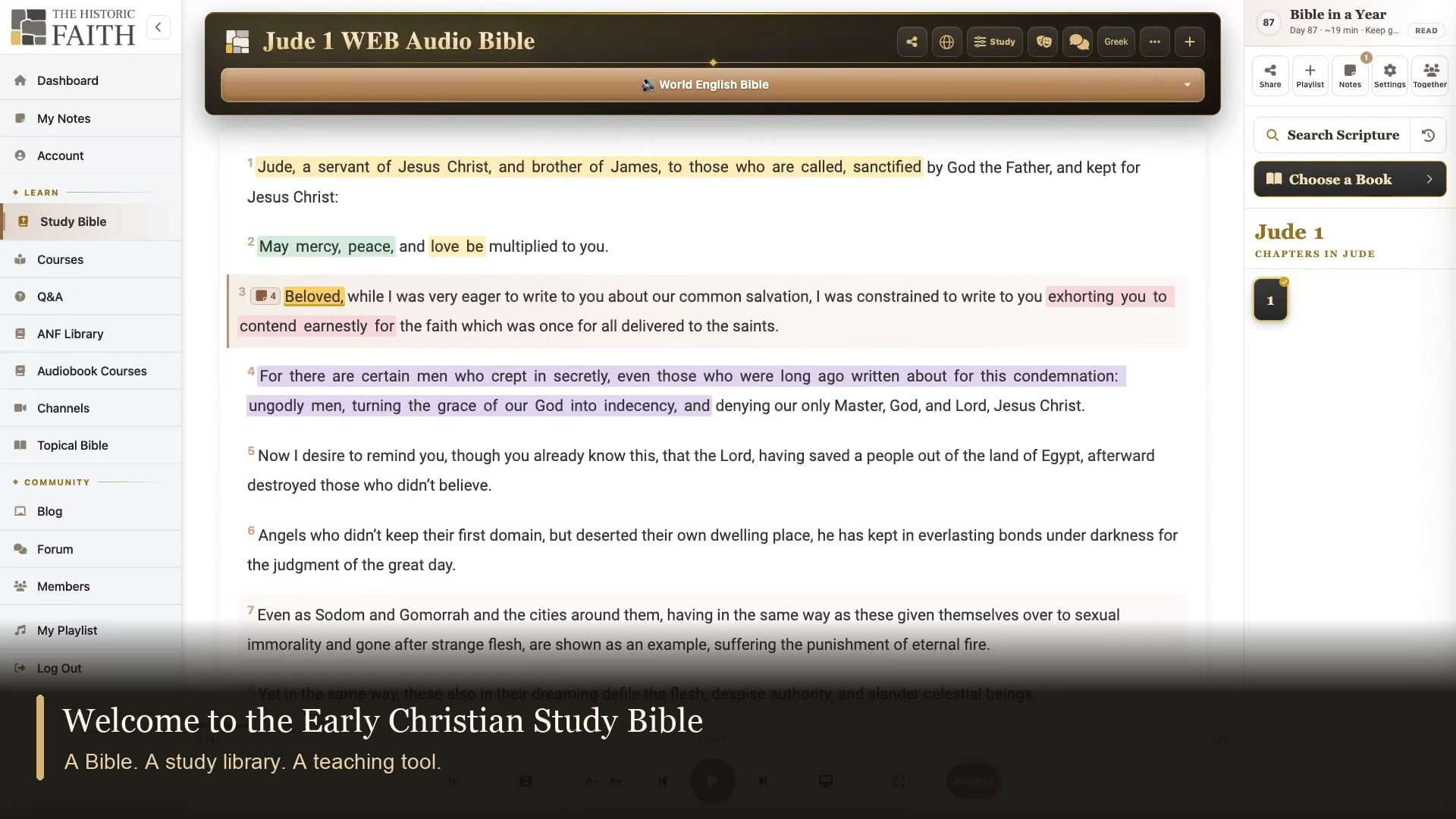 Words. Writings.
Guided tour · 21:50 · Several Bible editions.
See the phone experience · 5:31
One interlinear reader for both testaments — click any word to see the original Greek or Hebrew, Strong's number, gloss, and morphology. Whether you are studying the New Testament in Greek or the Old Testament in Hebrew, the tools work the same way.
Read and study the Greek New Testament with word-level tools built into every chapter.
See the Greek text alongside the English translation for every verse in the New Testament, displayed word by word in interlinear format.
Click any Greek word to open its Strong's entry with definitions, glosses, and every occurrence across the New Testament.
Every token includes full parsing information — tense, mood, voice, case, number, and gender — so you can study grammar in context.
Study Hebrew words and grammar in the Old Testament through the same interlinear surface.
See the Hebrew text with English translation for every verse in the Old Testament, laid out word by word with right-to-left support.
Click any Hebrew word to see its Strong's number, root meaning, glosses, and where else it appears throughout the Hebrew Bible.
Compare how Hebrew words were translated into Greek in the Septuagint, bridging the Old Testament's two language traditions.
The interlinear reader is designed to make original-language study accessible without requiring knowledge of Greek or Hebrew.
Tap or click any Greek or Hebrew word in the interlinear to instantly see its Strong's number, definition, and gloss in a popup.
From the Strong's popup, see where else in the Bible that same word appears — helping you trace a concept across books and testaments.
Related passages appear alongside the interlinear text so you can compare Scripture with Scripture as you study the original languages.
See what early Christians wrote about the passage you are studying, connecting your word-level research to patristic commentary.
Popular entry points into the interlinear reader.
The prologue of John's Gospel in NT Greek — one of the most studied passages in the New Testament.
The creation account in OT Hebrew — study bara, elohim, and ruach in their original language.
Paul's argument on life in the Spirit, rich with theological vocabulary worth studying in the Greek.
The shepherd psalm in OT Hebrew — study the vocabulary of provision, guidance, and comfort.
The suffering servant prophecy in Hebrew — one of the most important messianic passages in the Old Testament.
The Sermon on the Mount in NT Greek — study the Beatitudes and Jesus's teaching in the original language.
Open any book word-by-word in the original language with English glosses — Old Testament Hebrew (Masoretic Text, Westminster Leningrad Codex) and New Testament Greek — each word tagged with its Strong's number, transliteration, and full grammar parsing.