
G26 — Agape (Love)
Greek agape, with New Testament and Septuagint usage links where indexed.
The Early Christian Study Bible · Free to use
Study the word. Hear its pronunciation.
Search 14,298 Greek and Hebrew entries—free. Explore definitions, indexed occurrences, and pronunciation audio where available, then follow the words back into your Bible.
Click a word. Hear its pronunciation. Open the early Christian writings. Then see how to present and teach.
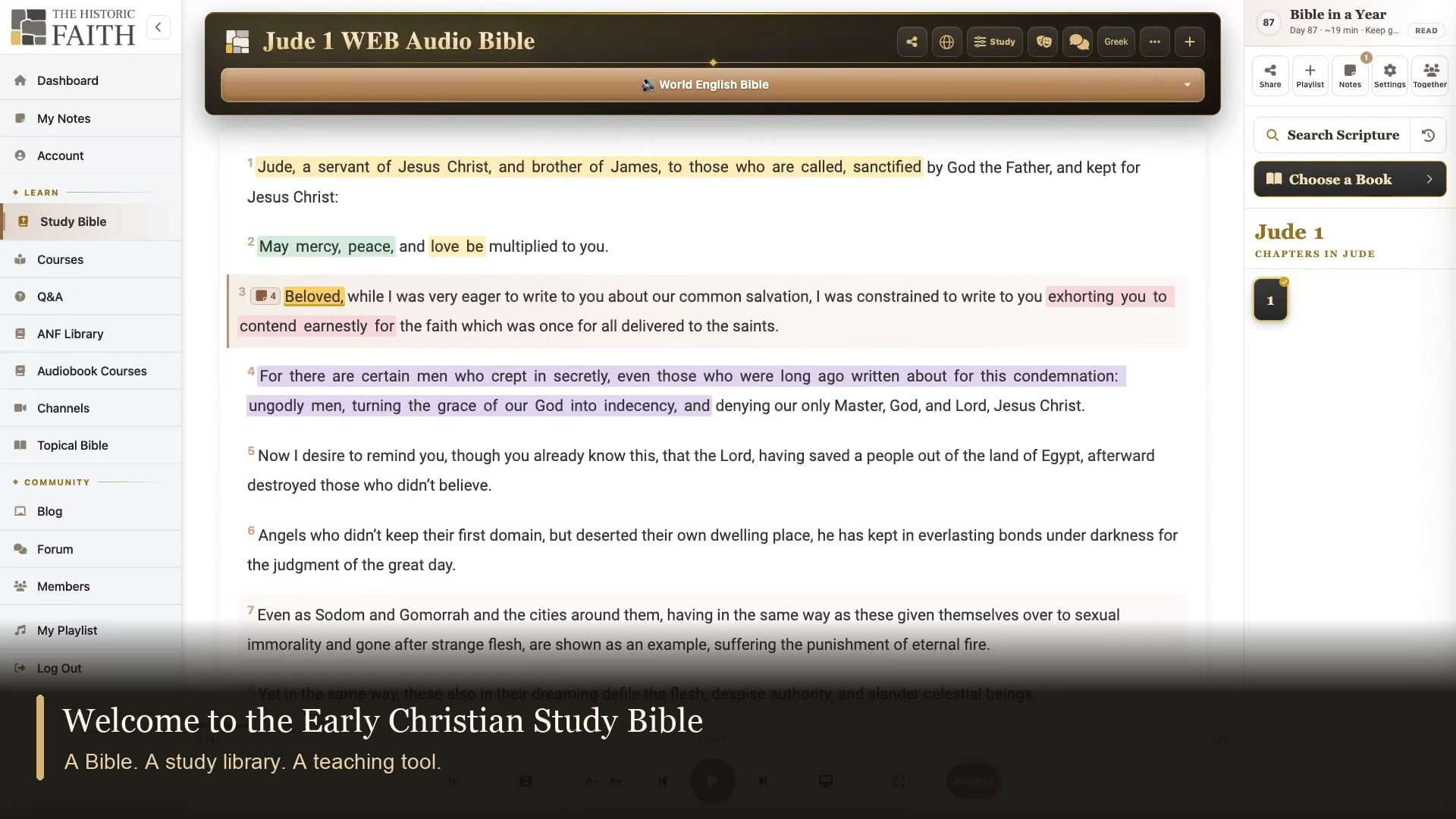 Words. Writings.
Guided tour · 21:50 · Several Bible editions.
See the phone experience · 5:31
Strong's Exhaustive Concordance, first published by James Strong in 1890, indexes every word of the King James Version and assigns each underlying original-language word a number — G1–G5624 for the Greek New Testament and H1–H8674 for the Hebrew Old Testament. Look up any English word, find its Strong's number, and see the Greek or Hebrew word behind it, its definition, and the verses where it occurs. This free online edition covers 14,298 entries with 767,764 indexed occurrences — including the Septuagint, deuterocanonical books, and 1 Enoch, which no print edition of Strong's includes.
These entry points are the quickest way to see how a Strong's number opens into a word, meaning, and Bible usage.
Greek agape, with New Testament and Septuagint usage links where indexed.
Greek kyrios, a major New Testament and Septuagint word-study bridge.
Hebrew reshith, the word behind “beginning” in Genesis 1:1 and other Old Testament usages.
Browse the local Greek and Hebrew Strong's entries in fast pages, open an exact number, or narrow the index by language, range, and usage count.
| Number | Word | Definition | Usages | Range |
|---|---|---|---|---|
|
G4351 — proskulio
Greek
|
προσκυλίω (proskulio)
proskulio
|
proskulio (pros-koo-lee'-o) v. 1. to roll towards, i.e. block against [from G4314 and G2947] | 2 | G4001-G5000 |
|
G4352 — proskuneo
Greek
|
προσκυνέω (proskuneo)
proskuneo
|
proskuneo (pros-koo-neh'-o) v. 1. to fawn or crouch to 2. to fall face down (prostrate) in adoration | 243 | G4001-G5000 |
|
G4353 — proskunetes
Greek
|
προσκυνητής (proskunetes)
proskunetes
|
proskunetes (pros-koo-nay-tace') n. 1. an adorer [from G4352] | 1 | G4001-G5000 |
|
G4354 — proslaleo
Greek
|
προσλαλέω (proslaleo)
proslaleo
|
proslaleo (pros-lal-eh'-o) v. 1. to talk to, i.e. converse with [from G4314 and G2980] | 4 | G4001-G5000 |
|
G4355 — proslambano
Greek
|
προσλαμβάνω (proslambano)
proslambano
|
proslambano (pros-lam-ban'-o) v. 1. to take to oneself, i.e. use (food), lead (aside), admit (to friendship or hospitality) [from G4314 and G2983] | 21 | G4001-G5000 |
|
G4356 — proslepsis
Greek
|
πρόσληψις (proslepsis)
proslepsis
|
proslepsis (pros'-lape-sis) n. 1. admission [from G4355] | 1 | G4001-G5000 |
|
G4357 — prosmeno
Greek
|
προσμένω (prosmeno)
prosmeno
|
prosmeno (pros-men'-o) v. 1. to stay further, i.e. remain in a place, with a person 2. (figuratively) to adhere to, persevere in | 9 | G4001-G5000 |
|
G4358 — prosormizo
Greek
|
προσορμίζω (prosormizo)
prosormizo
|
prosormizo (pros-or-mid'-zo) v. 1. to moor to 2. (by implication) land at | 1 | G4001-G5000 |
|
G4359 — prosopheilo
Greek
|
προσοφείλω (prosopheilo)
prosopheilo
|
prosopheilo (pros-of-ei'-lo) v. 1. to be indebted additionally [from G4314 and G3784] | 1 | G4001-G5000 |
|
G4360 — prosochthizo
Greek
|
προσοχθίζω (prosochthizo)
prosochthizo
|
prosochthizo (pros-okh-thid'-zo) v. 1. to feel indignant at [from G4314 and a form of ochtheo ?χθ?ω "to be vexed with something irksome, to be sorely angered"] | 22 | G4001-G5000 |
|
G4361 — prospeinos
Greek
|
πρόσπεινος (prospeinos)
prospeinos
|
prospeinos (pros'-pei-nos) adj. 1. hungering further, i.e. intensely hungry [from G4314 and the same as G3983] | 1 | G4001-G5000 |
|
G4362 — prospegnumi
Greek
|
προσπήγνυμι (prospegnumi)
prospegnumi
|
prospegnumi (pros-payg'-noo-mee) v. 1. to fasten to 2. (specially) to impale (on a cross) | 1 | G4001-G5000 |
|
G4363 — prospipto
Greek
|
προσπίπτω (prospipto)
prospipto
|
prospipto (pros-pip'-to) v. 1. to fall towards 2. (gently) prostrate oneself (in supplication or homage) | 30 | G4001-G5000 |
|
G4364 — prospoieomai
Greek
|
προσποιέομαι (prospoieomai)
prospoieomai
|
prospoieomai (pros-poy-eh'-om-ai) v. 1. to do forward for oneself, i.e. pretend (as if about to do a thing) [middle voice from G4314 and G4160] | 4 | G4001-G5000 |
|
G4365 — prosporeuomai
Greek
|
προσπορεύομαι (prosporeuomai)
prosporeuomai
|
prosporeuomai (pros-por-yoo'-om-ai) v. 1. to journey towards, i.e. approach {not the same as G4313} | 17 | G4001-G5000 |
|
G4366 — prosregnumi
Greek
|
προσρήγνυμι (prosregnumi)
prosregnumi
|
prosregnumi (pros-rayg'-noo-mee) v. 1. to tear towards, i.e. burst upon (as a tempest or flood) [from G4314 and G4486] | 2 | G4001-G5000 |
|
G4367 — prostasso
Greek
|
προστάσσω (prostasso)
prostasso
|
prostasso (pros-tas'-so) v. 1. to arrange towards 2. (figuratively) enjoin | 70 | G4001-G5000 |
|
G4368 — prostatis
Greek
|
προστάτις (prostatis)
prostatis
|
prostatis (pros-tat'-is) n. 1. a patroness, i.e. assistant [feminine of a derivative of G4291] | 1 | G4001-G5000 |
|
G4369 — prostithemi
Greek
|
προστίθημι (prostithemi)
prostithemi
|
prostithemi (pros-tith'-ay-mee) v. 1. to place additionally, i.e. lay beside, annex, repeat [from G4314 and G5087] | 286 | G4001-G5000 |
|
G4370 — prostrecho
Greek
|
προστρέχω (prostrecho)
prostrecho
|
prostrecho (pros-trekh'-o) v. 1. to run towards, i.e. hasten to meet or join [from G4314 and G5143 (including its alternate)] | 7 | G4001-G5000 |
|
G4371 — prosphagion
Greek
|
προσφάγιον (prosphagion)
prosphagion
|
prosphagion (pros-fag'-ee-on) n. 1. something eaten in addition to bread, i.e. a relish (specially, fish) [neuter of a presumed derivative of a compound of G4314 and G5315] | 1 | G4001-G5000 |
|
G4372 — prosphatos
Greek
|
πρόσφατος (prosphatos)
prosphatos
|
prosphatos (pros'-fat-os) adj. 1. previously (recently) slain (fresh) 2. (figuratively) lately made | 6 | G4001-G5000 |
|
G4373 — prosphatos
Greek
|
προσφάτως (prosphatos)
prosphatos
|
prosphatos (pros-fat'-oce) adv. 1. recently [adverb from G4372] | 6 | G4001-G5000 |
|
G4374
Greek
|
προσήνεγκαν
|
prosphero (pros-fer'-o) v. 1. to bear towards, i.e. lead to, tender (especially to God), treat [from G4314 and G5342 (including its alternate)] | 191 | G4001-G5000 |
|
G4375 — prosphiles
Greek
|
προσφιλής (prosphiles)
prosphiles
|
prosphiles (pros-fee-lace') adj. 1. friendly towards, i.e. acceptable [from a presumed compound of G4314 and G5368] | 3 | G4001-G5000 |
|
G4376 — prosphora
Greek
|
προσφορά (prosphora)
prosphora
|
prosphora (pros-for-ah') n. 1. presentation 2. (concretely) an oblation (bloodless) or sacrifice | 22 | G4001-G5000 |
|
G4377 — prosphoneo
Greek
|
προσφωνέω (prosphoneo)
prosphoneo
|
prosphoneo (pros-fo-neh'-o) v. 1. to sound towards, i.e. address, exclaim, summon [from G4314 and G5455] | 11 | G4001-G5000 |
|
G4378 — proschusis
Greek
|
πρόσχυσις (proschusis)
proschusis
|
proschusis (pros'-khoo-sis) n. 1. a shedding forth, i.e. affusion [from a comparative of G4314 and cheo "to pour"] | 1 | G4001-G5000 |
|
G4379 — prospsauo
Greek
|
προσψαύω (prospsauo)
prospsauo
|
prospsauo (pros-psau'-o) v. 1. to impinge, i.e. lay a finger on (in order to relieve) [from G4314 and psauo "to touch"] | 1 | G4001-G5000 |
|
G4380 — prosopolepteo
Greek
|
προσωποληπτέω (prosopolepteo)
prosopolepteo
|
prosopolepteo (pros-o-pol-ape-teh'-o) v. 1. to favor an individual, i.e. show partiality [from G4381] | 1 | G4001-G5000 |
|
G4381 — prosopoleptes
Greek
|
προσωπολήπτης (prosopoleptes)
prosopoleptes
|
prosopoleptes (pros-o-pol-ape'-tace) n. 1. an accepter of a face (individual) 2. (specially), one exhibiting partiality | 1 | G4001-G5000 |
|
G4382 — prosopolepsia
Greek
|
προσωποληψία (prosopolepsia)
prosopolepsia
|
prosopolepsia (pros-o-pol-ape-see'-ah) n. 1. partiality, i.e. favoritism [from G4381] | 4 | G4001-G5000 |
|
G4383 — prosopon
Greek
|
πρόσωπον (prosopon)
prosopon
|
prosopon (pros'-o-pon) n. 1. the front (as being towards view), i.e. the countenance, aspect, appearance, surface 2. (by implication) presence, person | 1,211 | G4001-G5000 |
|
G4384 — protasso
Greek
|
προτάσσω (protasso)
protasso
|
protasso (prot-as'-so) v. 1. to pre-arrange, i.e. prescribe [from G4253 and G5021] | 3 | G4001-G5000 |
|
G4385 — proteino
Greek
|
προτείνω (proteino)
proteino
|
proteino (prot-ei'-no) v. 1. to protend, i.e. tie prostrate (for scourging) [from G4253 and teino "to stretch"] | 8 | G4001-G5000 |
|
G4386 — proteron
Greek
|
πρότερον (proteron)
proteron
|
proteron (prot'-er-on) adj. 1. previously [neuter of G4387 as adverb (with or without the article)] | 72 | G4001-G5000 |
|
G4387 — proteros
Greek
|
πρότερος (proteros)
proteros
|
proteros (prot'-er-os) adj. 1. prior or previous [comparative of G4253] | 42 | G4001-G5000 |
|
G4388 — protithemai
Greek
|
προτίθεμαι (protithemai)
protithemai
|
protithemai (prot-ith'-em-ai) v. 1. to place before 2. (for oneself) to exhibit | 15 | G4001-G5000 |
|
G4389 — protrepomai
Greek
|
προτρέπομαι (protrepomai)
protrepomai
|
protrepomai (prot-rep'-om-ai) v. 1. to turn forward for oneself, i.e. encourage [middle voice from G4253 and the base of G5157] | 6 | G4001-G5000 |
|
G4390 — protrecho
Greek
|
προτρέχω (protrecho)
protrecho
|
protrecho (prot-rekh'-o) v. 1. to run forward, i.e. outstrip, precede [from G4253 and G5143 (including its alternate)] | 5 | G4001-G5000 |
|
G4391 — prouparcho
Greek
|
προϋπάρχω (prouparcho)
prouparcho
|
prouparcho (prou"-par'-kho) v. 1. to exist before 2. (adverbially) to be or do something previously | 2 | G4001-G5000 |
|
G4392 — prophasis
Greek
|
πρόφασις (prophasis)
prophasis
|
prophasis (prof'-as-is) n. 1. an outward showing, i.e. pretext [from a compound of G4253 and G5316] | 12 | G4001-G5000 |
|
G4393 — prophero
Greek
|
προφέρω (prophero)
prophero
|
prophero (prof-er'-o) v. 1. to bear forward, i.e. produce [from G4253 and G5342] | 6 | G4001-G5000 |
|
G4394 — propheteia
Greek
|
προφητεία (propheteia)
propheteia
|
propheteia (prof-ay-tei'-ah) n. 1. prediction (scriptural or other) [from G4396 ("prophecy")] | 31 | G4001-G5000 |
|
G4395 — propheteuo
Greek
|
προφητεύω (propheteuo)
propheteuo
|
propheteuo (prof-ate-yoo'-o) v. 1. to foretell events, divine, speak under inspiration, exercise the prophetic office [from G4396] | 130 | G4001-G5000 |
|
G4396 — prophetes
Greek
|
προφήτης (prophetes)
prophetes
|
prophetes (prof-ay'-tace) n. 1. a foreteller ("prophet") 2. (by analogy) an inspired speaker | 440 | G4001-G5000 |
|
G4397 — prophetikos
Greek
|
προφητικός (prophetikos)
prophetikos
|
prophetikos (prof-ay-tik-os') adj. 1. pertaining to a foreteller ("prophetic") [from G4396] | 2 | G4001-G5000 |
|
G4398 — prophetis
Greek
|
προφῆτις (prophetis)
prophetis
|
prophetis (prof-ay`-tis) n. 1. a female foreteller or an inspired woman [feminine of G4396] | 7 | G4001-G5000 |
|
G4399 — prophthano
Greek
|
προφθάνω (prophthano)
prophthano
|
prophthano (prof-than'-o) v. 1. to get an earlier start of, i.e. anticipate [from G4253 and G5348] | 21 | G4001-G5000 |
|
G4400 — procheirizomai
Greek
|
προχειρίζομαι (procheirizomai)
procheirizomai
|
procheirizomai (prokh-ei-rid'-zom-ai) v. 1. to handle for oneself in advance 2. (figuratively) to purpose | 7 | G4001-G5000 |
|
G4401 — procheirotoneo
Greek
|
προχειροτονέω (procheirotoneo)
procheirotoneo
|
procheirotoneo (prokh-ei-rot-on-eh'-o) v. 1. to elect in advance [from G4253 and G5500] | 1 | G4001-G5000 |
|
G4402 — Prochoros
Greek
|
Πρόχορος (Prochoros)
Prochoros
|
Prochoros (prokh'-or-os) n/p. 1. before the dance 2. Prochorus, a Christian | 1 | G4001-G5000 |
|
G4403 — prumna
Greek
|
πρύμνα (prumna)
prumna
|
prumna (proom'-nah) n. 1. the stern of a ship [feminine of prumnus (hindmost)] | 3 | G4001-G5000 |
|
G4404 — proi
Greek
|
πρωΐ (proi)
proi
|
proi (prow-ee"') adv. 1. at dawn 2. (by implication) the day-break watch | 175 | G4001-G5000 |
|
G4405 — proia
Greek
|
πρωΐα (proia)
proia
|
proia (prow-ee"'-ah) n. 1. day-dawn [feminine of a derivative of G4404 as noun] | 14 | G4001-G5000 |
|
G4406 — proimos
Greek
|
πρώϊμος (proimos)
proimos
|
proimos (prow'-ee"-mos) adj. 1. dawning 2. (by analogy) autumnal (showering, the first of the rainy season) | 9 | G4001-G5000 |
|
G4407 — proinos
Greek
|
πρωϊνός (proinos)
proinos
|
proinos (prow-ee"-nos') adj. 1. pertaining to the dawn, i.e. matutinal [from G4404] | 13 | G4001-G5000 |
|
G4408 — prora
Greek
|
πρώρα (prora)
prora
|
prora (pro'-ra) n. 1. the prow, i.e. forward part of a vessel [feminine of a presumed derivative of G4253 as noun] | 2 | G4001-G5000 |
|
G4409 — proteuo
Greek
|
πρωτεύω (proteuo)
proteuo
|
proteuo (prote-yoo'-o) v. 1. to be first (in rank or influence) [from G4413] | 4 | G4001-G5000 |
|
G4410 — protokathedria
Greek
|
πρωτοκαθεδρία (protokathedria)
protokathedria
|
protokathedria (pro-tok-ath-ed-ree'-ah) n. 1. a sitting first (in the front row), i.e. preeminence in council [from G4413 and G2515] | 4 | G4001-G5000 |
|
G4411 — protoklisia
Greek
|
πρωτοκλισία (protoklisia)
protoklisia
|
protoklisia (pro-tok-lis-ee'-ah) n. 1. a reclining first (in the place of honor) at the dinner-bed, i.e. preeminence at meals [from G4413 and G2828] | 5 | G4001-G5000 |
|
G4412 — proton
Greek
|
πρῶτον (proton)
proton
|
proton (pro`-ton) adj. 1. firstly (in time, place, order, or importance) [neuter of G4413 as adverb (with or without G3588)] | 66 | G4001-G5000 |
|
G4413 — protos
Greek
|
πρῶτος (protos)
protos
|
protos (pro`-tos) adj. 1. foremost (in time, place, order or importance) [contracted superlative of G4253] | 303 | G4001-G5000 |
|
G4414 — protostates
Greek
|
πρωτοστάτης (protostates)
protostates
|
protostates (pro-tos-tat'-ace) n. 1. one standing first in the ranks, i.e. a captain (champion) [from G4413 and G2476] | 2 | G4001-G5000 |
|
G4415 — prototokia
Greek
|
πρωτοτόκια (prototokia)
prototokia
|
prototokia (pro-tot-ok'-ee-ah) n. 1. primogeniture (as a privilege) [from G4416] | 8 | G4001-G5000 |
|
G4416 — prototokos
Greek
|
πρωτοτόκος (prototokos)
prototokos
|
prototokos (pro-tot-ok'-os) adj. 1. first-born {usually as noun; literally or figuratively} | 113 | G4001-G5000 |
|
G4417 — ptaio
Greek
|
πταίω (ptaio)
ptaio
|
ptaio (ptai'-o) v. 1. to trip 2. (figuratively) to err, sin, fail (of salvation) | 19 | G4001-G5000 |
|
G4418 — pterna
Greek
|
πτέρνα (pterna)
pterna
|
pterna (pter'-nah) n. 1. the heel (figuratively) [of uncertain derivation] | 8 | G4001-G5000 |
|
G4419 — pterugion
Greek
|
πτερύγιον (pterugion)
pterugion
|
pterugion (pter-oog'-ee-on) n. 1. a winglet 2. (figuratively) extremity (top corner) | 15 | G4001-G5000 |
|
G4420 — pterux
Greek
|
πτέρυξ (pterux)
pterux
|
pterux (pter'-oox) n. 1. a wing [from a derivative of G4072 (meaning a feather)] | 65 | G4001-G5000 |
|
G4421 — ptenon
Greek
|
πτηνόν (ptenon)
ptenon
|
ptenon (ptay-non') adj. 1. a bird [contraction for G4071] | 1 | G4001-G5000 |
|
G4422 — ptoeo
Greek
|
πτοέω (ptoeo)
ptoeo
|
ptoeo (pto-eh'-o) v. 1. to scare [probably akin to the alternate of G4098 (through the idea of causing to fall) or to G4072 (through that of causing to fly away)] | 35 | G4001-G5000 |
|
G4423 — ptoesis
Greek
|
πτόησις (ptoesis)
ptoesis
|
ptoesis (pto'-ay-sis) n. 1. alarm [from G4422] | 2 | G4001-G5000 |
|
G4424 — Ptolemais
Greek
|
Πτολεμαίς (Ptolemais)
Ptolemais
|
Ptolemais (ptol-em-ah-is') n/l. 1. Ptolemais, a place in Israel [from Ptolemaios (Ptolemy, after whom it was named)] | 45 | G4001-G5000 |
|
G4425 — ptuon
Greek
|
πτύον (ptuon)
ptuon
|
ptuon (ptoo'-on) n. 1. a winnowing-fork (as scattering like spittle) [from G4429] | 2 | G4001-G5000 |
|
G4426 — pturo
Greek
|
πτύρω (pturo)
pturo
|
pturo (ptoo'-ro) v. 1. to frighten [from a presumed derivative of G4429 (and thus akin to G4422)] | 1 | G4001-G5000 |
|
G4427 — ptusma
Greek
|
πτύσμα (ptusma)
ptusma
|
ptusma (ptoos'-mah) n. 1. saliva [from G4429] | 1 | G4001-G5000 |
|
G4428 — ptusso
Greek
|
πτύσσω (ptusso)
ptusso
|
ptusso (ptoos'-so) v. 1. to fold, i.e. furl a scroll [probably akin to petannumi "to spread" (and thus apparently allied to G4072 through the idea of expansion, and to G4429 through that of flattening)] | 1 | G4001-G5000 |
|
G4429 — ptuo
Greek
|
πτύω (ptuo)
ptuo
|
ptuo (ptoo'-o) v. 1. to spit [a primary verb] | 5 | G4001-G5000 |
|
G4430 — ptoma
Greek
|
πτῶμα (ptoma)
ptoma
|
ptoma (pto`-mah) n. 1. a ruin 2. (specially), lifeless body (corpse, carrion) | 24 | G4001-G5000 |
|
G4431 — ptosis
Greek
|
πτῶσις (ptosis)
ptosis
|
ptosis (pto`-sis) n. 1. a crash, i.e. downfall {literally or figuratively} | 37 | G4001-G5000 |
|
G4432 — ptocheia
Greek
|
πτωχεία (ptocheia)
ptocheia
|
ptocheia (pto-khei'-ah) n. 1. beggary, i.e. indigence {literally or figuratively} | 21 | G4001-G5000 |
|
G4433 — ptocheuo
Greek
|
πτωχεύω (ptocheuo)
ptocheuo
|
ptocheuo (pto-khyoo'-o) v. 1. to be a beggar 2. (by implication) to become indigent (figuratively) | 6 | G4001-G5000 |
|
G4434
Greek
|
πτωχοὶ
|
ptochos (pto-khos') adj. 1. a beggar (as cringing), a pauper 2. (figuratively) distressed | 145 | G4001-G5000 |
|
G4435 — pugme
Greek
|
πυγμή (pugme)
pugme
|
pugme (poog-may') n. 1. the clenched hand 2. (only in dative case as adverb) with the fist (hard scrubbing) | 3 | G4001-G5000 |
|
G4436 — Puthon
Greek
|
Πύθων (Puthon)
Puthon
|
Puthon (poo'-thone) n/p. 1. a Python 2. (by analogy, with the supposed diviner there) inspiration (soothsaying) | 1 | G4001-G5000 |
|
G4437 — puknos
Greek
|
πυκνός (puknos)
puknos
|
puknos (pook-nos') adj. 1. clasped (thick) 2. (figuratively) frequent | 9 | G4001-G5000 |
|
G4438 — pukteo
Greek
|
πυκτέω (pukteo)
pukteo
|
pukteo (pook-teh'-o) v. 1. to box (with the fist), i.e. contend (as a boxer) at the games (figuratively) [from a derivative of the same as G4435] | 1 | G4001-G5000 |
|
G4439 — pule
Greek
|
πύλη (pule)
pule
|
pule (poo'-lay) n. 1. a gate, i.e. the leaf or wing of a folding entrance {literally or figuratively} | 295 | G4001-G5000 |
|
G4440 — pulon
Greek
|
πυλών (pulon)
pulon
|
pulon (poo-lone') n. 1. a gate-way, door-way of a building or city 2. (by implication) a portal or vestibule | 36 | G4001-G5000 |
|
G4441 — punthanomai
Greek
|
πυνθάνομαι (punthanomai)
punthanomai
|
punthanomai (poon-than'-om-ai) v. 1. to question, i.e. ascertain by inquiry 2. (by implication) to learn (by casual intelligence) | 23 | G4001-G5000 |
|
G4442 — pur
Greek
|
πῦρ (pur)
pur
|
pur (poor`) n. 1. fire {literally or figuratively} | 541 | G4001-G5000 |
|
G4443 — pura
Greek
|
πυρά (pura)
pura
|
pura (poo-rah') n. 1. a fire {concretely} | 13 | G4001-G5000 |
|
G4444 — purgos
Greek
|
πύργος (purgos)
purgos
|
purgos (poor'-gos) n. 1. a tower or castle [apparently a primary word ("burgh")] | 74 | G4001-G5000 |
|
G4445 — puresso
Greek
|
πυρέσσω (puresso)
puresso
|
puresso (poo-res'-so) v. 1. to be on fire 2. (specially), to have a fever | 2 | G4001-G5000 |
|
G4446 — puretos
Greek
|
πυρετός (puretos)
puretos
|
puretos (poo-ret-os') n. 1. inflamed 2. (by implication) feverish (as noun, fever) | 7 | G4001-G5000 |
|
G4447 — purinos
Greek
|
πύρινος (purinos)
purinos
|
purinos (poo'-ree-nos) adj. 1. fiery 2. (by implication) flaming | 4 | G4001-G5000 |
|
G4448 — puroo
Greek
|
πυρόω (puroo)
puroo
|
puroo (poo-roh'-o) v. 1. to kindle 2. (passively) to be ignited, glow | 30 | G4001-G5000 |
|
G4449 — purrhazo
Greek
|
πυρῥάζω (purrhazo)
purrhazo
|
purrhazo (poor-rhad'-zo) v. 1. to redden (intransitively) [from G4450] | 2 | G4001-G5000 |
|
G4450 — purrhos
Greek
|
πυρῥός (purrhos)
purrhos
|
purrhos (poor-rhos') adj. 1. fire-like 2. (specially), flame- colored | 10 | G4001-G5000 |
|
G4451 — purosis
Greek
|
πύρωσις (purosis)
purosis
|
purosis (poo'-ro-sis) n. 1. ignition 2. (specially) smelting | 4 | G4001-G5000 |
|
G4452 — po
Greek
|
πῶ (po)
po
|
po (po`) prt. 1. an enclitic particle of indefiniteness {used only in the comparative} | 0 | G4001-G5000 |
|
G4453 — poleo
Greek
|
πωλέω (poleo)
poleo
|
poleo (po-leh'-o) v. 1. to barter (as a pedlar), i.e. to sell [probably ultimately from pelomai "to be busy, to trade"] | 35 | G4001-G5000 |
|
G4454 — polos
Greek
|
πῶλος (polos)
polos
|
polos (po`-los) n. 1. a "foal" or "filly" 2. (specially), a young ass | 17 | G4001-G5000 |
|
G4455 — popote
Greek
|
πώποτε (popote)
popote
|
popote (po'-pot-e) adv. 1. at any time 2. (with negative particle) at no time | 10 | G4001-G5000 |
|
G4456 — poroo
Greek
|
πωρόω (poroo)
poroo
|
poroo (po-roh'-o) v. 1. to petrify 2. (figuratively) to indurate (render stupid or callous) | 6 | G4001-G5000 |
|
G4457 — porosis
Greek
|
πώρωσις (porosis)
porosis
|
porosis (po'-ro-sis) n. 1. stupidity or callousness [from G4456] | 3 | G4001-G5000 |
|
G4458 — pos
Greek
|
πώς (pos)
pos
|
pos (poce') adv. 1. somehow or anyhow {used only in composition} | 2 | G4001-G5000 |
|
G4459 — pos
Greek
|
πῶς (pos)
pos
|
pos (poce`) adv. 1. in what way? 2. (sometimes indirect) how? | 226 | G4001-G5000 |
|
G4460 — Rhaab
Greek
|
Ῥαάβ (Rhaab)
Rhaab
|
Rhaab (rhah-ab') n/p. 1. Raab (i.e. Rachab), a Canaanitess [of Hebrew origin (H7343)] | 14 | G4001-G5000 |
|
G4461 — rhabbi
Greek
|
ῥαββί (rhabbi)
rhabbi
|
rhabbi (rhab-bee') heb. 1. my master, i.e Rabbi, as an official title of honor [of Hebrew origin (H7227 with pronominal suffix)] | 15 | G4001-G5000 |
|
G4462 — rhabboni
Greek
|
ῥαββονί (rhabboni)
rhabboni
|
rhabboni (rhab-bon-ee') (or rhabbouni hrab-boo-nee') aram. 1. my master, i.e Rabboni, as an official title of honor [of Chaldee origin, corresponding to G4461] | 2 | G4001-G5000 |
|
G4463 — rhabdizo
Greek
|
ῥαβδίζω (rhabdizo)
rhabdizo
|
rhabdizo (rhab-did'-zo) v. 1. to strike with a stick, i.e. bastinado [from G4464] | 4 | G4001-G5000 |
|
G4464 — rhabdos
Greek
|
ῥάβδος (rhabdos)
rhabdos
|
rhabdos (rhab'-dos) n. 1. a stick or wand (as a cudgel, a cane or a baton of royalty) [from the base of G4474] | 107 | G4001-G5000 |
|
G4465 — rhabdouchos
Greek
|
ῥαβδοῦχος (rhabdouchos)
rhabdouchos
|
rhabdouchos (rhab-dou`-khos) n. 1. a rod- (the Latin fasces) holder, i.e. a Roman lictor (constable or executioner) [from G4464 and G2192] | 2 | G4001-G5000 |
|
G4466 — Rhagau
Greek
|
Ῥαγαῦ (Rhagau)
Rhagau
|
Rhagau (rhag-au`) n/p. 1. Ragau (i.e. Reu), a patriarch [of Hebrew origin (H7466)] | 8 | G4001-G5000 |
|
G4467 — rhadiourgema
Greek
|
ῥᾳδιούργημα (rhadiourgema)
rhadiourgema
|
rhadiourgema (rhad"-ee-ourg'-ay-mah) n. 1. easy-going behavior 2. (by extension) a crime | 1 | G4001-G5000 |
|
G4468 — rhadiourgia
Greek
|
ῥᾳδιουργία (rhadiourgia)
rhadiourgia
|
rhadiourgia (rhad"-ee-ourg-ee'-a) n. 1. recklessness 2. (by extension) malignity | 1 | G4001-G5000 |
|
G4469 — rhaka
Greek
|
ῥακά (rhaka)
rhaka
|
rhaka (rhak-ah') aram. 1. O empty one, i.e. thou worthless (as a term of utter vilification) [of Chaldee origin] | 1 | G4001-G5000 |
|
G4470 — rhakos
Greek
|
ῥάκος (rhakos)
rhakos
|
rhakos (rhak'-os) n. 1. a "rag," i.e. piece of cloth [from G4486] | 4 | G4001-G5000 |
|
G4471 — Rhama
Greek
|
Ῥαμά (Rhama)
Rhama
|
Rhama (rham-ah') n/l. 1. Rama (i.e. Ramah), a place in Israel [of Hebrew origin (H7414)] | 24 | G4001-G5000 |
|
G4472 — rhantizo
Greek
|
ῥαντίζω (rhantizo)
rhantizo
|
rhantizo (rhan-tid'-zo) v. 1. to render besprinkled, i.e. asperse {ceremonially or figuratively} | 7 | G4001-G5000 |
|
G4473 — rhantismos
Greek
|
ῥαντισμός (rhantismos)
rhantismos
|
rhantismos (rhan-tis-mos') n. 1. aspersion (ceremonially or figuratively) [from G4472] | 6 | G4001-G5000 |
|
G4474 — rhapizo
Greek
|
ῥαπίζω (rhapizo)
rhapizo
|
rhapizo (rhap-id'-zo) v. 1. to slap [from a derivative of a primary rhepo "to let fall, to rap"] | 5 | G4001-G5000 |
|
G4475 — rhapisma
Greek
|
ῥάπισμα (rhapisma)
rhapisma
|
rhapisma (rhap'-is-mah) n. 1. a slap [from G4474] | 4 | G4001-G5000 |
|
G4476 — rhaphis
Greek
|
ῥαφίς (rhaphis)
rhaphis
|
rhaphis (rhaf-ece') n. 1. a needle [from a primary rhapto "to sew" (perhaps rather akin to the base of G4474 through the idea of puncturing)] | 3 | G4001-G5000 |
|
G4477 — Rhachab
Greek
|
Ῥαχάβ (Rhachab)
Rhachab
|
Rhachab (rhakh-ab') n/p. 1. Rachab, a Canaanitess [of Hebrew origin (H7343)] | 1 | G4001-G5000 |
|
G4478 — Rhachel
Greek
|
Ῥαχήλ (Rhachel)
Rhachel
|
Rhachel (rhakh-ale') n/p. 1. Rachel, the wife of Jacob [of Hebrew origin (H7354)] | 48 | G4001-G5000 |
|
G4479 — Rhebekka
Greek
|
Ῥεβέκκα (Rhebekka)
Rhebekka
|
Rhebekka (rhe-bek'-kah) n/p. 1. Rebecca (i.e. Ribkah), the wife of Isaac [of Hebrew origin (H7259)] | 32 | G4001-G5000 |
|
G4480 — rheda
Greek
|
ῥέδα (rheda)
rheda
|
rheda (rhed'-ah) n. 1. a rheda, i.e. four-wheeled carriage (wagon for riding) [of Latin origin] | 1 | G4001-G5000 |
|
G4481 — Rhemphan
Greek
|
Ῥεμφάν (Rhemphan)
Rhemphan
|
Rhemphan (rhem-fan') (by incorrect transliteration for a word of Hebrew origin) n/p. 1. Remphan (i.e. Kijun), an Egyptian idol [by incorrect transliteration for a word of Hebrew origin (H3594)] | 2 | G4001-G5000 |
|
G4482 — rheo
Greek
|
ῥέω (rheo)
rheo
|
rheo (rheh'-o) v. 1. to flow ("run", as water) [a primary verb, for some tenses of which a prolonged form rheuo hryoo'-o is used] | 39 | G4001-G5000 |
|
G4483 — rheo
Greek
|
ῥέω (rheo)
rheo
|
rheo (rheh'-o) (for certain tenses of which a prolonged form ereo er-eh'-o is used; and both as alternate for G2036) v. 1. to utter, i.e. speak or say [perhaps akin (or identical) with G4482 (through the idea of pouring forth)] | 26 | G4001-G5000 |
|
G4484 — Rhegion
Greek
|
Ῥήγιον (Rhegion)
Rhegion
|
Rhegion (rhayg'-ee-on) n/l. 1. Rhegium, a place in Italy [of Latin origin] | 1 | G4001-G5000 |
|
G4485 — rhegma
Greek
|
ῥήγμα (rhegma)
rhegma
|
rhegma (rhayg'-mah) n. 1. something torn, i.e. a fragment (by implication and abstractly, a fall) [from G4486] | 4 | G4001-G5000 |
|
G4486 — rhegnumi
Greek
|
ῥήγνυμι (rhegnumi)
rhegnumi
|
rhegnumi (rhayg'-noo-mee) (or rhesso rhace'-so) v. 1. to "break," "wreck" or "crack" 2. (especially) to sunder (by separation of the parts) or disrupt, lacerate | 43 | G4001-G5000 |
|
G4487 — rhema
Greek
|
ῥήμα (rhema)
rhema
|
rhema (rhay'-mah) n. 1. an utterance (individually, collectively or specially) 2. (by implication) a matter or topic | 560 | G4001-G5000 |
|
G4488 — Rhesa
Greek
|
Ῥησά (Rhesa)
Rhesa
|
Rhesa (rhay-sah') n/p. 1. Resa (i.e. Rephajah), an Israelite [probably of Hebrew origin (apparently for H7509)] | 1 | G4001-G5000 |
|
G4489 — rhetor
Greek
|
ῥήτωρ (rhetor)
rhetor
|
rhetor (rhay'-tore) n. 1. a speaker 2. (by implication) a forensic advocate | 1 | G4001-G5000 |
|
G4490 — rhetos
Greek
|
ῥητῶς (rhetos)
rhetos
|
rhetos (rhay-toce`) adv. 1. out-spokenly, i.e. distinctly [adverb from a derivative of G4483] | 1 | G4001-G5000 |
|
G4491 — rhiza
Greek
|
ῥίζα (rhiza)
rhiza
|
rhiza (rhid'-zah) n. 1. a root {literally or figuratively} | 72 | G4001-G5000 |
|
G4492 — rhizoo
Greek
|
ῥιζόω (rhizoo)
rhizoo
|
rhizoo (rhid-zoh'-o) v. 1. to root 2. (figuratively) to become stable | 6 | G4001-G5000 |
|
G4493 — rhipe
Greek
|
ῥιπή (rhipe)
rhipe
|
rhipe (rhee-pay') n. 1. a jerk (of the eye) 2. (by analogy) an instant | 1 | G4001-G5000 |
|
G4494 — rhipizo
Greek
|
ῥιπίζω (rhipizo)
rhipizo
|
rhipizo (rhip-id'-zo) v. 1. to breeze up 2. (by analogy) to agitate (into waves) | 1 | G4001-G5000 |
|
G4495 — rhipteo
Greek
|
ῥιπτέω (rhipteo)
rhipteo
|
rhipteo (rhip-teh'-o) v. 1. to toss up [from a derivative of G4496] | 3 | G4001-G5000 |
|
G4496 — rhipto
Greek
|
ῥίπτω (rhipto)
rhipto
|
rhipto (rhip'-to) v. 1. to fling (properly, with a quick toss) 2. (by qualification) to deposit (as if a load) | 93 | G4001-G5000 |
|
G4497 — Rhoboam
Greek
|
Ῥοβοάμ (Rhoboam)
Rhoboam
|
Rhoboam (rhob-o-am') n/p. 1. Roboam (i.e. Rechobam), an Israelite [of Hebrew origin (H7346)] | 45 | G4001-G5000 |
|
G4498 — Rhode
Greek
|
Ῥόδη (Rhode)
Rhode
|
Rhode (rhod'-ay) n/p. 1. Rode, a servant girl [probably for rhode (a rose)] | 1 | G4001-G5000 |
|
G4499 — Rhodos
Greek
|
Ῥόδος (Rhodos)
Rhodos
|
Rhodos (rhod'-os) n/l. 1. Rhodus, an island of the Mediterranean [probably from rhodon (a rose)] | 2 | G4001-G5000 |
|
G4500 — rhoizedon
Greek
|
ῥοιζηδόν (rhoizedon)
rhoizedon
|
rhoizedon (rhoyd-zay-don') adv. 1. whizzingly, i.e. with a crash [adverb from a derivative of rhoizos (a whir)] | 1 | G4001-G5000 |
No Strong's entries match that search.
Strong's works best when the number, original word, verse, and corpus stay connected.
Open a chapter and move from a word token to its Strong's page, parsing, and linked occurrences.
Greek Strong's entries can include New Testament, Septuagint, deuterocanonical, and 1 Enoch rows where indexed.
Dedicated Strong's pages can expose approved pronunciation audio beside the word-study data.
These are common words readers run into repeatedly, shown with an English meaning so the list is readable without already knowing the original languages.
Look up a word study by its transliteration — these are frequently searched Hebrew and Greek words. Each opens the matching Strong's entry, or lists the options when a spelling maps to several words.