
G26 — Agape (Love)
Greek agape, with New Testament and Septuagint usage links where indexed.
The Early Christian Study Bible · Free to use
Study the word. Hear its pronunciation.
Search 14,298 Greek and Hebrew entries—free. Explore definitions, indexed occurrences, and pronunciation audio where available, then follow the words back into your Bible.
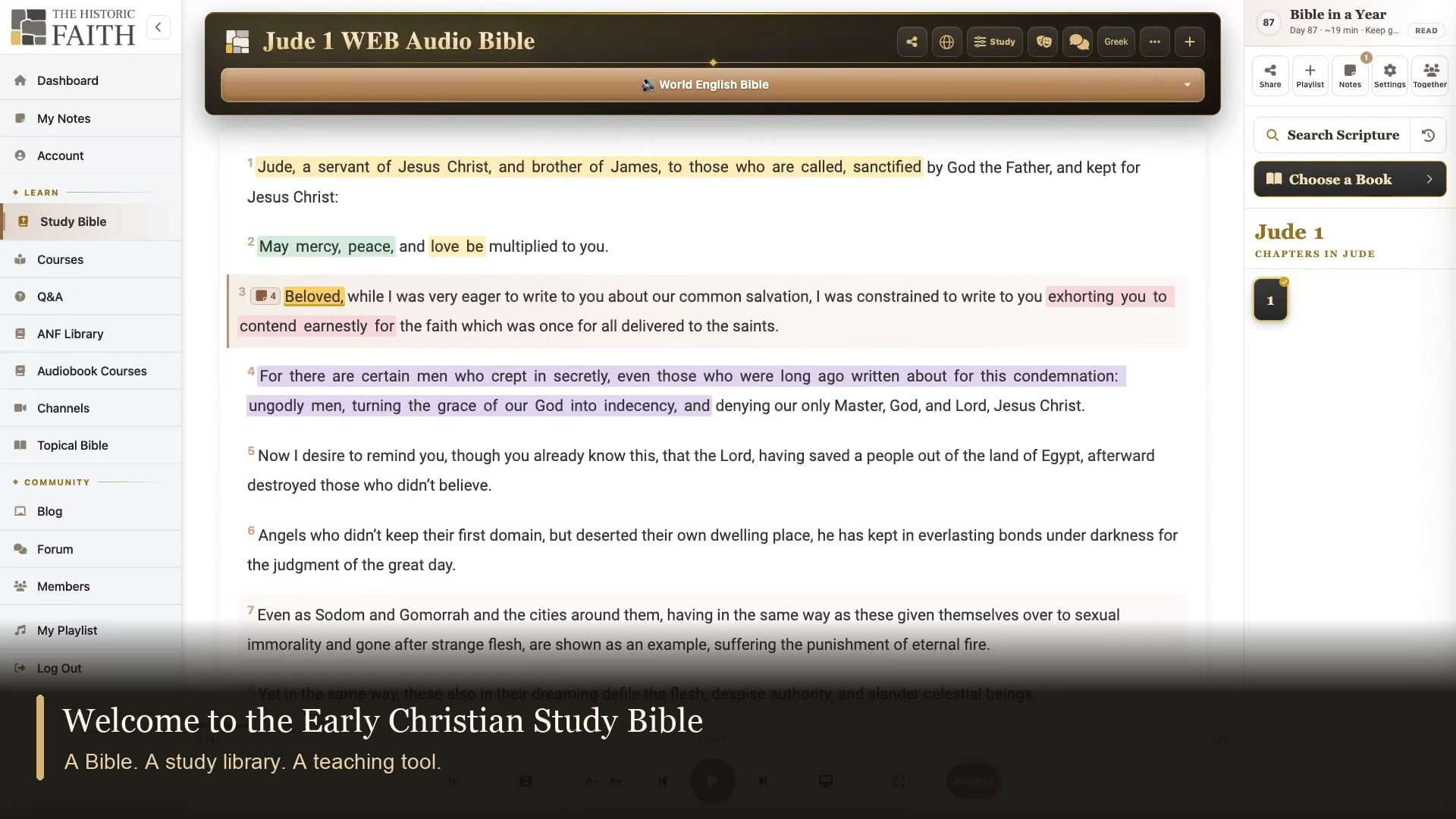
Click a word. Hear its pronunciation. Open the early Christian writings. Then see how to present and teach.
 Words. Writings.
Guided tour · 21:50 · Several Bible editions.
See the phone experience · 5:31
Strong's Exhaustive Concordance, first published by James Strong in 1890, indexes every word of the King James Version and assigns each underlying original-language word a number — G1–G5624 for the Greek New Testament and H1–H8674 for the Hebrew Old Testament. Look up any English word, find its Strong's number, and see the Greek or Hebrew word behind it, its definition, and the verses where it occurs. This free online edition covers 14,298 entries with 767,764 indexed occurrences — including the Septuagint, deuterocanonical books, and 1 Enoch, which no print edition of Strong's includes.
These entry points are the quickest way to see how a Strong's number opens into a word, meaning, and Bible usage.
Greek agape, with New Testament and Septuagint usage links where indexed.
Greek kyrios, a major New Testament and Septuagint word-study bridge.
Hebrew reshith, the word behind “beginning” in Genesis 1:1 and other Old Testament usages.
Browse the local Greek and Hebrew Strong's entries in fast pages, open an exact number, or narrow the index by language, range, and usage count.
| Number | Word | Definition | Usages | Range |
|---|---|---|---|---|
|
G1651 — elegcho
Greek
|
ἐλέγχω (elegcho)
elegcho
|
elegcho (el-eng'-kho) v. 1. to confute, admonish [of uncertain affinity] | 81 | G1001-G2000 |
|
G1652 — eleeinos
Greek
|
ἐλεεινός (eleeinos)
eleeinos
|
eleeinos (el-eh-ei-nos') adj. 1. pitiable [from G1656] | 2 | G1001-G2000 |
|
G1653 — eleeo
Greek
|
ἐλεέω (eleeo)
eleeo
|
eleeo (el-eh-eh'-o) v. 1. to have or show compassion (by word or deed) 2. (specially) by divine grace | 135 | G1001-G2000 |
|
G1654 — eleemosune
Greek
|
ἐλεημοσύνη (eleemosune)
eleemosune
|
eleemosune (el-eh-ay-mos-oo'-nay) n. 1. compassionateness 2. (as exercised towards the poor) beneficence | 59 | G1001-G2000 |
|
G1655
Greek
|
ἐλεήμονες
|
eleemon (el-eh-ay'-mone) adj. 1. compassionate (actively) [from G1653] | 29 | G1001-G2000 |
|
G1656 — eleos
Greek
|
ἔλεος (eleos)
eleos
|
eleos (el'-eh-os) n. 1. compassion {human or divine, especially active} | 321 | G1001-G2000 |
|
G1657 — eleutheria
Greek
|
ἐλευθερία (eleutheria)
eleutheria
|
eleutheria (el-yoo-ther-ee'-ah) n. 1. freedom (legitimate or licentious, chiefly moral or ceremonial) [from G1658] | 17 | G1001-G2000 |
|
G1658 — eleutheros
Greek
|
ἐλεύθερος (eleutheros)
eleutheros
|
eleutheros (el-yoo'-ther-os) adj. 1. unrestrained (to go at pleasure) 2. (as a citizen) not a slave (whether freeborn or set free (emancipated)) | 50 | G1001-G2000 |
|
G1659 — eleutheroo
Greek
|
ἐλευθερόω (eleutheroo)
eleutheroo
|
eleutheroo (el-yoo-ther-oh'-o) v. 1. to liberate 2. (figuratively) to exempt (from moral, ceremonial or mortal liability) | 10 | G1001-G2000 |
|
G1660 — eleusis
Greek
|
ἔλευσις (eleusis)
eleusis
|
eleusis (el'-yoo-sis) n. 1. an advent [from the alternate of G2064] | 1 | G1001-G2000 |
|
G1661 — elephantinos
Greek
|
ἐλεφάντινος (elephantinos)
elephantinos
|
elephantinos (el-ef-an'-tee-nos) adj. 1. elephantine 2. (by implication) composed of ivory | 11 | G1001-G2000 |
|
G1662 — Eliakeim
Greek
|
Ἐλιακείμ (Eliakeim)
Eliakeim
|
Eliakeim (el-ee-ak-eim') n/p. 1. Eliakim, an Israelite [of Hebrew origin (H471)] | 13 | G1001-G2000 |
|
G1663 — Eliezer
Greek
|
Ἐλιέζερ (Eliezer)
Eliezer
|
Eliezer (el-ee-ed'-zer) n/p. 1. Eliezer, an Israelite [of Hebrew origin (H461)] | 14 | G1001-G2000 |
|
G1664 — Elioud
Greek
|
Ἐλιούδ (Elioud)
Elioud
|
Elioud (el-ee-oud') n/p. 1. God of majesty 2. Eliud, an Israelite | 2 | G1001-G2000 |
|
G1665 — Elisabet
Greek
|
Ἐλισάβετ (Elisabet)
Elisabet
|
Elisabet (el-ee-sab'-et) n/p. 1. Elisabet, an Israelitess [of Hebrew origin (H472)] | 9 | G1001-G2000 |
|
G1666 — Elissaios
Greek
|
Ἐλισσαίος (Elissaios)
Elissaios
|
Elissaios (el-is-sai'-os) n/p. 1. Elissaeus, an Israelite [of Hebrew origin (H477)] | 1 | G1001-G2000 |
|
G1667 — helisso
Greek
|
ἑλίσσω (helisso)
helisso
|
helisso (hel-is'-so) v. 1. to coil or wrap [a form of G1507] | 3 | G1001-G2000 |
|
G1668 — helkos
Greek
|
ἕλκος (helkos)
helkos
|
helkos (hel'-kos) n. 1. an ulcer (as if drawn together) [probably from G1670] | 16 | G1001-G2000 |
|
G1669 — helkoo
Greek
|
ἡλκόω (helkoo)
helkoo
|
helkoo (hel-koh'-o) v. 1. to cause to ulcerate 2. (passively) be ulcerous | 1 | G1001-G2000 |
|
G1670 — helkuo
Greek
|
ἑλκύω (helkuo)
helkuo
|
helkuo (hel-koo'-o) (or helko hel'-ko) v. 1. to drag {literally or figuratively} | 38 | G1001-G2000 |
|
G1671 — Hellas
Greek
|
Ἑλλάς (Hellas)
Hellas
|
Hellas (hel-las') n/l. 1. Hellas (or Greece), a country of Europe [of uncertain affinity] | 5 | G1001-G2000 |
|
G1672 — Hellen
Greek
|
Ἕλλην (Hellen)
Hellen
|
Hellen (hel'-layn) n/g. 1. a Hellen (Grecian) or inhabitant of Hellas 2. (by extension) a Greek-speaking person | 39 | G1001-G2000 |
|
G1673 — Hellenikos
Greek
|
Ἑλληνικός (Hellenikos)
Hellenikos
|
Hellenikos (hel-lay-nee-kos') adj/g. 1. Hellenic, i.e. Grecian (in language) [from G1672] | 9 | G1001-G2000 |
|
G1674 — Hellenis
Greek
|
Ἑλληνίς (Hellenis)
Hellenis
|
Hellenis (hel-lay-nis') n/g. 1. a Grecian (i.e. non-Jewish) woman [feminine of G1672] | 3 | G1001-G2000 |
|
G1675 — Hellenistes
Greek
|
Ἑλληνιστής (Hellenistes)
Hellenistes
|
Hellenistes (hel-lay-nis-tace') n/g. 1. a Hellenist or Greek-speaking Jew [from a derivative of G1672] | 3 | G1001-G2000 |
|
G1676 — Hellenisti
Greek
|
Ἑλληνιστί (Hellenisti)
Hellenisti
|
Hellenisti (hel-lay-nis-tee') adv/g. 1. Hellenistically, i.e. in the Grecian language [adverb from a derivative of G1672] | 2 | G1001-G2000 |
|
G1677 — ellogeo
Greek
|
ἐλλογέω (ellogeo)
ellogeo
|
ellogeo (el-log-eh'-o) v. 1. to reckon in, i.e. attribute [from G1722 and G3056 (in the sense of account)] | 2 | G1001-G2000 |
|
G1678 — Elmodam
Greek
|
Ἐλμωδάμ (Elmodam)
Elmodam
|
Elmodam (el-mo-dam') n/p. 1. Elmodam, an Israelite [of Hebrew origin (perhaps for H486)] | 1 | G1001-G2000 |
|
G1679 — elpizo
Greek
|
ἐλπίζω (elpizo)
elpizo
|
elpizo (el-pid'-zo) v. 1. to expect or confide [from G1680] | 138 | G1001-G2000 |
|
G1680 — elpis
Greek
|
ἐλπίς (elpis)
elpis
|
elpis (el-pece') n. 1. expectation 2. (abstractly or concretely) confidence | 148 | G1001-G2000 |
|
G1681 — Elumas
Greek
|
Ἐλύμας (Elumas)
Elumas
|
Elumas (el-oo'-mas) n/p. 1. Elymas, a wizard [of foreign origin] | 1 | G1001-G2000 |
|
G1682 — eloi
Greek
|
ἐλοΐ (eloi)
eloi
|
eloi (el-o-ee"') aram. 1. my God [of Chaldean origin (H426 with pronominal suffix)] | 2 | G1001-G2000 |
|
G1683 — emautou
Greek
|
ἐμαυτοῦ (emautou)
emautou
|
emautou (em-au-tou`) p/f. 1. of myself {so likewise the (dative case) emautoi em-au-to', and (accusative case) emauton em-au-ton'} | 90 | G1001-G2000 |
|
G1684 — embaino
Greek
|
ἐμβαίνω (embaino)
embaino
|
embaino (em-bai'-no) v. 1. to walk on, i.e. embark (aboard a vessel), reach (a pool) [from G1722 and the base of G939] | 22 | G1001-G2000 |
|
G1685 — emballo
Greek
|
ἐμβάλλω (emballo)
emballo
|
emballo (em-bal'-lo) v. 1. to throw on 2. (figuratively) subject to (eternal punishment) | 75 | G1001-G2000 |
|
G1686 — embapto
Greek
|
ἐμβάπτω (embapto)
embapto
|
embapto (em-bap'-to) v. 1. to dip in, i.e. wet (a part of the person, etc.) by contact with a fluid [from G1722 and G911] | 3 | G1001-G2000 |
|
G1687 — embateuo
Greek
|
ἐμβατεύω (embateuo)
embateuo
|
embateuo (em-bat-yoo'-o) v. 1. to intrude on (figuratively) [from G1722 and a presumed derivative of the base of G939, equivalent to G1684] | 8 | G1001-G2000 |
|
G1688 — embibazo
Greek
|
ἐμβιβάζω (embibazo)
embibazo
|
embibazo (em-bib-ad'-zo) v. 1. to place on, i.e. transfer (aboard a vessel) [from G1722 and bibazo "to mount" (causative of G1684)] | 2 | G1001-G2000 |
|
G1689 — emblepo
Greek
|
ἐμβλέπω (emblepo)
emblepo
|
emblepo (em-blep'-o) v. 1. to look on 2. (relatively) to observe fixedly | 34 | G1001-G2000 |
|
G1690 — embrimaomai
Greek
|
ἐμβριμάομαι (embrimaomai)
embrimaomai
|
embrimaomai (em-brim-ah'-om-ai) v. 1. to have indignation on 2. (transitively) to blame | 5 | G1001-G2000 |
|
G1691
Greek
|
ἐμὲ
|
eme (em-eh') p/p. 1. me [a prolonged form of G3165] | 306 | G1001-G2000 |
|
G1692 — emeo
Greek
|
ἐμέω (emeo)
emeo
|
emeo (em-eh'-o) v. 1. to vomit [of uncertain affinity] | 2 | G1001-G2000 |
|
G1693 — emmainomai
Greek
|
ἐμμαίνομαι (emmainomai)
emmainomai
|
emmainomai (em-mai'-nom-ai) v. 1. to rave on, i.e. rage at [from G1722 and G3105] | 1 | G1001-G2000 |
|
G1694 — Emmanouel
Greek
|
Ἐμμανουήλ (Emmanouel)
Emmanouel
|
Emmanouel (em-man-ou-ale') n/p. 1. God with us 2. Emmanuel, a name of Christ | 2 | G1001-G2000 |
|
G1695 — Emmaous
Greek
|
Ἐμμαούς (Emmaous)
Emmaous
|
Emmaous (em-mah-ous') n/l. 1. Emmaus, a place in Israel [probably of Hebrew origin] | 1 | G1001-G2000 |
|
G1696 — emmeno
Greek
|
ἐμμένω (emmeno)
emmeno
|
emmeno (em-men'-o) v. 1. to stay in the same place 2. (figuratively) persevere | 22 | G1001-G2000 |
|
G1697 — Emmor
Greek
|
Ἐμμόρ (Emmor)
Emmor
|
Emmor (em-mor') n/p. 1. Emmor (i.e. Chamor), a Canaanite [of Hebrew origin (H2544)] | 1 | G1001-G2000 |
|
G1698 — emoi
Greek
|
ἐμοί (emoi)
emoi
|
emoi (em-oy') p/p. 1. to me [a prolonged form of G3427] | 314 | G1001-G2000 |
|
G1699 — emos
Greek
|
ἐμός (emos)
emos
|
emos (em-os') p/s. 1. my [from the oblique cases of G1473 (G1698, G1700, G1691)] | 151 | G1001-G2000 |
|
G1700 — emou
Greek
|
ἐμοῦ (emou)
emou
|
emou (em-ou`) p/p. 1. of me [a prolonged form of G3449] | 497 | G1001-G2000 |
|
G1701 — empaigmos
Greek
|
ἐμπαιγμός (empaigmos)
empaigmos
|
empaigmos (emp-aig-mos') n. 1. derision [from G1702] | 7 | G1001-G2000 |
|
G1702 — empaizo
Greek
|
ἐμπαίζω (empaizo)
empaizo
|
empaizo (emp-aid'-zo) v. 1. (properly) to make sport of as a child (teasing, harassing, etc.) 2. (concretely) to mock, deride | 35 | G1001-G2000 |
|
G1703 — empaiktes
Greek
|
ἐμπαικτής (empaiktes)
empaiktes
|
empaiktes (emp-aik-tace') n. 1. a mocker, a derider 2. (by implication) a false teacher (as one who mocks and belittles other people and their ideas) | 3 | G1001-G2000 |
|
G1704 — emperipateo
Greek
|
ἐμπεριπατέω (emperipateo)
emperipateo
|
emperipateo (em-per-ee-pat-eh'-o) v. 1. to perambulate on a place 2. (figuratively) to be occupied among persons | 8 | G1001-G2000 |
|
G1705 — empiplemi
Greek
|
ἐμπίπλημι (empiplemi)
empiplemi
|
empiplemi (em-pip'-lay-mee) (or empletho em-play'-tho) v. 1. to fill in (up) 2. (by implication) to satisfy | 147 | G1001-G2000 |
|
G1706 — empipto
Greek
|
ἐμπίπτω (empipto)
empipto
|
empipto (em-pip'-to) v. 1. to fall on 2. (literally) to be entrapped by | 49 | G1001-G2000 |
|
G1707 — empleko
Greek
|
ἐμπλέκω (empleko)
empleko
|
empleko (em-plek'-o) v. 1. to entwine 2. (figuratively) involve with | 4 | G1001-G2000 |
|
G1708 — emploke
Greek
|
ἐμπλοκή (emploke)
emploke
|
emploke (em-plok-ay') n. 1. elaborate braiding of the hair [from G1707] | 1 | G1001-G2000 |
|
G1709 — empneo
Greek
|
ἐμπνέω (empneo)
empneo
|
empneo (emp-neh'-o) v. 1. to inhale 2. (figuratively) to be animated by (bent upon) | 2 | G1001-G2000 |
|
G1710 — emporeuomai
Greek
|
ἐμπορεύομαι (emporeuomai)
emporeuomai
|
emporeuomai (em-por-yoo'-om-ai) v. 1. to travel in (a country as a pedlar) 2. (by implication) to trade | 13 | G1001-G2000 |
|
G1711 — emporia
Greek
|
ἐμπορία (emporia)
emporia
|
emporia (em-por-ee'-ah) n. 1. traffic [feminine from G1713] | 11 | G1001-G2000 |
|
G1712 — emporion
Greek
|
ἐμπόριον (emporion)
emporion
|
emporion (em-por'-ee-on) n. 1. a mart ("emporium") [neuter from G1713] | 4 | G1001-G2000 |
|
G1713 — emporos
Greek
|
ἔμπορος (emporos)
emporos
|
emporos (em'-por-os) n. 1. a (wholesale) tradesman [from G1722 and the base of G4198] | 28 | G1001-G2000 |
|
G1714 — empretho
Greek
|
ἐμπρήθω (empretho)
empretho
|
empretho (em-pray'-tho) v. 1. to enkindle, i.e. set on fire [from G1722 and pretho "to blow a flame"] | 29 | G1001-G2000 |
|
G1715 — emprosthen
Greek
|
ἔμπροσθεν (emprosthen)
emprosthen
|
emprosthen (em'-pros-then) adv. 1. in front of (in place or time) {literally or figuratively} | 190 | G1001-G2000 |
|
G1716 — emptuo
Greek
|
ἐμπτύω (emptuo)
emptuo
|
emptuo (emp-too'-o) v. 1. to spit at or on [from G1722 and G4429] | 8 | G1001-G2000 |
|
G1717 — emphanes
Greek
|
ἐμφανής (emphanes)
emphanes
|
emphanes (em-fan-ace') adj. 1. apparent in self [from a compound of G1722 and G5316] | 9 | G1001-G2000 |
|
G1718 — emphanizo
Greek
|
ἐμφανίζω (emphanizo)
emphanizo
|
emphanizo (em-fan-id'-zo) v. 1. to exhibit (in person) or disclose (by words) [from G1717] | 20 | G1001-G2000 |
|
G1719 — emphobos
Greek
|
ἔμφοβος (emphobos)
emphobos
|
emphobos (em'-fob-os) adj. 1. in fear, i.e. alarmed [from G1722 and G5401] | 7 | G1001-G2000 |
|
G1720 — emphusao
Greek
|
ἐμφυσάω (emphusao)
emphusao
|
emphusao (em-foo-sah'-o) v. 1. to blow at or on [from G1722 and phusao "to puff"] | 10 | G1001-G2000 |
|
G1721 — emphutos
Greek
|
ἔμφυτος (emphutos)
emphutos
|
emphutos (em'-foo-tos) adj. 1. implanted (figuratively) [from G1722 and a derivative of G5453] | 2 | G1001-G2000 |
|
G1722
Greek
|
ἔν
|
en (en) n. 1. "in," at, (up-)on, by, etc. {Often used in compounds, with substantially the same import; rarely with verbs of motion, and then not to indicate direction, except (elliptically) by a separate (and different) preposition} | 11,397 | G1001-G2000 |
|
G1723 — enagkalizomai
Greek
|
ἐναγκαλίζομαι (enagkalizomai)
enagkalizomai
|
enagkalizomai (en-ang-kal-id'-zom-ai) v. 1. to take in one's arms, i.e. embrace [from G1722 and a derivative of G43] | 4 | G1001-G2000 |
|
G1724 — enalios
Greek
|
ἐνάλιος (enalios)
enalios
|
enalios (en-al'-ee-os) adj. 1. in the sea, i.e. marine [from G1722 and G251] | 1 | G1001-G2000 |
|
G1725 — enanti
Greek
|
ἔναντι (enanti)
enanti
|
enanti (en'-an-tee) adv. 1. in front of 2. (figuratively) in the presence of | 231 | G1001-G2000 |
|
G1726 — enantion
Greek
|
ἐναντίον (enantion)
enantion
|
enantion (en-an-tee'-on) adv. 1. (adverbially) in the presence (view) of [neuter of G1727] | 400 | G1001-G2000 |
|
G1727 — enantios
Greek
|
ἐναντίος (enantios)
enantios
|
enantios (en-an-tee'-os) adj. 1. opposite 2. (figuratively) antagonistic | 70 | G1001-G2000 |
|
G1728 — enarchomai
Greek
|
ἐνάρχομαι (enarchomai)
enarchomai
|
enarchomai (en-ar'-khom-ai) v. 1. to commence on [from G1722 and G756] | 13 | G1001-G2000 |
|
G1729 — endees
Greek
|
ἐνδεής (endees)
endees
|
endees (en-deh-ace') adj. 1. deficient in [from a compound of G1722 and G1210 (in the sense of lacking)] | 23 | G1001-G2000 |
|
G1730 — endeigma
Greek
|
ἔνδειγμα (endeigma)
endeigma
|
endeigma (en'-deig-mah) n. 1. an indication (concretely) [from G1731] | 1 | G1001-G2000 |
|
G1731 — endeiknumi
Greek
|
ἐνδείκνυμι (endeiknumi)
endeiknumi
|
endeiknumi (en-deik'-noo-mee) v. 1. to indicate (by word or act) [from G1722 and G1166] | 23 | G1001-G2000 |
|
G1732 — endeixis
Greek
|
ἔνδειξις (endeixis)
endeixis
|
endeixis (en'-dike-sis) n. 1. indication (abstractly) [from G1731] | 4 | G1001-G2000 |
|
G1733 — hendeka
Greek
|
ἕνδεκα (hendeka)
hendeka
|
hendeka (hen'-dek-ah) n. 1. one and ten, i.e. eleven [from (the neuter of) G1520 and G1176] | 20 | G1001-G2000 |
|
G1734 — hendekatos
Greek
|
ἑνδέκατος (hendekatos)
hendekatos
|
hendekatos (hen-dek'-at-os) adj. 1. eleventh [ordinal from G1733] | 22 | G1001-G2000 |
|
G1735 — endechetai
Greek
|
ἐνδέχεται (endechetai)
endechetai
|
endechetai (en-dekh'-et-ai) v. 1. (impersonally) it is accepted in, i.e. admitted (possible) [third person singular present of a compound of G1722 and G1209] | 2 | G1001-G2000 |
|
G1736 — endemeo
Greek
|
ἐνδημέω (endemeo)
endemeo
|
endemeo (en-day-meh'-o) v. 1. to be in one's own country, i.e. home (figuratively) [from a compound of G1722 and G1218] | 3 | G1001-G2000 |
|
G1737 — endidusko
Greek
|
ἐνδιδύσκω (endidusko)
endidusko
|
endidusko (en-did-oos'-ko) v. 1. to invest (with a garment) [a prolonged form of G1746] | 5 | G1001-G2000 |
|
G1738 — endikos
Greek
|
ἔνδικος (endikos)
endikos
|
endikos (en'-dee-kos) adj. 1. in the right, i.e. equitable [from G1722 and G1349] | 2 | G1001-G2000 |
|
G1739 — endomesis
Greek
|
ἐνδόμησις (endomesis)
endomesis
|
endomesis (en-dom'-ay-sis) n. 1. a housing in (residence), i.e. structure [from a compound of G1722 and a derivative of the base of G1218] | 1 | G1001-G2000 |
|
G1740 — endoxazo
Greek
|
ἐνδοξάζω (endoxazo)
endoxazo
|
endoxazo (en-dox-ad'-zo) v. 1. to glorify [from G1741] | 13 | G1001-G2000 |
|
G1741 — endoxos
Greek
|
ἔνδοξος (endoxos)
endoxos
|
endoxos (en'-dox-os) adj. 1. in glory, i.e. splendid, (figuratively) noble [from G1722 and G1391] | 63 | G1001-G2000 |
|
G1742 — enduma
Greek
|
ἔνδυμα (enduma)
enduma
|
enduma (en'-doo-mah) n. 1. apparel (especially the outer robe) [from G1746] | 21 | G1001-G2000 |
|
G1743 — endunamoo
Greek
|
ἐνδυναμόω (endunamoo)
endunamoo
|
endunamoo (en-doo-nam-oh'-o) v. 1. to empower [from G1722 and G1412] | 9 | G1001-G2000 |
|
G1744 — enduno
Greek
|
ἐνδύνω (enduno)
enduno
|
enduno (en-doo'-no) v. 1. to sink (by implication, wrap on 2. (figuratively) sneak | 1 | G1001-G2000 |
|
G1745 — endusis
Greek
|
ἔνδυσις (endusis)
endusis
|
endusis (en'-doo-sis) n. 1. investment with clothing [from G1746] | 2 | G1001-G2000 |
|
G1746
Greek
|
ἐνδύσησθε·
|
enduo (en-doo'-o) v. 1. to invest with clothing {literally or figuratively} | 131 | G1001-G2000 |
|
G1747 — enedra
Greek
|
ἐνέδρα (enedra)
enedra
|
enedra (en-ed'-rah) n. 1. an ambuscade 2. (figuratively) murderous purpose | 5 | G1001-G2000 |
|
G1748 — enedreuo
Greek
|
ἐνεδρεύω (enedreuo)
enedreuo
|
enedreuo (en-ed-ryoo'-o) v. 1. to lurk 2. (figuratively) plot assassination | 28 | G1001-G2000 |
|
G1749 — enedron
Greek
|
ἔνεδρον (enedron)
enedron
|
enedron (en'-ed-ron) n. 1. an ambush 2. (figuratively) murderous design | 29 | G1001-G2000 |
|
G1750 — eneileo
Greek
|
ἐνειλέω (eneileo)
eneileo
|
eneileo (en-ei-leh'-o) v. 1. to enwrap [from G1772 and the base of G1507] | 2 | G1001-G2000 |
|
G1751 — eneimi
Greek
|
ἔνειμι (eneimi)
eneimi
|
eneimi (en'-ei-mee) v. 1. to be within (neuter participle plural) [from G1772 and G1510] | 7 | G1001-G2000 |
|
G1752
Greek
|
ἕνεκεν
|
heneka (hen'-ek-ah) (or heneken hen'-ek-en or heineken hi'-nek-en) adv. 1. on account of [of uncertain affinity] | 150 | G1001-G2000 |
|
G1753 — energeia
Greek
|
ἐνέργεια (energeia)
energeia
|
energeia (en-erg'-ei-ah) n. 1. efficiency ("energy") [from G1756] | 16 | G1001-G2000 |
|
G1754 — energeo
Greek
|
ἐνεργέω (energeo)
energeo
|
energeo (en-erg-eh'-o) v. 1. to be active, efficient [from G1756] | 26 | G1001-G2000 |
|
G1755 — energema
Greek
|
ἐνέργημα (energema)
energema
|
energema (en-erg'-ay-mah) n. 1. an effect [from G1754] | 2 | G1001-G2000 |
|
G1756 — energes
Greek
|
ἐνεργής (energes)
energes
|
energes (en-er-gace') adj. 1. active, operative [from G1722 and G2041] | 3 | G1001-G2000 |
|
G1757 — eneulogeo
Greek
|
ἐνευλογέω (eneulogeo)
eneulogeo
|
eneulogeo (en-yoo-log-eh'-o) v. 1. to confer a benefit on [from G1722 and G2127] | 10 | G1001-G2000 |
|
G1758 — enecho
Greek
|
ἐνέχω (enecho)
enecho
|
enecho (en-ekh'-o) v. 1. to hold in or upon, i.e. ensnare 2. (by implication) to keep a grudge | 8 | G1001-G2000 |
|
G1759 — enthade
Greek
|
ἐνθάδε (enthade)
enthade
|
enthade (en-thad'-eh) adv. 1. (properly) within 2. (of place) here, hither | 42 | G1001-G2000 |
|
G1760 — enthumeomai
Greek
|
ἐνθυμέομαι (enthumeomai)
enthumeomai
|
enthumeomai (en-thoo-meh'-om-ai) v. 1. to be inspirited, i.e. ponder [from a compound of G1722 and G2372] | 23 | G1001-G2000 |
|
G1761 — enthumesis
Greek
|
ἐνθύμησις (enthumesis)
enthumesis
|
enthumesis (en-thoo'-may-sis) n. 1. deliberation [from G1760] | 4 | G1001-G2000 |
|
G1762 — eni
Greek
|
ἔνι (eni)
eni
|
eni (en'-ee) v. 1. impersonally, there is in or among [contraction for the third person singular present indicative of G1751] | 5 | G1001-G2000 |
|
G1763 — eniautos
Greek
|
ἐνιαυτός (eniautos)
eniautos
|
eniautos (en-ee-au-tos') n. 1. a year [prolongation from a primary enos (a year)] | 140 | G1001-G2000 |
|
G1764 — enistemi
Greek
|
ἐνίστημι (enistemi)
enistemi
|
enistemi (en-is'-tay-mee) v. 1. to place on hand 2. (reflexively) impend, (participle) be instant | 18 | G1001-G2000 |
|
G1765 — enischuo
Greek
|
ἐνισχύω (enischuo)
enischuo
|
enischuo (en-is-khoo'-o) v. 1. to invigorate (transitively or reflexively) [from G1722 and G2480] | 51 | G1001-G2000 |
|
G1766 — ennatos
Greek
|
ἔννατος (ennatos)
ennatos
|
ennatos (en'-nat-os) adj. 1. ninth [ordinal from G1767] | 40 | G1001-G2000 |
|
G1767 — ennea
Greek
|
ἐννέα (ennea)
ennea
|
ennea (en-neh'-ah) n. 1. nine [a primary numeral] | 38 | G1001-G2000 |
|
G1768 — ennenekontaennea
Greek
|
ἐννενηκονταεννέα (ennenekontaennea)
ennenekontaennea
|
ennenekontaennea (en-nen-ay-kon-tah-en-neh'-ah) n. 1. ninety-nine [from a (tenth) multiple of G1767 and G1767 itself] | 4 | G1001-G2000 |
|
G1769 — enneos
Greek
|
ἐννεός (enneos)
enneos
|
enneos (en-neh-os') adj. 1. dumb (as making signs), i.e. silent from astonishment [from G1770] | 3 | G1001-G2000 |
|
G1770 — enneuo
Greek
|
ἐννεύω (enneuo)
enneuo
|
enneuo (en-nyoo'-o) v. 1. to nod at, i.e. beckon or communicate by gesture [from G1722 and G3506] | 3 | G1001-G2000 |
|
G1771 — ennoia
Greek
|
ἔννοια (ennoia)
ennoia
|
ennoia (en'-noy-ah) n. 1. thoughtfulness, i.e. moral understanding [from a compound of G1722 and G3563] | 16 | G1001-G2000 |
|
G1772 — ennomos
Greek
|
ἔννομος (ennomos)
ennomos
|
ennomos (en'-nom-os) adj. 1. (subjectively) legal 2. (objectively) subject to | 2 | G1001-G2000 |
|
G1773 — ennuchon
Greek
|
ἔννυχον (ennuchon)
ennuchon
|
ennuchon (en'-noo-khon) adv. 1. (adverbially) by night [neuter of a compound of G1722 and G3571] | 2 | G1001-G2000 |
|
G1774 — enoikeo
Greek
|
ἐνοικέω (enoikeo)
enoikeo
|
enoikeo (en-oy-keh'-o) v. 1. to inhabit (figuratively) [from G1722 and G3611] | 40 | G1001-G2000 |
|
G1775 — henotes
Greek
|
ἑνοτής (henotes)
henotes
|
henotes (hen-ot-ace') n. 1. oneness 2. (figuratively) unanimity | 2 | G1001-G2000 |
|
G1776 — enochleo
Greek
|
ἐνοχλέω (enochleo)
enochleo
|
enochleo (en-okh-leh'-o) v. 1. to crowd in 2. (figuratively) to annoy | 8 | G1001-G2000 |
|
G1777 — enochos
Greek
|
ἔνοχος (enochos)
enochos
|
enochos (en'-okh-os) adj. 1. liable to (a condition, penalty or imputation) [from G1758] | 26 | G1001-G2000 |
|
G1778 — entalma
Greek
|
ἔνταλμα (entalma)
entalma
|
entalma (en'-tal-mah) n. 1. an injunction, i.e. religious precept [from G1781] | 7 | G1001-G2000 |
|
G1779 — entaphiazo
Greek
|
ἐνταφιάζω (entaphiazo)
entaphiazo
|
entaphiazo (en-taf-ee-ad'-zo) v. 1. to inswathe with cerements for interment [from a compound of G1722 and G5028] | 3 | G1001-G2000 |
|
G1780 — entaphiasmos
Greek
|
ἐνταφιασμός (entaphiasmos)
entaphiasmos
|
entaphiasmos (en-taf-ee-as-mos') n. 1. preparation for interment [from G1779] | 2 | G1001-G2000 |
|
G1781 — entellomai
Greek
|
ἐντέλλομαι (entellomai)
entellomai
|
entellomai (en-tel'-lom-ai) v. 1. to enjoin [from G1722 and the base of G5056] | 404 | G1001-G2000 |
|
G1782 — enteuthen
Greek
|
ἐντεύθεν (enteuthen)
enteuthen
|
enteuthen (ent-yoo'-then) adv. 1. hence 2. (repeated) on both sides | 38 | G1001-G2000 |
|
G1783 — enteuxis
Greek
|
ἔντευξις (enteuxis)
enteuxis
|
enteuxis (ent'-yook-sis) n. 1. an interview 2. (specially) supplication | 3 | G1001-G2000 |
|
G1784 — entimos
Greek
|
ἔντιμος (entimos)
entimos
|
entimos (en'-tee-mos) adj. 1. valued (figuratively) [from G1722 and G5092] | 33 | G1001-G2000 |
|
G1785 — entole
Greek
|
ἐντολή (entole)
entole
|
entole (en-tol-ay') n. 1. injunction, i.e. an authoritative prescription [from G1781] | 293 | G1001-G2000 |
|
G1786 — entopios
Greek
|
ἐντόπιος (entopios)
entopios
|
entopios (en-top'-ee-os) adj. 1. a resident [from G1722 and G5117] | 1 | G1001-G2000 |
|
G1787 — entos
Greek
|
ἐντός (entos)
entos
|
entos (en-tos') adv. 1. inside (adverb or noun) [from G1722] | 10 | G1001-G2000 |
|
G1788 — entrepo
Greek
|
ἐντρέπω (entrepo)
entrepo
|
entrepo (en-trep'-o) v. 1. to turn about, reverse position 2. (in a good sense) to respect | 50 | G1001-G2000 |
|
G1789 — entrepho
Greek
|
ἐντρέφω (entrepho)
entrepho
|
entrepho (en-tref'-o) v. 1. (figuratively) to educate [from G1722 and G5142] | 1 | G1001-G2000 |
|
G1790 — entromos
Greek
|
ἔντρομος (entromos)
entromos
|
entromos (en'-trom-os) adj. 1. terrified [from G1722 and G5156] | 8 | G1001-G2000 |
|
G1791 — entrope
Greek
|
ἐντροπή (entrope)
entrope
|
entrope (en-trop-ay') n. 1. confusion [from G1788] | 9 | G1001-G2000 |
|
G1792 — entruphao
Greek
|
ἐντρυφάω (entruphao)
entruphao
|
entruphao (en-troo-fah'-o) v. 1. to revel in [from G1722 and G5171] | 6 | G1001-G2000 |
|
G1793 — entugchano
Greek
|
ἐντυγχάνω (entugchano)
entugchano
|
entugchano (en-toong-khan'-o) v. 1. to chance upon 2. (by implication) confer with | 19 | G1001-G2000 |
|
G1794 — entulisso
Greek
|
ἐντυλίσσω (entulisso)
entulisso
|
entulisso (en-too-lis'-so) v. 1. to entwine, i.e. wind up in [from G1722 and tulisso "to twist" (probably akin to G1507)] | 3 | G1001-G2000 |
|
G1795 — entupoo
Greek
|
ἐντυπόω (entupoo)
entupoo
|
entupoo (en-too-poh'-o) v. 1. to enstamp, i.e. engrave [from G1722 and a derivative of G5179] | 1 | G1001-G2000 |
|
G1796 — enubrizo
Greek
|
ἐνυβρίζω (enubrizo)
enubrizo
|
enubrizo (en-oo-brid'-zo) v. 1. to insult [from G1722 and G5195] | 1 | G1001-G2000 |
|
G1797 — enupniazomai
Greek
|
ἐνυπνιάζομαι (enupniazomai)
enupniazomai
|
enupniazomai (en-oop-nee-ad'-zom-ai) v. 1. to dream [middle voice from G1798] | 19 | G1001-G2000 |
|
G1798 — enupnion
Greek
|
ἐνύπνιον (enupnion)
enupnion
|
enupnion (en-oop'-nee-on) n. 1. something seen in sleep, i.e. a dream (vision in a dream) [from G1722 and G5258] | 72 | G1001-G2000 |
|
G1799
Greek
|
ἐνώπιον
|
enopion (en-o'-pee-on) adv. 1. in the face of {literally or figuratively} | 567 | G1001-G2000 |
|
G1800 — Enos
Greek
|
Ἐνώς (Enos)
Enos
|
Enos (en-oce') n/p. 1. Enos (i.e. Enosh), a patriarch [of Hebrew origin (H583)] | 8 | G1001-G2000 |
No Strong's entries match that search.
Strong's works best when the number, original word, verse, and corpus stay connected.
Open a chapter and move from a word token to its Strong's page, parsing, and linked occurrences.
Greek Strong's entries can include New Testament, Septuagint, deuterocanonical, and 1 Enoch rows where indexed.
Dedicated Strong's pages can expose approved pronunciation audio beside the word-study data.
These are common words readers run into repeatedly, shown with an English meaning so the list is readable without already knowing the original languages.
Look up a word study by its transliteration — these are frequently searched Hebrew and Greek words. Each opens the matching Strong's entry, or lists the options when a spelling maps to several words.