
G26 — Agape (Love)
Greek agape, with New Testament and Septuagint usage links where indexed.
The Early Christian Study Bible · Free to use
Study the word. Hear its pronunciation.
Search 14,298 Greek and Hebrew entries—free. Explore definitions, indexed occurrences, and pronunciation audio where available, then follow the words back into your Bible.
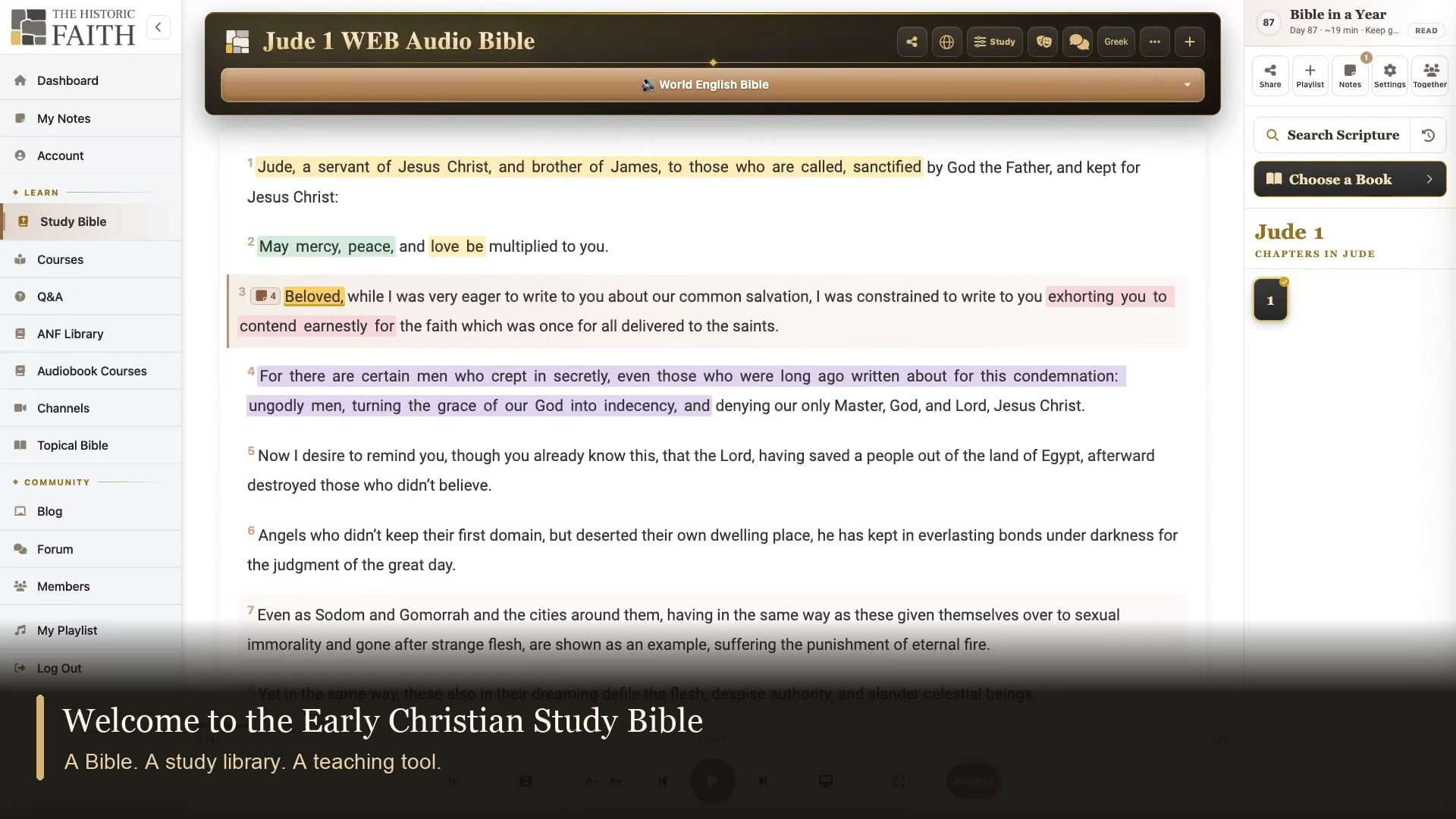
Click a word. Hear its pronunciation. Open the early Christian writings. Then see how to present and teach.
 Words. Writings.
Guided tour · 21:50 · Several Bible editions.
See the phone experience · 5:31
Strong's Exhaustive Concordance, first published by James Strong in 1890, indexes every word of the King James Version and assigns each underlying original-language word a number — G1–G5624 for the Greek New Testament and H1–H8674 for the Hebrew Old Testament. Look up any English word, find its Strong's number, and see the Greek or Hebrew word behind it, its definition, and the verses where it occurs. This free online edition covers 14,298 entries with 767,764 indexed occurrences — including the Septuagint, deuterocanonical books, and 1 Enoch, which no print edition of Strong's includes.
These entry points are the quickest way to see how a Strong's number opens into a word, meaning, and Bible usage.
Greek agape, with New Testament and Septuagint usage links where indexed.
Greek kyrios, a major New Testament and Septuagint word-study bridge.
Hebrew reshith, the word behind “beginning” in Genesis 1:1 and other Old Testament usages.
Browse the local Greek and Hebrew Strong's entries in fast pages, open an exact number, or narrow the index by language, range, and usage count.
| Number | Word | Definition | Usages | Range |
|---|---|---|---|---|
|
G4051 — perisseuma
Greek
|
περίσσευμα (perisseuma)
perisseuma
|
perisseuma (per-is'-syoo-mah) n. 1. a surplus, or superabundance [from G4052] | 5 | G4001-G5000 |
|
G4052 — perisseuo
Greek
|
περισσεύω (perisseuo)
perisseuo
|
perisseuo (per-is-syoo'-o) v. 1. to superabound (in quantity or quality), be in excess, be superfluous 2. (transitively) to cause to superabound or excel | 43 | G4001-G5000 |
|
G4053 — perissos
Greek
|
περισσός (perissos)
perissos
|
perissos (per-is-sos') adj. 1. superabundant (in quantity) or superior (in quality) 2. (by implication) excessive | 44 | G4001-G5000 |
|
G4054 — perissoteron
Greek
|
περισσότερον (perissoteron)
perissoteron
|
perissoteron (per-is-sot'-er-on) adj. 1. in a more superabundant way [neuter of G4055 (as adverb)] | 4 | G4001-G5000 |
|
G4055 — perissoteros
Greek
|
περισσότερος (perissoteros)
perissoteros
|
perissoteros (per-is-sot'-er-os) adj. 1. more superabundant (in number, degree or character) [comparative of G4053] | 0 | G4001-G5000 |
|
G4056 — perissoteros
Greek
|
περισσοτέρως (perissoteros)
perissoteros
|
perissoteros (per-is-sot-er'-oce) adv. 1. more superabundantly [adverb from G4055] | 12 | G4001-G5000 |
|
G4057 — perissos
Greek
|
περισσῶς (perissos)
perissos
|
perissos (per-is-soce`) adv. 1. superabundantly [adverb from G4053] | 10 | G4001-G5000 |
|
G4058 — peristera
Greek
|
περιστερά (peristera)
peristera
|
peristera (per-is-ter-ah') n. 1. a pigeon [of uncertain derivation] | 45 | G4001-G5000 |
|
G4059 — peritemno
Greek
|
περιτέμνω (peritemno)
peritemno
|
peritemno (per-ee-tem'-no) v. 1. to cut around 2. (specially) to circumcise | 53 | G4001-G5000 |
|
G4060 — peritithemi
Greek
|
περιτίθημι (peritithemi)
peritithemi
|
peritithemi (per-ee-tith'-ay-mee) v. 1. to place around 2. (by implication) to present | 54 | G4001-G5000 |
|
G4061 — peritome
Greek
|
περιτομή (peritome)
peritome
|
peritome (per-it-om-ay') n. 1. circumcision (the rite, the condition, or the people) {literally or figuratively} | 36 | G4001-G5000 |
|
G4062 — peritrepo
Greek
|
περιτρέπω (peritrepo)
peritrepo
|
peritrepo (per-ee-trep'-o) v. 1. to turn around 2. (mentally) to craze | 2 | G4001-G5000 |
|
G4063 — peritrecho
Greek
|
περιτρέχω (peritrecho)
peritrecho
|
peritrecho (per-ee-trekh'-o) v. 1. to run around, i.e. traverse [from G4012 and G5143 (including its alternate)] | 3 | G4001-G5000 |
|
G4064 — periphero
Greek
|
περιφέρω (periphero)
periphero
|
periphero (per-ee-fer'-o) v. 1. to convey around, i.e. transport hither and thither [from G4012 and G5342] | 8 | G4001-G5000 |
|
G4065 — periphroneo
Greek
|
περιφρονέω (periphroneo)
periphroneo
|
periphroneo (per-ee-fron-eh'-o) v. 1. to think beyond, i.e. depreciate (contemn) [from G4012 and G5426] | 5 | G4001-G5000 |
|
G4066 — perichoros
Greek
|
περίχωρος (perichoros)
perichoros
|
perichoros (per-ikh'-o-ros) adj. 1. around the region, i.e. circumjacent {(as noun, with G1093 implied vicinity)} | 31 | G4001-G5000 |
|
G4067 — peripsoma
Greek
|
περίψωμα (peripsoma)
peripsoma
|
peripsoma (per-ip'-so-mah) n. 1. something brushed all around, i.e. off-scrapings 2. (figuratively) scum | 2 | G4001-G5000 |
|
G4068 — perpereuomai
Greek
|
περπερεύομαι (perpereuomai)
perpereuomai
|
perpereuomai (per-per-yoo'-om-ai) v. 1. to boast [middle voice from perperos (braggart, perhaps by reduplication of the base of G4008)] | 1 | G4001-G5000 |
|
G4069 — Persis
Greek
|
Περσίς (Persis)
Persis
|
Persis (per-sece') n/p. 1. a Persian woman 2. Persis, a Christian female | 16 | G4001-G5000 |
|
G4070 — perusi
Greek
|
πέρυσι (perusi)
perusi
|
perusi (per'-oo-si) adv. 1. the by-gone 2. (as noun) last year | 2 | G4001-G5000 |
|
G4071 — peteinon
Greek
|
πετεινόν (peteinon)
peteinon
|
peteinon (pet-ei-non') n. 1. a flying animal, i.e. bird [neuter of a derivative of G4072] | 70 | G4001-G5000 |
|
G4072 — petomai
Greek
|
πέτομαι (petomai)
petomai
|
petomai (pet'-om-ai) (or prolongation petaomai pet-ah'-om-ai, or contracted ptaomai ptah'-om-ai) v. 1. to fly [middle voice of a primary verb] | 22 | G4001-G5000 |
|
G4073 — petra
Greek
|
πέτρα (petra)
petra
|
petra (pet'-ra) n. 1. a (mass of) rock {literally or figuratively} | 94 | G4001-G5000 |
|
G4074 — Petros
Greek
|
Πέτρος (Petros)
Petros
|
Petros (pet'-ros) n/p. 1. a (piece of) rock 2. as a name, Petrus, an apostle | 157 | G4001-G5000 |
|
G4075 — petrodes
Greek
|
πετρώδης (petrodes)
petrodes
|
petrodes (pet-ro'-dace) adj. 1. rock-like, i.e. rocky [from G4073 and G1491] | 4 | G4001-G5000 |
|
G4076 — peganon
Greek
|
πήγανον (peganon)
peganon
|
peganon (pay'-gan-on) n. 1. rue (from its thick or fleshy leaves) [from G4078] | 1 | G4001-G5000 |
|
G4077 — pege
Greek
|
πηγή (pege)
pege
|
pege (pay-gay') n. 1. a fount (source or supply, of water, blood, enjoyment), but not necessarily the original spring {literally or figuratively} | 102 | G4001-G5000 |
|
G4078 — pegnumi
Greek
|
πήγνυμι (pegnumi)
pegnumi
|
pegnumi (payg'-noo-mee) v. 1. to fix 2. (specially) to set up (a tent) | 36 | G4001-G5000 |
|
G4079 — pedalion
Greek
|
πηδάλιον (pedalion)
pedalion
|
pedalion (pay-dal'-ee-on) n. 1. a "pedal", i.e. helm [neuter of a (presumed) derivative of pedon (the blade of an oar, ultimately from G4228)] | 2 | G4001-G5000 |
|
G4080 — pelikos
Greek
|
πηλίκος (pelikos)
pelikos
|
pelikos (pay-lee'-kos) adj. 1. how much (as an indefinite), i.e. in size or (figuratively) dignity [a quantitative form (the feminine) of the base of G4225] | 4 | G4001-G5000 |
|
G4081 — pelos
Greek
|
πηλός (pelos)
pelos
|
pelos (pay-los') n. 1. clay [perhaps a primary word] | 35 | G4001-G5000 |
|
G4082 — pera
Greek
|
πήρα (pera)
pera
|
pera (pay'-rah) n. 1. a wallet or leather pouch for food [of uncertain affinity] | 9 | G4001-G5000 |
|
G4083 — pechus
Greek
|
πῆχυς (pechus)
pechus
|
pechus (pay`-khoos) n. 1. the fore-arm 2. (as a measure) a cubit | 132 | G4001-G5000 |
|
G4084 — piazo
Greek
|
πιάζω (piazo)
piazo
|
piazo (pee-ad'-zo) v. 1. to squeeze, i.e. seize (gently by the hand (press), or officially (arrest), or in hunting (capture)) [probably another form of G971] | 13 | G4001-G5000 |
|
G4085 — piezo
Greek
|
πιέζω (piezo)
piezo
|
piezo (pee-ed'-zo) v. 1. to pack [another form for G4084] | 3 | G4001-G5000 |
|
G4086 — pithanologia
Greek
|
πιθανολογία (pithanologia)
pithanologia
|
pithanologia (pith-an-ol-og-ee'-ah) n. 1. persuasive language [from a compound of a derivative of G3982 and G3056] | 1 | G4001-G5000 |
|
G4087 — pikraino
Greek
|
πικραίνω (pikraino)
pikraino
|
pikraino (pik-rai'-no) v. 1. to embitter {literally or figuratively} | 17 | G4001-G5000 |
|
G4088 — pikria
Greek
|
πικρία (pikria)
pikria
|
pikria (pik-ree'-ah) n. 1. acridity, extremely bitter 2. (especially) poison | 29 | G4001-G5000 |
|
G4089 — pikros
Greek
|
πικρός (pikros)
pikros
|
pikros (pik-ros') adj. 1. acrid, bitter 2. (by implication) poisonous (bodily or spiritually) | 36 | G4001-G5000 |
|
G4090 — pikros
Greek
|
πικρῶς (pikros)
pikros
|
pikros (pik-roce`) adv. 1. bitterly 2. (figuratively) violently | 8 | G4001-G5000 |
|
G4091 — Pilatos
Greek
|
Πιλάτος (Pilatos)
Pilatos
|
Pilatos (pil-at'-os) n/p. 1. close-pressed, i.e. firm 2. Pilatus, a Roman | 53 | G4001-G5000 |
|
G4092 — pimpremi
Greek
|
πίμπρημι (pimpremi)
pimpremi
|
pimpremi (pim'-pray-mee) v. 1. to fire, i.e. burn (figuratively and passively, become inflamed with fever) [a reduplicated and prolonged form of a primary preo preh'-o which occurs only as an alternate in certain tenses)] | 1 | G4001-G5000 |
|
G4093 — pinakidion
Greek
|
πινακίδιον (pinakidion)
pinakidion
|
pinakidion (pin-ak-id'-ee-on) n. 1. a tablet (for writing on) [diminutive of G4094] | 1 | G4001-G5000 |
|
G4094 — pinax
Greek
|
πίναξ (pinax)
pinax
|
pinax (pin'-ax) n. 1. a plate [apparently a form of G4109] | 5 | G4001-G5000 |
|
G4095 — pino
Greek
|
πίνω (pino)
pino
|
pino (pee'-no) v. 1. to imbibe {literally or figuratively} | 306 | G4001-G5000 |
|
G4096 — piotes
Greek
|
πιότης (piotes)
piotes
|
piotes (pee-ot'-ace) n. 1. plumpness 2. (by implication) richness (oiliness) | 12 | G4001-G5000 |
|
G4097 — piprasko
Greek
|
πιπράσκω (piprasko)
piprasko
|
piprasko (pip-ras'-ko) (a reduplicated and prolonged form of prao prah'-o; (which occurs only as an alternate in certain tenses)) v. 1. to sell (by travelling or traffic) 2. (figuratively) to dispose of as merchandise or into slavery | 40 | G4001-G5000 |
|
G4098 — pipto
Greek
|
πίπτω (pipto)
pipto
|
pipto (pip'-to) (a reduplicated and contractedm of peto pet'-o; (which occurs only as an alternate in certain tenses)) v. 1. to fall {literally or figuratively} | 453 | G4001-G5000 |
|
G4099 — Pisidia
Greek
|
Πισιδία (Pisidia)
Pisidia
|
Pisidia (pis-id-ee'-ah) n/l. 1. Pisidia, a region of Asia Minor [probably of foreign origin] | 2 | G4001-G5000 |
|
G4100 — pisteuo
Greek
|
πιστεύω (pisteuo)
pisteuo
|
pisteuo (pist-yoo'-o) v. 1. to have faith (in, upon, or with respect to, a person or thing), i.e. credit 2. (by implication) to entrust (especially one's spiritual well-being to Christ) | 304 | G4001-G5000 |
|
G4101 — pistikos
Greek
|
πιστικός (pistikos)
pistikos
|
pistikos (pis-tik-os') adj. 1. trustworthy, i.e. genuine (unadulterated) [from G4102] | 2 | G4001-G5000 |
|
G4102 — pistis
Greek
|
πίστις (pistis)
pistis
|
pistis (pis'-tis) n. 1. persuasion, i.e. credence 2. (morally) conviction (of religious truth, or the truthfulness of God or a religious teacher) | 280 | G4001-G5000 |
|
G4103
Greek
|
πιστὸς
|
pistos (pis-tos') adj. 1. (objectively) trustworthy 2. (subjectively) trustful | 130 | G4001-G5000 |
|
G4104 — pistoo
Greek
|
πιστόω (pistoo)
pistoo
|
pistoo (pis-toh'-o) v. 1. to assure [from G4103] | 16 | G4001-G5000 |
|
G4105 — planao
Greek
|
πλανάω (planao)
planao
|
planao (plan-ah'-o) v. 1. (properly) to cause to stray from the straight path (i.e. to roam, wander) 2. (figuratively) to lead astray from safety, truth, or moral uprightness | 150 | G4001-G5000 |
|
G4106 — plane
Greek
|
πλάνη (plane)
plane
|
plane (plan'-ay) n. 1. (properly) a straying or wandering from the straight path (i.e. a deviation, an error, a bending) 2. (objectively) fraudulence | 16 | G4001-G5000 |
|
G4107 — planetes
Greek
|
πλανήτης (planetes)
planetes
|
planetes (plan-ay'-tace) n. 1. a rover ("planet") 2. (figuratively) an erratic teacher | 2 | G4001-G5000 |
|
G4108 — planos
Greek
|
πλάνος (planos)
planos
|
planos (plan'-os) adj. 1. straying or wandering from the straight path 2. roaming, roving (as a "planos kuon" meaning "stray dog" or as a vagabond) | 5 | G4001-G5000 |
|
G4109 — plax
Greek
|
πλάξ (plax)
plax
|
plax (plax') n. 1. a moulding-board, i.e. flat surface ("plate", or tablet) {literally or figuratively} | 25 | G4001-G5000 |
|
G4110 — plasma
Greek
|
πλάσμα (plasma)
plasma
|
plasma (plas'-mah) n. 1. something moulded [from G4111] | 6 | G4001-G5000 |
|
G4111 — plasso
Greek
|
πλάσσω (plasso)
plasso
|
plasso (plas'-so) v. 1. to mould, i.e. shape or fabricate [a primary verb] | 51 | G4001-G5000 |
|
G4112 — plastos
Greek
|
πλαστός (plastos)
plastos
|
plastos (plas-tos') adj. 1. moulded 2. (by implication) artificial | 1 | G4001-G5000 |
|
G4113 — plateia
Greek
|
πλατεῖα (plateia)
plateia
|
plateia (plat-ei`-ah) n. 1. a wide "plat" or "place", i.e. open square [feminine of G4116] | 17 | G4001-G5000 |
|
G4114 — platos
Greek
|
πλάτος (platos)
platos
|
platos (plat'-os) n. 1. width [from G4116] | 49 | G4001-G5000 |
|
G4115 — platuno
Greek
|
πλατύνω (platuno)
platuno
|
platuno (plat-oo'-no) v. 1. to widen {literally or figuratively} | 25 | G4001-G5000 |
|
G4116 — platus
Greek
|
πλατύς (platus)
platus
|
platus (plat-oos') adj. 1. spread out "flat" ("plot"), i.e. broad [from G4111] | 58 | G4001-G5000 |
|
G4117 — plegma
Greek
|
πλέγμα (plegma)
plegma
|
plegma (pleg'-mah) n. 1. a plait (of hair) [from G4120] | 1 | G4001-G5000 |
|
G4118 — pleistos
Greek
|
πλεῖστος (pleistos)
pleistos
|
pleistos (plice`-tos) adj. 1. the largest number or very large [irregular superlative of G4183] | 7 | G4001-G5000 |
|
G4119 — pleion
Greek
|
πλείων (pleion)
pleion
|
pleion (plei'-own) (or neuter pleion pli'-on, or pleon pleh'-on) adj. 1. more in quantity, number, or quality 2. (in plural) the major portion | 134 | G4001-G5000 |
|
G4120 — pleko
Greek
|
πλέκω (pleko)
pleko
|
pleko (plek'-o) v. 1. to twine or braid [a primary word] | 5 | G4001-G5000 |
|
G4121 — pleonazo
Greek
|
πλεονάζω (pleonazo)
pleonazo
|
pleonazo (pleh-on-ad'-zo) v. 1. to do, make or be more, i.e. increase (transitively or intransitively) 2. (by extension) to superabound | 33 | G4001-G5000 |
|
G4122 — pleonekteo
Greek
|
πλεονεκτέω (pleonekteo)
pleonekteo
|
pleonekteo (pleh-on-ek-teh'-o) v. 1. to be covetous 2. (by implication) to over-reach | 8 | G4001-G5000 |
|
G4123 — pleonektes
Greek
|
πλεονέκτης (pleonektes)
pleonektes
|
pleonektes (pleh-on-ek'-tace) n. 1. holding (desiring) more, i.e. eager for gain (avaricious, hence a defrauder) [from G4119 and G2192] | 5 | G4001-G5000 |
|
G4124 — pleonexia
Greek
|
πλεονεξία (pleonexia)
pleonexia
|
pleonexia (pleh-on-ex-ee'-ah) n. 1. avarice 2. (by implication) fraudulency, extortion | 17 | G4001-G5000 |
|
G4125 — pleura
Greek
|
πλευρά (pleura)
pleura
|
pleura (plyoo-rah') n. 1. a rib 2. (by extension) side | 33 | G4001-G5000 |
|
G4126 — pleo
Greek
|
πλέω (pleo)
pleo
|
pleo (pleh'-o) (another form for pleuo plyoo'-o; which is used as an alternate in certain tenses) v. 1. to sail [probably a form of G4150 (through the idea of plunging through the water)] | 12 | G4001-G5000 |
|
G4127
Greek
|
πληγὰς
|
plege (play-gay') n. 1. a stroke 2. (by implication) a wound | 111 | G4001-G5000 |
|
G4128 — plethos
Greek
|
πλήθος (plethos)
plethos
|
plethos (play'-thos) n. 1. a fulness, i.e. a large number, throng, populace [from G4130] | 298 | G4001-G5000 |
|
G4129 — plethuno
Greek
|
πληθύνω (plethuno)
plethuno
|
plethuno (play-thoo'-no) v. 1. to increase (transitively or intransitively) [from another form of G4128] | 195 | G4001-G5000 |
|
G4130 — pletho
Greek
|
πλήθω (pletho)
pletho
|
pletho (play'-tho) v. 1. to fill 2. (figuratively) imbue, influence, supply | 131 | G4001-G5000 |
|
G4131 — plektes
Greek
|
πλήκτης (plektes)
plektes
|
plektes (plake'-tace) n. 1. a smiter, i.e. pugnacious (quarrelsome) [from G4141] | 2 | G4001-G5000 |
|
G4132 — plemmura
Greek
|
πλημμύρα (plemmura)
plemmura
|
plemmura (plame-moo'-rah) n. 1. flood-tide 2. (by analogy) a freshet | 2 | G4001-G5000 |
|
G4133 — plen
Greek
|
πλήν (plen)
plen
|
plen (playn') adv. 1. moreover (besides), i.e. albeit, save that, rather, yet [from G4119] | 247 | G4001-G5000 |
|
G4134 — pleres
Greek
|
πλήρης (pleres)
pleres
|
pleres (play'-race) adj. 1. filled, replete, or covered over 2. (by analogy) complete | 134 | G4001-G5000 |
|
G4135 — plerophoreo
Greek
|
πληροφορέω (plerophoreo)
plerophoreo
|
plerophoreo (play-rof-or-eh'-o) v. 1. to carry out fully (in evidence), i.e. completely assure (or convince), entirely accomplish [from G4134 and G5409] | 6 | G4001-G5000 |
|
G4136 — plerophoria
Greek
|
πληροφορία (plerophoria)
plerophoria
|
plerophoria (play-rof-or-ee'-ah) n. 1. entire confidence [from G4135] | 4 | G4001-G5000 |
|
G4137 — pleroo
Greek
|
πληρόω (pleroo)
pleroo
|
pleroo (play-roh'-o) v. 1. to fully, completely fill 2. (literally) to cram (a net), level up (a hollow) | 195 | G4001-G5000 |
|
G4138 — pleroma
Greek
|
πλήρωμα (pleroma)
pleroma
|
pleroma (play'-ro-mah) n. 1. repletion or completion 2. (subjectively) what fills (as contents, supplement, copiousness, multitude) | 30 | G4001-G5000 |
|
G4139 — plesion
Greek
|
πλησίον (plesion)
plesion
|
plesion (play-see'-on) adv. 1. (adverbially) close by 2. (as noun) a neighbor, i.e. fellow (as man, countryman, Christian or friend) | 212 | G4001-G5000 |
|
G4140 — plesmone
Greek
|
πλησμονή (plesmone)
plesmone
|
plesmone (place-mon-ay') n. 1. a filling up 2. (figuratively) gratification | 28 | G4001-G5000 |
|
G4141 — plesso
Greek
|
πλήσσω (plesso)
plesso
|
plesso (place'-so) v. 1. to pound 2. (figuratively) to inflict with (calamity) | 24 | G4001-G5000 |
|
G4142 — ploiarion
Greek
|
πλοιάριον (ploiarion)
ploiarion
|
ploiarion (ploy-ar'-ee-on) n. 1. a boat [neuter of a presumed derivative of G4143] | 5 | G4001-G5000 |
|
G4143 — ploion
Greek
|
πλοῖον (ploion)
ploion
|
ploion (ploy`-on) n. 1. a sailer, i.e. vessel [from G4126] | 102 | G4001-G5000 |
|
G4144 — ploos
Greek
|
πλόος (ploos)
ploos
|
ploos (ploh'-os) n. 1. a sail, i.e. navigation [from G4126] | 3 | G4001-G5000 |
|
G4145 — plousios
Greek
|
πλούσιος (plousios)
plousios
|
plousios (plou'-see-os) adj. 1. wealthy 2. (figuratively) abounding with | 81 | G4001-G5000 |
|
G4146 — plousios
Greek
|
πλουσίως (plousios)
plousios
|
plousios (plou-see'-oce) adv. 1. copiously [adverb from G4145] | 4 | G4001-G5000 |
|
G4147 — plouteo
Greek
|
πλουτέω (plouteo)
plouteo
|
plouteo (plou-teh'-o) v. 1. to be (or become) wealthy {literally or figuratively} | 25 | G4001-G5000 |
|
G4148 — ploutizo
Greek
|
πλουτίζω (ploutizo)
ploutizo
|
ploutizo (plou-tid'-zo) v. 1. to make wealthy (figuratively) [from G4149] | 14 | G4001-G5000 |
|
G4149 — ploutos
Greek
|
πλοῦτος (ploutos)
ploutos
|
ploutos (plou`-tos) n. 1. wealth (as fulness) 2. (literally) money, possessions | 115 | G4001-G5000 |
|
G4150 — pluno
Greek
|
πλύνω (pluno)
pluno
|
pluno (ploo'-no) v. 1. to "plunge", i.e. launder clothing [a prolonged form of an obsolete pluo "to flow"] | 50 | G4001-G5000 |
|
G4151 — pneuma
Greek
|
πνεῦμα (pneuma)
pneuma
|
pneuma (pnyoo`-mah) n. 1. a current of air, i.e. breath (blast) or a breeze 2. (by analogy or figuratively) a spirit | 687 | G4001-G5000 |
|
G4152 — pneumatikos
Greek
|
πνευματικός (pneumatikos)
pneumatikos
|
pneumatikos (pnyoo-mat-ik-os') adj. 1. spiritual 2. (demonically) of evil spirits | 21 | G4001-G5000 |
|
G4153 — pneumatikos
Greek
|
πνευματικῶς (pneumatikos)
pneumatikos
|
pneumatikos (pnyoo-mat-ik-oce`) adv. 1. non-physically, i.e. divinely, figuratively [adverb from G4152] | 2 | G4001-G5000 |
|
G4154 — pneo
Greek
|
πνέω (pneo)
pneo
|
pneo (pneh'-o) v. 1. to breathe hard, i.e. breeze [a primary word] | 10 | G4001-G5000 |
|
G4155 — pnigo
Greek
|
πνίγω (pnigo)
pnigo
|
pnigo (pnee'-go) v. 1. to wheeze (causative) 2. (by implication) to throttle or strangle (drown) | 4 | G4001-G5000 |
|
G4156 — pniktos
Greek
|
πνικτός (pniktos)
pniktos
|
pniktos (pnik-tos') adj. 1. throttled 2. (neuter concretely) an animal choked to death (not bled) | 3 | G4001-G5000 |
|
G4157 — pnoe
Greek
|
πνοή (pnoe)
pnoe
|
pnoe (pno-ay') n. 1. respiration, a breeze [from G4154] | 27 | G4001-G5000 |
|
G4158 — poderes
Greek
|
ποδήρης (poderes)
poderes
|
poderes (pod-ay'-race) adj. 1. a dress reaching the ankles {G2066 implied} | 13 | G4001-G5000 |
|
G4159 — pothen
Greek
|
πόθεν (pothen)
pothen
|
pothen (poth'-en) adv. 1. from which (as interrogative) or what (as relative) place, state, source or cause [from the base of G4213 with enclitic adverb of origin] | 68 | G4001-G5000 |
|
G4160
Greek
|
ἐποίησεν
|
poieo (poy-eh'-o) v. 1. to make or do {in a very wide application, more or less direct; properly refers to a single act thus differing from G4238} | 3,269 | G4001-G5000 |
|
G4161 — poiema
Greek
|
ποίημα (poiema)
poiema
|
poiema (poy'-ay-mah) n. 1. a product, i.e. fabric {literally or figuratively} | 29 | G4001-G5000 |
|
G4162 — poiesis
Greek
|
ποίησις (poiesis)
poiesis
|
poiesis (poy'-ay-sis) n. 1. action, i.e. performance (of the law) [from G4160] | 12 | G4001-G5000 |
|
G4163 — poietes
Greek
|
ποιητής (poietes)
poietes
|
poietes (poy-ay-tace') n. 1. a performer 2. (specially) a "poet" | 7 | G4001-G5000 |
|
G4164 — poikilos
Greek
|
ποικίλος (poikilos)
poikilos
|
poikilos (poy-kee'-los) adj. 1. motley, i.e. various in character [of uncertain derivation] | 34 | G4001-G5000 |
|
G4165 — poimaino
Greek
|
ποιμαίνω (poimaino)
poimaino
|
poimaino (poy-mai'-no) v. 1. to tend as a shepherd of 2. (figuratively) supervisor | 61 | G4001-G5000 |
|
G4166 — poimen
Greek
|
ποιμήν (poimen)
poimen
|
poimen (poy-mayn') n. 1. a shepherd {literally or figuratively} | 85 | G4001-G5000 |
|
G4167 — poimne
Greek
|
ποίμνη (poimne)
poimne
|
poimne (poym'-nay) n. 1. a flock {literally or figuratively} | 5 | G4001-G5000 |
|
G4168 — poimnion
Greek
|
ποίμνιον (poimnion)
poimnion
|
poimnion (poym'-nee-on) n. 1. a flock 2. (figuratively) group (of believers) | 73 | G4001-G5000 |
|
G4169 — poios
Greek
|
ποῖος (poios)
poios
|
poios (poy`-os) p/i. 1. individualizing interrogative (of character) what sort of 2. (of number) which one | 64 | G4001-G5000 |
|
G4170 — polemeo
Greek
|
πολεμέω (polemeo)
polemeo
|
polemeo (pol-em-eh'-o) v. 1. to be (engaged) in warfare, i.e. to battle {literally or figuratively} | 188 | G4001-G5000 |
|
G4171 — polemos
Greek
|
πόλεμος (polemos)
polemos
|
polemos (pol'-em-os) n. 1. warfare (a single encounter or a series) {literally or figuratively} | 369 | G4001-G5000 |
|
G4172 — polis
Greek
|
πόλις (polis)
polis
|
polis (pol'-is) n. 1. a town (properly, with walls, of greater or less size) [probably from pelomai "to bustle", or perhaps from G4183] | 1,408 | G4001-G5000 |
|
G4173 — politarches
Greek
|
πολιτάρχης (politarches)
politarches
|
politarches (pol-it-ar'-khace) n. 1. a town-officer, i.e. magistrate [from G4172 and G757] | 2 | G4001-G5000 |
|
G4174 — politeia
Greek
|
πολιτεία (politeia)
politeia
|
politeia (pol-ee-tei'-ah) n. 1. citizenship 2. (concretely) a community | 10 | G4001-G5000 |
|
G4175 — politeuma
Greek
|
πολίτευμα (politeuma)
politeuma
|
politeuma (pol-it'-yoo-mah) n. 1. a community 2. (abstractly) citizenship (figuratively) | 2 | G4001-G5000 |
|
G4176 — politeuomai
Greek
|
πολιτεύομαι (politeuomai)
politeuomai
|
politeuomai (pol-it-yoo'-om-ai) v. 1. to behave as a citizen (figuratively) [middle voice of a derivative of G4177] | 2 | G4001-G5000 |
|
G4177 — polites
Greek
|
πολίτης (polites)
polites
|
polites (pol-ee'-tace) n. 1. a citizen, a townsman [from G4172] | 19 | G4001-G5000 |
|
G4178 — pollakis
Greek
|
πολλάκις (pollakis)
pollakis
|
pollakis (pol-lak'-is) adv. 1. many times, i.e. frequently [multiplicative adverb from G4183] | 27 | G4001-G5000 |
|
G4179 — pollaplasion
Greek
|
πολλαπλασίων (pollaplasion)
pollaplasion
|
pollaplasion (pol-lap-las-ee'-own) adj. 1. manifold 2. (neuter as noun) very much more | 1 | G4001-G5000 |
|
G4180 — polulogia
Greek
|
πολυλογία (polulogia)
polulogia
|
polulogia (pol-oo-log-ee'-ah) n. 1. loquacity, i.e. prolixity [from a compound of G4183 and G3056] | 2 | G4001-G5000 |
|
G4181 — polumeros
Greek
|
πολυμέρως (polumeros)
polumeros
|
polumeros (pol-oo-mer'-oce) adv. 1. in many portions, i.e. variously as to time and agency (piecemeal) [adverb from a compound of G4183 and G3313] | 1 | G4001-G5000 |
|
G4182 — polupoikilos
Greek
|
πολυποίκιλος (polupoikilos)
polupoikilos
|
polupoikilos (pol-oo-poy'-kil-os) adj. 1. much variegated, i.e. multifarious [from G4183 and G4164] | 1 | G4001-G5000 |
|
G4183 — polus
Greek
|
πολύς (polus)
polus
|
polus (pol-oos') (including the forms from the alternate pollos) adj. 1. (singular) much (in any respect) or (plural) many, (neuter singular as adverbial) largely, (neuter plural as adverb or noun) often, mostly, largely [from ???] | 1,052 | G4001-G5000 |
|
G4184 — polusplagchnos
Greek
|
πολύσπλαγχνος (polusplagchnos)
polusplagchnos
|
polusplagchnos (pol-oo'-splagkh-nos) adj. 1. extremely compassionate [from G4183 and G4698 (figuratively)] | 1 | G4001-G5000 |
|
G4185 — poluteles
Greek
|
πολυτελής (poluteles)
poluteles
|
poluteles (pol-oo-tel-ace') adj. 1. extremely expensive [from G4183 and G5056] | 17 | G4001-G5000 |
|
G4186 — polutimos
Greek
|
πολύτιμος (polutimos)
polutimos
|
polutimos (pol-oot'-ee-mos) adj. 1. extremely valuable [from G4183 and G5092] | 2 | G4001-G5000 |
|
G4187 — polutropos
Greek
|
πολυτρόπως (polutropos)
polutropos
|
polutropos (pol-oot-rop'-oce) adv. 1. in many ways, i.e. variously as to method or form [adverb from a compound of G4183 and G5158] | 1 | G4001-G5000 |
|
G4188 — poma
Greek
|
πόμα (poma)
poma
|
poma (pom'-ah) n. 1. a beverage [from the alternate of G4095] | 7 | G4001-G5000 |
|
G4189 — poneria
Greek
|
πονηρία (poneria)
poneria
|
poneria (pon-ay-ree'-ah) n. 1. depravity 2. (specially) malice | 75 | G4001-G5000 |
|
G4190 — poneros
Greek
|
πονηρός (poneros)
poneros
|
poneros (pon-ay-ros') adj. 1. hurtful, i.e. evil 2. (figuratively) calamitous | 415 | G4001-G5000 |
|
G4191 — poneroteros
Greek
|
πονηρότερος (poneroteros)
poneroteros
|
poneroteros (pon-ay-rot'-er-os) adj. 1. more evil [comparative of G4190] | 1 | G4001-G5000 |
|
G4192 — ponos
Greek
|
πόνος (ponos)
ponos
|
ponos (pon'-os) n. 1. toil 2. (by implication) anguish | 93 | G4001-G5000 |
|
G4193 — Pontikos
Greek
|
Ποντικός (Pontikos)
Pontikos
|
Pontikos (pon-tik-os') adj/g. 1. a Pontican, i.e. native of Pontus [from G4195] | 1 | G4001-G5000 |
|
G4194 — Pontios
Greek
|
Πόντιος (Pontios)
Pontios
|
Pontios (pon'-tee-os) n/p. 1. apparently bridged 2. Pontius, a Roman | 4 | G4001-G5000 |
|
G4195 — Pontos
Greek
|
Πόντος (Pontos)
Pontos
|
Pontos (pon'-tos) n/l. 1. a sea 2. Pontus, a region of Asia Minor | 2 | G4001-G5000 |
|
G4196 — Poplios
Greek
|
Πόπλιος (Poplios)
Poplios
|
Poplios (pop'-lee-os) n/p. 1. apparently "popular" 2. Poplius (i.e. Publius), a Roman | 2 | G4001-G5000 |
|
G4197 — poreia
Greek
|
πορεία (poreia)
poreia
|
poreia (por-ei'-ah) n. 1. travel (by land) 2. (figuratively, plural) proceedings, i.e. career | 29 | G4001-G5000 |
|
G4198 — poreuomai
Greek
|
πορεύομαι (poreuomai)
poreuomai
|
poreuomai (por-yoo'-om-ai) v. 1. to traverse, i.e. travel (especially to remove) 2. (figuratively) to die, live, etc. | 1,168 | G4001-G5000 |
|
G4199 — portheo
Greek
|
πορθέω (portheo)
portheo
|
portheo (por-theh'-o) v. 1. (figuratively) to ravage [prolongation from pertho "to sack"] | 5 | G4001-G5000 |
|
G4200 — porismos
Greek
|
πορισμός (porismos)
porismos
|
porismos (por-is-mos') n. 1. furnishing (procuring) 2. (by implication) money-getting (acquisition) | 4 | G4001-G5000 |
No Strong's entries match that search.
Strong's works best when the number, original word, verse, and corpus stay connected.
Open a chapter and move from a word token to its Strong's page, parsing, and linked occurrences.
Greek Strong's entries can include New Testament, Septuagint, deuterocanonical, and 1 Enoch rows where indexed.
Dedicated Strong's pages can expose approved pronunciation audio beside the word-study data.
These are common words readers run into repeatedly, shown with an English meaning so the list is readable without already knowing the original languages.
Look up a word study by its transliteration — these are frequently searched Hebrew and Greek words. Each opens the matching Strong's entry, or lists the options when a spelling maps to several words.