
G26 — Agape (Love)
Greek agape, with New Testament and Septuagint usage links where indexed.
The Early Christian Study Bible · Free to use
Study the word. Hear its pronunciation.
Search 14,298 Greek and Hebrew entries—free. Explore definitions, indexed occurrences, and pronunciation audio where available, then follow the words back into your Bible.
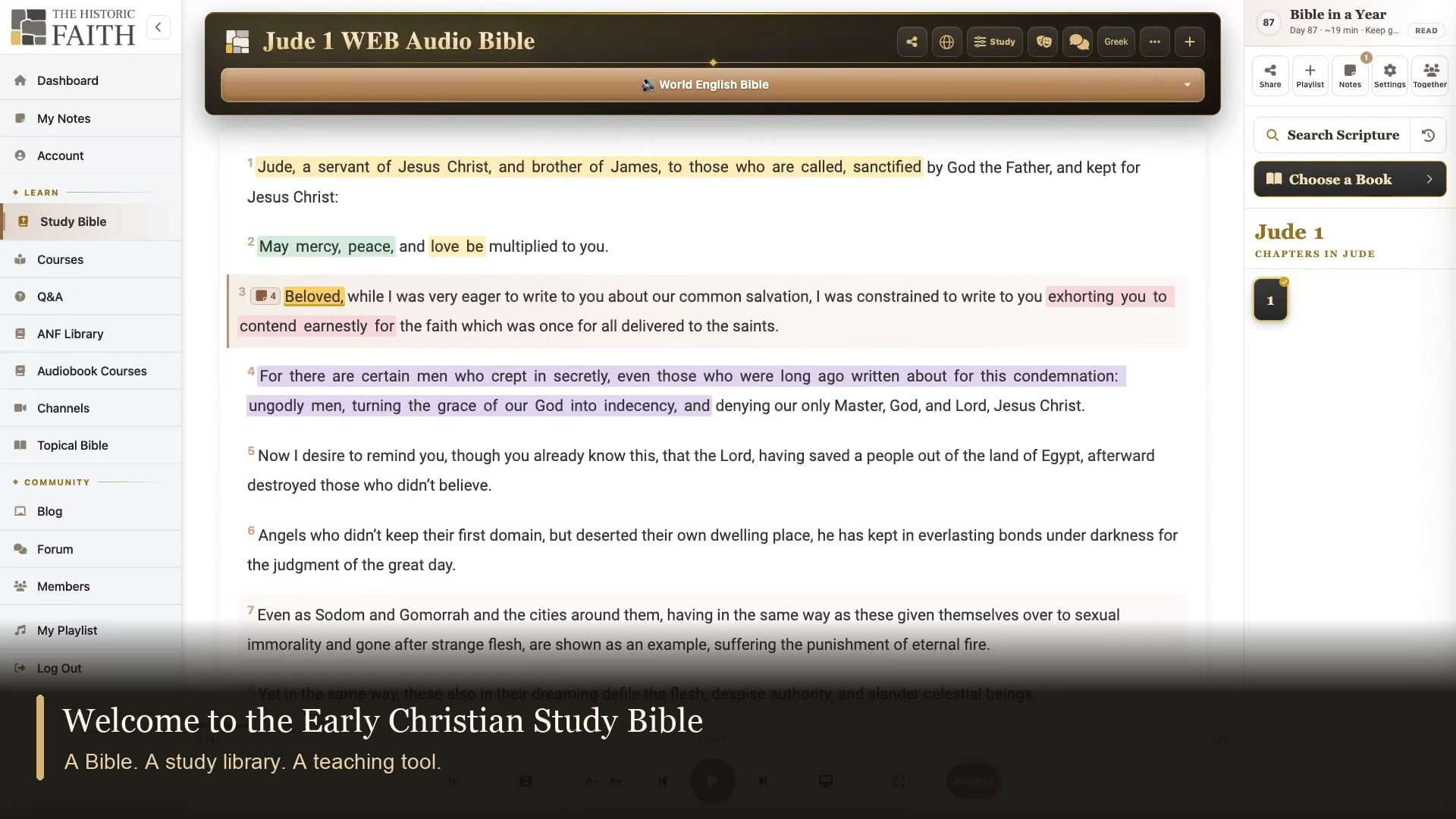
Click a word. Hear its pronunciation. Open the early Christian writings. Then see how to present and teach.
 Words. Writings.
Guided tour · 21:50 · Several Bible editions.
See the phone experience · 5:31
Strong's Exhaustive Concordance, first published by James Strong in 1890, indexes every word of the King James Version and assigns each underlying original-language word a number — G1–G5624 for the Greek New Testament and H1–H8674 for the Hebrew Old Testament. Look up any English word, find its Strong's number, and see the Greek or Hebrew word behind it, its definition, and the verses where it occurs. This free online edition covers 14,298 entries with 767,764 indexed occurrences — including the Septuagint, deuterocanonical books, and 1 Enoch, which no print edition of Strong's includes.
These entry points are the quickest way to see how a Strong's number opens into a word, meaning, and Bible usage.
Greek agape, with New Testament and Septuagint usage links where indexed.
Greek kyrios, a major New Testament and Septuagint word-study bridge.
Hebrew reshith, the word behind “beginning” in Genesis 1:1 and other Old Testament usages.
Browse the local Greek and Hebrew Strong's entries in fast pages, open an exact number, or narrow the index by language, range, and usage count.
| Number | Word | Definition | Usages | Range |
|---|---|---|---|---|
|
G1051 — gala
Greek
|
γάλα (gala)
gala
|
gala (gal'-ah) n. 1. (figuratively) milk [of uncertain affinity] | 51 | G1001-G2000 |
|
G1052 — Galates
Greek
|
Γαλάτης (Galates)
Galates
|
Galates (gal-at'-ace) n/g. 1. a Galatian or inhabitant of Galatia [from G1053] | 2 | G1001-G2000 |
|
G1053 — Galatia
Greek
|
Γαλατία (Galatia)
Galatia
|
Galatia (gal-at-ee'-ah) n/l. 1. Galatia, a region of Asia [of foreign origin] | 4 | G1001-G2000 |
|
G1054 — Galatikos
Greek
|
Γαλατικός (Galatikos)
Galatikos
|
Galatikos (gal-at-ee-kos') adj/g. 1. Galatic or relating to Galatia [from G1053] | 2 | G1001-G2000 |
|
G1055 — galene
Greek
|
γαλήνη (galene)
galene
|
galene (gal-ay'-nay) n. 1. tranquillity [of uncertain derivation] | 3 | G1001-G2000 |
|
G1056 — Galilaia
Greek
|
Γαλιλαία (Galilaia)
Galilaia
|
Galilaia (gal-il-ai'-ah) n/l. 1. known as the heathen circle 2. Galiloea, a region of Israel | 88 | G1001-G2000 |
|
G1057 — Galilaios
Greek
|
Γαλιλαῖος (Galilaios)
Galilaios
|
Galilaios (gal-ee-lai`-os) n/g. 1. Galilean or belonging to Galilea [from G1056] | 10 | G1001-G2000 |
|
G1058 — Gallion
Greek
|
Γαλλίων (Gallion)
Gallion
|
Gallion (gal-lee'-own) n/p. 1. Gallion (i.e. Gallio), a Roman officer [of Latin origin] | 3 | G1001-G2000 |
|
G1059 — Gamaliel
Greek
|
Γαμαλιήλ (Gamaliel)
Gamaliel
|
Gamaliel (gam-al-ee-ale') n/p. 1. Gamaliel (i.e. Gamliel), an Israelite [of Hebrew origin (H1583)] | 7 | G1001-G2000 |
|
G1060 — gameo
Greek
|
γαμέω (gameo)
gameo
|
gameo (gam-eh'-o) v. 1. to wed (of either sex) [from G1062] | 27 | G1001-G2000 |
|
G1061 — gamisko
Greek
|
γαμίσκω (gamisko)
gamisko
|
gamisko (gam-is'-ko) v. 1. to espouse (a daughter to a husband) [from G1062] | 1 | G1001-G2000 |
|
G1062 — gamos
Greek
|
γάμος (gamos)
gamos
|
gamos (gam'-os) n. 1. nuptials [of uncertain affinity] | 33 | G1001-G2000 |
|
G1063
Greek
|
γάρ
|
gar (gar') conj. 1. (properly) assigning a reason {(used in argument, explanation or intensification; often with other particles)} | 2,426 | G1001-G2000 |
|
G1064 — gaster
Greek
|
γαστήρ (gaster)
gaster
|
gaster (gas-tare') n. 1. the stomach 2. (by analogy) the matrix | 73 | G1001-G2000 |
|
G1065 — ge
Greek
|
γέ (ge)
ge
|
ge (gheh') prt. 1. of emphasis or qualification {Often used with other particles prefixed} | 162 | G1001-G2000 |
|
G1066 — Gedeon
Greek
|
Γεδεών (Gedeon)
Gedeon
|
Gedeon (ghed-eh-own') n/p. 1. Gedeon (i.e. Gid(e)on), an Israelite [of Hebrew origin (H1439)] | 45 | G1001-G2000 |
|
G1067 — geenna
Greek
|
γέεννα (geenna)
geenna
|
geenna (gheh'-en-nah) n. 1. valley of (the son of) Hinnom 2. ge-henna (or Ge-Hinnom), a valley of Jerusalem, | 12 | G1001-G2000 |
|
G1068 — Gethsemane
Greek
|
Γεθσημανῆ (Gethsemane)
Gethsemane
|
Gethsemane (gheth-say-man-ay`) n/l. 1. oil-press 2. Gethsemane, a garden near Jerusalem | 2 | G1001-G2000 |
|
G1069 — geiton
Greek
|
γείτων (geiton)
geiton
|
geiton (ghei'-tone) n. 1. a neighbour (as adjoining one's ground) 2. (by implication) a friend | 20 | G1001-G2000 |
|
G1070 — gelao
Greek
|
γελάω (gelao)
gelao
|
gelao (ghel-ah'-o) v. 1. to laugh (as a sign of joy or satisfaction) [of uncertain affinity] | 17 | G1001-G2000 |
|
G1071 — gelos
Greek
|
γέλως (gelos)
gelos
|
gelos (ghel'-ows) n. 1. laughter (as a mark of gratification) [from G1070] | 20 | G1001-G2000 |
|
G1072 — gemizo
Greek
|
γεμίζω (gemizo)
gemizo
|
gemizo (ghem-id'-zo) v. 1. to fill entirely [transitive from G1073] | 10 | G1001-G2000 |
|
G1073 — gemo
Greek
|
γέμω (gemo)
gemo
|
gemo (ghem'-o) v. 1. to swell out, i.e. be full [a primary verb] | 18 | G1001-G2000 |
|
G1074 — genea
Greek
|
γενεά (genea)
genea
|
genea (ghen-eh-ah') n. 1. a generation 2. (by implication) an age (the period or the persons) | 214 | G1001-G2000 |
|
G1075 — genealogeo
Greek
|
γενεαλογέω (genealogeo)
genealogeo
|
genealogeo (ghen-eh-al-og-eh'-o) v. 1. to reckon by generations, i.e. trace in genealogy [from G1074 and G3056] | 2 | G1001-G2000 |
|
G1076 — genealogia
Greek
|
γενεαλογία (genealogia)
genealogia
|
genealogia (ghen-eh-al-og-ee'-ah) n. 1. tracing by generations, i.e. "genealogy" [from G1074 and G3056] | 2 | G1001-G2000 |
|
G1077 — genesia
Greek
|
γενέσια (genesia)
genesia
|
genesia (ghen-es'-ee-ah) n. 1. birthday ceremonies [neuter plural of a derivative of G1078] | 2 | G1001-G2000 |
|
G1078 — genesis
Greek
|
γένεσις (genesis)
genesis
|
genesis (ghen'-es-is) n. 1. nativity 2. (figuratively) nature | 57 | G1001-G2000 |
|
G1079 — genete
Greek
|
γενετή (genete)
genete
|
genete (ghen-et-ay') n. 1. birth [feminine of a presumed derivative of the base of G1074] | 2 | G1001-G2000 |
|
G1080
Greek
|
γεννάω
|
gennao (ghen-nah'-o) v. 1. (properly, of the father) to procreate 2. (by extension, of the mother) to conceive | 255 | G1001-G2000 |
|
G1081 — gennema
Greek
|
γέννημα (gennema)
gennema
|
gennema (ghen'-nay-mah) n. 1. offspring 2. (by analogy) produce | 76 | G1001-G2000 |
|
G1082 — Gennesaret
Greek
|
Γεννησαρέτ (Gennesaret)
Gennesaret
|
Gennesaret (ghen-nay-sar-et') n/l. 1. Gennesaret (i.e. Kinnereth), a lake and plain in Israel [of Hebrew origin] | 3 | G1001-G2000 |
|
G1083 — gennesis
Greek
|
γέννησις (gennesis)
gennesis
|
gennesis (ghen'-nay-sis) n. 1. nativity [from G1080] | 3 | G1001-G2000 |
|
G1084 — gennetos
Greek
|
γεννητός (gennetos)
gennetos
|
gennetos (ghen-nay-tos') adj. 1. born [from G1080] | 7 | G1001-G2000 |
|
G1085 — genos
Greek
|
γένος (genos)
genos
|
genos (ghen'-os) n. 1. kin {abstract or concrete, literal or figurative, individual or collective} | 113 | G1001-G2000 |
|
G1086 — Gergesenos
Greek
|
Γεργεσηνός (Gergesenos)
Gergesenos
|
Gergesenos (gher-ghes-ay-nos') n/g. 1. a Gergesene (i.e. Girgashite) or one of the aborigines of Israel [of Hebrew origin (H1622)] | 1 | G1001-G2000 |
|
G1087 — gerousia
Greek
|
γερουσία (gerousia)
gerousia
|
gerousia (gher-ou-see'-ah) n. 1. the eldership 2. (collectively) the Jewish Sanhedrin | 35 | G1001-G2000 |
|
G1088 — geron
Greek
|
γέρων (geron)
geron
|
geron (gher'-own) n. 1. old (man) [of uncertain affinity] | 19 | G1001-G2000 |
|
G1089 — geuomai
Greek
|
γεύομαι (geuomai)
geuomai
|
geuomai (ghyoo'-om-ai) v. 1. to taste 2. (by implication) to eat | 31 | G1001-G2000 |
|
G1090 — georgeo
Greek
|
γεωργέω (georgeo)
georgeo
|
georgeo (gheh-owr-gheh'-o) v. 1. to till (the soil) [from G1092] | 4 | G1001-G2000 |
|
G1091 — georgion
Greek
|
γεώργιον (georgion)
georgion
|
georgion (gheh-ore'-ghee-on) n. 1. cultivable, i.e. a farm [neuter of a (presumed) derivative of G1092] | 8 | G1001-G2000 |
|
G1092 — georgos
Greek
|
γεωργός (georgos)
georgos
|
georgos (gheh-ore-gos') n. 1. a land-worker, i.e. farmer [from G1093 and the base of G2041] | 26 | G1001-G2000 |
|
G1093 — ge
Greek
|
γῆ (ge)
ge
|
ge (ghay`) n. 1. soil 2. (by extension) a region, or the solid part or the whole of the earthly globe (including the occupants in each application) | 2,863 | G1001-G2000 |
|
G1094 — geras
Greek
|
γήρας (geras)
geras
|
geras (ghay'-ras) n. 1. old age [akin to G1088] | 43 | G1001-G2000 |
|
G1095 — gerasko
Greek
|
γηράσκω (gerasko)
gerasko
|
gerasko (ghay-ras'-kow) v. 1. to grow old [from G1094] | 19 | G1001-G2000 |
|
G1096
Greek
|
γέγονεν
|
ginomai (ghin'-om-ai) v. 1. to cause to be ("gen"-erate) 2. (reflexively) to become (come into being) | 2,548 | G1001-G2000 |
|
G1097
Greek
|
γινώσκω
|
(ghin-oce'-ko) v. 1. to "know" (absolutely) {in a great variety of applications and with many implications (as follow, with others not thus clearly expressed)} | 877 | G1001-G2000 |
|
G1098 — gleukos
Greek
|
γλεύκος (gleukos)
gleukos
|
gleukos (glyoo'-kos) n. 1. sweet wine 2. (properly) fresh, unfermented juice, but used of the more sugary, fermented wine (and therefore highly inebriating) | 2 | G1001-G2000 |
|
G1099 — glukus
Greek
|
γλυκύς (glukus)
glukus
|
glukus (gloo-koos') adj. 1. sweet (i.e. not bitter nor salt) [of uncertain affinity] | 18 | G1001-G2000 |
|
G1100 — glossa
Greek
|
γλῶσσα (glossa)
glossa
|
glossa (glows`-sah) n. 1. the tongue 2. (by implication) a language | 198 | G1001-G2000 |
|
G1101 — glossokomon
Greek
|
γλωσσόκομον (glossokomon)
glossokomon
|
glossokomon (gloce-sok'-om-on) n. 1. (properly) a case (to keep mouthpieces of wind-instruments in) i.e. (by extension) a casket or (specially) purse [from G1100 and the base of G2889] | 5 | G1001-G2000 |
|
G1102 — gnapheus
Greek
|
γναφεύς (gnapheus)
gnapheus
|
gnapheus (gnaf-yuce') n. 1. a cloth-dresser [by variation for a derivative from knapto "to tease cloth"] | 4 | G1001-G2000 |
|
G1103 — gnesios
Greek
|
γνήσιος (gnesios)
gnesios
|
gnesios (gnay'-see-os) adj. 1. legitimate (of birth), i.e. genuine [a derivative of G1078] | 6 | G1001-G2000 |
|
G1104 — gnesios
Greek
|
γνησίως (gnesios)
gnesios
|
gnesios (gnay-see'-ose) adv. 1. genuinely, i.e. really [adverb from G1103] | 3 | G1001-G2000 |
|
G1105 — gnophos
Greek
|
γνόφος (gnophos)
gnophos
|
gnophos (gnof'-os) n. 1. gloom (as of a storm) 2. stormy gloom | 26 | G1001-G2000 |
|
G1106 — gnome
Greek
|
γνώμη (gnome)
gnome
|
gnome (gno'-may) n. 1. cognition 2. (subjectively) opinion | 39 | G1001-G2000 |
|
G1107 — gnorizo
Greek
|
γνωρίζω (gnorizo)
gnorizo
|
gnorizo (gno-rid'-zo) v. 1. to make known 2. (subjectively) to know | 89 | G1001-G2000 |
|
G1108 — gnosis
Greek
|
γνῶσις (gnosis)
gnosis
|
gnosis (gno`-sis) n. 1. knowing (the act) 2. (by implication) knowledge | 84 | G1001-G2000 |
|
G1109 — gnostes
Greek
|
γνώστης (gnostes)
gnostes
|
gnostes (gnoce'-tace) n. 1. an expert, a connoisseur [from G1097] | 5 | G1001-G2000 |
|
G1110 — gnostos
Greek
|
γνωστός (gnostos)
gnostos
|
gnostos (gnoce-tos') adj. 1. known (absolutely) 2. (of things) understood clearly as fact or truth | 38 | G1001-G2000 |
|
G1111 — gogguzo
Greek
|
γογγύζω (gogguzo)
gogguzo
|
gogguzo (gong-good'-zo) v. 1. to grumble [of uncertain derivation] | 21 | G1001-G2000 |
|
G1112 — goggusmos
Greek
|
γογγυσμός (goggusmos)
goggusmos
|
goggusmos (gong-goos-mos') n. 1. a grumbling [from G1111] | 14 | G1001-G2000 |
|
G1113 — goggustes
Greek
|
γογγυστής (goggustes)
goggustes
|
goggustes (gong-goos-tace') n. 1. a grumbler [from G1111] | 1 | G1001-G2000 |
|
G1114 — goes
Greek
|
γόης (goes)
goes
|
goes (go'-ace) n. 1. (properly) a wizard (as muttering spells) 2. (by implication) an imposter | 1 | G1001-G2000 |
|
G1115 — Golgotha
Greek
|
Γολγοθᾶ (Golgotha)
Golgotha
|
Golgotha (gol-goth-ah`) n/l. 1. the skull 2. Golgotha, a knoll near Jerusalem | 3 | G1001-G2000 |
|
G1116 — Gomorrha
Greek
|
Γόμορῥα (Gomorrha)
Gomorrha
|
Gomorrha (gom'-or-rhah) n/l. 1. Gomorrha (i.e. Amorah), a place near the Dead Sea [of Hebrew origin] | 25 | G1001-G2000 |
|
G1117 — gomos
Greek
|
γόμος (gomos)
gomos
|
gomos (gom'-os) n. 1. a load (as filling) 2. (specially) a cargo | 5 | G1001-G2000 |
|
G1118 — goneus
Greek
|
γονεύς (goneus)
goneus
|
goneus (gon-yooce') n. 1. a parent [from the base of G1096] | 34 | G1001-G2000 |
|
G1119 — gonu
Greek
|
γονύ (gonu)
gonu
|
gonu (gon-oo') n. 1. the "knee" [of uncertain affinity] | 42 | G1001-G2000 |
|
G1120 — gonupeteo
Greek
|
γονυπετέω (gonupeteo)
gonupeteo
|
gonupeteo (gon-oo-pet-eh'-o) v. 1. to fall on the knee [from a compound of G1119 and the alternate of G4098] | 4 | G1001-G2000 |
|
G1121 — gramma
Greek
|
γράμμα (gramma)
gramma
|
gramma (gram'-mah) n. 1. a writing, i.e. a letter, note, epistle, book, etc. 2. (plural) learning | 35 | G1001-G2000 |
|
G1122 — grammateus
Greek
|
γραμματεύς (grammateus)
grammateus
|
grammateus (gram-mat-yooce') n. 1. a writer 2. (professionally) scribe or secretary | 151 | G1001-G2000 |
|
G1123 — graptos
Greek
|
γραπτός (graptos)
graptos
|
graptos (grap-tos') adj. 1. inscribed (figuratively) [from G1125] | 1 | G1001-G2000 |
|
G1124 — graphe
Greek
|
γραφή (graphe)
graphe
|
graphe (graf-ay') n. 1. a document, i.e. holy Writ (or its contents or a statement in it) [(not given)] | 91 | G1001-G2000 |
|
G1125
Greek
|
γέγραπται
|
grapho (graf'-o) v. 1. to "grave", especially to write 2. (figuratively) to describe | 474 | G1001-G2000 |
|
G1126 — graodes
Greek
|
γραώδης (graodes)
graodes
|
graodes (grah-o'-dace) adj. 1. crone-like, i.e. silly [from graus (an old woman) and G1491] | 1 | G1001-G2000 |
|
G1127 — gregoreuo
Greek
|
γρηγορεύω (gregoreuo)
gregoreuo
|
gregoreuo (gray-gor-yoo'-o) v. 1. to keep awake, i.e. watch {literally or figuratively} | 30 | G1001-G2000 |
|
G1128 — gumnazo
Greek
|
γυμνάζω (gumnazo)
gumnazo
|
gumnazo (goom-nad'-zo) v. 1. to practise naked (in the games), i.e. train (figuratively) [from G1131] | 5 | G1001-G2000 |
|
G1129 — gumnasia
Greek
|
γυμνασία (gumnasia)
gumnasia
|
gumnasia (goom-nas-ee'-ah) n. 1. training 2. (figuratively) asceticism | 2 | G1001-G2000 |
|
G1130 — gumneteuo
Greek
|
γυμνητεύω (gumneteuo)
gumneteuo
|
gumneteuo (goom-nayt-yoo'-o) v. 1. to strip 2. (reflexively) go poorly clad | 1 | G1001-G2000 |
|
G1131 — gumnos
Greek
|
γυμνός (gumnos)
gumnos
|
gumnos (goom-nos') adj. 1. nude {absolute or relative, literal or figurative} | 47 | G1001-G2000 |
|
G1132 — gumnotes
Greek
|
γυμνότης (gumnotes)
gumnotes
|
gumnotes (goom-not'-ace) n. 1. nudity (absolute or comparative) [from G1131] | 4 | G1001-G2000 |
|
G1133 — gunaikarion
Greek
|
γυναικάριον (gunaikarion)
gunaikarion
|
gunaikarion (goo-nai-kar'-ee-on) n. 1. a little (i.e. foolish) woman [a diminutive from G1135] | 1 | G1001-G2000 |
|
G1134 — gunaikeios
Greek
|
γυναικεῖος (gunaikeios)
gunaikeios
|
gunaikeios (goo-nai-kei`-os) adj. 1. feminine [from G1135] | 7 | G1001-G2000 |
|
G1135
Greek
|
γυνή
|
gune (goo-nay') n. 1. a woman 2. (specially) a wife | 1,058 | G1001-G2000 |
|
G1136 — Gog
Greek
|
Γώγ (Gog)
Gog
|
Gog (gogue') n/p. 1. Gog, a symbolic name for some future Antichrist [of Hebrew origin (H1463)] | 12 | G1001-G2000 |
|
G1137 — gonia
Greek
|
γωνία (gonia)
gonia
|
gonia (go-nee'-ah) n. 1. an angle [probably akin to G1119] | 41 | G1001-G2000 |
|
G1138
Greek
|
Δαβίδ
|
Dabid (dab-eed') n/p. 1. Dabid (i.e. David), the Israelite king [of Hebrew origin (H1732)] | 973 | G1001-G2000 |
|
G1139 — daimonizomai
Greek
|
δαιμονίζομαι (daimonizomai)
daimonizomai
|
daimonizomai (dai-mon-id'-zom-ai) v. 1. to be exercised by a demon [middle voice from G1142] | 13 | G1001-G2000 |
|
G1140 — daimonion
Greek
|
δαιμόνιον (daimonion)
daimonion
|
daimonion (dai-mon'-ee-on) n. 1. a demonic being 2. (by extension) a deity | 70 | G1001-G2000 |
|
G1141 — daimoniodes
Greek
|
δαιμονιώδης (daimoniodes)
daimoniodes
|
daimoniodes (dai-mon-ee-o'-dace) adj. 1. dæmon-like, demonic [from G1140 and G1142] | 1 | G1001-G2000 |
|
G1142 — daimon
Greek
|
δαίμων (daimon)
daimon
|
daimon (dai'-mown) n. 1. a demon or supernatural spirit (of a bad nature) [from daio "to distribute fortunes"] | 6 | G1001-G2000 |
|
G1143 — dakno
Greek
|
δάκνω (dakno)
dakno
|
dakno (dak'-no) v. 1. to bite 2. (figuratively) thwart | 14 | G1001-G2000 |
|
G1144 — dakru
Greek
|
δάκρυ (dakru)
dakru
|
dakru (dak'-roo) (or dakruon dak'-roo-on) n. 1. a tear [of uncertain affinity] | 44 | G1001-G2000 |
|
G1145 — dakruo
Greek
|
δακρύω (dakruo)
dakruo
|
dakruo (dak-roo'-o) v. 1. to shed tears [from G1144] | 10 | G1001-G2000 |
|
G1146 — daktulios
Greek
|
δακτύλιος (daktulios)
daktulios
|
daktulios (dak-too'-lee-os) n. 1. a finger-ring [from G1147] | 35 | G1001-G2000 |
|
G1147 — daktulos
Greek
|
δάκτυλος (daktulos)
daktulos
|
daktulos (dak'-too-los) n. 1. a finger [probably from G1176] | 45 | G1001-G2000 |
|
G1148 — Dalmanoutha
Greek
|
Δαλμανουθά (Dalmanoutha)
Dalmanoutha
|
Dalmanoutha (dal-man-ou-thah') n/l. 1. Dalmanutha, a place in Israel [probably of Chaldee origin] | 1 | G1001-G2000 |
|
G1149 — Dalmatia
Greek
|
Δαλματία (Dalmatia)
Dalmatia
|
Dalmatia (dal-mat-ee'-ah) n/l. 1. Dalmatia, a region of Europe [probably of foreign derivation] | 1 | G1001-G2000 |
|
G1150 — damazo
Greek
|
δαμάζω (damazo)
damazo
|
damazo (dam-ad'-zo) v. 1. to tame [a variation of an obsolete primary of the same meaning] | 4 | G1001-G2000 |
|
G1151 — damalis
Greek
|
δάμαλις (damalis)
damalis
|
damalis (dam'-al-is) n. 1. a heifer (as tame) [probably from the base of G1150] | 39 | G1001-G2000 |
|
G1152 — Damaris
Greek
|
Δάμαρις (Damaris)
Damaris
|
Damaris (dam'-ar-is) n/p. 1. perhaps gentle 2. Damaris, an Athenian woman | 1 | G1001-G2000 |
|
G1153 — Damaskenos
Greek
|
Δαμασκηνός (Damaskenos)
Damaskenos
|
Damaskenos (dam-as-kay-nos') adj/g. 1. a Damascene or inhabitant of Damascus [from G1154] | 2 | G1001-G2000 |
|
G1154 — Damaskos
Greek
|
Δαμασκός (Damaskos)
Damaskos
|
Damaskos (dam-as-kos') n/l. 1. Damascus, a city of Syria [of Hebrew origin (H1834)] | 60 | G1001-G2000 |
|
G1155 — daneizo
Greek
|
δανείζω (daneizo)
daneizo
|
daneizo (dan-ide'-zo) v. 1. to loan on interest 2. (reflexively) to borrow | 21 | G1001-G2000 |
|
G1156 — daneion
Greek
|
δάνειον (daneion)
daneion
|
daneion (dan'-ei-on) n. 1. a loan [from danos "a gift" (probably akin to the base of G1325)] | 5 | G1001-G2000 |
|
G1157 — daneistes
Greek
|
δανειστής (daneistes)
daneistes
|
daneistes (dan-ice-tace') n. 1. a lender [from G1155] | 5 | G1001-G2000 |
|
G1158 — Daniel
Greek
|
Δανιήλ (Daniel)
Daniel
|
Daniel (dan-ee-ayl') n/p. 1. Daniel, an Israelite [of Hebrew origin (H1840)] | 110 | G1001-G2000 |
|
G1159
Greek
|
δαπανήσασα
|
dapanao (dap-an-ah'-o) v. 1. to expend 2. (in a good sense) to incur cost | 14 | G1001-G2000 |
|
G1160 — dapane
Greek
|
δαπάνη (dapane)
dapane
|
dapane (dap-an'-ay) n. 1. expense (as consuming) [from dapto "to devour"] | 9 | G1001-G2000 |
|
G1161
Greek
|
δέ
|
de (deh') conj. 1. but, and, etc. {(often unexpressed in English)} | 6,612 | G1001-G2000 |
|
G1162 — deesis
Greek
|
δέησις (deesis)
deesis
|
deesis (deh'-ay-sis) n. 1. a petition [from G1189] | 91 | G1001-G2000 |
|
G1163 — dei
Greek
|
δεῖ (dei)
dei
|
dei (dei`) (also deon deh-on') v. 1. it is (was, etc.) necessary (as binding) [third person singular active present of G1210, neuter active participle of the same, both used impersonally] | 145 | G1001-G2000 |
|
G1164 — deigma
Greek
|
δεῖγμα (deigma)
deigma
|
deigma (deig`-mah) n. 1. a specimen (as shown) [from the base of G1166] | 1 | G1001-G2000 |
|
G1165 — deigmatizo
Greek
|
δειγματίζω (deigmatizo)
deigmatizo
|
deigmatizo (deigh-mat-id'-zo) v. 1. to exhibit [from G1164] | 1 | G1001-G2000 |
|
G1166 — deiknuo
Greek
|
δεικνύω (deiknuo)
deiknuo
|
deiknuo (dike-noo'-o) v. 1. to show {literally or figuratively} | 144 | G1001-G2000 |
|
G1167 — deilia
Greek
|
δειλία (deilia)
deilia
|
deilia (dei-lee'-ah) n. 1. timidity [from G1169] | 10 | G1001-G2000 |
|
G1168 — deiliao
Greek
|
δειλιάω (deiliao)
deiliao
|
deiliao (dei-lee-ah'-o) v. 1. to be timid [from G1167] | 18 | G1001-G2000 |
|
G1169 — deilos
Greek
|
δειλός (deilos)
deilos
|
deilos (dei-los') adj. 1. timid 2. (by implication) faithless | 21 | G1001-G2000 |
|
G1170 — deina
Greek
|
δεῖνα (deina)
deina
|
deina (dei`-nah) adj. 1. so and so (when the person is not specified) [probably a derivative of deos (dread), through the idea of forgetting the name as fearful, i.e. strange] | 1 | G1001-G2000 |
|
G1171 — deinos
Greek
|
δεινῶς (deinos)
deinos
|
deinos (dei-noce`) adv. 1. terribly, i.e. excessively [adverb from a derivative of deos (dread)] | 6 | G1001-G2000 |
|
G1172 — deipneo
Greek
|
δειπνέω (deipneo)
deipneo
|
deipneo (deip-neh'-o) v. 1. to dine, i.e. take the principle (or evening) meal [from G1173] | 6 | G1001-G2000 |
|
G1173 — deipnon
Greek
|
δεῖπνον (deipnon)
deipnon
|
deipnon (deip`-non) n. 1. dinner, i.e. the chief meal (usually in the evening) [from dapto "to devour"] | 19 | G1001-G2000 |
|
G1174 — deisidaimonesteros
Greek
|
δεισιδαιμονέστερος (deisidaimonesteros)
deisidaimonesteros
|
deisidaimonesteros (dice-ee-dai-mon-es'-ter-os) adj. 1. more religious than others [the compound of a derivative of the base of G1169 and G1142] | 1 | G1001-G2000 |
|
G1175 — deisidaimonia
Greek
|
δεισιδαιμονία (deisidaimonia)
deisidaimonia
|
deisidaimonia (dice-ee-dai-mon-ee'-ah) n. 1. religion [the compound of a derivative of the base of G1169 and G1142] | 1 | G1001-G2000 |
|
G1176 — deka
Greek
|
δέκα (deka)
deka
|
deka (dek'-ah) n. 1. ten [a primary numeral] | 287 | G1001-G2000 |
|
G1177 — dekaduo
Greek
|
δεκαδύο (dekaduo)
dekaduo
|
dekaduo (dek-ad-oo'-oh) n. 1. two and ten, i.e. twelve [from G1176 and G1417] | 2 | G1001-G2000 |
|
G1178 — dekapente
Greek
|
δεκαπέντε (dekapente)
dekapente
|
dekapente (dek-ap-en'-teh) n. 1. ten and five, i.e. fifteen [from G1176 and G4002] | 3 | G1001-G2000 |
|
G1179 — Dekapolis
Greek
|
Δεκάπολις (Dekapolis)
Dekapolis
|
Dekapolis (dek-ap'-ol-is) n/l. 1. the ten-city region 2. the Decapolis, a district in Syria | 3 | G1001-G2000 |
|
G1180 — dekatessares
Greek
|
δεκατέσσαρες (dekatessares)
dekatessares
|
dekatessares (dek-at-es'-sar-es) n. 1. ten and four, i.e. fourteen [from G1176 and G5064] | 3 | G1001-G2000 |
|
G1181 — dekate
Greek
|
δεκάτη (dekate)
dekate
|
dekate (dek-at'-ay) adj. 1. a tenth, i.e. as a percentage 2. (technically) a tithe | 18 | G1001-G2000 |
|
G1182 — dekatos
Greek
|
δέκατος (dekatos)
dekatos
|
dekatos (dek'-at-os) adj. 1. tenth [ordinal from G1176] | 67 | G1001-G2000 |
|
G1183 — dekatoo
Greek
|
δεκατόω (dekatoo)
dekatoo
|
dekatoo (dek-at-oh'-o) v. 1. to tithe, i.e. to give, take, or receive a tenth [from G1181] | 3 | G1001-G2000 |
|
G1184 — dektos
Greek
|
δεκτός (dektos)
dektos
|
dektos (dek-tos') adj. 1. approved 2. (figuratively) propitious | 39 | G1001-G2000 |
|
G1185 — deleazo
Greek
|
δελεάζω (deleazo)
deleazo
|
deleazo (del-eh-ad'-zo) v. 1. to entrap 2. (figuratively) delude | 3 | G1001-G2000 |
|
G1186 — dendron
Greek
|
δένδρον (dendron)
dendron
|
dendron (den'-dron) n. 1. a tree [probably from drus "an oak"] | 70 | G1001-G2000 |
|
G1187 — dexiolabos
Greek
|
δεξιολάβος (dexiolabos)
dexiolabos
|
dexiolabos (dex-ee-ol-ab'-os) n. 1. a guardsman (as if taking the right) or light-armed soldier [from G1188 and G2983] | 1 | G1001-G2000 |
|
G1188 — dexios
Greek
|
δεξιός (dexios)
dexios
|
dexios (dex-ee-os') adj. 1. the right side or (feminine) hand (as that which usually takes) [from G1209] | 238 | G1001-G2000 |
|
G1189 — deomai
Greek
|
δέομαι (deomai)
deomai
|
deomai (deh'-om-ai) v. 1. to beg (as binding oneself), i.e. petition [middle voice of G1210] | 44 | G1001-G2000 |
|
G1190 — Derbaios
Greek
|
Δερβαῖος (Derbaios)
Derbaios
|
Derbaios (der-bai`-os) adj/g. 1. a Derbæan or inhabitant of Derbe [from G1191] | 1 | G1001-G2000 |
|
G1191 — Derbe
Greek
|
Δέρβη (Derbe)
Derbe
|
Derbe (der'-bay) n/l. 1. Derbe, a place in Asia Minor [of foreign origin] | 3 | G1001-G2000 |
|
G1192 — derma
Greek
|
δέρμα (derma)
derma
|
derma (der'-mah) n. 1. a hide [from G1194] | 63 | G1001-G2000 |
|
G1193 — dermatinos
Greek
|
δερμάτινος (dermatinos)
dermatinos
|
dermatinos (der-mat'-ee-nos) adj. 1. made of hide [from G1192] | 15 | G1001-G2000 |
|
G1194 — dero
Greek
|
δέρω (dero)
dero
|
dero (der'-o) v. 1. (properly) to flay 2. (by implication) to scourge | 16 | G1001-G2000 |
|
G1195 — desmeuo
Greek
|
δεσμεύω (desmeuo)
desmeuo
|
desmeuo (des-myoo'-o) v. 1. to be a binder (captor), i.e. to enchain (a prisoner), to tie on (a load) [from a (presumed) derivative of G1196] | 11 | G1001-G2000 |
|
G1196 — desmeo
Greek
|
δεσμέω (desmeo)
desmeo
|
desmeo (des-meh'-o) v. 1. to tie, i.e. shackle [from G1199] | 1 | G1001-G2000 |
|
G1197 — desme
Greek
|
δεσμή (desme)
desme
|
desme (des-may') n. 1. a bundle [from G1196] | 2 | G1001-G2000 |
|
G1198 — desmios
Greek
|
δέσμιος (desmios)
desmios
|
desmios (des'-mee-os) n. 1. a captive (as bound) [from G1199] | 25 | G1001-G2000 |
|
G1199 — desmon
Greek
|
δεσμόν (desmon)
desmon
|
desmon (des-mon') (or desmos des-mos') n. 1. a band, i.e. ligament (of the body) or shackle (of a prisoner) 2. (figuratively) an impediment or disability | 66 | G1001-G2000 |
|
G1200 — desmophulax
Greek
|
δεσμοφύλαξ (desmophulax)
desmophulax
|
desmophulax (des-mof-oo'-lax) n. 1. a jailer (as guarding the prisoners) [from G1199 and G5441] | 4 | G1001-G2000 |
No Strong's entries match that search.
Strong's works best when the number, original word, verse, and corpus stay connected.
Open a chapter and move from a word token to its Strong's page, parsing, and linked occurrences.
Greek Strong's entries can include New Testament, Septuagint, deuterocanonical, and 1 Enoch rows where indexed.
Dedicated Strong's pages can expose approved pronunciation audio beside the word-study data.
These are common words readers run into repeatedly, shown with an English meaning so the list is readable without already knowing the original languages.
Look up a word study by its transliteration — these are frequently searched Hebrew and Greek words. Each opens the matching Strong's entry, or lists the options when a spelling maps to several words.