
G26 — Agape (Love)
Greek agape, with New Testament and Septuagint usage links where indexed.
The Early Christian Study Bible · Free to use
Study the word. Hear its pronunciation.
Search 14,298 Greek and Hebrew entries—free. Explore definitions, indexed occurrences, and pronunciation audio where available, then follow the words back into your Bible.
Click a word. Hear its pronunciation. Open the early Christian writings. Then see how to present and teach.
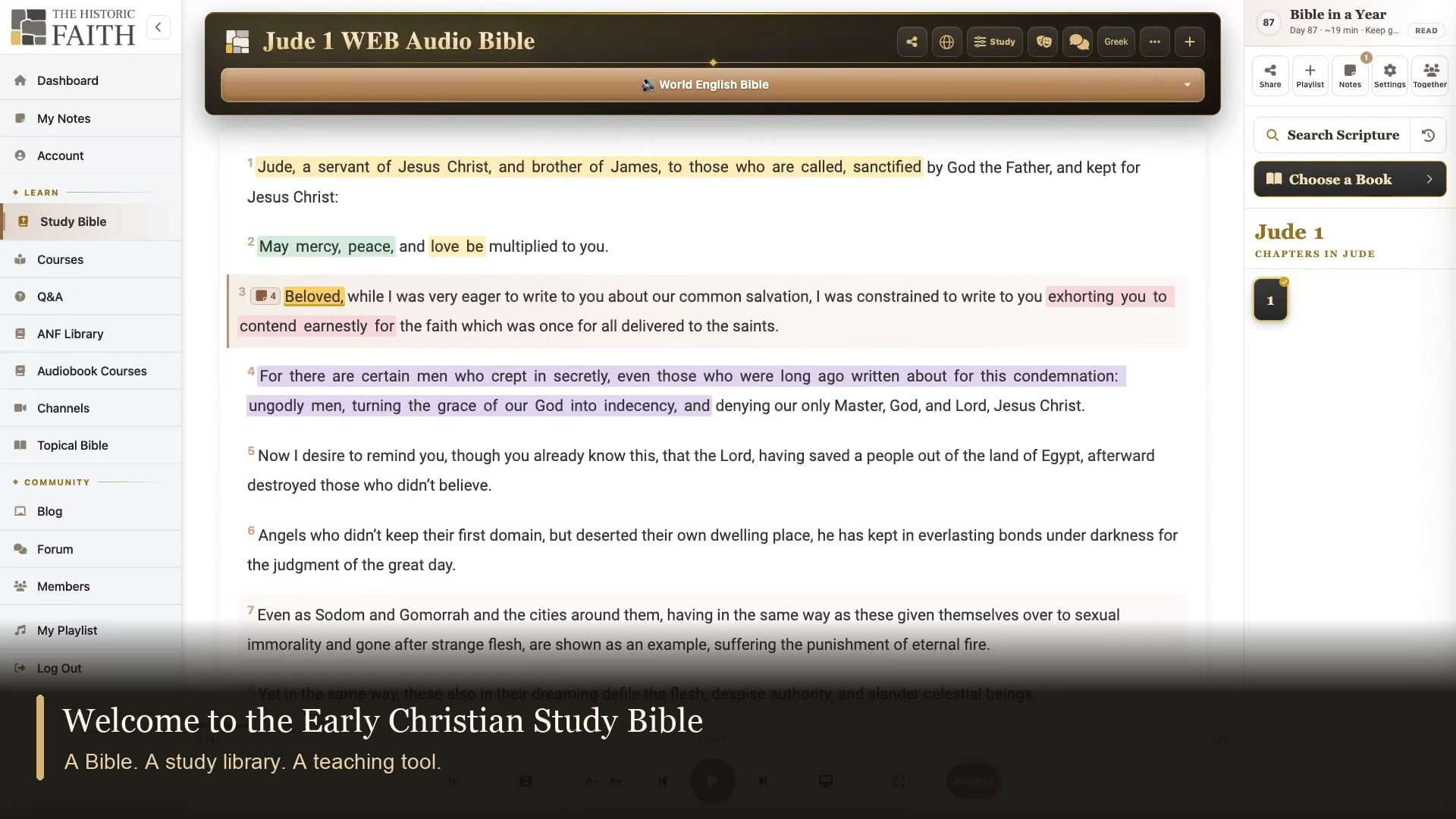 Words. Writings.
Guided tour · 21:50 · Several Bible editions.
See the phone experience · 5:31
Strong's Exhaustive Concordance, first published by James Strong in 1890, indexes every word of the King James Version and assigns each underlying original-language word a number — G1–G5624 for the Greek New Testament and H1–H8674 for the Hebrew Old Testament. Look up any English word, find its Strong's number, and see the Greek or Hebrew word behind it, its definition, and the verses where it occurs. This free online edition covers 14,298 entries with 767,764 indexed occurrences — including the Septuagint, deuterocanonical books, and 1 Enoch, which no print edition of Strong's includes.
These entry points are the quickest way to see how a Strong's number opens into a word, meaning, and Bible usage.
Greek agape, with New Testament and Septuagint usage links where indexed.
Greek kyrios, a major New Testament and Septuagint word-study bridge.
Hebrew reshith, the word behind “beginning” in Genesis 1:1 and other Old Testament usages.
Browse the local Greek and Hebrew Strong's entries in fast pages, open an exact number, or narrow the index by language, range, and usage count.
| Number | Word | Definition | Usages | Range |
|---|---|---|---|---|
|
G2251 — hemeteros
Greek
|
ἡμέτερος (hemeteros)
hemeteros
|
hemeteros (hay-met'-er-os) p/s. 1. our [from G2249] | 26 | G2001-G3000 |
|
G2252 — emen
Greek
|
ἤμην (emen)
emen
|
emen (ay'-mayn) v. 1. I was [a prolonged form of G2358] | 16 | G2001-G3000 |
|
G2253 — hemithanes
Greek
|
ἡμιθανής (hemithanes)
hemithanes
|
hemithanes (hay-mee-than-ace') adj. 1. half dead, i.e. entirely exhausted [from a presumed compound of the base of G2255 and G2348] | 2 | G2001-G3000 |
|
G2254 — hemin
Greek
|
ἡμῖν (hemin)
hemin
|
hemin (hay-meen`) p/p. 1. to (or for, with, by) us [dative case plural of G1473] | 526 | G2001-G3000 |
|
G2255 — hemisu
Greek
|
ἥμισυ (hemisu)
hemisu
|
hemisu (hay'-mee-soo) adj. 1. (as noun) half [neuter of a derivative from an inseparable prefix akin to G260 (through the idea of partition involved in connection) and meaning semi-] | 122 | G2001-G3000 |
|
G2256 — hemiorion
Greek
|
ἡμιώριον (hemiorion)
hemiorion
|
hemiorion (hay-mee-o'-ree-on) n. 1. a half-hour [from the base of G2255 and G5610] | 1 | G2001-G3000 |
|
G2257 — hemon
Greek
|
ἡμῶν (hemon)
hemon
|
hemon (hay-mone`) p/p. 1. of (or from) us [genitive case plural of G1473] | 1,332 | G2001-G3000 |
|
G2258 — en
Greek
|
ἦν (en)
en
|
en (ayn) v. 1. I (thou, etc.) was (wast or were) [imperfect of G1510] | 406 | G2001-G3000 |
|
G2259 — henika
Greek
|
ἡνίκα (henika)
henika
|
henika (hay-nee'-kah) adv. 1. at which time [of uncertain affinity] | 103 | G2001-G3000 |
|
G2260 — eper
Greek
|
ἤπερ (eper)
eper
|
eper (ay'-per) prt. 1. than at all (or than perhaps, than indeed) [from G2228 and G4007] | 4 | G2001-G3000 |
|
G2261 — epios
Greek
|
ἤπιος (epios)
epios
|
epios (ay'-pee-os) adj. 1. (properly) affable, i.e. mild or kind [probably from G2031] | 2 | G2001-G3000 |
|
G2262 — Er
Greek
|
Ἤρ (Er)
Er
|
Er (ayr) n/p. 1. Er, an Israelite [of Hebrew origin (H6147)] | 9 | G2001-G3000 |
|
G2263 — eremos
Greek
|
ἤρεμος (eremos)
eremos
|
eremos (ay'-rem-os) adj. 1. tranquil [perhaps by transposition from G2048 (through the idea of stillness)] | 1 | G2001-G3000 |
|
G2264 — Herodes
Greek
|
Ἡρώδης (Herodes)
Herodes
|
Herodes (hay-ro'-dace) n/p. 1. heroic 2. Herod, the name of four Jewish kings | 41 | G2001-G3000 |
|
G2265 — Herodianoi
Greek
|
Ἡρωδιανοί (Herodianoi)
Herodianoi
|
Herodianoi (hay-ro-dee-an-oy') n/g. 1. Herodians, i.e. partisans of Herod [plural of a derivative of G2264] | 3 | G2001-G3000 |
|
G2266 — Herodias
Greek
|
Ἡρωδιάς (Herodias)
Herodias
|
Herodias (hay-ro-dee-as') n/p. 1. Herodias, a woman of the Heodian family [from G2264] | 6 | G2001-G3000 |
|
G2267 — Herodion
Greek
|
Ἡρωδίων (Herodion)
Herodion
|
Herodion (hay-ro-dee'-own) n/p. 1. Herodion, a Christian [from G2264] | 1 | G2001-G3000 |
|
G2268 — Hesaias
Greek
|
Ἡσαίας (Hesaias)
Hesaias
|
Hesaias (hay-sai'-as) n/p. 1. Hesaias (i.e. Jeshajah), an Israelite [of Hebrew origin (H3470)] | 55 | G2001-G3000 |
|
G2269 — Esau
Greek
|
Ἠσαῦ (Esau)
Esau
|
Esau (ay-sau`) n/p. 1. Esau, an Edomite [of Hebrew origin (H6215)] | 97 | G2001-G3000 |
|
G2270 — hesuchazo
Greek
|
ἡσυχάζω (hesuchazo)
hesuchazo
|
hesuchazo (hay-soo-khad'-zo) v. 1. to keep still (intransitively), i.e. refrain from labor, meddlesomeness or speech [a prolonged form of a compound probably of a derivative of the base of G1476 and perhaps G2192] | 47 | G2001-G3000 |
|
G2271 — hesuchia
Greek
|
ἡσυχία (hesuchia)
hesuchia
|
hesuchia (hay-soo-khee'-ah) n. 1. (as noun) stillness, i.e. desistance from bustle or language [feminine of G2272] | 15 | G2001-G3000 |
|
G2272 — hesuchios
Greek
|
ἡσύχιος (hesuchios)
hesuchios
|
hesuchios (hay-soo'-khee-os) adj. 1. (properly) keeping one's seat (sedentary) 2. (by implication) still (undisturbed, undisturbing) | 3 | G2001-G3000 |
|
G2273 — etoi
Greek
|
ἤτοι (etoi)
etoi
|
etoi (ay'-toy) conj. 1. either indeed [from G2228 and G5104] | 2 | G2001-G3000 |
|
G2274 — hettao
Greek
|
ἡττάω (hettao)
hettao
|
hettao (hayt-tah'-o) v. 1. to make worse, i.e. vanquish 2. (by implication) to rate lower | 16 | G2001-G3000 |
|
G2275 — hettema
Greek
|
ἥττημα (hettema)
hettema
|
hettema (hayt'-tay-mah) n. 1. a deterioration 2. (objectively) failure or (subjectively) loss | 3 | G2001-G3000 |
|
G2276 — hetton
Greek
|
ἥττον (hetton)
hetton
|
hetton (hate'-ton) adj. 1. worse (as noun) 2. (by implication) less (as adverb) | 16 | G2001-G3000 |
|
G2277
Greek
|
ἤτω
|
(ay'-to) v. 1. let him (or it) be [third person singular imperative of G1510] | 2 | G2001-G3000 |
|
G2278 — echeo
Greek
|
ἠχέω (echeo)
echeo
|
echeo (ay-kheh'-o) v. 1. to make a loud noise, i.e. reverberate [from G2279] | 23 | G2001-G3000 |
|
G2279 — echos
Greek
|
ἦχος (echos)
echos
|
echos (ay'-khos) n. 1. a loud or confused noise ("echo"), i.e. roar 2. (figuratively) a rumor | 23 | G2001-G3000 |
|
G2280 — Thaddaios
Greek
|
Θαδδαῖος (Thaddaios)
Thaddaios
|
Thaddaios (thad-dai`-os) n/p. 1. Thaddaeus, one of the Apostles [of uncertain origin] | 2 | G2001-G3000 |
|
G2281 — thalassa
Greek
|
θάλασσα (thalassa)
thalassa
|
thalassa (thal'-as-sah) n. 1. the sea {(genitive case or specially)} | 448 | G2001-G3000 |
|
G2282 — thalpo
Greek
|
θάλπω (thalpo)
thalpo
|
thalpo (thal'-po) v. 1. to brood 2. (figuratively) to foster | 6 | G2001-G3000 |
|
G2283 — Thamar
Greek
|
Θάμαρ (Thamar)
Thamar
|
Thamar (tham'-ar) n/p. 1. Thamar (i.e. Tamar), an Israelitess [of Hebrew origin (H8559)] | 8 | G2001-G3000 |
|
G2284 — thambeo
Greek
|
θαμβέω (thambeo)
thambeo
|
thambeo (tham-beh'-o) v. 1. to stupefy (with surprise), i.e. astound [from G2285] | 9 | G2001-G3000 |
|
G2285 — thambos
Greek
|
θάμβος (thambos)
thambos
|
thambos (tham'-bos) n. 1. overwhelming amazement (by surprise), i.e. astonishment [akin to an obsolete tapho "to dumbfound"] | 9 | G2001-G3000 |
|
G2286 — thanasimos
Greek
|
θανάσιμος (thanasimos)
thanasimos
|
thanasimos (than-as'-ee-mos) adj. 1. deadly, lethal 2. (by implication) poisonous | 1 | G2001-G3000 |
|
G2287 — thanatephoros
Greek
|
θανατήφορος (thanatephoros)
thanatephoros
|
thanatephoros (than-at-ay'-for-os) adj. 1. death-bearing, i.e. fatal [from (the feminine form of) G2288 and G5342] | 6 | G2001-G3000 |
|
G2288
Greek
|
θανάτου
|
thanatos (than'-at-os) n. 1. death {literally or figuratively; properly, an adjective used as a noun} | 431 | G2001-G3000 |
|
G2289 — thanatoo
Greek
|
θανατόω (thanatoo)
thanatoo
|
thanatoo (than-at-oh'-o) v. 1. to put to death, to kill {literally or figuratively} | 155 | G2001-G3000 |
|
G2290 — thapto
Greek
|
θάπτω (thapto)
thapto
|
thapto (thap'-to) v. 1. to celebrate funeral rites, i.e. inter [a primary verb] | 150 | G2001-G3000 |
|
G2291 — Thara
Greek
|
Θάρα (Thara)
Thara
|
Thara (thar'-ah) n/p. 1. Thara (i.e. Terach), the father of Abraham [of Hebrew origin (H8646)] | 10 | G2001-G3000 |
|
G2292 — tharrheo
Greek
|
θαρῥέω (tharrheo)
tharrheo
|
tharrheo (thar-rheh'-o) v. 1. to exercise courage [another form for G2293] | 7 | G2001-G3000 |
|
G2293 — tharseo
Greek
|
θαρσέω (tharseo)
tharseo
|
tharseo (thar-seh'-o) v. 1. to have courage [from G2294] | 36 | G2001-G3000 |
|
G2294 — tharsos
Greek
|
θάρσος (tharsos)
tharsos
|
tharsos (thar'-sos) n. 1. boldness (subjectively) [akin (by transposition) to thrasos (daring)] | 6 | G2001-G3000 |
|
G2295 — thauma
Greek
|
θαῦμα (thauma)
thauma
|
thauma (thau`-mah) n. 1. wonder (properly concrete, but by implication, abstract) [apparently from a form of G2300] | 3 | G2001-G3000 |
|
G2296 — thaumazo
Greek
|
θαυμάζω (thaumazo)
thaumazo
|
thaumazo (thau-mad'-zo) v. 1. to wonder 2. (by implication) to admire | 99 | G2001-G3000 |
|
G2297 — thaumasios
Greek
|
θαυμάσιος (thaumasios)
thaumasios
|
thaumasios (thau-mas'-ee-os) adj. 1. wondrous 2. (neuter as noun) a miracle | 57 | G2001-G3000 |
|
G2298 — thaumastos
Greek
|
θαυμαστός (thaumastos)
thaumastos
|
thaumastos (thau-mas-tos') adj. 1. wondered at 2. (by implication) wonderful | 44 | G2001-G3000 |
|
G2299 — thea
Greek
|
θεά (thea)
thea
|
thea (theh-ah') n. 1. a female deity [feminine of G2316] | 5 | G2001-G3000 |
|
G2300 — theaomai
Greek
|
θεάομαι (theaomai)
theaomai
|
theaomai (theh-ah'-om-ai) v. 1. to look closely at 2. (by implication) to perceive | 31 | G2001-G3000 |
|
G2301 — theatrizo
Greek
|
θεατρίζω (theatrizo)
theatrizo
|
theatrizo (theh-at-rid'-zo) v. 1. to expose as a spectacle [from G2302] | 1 | G2001-G3000 |
|
G2302 — theatron
Greek
|
θέατρον (theatron)
theatron
|
theatron (theh'-at-ron) n. 1. a place for public show ("theatre"), i.e. general audience-room 2. (by implication) a show itself (figuratively) | 3 | G2001-G3000 |
|
G2303 — theion
Greek
|
θεῖον (theion)
theion
|
theion (thei`-on) n. 1. sulphur [probably neuter of G2304 (in its original sense of flashing)] | 9 | G2001-G3000 |
|
G2304 — theios
Greek
|
θεῖος (theios)
theios
|
theios (thei`-os) adj. 1. godlike (neuter as noun, divinity) [from G2316] | 42 | G2001-G3000 |
|
G2305 — theiotes
Greek
|
θειότης (theiotes)
theiotes
|
theiotes (thei-ot'-ace) n. 1. divinity (abstractly) [from G2304] | 2 | G2001-G3000 |
|
G2306 — theiodes
Greek
|
θειώδης (theiodes)
theiodes
|
theiodes (thei-o'-dace) adj. 1. sulphur-like, i.e. sulphurous [from G2303 and G1491] | 1 | G2001-G3000 |
|
G2307 — thelema
Greek
|
θέλημα (thelema)
thelema
|
thelema (thel'-ay-mah) n. 1. a determination (properly, the thing) 2. (actively) choice | 105 | G2001-G3000 |
|
G2308 — thelesis
Greek
|
θέλησις (thelesis)
thelesis
|
thelesis (thel'-ay-sis) n. 1. determination (properly, the act), i.e. option [from G2309] | 8 | G2001-G3000 |
|
G2309 — thelo
Greek
|
θέλω (thelo)
thelo
|
thelo (thel'-o) (or ethelo eth-el'-o, in certain tenses theleo thel-eh'-o, and etheleo eth-el-eh'-o, which are otherwise obsolete) v. 1. to determine, i.e. choose or prefer 2. (by implication) to wish, i.e. be inclined to | 346 | G2001-G3000 |
|
G2310 — themelios
Greek
|
θεμέλιος (themelios)
themelios
|
themelios (them-el'-ee-os) n. 1. something put down, i.e. a substructure (of a building, etc.) {literally or figuratively} | 64 | G2001-G3000 |
|
G2311 — themelioo
Greek
|
θεμελιόω (themelioo)
themelioo
|
themelioo (them-el-ee-oh'-o) v. 1. to lay a basis for 2. (literally) to erect | 45 | G2001-G3000 |
|
G2312 — theodidaktos
Greek
|
θεοδίδακτος (theodidaktos)
theodidaktos
|
theodidaktos (theh-od-id'-ak-tos) adj. 1. divinely instructed [from G2316 and G1321] | 1 | G2001-G3000 |
|
G2313 — theomacheo
Greek
|
θεομαχέω (theomacheo)
theomacheo
|
theomacheo (theh-oh-makh-eh'-o) v. 1. to resist deity [from G2314] | 2 | G2001-G3000 |
|
G2314 — theomachos
Greek
|
θεόμαχος (theomachos)
theomachos
|
theomachos (theh-om'-akh-os) adj. 1. an opponent of deity [from G2316 and G3164] | 1 | G2001-G3000 |
|
G2315 — theopneustos
Greek
|
θεόπνευστος (theopneustos)
theopneustos
|
theopneustos (theh-op'-nyoo-stos) adj. 1. divinely breathed in [from G2316 and a presumed derivative of G4154] | 1 | G2001-G3000 |
|
G2316
Greek
|
θεός
|
theos (theh-os') n. 1. a deity 2. (figuratively) a magistrate | 4,251 | G2001-G3000 |
|
G2317 — theosebeia
Greek
|
θεοσέβεια (theosebeia)
theosebeia
|
theosebeia (theh-os-eb'-ei-ah) n. 1. reverence of God [from G2318] | 8 | G2001-G3000 |
|
G2318 — theosebes
Greek
|
θεοσεβής (theosebes)
theosebes
|
theosebes (theh-os-eb-ace') adj. 1. reverent of God [from G2316 and G4576] | 8 | G2001-G3000 |
|
G2319 — theostuges
Greek
|
θεοστυγής (theostuges)
theostuges
|
theostuges (theh-os-too-gace') adj. 1. hateful to God, i.e. impious [from G2316 and the base of G4767] | 1 | G2001-G3000 |
|
G2320 — theotes
Greek
|
θεότης (theotes)
theotes
|
theotes (theh-ot'-ace) n. 1. divinity (abstractly) [from G2316] | 1 | G2001-G3000 |
|
G2321 — Theophilos
Greek
|
Θεόφιλος (Theophilos)
Theophilos
|
Theophilos (theh-of'-il-os) n/p. 1. friend of God 2. Theophilus, a Christian | 2 | G2001-G3000 |
|
G2322 — therapeia
Greek
|
θεραπεία (therapeia)
therapeia
|
therapeia (ther-ap-ei'-ah) n. 1. attendance (specially, medical, i.e. cure) 2. (figuratively and collectively) domestics | 9 | G2001-G3000 |
|
G2323 — therapeuo
Greek
|
θεραπεύω (therapeuo)
therapeuo
|
therapeuo (ther-ap-yoo'-o) v. 1. to wait upon menially 2. (figuratively) to adore (God) | 64 | G2001-G3000 |
|
G2324 — therapon
Greek
|
θεράπων (therapon)
therapon
|
therapon (ther-ap'-own) n. 1. a menial attendant (as if cherishing) [apparently a participle from an otherwise obsolete derivative of the base of G2330] | 60 | G2001-G3000 |
|
G2325 — therizo
Greek
|
θερίζω (therizo)
therizo
|
therizo (ther-id'-zo) v. 1. to harvest [from G2330 (in the sense of the crop)] | 42 | G2001-G3000 |
|
G2326 — therismos
Greek
|
θερισμός (therismos)
therismos
|
therismos (ther-is-mos') n. 1. reaping, i.e. the crop [from G2325] | 36 | G2001-G3000 |
|
G2327 — theristes
Greek
|
θεριστής (theristes)
theristes
|
theristes (ther-is-tace') n. 1. a harvester [from G2325] | 3 | G2001-G3000 |
|
G2328 — thermaino
Greek
|
θερμαίνω (thermaino)
thermaino
|
thermaino (ther-mai'-no) v. 1. to heat (oneself) [from G2329] | 17 | G2001-G3000 |
|
G2329 — therme
Greek
|
θέρμη (therme)
therme
|
therme (ther'-may) n. 1. warmth [from the base of G2330] | 1 | G2001-G3000 |
|
G2330 — theros
Greek
|
θέρος (theros)
theros
|
theros (ther'-os) n. 1. (properly) heat, i.e. summer [from a primary thero "to heat"] | 10 | G2001-G3000 |
|
G2331 — Thessalonikeus
Greek
|
Θεσσαλονικεύς (Thessalonikeus)
Thessalonikeus
|
Thessalonikeus (thes-sal-on-ik-yoos') n/g. 1. a Thessalonican, i.e. inhabitant of Thessalonice [from G2332] | 6 | G2001-G3000 |
|
G2332 — Thessalonike
Greek
|
Θεσσαλονίκη (Thessalonike)
Thessalonike
|
Thessalonike (thes-sal-on-ee'-kay) n/l. 1. Thessalonice, a place in Asia Minor [from Thessalos (a Thessalian) and G3529] | 5 | G2001-G3000 |
|
G2333 — Theudas
Greek
|
Θευδᾶς (Theudas)
Theudas
|
Theudas (thyoo-das`) n/p. 1. Theudas, an Israelite [of uncertain origin] | 1 | G2001-G3000 |
|
G2334 — theoreo
Greek
|
θεωρέω (theoreo)
theoreo
|
theoreo (theh-o-reh'-o) v. 1. to be a spectator of, i.e. discern {literally, figuratively (experience) or intensively (acknowledge)} | 116 | G2001-G3000 |
|
G2335 — theoria
Greek
|
θεωρία (theoria)
theoria
|
theoria (theh-o-ree'-ah) n. 1. spectatorship 2. (concretely) a spectacle | 4 | G2001-G3000 |
|
G2336 — theke
Greek
|
θήκη (theke)
theke
|
theke (thay'-kay) n. 1. a receptacle, i.e. scabbard [from G5087] | 4 | G2001-G3000 |
|
G2337 — thelazo
Greek
|
θηλάζω (thelazo)
thelazo
|
thelazo (thay-lad'-zo) v. 1. to suckle, (by implication) to suck [from thele (the nipple)] | 33 | G2001-G3000 |
|
G2338 — thelus
Greek
|
θήλυς (thelus)
thelus
|
thelus (thay'-loos) adj. 1. female [from thele (the nipple)] | 42 | G2001-G3000 |
|
G2339 — thera
Greek
|
θήρα (thera)
thera
|
thera (thay'-rah) n. 1. hunting 2. (figuratively) destruction | 30 | G2001-G3000 |
|
G2340 — thereuo
Greek
|
θηρεύω (thereuo)
thereuo
|
thereuo (thay-ryoo'-o) v. 1. to hunt (an animal) 2. (figuratively) to carp at | 17 | G2001-G3000 |
|
G2341 — theriomacheo
Greek
|
θηριομαχέω (theriomacheo)
theriomacheo
|
theriomacheo (thay-ree-om-akh-eh'-o) v. 1. to be a beast-fighter (in the gladiatorial show) 2. (figuratively) to encounter (furious men) | 1 | G2001-G3000 |
|
G2342
Greek
|
θηρίων
|
therion (thay-ree'-on) n. 1. a dangerous animal [diminutive from ther (a wild animal, as game)] | 172 | G2001-G3000 |
|
G2343 — thesaurizo
Greek
|
θησαυρίζω (thesaurizo)
thesaurizo
|
thesaurizo (thay-sau-rid'-zo) v. 1. to amass or reserve {literally or figuratively} | 20 | G2001-G3000 |
|
G2344 — thesauros
Greek
|
θησαυρός (thesauros)
thesauros
|
thesauros (thay-sau-ros') n. 1. a deposit, i.e. wealth {literally or figuratively} | 101 | G2001-G3000 |
|
G2345 — thiggano
Greek
|
θιγγάνω (thiggano)
thiggano
|
thiggano (thing-gan'-o) v. 1. to manipulate, i.e. have to do with 2. (by implication) to injure | 4 | G2001-G3000 |
|
G2346 — thlibo
Greek
|
θλίβω (thlibo)
thlibo
|
thlibo (thlee'-bo) v. 1. to crowd {literally or figuratively} | 101 | G2001-G3000 |
|
G2347 — thlipsis
Greek
|
θλίψις (thlipsis)
thlipsis
|
thlipsis (thlip'-sis) n. 1. pressure {literally or figuratively} | 161 | G2001-G3000 |
|
G2348 — thnesko
Greek
|
θνήσκω (thnesko)
thnesko
|
thnesko (thnay'-sko) v. 1. to die {literally or figuratively} | 91 | G2001-G3000 |
|
G2349 — thnetos
Greek
|
θνητός (thnetos)
thnetos
|
thnetos (thnay-tos') adj. 1. liable to die [from G2348] | 15 | G2001-G3000 |
|
G2350 — thorubeo
Greek
|
θορυβέω (thorubeo)
thorubeo
|
thorubeo (thor-oo-beh'-o) v. 1. to be in tumult, i.e. disturb, clamor [from G2351] | 8 | G2001-G3000 |
|
G2351 — thorubos
Greek
|
θόρυβος (thorubos)
thorubos
|
thorubos (thor'-oo-bos) n. 1. a disturbance [from the base of G2360] | 17 | G2001-G3000 |
|
G2352 — thrauo
Greek
|
θραύω (thrauo)
thrauo
|
thrauo (thrau'-o) v. 1. to crush [a primary verb] | 23 | G2001-G3000 |
|
G2353 — thremma
Greek
|
θρέμμα (thremma)
thremma
|
thremma (threm'-mah) n. 1. stock (as raised on a farm) [from G5142] | 1 | G2001-G3000 |
|
G2354 — threneo
Greek
|
θρηνέω (threneo)
threneo
|
threneo (thray-neh'-o) v. 1. to bewail [from G2355] | 27 | G2001-G3000 |
|
G2355 — threnos
Greek
|
θρῆνος (threnos)
threnos
|
threnos (thray`-nos) n. 1. wailing [from the base of G2360] | 30 | G2001-G3000 |
|
G2356 — threskeia
Greek
|
θρησκεία (threskeia)
threskeia
|
threskeia (thrace-kei'-ah) n. 1. ceremonial observance [from a derivative of G2357] | 8 | G2001-G3000 |
|
G2357 — threskos
Greek
|
θρῆσκος (threskos)
threskos
|
threskos (thrace`-kos) adj. 1. ceremonious in worship (as demonstrative) 2. religious | 1 | G2001-G3000 |
|
G2358 — thriambeuo
Greek
|
θριαμβεύω (thriambeuo)
thriambeuo
|
thriambeuo (three-am-byoo'-o) v. 1. to make an acclamatory procession 2. (figuratively) to conquer or (by Hebraism) to give victory | 2 | G2001-G3000 |
|
G2359 — thrix
Greek
|
θρίξ (thrix)
thrix
|
thrix (threex') n. 1. hair [genitive case trichos, etc.] | 57 | G2001-G3000 |
|
G2360 — throeo
Greek
|
θροέω (throeo)
throeo
|
throeo (thro-eh'-o) v. 1. to clamor 2. (by implication) to frighten | 4 | G2001-G3000 |
|
G2361 — thrombos
Greek
|
θρόμβος (thrombos)
thrombos
|
thrombos (throm'-bos) n. 1. a clot [perhaps from G5142 (in the sense of thickening)] | 1 | G2001-G3000 |
|
G2362 — thronos
Greek
|
θρόνος (thronos)
thronos
|
thronos (thron'-os) n. 1. a stately seat, "throne" 2. (by implication) power | 195 | G2001-G3000 |
|
G2363 — Thuateira
Greek
|
Θυάτειρα (Thuateira)
Thuateira
|
Thuateira (thoo-at'-ei-rah) n/l. 1. Thyatira, a place in Asia Minor [of uncertain derivation] | 4 | G2001-G3000 |
|
G2364 — thugater
Greek
|
θυγάτηρ (thugater)
thugater
|
thugater (thoo-gat'-ayr) n. 1. a female child 2. (by Hebraism) descendant (or inhabitant) | 540 | G2001-G3000 |
|
G2365 — thugatrion
Greek
|
θυγάτριον (thugatrion)
thugatrion
|
thugatrion (thoo-gat'-ree-on) n. 1. a daughterling [from G2364] | 2 | G2001-G3000 |
|
G2366 — thuella
Greek
|
θύελλα (thuella)
thuella
|
thuella (thoo'-el-lah) n. 1. (in the sense of blowing) a storm [from G2380] | 4 | G2001-G3000 |
|
G2367 — thuinos
Greek
|
θύϊνος (thuinos)
thuinos
|
thuinos (thoo'-ee"-nos) adj. 1. made of citron-wood [from a derivative of G2380 (in the sense of blowing, denoting a certain fragrant tree)] | 1 | G2001-G3000 |
|
G2368 — thumiama
Greek
|
θυμίαμα (thumiama)
thumiama
|
thumiama (thoo-mee'-am-ah) n. 1. an aroma 2. (religiously) a fragrant powder burnt within a service | 82 | G2001-G3000 |
|
G2369 — thumiasterion
Greek
|
θυμιαστήριον (thumiasterion)
thumiasterion
|
thumiasterion (thoo-mee-as-tay'-ree-on) n. 1. a place of fumigation, i.e. the alter of incense (in the Temple) [from a derivative of G2370] | 4 | G2001-G3000 |
|
G2370 — thumiao
Greek
|
θυμιάω (thumiao)
thumiao
|
thumiao (thoo-mee-ah'-o) v. 1. to burn incense 2. (religiously) to offer aromatic fumes | 47 | G2001-G3000 |
|
G2371 — thumomacheo
Greek
|
θυμομαχέω (thumomacheo)
thumomacheo
|
thumomacheo (thoo-mom-akh-eh'-o) v. 1. to be in a furious fight 2. (figuratively) to be exasperated | 1 | G2001-G3000 |
|
G2372 — thumos
Greek
|
θυμός (thumos)
thumos
|
thumos (thoo-mos') n. 1. passion (as if breathing hard) [from G2380] | 310 | G2001-G3000 |
|
G2373
Greek
|
ἐθυμώθη
|
thumoo (thoo-moh'-ow) v. 1. to put in a passion, i.e. enrage [from G2372] | 60 | G2001-G3000 |
|
G2374 — thura
Greek
|
θύρα (thura)
thura
|
thura (thoo'-rah) n. 1. a portal or entrance (the opening or the closure) {literally or figuratively} | 239 | G2001-G3000 |
|
G2375 — thureos
Greek
|
θυρεός (thureos)
thureos
|
thureos (thoo-reh-os') n. 1. a large shield (as door-shaped) [from G2374] | 21 | G2001-G3000 |
|
G2376 — thuris
Greek
|
θυρίς (thuris)
thuris
|
thuris (thoo-rece') n. 1. an aperture, i.e. window [from G2374] | 34 | G2001-G3000 |
|
G2377 — thuroros
Greek
|
θυρωρός (thuroros)
thuroros
|
thuroros (thoo-ro-ros') n. 1. a gate- warden [from G2374 and ouros (a watcher)] | 14 | G2001-G3000 |
|
G2378 — thusia
Greek
|
θυσία (thusia)
thusia
|
thusia (thoo-see'-ah) n. 1. sacrifice (the act or the victim) {literally or figuratively} | 369 | G2001-G3000 |
|
G2379 — thusiasterion
Greek
|
θυσιαστήριον (thusiasterion)
thusiasterion
|
thusiasterion (thoo-see-as-tay'-ree-on) n. 1. a place of sacrifice, i.e. an altar {special or genitive case, literal or figurative} | 374 | G2001-G3000 |
|
G2380 — thuo
Greek
|
θύω (thuo)
thuo
|
thuo (thoo'-o) v. 1. (properly) to rush (breathe hard, blow, smoke) 2. (by implication) to sacrifice | 137 | G2001-G3000 |
|
G2381 — Thomas
Greek
|
Θωμᾶς (Thomas)
Thomas
|
Thomas (tho-mas`) n/p. 1. the twin 2. Thomas, a Christian | 12 | G2001-G3000 |
|
G2382 — thorax
Greek
|
θώραξ (thorax)
thorax
|
thorax (tho'-rax) n. 1. the chest ("thorax") 2. (by implication) a corslet | 20 | G2001-G3000 |
|
G2383 — Iaeiros
Greek
|
Ἰάειρος (Iaeiros)
Iaeiros
|
Iaeiros (ee-ah'-ei-ros) n/p. 1. Jairus (i.e. Jair), an Israelite [of Hebrew origin (H2971)] | 2 | G2001-G3000 |
|
G2384 — Iakob
Greek
|
Ἰακώβ (Iakob)
Iakob
|
Iakob (ee-ak-obe') n/p. 1. Jacob (i.e. Ja`akob), the ancestor and father of the Israelites [of Hebrew origin (H3290)] | 388 | G2001-G3000 |
|
G2385 — Iakobos
Greek
|
Ἰάκωβος (Iakobos)
Iakobos
|
Iakobos (ee-ak'-o-bos) n/p. 1. Jacobus, the name of three Israelites [the same as G2384 Graecized] | 38 | G2001-G3000 |
|
G2386 — iama
Greek
|
ἴαμα (iama)
iama
|
iama (ee'-am-ah) n. 1. a cure (the effect) [from G2390] | 12 | G2001-G3000 |
|
G2387 — Iambres
Greek
|
Ἰαμβρῆς (Iambres)
Iambres
|
Iambres (ee-am-brace`) n/p. 1. Jambres, an Egyptian [of Egyptian origin] | 1 | G2001-G3000 |
|
G2388 — Ianna
Greek
|
Ἰαννά (Ianna)
Ianna
|
Ianna (ee-an-nah') n/p. 1. Janna, an Israelite [probably of Hebrew origin] | 1 | G2001-G3000 |
|
G2389 — Iannes
Greek
|
Ἰαννῆς (Iannes)
Iannes
|
Iannes (ee-an-nace`) n/p. 1. Jannes, an Egyptian [of Egyptian origin] | 1 | G2001-G3000 |
|
G2390 — iaomai
Greek
|
ἰάομαι (iaomai)
iaomai
|
iaomai (ee-ah'-om-ai) v. 1. to cure {literally or figuratively} | 87 | G2001-G3000 |
|
G2391 — Iared
Greek
|
Ἰάρεδ (Iared)
Iared
|
Iared (ee-ar'-ed) n/p. 1. Jared (i.e. Jered), an antediluvian (pre-flood) [of Hebrew origin (H3382)] | 9 | G2001-G3000 |
|
G2392 — iasis
Greek
|
ἴασις (iasis)
iasis
|
iasis (ee'-as-is) n. 1. curing (the act) [from G2390] | 30 | G2001-G3000 |
|
G2393 — iaspis
Greek
|
ἴασπις (iaspis)
iaspis
|
iaspis (ee'-as-pis) n. 1. "jasper", a gem [probably of foreign origin] | 8 | G2001-G3000 |
|
G2394 — Iason
Greek
|
Ἰάσων (Iason)
Iason
|
Iason (ee-as'-oan) n/p. 1. about to cure 2. Jason, a Christian | 20 | G2001-G3000 |
|
G2395 — iatros
Greek
|
ἰατρός (iatros)
iatros
|
iatros (ee-at-ros') n. 1. a physician [from G2390] | 19 | G2001-G3000 |
|
G2396 — ide
Greek
|
ἴδε (ide)
ide
|
ide (id'-eh) inj. 1. (used as an interjection to denote surprise) lo! [second person singular imperative active of G1492] | 1 | G2001-G3000 |
|
G2397 — idea
Greek
|
ἰδέα (idea)
idea
|
idea (id-eh'-ah) n. 1. a sight (comparative figuratively "idea"), i.e. aspect [from G1492] | 8 | G2001-G3000 |
|
G2398 — idios
Greek
|
ἴδιος (idios)
idios
|
idios (id'-ee-os) adj. 1. pertaining to self, i.e. one's own 2. (by implication) private or separate | 185 | G2001-G3000 |
|
G2399 — idiotes
Greek
|
ἰδιώτης (idiotes)
idiotes
|
idiotes (id-ee-o'-tace) n. 1. a private person 2. (by implication) an ignoramus | 5 | G2001-G3000 |
|
G2400 — idou
Greek
|
ἰδού (idou)
idou
|
idou (id-ou') v. 1. (used as imperative) lo! [second person singular imperative middle voice of G1492] | 1,231 | G2001-G3000 |
No Strong's entries match that search.
Strong's works best when the number, original word, verse, and corpus stay connected.
Open a chapter and move from a word token to its Strong's page, parsing, and linked occurrences.
Greek Strong's entries can include New Testament, Septuagint, deuterocanonical, and 1 Enoch rows where indexed.
Dedicated Strong's pages can expose approved pronunciation audio beside the word-study data.
These are common words readers run into repeatedly, shown with an English meaning so the list is readable without already knowing the original languages.
Look up a word study by its transliteration — these are frequently searched Hebrew and Greek words. Each opens the matching Strong's entry, or lists the options when a spelling maps to several words.