
Read
Study one verse
Open the verse in the audio Bible. Press and hold it (phone) or right-click it (computer). Choose Early Church to see what they wrote.
Free · No sign-up · Read or listen
What the first Christians wrote on each verse — not a modern commentary.
Bible commentary noun Writing that explains the Bible, book by book and verse by verse.
Short answer
Right here, free, with no sign-up. This is an early-church commentary: what Christians of the first 300 or so years, plus John Chrysostom, wrote about the Bible, verse by verse, in their own words. It is not a modern verse-by-verse commentary like Matthew Henry’s. Open any verse in the audio Bible and choose Early Church to see more than 5.4 million links on over 37,000 Bible verses.
Or tap a famous verse:
Behind the title: Papyrus 46, a page of Paul’s letters copied about AD 200. Chester Beatty Library; public domain, via Wikimedia Commons.
Start here
Pick a book, then a chapter. The chapter opens in the free audio Bible. Then press and hold the verse (phone) or right-click it (computer), and choose Early Church.
Under each book: its passage studies, audio course, Chrysostom’s homilies (to read) and the oldest commentaries.
Good to know: if the audio Bible says it is busy, wait a minute and try again — or use the passage studies and the library, which always open.
What no other site has (that we know of)
The big commentary sites mostly carry commentaries from the Reformation to today. This one goes back to the first Christians, and much of it you can listen to. We know of no other site that has these things together.
5.4 million+
links
Open any verse and see what the early Christians wrote about it — more than 5.4 million links across over 37,000 verses.
Try it on John 3:16640
timed clips
In Romans, tap a verse and hear the early-church comment on it read aloud inside the lesson — 640 clips. We know of no other site that has this.
Try it on Romans 8:28156
works read aloud
Listen free: 156 early Christian writings read aloud — over 300 hours.
Open the library69
audio lessons
All of Romans, verse by verse, in 69 free audio lessons (about 20 hours).
Start Romans199
passage studies
199 passage studies: what the early Christians said a passage means, with their own words.
Browse the studies25
topic pages
The Sermon on the Mount, passage by passage, in the words of 37 early Christian writers — about 15 hours you can listen to.
Open the 25 topics200s
AD
Read or listen to the oldest Bible commentaries: Origen on John and Matthew, Victorinus on Revelation, and Hippolytus’s writings on Daniel.
See the oldest17
New Testament books
Read John Chrysostom’s sermons that walk verse by verse through 17 books of the New Testament.
Read the homiliesFour ways in
Read
Open the verse in the audio Bible. Press and hold it (phone) or right-click it (computer). Choose Early Church to see what they wrote.
Read and listen
Take Romans: hear all 69 lessons, read Chrysostom’s homilies on Romans, then read its 12 passage studies.
Listen
156 early-church works read aloud (over 300 hours), the Sermon on the Mount (about 15 hours) and Romans (about 20 hours). Press play and go.
Learn together
The 25 Sermon on the Mount topics make a 25-week class. The 365 daily devotionals each end with three questions.
Short answer
A Bible commentary explains the Bible passage by passage, often verse by verse. It tells you what the words meant, how a verse fits its chapter, and how the rest of Scripture sheds light on it. A study Bible gives short notes at the foot of the page; a commentary goes deeper.
Christians were writing commentaries by the early 200s (see the oldest commentary). Here you read those early comments next to the verse itself.
A verse, then a comment on it
Philippians 4:13 I can do all things through Christ which strengtheneth me.
“The success is not my own, but His, who has given me strength.”
Short answer
Read the verse first, and if you can, listen to the whole chapter. Then read the comment. Ask what the writer saw in the verse, and check it against the verses around it and the cross references. Compare more than one writer. Where the early Christians agree, you are hearing a shared witness.
Short answer
It depends on what you want. For a modern pastor’s or scholar’s explanation, the well-known classic commentaries are free on several large Bible sites. If you want to know how the earliest Christians understood a verse, in their own words and often read aloud, that is what this commentary gives you, free.
Many readers use both: a modern commentary for background, and the early church as a witness to what the apostles taught.
Pick by what you need
Short answer
Open the chapter in the audio Bible. Press and hold the verse on a phone, or right-click it on a computer, then choose Early Church. You will see what early Christian writers said about that verse, each with a link to read the whole passage.
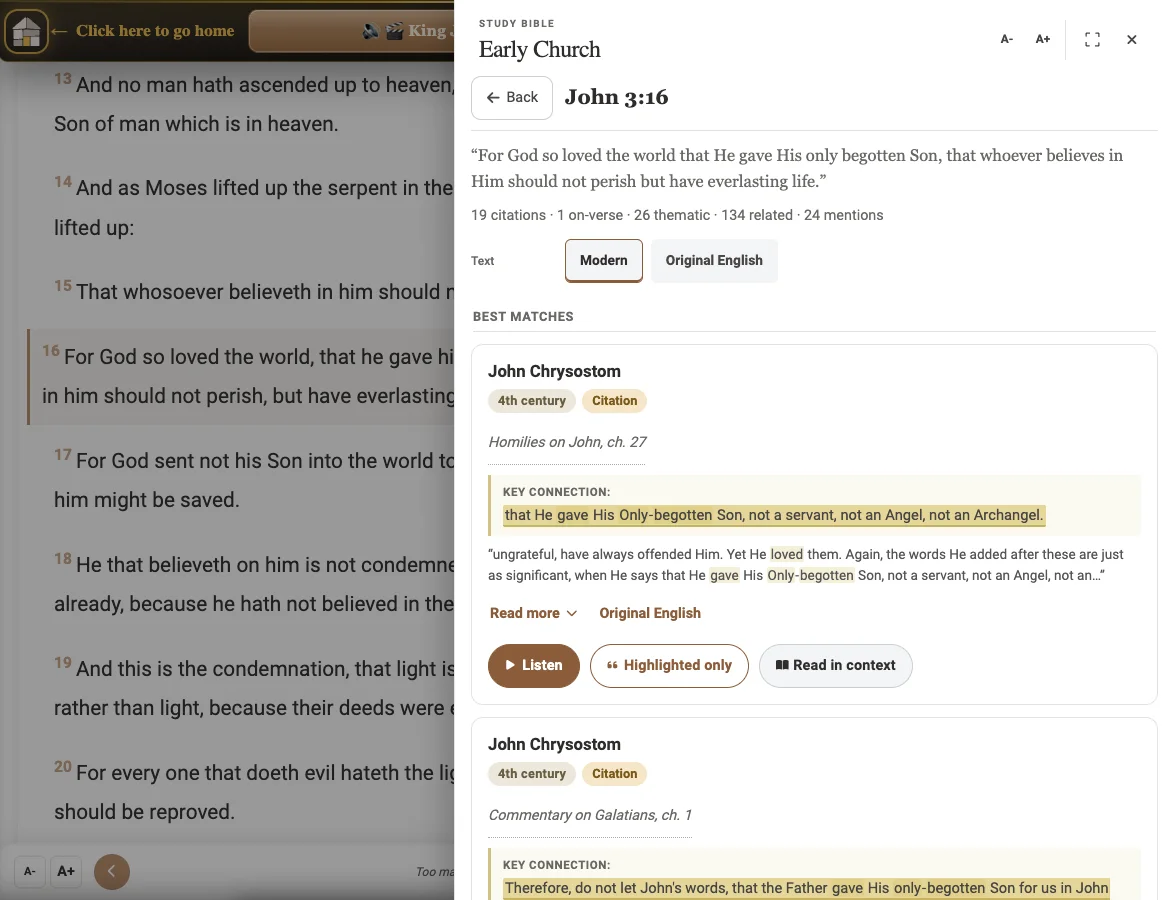
Oldest first. Each comment is copied word for word from the writing on our site. Press Listen to hear it read aloud, or Read to see it in its place.
1st centuryc. AD 96
He is despised and rejected of men; a man of sorrows, and acquainted with grief: and we hid as it were our faces from him; he was despised, and we esteemed him not.
“Our Lord Jesus Christ, the Sceptre of the majesty of God, did not come with pride or arrogance, even though He could have, but in a lowly condition, as the Holy Spirit had declared about Him.”
Passage study: Isaiah 52:13–53:12
2nd centuryc. AD 155
But I say unto you, Love your enemies, bless them that curse you, do good to them that hate you, and pray for them which despitefully use you, and persecute you;
“We used to hate and destroy one another. Because of their different customs, we would not live with people from a different tribe. Now, since Christ came, we live closely with them. We pray for our enemies.”
Passage study: Matthew 5:38–48
Turn of the 3rd centuryc. AD 200
After this manner therefore pray ye: Our Father which art in heaven, Hallowed be thy name.
“In the Lord’s Prayer, there is a summary of the whole Gospel. The prayer begins with a witness about God and with the reward of faith when we say, ‘Our Father in the heavens.’”
3rd centuryc. AD 230
In the beginning was the Word, and the Word was with God, and the Word was God.
“The Word was always with the Father, and so it is said, ‘And the Word was with God.’ He did not come to God.”
Passage study: John 1:1–18
3rd centuryc. AD 256
And now abideth faith, hope, charity, these three; but the greatest of these is charity.
“Love is the bond of brotherhood, the foundation of peace, and the firm support and security of unity. It is greater than both hope and faith. It surpasses both good works and martyrdoms.”
Passage study: 1 Corinthians 13
3rd centuryc. AD 260
And had a wall great and high, and had twelve gates, and at the gates twelve angels, and names written thereon, which are the names of the twelve tribes of the children of Israel:
“We believe the twelve gates are the number of the apostles. They shine in the four virtues like precious stones.”
Passage study: Revelation 21:1–8
4th centuryc. AD 390
And we know that all things work together for good to them that love God, to them who are the called according to his purpose.
“Now when he says ‘all things,’ he includes even the things that seem painful. Even if tribulation, poverty, imprisonment, famine, death, or anything else whatever comes upon us, God is able to turn all these things into their opposite.”
Passage study: Romans 8:18–39
4th centuryc. AD 400
Now faith is the substance of things hoped for, the evidence of things not seen.
“For since the things hoped for seem to have no substance, faith gives them substance. Or rather, it does not give it, but is itself their substance.”
Passage study: Hebrews 11
45 early Christian writers have their own page in the library. Start with these:
Short answer
The oldest Christian Bible commentary that survives whole is usually said to be Hippolytus’s Commentary on Daniel, from the early 200s. Origen wrote the first known commentary on Matthew, and Victorinus of Pettau wrote the oldest commentary on Revelation that has come down to us, around AD 260. You can read and hear their work here.
Dates and “oldest” claims come from the sources under the timeline. Our library has Hippolytus’s writings on Daniel (fragments and Christ and Antichrist), the surviving books of Origen on John and on Matthew, and Victorinus’s commentary on Revelation.
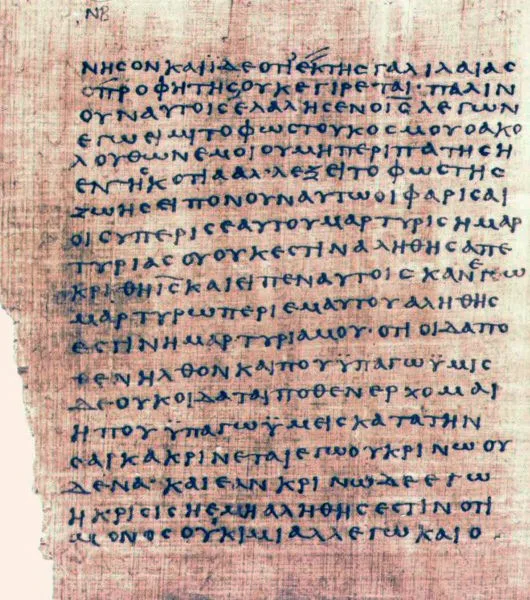
Heracleon on John a Gnostic teacher
The first known commentary on a New Testament book. He was not a voice of the church; his comments survive only as quotes in Origen’s replies.1
Hippolytus on Daniel
Called the oldest Christian commentary that survives complete.2
Read or listen Hippolytus’s fragments · Christ and Antichrist
Origen on John and on Matthew
The first known commentary on Matthew.3
Read or listen Origen on John (mostly John 1–2) · Origen on Matthew
Victorinus on Revelation
The oldest commentary on Revelation that has come down to us,4 written about 260.5
Read or listen Commentary on the Apocalypse
John Chrysostom
Verse-by-verse sermons on 17 New Testament books.
Read (text only) His homilies, book by book
For the car, the kitchen, the walk
Short answer
Yes. All of Romans is taught verse by verse in 69 free audio lessons, about 20 hours. Matthew chapters 1–13 has 16 audio lessons, about 9 hours, and the Sermon on the Mount has 25 topic pages you can listen to. You can also hear 156 early Christian writings read aloud, over 300 hours.
Free lessons by David Bercot that go through the text with the early Christians. No sign-up.
69 audio lessons · about 20 hours
One lesson per passage, Romans 1:1 to 16:27, each with a transcript that follows the words.
Start with a lesson
16 audio lessons · about 9 hours
Chapter by chapter with the early Christians, Matthew 1–13.
Matthew commentary (audio course, chapters 1–13)25 topics · about 15 hours
Matthew 5–7 in 784 early-church passages from 37 writers. Every page plays.
Sermon on the Mount commentary (25 topics)12 lessons · about 10 hours
A second, slower series on Romans 1:1–5:11, with video.
Romans Explained (Romans 1–5)156 works · over 300 hours
The Ante-Nicene Fathers, chapter by chapter. Listen while you read.
The narrated early-church libraryWondering how this differs from other commentaries? Hear the teacher’s short answer.
Short answer
Yes, in three ways. The Early Church panel works on single verses. John Chrysostom’s sermons walk verse by verse through 17 books of the New Testament. And the Romans course takes one passage per lesson, from Romans 1:1 to 16:27. The panel is strongest in the New Testament.
About 9 in 10 New Testament verses have a best-match or on-this-verse early-church passage. The Old Testament has fewer, but almost every verse still has links.
A sermon that walks verse by verse: John 1:1–2
“just as the words, ‘In the beginning was the Word,’ show His eternity, so the words, ‘was in the beginning with God,’ have declared to us His co-eternity”
Short answer
Yes, in the form of sermons. John Chrysostom, a preacher of the late 300s, preached series of homilies that explain books of the Bible verse by verse. Our library has his homilies on 17 New Testament books to read, including Matthew (to chapter 18), John, Acts, Romans, the Corinthian letters and Hebrews.
Text only for now Chrysostom’s homilies are to read on this site; they are not narrated yet.
Chrysostom on Matthew 5:44
“For He did not say, do not hate, but love. He did not say, do not injure, but do good.”
Homilies on Matthew has Homilies 1–60, up to Matthew 18:15. All of his works: the John Chrysostom collection · about John Chrysostom.
An honest comparison
Short answer
The classic verse-by-verse commentaries from the 1700s and 1800s, and modern teachers’ commentaries, are free on many Bible sites. Study Bibles add short notes. This page gives you something older: what the earliest Christians wrote about each verse, free to read and often to hear.
| Kind | For example | When written | What it gives you | On this site? |
|---|---|---|---|---|
| Classic verse-by-verse commentaries | Barnes, Gill, Jamieson-Fausset-Brown | 1700s–1800s | One author or team explaining every verse | No — free on many other Bible sites |
| Modern commentaries | Enduring Word (David Guzik) and others | Recent | A present-day teacher’s explanation | No — free on other sites |
| Early-church commentary This page | Clement of Rome, Irenaeus, Tertullian, Origen, Hippolytus, Cyprian, John Chrysostom | About AD 96 to the late 300s | What the first Christians wrote about the verse, in their own words — plus audio lessons | Yes, free, to read and often to hear |
| Study Bible notes | An editorial team | Modern | Short notes under the text, introductions, maps | Not our focus; we have cross references, Strong’s and an interlinear |
| Catena (“chain”) | Later editors who gathered earlier writers’ comments | Later centuries | A chain of early comments, verse by verse6 | Our Early Church panel works in a similar way |
Commentaries named in this table are listed only to explain the kinds; we do not host them. 6. Wikipedia, “Catena (biblical commentary).”
More short answers
Yes, it is free. You do not need an account, and there are no ads or paywalls. Open a verse and read or listen.
Yes. The early Christians did not write one book covering the whole Bible, but they wrote commentaries, sermons and letters that explain verse after verse. We gather them by verse in the audio Bible’s Early Church panel, and our Church Fathers commentary page shows how it works. The library holds Christians of the first 300 or so years, plus John Chrysostom. The panel also shows a few later writers.
No. The classic and modern commentaries in the comparison above are free on other Bible sites. This site gives you something older: what the early Christians wrote about the Bible, which you can use alongside any of them.
A catena, Latin for “chain,” is a commentary built by gathering earlier writers’ comments, mostly the early Christians, verse by verse. The best known is Thomas Aquinas’s Catena Aurea on the four Gospels.
The early Christians wrote long before the church divided into Catholic, Orthodox and Protestant, and all of those traditions read them. We let them speak in their own words, as witnesses to what the apostles taught.
The audio Bible has the King James, New King James, English Standard and World English Bible narrated, and over 2,000 translations with audio. While you read, open Early Church on any verse.
Wait a minute and try again. In the meantime, the passage studies, the library and the courses always open, and every book above has links to them.
Yes. On a phone, press and hold a verse, then choose Early Church. The writings, lessons and devotionals all play on a phone, so you can listen while you drive or walk.
These writers lived closest to the apostles. Some of them learned from people who had known the apostles. They are not Scripture, but they show how the first churches understood it, before later arguments shaped how we read it.
Most commentaries give one later author’s view. Ours sets the early Christians beside the verse, and our teacher explains it in light of what they wrote. Our teacher explains why in a short audio lesson.
Where to go next
The Law
Genesis
Numbers
History
Judges
1 Samuel
2 Samuel
2 Chronicles
Poetry and Wisdom
Job
Psalms
Proverbs
Ecclesiastes
The Prophets
Isaiah
Jeremiah
Ezekiel
Micah
Gospels and Acts
Matthew
John
The Letters
Romans
1 Corinthians
Ephesians
Colossians
1 Thessalonians
1 Timothy
2 Timothy
Jude
Revelation
Coming soon
Updated · Bible text: King James Version (public domain). Early Christian quotes are copied word for word from the writings in our library. · Back to the top