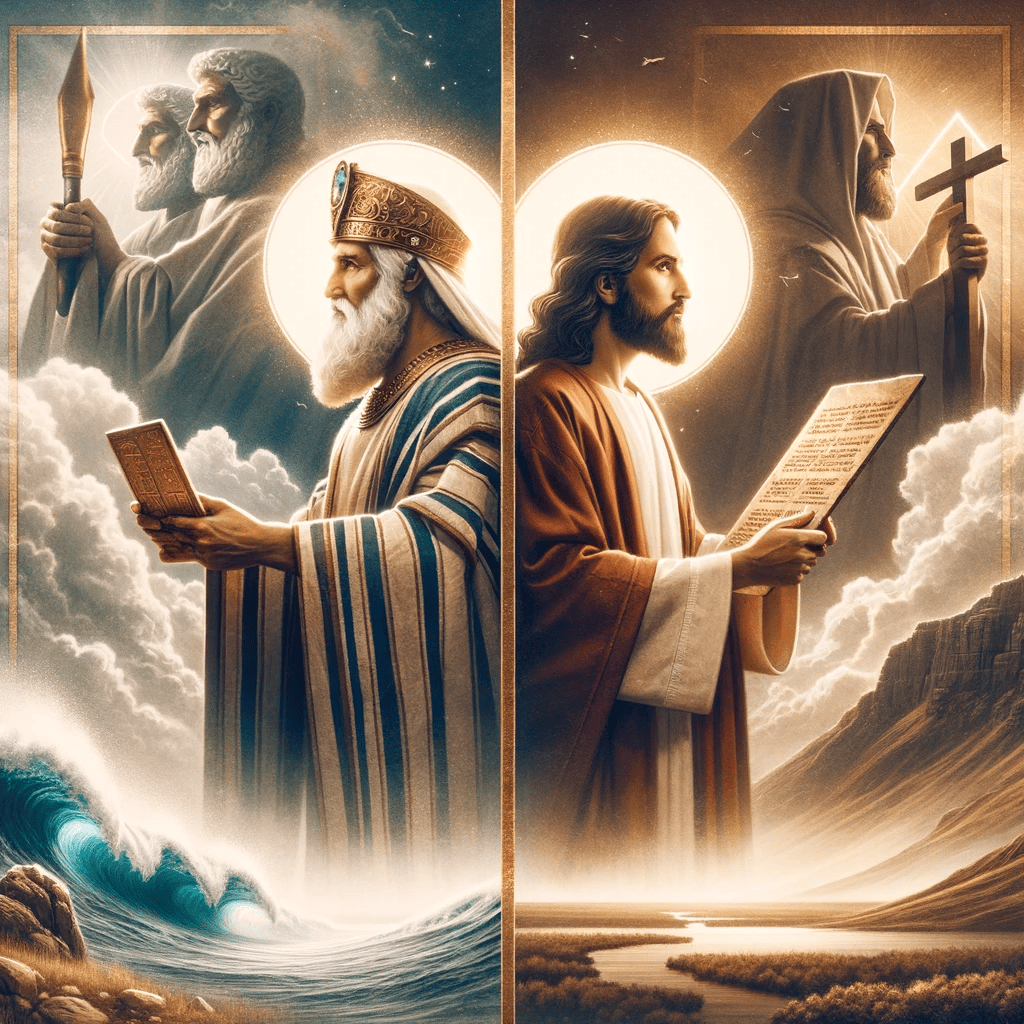
What does Joshua 6 mean?
Joshua 6 tells how God gave Jericho to Israel after seven days of marching, trumpets, and shouts. The chapter also shows Rahab being saved because she helped the spies and tied the scarlet cord in her window. Early Christian writers like Clement of Rome, Justin Martyr, Irenaeus, Tertullian, and Cyprian used the story to teach faith, obedience, and rescue through God’s mercy.
114 early-church witnesses · 205 source quotations · compared with Scripture
What does Joshua 6 mean?
Joshua 6 means that Jericho did not fall by human strength but because the Lord gave the city to Israel in the way he commanded. The marching, trumpets, and shout show Joshua’s obedience and God’s power to win the battle. Rahab’s rescue shows that faith and trust in God lead to life, even in the middle of judgment. Early Christian writers used the chapter most often to point to Rahab’s faith and to read Joshua as a picture of Christ leading God’s people.
Many more early Christian quotations, Bible passages, and source links are gathered below so you can study the evidence for yourself.
Passage context
Joshua and Israel are standing before Jericho after crossing into the land. God tells Joshua how the city will be taken: march around it, wait, and then shout on the seventh day. The wall falls, the city is taken, and Rahab and her household are spared because she hid the spies.
Why early Christian sources matter
Early Christian writers help show how the church read Joshua 6 very early. Clement of Rome and Cyprian stress Rahab’s faith and the protection of her house, while Justin Martyr and Tertullian connect Joshua and Rahab to Christ and salvation. Irenaeus also treats Joshua as a figure who leads God’s people into inheritance, which supports a Christ-centered reading of the book.
Common interpretation points
- The strongest repeated theme is Rahab’s faith and rescue, not a detailed moral lesson about the walls.
- Several writers use Joshua as a type of Jesus Christ, but that reading is broader than Joshua 6 alone.
- The exact miracle at Jericho is not deeply explained by the early writers here; they mainly stress obedience, judgment, and salvation.
Evidence-Based Summary
Joshua 6 is about the Lord giving Jericho into Israel’s hands, with the city falling after seven days of marching and the trumpet blast. Early Christian writers mainly used the chapter as an example of God’s power, Joshua’s obedience, and Rahab’s rescue through faith and the scarlet cord. Clement of Rome, Irenaeus, Justin Martyr, Tertullian, and Cyprian all pick up parts of the story, especially Rahab and the fall of Jericho.
The evidence is broad for Rahab as a type of salvation and for Joshua as a figure of Christ, but it is thinner on the exact meaning of the wall-falling event itself beyond God’s saving judgment and victory.
Key Takeaways
- Joshua 6 teaches that Jericho fell because God gave the victory, not because Israel was strong.
- Rahab’s rescue is the clearest point early Christians repeat from this chapter.
- Several early writers read Joshua as a type of Christ who leads God’s people into inheritance.
Questions Answered by the Sources
Why did Jericho fall in Joshua 6?
Jericho fell because the Lord gave the city to Israel after Joshua and the people obeyed his command. Tertullian links the fall to the seventh day, and the Bible cards give the marching, trumpet blast, and collapse of the wall. The early writers focus on God’s predicted victory, not on a natural explanation for the collapse.
-
Tertullian, An Answer to the Jews Direct teaching
Joshua 6:1-20 Which was so done; and when the space of the seventh day was finished, just as was predicted, down fell the walls of the city.
-
Tertullian, An Answer to the Jews Supporting witness
and thus, when the seventh day's circuit had been performed, the walls of the city would spontaneously fall.
-
Joshua 6:2 Direct teaching
And the LORD said unto Joshua, See, I have given into thine hand Jericho, and the king thereof, and the mighty men of valour.
-
Joshua 6:3 Direct teaching
You shall march around the city, all you men of war; you shall go all around the city once. This you shall do six days.
-
Joshua 6:10 Direct teaching
And Joshua had commanded the people, saying, Ye shall not shout, nor make any noise with your voice, neither shall any word proceed out of your mouth, until the day I bid you shout; then shall ye shout.
-
Joshua 6:5 Direct teaching
And it shall come to pass, that when they make a long blast with the ram's horn, and when ye hear the sound of the trumpet, all the people shall shout with a great shout; and the wall of the city shall fall down flat, and the people shall ascend up every man straight before him.
-
Joshua 6:16 Direct teaching
And it came to pass at the seventh time, when the priests blew with the trumpets, Joshua said unto the people, Shout; for the LORD hath given you the city.
-
Joshua 6:20 Direct teaching
So the people shouted when the priests blew with the trumpets: and it came to pass, when the people heard the sound of the trumpet, and the people shouted with a great shout, that the wall fell down flat, so that the people went up into the city, every man straight before him, and they took the city.
-
Joshua 6:15 Supporting witness
And it came to pass on the seventh day, that they rose early about the dawning of the day, and compassed the city after the same manner seven times: only on that day they compassed the city seven times.
-
Joshua 6:1 Background
Now Jericho was shut up inside and outside because of the people of Israel. None went out, and none came in.
-
Joshua 6:14 Background
And all the rest of the multitude compassed the city six times from within a short distance, and went back again into the camp; this they did six days.
-
Joshua 6:26 Supporting witness
And Joshua adjured them at that time, saying, Cursed be the man before the LORD, that riseth up and buildeth this city Jericho: he shall lay the foundation thereof in his firstborn, and in his youngest son shall he set up the gates of it.
Why was Rahab saved in Joshua 6?
Rahab was saved because she hid the spies and gathered her family under the protection of her house. Clement of Rome, Irenaeus, Justin Martyr, Origen, and Cyprian all treat her as an example of faith, hospitality, and rescue. This is the clearest and strongest theme in the early Christian reading of Joshua 6.
-
Clement of Rome, First Epistle to the Corinthians Direct teaching
Due to her faith and hospitality, Rahab the harlot was saved. When spies were sent by Joshua, the son of Nun, to Jericho, the king of the land found out they were there to spy on their land and sent men to capture them so that they could be put to death. But hospitable Rahab took them in and hid them on her roof under some stalks of flax. When the men sent by the king arrived and said, "Men came to you to spy on our land; bring them out, as the king commands," she replied, "The two men you seek came to me, but quickly left and are gone," thus not revealing the spies to them. Then she said to the men, "I know for sure that the Lord your God has given you this city, for fear and dread of you have fallen on its inhabitants. When you take it, keep me and my father's household safe." And they said to her, "It shall be as you have spoken to us. As soon as you know we are near, you shall gather all your family under your roof, and they shall be preserved, but all found outside your house shall perish." They also gave her a sign, telling her to hang a scarlet thread from her house. In this way, they showed that redemption would flow through the blood of the Lord to all who believe and hope
-
Clement of Rome, First Epistle to the Corinthians Supporting witness
For when spies were sent by Joshua, the son of Nun, to Jericho, the king of the country ascertained that they were come to spy out their land, and sent men to seize them, in order that, when taken, they might be put to death.
-
Irenaeus, Against Heresies: Book IV Direct teaching
And when the entire city in which she lived fell to ruins at the sounding of the seven trumpets, Rahab the harlot was preserved, when all was over [in ultimis], together with all her house, through faith of the scarlet sign;
-
Justin Martyr, Dialogue with Trypho Direct teaching
For the sign of the scarlet thread, which the spies, sent to Jericho by Joshua, son of Nave (Nun), gave to Rahab the harlot, telling her to bind it to the window through which she let them down to escape from their enemies, also manifested the symbol of the blood of Christ, by which those who were at one time harlots and unrighteous persons out of all nations are saved, receiving remission of sins, and continuing no longer in sin.
-
Clement of Alexandria, The Stromata (Miscellanies) Supporting witness
For faith and hospitality, Rahab the harlot was saved.
-
Irenaeus, Against Heresies: Book IV Supporting witness
Thus also did Rahab the harlot, while condemning herself, inasmuch as she was a Gentile, guilty of all sins, nevertheless receive the three spies, who were spying out all the land, and hid them at her home;
-
Clement of Rome, First Epistle to the Corinthians Supporting witness
As soon, therefore, as thou knowest that we are at hand, thou shalt gather all thy family under thy roof, and they shall be preserved, but all that are found outside of thy dwelling shall perish.” Moreover, they gave her a sign to this effect, that she should hang forth from her house a scarlet thread.
-
Clement of Rome, Connection to Hebrews 11:31 Supporting witness
On account of her faith and hospitality, Rahab the harlot was saved. For when spies were sent by Joshua, the son of Nun, to Jericho, the king of the country ascertained that they had come to spy out their land, and sent men to seize them, in order that, when taken, they might be put to death. But the hospitable Rahab receiving them, concealed them on the roof of her house under some stalks of flax.
-
Cyprian, Epistles Supporting witness
Exodus 12:46 Which also we see expressed concerning Rahab, who herself also bore a type of the Church, who received the command which said, You shall bring your father, and your mother, and your brethren, and all your father's household unto you into your house;
-
Joshua 2:18 Direct teaching
Behold, when we come into the land, you shall tie this scarlet cord in the window through which you let us down, and you shall gather into your house your father and mother, your brothers, and all your father's household.
-
Joshua 2:21 Direct teaching
And she said, According unto your words, so be it. And she sent them away, and they departed: and she bound the scarlet line in the window.
-
Joshua 2:15 Background
Then she let them down by a cord through the window: for her house was upon the town wall, and she dwelt upon the wall.
More related quotations from this section 8 shown
-
Joshua 6:22 Direct teaching
But Joshua had said to the two men who had spied out the country, “Go into the harlot’s house, and from there bring out the woman and all that she has, as you swore to her.”
-
Joshua 6:25 Direct teaching
And Joshua saved Rahab the harlot alive, and her father's household, and all that she had; and she dwelleth in Israel even unto this day; because she hid the messengers, which Joshua sent to spy out Jericho.
-
Joshua 6:23 Direct teaching
And the young men that were spies went in, and brought out Rahab, and her father, and her mother, and her brethren, and all that she had; and they brought out all her kindred, and left them without the camp of Israel.
-
Joshua 6:17 Direct teaching
Now the city shall be doomed by the Lord to destruction, it and all who are in it. Only Rahab the harlot shall live, she and all who are with her in the house, because she hid the messengers that we sent.
-
Joshua 2:1 Background
And Joshua the son of Nun sent out of Shittim two young men to spy the land, saying, Go up and view the land and Jericho: and the two young men went and entered into Jericho; and they entered into the house of a harlot, whose name was Rahab, and lodged there.
-
Joshua 2:3 Background
And the king of Jericho sent and spoke to Rahab, saying, Bring out the men that entered into thy house this night; for they are come to spy out the land.
-
Joshua 2:2 Background
And it was reported to the king of Jericho, saying, Men of the sons of Israel have come in hither to spy the land.
-
Joshua 2:6 Background
But she had brought them up upon the house, and hid them in the flax stalks that were spread by her on the house.
Did early Christians see Joshua as a picture of Christ?
Yes. Justin Martyr, Irenaeus, Tertullian, and the Apostolic Constitutions all read Joshua as a figure who points forward to Christ. They connect Joshua’s name, leadership, and role in bringing God’s people into inheritance with Jesus and the gospel.
-
Justin Martyr, Dialogue with Trypho Direct teaching
...elieve man was made from, with ‘Let Us make,’—I will quote again the words by Moses himself. They clearly show that [God] was speaking with someone distinct from Himself and also a rational Being. These are the words: ‘And God said, Behold, Adam has become like one of us, knowing good and evil.’ By saying ‘like one of us,’ [Moses] declared that there are a number of persons associated together, and they are at least two. I do not claim that the belief of the heresy among you is true, nor that its teachers can prove that [God] spoke to angels or that angels crafted humans. This Offspring, truly brought forth from the Father, was with the Father before all creatures, and the Father communed with Him. Scripture through Solomon makes it clear that He whom Solomon calls Wisdom was begotten as a Beginning before all His creatures and as Offspring by God. This is also confirmed in the revelation made by Joshua the son of Nun. Consider the following from the book of Joshua to make this clear to you; it is this: ‘When Joshua was near Jericho, he looked up and saw a man standing opposite him. Joshua approached Him and asked, Are you for us or for our adversaries? He said to him, I am the
-
Justin Martyr, Dialogue with Trypho Direct teaching
Here is the passage rewritten in modern English: “This is what I mean. Jesus (Joshua), as I have frequently mentioned, who was called Oshea when he was sent to spy out the land of Canaan, was renamed by Moses as Jesus (Joshua). You neither ask why this was done nor do you seem puzzled about it or inquire deeply. Thus, you overlook Christ; and even though you read, you do not understand; and even now, though you hear that Jesus is our Christ, you don't realize that the name was given to Him not without purpose or by accident. Yet you engage in theological discussions as to why one letter was added to Abraham’s first name; and regarding why another letter was added to Sarah’s name, you have similar elaborate debates. But why don’t you similarly investigate the reason why the name of Oshea the son of Nave (Nun), given by his father, was changed to Jesus (Joshua)? Not only was his name changed, but he was also appointed as Moses' successor, being the only one among his peers who came out of Egypt, leading the survivors into the Holy Land; and as he, not Moses, led the people into the Holy Land and distributed it by lot to those who entered with him, in the same way, Jesus the Christ wi
-
Irenaeus, Fragments from the Lost Writings of Irenæus Direct teaching
"Take Joshua, the son of Nun, for yourself." It was appropriate that Moses should lead the people out of Egypt, but that Jesus (Joshua) should lead them into their inheritance. Also, just as the law was meant to end, Moses' role should end, but Joshua, as the word and a true representation of the Word made flesh, should be a messenger to the people. Furthermore, it was suitable that Moses should provide manna as food for the ancestors, but Joshua should provide wheat; as the first-fruits of life, a symbol of the body of Christ, as Scripture declares that the Lord's manna ceased when the people ate wheat from the land.
-
Irenaeus, Fragments from the Lost Writings of Irenæus Supporting witness
“Take unto thee Joshua () the son of Nun.” For it was proper that Moses should lead the people out of Egypt, but that Jesus (Joshua) should lead them into the inheritance.
-
Tertullian, Against Marcion Supporting witness
...o be the successor of Moses, was not his old name changed, and was he not for the first time called Joshua? It is true, you say. Then this is the first thing we observe: it was a figure of Him who was to come. For since Jesus Christ was to bring a new generation, because we are born in the wilderness of this world, into the promised land flowing with milk and honey, that is, into the possession of eternal life, than which nothing can be sweeter; and since this was to be brought about not by Moses, that is, not by the discipline of the law, but by Joshua, by the grace of the gospel, our circumcision being carried out by a knife of stone, that is, by the circumcision of Christ, for Christ is a rock, therefore that great man, who was appointed as a type of this mystery, was actually consecrated with the figure of the Lord's own name, by being called Joshua. Christ Himself even then testified that this name was His own, when He talked with Moses. For who was it that talked with him, but the Spirit of the Creator, which is Christ? Therefore, when He spoke this commandment to the people, "Behold, I send my angel before your face, to keep you in the way, and to bring you into the land
-
Tertullian, Against Marcion Supporting witness
but Joshua also (Jesus), because it was a type of His own future name.
-
Tertullian, An Answer to the Jews Supporting witness
...d this had to happen not through Moses, that is, not through the discipline of the Law, but through Joshua, that is, through the grace of the new law, after our circumcision with a knife of rock, that is, with Christ's precepts, for Christ is in many ways and figures foretold as a rock. Therefore the man who was being prepared to act as an image of this sacrament was inaugurated under the figure of the Lord's name, so as to be named Jesus. For He who always spoke to Moses was the Son of God Himself. He also was always seen. Numbers 12:5-8. For no one ever saw God the Father and lived. And so it is agreed that the Son of God Himself spoke to Moses and said to the people, "Behold, I send My angel before your face"—that is, the people's—"to guard you on the journey, and to bring you into the land which I have prepared for you. Attend to him, and do not be disobedient to him; for he has not escaped your notice, since My name is upon him." Exodus 23:20-21. For Joshua, not Moses, was to bring the people into the land of promise. Now He called him an angel because of the greatness of the mighty deeds which he was to accomplish, and Joshua the son of Nun did accomplish them, as you your
-
Tertullian, An Answer to the Jews Supporting witness
Exodus 23:20-21 For Joshua was to introduce the people into the land of promise, not Moses.
-
Apostolic Constitutions, Apostolic Constitutions Supporting witness
You declared Joshua to be the general of the army, and overthrew the seven nations of Canaan by him;
-
Apostolic Constitutions, Apostolic Constitutions Supporting witness
Deuteronomy 18:15 Him did Joshua the Son of Nun see, as the captain of the Lord's host, in armour, for their assistance against Jericho;
-
Apostolic Constitutions, Apostolic Constitutions Supporting witness
... soul that will not hear that Prophet shall be destroyed from among his people," Deuteronomy 18:15. Joshua the son of Nun saw Him as the captain of the Lord's host, in armor, for their help against Jericho. He fell down before Him and worshiped, as a servant does to his master, Joshua 5:14. Samuel knew Him as the Anointed of God, 1 Samuel 12:3, and from that came the name "anointed" for the priests and the kings. David knew Him, and sang a hymn concerning Him, "A song concerning the Beloved," and then adds in His person, and says, "Gird Your sword upon Your thigh, O You who are mighty in Your beauty and renown. Go on, and prosper, and reign, for the sake of truth, and meekness, and righteousness; and Your right hand shall guide You in a wonderful manner. Your darts are sharpened, O You who are mighty; the people shall fall under You in the heart of the king's enemies. Therefore God, Your God, has anointed You with the oil of gladness above Your fellows." Concerning Him Solomon also spoke, as in His person: "The Lord created me the beginning of His ways, for His works; before the world He founded me, in the beginning before He made the earth, before the fountains of waters came,
-
Apostolic Constitutions, Apostolic Constitutions Background
...f Jacob in Bethel; of Moses in the desert; of Aaron between the dead and the living, Numbers 16; of Joshua the son of Nun in Gilgal, Joshua 5; of Gideon at the rock and with the fleeces, before his sin; of Manoah and his wife in the field; of Samson in his thirst before the transgression; of Jephtha in the war before his rash vow; of Barak and Deborah in the days of Sisera; of Samuel in Mizpeh, 1 Samuel 7; of David at the threshing floor of Ornan the Jebusite; of Solomon in Gibeon and in Jerusalem; of Elijah on Mount Carmel, 1 Kings 18; of Elisha at the barren spring, 2 Kings 2; of Jehoshaphat in war; of Hezekiah in his sickness and concerning Sennacherib; of Manasseh in the land of the Chaldeans, after his transgression, 2 Chronicles 33; of Josiah in Phassa; of Ezra at the return, Ezra 8; of Daniel in the den of lions; of Jonah in the whale's belly, Jonah 2; of the three children in the fiery furnace, Daniel 3; of Hannah in the tabernacle before the ark, 1 Samuel 1; of Nehemiah at the rebuilding of the walls; of Zerubbabel; of Mattathias and his sons in their zeal; of Jael in blessings. Now also receive the prayers of Your people, which are offered to You with knowledge, throug
More related quotations from this section 12 shown
-
Clement of Alexandria, The Stromata (Miscellanies) Background
...e dates of the other prophets among the Hebrews who succeeded Moses. After the end of Moses's life, Joshua succeeded to the leadership of the people. And he, after warring for sixty-five years, rested in the good land another twenty-five. As the book of Joshua relates, the man mentioned above was the successor of Moses for twenty-seven years. Then the Hebrews, having sinned, were delivered to Chusachar king of Mesopotamia for eight years, as the book of Judges mentions. But afterward, having begged the Lord, they received Gothoniel as leader, the younger brother of Caleb, of the tribe of Judah. Having slain the king of Mesopotamia, he ruled over the people for forty years in succession. And having sinned again, they were delivered into the hands of Æglom king of the Moabites for eighteen years. But when they repented, Aod, a man who had equal use of both hands, of the tribe of Ephraim, was their leader for eighty years. It was he who dispatched Æglom. On the death of Aod, and when they sinned again, they were delivered into the hand of Jabim king of Canaan for twenty years. After him Deborah the wife of Lapidoth, of the tribe of Ephraim, prophesied. And Ozias the son of Rhiesu w
-
Hippolytus, Exegetical Fragments Background
And Joshua, the sun of Nun, was filled with the spirit of wisdom, for Moses had laid his hand on him. And all the children of Israel obeyed him. And God charged Joshua, the sun of Nun, on a certain day, namely, the seventh day of the month Nisan.
-
Hippolytus, Exegetical Fragments Background
And God charged Joshua the Son of Nun on a certain day — namely, the seventh day of the month Nisan.
-
Hippolytus, Exegetical Fragments Background
And when Moses descended from Mount Nebo, he called for Joshua the Son of Nun, and said to him before the children of Israel: Prevail, and be strong;
-
Wisdom of Sirach 46:1 Background
Joshua the son of Nave was valiant in the wars, And was the successor of Moses in prophecies, Who according to his name was made great For the saving of the elect of God, And taking vengeance of the enemies that rose up against them, That he might set Israel in their inheritance.
-
Deuteronomy 31:7 Background
And Moses called Joshua, and said to him before all Israel, Be courageous and strong; for thou shalt go in before this people into the land which the Lord swore to your fathers to give to them, and thou shalt give it to them for an inheritance.
-
Joshua 3:7 Background
And the Lord said to Joshua, This day do I begin to exalt thee before all the children of Israel, that they may know that as I was with Moses, so will I also be with thee.
-
Deuteronomy 34:9 Background
And Joshua the son of Nun was filled with the spirit of knowledge, for Moses had laid his hands upon him; and the children of Israel hearkened to him; and they did as the Lord commanded Moses.
-
Deuteronomy 31:3 Background
The Lord thy God who goes before thee, he shall destroy these nations before thee, and thou shalt inherit them: and it shall be Joshua that goes before thy face, as the Lord has spoken.
-
Deuteronomy 3:28 Background
And charge Joshua, and strengthen him, and encourage him; for he shall go before the face of this people, and he shall give them the inheritance of all the land which thou hast seen.
-
Deuteronomy 31:23 Background
And he charged Joshua, and said, Be courageous and strong, for thou shalt bring the sons of Israel into the land, which the Lord swore to them, and he shall be with thee.
-
Deuteronomy 1:38 Background
Joshua the son of Nun, who stands by thee, he shall enter in there; do thou strengthen him, for he shall cause Israel to inherit it.
Common Questions
Why did the walls of Jericho fall in Joshua 6?
They fell because the Lord gave the city to Israel after the people obeyed his command to march, trumpet, and shout.
Why was Rahab saved in Joshua 6?
Rahab was saved because she hid the spies and trusted the sign she was given; early Christian writers also call her faith and hospitality important.
Do early Christians treat Joshua 6 as a picture of Christ?
Yes. Justin Martyr and Tertullian use Joshua as a type of Christ, and they also connect Rahab’s scarlet cord to salvation.
What is the main message of Joshua 6?
God gives Jericho into Israel’s hands when they obey his command, and Rahab is spared because she trusted and helped the spies.
How did early Christians use Rahab in Joshua 6?
They used Rahab as an example of faith and as a picture of rescue, often linking her scarlet cord to salvation.
Source Index for Joshua 6
The guided sections above show the strongest quotations. This compact index highlights 160 ranked source links from 205 compiled sources for deeper study.
Source index 160 ranked links shown
Early Christian Writings 80 shown of 114
Primary-source quotations from early Christian writers and church documents.
-
Clement of Rome, Connection to Hebrews 11:31
Bible Passages 80 shown of 91
Related Bible passages saved for comparison with the early Christian quotations.