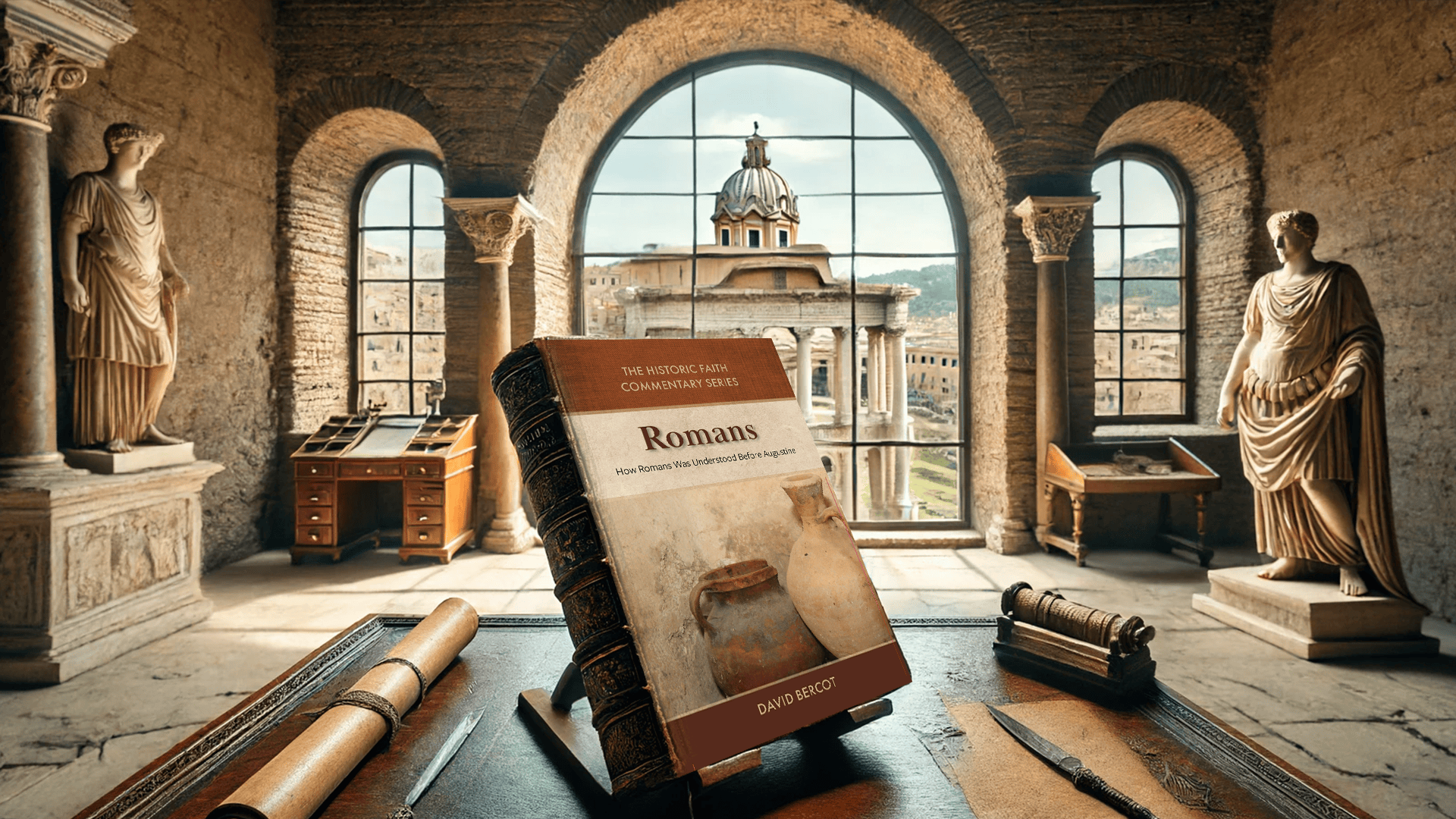
This free course continues David Bercot’s commentary on Romans by walking through chapters 9–16 with special attention to how Romans was understood before Augustine and Luther. The lessons follow Paul’s argument about God’s mercy to Jews and Gentiles, the place of Israel, the inclusion of the Gentiles, and the difference between righteousness sought through the Mosaic Law and righteousness through faith in Christ. The course also traces Paul’s shift from argument to exhortation:
living as a sacrifice, using gifts humbly in one body, loving without hypocrisy, refusing retaliation, submitting to governing authorities, and respecting the consciences of fellow believers. Later lessons cover unity between Jewish and Gentile Christians, Paul’s ministry and travel plans, his greetings to believers in Rome, and his closing warning against divisive teachers.
Throughout the course, Bercot interacts with early Christian writers such as Origen, Irenaeus, Tertullian, Ambrosiaster, Chrysostom, and others where the transcripts present their comments.
This lesson introduces Romans 9 as part of Paul’s larger argument about God’s mercy to Jews and Gentiles. It also discusses Paul’s grief for Israel, the meaning of anathema, and early Christian testimony to Christ’s divinity in Romans 9:5.
- Why should Romans 9 not be read in isolation?
- How does Paul express his sorrow for Israel?
- How did early Christians understand Paul’s statement about Christ as God over all?
This lesson explains Paul’s statement that not all who are of Israel are truly Israel. It contrasts fleshly descent from Abraham with the children of promise who follow Christ by faith.
- What does it mean that not all Israel is Israel?
- Why does Paul use Isaac as an example?
- How are believers connected to Abraham’s promise?
This lesson begins the discussion of Jacob and Esau as an argument about two peoples rather than isolated individual destinies. It presents Paul’s point that God could include Gentiles in His people before their spiritual birth, just as Jacob was chosen before birth.
- Why does Paul move from Isaac to Jacob and Esau?
- How does the lesson connect Jacob and Esau with two nations?
- What does this passage say about Gentile inclusion?
This lesson continues the Jacob and Esau discussion by emphasizing fleshly Israel and spiritual Israel. It connects Paul’s argument in Romans with Old Testament prophecies about Gentiles coming to the God of Jacob and with Paul’s parallel use of Sarah and Hagar in Galatians.
- How does the Jacob and Esau passage relate to fleshly and spiritual Israel?
- Why does the lesson bring in Old Testament prophecies about the Gentiles?
- How does Galatians 4 help explain Paul’s argument?
This lesson explains Paul’s answer to the charge that God is unjust for showing mercy to the Gentiles. It applies the passage mainly to Jews and Gentiles while also discussing individual salvation, human response, obedience, and God’s greater role in salvation.
- Why does Paul say there is no injustice with God?
- How does the golden calf episode illuminate God’s mercy?
- How does this lesson balance divine mercy and human response?
This lesson discusses Pharaoh’s hardening and argues that God’s patience and actions can soften some people while hardening others who despise His kindness. It also applies the pattern to unbelieving Jews who hardened their own hearts while other Jews came to faith.
- What is the difference between God raising Pharaoh up and creating Pharaoh for that purpose?
- How can the same divine action soften some and harden others?
- How does Pharaoh’s hardening relate to Israel’s unbelief?
This lesson treats the potter and clay passage as part of Paul’s dialogue with a Jewish opponent about God’s fairness. It reads the image alongside Jeremiah 18, emphasizing repentance, long-suffering, and human responsibility rather than arbitrary destruction.
- Who is Paul answering in the potter and clay passage?
- How does Jeremiah 18 shape the meaning of the image?
- What are vessels of wrath and vessels of mercy in this lesson?
This lesson brings Romans 9 to its conclusion by showing Paul’s focus on the calling of Jews and Gentiles, the remnant of Israel, and the stumbling of those who pursued righteousness through the law without faith in Christ. It also discusses Hosea, Isaiah, and the stone of stumbling.
- How does Romans 9:24 clarify Paul’s main subject?
- What role do Hosea and Isaiah play in Paul’s argument?
- Why did fleshly Israel stumble at Christ?
This lesson opens Romans 10 by explaining Paul’s sorrow over Israel’s attempt to establish righteousness through the Mosaic Law after Christ had fulfilled it. It presents Christ as the end of the law both as its conclusion and as its intended goal.
- Why does Paul say Israel had zeal without knowledge?
- What is meant by seeking one’s own righteousness?
- In what ways is Christ the end of the law?
This lesson contrasts the righteousness of the law with the righteousness of faith and explains Paul’s use of Moses, Joel, and Isaiah. It emphasizes that Jew and Gentile alike are saved through faith in Christ and that believing the gospel is inseparable from obeying it.
- What kind of life did the Mosaic Law promise?
- What does it mean to confess and believe in Christ?
- Why does Paul stress that whoever calls on the Lord will be saved?
- How are belief and obedience connected?
This lesson explains faith coming through hearing the Word of God and compares the responses of Jews and Gentiles. It also discusses Paul’s use of Moses and Isaiah, including the image of God stretching out His hands to a disobedient people and its Messianic application.
- Why does Paul say faith comes through hearing?
- How did the Gentiles respond differently from many Jews?
- What does it mean for God to stretch out His hands all day?
This lesson begins Romans 11 by showing that God has not cast off His people, because a believing Jewish remnant remains. It uses Paul himself and the 7,000 in Elijah’s day to explain a remnant chosen by grace rather than by the works of the Mosaic Law.
- How does Paul answer the claim that God rejected Israel?
- Why is Elijah’s remnant important for Romans 11?
- What does a remnant according to grace mean?
This lesson discusses the blinding of unbelieving Israel, the obtaining of righteousness by the chosen remnant, and the extension of reconciliation to the Gentiles. It also considers Paul’s hope that his ministry to the Gentiles might provoke some Jews to salvation.
- What does it mean that the rest were blinded?
- How did Israel’s fall bring blessing to the Gentiles?
- Why did Paul hope to provoke some of his people to salvation?
This lesson explains Paul’s olive tree image, with Gentiles grafted into the root connected with Abraham and Jews able to be grafted back in through faith. It warns Gentile believers against boasting and stresses one people of God rather than separate trees or flocks.
- What is the olive tree in Romans 11?
- Why must Gentile believers not boast against Jewish branches?
- How can unbelieving Jews be grafted back in?
- How many flocks does the lesson say Christ will have?
This lesson marks Paul’s turn to the transformed life after his main argument about Jews, Gentiles, law, grace, and faith. It explains living sacrifices, nonconformity to the world, renewal of the mind, and cooperation with divine grace.
- What does it mean to present the body as a living sacrifice?
- How does Paul contrast the world’s fashion with transformation?
- What role does human cooperation have in renewal?
This lesson covers humility, sober thinking, and diverse gifts in the one body of Christ. It discusses prophecy, ministry, teaching, exhortation, giving, leadership, and mercy as gifts to be used faithfully rather than arrogantly.
- Why does Paul warn against thinking too highly of oneself?
- How are different gifts used within one body?
- What examples of prophecy and mercy are discussed?
This lesson presents Paul’s description of sincere love, abhorring evil, brotherly affection, zeal, patience, prayer, hospitality, humility, and unity. It emphasizes that these are commands for the transformed Christian life, not mere ideals.
- What does love without hypocrisy look like?
- Why must Christians abhor evil and cling to good?
- How do prayer, hospitality, and humility express the Christ-life?
This lesson explains Paul’s command not to repay evil for evil in light of Jesus’ teaching on nonretaliation and love for enemies. It treats vengeance as belonging to God and describes overcoming evil with good as a command of the New Covenant.
- Why must Christians not retaliate against evil?
- What does it mean to leave vengeance to God?
- How does loving enemies overcome evil with good?
This lesson begins Romans 13 by explaining submission to governing authorities as part of faithful Christian living. It discusses why God instituted governments, the problem of anarchy, and how Christians are to respond even when rulers are evil.
- Why does Paul tell every soul to be subject to governing authorities?
- What purpose do governments serve in restraining evil?
- How does the lesson handle unjust or evil rulers?
This lesson continues the discussion of Romans 13 with questions about public office, taxes, honor, war taxes, and commands that conflict with God’s commands. It presents early Christian reasoning that Christians obey Caesar in what does not offend God but must obey Christ above all.
- Can Christians hold public office according to the discussion in this lesson?
- What does Paul mean by tribute, customs, fear, and honor?
- What should Christians do when Caesar commands what Christ forbids?
This lesson explains Paul’s command to owe nothing except the continuing debt of love. It connects love of neighbor with the moral content of the law and with Jesus’ teaching that love fulfills the law and extends even to enemies.
- Does Romans 13:8 forbid borrowing money?
- Why is love described as a continuing debt?
- How does love fulfill the law?
This lesson calls Christians to wake from spiritual lethargy because salvation is nearer than when they first believed. It contrasts the works of darkness with putting on the Lord Jesus Christ and concludes Paul’s great argument through Romans 13.
- What kind of sleep does Paul warn against?
- Why is salvation nearer than when believers first believed?
- What does it mean to put on the Lord Jesus Christ?
This lesson introduces Romans 14 by addressing Jewish and Gentile believers with different convictions about food. Paul permits continued dietary scruples under certain conditions while commanding believers not to despise or judge one another.
- Why did some Jewish believers still avoid certain foods?
- What conditions does Paul place on continued dietary observance?
- Why must believers not judge one another over food?
This lesson grounds Paul’s warning against judging a brother in the coming judgment seat of Christ. It distinguishes correction from condemnation and warns against placing a stumbling block before another believer.
- Why does Judgment Day make judging a brother so serious?
- How is correction different from condemnation?
- What is a stumbling block in this lesson?
This lesson explains Paul’s statement that nothing is unclean in itself within the context of foods, not moral evil. It urges believers to pursue peace, edification, and care for weak consciences while also noting that Romans 14 should not be used to impose scruples on others.
- What does Paul mean when he says nothing is unclean in itself?
- How can lawful conduct still wound another believer?
- When should Christians limit liberty for the sake of conscience?
- When does Paul counsel believers to stand fast in liberty?
This lesson begins Romans 15 by calling the strong to bear the weaknesses of the weak and seek their neighbor’s edification. It uses Christ’s example, the value of the Old Testament Scriptures, and the need for unity to urge believers to receive one another.
- What does it mean for the strong to bear the infirmities of the weak?
- How does Christ’s example shape Christian patience?
- Why are the Old Testament Scriptures still valuable?
- How does receiving one another serve unity?
This lesson returns to prophecies about Gentile salvation and the unity of Jewish and Gentile believers. It explains Christ as a minister to the circumcision and traces Paul’s use of Old Testament passages showing Gentiles glorifying, rejoicing, praising, and trusting in God.
- How was Christ a minister to the circumcision?
- What prophecies does Paul use to show Gentile inclusion?
- Why should Jews and Gentiles glorify God together?
This lesson explains Paul’s frankness as part of his God-given ministry to the Gentiles. It presents Paul as offering the Gentiles to God through the gospel, rejoicing only in what Christ worked through him, and preaching where Christ had not been named.
- Why does Paul say he wrote boldly on certain points?
- How is Paul’s ministry to the Gentiles described as priestly service?
- Why did Paul seek to preach where Christ had not been named?
This lesson covers Paul’s desire to visit Rome on his way to Spain and his prior obligation to deliver alms to the needy saints in Jerusalem. It emphasizes his missionary calling, concern for the poor, and prayer for peace amid opposition and internal tensions.
- Why had Paul been hindered from visiting Rome?
- Why did Paul plan to go to Spain?
- What was the collection for Jerusalem?
- Why does Paul close this passage by calling God the God of peace?
This lesson begins Paul’s greetings and highlights his commendation of Phoebe along with his gratitude for Priscilla and Aquila. It shows Paul’s appreciation for women who served and for coworkers who offered hospitality, assistance, and risked themselves for his sake.
- Why is Romans 16 valuable for understanding Paul’s view of women who served?
- How does Paul commend Phoebe?
- What did Priscilla and Aquila do for Paul and the churches?
This lesson continues Paul’s greetings, discussing the order of Priscilla and Aquila’s names, the church in their house, Andronicus and Junius or Junia, and the holy kiss. It presents the holy kiss as a practice that expressed unity across social distinctions in the church.
- Does the order of Priscilla and Aquila’s names prove prominence?
- How did early Christians understand the church in their house?
- What questions surround Andronicus and Junius or Junia?
- What did the holy kiss express?
This lesson explains Paul’s warning to mark and avoid those who cause divisions and offenses contrary to apostolic teaching. It connects divisiveness with serious sin, warns against flattering deceivers, and ends with hope that God will bruise Satan under believers’ feet.
- Why is causing division in the church so serious?
- Who are believers told to mark and avoid?
- How do flattering teachers deceive the simple?
- What does it mean that God will bruise Satan under their feet?
This final lesson covers greetings from Paul’s fellow workers, including Timothy, Tertius, Gaius, and others, and discusses the closing doxology. It emphasizes the obedience of faith, the revealed mystery of the gospel, and glory to the only wise God through Jesus Christ.
- Who sends greetings from Paul’s circle of coworkers?
- What role did Tertius have in the writing of Romans?
- How does the closing doxology connect faith and obedience?
- Why does Paul give glory to the only wise God?