
G26 — Agape (Love)
Greek agape, with New Testament and Septuagint usage links where indexed.
The Early Christian Study Bible · Free to use
Study the word. Hear its pronunciation.
Search 14,298 Greek and Hebrew entries—free. Explore definitions, indexed occurrences, and pronunciation audio where available, then follow the words back into your Bible.
Click a word. Hear its pronunciation. Open the early Christian writings. Then see how to present and teach.
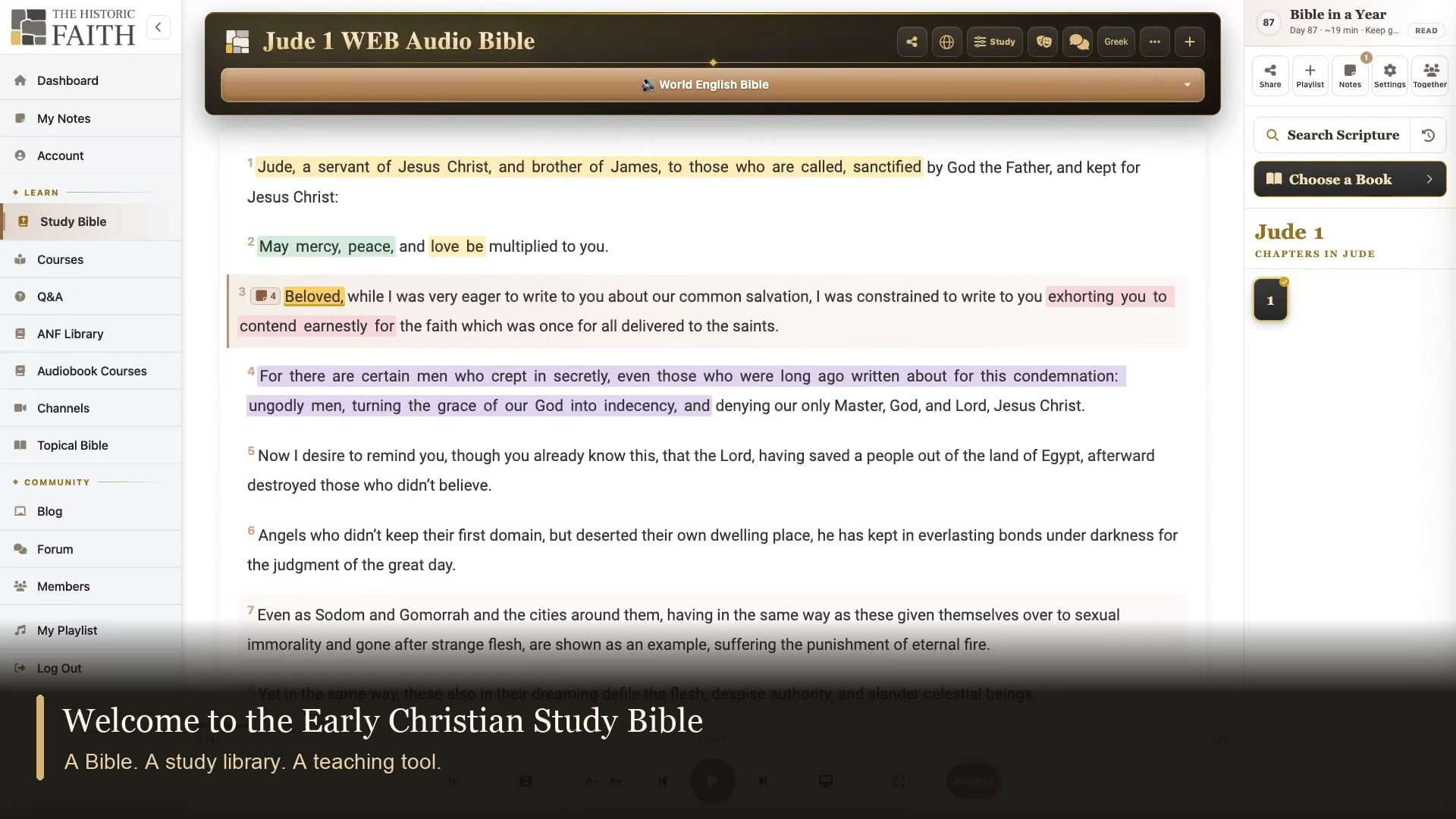 Words. Writings.
Guided tour · 21:50 · Several Bible editions.
See the phone experience · 5:31
Strong's Exhaustive Concordance, first published by James Strong in 1890, indexes every word of the King James Version and assigns each underlying original-language word a number — G1–G5624 for the Greek New Testament and H1–H8674 for the Hebrew Old Testament. Look up any English word, find its Strong's number, and see the Greek or Hebrew word behind it, its definition, and the verses where it occurs. This free online edition covers 14,298 entries with 767,764 indexed occurrences — including the Septuagint, deuterocanonical books, and 1 Enoch, which no print edition of Strong's includes.
These entry points are the quickest way to see how a Strong's number opens into a word, meaning, and Bible usage.
Greek agape, with New Testament and Septuagint usage links where indexed.
Greek kyrios, a major New Testament and Septuagint word-study bridge.
Hebrew reshith, the word behind “beginning” in Genesis 1:1 and other Old Testament usages.
Browse the local Greek and Hebrew Strong's entries in fast pages, open an exact number, or narrow the index by language, range, and usage count.
| Number | Word | Definition | Usages | Range |
|---|---|---|---|---|
|
G1351 — dilogos
Greek
|
δίλογος (dilogos)
dilogos
|
dilogos (dil'-og-os) adj. 1. equivocal, i.e. telling a different story [from G1364 and G3056] | 1 | G1001-G2000 |
|
G1352 — dio
Greek
|
διό (dio)
dio
|
dio (dee-oh') conj. 1. through which thing, i.e. consequently [from G1223 and G3739] | 80 | G1001-G2000 |
|
G1353 — diodeuo
Greek
|
διοδεύω (diodeuo)
diodeuo
|
diodeuo (dee-od-yoo'-o) v. 1. to travel through [from G1223 and G3593] | 22 | G1001-G2000 |
|
G1354 — Dionusios
Greek
|
Διονύσιος (Dionusios)
Dionusios
|
Dionusios (dee-on-oo'-see-os) n/p. 1. reveller 2. Dionysius, an Athenian | 1 | G1001-G2000 |
|
G1355 — dioper
Greek
|
διόπερ (dioper)
dioper
|
dioper (dee-op'-er) conj. 1. on which very account [from G1352 and G4007] | 9 | G1001-G2000 |
|
G1356 — diopetes
Greek
|
διοπετής (diopetes)
diopetes
|
diopetes (dee-op-et-ace') adj. 1. sky-fallen (i.e. an aerolite) [from the alternate of G2203 and the alternate of G4098] | 1 | G1001-G2000 |
|
G1357 — diorthosis
Greek
|
διόρθωσις (diorthosis)
diorthosis
|
diorthosis (dee-or'-tho-sis) n. 1. rectification 2. (specially) the Messianic restauration | 1 | G1001-G2000 |
|
G1358 — diorusso
Greek
|
διορύσσω (diorusso)
diorusso
|
diorusso (dee-or-oos'-so) v. 1. to penetrate burglariously [from G1223 and G3736] | 8 | G1001-G2000 |
|
G1359 — Dioskouroi
Greek
|
Διόσκουροι (Dioskouroi)
Dioskouroi
|
Dioskouroi (dee-os'-kou-roy) n/p. 1. sons of Jupiter, i.e. the twins Dioscuri [from the alternate of G2203 and a form of the base of G2877] | 1 | G1001-G2000 |
|
G1360 — dioti
Greek
|
διότι (dioti)
dioti
|
dioti (dee-ot'-ee) conj. 1. on the very account that, or inasmuch as [from G1223 and G3754] | 326 | G1001-G2000 |
|
G1361 — Diotrephes
Greek
|
Διοτρεφής (Diotrephes)
Diotrephes
|
Diotrephes (dee-ot-ref-ace') n/p. 1. Jove-nourished 2. Diotrephes, an opponent of Christianity | 1 | G1001-G2000 |
|
G1362 — diplous
Greek
|
διπλούς (diplous)
diplous
|
diplous (dip-lous') adj. 1. two-fold [from G1364 and (probably) the base of G4119] | 29 | G1001-G2000 |
|
G1363 — diploo
Greek
|
διπλόω (diploo)
diploo
|
diploo (dip-loh'-o) v. 1. to render two-fold [from G1362] | 1 | G1001-G2000 |
|
G1364 — dis
Greek
|
δίς (dis)
dis
|
dis (dees') adv. 1. twice [adverb from G1417] | 23 | G1001-G2000 |
|
G1365 — distazo
Greek
|
διστάζω (distazo)
distazo
|
distazo (dis-tad'-zo) v. 1. (properly) to duplicate 2. (mentally) to waver (in opinion) | 2 | G1001-G2000 |
|
G1366 — distomos
Greek
|
δίστομος (distomos)
distomos
|
distomos (dis'-tom-os) adj. 1. double-edged [from G1364 and G4750] | 7 | G1001-G2000 |
|
G1367 — dischilioi
Greek
|
δισχίλιοι (dischilioi)
dischilioi
|
dischilioi (dis-khil'-ee-oy) n. 1. two thousand [from G1364 and G5507] | 43 | G1001-G2000 |
|
G1368 — diulizo
Greek
|
διυλίζω (diulizo)
diulizo
|
diulizo (dee-oo-lid'-zo) v. 1. to strain out [from G1223 and hulizo hoo-lid'-zo "to filter"] | 2 | G1001-G2000 |
|
G1369 — dichazo
Greek
|
διχάζω (dichazo)
dichazo
|
dichazo (dee-khad'-zo) v. 1. to make apart 2. to separate | 1 | G1001-G2000 |
|
G1370 — dichostasia
Greek
|
διχοστασία (dichostasia)
dichostasia
|
dichostasia (dee-khos-tas-ee'-ah) n. 1. disunion 2. (figuratively) dissension | 4 | G1001-G2000 |
|
G1371 — dichotomeo
Greek
|
διχοτομέω (dichotomeo)
dichotomeo
|
dichotomeo (dee-khot-om-eh'-o) v. 1. to bisect 2. (by extension) to flog severely | 3 | G1001-G2000 |
|
G1372 — dipsao
Greek
|
διψάω (dipsao)
dipsao
|
dipsao (dip-sah'-o) v. 1. to thirst for {literally or figuratively} | 51 | G1001-G2000 |
|
G1373 — dipsos
Greek
|
δίψος (dipsos)
dipsos
|
dipsos (dip'-sos) n. 1. thirst [of uncertain affinity] | 15 | G1001-G2000 |
|
G1374 — dipsuchos
Greek
|
δίψυχος (dipsuchos)
dipsuchos
|
dipsuchos (dip'-soo-khos) adj. 1. two-spirited, i.e. vacillating (in opinion or purpose) [from G1364 and G5590] | 2 | G1001-G2000 |
|
G1375 — diogmos
Greek
|
διωγμός (diogmos)
diogmos
|
diogmos (dee-ogue-mos') n. 1. persecution [from G1377] | 12 | G1001-G2000 |
|
G1376 — dioktes
Greek
|
διώκτης (dioktes)
dioktes
|
dioktes (dee-oke'-tace) n. 1. a persecutor [from G1377] | 1 | G1001-G2000 |
|
G1377 — dioko
Greek
|
διώκω (dioko)
dioko
|
dioko (dee-o'-ko) v. 1. to pursue 2. (by implication) to persecute | 139 | G1001-G2000 |
|
G1378 — dogma
Greek
|
δόγμα (dogma)
dogma
|
dogma (dog'-mah) n. 1. a law (civil, ceremonial or ecclesiastical) [from the base of G1380] | 22 | G1001-G2000 |
|
G1379 — dogmatizo
Greek
|
δογματίζω (dogmatizo)
dogmatizo
|
dogmatizo (dog-mat-id'-zo) v. 1. to prescribe by statute 2. (reflexively) to submit to, ceremonially rule | 6 | G1001-G2000 |
|
G1380
Greek
|
δόξητε
|
dokeo (dok-eh'-o) v. 1. to think 2. (by implication) to seem (truthfully or uncertainly) | 120 | G1001-G2000 |
|
G1381 — dokimazo
Greek
|
δοκιμάζω (dokimazo)
dokimazo
|
dokimazo (dok-im-ad'-zo) v. 1. to test 2. (by implication) to approve | 54 | G1001-G2000 |
|
G1382 — dokime
Greek
|
δοκιμή (dokime)
dokime
|
dokime (dok-ee-may') n. 1. test 2. (by implication) trustiness | 6 | G1001-G2000 |
|
G1383 — dokimion
Greek
|
δοκίμιον (dokimion)
dokimion
|
dokimion (dok-im'-ee-on) n. 1. a testing 2. (by implication) trustworthiness | 3 | G1001-G2000 |
|
G1384 — dokimos
Greek
|
δόκιμος (dokimos)
dokimos
|
dokimos (dok'-ee-mos) adj. 1. (properly) acceptable (current after assayal), i.e. approved [from G1380] | 13 | G1001-G2000 |
|
G1385 — dokos
Greek
|
δοκός (dokos)
dokos
|
dokos (dok-os') n. 1. a stick of timber [from G1209 (through the idea of holding up)] | 15 | G1001-G2000 |
|
G1386 — dolios
Greek
|
δόλιος (dolios)
dolios
|
dolios (dol'-ee-os) adj. 1. guileful [from G1388] | 25 | G1001-G2000 |
|
G1387 — dolioo
Greek
|
δολιόω (dolioo)
dolioo
|
dolioo (dol-ee-oh'-o) v. 1. to be guileful [from G1386] | 5 | G1001-G2000 |
|
G1388 — dolos
Greek
|
δόλος (dolos)
dolos
|
dolos (dol'-os) n. 1. a trick (bait) 2. (figuratively) wile | 65 | G1001-G2000 |
|
G1389 — doloo
Greek
|
δολόω (doloo)
doloo
|
doloo (dol-oh'-o) v. 1. to ensnare 2. (figuratively) adulterate | 3 | G1001-G2000 |
|
G1390 — doma
Greek
|
δόμα (doma)
doma
|
doma (dom'-ah) n. 1. a present [from the base of G1325] | 57 | G1001-G2000 |
|
G1391 — doxa
Greek
|
δόξα (doxa)
doxa
|
doxa (dox'-ah) n. 1. glory (as very apparent), in a wide application (literal or figurative, objective or subjective) [from the base of G1380] | 549 | G1001-G2000 |
|
G1392 — doxazo
Greek
|
δοξάζω (doxazo)
doxazo
|
doxazo (dox-ad'-zo) v. 1. to render (or esteem) glorious (in a wide application) [from G1391] | 175 | G1001-G2000 |
|
G1393 — Dorkas
Greek
|
Δορκάς (Dorkas)
Dorkas
|
Dorkas (dor-kas') n/p. 1. gazelle 2. Dorcas, a Christian woman | 2 | G1001-G2000 |
|
G1394 — dosis
Greek
|
δόσις (dosis)
dosis
|
dosis (dos'-is) n. 1. a giving 2. (by implication, concretely) a gift | 23 | G1001-G2000 |
|
G1395 — dotes
Greek
|
δότης (dotes)
dotes
|
dotes (dot'-ace) n. 1. a giver [from the base of G1325] | 2 | G1001-G2000 |
|
G1396 — doulagogeo
Greek
|
δουλαγωγέω (doulagogeo)
doulagogeo
|
doulagogeo (dou-lag-ogue-eh'-o) v. 1. to be a slave-driver 2. to bring into subjection | 1 | G1001-G2000 |
|
G1397 — douleia
Greek
|
δουλεία (douleia)
douleia
|
douleia (dou-lei'-ah) n. 1. slavery (ceremonially or figuratively) [from G1398] | 46 | G1001-G2000 |
|
G1398 — douleuo
Greek
|
δουλεύω (douleuo)
douleuo
|
douleuo (doul-yoo'-o) v. 1. to be a slave to 2. to be enslaved | 152 | G1001-G2000 |
|
G1399 — doule
Greek
|
δούλη (doule)
doule
|
doule (dou'-lay) n. 1. a female slave (involuntarily or voluntarily) [feminine of G1401] | 45 | G1001-G2000 |
|
G1400 — doulon
Greek
|
δοῦλον (doulon)
doulon
|
doulon (dou`-lon) n. 1. subservient [neuter of G1401] | 1 | G1001-G2000 |
|
G1401 — doulos
Greek
|
δοῦλος (doulos)
doulos
|
doulos (dou`-los) n. 1. (involuntarily) a slave 2. (of necessity) a bond-servant | 446 | G1001-G2000 |
|
G1402 — douloo
Greek
|
δουλόω (douloo)
douloo
|
douloo (dou-loh'-o) v. 1. to enslave {literally or figuratively} | 14 | G1001-G2000 |
|
G1403 — doche
Greek
|
δοχή (doche)
doche
|
doche (dokh-ay') n. 1. a reception, i.e. convivial entertainment [from G1209] | 11 | G1001-G2000 |
|
G1404 — drakon
Greek
|
δράκων (drakon)
drakon
|
drakon (drak'-own) n. 1. a fabulous kind of serpent (perhaps as supposed to fascinate) [probably from an alternate form of derkomai "to look"] | 42 | G1001-G2000 |
|
G1405 — drassomai
Greek
|
δράσσομαι (drassomai)
drassomai
|
drassomai (dras'-som-ai) v. 1. to grasp 2. (figuratively) entrap | 9 | G1001-G2000 |
|
G1406 — drachme
Greek
|
δραχμή (drachme)
drachme
|
drachme (drakh-may') n. 1. a drachma or (silver) coin (as handled) [from G1405] | 9 | G1001-G2000 |
|
G1407 — drepanon
Greek
|
δρέπανον (drepanon)
drepanon
|
drepanon (drep'-an-on) n. 1. a gathering hook (especially for harvesting) [from drepo "to pluck"] | 19 | G1001-G2000 |
|
G1408 — dromos
Greek
|
δρόμος (dromos)
dromos
|
dromos (drom'-os) n. 1. a race 2. (figuratively) career | 11 | G1001-G2000 |
|
G1409 — Drousilla
Greek
|
Δρούσιλλα (Drousilla)
Drousilla
|
Drousilla (drou'-sil-lah) n/p. 1. Drusilla, a member of the Herodian family [a feminine diminutive of Drusus (a Roman name)] | 1 | G1001-G2000 |
|
G1410 — dunamai
Greek
|
δύναμαι (dunamai)
dunamai
|
dunamai (doo'-nam-ai) v. 1. to be able or possible [of uncertain affinity] | 491 | G1001-G2000 |
|
G1411 — dunamis
Greek
|
δύναμις (dunamis)
dunamis
|
dunamis (doo'-nam-is) n. 1. force 2. (specially) miraculous power | 661 | G1001-G2000 |
|
G1412 — dunamoo
Greek
|
δυναμόω (dunamoo)
dunamoo
|
dunamoo (doo-nam-oh'-o) v. 1. to enable [from G1411] | 5 | G1001-G2000 |
|
G1413 — dunastes
Greek
|
δυνάστης (dunastes)
dunastes
|
dunastes (doo-nas'-tace) n. 1. a ruler or officer [from G1410] | 66 | G1001-G2000 |
|
G1414 — dunateo
Greek
|
δυνατέω (dunateo)
dunateo
|
dunateo (doo-nat-eh'-o) v. 1. to be efficient (figuratively) [from G1415] | 1 | G1001-G2000 |
|
G1415 — dunatos
Greek
|
δυνατός (dunatos)
dunatos
|
dunatos (doo-nat-os') adj. 1. powerful or capable 2. (neuter) possible | 195 | G1001-G2000 |
|
G1416 — duno
Greek
|
δύνω (duno)
duno
|
duno (doo'-no) (or dumi doo'-mee) v. 1. to go "down" [prolonged forms of an obsolete primary duo doo'-o "to sink"] | 27 | G1001-G2000 |
|
G1417
Greek
|
δύο
|
duo (doo'-oh) n. 1. two [a primary numeral] | 694 | G1001-G2000 |
|
G1418 — dus-
Greek
|
δυσ (dus-)
dus-
|
dus- (doos-) prt. 1. hard, i.e. with difficulty {used only in composition as a prefix} | 0 | G1001-G2000 |
|
G1419 — dusbastaktos
Greek
|
δυσβάστακτος (dusbastaktos)
dusbastaktos
|
dusbastaktos (doos-bas'-tak-tos) adj. 1. oppressive [from G1418 and a derivative of G941] | 3 | G1001-G2000 |
|
G1420 — dusenteria
Greek
|
δυσεντερία (dusenteria)
dusenteria
|
dusenteria (doos-en-ter-ee'-ah) n. 1. a "dysentery" [from G1418 and a comparative of G1787 (meaning a bowel)] | 1 | G1001-G2000 |
|
G1421 — dusermeneutos
Greek
|
δυσερμήνευτος (dusermeneutos)
dusermeneutos
|
dusermeneutos (doos-er-mayn'-yoo-tos) adj. 1. difficult of explanation [from G1418 and a presumed derivative of G2059] | 1 | G1001-G2000 |
|
G1422 — duskolos
Greek
|
δύσκολος (duskolos)
duskolos
|
duskolos (doos'-kol-os) adj. 1. (properly) fastidious about eating (peevish) 2. (genitive case) impracticable | 2 | G1001-G2000 |
|
G1423 — duskolos
Greek
|
δυσκόλως (duskolos)
duskolos
|
duskolos (doos-kol'-oce) adv. 1. impracticably [adverb from G1422] | 3 | G1001-G2000 |
|
G1424 — dusme
Greek
|
δυσμή (dusme)
dusme
|
dusme (doos-may') n. 1. the sun-set 2. (by implication) the western region | 63 | G1001-G2000 |
|
G1425 — dusnoetos
Greek
|
δυσνόητος (dusnoetos)
dusnoetos
|
dusnoetos (doos-no'-ay-tos) adj. 1. difficult of perception [from G1418 and a derivative of G3539] | 1 | G1001-G2000 |
|
G1426 — dusphemia
Greek
|
δυσφημία (dusphemia)
dusphemia
|
dusphemia (doos-fay-mee'-ah) n. 1. defamation [from a compound of G1418 and G5345] | 3 | G1001-G2000 |
|
G1427 — dodeka
Greek
|
δώδεκα (dodeka)
dodeka
|
dodeka (do'-dek-ah) n. 1. two and ten, i.e. a dozen [from G1417 and G1176] | 138 | G1001-G2000 |
|
G1428 — dodekatos
Greek
|
δωδέκατος (dodekatos)
dodekatos
|
dodekatos (do-dek'-at-os) adj. 1. twelfth [from G1427] | 20 | G1001-G2000 |
|
G1429 — dodekaphulon
Greek
|
δωδεκάφυλον (dodekaphulon)
dodekaphulon
|
dodekaphulon (do-dek-af'-oo-lon) n. 1. the commonwealth of Israel [from G1427 and G5443] | 1 | G1001-G2000 |
|
G1430 — doma
Greek
|
δῶμα (doma)
doma
|
doma (do`-mah) n. 1. (properly) an edifice 2. (specially) a roof | 32 | G1001-G2000 |
|
G1431 — dorea
Greek
|
δωρεά (dorea)
dorea
|
dorea (do-reh-ah') n. 1. a gratuity [from G1435] | 28 | G1001-G2000 |
|
G1432 — dorean
Greek
|
δωρεάν (dorean)
dorean
|
dorean (do-reh-an') adv. 1. gratuitously {literally or figuratively} | 23 | G1001-G2000 |
|
G1433 — doreomai
Greek
|
δωρέομαι (doreomai)
doreomai
|
doreomai (do-reh'-om-ai) v. 1. to bestow gratuitously [middle voice from G1435] | 11 | G1001-G2000 |
|
G1434 — dorema
Greek
|
δώρημα (dorema)
dorema
|
dorema (do'-ray-mah) n. 1. a bestowment [from G1433] | 3 | G1001-G2000 |
|
G1435 — doron
Greek
|
δῶρον (doron)
doron
|
doron (do`-ron) n. 1. a present, specially, a sacrifice [from ???] | 172 | G1001-G2000 |
|
G1436 — ea
Greek
|
ἔα (ea)
ea
|
ea (eh'-ah) inj. 1. (properly) let it be 2. (as interjection) aha! | 5 | G1001-G2000 |
|
G1437
Greek
|
ἐὰν
|
ean (eh-an') cond. 1. in case that, provided that, etc. {Often used in connection with other particles to denote indefiniteness or uncertainty} | 1,425 | G1001-G2000 |
|
G1438 — heautou
Greek
|
ἑαυτού (heautou)
heautou
|
heautou (heh-au-tou') p/f. 1. self (selves) {him- (her-, it-, them-, also (in conjunction with the personal pronoun of the other persons) my-, thy-, our-, your-) , etc.} | 865 | G1001-G2000 |
|
G1439 — eao
Greek
|
ἐάω (eao)
eao
|
eao (eh-ah'-o) v. 1. to let be, i.e. permit or leave alone [of uncertain affinity] | 41 | G1001-G2000 |
|
G1440 — hebdomekonta
Greek
|
ἑβδομήκοντα (hebdomekonta)
hebdomekonta
|
hebdomekonta (heb-dom-ay'-kon-tah) n. 1. seventy [from G1442 and a modified form of G1176] | 113 | G1001-G2000 |
|
G1441 — hebdomekontakis
Greek
|
ἑβδομηκοντακίς (hebdomekontakis)
hebdomekontakis
|
hebdomekontakis (heb-dom-ay-kon-tak-is') adv. 1. seventy times [multiple adverb from G1440] | 2 | G1001-G2000 |
|
G1442 — hebdomos
Greek
|
ἕβδομος (hebdomos)
hebdomos
|
hebdomos (heb'-dom-os) adj. 1. seventh [ordinal from G2033] | 132 | G1001-G2000 |
|
G1443 — Eber
Greek
|
Ἐβέρ (Eber)
Eber
|
Eber (eb-er') n/p. 1. Eber, a patriarch [of Hebrew origin (H5677)] | 9 | G1001-G2000 |
|
G1444 — Hebraikos
Greek
|
Ἑβραϊκός (Hebraikos)
Hebraikos
|
Hebraikos (heb-rai"-kos') adj/g. 1. Hebraic or the Jewish language [from G1443] | 1 | G1001-G2000 |
|
G1445 — Hebraios
Greek
|
Ἑβραῖος (Hebraios)
Hebraios
|
Hebraios (heb-rai`-os) adj/g. 1. a Hebræan (i.e. Hebrew) or Jew [from G1443] | 43 | G1001-G2000 |
|
G1446 — Hebrais
Greek
|
Ἑβραΐς (Hebrais)
Hebrais
|
Hebrais (heb-rah-is"') n/g. 1. the Hebraistic (Hebrew) or Jewish (Chaldee) language [from G1443] | 5 | G1001-G2000 |
|
G1447 — Hebraisti
Greek
|
Ἑβραϊστί (Hebraisti)
Hebraisti
|
Hebraisti (heb-rah-is"-tee') adv/g. 1. Hebraistically or in the Jewish (Chaldee) language [adverb from G1446] | 6 | G1001-G2000 |
|
G1448
Greek
|
ἤγγικεν
|
eggizo (eng-id'-zo) v. 1. to make near 2. (reflexively) approach | 192 | G1001-G2000 |
|
G1449 — eggrapho
Greek
|
ἐγγράφω (eggrapho)
eggrapho
|
eggrapho (eng-graf'-o) v. 1. to "engrave", i.e. inscribe [from G1722 and G1125] | 5 | G1001-G2000 |
|
G1450 — egguos
Greek
|
ἔγγυος (egguos)
egguos
|
egguos (eng'-goo-os) adj. 1. pledged (as if articulated by a member), i.e. a bondsman [from G1722 and guion (a limb)] | 4 | G1001-G2000 |
|
G1451 — eggus
Greek
|
ἐγγύς (eggus)
eggus
|
eggus (eng-goos') adv. 1. near {literally or figuratively, of place or time} | 87 | G1001-G2000 |
|
G1452 — ἐγγύτερονegguteron
Greek
|
ἐγγύτερον (ἐγγύτερονegguteron)
ἐγγύτερονegguteron
|
ἐγγύτερονegguteron (eng-goo'-ter-on) adv. 1. nearer [neuter of the comparative of G1451] | 1 | G1001-G2000 |
|
G1453
Greek
|
Ἐγερθεὶς
|
egeiro (eg-ei'-ro) v. 1. to waken 2. (literally) rouse from sleep, from sitting or lying, from disease, from death | 204 | G1001-G2000 |
|
G1454 — egersis
Greek
|
ἔγερσις (egersis)
egersis
|
egersis (eg'-er-sis) n. 1. a resurgence (from death) [from G1453] | 3 | G1001-G2000 |
|
G1455 — egkathetos
Greek
|
ἐγκάθετος (egkathetos)
egkathetos
|
egkathetos (eng-kath'-et-os) adj. 1. subinduced, i.e. surreptitiously suborned as a lier-in-wait [from G1722 and a derivative of G2524] | 3 | G1001-G2000 |
|
G1456 — egkainia
Greek
|
ἐγκαίνια (egkainia)
egkainia
|
egkainia (eng-kai'-nee-ah) n. 1. innovatives 2. (specially) renewal (of religious services after the Antiochian interruption) | 5 | G1001-G2000 |
|
G1457 — egkainizo
Greek
|
ἐγκαινίζω (egkainizo)
egkainizo
|
egkainizo (eng-kai-nid'-zo) v. 1. to renew, i.e. inaugurate [from G1456] | 16 | G1001-G2000 |
|
G1458 — egkaleo
Greek
|
ἐγκαλέω (egkaleo)
egkaleo
|
egkaleo (eng-kal-eh'-o) v. 1. to call in (as a debt or demand), i.e. bring to account (charge, criminate, etc.) [from G1722 and G2564] | 13 | G1001-G2000 |
|
G1459 — egkataleipo
Greek
|
ἐγκαταλείπω (egkataleipo)
egkataleipo
|
egkataleipo (eng-kat-al-ei'-po) v. 1. to leave behind in some place 2. (in a good sense) let remain over | 176 | G1001-G2000 |
|
G1460 — egkatoikeo
Greek
|
ἐγκατοικέω (egkatoikeo)
egkatoikeo
|
egkatoikeo (eng-kat-oy-keh'-o) v. 1. to settle down in a place, i.e. reside [from G1722 and G2730] | 1 | G1001-G2000 |
|
G1461 — egkentrizo
Greek
|
ἐγκεντρίζω (egkentrizo)
egkentrizo
|
egkentrizo (eng-ken-trid'-zo) v. 1. to prick in, i.e. ingraft [from G1722 and a derivative of G2759] | 5 | G1001-G2000 |
|
G1462 — egklema
Greek
|
ἔγκλημα (egklema)
egklema
|
egklema (eng'-klay-mah) n. 1. an accusation, i.e. offence alleged [from G1458] | 2 | G1001-G2000 |
|
G1463 — egkomboomai
Greek
|
ἐγκομβόομαι (egkomboomai)
egkomboomai
|
egkomboomai (eng-kom-boh'-om-ai) v. 1. to engirdle oneself (for labor) 2. (figuratively) to wear the apron as being a badge of servitude (in token of mutual deference) | 1 | G1001-G2000 |
|
G1464 — egkope
Greek
|
ἐγκοπή (egkope)
egkope
|
egkope (eng-kop-ay') n. 1. a hindrance [from G1465] | 1 | G1001-G2000 |
|
G1465 — egkopto
Greek
|
ἐγκόπτω (egkopto)
egkopto
|
egkopto (eng-kop'-to) v. 1. to cut into 2. (figuratively) impede, detain | 3 | G1001-G2000 |
|
G1466 — egkrateia
Greek
|
ἐγκράτεια (egkrateia)
egkrateia
|
egkrateia (eng-krat'-ei-ah) n. 1. self-control (especially continence) [from G1468] | 4 | G1001-G2000 |
|
G1467 — egkrateuomai
Greek
|
ἐγκρατεύομαι (egkrateuomai)
egkrateuomai
|
egkrateuomai (eng-krat-yoo'-om-ai) v. 1. to exercise self-restraint (in diet and chastity) [middle voice from G1468] | 4 | G1001-G2000 |
|
G1468 — egkrates
Greek
|
ἐγκρατής (egkrates)
egkrates
|
egkrates (eng-krat-ace') adj. 1. strong in a thing (masterful) 2. (figuratively and reflexively) self-controlled (in appetite, etc.) | 12 | G1001-G2000 |
|
G1469 — egkrino
Greek
|
ἐγκρίνω (egkrino)
egkrino
|
egkrino (eng-kree'-no) v. 1. to judge in, i.e. count among [from G1722 and G2919] | 1 | G1001-G2000 |
|
G1470 — egkrupto
Greek
|
ἐγκρύπτω (egkrupto)
egkrupto
|
egkrupto (eng-kroop'-to) v. 1. to conceal in, i.e. incorporate with [from G1722 and G2928] | 9 | G1001-G2000 |
|
G1471 — egkuos
Greek
|
ἔγκυος (egkuos)
egkuos
|
egkuos (eng'-koo-os) n. 1. swelling inside, i.e. pregnant [from G1722 and the base of G2949] | 2 | G1001-G2000 |
|
G1472 — egchrio
Greek
|
ἐγχρίω (egchrio)
egchrio
|
egchrio (eng-khree'-o) v. 1. to rub in (oil), i.e. besmear [from G1722 and G5548] | 4 | G1001-G2000 |
|
G1473 — ego
Greek
|
ἐγώ (ego)
ego
|
ego (eg-o') p/p. 1. (emphatically, of the first person) I {Only expressed when emphatic. For the other cases and the plural, see also} | 1,638 | G1001-G2000 |
|
G1474 — edaphizo
Greek
|
ἐδαφίζω (edaphizo)
edaphizo
|
edaphizo (ed-af-id'-zo) v. 1. to raze [from G1475] | 7 | G1001-G2000 |
|
G1475 — edaphos
Greek
|
ἔδαφος (edaphos)
edaphos
|
edaphos (ed'-af-os) n. 1. a basis (bottom), i.e. the soil [from the base of G1476] | 23 | G1001-G2000 |
|
G1476 — hedraios
Greek
|
ἑδραῖος (hedraios)
hedraios
|
hedraios (hed-rai`-os) adj. 1. sedentary (characterized by sitting much or long) 2. (by implication) immovable, steadfast | 3 | G1001-G2000 |
|
G1477 — hedraioma
Greek
|
ἑδραίωμα (hedraioma)
hedraioma
|
hedraioma (hed-rai'-o-mah) n. 1. a support 2. (figuratively) basis | 1 | G1001-G2000 |
|
G1478 — Ezekias
Greek
|
Ἐζεκίας (Ezekias)
Ezekias
|
Ezekias (ed-zek-ee'-as) n/p. 1. Ezekias (i.e. Hezekeiah), an Israelite [of Hebrew origin (H2396)] | 121 | G1001-G2000 |
|
G1479 — ethelothreskeia
Greek
|
ἐθελοθρησκεία (ethelothreskeia)
ethelothreskeia
|
ethelothreskeia (eth-el-oth-race-kei'-ah) n. 1. willful (arbitrary and unwarranted) piety, i.e. pretended, false, or counterfeit observance [from G2309 and G2356] | 1 | G1001-G2000 |
|
G1480 — ethizo
Greek
|
ἐθίζω (ethizo)
ethizo
|
ethizo (eth-id'-zo) v. 1. to accustom 2. (neuter passive participle) customary | 3 | G1001-G2000 |
|
G1481 — ethnarches
Greek
|
ἐθνάρχης (ethnarches)
ethnarches
|
ethnarches (eth-nar'-khace) n. 1. the governor (not king) of a district [from G1484 and G746] | 4 | G1001-G2000 |
|
G1482 — ethnikos
Greek
|
ἐθνικός (ethnikos)
ethnikos
|
ethnikos (eth-nee-kos') adj. 1. national ("ethnic") 2. (specially) a Gentile | 2 | G1001-G2000 |
|
G1483 — ethnikos
Greek
|
ἐθνικῶς (ethnikos)
ethnikos
|
ethnikos (eth-nee-koce`) adv. 1. as a Gentile [adverb from G1482] | 1 | G1001-G2000 |
|
G1484 — ethnos
Greek
|
ἔθνος (ethnos)
ethnos
|
ethnos (eth'-nos) n. 1. a race (as of the same habit), i.e. a tribe 2. (specially) a foreign (non-Jewish) one, Gentiles | 990 | G1001-G2000 |
|
G1485 — ethos
Greek
|
ἔθος (ethos)
ethos
|
ethos (eth'-os) n. 1. a usage (prescribed by habit or law) [from G1486] | 18 | G1001-G2000 |
|
G1486 — etho
Greek
|
ἔθω (etho)
etho
|
etho (eth'-o) v. 1. to be used (by habit or custom) {neuter perfect participle usage} | 7 | G1001-G2000 |
|
G1487 — ei
Greek
|
εἰ (ei)
ei
|
ei (ei) cond. 1. if, whether, that, etc. {Often used in connection or composition with other particles, especially in the comparables} | 1,117 | G1001-G2000 |
|
G1488 — ei
Greek
|
εἶ (ei)
ei
|
ei (ei`) v. 1. thou art [second person singular present of G1510] | 89 | G1001-G2000 |
|
G1489 — eige
Greek
|
εἴγε (eige)
eige
|
eige (ei'-gheh) cond. 1. if indeed, seeing that, unless, (with negative) otherwise [from G1487 and G1065] | 5 | G1001-G2000 |
|
G1490
Greek
|
εἰ δε μή
|
ei de me (ei deh may') (or sometimes ei de mege) conj. 1. but if not [from G1487, G1161, and G3361 (sometimes with G1065 added)] | 0 | G1001-G2000 |
|
G1491 — eidos
Greek
|
εἶδος (eidos)
eidos
|
eidos (ei`-dos) n. 1. a view, i.e. form {literally or figuratively} | 59 | G1001-G2000 |
|
G1492 — eido
Greek
|
εἴδω (eido)
eido
|
eido (ei'-do) v. 1. (properly) to see 2. (by implication, in the perfect tense only) to know | 750 | G1001-G2000 |
|
G1493 — eidoleion
Greek
|
εἰδωλεῖον (eidoleion)
eidoleion
|
eidoleion (ei-do-lei`-on) n. 1. an image-temple, idol's temple [neuter of a presumed derivative of G1497] | 2 | G1001-G2000 |
|
G1494 — eidolothuton
Greek
|
εἰδωλόθυτον (eidolothuton)
eidolothuton
|
eidolothuton (ei-do-loth'-oo-ton) adj. 1. an image-sacrifice, i.e. part of an idolatrous offering [neuter of a compound of G1497 and a presumed derivative of G2380] | 11 | G1001-G2000 |
|
G1495 — eidololatreia
Greek
|
εἰδωλολατρεία (eidololatreia)
eidololatreia
|
eidololatreia (ei-do-lol-at-rei'-ah) n. 1. image-worship {literally or figuratively} | 4 | G1001-G2000 |
|
G1496 — eidololatres
Greek
|
εἰδωλολάτρης (eidololatres)
eidololatres
|
eidololatres (ei-do-lol-at'-race) n. 1. an image-servant or image-worshipper {literally or figuratively} | 7 | G1001-G2000 |
|
G1497 — eidolon
Greek
|
εἴδωλον (eidolon)
eidolon
|
eidolon (ei'-do-lon) n. 1. an image, idol (i.e. for worship) 2. (by implication) a heathen god | 91 | G1001-G2000 |
|
G1498 — eien
Greek
|
εἴην (eien)
eien
|
eien (ei'-ayn) v. 1. might (could, would, or should) be [optative (i.e. English subjunctive) present of G1510 (including the other person)] | 12 | G1001-G2000 |
|
G1499
Greek
|
εἰ καί
|
ei kai (ei kai') conj. 1. if also (or even) [from G1487 and G2532] | 0 | G1001-G2000 |
|
G1500 — eike
Greek
|
εἰκῆ (eike)
eike
|
eike (ei-kay`) adv. 1. idly, i.e. without reason (or effect) [probably from G1502 (through the idea of failure)] | 7 | G1001-G2000 |
No Strong's entries match that search.
Strong's works best when the number, original word, verse, and corpus stay connected.
Open a chapter and move from a word token to its Strong's page, parsing, and linked occurrences.
Greek Strong's entries can include New Testament, Septuagint, deuterocanonical, and 1 Enoch rows where indexed.
Dedicated Strong's pages can expose approved pronunciation audio beside the word-study data.
These are common words readers run into repeatedly, shown with an English meaning so the list is readable without already knowing the original languages.
Look up a word study by its transliteration — these are frequently searched Hebrew and Greek words. Each opens the matching Strong's entry, or lists the options when a spelling maps to several words.