
G26 — Agape (Love)
Greek agape, with New Testament and Septuagint usage links where indexed.
The Early Christian Study Bible · Free to use
Study the word. Hear its pronunciation.
Search 14,298 Greek and Hebrew entries—free. Explore definitions, indexed occurrences, and pronunciation audio where available, then follow the words back into your Bible.
Click a word. Hear its pronunciation. Open the early Christian writings. Then see how to present and teach.
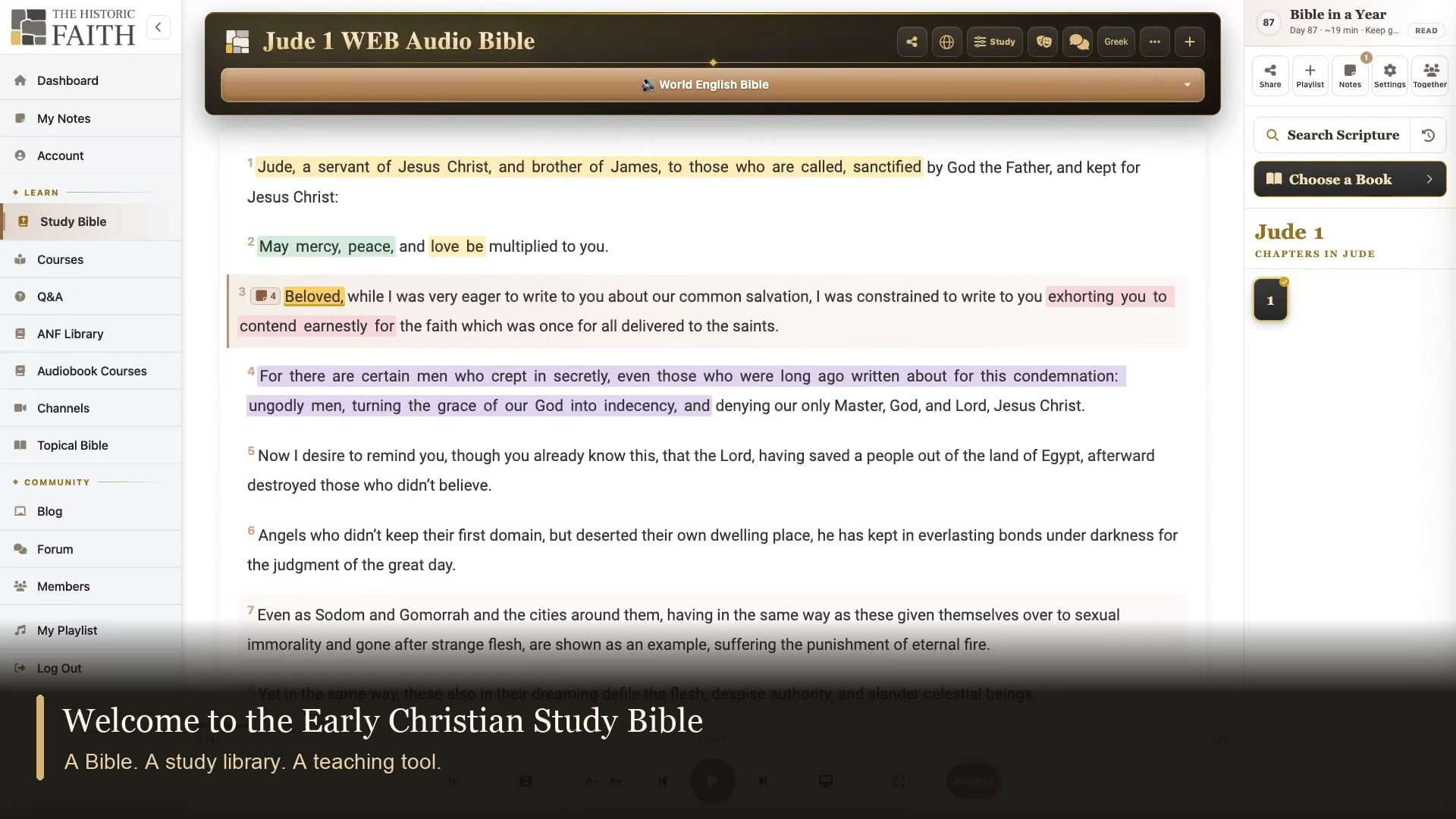 Words. Writings.
Guided tour · 21:50 · Several Bible editions.
See the phone experience · 5:31
Strong's Exhaustive Concordance, first published by James Strong in 1890, indexes every word of the King James Version and assigns each underlying original-language word a number — G1–G5624 for the Greek New Testament and H1–H8674 for the Hebrew Old Testament. Look up any English word, find its Strong's number, and see the Greek or Hebrew word behind it, its definition, and the verses where it occurs. This free online edition covers 14,298 entries with 767,764 indexed occurrences — including the Septuagint, deuterocanonical books, and 1 Enoch, which no print edition of Strong's includes.
These entry points are the quickest way to see how a Strong's number opens into a word, meaning, and Bible usage.
Greek agape, with New Testament and Septuagint usage links where indexed.
Greek kyrios, a major New Testament and Septuagint word-study bridge.
Hebrew reshith, the word behind “beginning” in Genesis 1:1 and other Old Testament usages.
Browse the local Greek and Hebrew Strong's entries in fast pages, open an exact number, or narrow the index by language, range, and usage count.
| Number | Word | Definition | Usages | Range |
|---|---|---|---|---|
|
H5477 — Cuwach
Hebrew
|
סוַּח (Cuwach)
Cuwach
|
Cuwach (soo'-akh) n/p. 1. sweeping 2. Suach, an Israelite | 1 | H5001-H6000 |
|
H5478 — cuwchah
Hebrew
|
סוּחָה (cuwchah)
cuwchah
|
cuwchah (soo-khaw') n-f. 1. something swept away, i.e. filth [from the same as H5477] | 1 | H5001-H6000 |
|
H5479 — Cowtay
Hebrew
|
סוֹטַי (Cowtay)
Cowtay
|
Cowtay (so-tah'-ee) n/p. 1. roving 2. Sotai, one of the Nethinim | 2 | H5001-H6000 |
|
H5480 — cuwk
Hebrew
|
סוּך (cuwk)
cuwk
|
cuwk (sook) v. 1. (properly) to smear over (with oil), i.e. anoint [a primitive root] | 8 | H5001-H6000 |
|
H5481 — cuwmpownyah
Hebrew
|
סוּמפּוֹנְיָה סוּמפּוֹנְיָה סִיפוֹנְיָא (cuwmpownyah)
cuwmpownyah
|
cuwmpownyah (soom-po-neh-yaw') ((Aramaic) or cuwmponyah (Aramaic) {soom-po-neh-yaw'} or ciyphonya) n-f. 1. a wind instrument (with a double pipe), a bagpipe, panpipes [of Greek origin] | 3 | H5001-H6000 |
|
H5482 — Cveneh
Hebrew
|
סְוֵנֵה סְוֵנָה סְוֵן (Cveneh)
Cveneh
|
Cveneh (sev-ay-nay') ((rather to be written Cvenah {sev-ay'-naw} for Cven {sev-ane'} i.e to Seven)) n/l. 1. Seven, a place in Upper Egypt [of Egyptian derivation] | 2 | H5001-H6000 |
|
H5483 — cuwc
Hebrew
|
סוּס סוּס (cuwc)
cuwc
|
cuwc (soos) (or cuc {soos}) n-m. 1. a horse (as leaping) 2. also a swallow (from its rapid flight) | 131 | H5001-H6000 |
|
H5484 — cuwcah
Hebrew
|
סוּסָה (cuwcah)
cuwcah
|
cuwcah (soo-saw') n-f. 1. a mare [feminine of H5483] | 1 | H5001-H6000 |
|
H5485 — Cuwciy
Hebrew
|
סוּסִי (Cuwciy)
Cuwciy
|
Cuwciy (soo-see') n/p. 1. horse-like 2. Susi, an Israelite | 1 | H5001-H6000 |
|
H5486 — cuwph
Hebrew
|
סוּף (cuwph)
cuwph
|
cuwph (soof) v. 1. to snatch away, i.e. terminate [a primitive root] | 7 | H5001-H6000 |
|
H5487 — cuwph
Hebrew
|
סוּף (cuwph)
cuwph
|
cuwph (soof) v. 1. to come to an end [(Aramaic) corresponding to H5486] | 2 | H5001-H6000 |
|
H5488 — cuwph
Hebrew
|
סוּף (cuwph)
cuwph
|
cuwph (soof) n-m. 1. a reed, especially the papyrus [probably of Egyptian origin] | 28 | H5001-H6000 |
|
H5489 — Cuwph
Hebrew
|
סוּף (Cuwph)
Cuwph
|
Cuwph (soof) n/l. 1. the Reed (Sea) [for H5488 (by ellipsis of H3220)] | 1 | H5001-H6000 |
|
H5490 — cowph
Hebrew
|
סוֹף (cowph)
cowph
|
cowph (sofe) n-m. 1. a termination [from H5486] | 5 | H5001-H6000 |
|
H5491 — cowph
Hebrew
|
סוֹף (cowph)
cowph
|
cowph (sofe) n-m. 1. end [(Aramaic) corresponding to H5490] | 5 | H5001-H6000 |
|
H5492 — cuwphah
Hebrew
|
סוּפָה (cuwphah)
cuwphah
|
cuwphah (soo-faw') n-f. 1. a hurricane [from H5486] | 16 | H5001-H6000 |
|
H5493 — cuwr
Hebrew
|
סוּר שׂוּר (cuwr)
cuwr
|
cuwr (soor) (or suwr (Hosea 9:12)) v. 1. to turn off (literal or figurative) [a primitive root] | 282 | H5001-H6000 |
|
H5494 — cuwr
Hebrew
|
סוּר (cuwr)
cuwr
|
cuwr (soor) v-xxp. 1. turned off, i.e. deteriorated [probably passive participle of H5493] | 1 | H5001-H6000 |
|
H5495 — Cuwr
Hebrew
|
סוּר (Cuwr)
Cuwr
|
Cuwr (soor) n/l. 1. Sur, a gate of the temple [the same as H5494] | 1 | H5001-H6000 |
|
H5496 — cuwth
Hebrew
|
סוּת (cuwth)
cuwth
|
cuwth (sooth) v. 1. (properly) to prick 2. (figuratively) stimulate | 18 | H5001-H6000 |
|
H5497 — cuwth
Hebrew
|
סוּת (cuwth)
cuwth
|
cuwth (sooth) n-m. 1. covering, i.e. clothing [probably from the same root as H4533] | 1 | H5001-H6000 |
|
H5498 — cachab
Hebrew
|
סָחַב (cachab)
cachab
|
cachab (saw-khab') v. 1. to trail along [a primitive root] | 5 | H5001-H6000 |
|
H5499 — cchabah
Hebrew
|
סְחָבָה (cchabah)
cchabah
|
cchabah (seh-khaw-baw') n-f. 1. a rag [from H5498] | 2 | H5001-H6000 |
|
H5500 — cachah
Hebrew
|
סָחָה (cachah)
cachah
|
cachah (saw-khaw') v. 1. to sweep away [a primitive root] | 1 | H5001-H6000 |
|
H5501 — cchiy
Hebrew
|
סְחִי (cchiy)
cchiy
|
cchiy (seh-khee') n-m. 1. refuse (as swept off) [from H5500] | 1 | H5001-H6000 |
|
H5502 — cachaph
Hebrew
|
סָחַף (cachaph)
cachaph
|
cachaph (saw-khaf') v. 1. to scrape off [a primitive root] | 2 | H5001-H6000 |
|
H5503 — cachar
Hebrew
|
סָחַר (cachar)
cachar
|
cachar (saw-khar') v. 1. to travel round (specifically as a pedlar) 2. intensively, to palpitate | 20 | H5001-H6000 |
|
H5504 — cachar
Hebrew
|
סַחַר (cachar)
cachar
|
cachar (sakh'-ar) n-m. 1. profit (from trade) [from H5503] | 3 | H5001-H6000 |
|
H5505 — cachar
Hebrew
|
סָחַר (cachar)
cachar
|
cachar (saw-khar') n-m. 1. an emporium 2. abstractly, profit (from trade) | 3 | H5001-H6000 |
|
H5506 — cchorah
Hebrew
|
סְחוֹרָה (cchorah)
cchorah
|
cchorah (sekh-o-raw') n-f. 1. merchandise [from H5503] | 1 | H5001-H6000 |
|
H5507 — cocherah
Hebrew
|
סוֹחֵרָה (cocherah)
cocherah
|
cocherah (so-khay-raw') n-f. 1. something surrounding the person, i.e. a shield [(properly) active participle feminine of H5503] | 1 | H5001-H6000 |
|
H5508 — cochereth
Hebrew
|
סוֹחֶרֶת (cochereth)
cochereth
|
cochereth (so-kheh'-reth) n-f. 1. probably a (black) tile (or tessara) for laying borders with [similar to H5507] | 1 | H5001-H6000 |
|
H5509 — ciyg
Hebrew
|
סִיגּ סוּג (ciyg)
ciyg
|
ciyg (seeg) (or cuwg (Ezekiel 22:18)) n-m. 1. scoria [from H5472 in the sense of refuse] | 7 | H5001-H6000 |
|
H5510 — Ciyvan
Hebrew
|
סִיוָן (Ciyvan)
Ciyvan
|
Ciyvan (see-vawn') n/t. 1. Sivan, the third Heb. month [probably of Persian origin] | 1 | H5001-H6000 |
|
H5511 — Ciychown
Hebrew
|
סִיחוֹן סִיחוֹן (Ciychown)
Ciychown
|
Ciychown (see-khone') (or Ciychon {see-khone'}) n/p. 1. tempestuous 2. Sichon, an Amoritish king | 34 | H5001-H6000 |
|
H5512 — Ciyn
Hebrew
|
סִין (Ciyn)
Ciyn
|
Ciyn (seen) n/l. 1. Sin the name of an Egyptian town and (probably) desert adjoining [of uncertain derivation] | 6 | H5001-H6000 |
|
H5513 — Ciynay
Hebrew
|
סִינִי (Ciynay)
Ciynay
|
Ciynay (see-nee') adj. 1. a Sinite, or descendant of one of the sons of Canaan [from an otherwise unknown name of a man] | 2 | H5001-H6000 |
|
H5514 — Ciynay
Hebrew
|
סִינַי (Ciynay)
Ciynay
|
Ciynay (see-nah'-ee) n/l. 1. Sinai, mountain of Arabia [of uncertain derivation] | 34 | H5001-H6000 |
|
H5515 — Ciyniym
Hebrew
|
סִינִים (Ciyniym)
Ciyniym
|
Ciyniym (see-neem') adj. 1. Sinim, a distant Oriental region [plural of an otherwise unknown name] | 1 | H5001-H6000 |
|
H5516 — Ciycra';
Hebrew
|
סִיסְרָא (Ciycra';)
Ciycra';
|
Ciycra'; (see-ser-aw') n/p. 1. Sisera, the name of a Canaanitish king and of one of the Nethinim [of uncertain derivation] | 19 | H5001-H6000 |
|
H5517 — Ciy`a'
Hebrew
|
סִיעָא סִיעֲהָא (Ciy`a')
Ciy`a'
|
Ciy`a' (see-ah') (or Ciyeahai {see-ah-haw'}) n/p. 1. congregation 2. Sia or Siaha, one of the Nethinim | 2 | H5001-H6000 |
|
H5518 — ciyr
Hebrew
|
סִיר סִירָה סִרָה (ciyr)
ciyr
|
ciyr (seer) (or (feminine) ciyrah {see-raw'} or cirah (Jeremiah 52:18)) n-m. 1. a pot 2. (also) a thorn (as springing up rapidly) | 32 | H5001-H6000 |
|
H5519 — cak
Hebrew
|
סָך (cak)
cak
|
cak (sawk) n-m. 1. (properly) a thicket of men, i.e. a crowd [from H5526] | 1 | H5001-H6000 |
|
H5520 — cok
Hebrew
|
סוֹך (cok)
cok
|
cok (soke) n-m. 1. a hut (as of entwined boughs) 2. also a lair | 4 | H5001-H6000 |
|
H5521 — cukkah
Hebrew
|
סוּכָּה (cukkah)
cukkah
|
cukkah (sook-kaw') n-f. 1. a hut or lair [fem of H5520] | 29 | H5001-H6000 |
|
H5522 — cikkuwth
Hebrew
|
סִכּוּת (cikkuwth)
cikkuwth
|
cikkuwth (sik-kooth') n/p. 1. an (idolatrous) booth [feminine of H5519] | 1 | H5001-H6000 |
|
H5523 — Cukkowth
Hebrew
|
סוּכּוֹת סוּכּוֹת (Cukkowth)
Cukkowth
|
Cukkowth (sook-kohth') (or Cukkoth {sook-kohth'}) n/l. 1. booths 2. Succoth, the name of a place in Egypt and of three in Israel | 16 | H5001-H6000 |
|
H5524
Hebrew
|
סוּכּוֹת בְּנוֹת
|
Cukkowth bnowth (sook-kohth' ben-ohth') n/t. 1. booths of (the) daughters 2. brothels, i.e. idoalatrous tents for impure purpose | 1 | H5001-H6000 |
|
H5525 — Cukkiy
Hebrew
|
סוּכִּי (Cukkiy)
Cukkiy
|
Cukkiy (sook-kee') n/p. 1. a Sukkite, or inhabitant of some place near Egypt (i.e. hut-dwellers) [patrial from an unknown name (perhaps H5520)] | 1 | H5001-H6000 |
|
H5526 — cakak
Hebrew
|
סָכַך שָׂכַך (cakak)
cakak
|
cakak (saw-kak') (or sakak (Exodus 33:22)) v. 1. (properly) to entwine as a screen 2. (by implication) to fence in, cover over | 23 | H5001-H6000 |
|
H5527 — Ckakah
Hebrew
|
סְכָכָה (Ckakah)
Ckakah
|
Ckakah (sek-aw-kaw') n/l. 1. inclosure 2. Secacah, a place in Israel | 1 | H5001-H6000 |
|
H5528 — cakal
Hebrew
|
סָכַל (cakal)
cakal
|
cakal (saw-kal') v. 1. to be silly [for H3688] | 8 | H5001-H6000 |
|
H5529 — cekel
Hebrew
|
סֶכֶל (cekel)
cekel
|
cekel (seh'-kal) n-m. 1. silliness 2. concretely and collectively, dolts | 1 | H5001-H6000 |
|
H5530 — cakal
Hebrew
|
סָכָל (cakal)
cakal
|
cakal (saw-kawl') n-m. 1. silly [from H5528] | 6 | H5001-H6000 |
|
H5531 — cikluwth
Hebrew
|
סִכלוּת שִׂכלוּת (cikluwth)
cikluwth
|
cikluwth (sik-looth') (or sikluwth (Ecclesiastes 1:17)) n-m. 1. silliness [from H5528] | 7 | H5001-H6000 |
|
H5532 — cakan
Hebrew
|
סָכַן (cakan)
cakan
|
cakan (saw-kan') v. 1. to be familiar with 2. (by implication) to minister to, be serviceable to, be customary | 10 | H5001-H6000 |
|
H5533 — cakan
Hebrew
|
סָכַן (cakan)
cakan
|
cakan (saw-kan') v. 1. (properly) to cut, i.e. damage 2. also to grow (causatively, make) poor | 2 | H5001-H6000 |
|
H5534 — caker
Hebrew
|
סָכַר (caker)
caker
|
caker (saw-kar') v. 1. to shut up 2. (by implication) to surrender | 3 | H5001-H6000 |
|
H5535 — cakath
Hebrew
|
סָכַת (cakath)
cakath
|
cakath (saw-kath') v. 1. to be silent 2. (by implication) to observe quietly | 1 | H5001-H6000 |
|
H5536 — cal
Hebrew
|
סַל (cal)
cal
|
cal (sal) n-m. 1. (properly) a willow twig (as pendulous), i.e. an osier 2. but only as woven into a basket | 13 | H5001-H6000 |
|
H5537 — cala'
Hebrew
|
סָלָא (cala')
cala'
|
cala' (saw-law') v. 1. to suspend in a balance, i.e. weigh [a primitive root] | 1 | H5001-H6000 |
|
H5538 — Cilla'
Hebrew
|
סִלָּא (Cilla')
Cilla'
|
Cilla' (sil-law') n-m. 1. an embankment 2. Silla, a place in Jerusalem | 1 | H5001-H6000 |
|
H5539 — calad
Hebrew
|
סָלַד (calad)
calad
|
calad (saw-lad') v. 1. probably to leap (with joy), i.e. exult [a primitive root] | 1 | H5001-H6000 |
|
H5540 — Celed
Hebrew
|
סֶלֶד (Celed)
Celed
|
Celed (seh'-led) n/p. 1. exultation 2. Seled, an Israelite | 1 | H5001-H6000 |
|
H5541 — calah
Hebrew
|
סָלָה (calah)
calah
|
calah (saw-law') v. 1. to hang up, i.e. weigh, or (figuratively) contemn [a primitive root] | 4 | H5001-H6000 |
|
H5542 — celah
Hebrew
|
סֶלָה (celah)
celah
|
celah (seh'-law) v. 1. suspension (of music), i.e. pause [from H5541] | 74 | H5001-H6000 |
|
H5543 — Calluw
Hebrew
|
סַלוּ סַלוּא סָלוּא סַלַּי (Calluw)
Calluw
|
Calluw (sal-loo') (or Calluw {sal-loo'}; or Caluw {sal-loo'}; or Callay {sal-lah'-ee};) n/p. 1. weighed 2. Sallu or Sallai, the name of two Israelites | 6 | H5001-H6000 |
|
H5544 — cillown
Hebrew
|
סִלּוֹן סַלּוֹן (cillown)
cillown
|
cillown (sil-lone') (or callown {sal-one'};) n-m. 1. a prickle (as if pendulous) [from H5541] | 2 | H5001-H6000 |
|
H5545 — calach
Hebrew
|
סָלַח (calach)
calach
|
calach (saw-lakh') v. 1. to forgive [a primitive root] | 45 | H5001-H6000 |
|
H5546 — callach
Hebrew
|
סַלָּח (callach)
callach
|
callach (saw-lawkh') adj. 1. forgiving [from H5545] | 1 | H5001-H6000 |
|
H5547 — cliychah
Hebrew
|
סְלִיחָה (cliychah)
cliychah
|
cliychah (sel-ee-khaw') n-f. 1. pardon [from H5545] | 3 | H5001-H6000 |
|
H5548 — Calkah
Hebrew
|
סַלכָּה (Calkah)
Calkah
|
Calkah (sal-kaw') n/l. 1. walking 2. Salcah, a place East of the Jordan | 4 | H5001-H6000 |
|
H5549 — calal
Hebrew
|
סָלַל (calal)
calal
|
calal (saw-lal') v. 1. to mound up (especially a turnpike) 2. figurative, to exalt | 10 | H5001-H6000 |
|
H5550 — collah
Hebrew
|
סוֹלְלָה סוֹלְלָה (collah)
collah
|
collah (so-lel-aw') (or cowllah {so-lel-aw'}) n-f. 1. a military mound, i.e. rampart of besiegers [active participle feminine of H5549, but used passively] | 11 | H5001-H6000 |
|
H5551 — cullam
Hebrew
|
סוּלָּם (cullam)
cullam
|
cullam (sool-lawm') n-m. 1. a stair-case [from H5549] | 1 | H5001-H6000 |
|
H5552 — calcillah
Hebrew
|
סַלסִלָּה (calcillah)
calcillah
|
calcillah (sal-sil-law') n-f. 1. a twig (as pendulous) [from H5541] | 1 | H5001-H6000 |
|
H5553 — cela`
Hebrew
|
סֶלַע (cela`)
cela`
|
cela` (seh'-lah) n-m. 1. a craggy rock, literally or figuratively (a fortress) [from an unused root meaning to be lofty] | 54 | H5001-H6000 |
|
H5554 — Cela`
Hebrew
|
סֶלַע (Cela`)
Cela`
|
Cela` (seh'-lah) n/l. 1. Sela, the rock-city of Idumaea [the same as H5553] | 2 | H5001-H6000 |
|
H5555
Hebrew
|
סֶלַע הַמַּחלְקוֹת
|
Cela` ham-machlqowth (seh'-lah ham-makh-lek-oth') n/l. 1. rock of the divisions 2. Sela- ham-Machlekoth, a place in Israel | 1 | H5001-H6000 |
|
H5556 — col`am
Hebrew
|
סָלעָם (col`am)
col`am
|
col`am (sol-awm') n-m. 1. a kind of locust (from its destructiveness) [apparently from the same as H5553 in the sense of crushing as with a rock, i.e. consuming] | 1 | H5001-H6000 |
|
H5557 — calaph
Hebrew
|
סָלַף (calaph)
calaph
|
calaph (saw-laf') v. 1. (properly) to wrench, i.e. (figuratively) to subvert [a primitive root] | 7 | H5001-H6000 |
|
H5558 — celeph
Hebrew
|
סֶלֶף (celeph)
celeph
|
celeph (seh'-lef) n-m. 1. distortion, i.e. (figuratively) viciousness [from H5557] | 2 | H5001-H6000 |
|
H5559 — cliq
Hebrew
|
סְלִק (cliq)
cliq
|
cliq (sel-eek') v. 1. to ascend [(Aramaic) a primitive root] | 5 | H5001-H6000 |
|
H5560 — coleth
Hebrew
|
סוֹלֶת (coleth)
coleth
|
coleth (so'-leth) n-f. 1. flour (as chipped off) [from an unused root meaning to strip] | 52 | H5001-H6000 |
|
H5561 — cam
Hebrew
|
סַם (cam)
cam
|
cam (sam) n-m. 1. an aroma [from an unused root meaning to smell sweet] | 15 | H5001-H6000 |
|
H5562
Hebrew
|
סַמגַּר נְבוֹ
|
Camgar Nbow (sam-gar' neb-o') n/p. 1. Samgar-Nebo, a Babylonian general [of foreign origin] | 1 | H5001-H6000 |
|
H5563 — cmadar
Hebrew
|
סְמָדַר (cmadar)
cmadar
|
cmadar (sem-aw-dar') n-m. 1. a vine blossom 2. used also adverbially, abloom | 3 | H5001-H6000 |
|
H5564 — camak
Hebrew
|
סָמַך (camak)
camak
|
camak (saw-mak') v. 1. to prop (literally or figuratively) 2. reflexively, to lean upon or take hold of (in a favorable or unfavorable sense) | 47 | H5001-H6000 |
|
H5565 — Cmakyahuw
Hebrew
|
סְמַכיָהוּ (Cmakyahuw)
Cmakyahuw
|
Cmakyahuw (sem-ak-yaw'-hoo) n/p. 1. supported of Jah 2. Semakjah, an Israelite | 1 | H5001-H6000 |
|
H5566 — cemel
Hebrew
|
סֶמֶל סֵמֶל (cemel)
cemel
|
cemel (seh'-mel) (or cemel {say'-mel}) n-m. 1. a likeness [from an unused root meaning to resemble] | 5 | H5001-H6000 |
|
H5567 — caman
Hebrew
|
סָמַן (caman)
caman
|
caman (saw-man') v. 1. to designate [a primitive root] | 1 | H5001-H6000 |
|
H5568 — camar
Hebrew
|
סָמַר (camar)
camar
|
camar (saw-mar') v. 1. to be erect, i.e. bristle as hair [a primitive root] | 2 | H5001-H6000 |
|
H5569 — camar
Hebrew
|
סָמָר (camar)
camar
|
camar (saw-mar') adj. 1. bristling, i.e. shaggy [from H5568] | 1 | H5001-H6000 |
|
H5570 — Cna'ah
Hebrew
|
סְנָאָה (Cna'ah)
Cna'ah
|
Cna'ah (sen-aw-aw') n/p. 1. thorny 2. Senaah, a place in Israel | 3 | H5001-H6000 |
|
H5571 — Canballat
Hebrew
|
סַנבַּלַּט (Canballat)
Canballat
|
Canballat (san-bal-lat') n/p. 1. Sanballat, a Persian satrap of Samaria [of foreign origin] | 10 | H5001-H6000 |
|
H5572 — cnah
Hebrew
|
סְנֶה (cnah)
cnah
|
cnah (sen-eh') n-m. 1. a bramble [from an unused root meaning to prick] | 4 | H5001-H6000 |
|
H5573 — Ceneh
Hebrew
|
סֶנֶה (Ceneh)
Ceneh
|
Ceneh (seh-neh') n/l. 1. thorn 2. Seneh, a crag in Israel | 1 | H5001-H6000 |
|
H5574 — Cnuw'ah
Hebrew
|
סְנוּאָה סְנוּאָה (Cnuw'ah)
Cnuw'ah
|
Cnuw'ah (sen-oo-aw') (or Cnu.ah {sen-oo-aw'}) n/p. 1. pointed 2. (used with the article as a proper name) Senuah, the name of two Israelites | 2 | H5001-H6000 |
|
H5575 — canver
Hebrew
|
סַנוֵר (canver)
canver
|
canver (san-vare') n-m. 1. (in plural) blindness [of uncertain derivation] | 2 | H5001-H6000 |
|
H5576 — Cancheriyb
Hebrew
|
סַנחֵרִיבּ (Cancheriyb)
Cancheriyb
|
Cancheriyb (san-khay-reeb') n/p. 1. Sancherib, an Assyrian king [of foreign origin] | 13 | H5001-H6000 |
|
H5577 — cancin
Hebrew
|
סַנסִן (cancin)
cancin
|
cancin (san-seen') n-m. 1. a twig (as tapering) [from an unused root meaning to be pointed] | 1 | H5001-H6000 |
|
H5578 — Cancannah
Hebrew
|
סַנסַנָּה (Cancannah)
Cancannah
|
Cancannah (san-san-naw') n/p. 1. a bough 2. Sansannah, a place in Israel | 1 | H5001-H6000 |
|
H5579 — cnappiyr
Hebrew
|
סְנַפִּיר (cnappiyr)
cnappiyr
|
cnappiyr (sen-ap-peer') n-m. 1. a fin (collectively) [of uncertain derivation] | 5 | H5001-H6000 |
|
H5580 — cac
Hebrew
|
סָס (cac)
cac
|
cac (sawce) n-m. 1. a moth (from the agility of the fly) [from the same as H5483] | 1 | H5001-H6000 |
|
H5581 — Cicmay
Hebrew
|
סִסמַי (Cicmay)
Cicmay
|
Cicmay (sis-mah'-ee) n/p. 1. Sismai, an Israelite [of uncertain derivation] | 1 | H5001-H6000 |
|
H5582 — ca`ad
Hebrew
|
סָעַד (ca`ad)
ca`ad
|
ca`ad (saw-ad') v. 1. to suport (mostly figurative) [a primitive root] | 12 | H5001-H6000 |
|
H5583 — c`ad
Hebrew
|
סְעַד (c`ad)
c`ad
|
c`ad (seh-ad') v. 1. to aid [(Aramaic) corresponding to H5582] | 1 | H5001-H6000 |
|
H5584 — ca`ah
Hebrew
|
סָעָה (ca`ah)
ca`ah
|
ca`ah (saw-aw') v. 1. to rush [a primitive root] | 1 | H5001-H6000 |
|
H5585 — ca`iyph
Hebrew
|
סָעִיף (ca`iyph)
ca`iyph
|
ca`iyph (saw-eef') n-m. 1. a fissure (of rocks) 2. also a bough (as subdivided) | 6 | H5001-H6000 |
|
H5586 — ca`aph
Hebrew
|
סָעַף (ca`aph)
ca`aph
|
ca`aph (saw-af') v. 1. (properly) to divide up 2. but used only as denominative from H5585, to disbranch (a tree) | 1 | H5001-H6000 |
|
H5587 — ca`iph
Hebrew
|
סָעִף שָׂעִף (ca`iph)
ca`iph
|
ca`iph (saw-eef') (or samiph {saw-eef'}) n-f. 1. divided (in mind), i.e. (abstractly) a sentiment [from H5586] | 3 | H5001-H6000 |
|
H5588 — ce`eph
Hebrew
|
סֵעֵף (ce`eph)
ce`eph
|
ce`eph (say-afe') adj. 1. divided (in mind), i.e. (concretely) a skeptic [from H5586] | 1 | H5001-H6000 |
|
H5589 — c`appah
Hebrew
|
סְעַפָּה (c`appah)
c`appah
|
c`appah (seh-ap-paw') n-f. 1. a twig [feminine of H5585] | 2 | H5001-H6000 |
|
H5590 — ca`ar
Hebrew
|
סָעַר (ca`ar)
ca`ar
|
ca`ar (saw-ar') v. 1. to rush upon 2. (by implication) to toss | 7 | H5001-H6000 |
|
H5591 — ca`ar
Hebrew
|
סַעַר סְעָרָה (ca`ar)
ca`ar
|
ca`ar (sah'-ar) (or (feminine) ctarah {seh-aw-raw'}) n-e. 1. a hurricane [from H5590] | 22 | H5001-H6000 |
|
H5592 — caph
Hebrew
|
סַף (caph)
caph
|
caph (saf) n-m. 1. a vestibule (as a limit) 2. also a dish (for holding blood or wine) | 28 | H5001-H6000 |
|
H5593 — Caph
Hebrew
|
סַף (Caph)
Caph
|
Caph (saf) n/p. 1. Saph, a Philistine [the same as H5592] | 1 | H5001-H6000 |
|
H5594 — caphad
Hebrew
|
סָפַד (caphad)
caphad
|
caphad (saw-fad') v. 1. (properly) to tear the hair and beat the breasts (as Orientals do in grief) 2. (generally) to lament | 29 | H5001-H6000 |
|
H5595 — caphah
Hebrew
|
סָפָה (caphah)
caphah
|
caphah (saw-faw') v. 1. (properly) to scrape 2. (literally) to shave | 20 | H5001-H6000 |
|
H5596 — caphach
Hebrew
|
סָפַח שָׂפַח (caphach)
caphach
|
caphach (saw-fakh') (or saphach (Isaiah 3:17)) v. 1. (properly) to scrape out, but in certain peculiar senses (of removal or association) [a primitive root] | 6 | H5001-H6000 |
|
H5597 — cappachath
Hebrew
|
סַפַּחַת (cappachath)
cappachath
|
cappachath (sap-pakh'-ath) n-f. 1. the mange (as making the hair fall off) [from H5596] | 2 | H5001-H6000 |
|
H5598 — Cippay
Hebrew
|
סִפַּי (Cippay)
Cippay
|
Cippay (sip-pah'-ee) n/p. 1. bason-like 2. Sippai, a Philistine | 1 | H5001-H6000 |
|
H5599 — caphiyach
Hebrew
|
סָפִיַח (caphiyach)
caphiyach
|
caphiyach (saw-fee'-akh) n-m. 1. something (spontaneously) falling off, i.e. a self-sown crop 2. (figuratively) a freshet | 5 | H5001-H6000 |
|
H5600 — cphiynah
Hebrew
|
סְפִינָה (cphiynah)
cphiynah
|
cphiynah (sef-ee-naw') n-f. 1. a (sea-going) vessel (as ceiled with a deck) [from H5603] | 1 | H5001-H6000 |
|
H5601 — cappiyr
Hebrew
|
סַפִּיר (cappiyr)
cappiyr
|
cappiyr (sap-peer') n-m. 1. a gem (perhaps used for scratching other substances), probably the sapphire [from H5608] | 11 | H5001-H6000 |
|
H5602 — cephel
Hebrew
|
סֵפֶל (cephel)
cephel
|
cephel (say'-fel) n-m. 1. a basin (as deepened out) [from an unused root meaning to depress] | 2 | H5001-H6000 |
|
H5603 — caphan
Hebrew
|
סָפַן (caphan)
caphan
|
caphan (saw-fan') v. 1. to hide by covering 2. specifically, to roof (passive participle as noun, a roof) or wainscot | 6 | H5001-H6000 |
|
H5604 — cippun
Hebrew
|
סִפּוּן (cippun)
cippun
|
cippun (sip-poon') n-m. 1. a wainscot [from H5603] | 1 | H5001-H6000 |
|
H5605 — caphaph
Hebrew
|
סָפַף (caphaph)
caphaph
|
caphaph (saw-faf') v. 1. (properly) to snatch away, i.e. terminate 2. but used only as denominative from H5592 (in the sense of a vestibule), to wait at the threshold | 1 | H5001-H6000 |
|
H5606 — caphaq
Hebrew
|
סָפַק שָׂפַק (caphaq)
caphaq
|
caphaq (saw-fak') (or saphaq (1 Kings 20:10; Job 27:23; Isaiah 2:6)) v. 1. to clap the hands (in token of compact, derision, grief, indignation, or punishment) 2. (by implication) of satisfaction, to be enough | 10 | H5001-H6000 |
|
H5607 — cepheq
Hebrew
|
סֵפֶק שֶׂפֶק (cepheq)
cepheq
|
cepheq (say'-fek) (or sepheq (Job 20:22; Job 36:18)) n-m. 1. chastisement 2. also satiety | 2 | H5001-H6000 |
|
H5608 — caphar
Hebrew
|
סָפַר (caphar)
caphar
|
caphar (saw-far') n-m. 1. (properly) to score with a mark as a tally or record 2. (by implication) to inscribe, and also to enumerate | 154 | H5001-H6000 |
|
H5609 — cphar
Hebrew
|
סְפַר (cphar)
cphar
|
cphar (sef-ar') n-m. 1. a book [(Aramaic) from a root corresponding to H5608] | 4 | H5001-H6000 |
|
H5610 — cphar
Hebrew
|
סְפָר (cphar)
cphar
|
cphar (sef-awr') n-m. 1. a census [from H5608] | 1 | H5001-H6000 |
|
H5611 — Cphar
Hebrew
|
סְפָר (Cphar)
Cphar
|
Cphar (sef-awr') n/l. 1. Sephar, a place in Arabia [the same as H5610] | 1 | H5001-H6000 |
|
H5612 — cepher
Hebrew
|
סֵפֶר סִפרָה (cepher)
cepher
|
cepher (say'-fer) (or (feminine) ciphrah (Psa. 56)) n-e. 1. (properly) writing (the art or a document) 2. (by implication) a book | 174 | H5001-H6000 |
|
H5613 — capher
Hebrew
|
סָפֵר (capher)
capher
|
capher (saw-fare') n-m. 1. a scribe (secular or sacred) [(Aramaic) from the same as H5609] | 6 | H5001-H6000 |
|
H5614 — Cpharad
Hebrew
|
סְפָרָד (Cpharad)
Cpharad
|
Cpharad (sef-aw-rawd') n/l. 1. Sepharad, a region of Assyria [of foreign derivation] | 1 | H5001-H6000 |
|
H5615 — cphorah
Hebrew
|
סְפוֹרָה (cphorah)
cphorah
|
cphorah (sef-o-raw') n-f. 1. a numeration [from H5608] | 1 | H5001-H6000 |
|
H5616 — Cpharviy
Hebrew
|
סְפַרוִי (Cpharviy)
Cpharviy
|
Cpharviy (sef-ar-vee') adj. 1. a Sepharvite or inhabitant of Sepharvain [patrial from H5617] | 1 | H5001-H6000 |
|
H5617 — Cpharvayim
Hebrew
|
סְפַרוַיִם סְפָרִים (Cpharvayim)
Cpharvayim
|
Cpharvayim (sef-ar-vah'-yim) (or Sepharim) n/l. 1. a place in Assyria [of foreign derivation] | 6 | H5001-H6000 |
|
H5618 — Cophereth
Hebrew
|
סוֹפֶרֶת (Cophereth)
Cophereth
|
Cophereth (so-feh'-reth) n/p. 1. (properly, female) a scribe 2. Sophereth, a temple servant | 2 | H5001-H6000 |
|
H5619 — caqal
Hebrew
|
סָקַל (caqal)
caqal
|
caqal (saw-kal') v. 1. (properly) to be weighty 2. but used only in the sense of lapidation or its contrary (as if a delapidation) | 20 | H5001-H6000 |
|
H5620 — car
Hebrew
|
סַר (car)
car
|
car (sar) adj. 1. peevish [contracted from H5637] | 3 | H5001-H6000 |
|
H5621 — carab
Hebrew
|
סָרָב (carab)
carab
|
carab (saw-rawb') n-m. 1. a thistle [from an unused root meaning to sting] | 1 | H5001-H6000 |
|
H5622 — carbal
Hebrew
|
סַרבַּל (carbal)
carbal
|
carbal (sar-bal') n-m. 1. a cloak [(Aramaic) of uncertain derivation] | 2 | H5001-H6000 |
|
H5623 — Cargown
Hebrew
|
סַרגּוֹן (Cargown)
Cargown
|
Cargown (sar-gone') n/p. 1. Sargon, an Assyrian king [of foreign derivation] | 1 | H5001-H6000 |
|
H5624 — Cered
Hebrew
|
סֶרֶד (Cered)
Cered
|
Cered (seh'-red) n/p. 1. trembling 2. Sered, an Israelite | 2 | H5001-H6000 |
|
H5625 — Cardiy
Hebrew
|
סַרדִּי (Cardiy)
Cardiy
|
Cardiy (sar-dee') adj. 1. a Seredite (collectively) or descendants of Sered [patron from H5624] | 1 | H5001-H6000 |
|
H5626 — Cirah
Hebrew
|
סִרָה (Cirah)
Cirah
|
Cirah (see-raw') n/l. 1. departure 2. Sirah, a cistern so-called | 1 | H5001-H6000 |
No Strong's entries match that search.
Strong's works best when the number, original word, verse, and corpus stay connected.
Open a chapter and move from a word token to its Strong's page, parsing, and linked occurrences.
Greek Strong's entries can include New Testament, Septuagint, deuterocanonical, and 1 Enoch rows where indexed.
Dedicated Strong's pages can expose approved pronunciation audio beside the word-study data.
These are common words readers run into repeatedly, shown with an English meaning so the list is readable without already knowing the original languages.
Look up a word study by its transliteration — these are frequently searched Hebrew and Greek words. Each opens the matching Strong's entry, or lists the options when a spelling maps to several words.