
G26 — Agape (Love)
Greek agape, with New Testament and Septuagint usage links where indexed.
The Early Christian Study Bible · Free to use
Study the word. Hear its pronunciation.
Search 14,298 Greek and Hebrew entries—free. Explore definitions, indexed occurrences, and pronunciation audio where available, then follow the words back into your Bible.
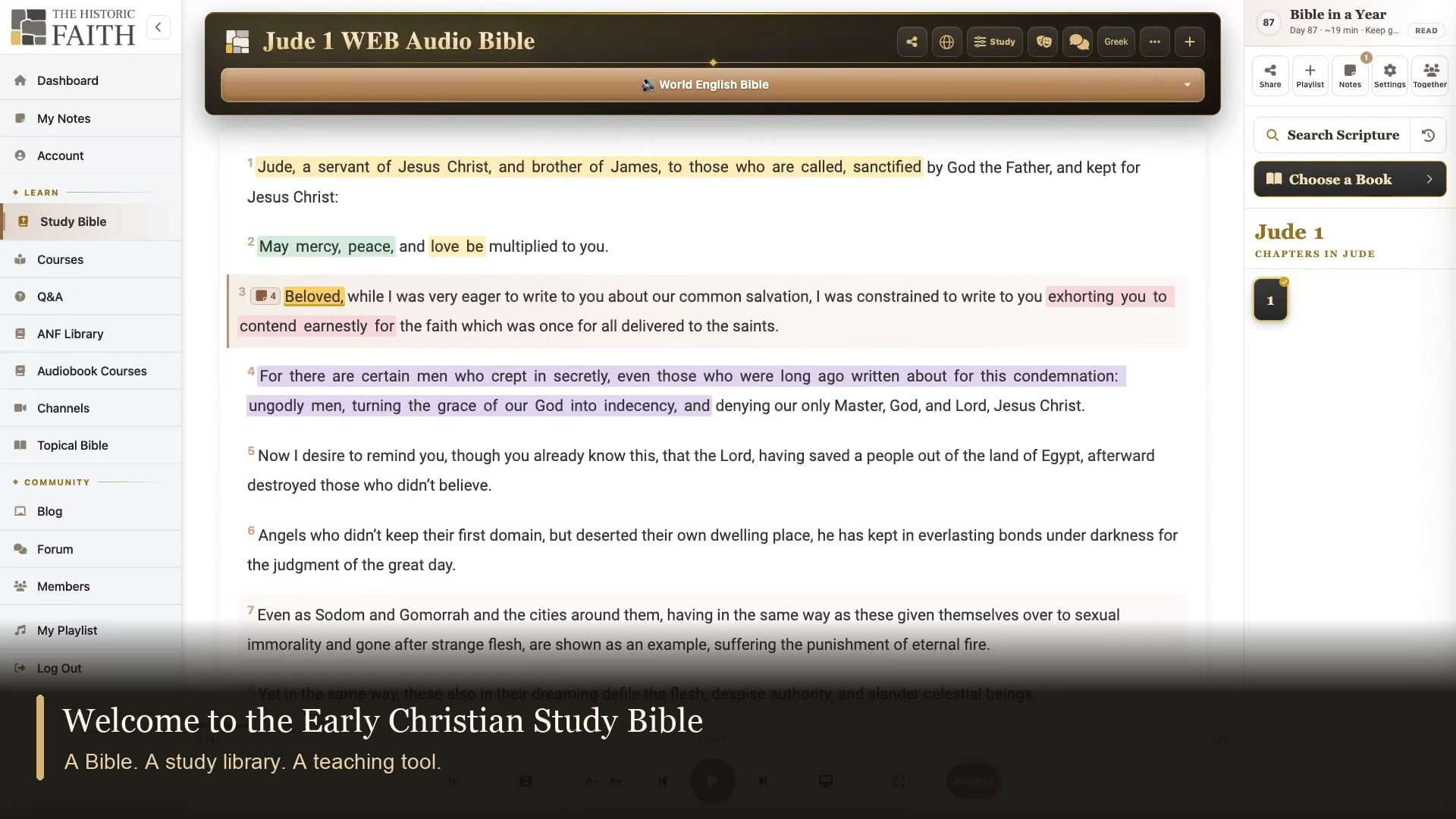
Click a word. Hear its pronunciation. Open the early Christian writings. Then see how to present and teach.
 Words. Writings.
Guided tour · 21:50 · Several Bible editions.
See the phone experience · 5:31
Strong's Exhaustive Concordance, first published by James Strong in 1890, indexes every word of the King James Version and assigns each underlying original-language word a number — G1–G5624 for the Greek New Testament and H1–H8674 for the Hebrew Old Testament. Look up any English word, find its Strong's number, and see the Greek or Hebrew word behind it, its definition, and the verses where it occurs. This free online edition covers 14,298 entries with 767,764 indexed occurrences — including the Septuagint, deuterocanonical books, and 1 Enoch, which no print edition of Strong's includes.
These entry points are the quickest way to see how a Strong's number opens into a word, meaning, and Bible usage.
Greek agape, with New Testament and Septuagint usage links where indexed.
Greek kyrios, a major New Testament and Septuagint word-study bridge.
Hebrew reshith, the word behind “beginning” in Genesis 1:1 and other Old Testament usages.
Browse the local Greek and Hebrew Strong's entries in fast pages, open an exact number, or narrow the index by language, range, and usage count.
| Number | Word | Definition | Usages | Range |
|---|---|---|---|---|
|
H2177 — zan
Hebrew
|
זַן (zan)
zan
|
zan (zan) n-m. 1. (properly) nourished (or fully developed), i.e. a form or sort [from H2109] | 2 | H2001-H3000 |
|
H2178 — zan
Hebrew
|
זַן (zan)
zan
|
zan (zan) n-m. 1. sort [(Aramaic) corresponding to H2177] | 4 | H2001-H3000 |
|
H2179 — zanab
Hebrew
|
זָנַב (zanab)
zanab
|
zanab (zaw-nab') v. 1. to curtail, i.e. cut off the rear [a primitive root meaning to wag, used only as a denominative from H2180] | 2 | H2001-H3000 |
|
H2180 — zanab
Hebrew
|
זָנָב (zanab)
zanab
|
zanab (zaw-nawb') n-m. 1. the tail (literally or figuratively) [from H2179 (in the original sense of flapping)] | 9 | H2001-H3000 |
|
H2181
Hebrew
|
הַכְזוֹנָ֕ה
|
zanah (zaw-naw') v. 1. to commit adultery (usually of the female, and less often of simple fornication, rarely of involuntary ravishment) 2. figuratively, to commit idolatry (the Jewish people being regarded as the spouse of Jehovah) | 82 | H2001-H3000 |
|
H2182 — Zanowach
Hebrew
|
זָנוַֹח (Zanowach)
Zanowach
|
Zanowach (zaw-no'-akh) n/l. 1. rejected 2. Zanoach, the name of two places in Israel | 5 | H2001-H3000 |
|
H2183 — zanuwn
Hebrew
|
זָנוּן (zanuwn)
zanuwn
|
zanuwn (zaw-noon') n-m. 1. adultery 2. (figuratively) idolatry | 10 | H2001-H3000 |
|
H2184 — znuwth
Hebrew
|
זְנוּת (znuwth)
znuwth
|
znuwth (zen-ooth') n-f. 1. adultery, i.e. (figuratively) infidelity, idolatry [from H2181] | 9 | H2001-H3000 |
|
H2185 — zonowth
Hebrew
|
זוֹנוֹת (zonowth)
zonowth
|
zonowth (zo-noth') n-f. 1. harlots [regarded by some as if from H2109 or an unused root, and applied to military equipments, but evidently the feminine plural active participle of H2181] | 1 | H2001-H3000 |
|
H2186 — zanach
Hebrew
|
זָנַח (zanach)
zanach
|
zanach (zaw-nakh') v. 1. cast away (off), remove far away (off) [a primitive root meaning to push aside, i.e. reject, forsake, fail] | 20 | H2001-H3000 |
|
H2187 — zanaq
Hebrew
|
זָנַק (zanaq)
zanaq
|
zanaq (zaw-nak') v. 1. (properly) to draw together the feet (as an animal about to dart upon its prey), i.e. to spring forward [a primitive root] | 1 | H2001-H3000 |
|
H2188 — ze`ah
Hebrew
|
זֵעָה (ze`ah)
ze`ah
|
ze`ah (zay-aw') n-f. 1. perspiration [from H2111 (in the sense of H3154)] | 1 | H2001-H3000 |
|
H2189 — za`avah
Hebrew
|
זַעֲוָה (za`avah)
za`avah
|
za`avah (zah-av-aw') n-f. 1. agitation, maltreatment [by transposition for H2113] | 2 | H2001-H3000 |
|
H2190 — Za`avan
Hebrew
|
זַעֲוָן (Za`avan)
Za`avan
|
Za`avan (zah-av-awn') n/p. 1. disquiet 2. Zaavan, an Idumaean | 2 | H2001-H3000 |
|
H2191 — ze`eyr
Hebrew
|
זְעֵיר (ze`eyr)
ze`eyr
|
ze`eyr (zeh-ayr') n-m. 1. small [from an unused root (akin (by permutation) to H6819), meaning to dwindle] | 3 | H2001-H3000 |
|
H2192 — z`eyr
Hebrew
|
זְעֵיר (z`eyr)
z`eyr
|
z`eyr (zeh-ayr') adj. 1. little [(Aramaic) corresponding to H2191] | 1 | H2001-H3000 |
|
H2193 — za`ak
Hebrew
|
זָעַך (za`ak)
za`ak
|
za`ak (zaw-ak') v. 1. to extinguish [a primitive root] | 1 | H2001-H3000 |
|
H2194 — za`am
Hebrew
|
זָעַם (za`am)
za`am
|
za`am (zaw-am') v. 1. (properly) to foam at the mouth, i.e. to be enraged [a primitive root] | 11 | H2001-H3000 |
|
H2195 — za`am
Hebrew
|
זַעַם (za`am)
za`am
|
za`am (zah'-am) n-m. 1. strictly froth at the mouth, i.e. (figuratively) fury (especially of God's displeasure with sin) [from H2194] | 22 | H2001-H3000 |
|
H2196 — za`aph
Hebrew
|
זָעַף (za`aph)
za`aph
|
za`aph (zaw-af') v. 1. (properly) to boil up, i.e. (figuratively) to be peevish or angry [a primitive root] | 4 | H2001-H3000 |
|
H2197 — za`aph
Hebrew
|
זַעַף (za`aph)
za`aph
|
za`aph (zah'-af) n-m. 1. anger [from H2196] | 6 | H2001-H3000 |
|
H2198 — za`eph
Hebrew
|
זָעֵף (za`eph)
za`eph
|
za`eph (zaw-afe') adj. 1. angry [from H2196] | 2 | H2001-H3000 |
|
H2199 — za`aq
Hebrew
|
זָעַק (za`aq)
za`aq
|
za`aq (zaw-ak') v. 1. to shriek (from anguish or danger) 2. by analogy, (as a herald) to announce or convene publicly | 73 | H2001-H3000 |
|
H2200 — z`iq
Hebrew
|
זְעִק (z`iq)
z`iq
|
z`iq (zek'-eek) v. 1. to make an outcry [(Aramaic) corresponding to H2199] | 1 | H2001-H3000 |
|
H2201 — za`aq
Hebrew
|
זַעַק זְעָקָה (za`aq)
za`aq
|
za`aq (zah'-ak) (and (feminine) zoaqah {zeh-aw-kaw'}) n-f. 1. a shriek or outcry [from H2199] | 18 | H2001-H3000 |
|
H2202 — Ziphron
Hebrew
|
זִפרוֹן (Ziphron)
Ziphron
|
Ziphron (zi-frone') n/l. 1. Ziphron, a place in Israel [from an unused root (meaning to be fragrant)] | 1 | H2001-H3000 |
|
H2203 — zepheth
Hebrew
|
זֶפֶת (zepheth)
zepheth
|
zepheth (zeh'-feth) n-f. 1. asphalt (from its tendency to soften in the sun) [from an unused root (meaning to liquify)] | 2 | H2001-H3000 |
|
H2204 — zaqen
Hebrew
|
זָקֵן (zaqen)
zaqen
|
zaqen (zaw-kane') v. 1. to be old [a primitive root] | 26 | H2001-H3000 |
|
H2205 — zaqen
Hebrew
|
זָקֵן (zaqen)
zaqen
|
zaqen (zaw-kane') adj. 1. old [from H2204] | 171 | H2001-H3000 |
|
H2206 — zaqan
Hebrew
|
זָקָן (zaqan)
zaqan
|
zaqan (zaw-kawn') n-m. 1. the beard (as indicating age) [from H2204] | 18 | H2001-H3000 |
|
H2207 — zoqen
Hebrew
|
זוֹקֶן (zoqen)
zoqen
|
zoqen (zo'-ken) n-m. 1. old age [from H2204] | 1 | H2001-H3000 |
|
H2208 — zaqun
Hebrew
|
זָקוּן (zaqun)
zaqun
|
zaqun (zaw-koon') n-m. 1. old age [(properly) passive participle of H2204 (used only in the plural as a noun)] | 4 | H2001-H3000 |
|
H2209 — ziqnah
Hebrew
|
זִקנָה (ziqnah)
ziqnah
|
ziqnah (zik-naw') n-f. 1. old age [feminine of H2205] | 6 | H2001-H3000 |
|
H2210 — zaqaph
Hebrew
|
זָקַף (zaqaph)
zaqaph
|
zaqaph (zaw-kaf') v. 1. to life, i.e. (figuratively) comfort [a primitive root] | 2 | H2001-H3000 |
|
H2211 — zqaph
Hebrew
|
זְקַף (zqaph)
zqaph
|
zqaph (zek-af') v. 1. to hang, i.e. impale [(Aramaic) corresponding to H2210] | 1 | H2001-H3000 |
|
H2212 — zaqaq
Hebrew
|
זָקַק (zaqaq)
zaqaq
|
zaqaq (zaw-kak') v. 1. to strain, (figuratively) extract, clarify [a primitive root] | 7 | H2001-H3000 |
|
H2213 — zer
Hebrew
|
זֵר (zer)
zer
|
zer (zare) n-m. 1. a chaplet (as spread around the top), i.e. (specifically) a border moulding [from H2237 (in the sense of scattering)] | 10 | H2001-H3000 |
|
H2214 — zara'
Hebrew
|
זָרָא (zara')
zara'
|
zara' (zaw-raw') n-m. 1. disgust [from H2114 (in the sense of estrangement)] | 1 | H2001-H3000 |
|
H2215 — zarab
Hebrew
|
זָרַב (zarab)
zarab
|
zarab (zaw-rab') v. 1. to flow away [a primitive root] | 1 | H2001-H3000 |
|
H2216 — Zrubbabel
Hebrew
|
זְרוּבָּבֶל (Zrubbabel)
Zrubbabel
|
Zrubbabel (zer-oob-baw-bel') n/p. 1. descended of (i.e. from) Babylon, i.e. born there 2. Zerubbabel, an Israelite | 20 | H2001-H3000 |
|
H2217 — Zrubbabel
Hebrew
|
זְרוּבָּבֶל (Zrubbabel)
Zrubbabel
|
Zrubbabel (zer-oob-baw-bel') n/p. 1. Zerubbabel [(Aramaic) corresponding to H2216] | 1 | H2001-H3000 |
|
H2218 — Zered
Hebrew
|
זֶרֶד (Zered)
Zered
|
Zered (zeh'-red) n/l. 1. lined with shrubbery 2. Zered, a brook East of the Dead Sea | 3 | H2001-H3000 |
|
H2219 — zarah
Hebrew
|
זָרָה (zarah)
zarah
|
zarah (zaw-raw') v. 1. to toss about 2. (by implication) to diffuse, winnow | 38 | H2001-H3000 |
|
H2220 — zrowa`
Hebrew
|
זְרוַֹע זְרוַֹע זְרוֹעָה זְרוֹעָה (zrowa`)
zrowa`
|
zrowa` (zer-o'-ah) (or (shortened) zroao {zer-o'-ah} and (feminine) zrowpah {zer-o-aw'}; or zrowah {zer-o-aw'};) n-f. 1. the arm (as stretched out), or (of animals) the foreleg 2. (figuratively) force | 84 | H2001-H3000 |
|
H2221 — zeruwa`
Hebrew
|
זֵרוַּע (zeruwa`)
zeruwa`
|
zeruwa` (zay-roo'-ah) n-m. 1. something sown, i.e. a plant [from H2232] | 2 | H2001-H3000 |
|
H2222 — zarziyph
Hebrew
|
זַרזִיף (zarziyph)
zarziyph
|
zarziyph (zar-zeef') v. 1. a pouring rain [by reduplication from an unused root meaning to flow] | 1 | H2001-H3000 |
|
H2223 — zarziyr
Hebrew
|
זַרזִיר (zarziyr)
zarziyr
|
zarziyr (zar-zeer') n-m. 1. (properly) tightly girt, i.e. probably a racer, or some fleet animal (as being slender in the waist) [by reduplication from H2115] | 1 | H2001-H3000 |
|
H2224 — zarach
Hebrew
|
זָרַח (zarach)
zarach
|
zarach (zaw-rakh') v. 1. (properly) to irradiate (or shoot forth beams), i.e. to rise (as the sun) 2. specifically, to appear (as a symptom of leprosy) | 17 | H2001-H3000 |
|
H2225 — zerach
Hebrew
|
זֶרַח (zerach)
zerach
|
zerach (zeh'-rakh) n-m. 1. a rising of light [from H2224] | 1 | H2001-H3000 |
|
H2226 — Zerach
Hebrew
|
זֶרַח (Zerach)
Zerach
|
Zerach (zeh'-rakh) n/p. 1. Zerach, the name of three Israelites, also of an Idumaean and an Ethiopian prince [the same as H2225] | 21 | H2001-H3000 |
|
H2227 — Zarchiy
Hebrew
|
זַרחִי (Zarchiy)
Zarchiy
|
Zarchiy (zar-khee') n-m. 1. a Zarchite or descendant of Zerach [patronymically from H2226] | 5 | H2001-H3000 |
|
H2228 — Zrachyah
Hebrew
|
זְרַחיָה (Zrachyah)
Zrachyah
|
Zrachyah (zer-akh-yaw') n/p. 1. Jah has risen [from H2225 and H3050] | 4 | H2001-H3000 |
|
H2229 — zaram
Hebrew
|
זָרַם (zaram)
zaram
|
zaram (zaw-ram') v. 1. to gush (as water) [a primitive root] | 2 | H2001-H3000 |
|
H2230 — zerem
Hebrew
|
זֶרֶם (zerem)
zerem
|
zerem (zeh'-rem) n-m. 1. a gush of water [from H2229] | 7 | H2001-H3000 |
|
H2231 — zirmah
Hebrew
|
זִרמָה (zirmah)
zirmah
|
zirmah (zir-maw') n-f. 1. a gushing of fluid (semen) [feminine of H2230] | 1 | H2001-H3000 |
|
H2232 — zara`
Hebrew
|
זָרַע (zara`)
zara`
|
zara` (zaw-rah') v. 1. to sow 2. (figuratively) to disseminate, plant, fructify | 54 | H2001-H3000 |
|
H2233 — zera`
Hebrew
|
זֶרַע (zera`)
zera`
|
zera` (zeh'-rah) n-m. 1. seed 2. (figuratively) fruit, plant, sowing-time, posterity | 205 | H2001-H3000 |
|
H2234 — zra`
Hebrew
|
זְרַע (zra`)
zra`
|
zra` (zer-ah') n-m. 1. posterity [(Aramaic) corresponding to H2233] | 1 | H2001-H3000 |
|
H2235 — zeroa`
Hebrew
|
זֵרוַֹע זֵרָעוֹן (zeroa`)
zeroa`
|
zeroa` (zay-ro'-ah) (or zeraSon {zay-raw-ohn'}) n-m. 1. something sown (only in the plural), i.e. a vegetable (as food) [from H2232] | 2 | H2001-H3000 |
|
H2236 — zaraq
Hebrew
|
זָרַק (zaraq)
zaraq
|
zaraq (zaw-rak') v. 1. to sprinkle (fluid or solid particles) [a primitive root] | 33 | H2001-H3000 |
|
H2237 — zarar
Hebrew
|
זָרַר (zarar)
zarar
|
zarar (zaw-rar') v. 1. perhaps to diffuse, i.e. (specifically) to sneeze [a primitive root] | 1 | H2001-H3000 |
|
H2238 — Zeresh
Hebrew
|
זֶרֶשׁ (Zeresh)
Zeresh
|
Zeresh (zeh'-resh) n/p. 1. Zeresh, Haman's wife [of Persian origin] | 3 | H2001-H3000 |
|
H2239 — zereth
Hebrew
|
זֶרֶת (zereth)
zereth
|
zereth (zeh'-reth) n-f. 1. the spread of the fingers, i.e. a span [from H2219] | 5 | H2001-H3000 |
|
H2240 — Zattuw'
Hebrew
|
זַתּתּוּא (Zattuw')
Zattuw'
|
Zattuw' (zat-too') n/p. 1. Zattu, an Israelite [of uncertain derivation] | 4 | H2001-H3000 |
|
H2241 — Zetham
Hebrew
|
זֵתָם (Zetham)
Zetham
|
Zetham (zay-thawm') n/p. 1. Zetham, an &Š Israelite [apparently a variation for H2133] | 2 | H2001-H3000 |
|
H2242 — Zethar
Hebrew
|
זֵתַר (Zethar)
Zethar
|
Zethar (zay-thar') n/p. 1. Zethar, a eunuch of Xerxes [of Persian origin] | 1 | H2001-H3000 |
|
H2243 — chob
Hebrew
|
חוֹב (chob)
chob
|
chob (khobe) n-m. 1. (properly) a cherisher, i.e. the bosom [by contraction from H2245] | 1 | H2001-H3000 |
|
H2244 — chaba'
Hebrew
|
חָבָא (chaba')
chaba'
|
chaba' (khaw-baw') v. 1. to secrete [a primitive root] | 33 | H2001-H3000 |
|
H2245 — chabab
Hebrew
|
חָבַב (chabab)
chabab
|
chabab (khaw-bab') v. 1. (properly) to hide (as in the bosom), i.e. to cherish (with affection) [a primitive root] | 1 | H2001-H3000 |
|
H2246 — Chobab
Hebrew
|
חוֹבָב (Chobab)
Chobab
|
Chobab (kho-bawb') n/p. 1. cherished 2. Chobab, father-in-law of Moses | 2 | H2001-H3000 |
|
H2247 — chabah
Hebrew
|
חָבָה (chabah)
chabah
|
chabah (khaw-bah') v. 1. to secrete [a primitive root] | 5 | H2001-H3000 |
|
H2248 — chabuwlah
Hebrew
|
חֲבוּלָה (chabuwlah)
chabuwlah
|
chabuwlah (khab-oo-law') n-m. 1. (properly) overthrown, i.e. (morally) crime [(Aramaic) from H2255] | 1 | H2001-H3000 |
|
H2249 — Chabowr
Hebrew
|
חָבוֹר (Chabowr)
Chabowr
|
Chabowr (khaw-bore') n/l. 1. united 2. Chabor, a river of Assyria | 3 | H2001-H3000 |
|
H2250 — chabbuwrah
Hebrew
|
חַבּוּרָה חַבּוּרָה חֲבוּרָה (chabbuwrah)
chabbuwrah
|
chabbuwrah (khab-boo-raw') (or chabburah {khab-boo-raw'} or chaburah {khab-oo-raw'};) n-f. 1. (properly) bound (with stripes), i.e. a weal (or black-and-blue mark itself) [from H2266] | 6 | H2001-H3000 |
|
H2251 — chabat
Hebrew
|
חָבַט (chabat)
chabat
|
chabat (khaw-bat') v. 1. to knock out or off [a primitive root] | 5 | H2001-H3000 |
|
H2252 — Chabayah
Hebrew
|
חֲבַיָּה חֲבָיָה (Chabayah)
Chabayah
|
Chabayah (khab-ah-yaw') (or Chabayah {khab-aw-yaw'}) n/p. 1. Jah has hidden 2. Chabajah, an Israelite | 2 | H2001-H3000 |
|
H2253 — chebyown
Hebrew
|
חֶביוֹן (chebyown)
chebyown
|
chebyown (kheb-yone') n-m. 1. a concealment [from H2247] | 1 | H2001-H3000 |
|
H2254 — chabal
Hebrew
|
חָבַל (chabal)
chabal
|
chabal (khaw-bal') v. 1. to wind tightly (as a rope), i.e. to bind 2. specifically, by a pledge | 23 | H2001-H3000 |
|
H2255 — chabal
Hebrew
|
חֲבַל (chabal)
chabal
|
chabal (khab-al') v. 1. to ruin [(Aramaic) corresponding to H2254] | 6 | H2001-H3000 |
|
H2256 — chebel
Hebrew
|
חֶבֶל חֵבֶל (chebel)
chebel
|
chebel (kheh'-bel) (or chebel {khay'-bel}) n-m. 1. a rope (as twisted), especially a measuring line 2. (by implication, as measured) a district or inheritance | 60 | H2001-H3000 |
|
H2257 — chabal
Hebrew
|
חֲבַל (chabal)
chabal
|
chabal (khab-al') n-m. 1. harm (personal or pecuniary) [(Aramaic) from H2255] | 3 | H2001-H3000 |
|
H2258 — chabol
Hebrew
|
חֲבוֹל חֲבוֹלָה (chabol)
chabol
|
chabol (khab-ole') (or (feminine) chabolah {khab-o-law'}) n-m. 1. a pawn (as security for debt) [from H2254] | 4 | H2001-H3000 |
|
H2259 — chobel
Hebrew
|
חוֹבֵל (chobel)
chobel
|
chobel (kho-bale') n-m. 1. a sailor [active participle from H2254 (in the sense of handling ropes)] | 5 | H2001-H3000 |
|
H2260 — chibbel
Hebrew
|
חִבֵּל (chibbel)
chibbel
|
chibbel (khib-bale') n-m. 1. a mast [from H2254 (in the sense of furnished with ropes)] | 1 | H2001-H3000 |
|
H2261 — chabatstseleth
Hebrew
|
חֲבַצֶּלֶת (chabatstseleth)
chabatstseleth
|
chabatstseleth (khab-ats-tseh'-leth) n-f. 1. probably meadow-saffron [of uncertain derivation] | 2 | H2001-H3000 |
|
H2262 — Chabatstsanyah
Hebrew
|
חֲבַצַּניָה (Chabatstsanyah)
Chabatstsanyah
|
Chabatstsanyah (khab-ats-tsan-yaw') n/p. 1. Chabatstsanjah, a Rechabite [of uncertain derivation] | 1 | H2001-H3000 |
|
H2263 — chabaq
Hebrew
|
חָבַק (chabaq)
chabaq
|
chabaq (khaw-bak') v. 1. to clasp (the hands or in embrace) [a primitive root] | 12 | H2001-H3000 |
|
H2264 — chibbuq
Hebrew
|
חִבּוּק (chibbuq)
chibbuq
|
chibbuq (khib-book') n-m. 1. a clasping of the hands (in idleness) [from H2263] | 2 | H2001-H3000 |
|
H2265 — Chabaqquwq
Hebrew
|
חֲבַקּוּק (Chabaqquwq)
Chabaqquwq
|
Chabaqquwq (khab-ak-kook') n/p. 1. embrace 2. Chabakkuk, the prophet | 2 | H2001-H3000 |
|
H2266 — chabar
Hebrew
|
חָבַר (chabar)
chabar
|
chabar (khaw-bar') v. 1. to join (literally or figuratively) 2. specifically (by means of spells) to fascinate | 24 | H2001-H3000 |
|
H2267 — cheber
Hebrew
|
חֶבֶר (cheber)
cheber
|
cheber (kheh'-ber) n-m. 1. a society 2. also a spell | 7 | H2001-H3000 |
|
H2268 — Cheber
Hebrew
|
חֶבֶר (Cheber)
Cheber
|
Cheber (kheh'-ber) n/p. 1. community 2. Cheber, the name of a Kenite and of three Israelites | 10 | H2001-H3000 |
|
H2269 — chabar
Hebrew
|
חֲבַר (chabar)
chabar
|
chabar (khab-ar') n-m. 1. an associate [(Aramaic) from a root corresponding to H2266] | 3 | H2001-H3000 |
|
H2270 — chaber
Hebrew
|
חָבֵר (chaber)
chaber
|
chaber (khaw-bare') adj. 1. an associate [from H2266] | 11 | H2001-H3000 |
|
H2271 — chabbar
Hebrew
|
חַבָּר (chabbar)
chabbar
|
chabbar (khab-bawr') n-m. 1. a partner [from H2266] | 1 | H2001-H3000 |
|
H2272 — chabarburah
Hebrew
|
חֲבַרבּוּרָה (chabarburah)
chabarburah
|
chabarburah (khab-ar-boo-raw') n-f. 1. a streak (like a line), as on the tiger [by reduplication from H2266] | 1 | H2001-H3000 |
|
H2273 — chabrah
Hebrew
|
חַברָה (chabrah)
chabrah
|
chabrah (khab-raw') n-f. 1. an associate [(Aramaic) feminine of H2269] | 1 | H2001-H3000 |
|
H2274 — chebrah
Hebrew
|
חֶברָה (chebrah)
chebrah
|
chebrah (kheb-raw') n-f. 1. association [feminine of H2267] | 1 | H2001-H3000 |
|
H2275 — Chebrown
Hebrew
|
חֶברוֹן (Chebrown)
Chebrown
|
Chebrown (kheb-rone') n/l. 1. seat of association 2. Chebron, a place in Israel, also the name of two Israelites | 66 | H2001-H3000 |
|
H2276 — Chebrowniy
Hebrew
|
חֶברוֹנִי חֶברוֹנִי (Chebrowniy)
Chebrowniy
|
Chebrowniy (kheb-ro-nee') (or Chebroniy {kheb-ro-nee'}) n-m. 1. Chebronite (collectively), an inhabitant of Chebron [patronymically from H2275] | 5 | H2001-H3000 |
|
H2277 — Chebriy
Hebrew
|
חֶברִי (Chebriy)
Chebriy
|
Chebriy (kheb-ree') n-m. 1. a Chebrite (collectively) or descendants of Cheber [patronymically from H2268] | 1 | H2001-H3000 |
|
H2278 — chabereth
Hebrew
|
חֲבֶרֶת (chabereth)
chabereth
|
chabereth (khab-eh'-reth) n-f. 1. a consort [feminine of H2270] | 1 | H2001-H3000 |
|
H2279 — chobereth
Hebrew
|
חוֹבֶרֶת (chobereth)
chobereth
|
chobereth (kho-beh'-reth) n-f. 1. a joint [feminine active participle of H2266] | 3 | H2001-H3000 |
|
H2280 — chabash
Hebrew
|
חָבַשׁ (chabash)
chabash
|
chabash (khaw-bash') v. 1. to wrap firmly (especially a turban, compress, or saddle) 2. (figuratively) to stop, to rule | 30 | H2001-H3000 |
|
H2281 — chabeth
Hebrew
|
חָבֵת (chabeth)
chabeth
|
chabeth (khaw-bayth') n-m. 1. something fried, probably a griddle-cake [from an unused root probably meaning to cook] | 1 | H2001-H3000 |
|
H2282 — chag
Hebrew
|
חַג חָג (chag)
chag
|
chag (khag) (or chag {khawg}) n-m. 1. a festival, or a victim therefor [from H2287] | 55 | H2001-H3000 |
|
H2283 — chagra'
Hebrew
|
חָגָא (chagra')
chagra'
|
chagra' (khaw-gaw') n-f. 1. (properly) vertigo, i.e. (figuratively) fear [from an unused root meaning to revolve] | 1 | H2001-H3000 |
|
H2284 — chagab
Hebrew
|
חָגָב (chagab)
chagab
|
chagab (khaw-gawb') n-m. 1. a locust [of uncertain derivation] | 5 | H2001-H3000 |
|
H2285 — Chagab
Hebrew
|
חָגָב (Chagab)
Chagab
|
Chagab (khaw-gawb') n/p. 1. locust 2. Chagab, one of the Nethinim | 1 | H2001-H3000 |
|
H2286 — Chagaba'
Hebrew
|
חֲגָבָא חֲגָבָה (Chagaba')
Chagaba'
|
Chagaba' (khag-aw-baw') (or Chagabah {khag-aw-baw'}) n/p. 1. locust 2. Chagaba or Chagabah, one of the Nethinim | 2 | H2001-H3000 |
|
H2287 — chagag
Hebrew
|
חָגַג (chagag)
chagag
|
chagag (khaw-gag') v. 1. (properly) to move in a circle 2. (specifically) to march in a sacred procession, to observe a festival | 14 | H2001-H3000 |
|
H2288 — chagav
Hebrew
|
חֲגָו (chagav)
chagav
|
chagav (khag-awv') n-m. 1. a rift in rocks [from an unused root meaning to take refuge] | 3 | H2001-H3000 |
|
H2289 — chagowr
Hebrew
|
חֲגוֹר (chagowr)
chagowr
|
chagowr (khaw-gore') n-m. 1. belted [from H2296] | 3 | H2001-H3000 |
|
H2290 — chagowr
Hebrew
|
חֲגוֹר חֲגוֹר חֲגוֹרָה חֲגוֹרָה (chagowr)
chagowr
|
chagowr (khag-ore') (or chagor {khag-ore'} and (feminine) chagowrah {khag-o-raw'}; or chagorah {khag-o-raw'};) n/p. 1. a belt (for the waist) [from H2296] | 7 | H2001-H3000 |
|
H2291 — Chaggiy
Hebrew
|
חַגִּי (Chaggiy)
Chaggiy
|
Chaggiy (khag-ghee') adj. 1. festive, Chaggi, an Israelite 2. (patronymically) a Chaggite, or descendant of the same | 2 | H2001-H3000 |
|
H2292 — Chaggay
Hebrew
|
חַגַּי (Chaggay)
Chaggay
|
Chaggay (khag-gah'-ee) n/p. 1. festive 2. Chaggai, a Heb. prophet | 11 | H2001-H3000 |
|
H2293 — Chaggiyah
Hebrew
|
חַגִּיָה (Chaggiyah)
Chaggiyah
|
Chaggiyah (khag-ghee-yaw') n/p. 1. festival of Jah 2. Chaggijah, an Israelite | 1 | H2001-H3000 |
|
H2294 — Chaggiyith
Hebrew
|
חַגִּיתּ (Chaggiyith)
Chaggiyith
|
Chaggiyith (khag-gheeth') n/p. 1. festive 2. Chaggith, a wife of David | 5 | H2001-H3000 |
|
H2295 — Choglah
Hebrew
|
חָגלָה (Choglah)
Choglah
|
Choglah (khog-law') n/p. 1. probably a partridge 2. Choglah, an Israelitess | 4 | H2001-H3000 |
|
H2296 — chagar
Hebrew
|
חָגַר (chagar)
chagar
|
chagar (khaw-gar') v. 1. to gird on (as a belt, armor, etc.) [a primitive root] | 40 | H2001-H3000 |
|
H2297 — chad
Hebrew
|
חַד (chad)
chad
|
chad (khad) adj. 1. one [abridged from H259] | 1 | H2001-H3000 |
|
H2298 — chad
Hebrew
|
חַד (chad)
chad
|
chad (khad) adj. 1. as card. one 2. as article single | 14 | H2001-H3000 |
|
H2299 — chad
Hebrew
|
חַד (chad)
chad
|
chad (khad) adj. 1. sharp [from H2300] | 4 | H2001-H3000 |
|
H2300 — chadad
Hebrew
|
חָדַד (chadad)
chadad
|
chadad (khaw-dad') v. 1. to be (causatively, make) sharp or (figuratively) severe [a primitive root] | 5 | H2001-H3000 |
|
H2301 — Chadad
Hebrew
|
חֲדַד (Chadad)
Chadad
|
Chadad (khad-ad') n/p. 1. fierce 2. Chadad, an Ishmaelite | 2 | H2001-H3000 |
|
H2302 — chadah
Hebrew
|
חָדָה (chadah)
chadah
|
chadah (khaw-daw') v. 1. to rejoice [a primitive root] | 3 | H2001-H3000 |
|
H2303 — chadduwd
Hebrew
|
חַדּוּד (chadduwd)
chadduwd
|
chadduwd (khad-dood') adj. 1. a point [from H2300] | 1 | H2001-H3000 |
|
H2304 — chedvah
Hebrew
|
חֶדוָה (chedvah)
chedvah
|
chedvah (khed-vaw') n-f. 1. rejoicing [from H2302] | 2 | H2001-H3000 |
|
H2305 — chedvah
Hebrew
|
חֶדוָה (chedvah)
chedvah
|
chedvah (khed-vaw') n-f. 1. joy [(Aramaic) corresponding to H2304] | 1 | H2001-H3000 |
|
H2306 — chadiy
Hebrew
|
חֲדִי (chadiy)
chadiy
|
chadiy (khad-ee') n-m. 1. a breast [(Aramaic) corresponding to H2373] | 1 | H2001-H3000 |
|
H2307 — Chadiyd
Hebrew
|
חָדִידּ (Chadiyd)
Chadiyd
|
Chadiyd (khaw-deed') n/p. 1. a peak 2. Chadid, a place in Israel | 3 | H2001-H3000 |
|
H2308 — chadal
Hebrew
|
חָדַל (chadal)
chadal
|
chadal (khaw-dal') v. 1. (properly) to be flabby 2. (by implication) desist | 56 | H2001-H3000 |
|
H2309 — chedel
Hebrew
|
חֶדֶל (chedel)
chedel
|
chedel (kheh'-del) n-m. 1. rest, i.e. the state of the dead [from H2308] | 1 | H2001-H3000 |
|
H2310 — chadel
Hebrew
|
חָדֵל (chadel)
chadel
|
chadel (khaw-dale') adj. 1. vacant, i.e. ceasing or destitute [from H2308] | 3 | H2001-H3000 |
|
H2311 — Chadlay
Hebrew
|
חַדלַי (Chadlay)
Chadlay
|
Chadlay (khad-lah'-ee) n/p. 1. idle 2. Chadlai, an Israelite | 1 | H2001-H3000 |
|
H2312 — chedeq
Hebrew
|
חֵדֶק (chedeq)
chedeq
|
chedeq (khay'-dek) n-m. 1. a prickly plant [from an unused root meaning to sting] | 2 | H2001-H3000 |
|
H2313 — Chiddeqel
Hebrew
|
חִדֶּקֶל (Chiddeqel)
Chiddeqel
|
Chiddeqel (khid-deh'-kel) n/p. 1. the Chiddekel (or Tigris) river [probably of foreign origin] | 2 | H2001-H3000 |
|
H2314 — chadar
Hebrew
|
חָדַר (chadar)
chadar
|
chadar (khaw-dar') v. 1. (properly) to inclose (as a room), i.e. (by analogy,) to beset (as in a siege) [a primitive root] | 1 | H2001-H3000 |
|
H2315 — cheder
Hebrew
|
חֶדֶר (cheder)
cheder
|
cheder (kheh'-der) n-m. 1. an apartment (usually literal) [from H2314] | 33 | H2001-H3000 |
|
H2316 — Chadar
Hebrew
|
חֲדַר (Chadar)
Chadar
|
Chadar (khad-ar') n/p. 1. chamber 2. Chadar, an Ishmaelite | 0 | H2001-H3000 |
|
H2317 — Chadrak
Hebrew
|
חַדרָך (Chadrak)
Chadrak
|
Chadrak (khad-rawk') n/l. 1. Chadrak, a Syrian deity [of uncertain derivation] | 1 | H2001-H3000 |
|
H2318 — chadash
Hebrew
|
חָדַשׁ (chadash)
chadash
|
chadash (khaw-dash') v. 1. to be new 2. causatively, to rebuild | 10 | H2001-H3000 |
|
H2319 — chadash
Hebrew
|
חָדָשׁ (chadash)
chadash
|
chadash (khaw-dawsh') adj. 1. new [from H2318] | 48 | H2001-H3000 |
|
H2320 — chodesh
Hebrew
|
חוֹדֶשׁ (chodesh)
chodesh
|
chodesh (kho'-desh) n-m. 1. the new moon 2. (by implication) a month | 224 | H2001-H3000 |
|
H2321 — Chodesh
Hebrew
|
חוֹדֶשׁ (Chodesh)
Chodesh
|
Chodesh (kho'-desh) n/p. 1. Chodesh, an Israelitess [the same as H2320] | 1 | H2001-H3000 |
|
H2322 — Chadashah
Hebrew
|
חֲדָשָׁה (Chadashah)
Chadashah
|
Chadashah (khad-aw-shaw') n/l. 1. new 2. Chadashah, a place in Israel | 1 | H2001-H3000 |
|
H2323 — chadath
Hebrew
|
חֲדָת (chadath)
chadath
|
chadath (khad-ath') adj. 1. new [(Aramaic) corresponding to H2319] | 1 | H2001-H3000 |
|
H2324 — chava'
Hebrew
|
חֲוָא (chava')
chava'
|
chava' (khav-aw') v. 1. to show [(Aramaic) corresponding to H2331] | 13 | H2001-H3000 |
|
H2325 — chuwb
Hebrew
|
חוּב חָיַב (chuwb)
chuwb
|
chuwb (khoob) (also chayab {khaw-yab'}) v. 1. (properly) perhaps to tie 2. (figuratively, reflexively) to owe | 1 | H2001-H3000 |
|
H2326 — chowb
Hebrew
|
חוֹב (chowb)
chowb
|
chowb (khobe) n-m. 1. debt [from H2325] | 1 | H2001-H3000 |
No Strong's entries match that search.
Strong's works best when the number, original word, verse, and corpus stay connected.
Open a chapter and move from a word token to its Strong's page, parsing, and linked occurrences.
Greek Strong's entries can include New Testament, Septuagint, deuterocanonical, and 1 Enoch rows where indexed.
Dedicated Strong's pages can expose approved pronunciation audio beside the word-study data.
These are common words readers run into repeatedly, shown with an English meaning so the list is readable without already knowing the original languages.
Look up a word study by its transliteration — these are frequently searched Hebrew and Greek words. Each opens the matching Strong's entry, or lists the options when a spelling maps to several words.