Skip to content

Add your phone number?

Optional. Nothing is sent unless you choose it.

Hebrew Old Testament (Tanakh) · free

Hebrew Bible: Read It Online with English

What is the Hebrew Bible?

The Hebrew Bible is the collection of sacred writings, written mostly in Hebrew with some Aramaic, that Jewish readers call the Tanakh and Christians call the Old Testament.1 Jewish tradition counts 24 books in three parts: the Torah, the Prophets (Nevi’im) and the Writings (Ketuvim). The Protestant Old Testament divides the very same writings into 39 books.3

Read all 39 books here in Hebrew, with English: the Hebrew words with their sound in English letters and a short English meaning.

Free to read, no sign-up. You do not need to know Hebrew to start.

Genesis 1:1, the first verse, word by word

בְּרֵאשִׁ֖ית בָּרָ֣א אֱלֹהִ֑ים אֵ֥ת הַשָּׁמַ֖יִם וְאֵ֥ת הָאָֽרֶץ׃

Hebrew reads from right to left. Tap a word to find it in the English.

  1. Hear it H7225
  2. Hear it H1254
  3. Hear it H430
  4. Hear it H853
  5. Hear it H8064
  6. Hear it H853
  7. Hear it H776

In the beginning, God created the heavens and the earth.

Genesis 1:1, World English Bible

The little word 'et has no English. It points to what God created.

Hebrew Bible at a glance10 key facts
Also called
Tanakh (the Jewish name); the Old Testament (the Christian name)
Books
24 in Jewish counting; 39 in the Protestant Old Testament
Parts
Torah (5 books) · Nevi’im (8) · Ketuvim (11)
Languages
Biblical Hebrew; some Aramaic in Daniel, Ezra and Jeremiah 10:11
Script
Hebrew alphabet, 22 letters, read right to left
Standard text
The Masoretic Text
Oldest complete copy
Leningrad Codex, AD 1008–1009
Older witnesses
Aleppo Codex (about AD 930, part lost); Dead Sea Scrolls (from about the 3rd century BC)
Greek translation
The Septuagint, begun in the 3rd century BC
On this site
39 books · 929 chapters · 304,191 Hebrew words, free with no sign-up Counted on our live pages, November 2026
The Septuagint word for each wordGenesis 1:1 in the Greek Old Testament

The Septuagint is the Greek translation of these scriptures that the New Testament writers often quoted. Our chapter pages name, for each Hebrew word, the word the Septuagint translators chose.

ἐν ἀρχῇ ἐποίησεν ὁ θεὸς τὸν οὐρανὸν καὶ τὴν γῆν

Genesis 1 in the Septuagint

  1. בְּרֵאשִׁ֖יתbe.re.Shitἀρχῇ arche, G746
  2. בָּרָ֣אba.Ra'ἐποίησεν epoiesen, G4160
  3. אֱלֹהִ֑ים'E.lo.Himθεὸς theos, G2316
  4. אֵ֥ת'etno single word
  5. הַשָּׁמַ֖יִםha.sha.Ma.yimοὐρανὸν ouranon, G3772
  6. וְאֵ֥תve.'Etno single word
  7. הָאָֽרֶץ׃ha.'A.retzγῆν gen, G1093

In Genesis the English under each Hebrew word is a translation in context; in the other books it is the dictionary meaning.

Read the Hebrew Bible online: all 39 books

Choose a book to open its chapters in Hebrew with English. The Historic Faith is a Christian ministry. We show the Hebrew text in the order of the Christian Old Testament and note the Jewish order (Tanakh) too.

Each book shows where it sits in the Tanakh: Torah Instruction, Nevi’im Prophets, Ketuvim Writings.

The Law (Torah)

Genesis to Deuteronomy · 5 books. The Five Books of Moses.

  1. Genesis50 chaptersTorah
  2. Exodus40 chaptersTorah
  3. Leviticus27 chaptersTorah
  4. Numbers36 chaptersTorah
  5. Deuteronomy34 chaptersTorah

History

Joshua to Esther · 12 books

  1. Joshua24 chaptersNevi'im
  2. Judges21 chaptersNevi'im
  3. Ruth4 chaptersKetuvim
  4. 1 Samuel31 chaptersNevi'im
  5. 2 Samuel24 chaptersNevi'im
  6. 1 Kings22 chaptersNevi'im
  7. 2 Kings25 chaptersNevi'im
  8. 1 Chronicles29 chaptersKetuvim
  9. 2 Chronicles36 chaptersKetuvim
  10. Ezra10 chaptersKetuvim
  11. Nehemiah13 chaptersKetuvim
  12. Esther10 chaptersKetuvim

Poetry and Wisdom

Job to Song of Solomon · 5 books

  1. Job42 chaptersKetuvim
  2. Psalms150 chaptersKetuvim
  3. Proverbs31 chaptersKetuvim
  4. Ecclesiastes12 chaptersKetuvim
  5. Song of Solomon8 chaptersKetuvim

Major Prophets

Isaiah to Daniel · 5 books

  1. Isaiah66 chaptersNevi'im
  2. Jeremiah52 chaptersNevi'im
  3. Lamentations5 chaptersKetuvim
  4. Ezekiel48 chaptersNevi'im
  5. Daniel12 chaptersKetuvim

Minor Prophets

Hosea to Malachi · 12 books. Jewish Bibles count these twelve as one book, the Twelve.

  1. Hosea14 chaptersNevi'im
  2. Joel3 chaptersNevi'im
  3. Amos9 chaptersNevi'im
  4. Obadiah1 chapterNevi'im
  5. Jonah4 chaptersNevi'im
  6. Micah7 chaptersNevi'im
  7. Nahum3 chaptersNevi'im
  8. Habakkuk3 chaptersNevi'im
  9. Zephaniah3 chaptersNevi'im
  10. Haggai2 chaptersNevi'im
  11. Zechariah14 chaptersNevi'im
  12. Malachi4 chaptersNevi'im

What no other site has

Encyclopedias explain the Hebrew Bible but do not let you read it; reading sites give the text but little else. Some single tools below exist elsewhere. The three marked Only here, as far as we know we have not found on any other site we checked.

  • Only here, as far as we know

    105 of 111 words matched in Psalm 91

    Beside the Septuagint

    See the Hebrew beside the Greek Old Testament (Septuagint) that the New Testament writers often quoted. Our Septuagint has 50 books.

    Compare Isaiah 7
  • Only here, as far as we know

    74 Old Testament passages

    What the early Christians wrote

    Read what the earliest Christians wrote about Psalm 23, Isaiah 53 and 72 other Old Testament passages, one tap from the Hebrew.

    Early Christians on Psalm 23
  • Only here, as far as we know

    929 of 929 chapters with English audio

    Listen in English while you read

    Every Old Testament chapter has English audio on the same page as the Hebrew words (Berean Standard Bible, read by Bob Souer). The Hebrew itself is not read aloud.

    listen while you read
  • 304,191 Hebrew words

    All 39 books, on plain pages

    929 chapters: the Hebrew words with their sound in English letters and their meaning.

    Deuteronomy 6
  • 8,673 words you can hear (computer voice)

    Hear the words spoken

    Shalom, Elohim and thousands more, said aloud. The voice is computer-made.

    Hear shalom, H7965
  • 8,674 word pages

    A page for every Hebrew word

    H1 to H8674: each word’s meaning, sound and every verse it is in.

    Strong's Concordance
  • 4 English Bibles

    Your English under the Hebrew

    NKJV, KJV, ESV or World English Bible above the Hebrew: your choice.

    Psalm 23

Where would you like to begin?

Four ways in, depending on why you came.

  1. Just curious?

    What it is, why there are 24 or 39 books, and how the text reached us.

  2. Want to hear the words?

    Each word page has a play button. Every chapter has English audio.

  3. Studying a passage?

    Each Hebrew word with its sound, English meaning and Strong's number.

  4. Teaching a class?

    Free courses and talks, plus what the early Christians wrote.

Famous passages in Hebrew

Passages many readers know by heart. The English is the World English Bible, which writes the divine name as “Yahweh”; most English Bibles write “the LORD”.

Numbers 6:24–26

The priestly blessing

יְבָֽרֶכְךָ֥ יְהוָ֖ה וְיִשְׁמְרֶֽךָ׃

יָאֵ֨ר יְהוָ֧ה׀ פָּנָ֛יו אֵלֶ֖יךָ וִֽיחֻנֶּֽךָּ׃

יִשָּׂ֨א יְהוָ֤ה׀ פָּנָיו֙ אֵלֶ֔יךָ וְיָשֵׂ֥ם לְךָ֖ שָׁלֽוֹם׃

“Yahweh bless you, and keep you. Yahweh make his face to shine on you, and be gracious to you. Yahweh lift up his face toward you, and give you peace.”

In English letters yĕbārekkā yĕhwâ wĕyišmĕrekā · yāʾēr yĕhwâ pānāyw ʾēlêkā wîḥunnekkā · yiśśāʾ yĕhwâ pānāyw ʾēlêkā wĕyāśēm lĕkā šālôm

Key words to bless, H1288 to guard, H8104 shalom, H7965

Read Numbers 6

Deuteronomy 6:4

The Shema: “Hear, Israel”

שְׁמַ֖ע יִשְׂרָאֵ֑ל יְהוָ֥ה אֱלֹהֵ֖ינוּ יְהוָ֥ה׀ אֶחָֽד׃

“Hear, Israel: Yahweh is our God. Yahweh is one.”

In English letters šĕmaʿ yiśrāʾēl yĕhwâ ʾĕlōhênû yĕhwâ ʾeḥād

Key words shama, H8085 the divine name, H3068 one, H259

Isaiah 7:14

“The virgin will conceive”

לָ֠כֵן יִתֵּ֨ן אֲדֹנָ֥י ה֛וּא לָכֶ֖ם א֑וֹת הִנֵּ֣ה הָעַלְמָ֗ה הָרָה֙ וְיֹלֶ֣דֶת בֵּ֔ן וְקָרָ֥את שְׁמ֖וֹ עִמָּ֥נוּ אֵֽל׃

“Therefore the Lord himself will give you a sign. Behold, the virgin will conceive, and bear a son, and shall call his name Immanuel.”

Key words almah, H5959 parthenos, G3933

Where the Hebrew has almah, the Septuagint has parthenos. Christians read this verse as pointing to Christ (see Matthew 1:23); Jewish readers read it differently.

Questions people ask about the Hebrew Bible

Each answer starts with a short answer, then more detail, then where to go deeper on this site.

Is the Hebrew Bible the same as the Old Testament?

Yes in content, no in name, count and order. The Protestant Old Testament has the same writings as the Hebrew Bible, but counts them as 39 books instead of 24 and puts them in a different order: the Jewish order ends with Chronicles, the Christian Old Testament ends with Malachi. Catholic and Orthodox Old Testaments add books that came to the Church through the Greek Septuagint.

See the three names

Hebrew Bible

The neutral name used by scholars and on this page. It names the language of the text without taking a side between Jewish and Christian use.2

Tanakh

The Jewish name, made from the first letters of the three parts: Torah, Nevi’im and Ketuvim. Jewish readers also call it the Mikra, “what is read”.

Old Testament

The Christian name, used alongside the New Testament. Protestant Bibles contain the same writings as the Tanakh.

Same writings, different arrangement
Hebrew Bible (Tanakh)Protestant Old Testament
WritingsThe sameThe same
Books2439
PartsTorah, Prophets, WritingsLaw, History, Poetry, Prophets
Last bookChroniclesMalachi

What is the Tanakh?

Tanakh is the Jewish name for the Hebrew Bible. It is made from the first letters of its three parts: T for Torah (Instruction, 5 books), N for Nevi’im (Prophets, 8 books) and K for Ketuvim (Writings, 11 books). Together they make 24 books.

See the 24 books and their Hebrew names

Each book’s Hebrew name in English letters. The five books of the Torah take theirs from a word in the first line.

Torah Instruction · 5 books

  1. Genesis Bereshit
  2. Exodus Shemot
  3. Leviticus Vayikra
  4. Numbers Bamidbar
  5. Deuteronomy Devarim

Nevi’im Prophets · 8 books

  1. Joshua Yehoshua
  2. Judges Shoftim
  3. Samuel Shmuel
  4. Kings Melachim
  5. Isaiah Yeshayahu
  6. Jeremiah Yirmeyahu
  7. Ezekiel Yechezkel
  8. The Twelve Trei Asar

Ketuvim Writings · 11 books

  1. Psalms Tehillim
  2. Proverbs Mishlei
  3. Job Iyov
  4. Song of Songs Shir HaShirim
  5. Ruth Rut
  6. Lamentations Eichah
  7. Ecclesiastes Kohelet
  8. Esther Ester
  9. Daniel Daniyel
  10. Ezra–Nehemiah Ezra–Nechemyah
  11. Chronicles Divrei HaYamim

How many books are in the Hebrew Bible, and why 24, not 39?

The Hebrew Bible has 24 books. Christians count the same writings as 39 because five Hebrew books are split: Samuel, Kings and Chronicles each become two books, Ezra–Nehemiah becomes two, and the Twelve (the Minor Prophets) become twelve. Nothing is missing; only the counting differs.3

Go deeper

Coming soon: Books of the Hebrew Bible in order

What language is the Hebrew Bible written in?

Mostly Biblical Hebrew. A few parts are in Biblical Aramaic, a sister language: Daniel 2:4b to 7:28, Ezra 4:8 to 6:18 and 7:12–26, and one verse, Jeremiah 10:11.4

Go deeper

Coming soon: Aramaic in the Bible

See where the Aramaic is

Hebrew and Aramaic use the same 22-letter alphabet, so the Aramaic parts look like Hebrew on the page.

How do you read Hebrew?

From right to left. The Hebrew alphabet has 22 letters, and all of them are consonants. The vowels are small dots and dashes written under, over or inside the letters (vowel points, or nikkud). Hebrew Bibles also carry accent marks that show stress and how the verse is chanted.5

See an example
Try it: Psalm 23:1, starting at the right

יְהוָ֥ה רֹ֝עִ֗י לֹ֣א אֶחְסָֽר׃

  1. יְהוָ֥הyĕhwâthe LORD (the divine name)H3068
  2. רֹ֝עִ֗יrōʿîto tend a flockH7462
  3. לֹ֣אlōʾnotH3808
  4. אֶחְסָֽר׃ʾeḥsārto lackH2637

“Yahweh is my shepherd: I shall lack nothing.” World English Bible · Psalm 23

What the Masoretes added: Genesis 1:1

Letters only, as in the ancient scrolls

בראשית ברא אלהים את השמים ואת הארץ

With the vowel points and accent marks, as on our pages

בְּרֵאשִׁ֖ית בָּרָ֣א אֱלֹהִ֑ים אֵ֥ת הַשָּׁמַ֖יִם וְאֵ֥ת הָאָֽרֶץ׃

The dots and dashes above and below the letters are the vowels and accents.

What is the Masoretic Text?

The Masoretic Text is the standard Hebrew text of the Bible. It was copied and guarded by Jewish scribes called the Masoretes, chiefly in Tiberias (best known is the Ben Asher family), who between about the 7th and 10th centuries AD added the vowel points, accent marks and notes in the margins. Almost every English Old Testament is translated from it.5

Go deeper

Coming soon: The Masoretic Text

See the codex and our text
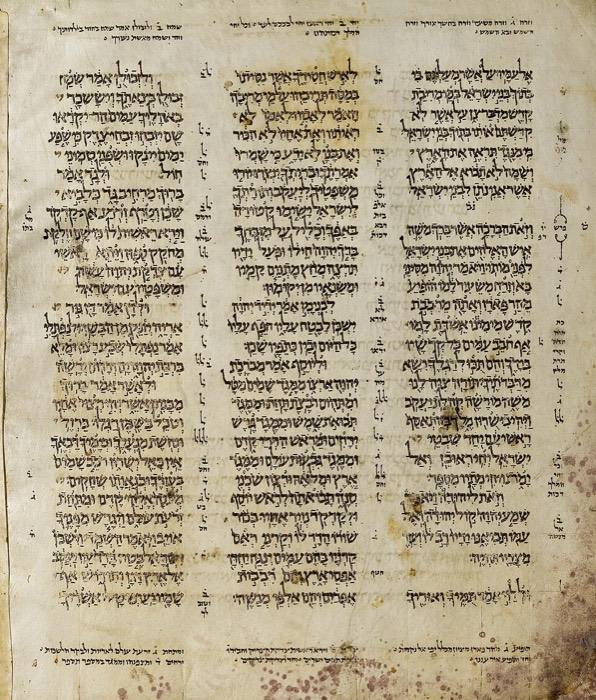
A page of the Leningrad Codex: three columns of handwritten Hebrew on old parchment, the opening of Genesis
Genesis 1 in the Leningrad Codex, copied AD 1008–1009.7 Image: Wikimedia Commons, public domain.

Credit where it is due

Christians who read the Old Testament today owe the text they translate to the care of these Jewish scribes. They counted letters and words so the text would be copied exactly.

The text you read here

The Hebrew Masoretic Text, with vowels and accent marks. Word tagging and Strong’s data come from STEPBible.org and MACULA Hebrew, built on the Westminster Leningrad Codex (a digital text of the Leningrad Codex) and the Open Scriptures Hebrew Bible. Full credit.

What is the oldest Hebrew Bible?

The oldest pieces are among the Dead Sea Scrolls, found near Qumran; the earliest biblical fragments date to about the 3rd century BC. The oldest complete Hebrew Bible with a written date is the Leningrad Codex, AD 1008–1009. The Aleppo Codex (about AD 930) is older, but about 40% of it has been lost since 1947.8

Go deeper

See the timeline
  1. 3rd century BC – 1st century AD

    Dead Sea Scrolls

    Part of the Great Isaiah Scroll from Qumran: a long strip of parchment with columns of Hebrew

    Found near Qumran from 1947. The Great Isaiah Scroll is very close to later Hebrew Isaiah, though not identical; some scroll readings agree with the Septuagint.

  2. About AD 600–1000

    The Masoretes

    The Ben Asher family of Tiberias and others fix the vowels, accents and notes of the Masoretic Text.

  3. About AD 930

    Aleppo Codex

    A page of Deuteronomy in the Aleppo Codex: three columns of pointed Hebrew with notes in the margins

    A fine Ben Asher manuscript. About 40% of it was lost after 1947.6

  4. AD 1008–1009

    Leningrad Codex

    The Genesis 1 page of the Leningrad Codex: three columns of handwritten Hebrew

    The oldest complete dated Hebrew Bible, copied by the scribe Samuel ben Jacob.7

  5. 1977

    Biblia Hebraica Stuttgartensia

    The standard printed scholarly edition (BHS), based on the Leningrad Codex. The Westminster Leningrad Codex is a public-domain digital text of it.

  6. Today

    On this site

    The Masoretic Text with vowels and accent marks, tagged with open data from STEPBible and MACULA Hebrew.

Where can I read the Hebrew Bible online with English?

Right here, free, with no sign-up. All 39 books and 929 chapters show the Hebrew words with their sound in English letters, a short English meaning and, for nearly all, a link to the word’s own page, under the English Bible you choose (NKJV, KJV, ESV or World English Bible).11

See how, in three steps

בְּרֵאשִׁ֖ית

be.re.Shit “in beginning”

You do not need to know Hebrew to start

  1. Start at the right

    Hebrew runs from right to left. The first letter of a word is the one on the right.

  2. Read the English letters

    Under each Hebrew word is its sound in English letters and a short English meaning. Choose the English Bible above it: NKJV, KJV, ESV or World English Bible.

  3. Tap a word, or press play

    A word opens its own page, with its meaning and a spoken pronunciation. Press play to hear the chapter in English while you read. The Hebrew itself is not read aloud on the chapter pages.

Want the word-by-word tool for both Testaments? Use our Hebrew interlinear Bible.

How is the Hebrew Bible different from the Septuagint?

The Septuagint is the old Greek translation of the Hebrew scriptures, begun by Jewish translators in Egypt in the 3rd century BC. It mostly follows the Hebrew closely, but in places it reads differently, it adds books found in Catholic and Orthodox Bibles, and it joins and divides some psalms differently, so most psalm numbers run one lower.10

See the table
Two old forms of the same scriptures
Hebrew Bible (Masoretic Text)Septuagint
LanguageHebrew, some AramaicGreek
What it isThe original-language textA translation, begun in the 3rd century BC
Books24 (39 in Christian counting)More; our edition has 50
Read it herePsalm 23Septuagint Psalm 22

One verse, word by word: Genesis 1:1 with the Septuagint’s word for each Hebrew word.

What did the early Christians write about the Hebrew Bible?

A great deal. The Christians of the first centuries wrote about Genesis, the Psalms, Isaiah and many other Old Testament chapters. We have gathered what they said on 74 Old Testament passages from 20 books, plus 12 answers on the Old Testament’s text, canon and language. Our Hebrew chapter pages, such as Genesis 1 and Psalm 23, also show what the Early Church wrote about that chapter.

See the pages

Quick questions

Why is the Hebrew Bible in a different order?

The Hebrew Bible runs Torah, then Prophets, then Writings, and ends with Chronicles. The Christian Old Testament groups the books as law, history, poetry and prophets, and ends with Malachi, just before the Gospels.

Are the Dead Sea Scrolls the same as the Bible we read?

Very close, though not identical. The scrolls found near Qumran include the oldest known copies of biblical books, some from about the 3rd century BC. The Great Isaiah Scroll is very close to the later Hebrew text of Isaiah, and some scroll readings agree with the Septuagint.

What is a Strong’s number?

A reference number for each original word of the Bible, from James Strong’s concordance (1890). Hebrew words run from H1 to H8674. On this site each number has its own page, for example shalom, H7965.9

Does the Hebrew Bible include the Apocrypha or the New Testament?

No. Books such as Tobit, Judith, Wisdom and the Maccabees came to Christians through the Greek Septuagint; they are in Catholic and Orthodox Old Testaments, not in the Hebrew Bible. The New Testament was written later, in Greek.

Why is Psalm 23 called Psalm 22 in the Greek Bible?

The Septuagint joins and divides some psalms differently, so most psalm numbers run one lower. Hebrew Psalm 23 is Psalm 22 in the Septuagint.

Can I hear Hebrew words spoken?

Yes, one word at a time. 8,673 Hebrew words have a spoken pronunciation on their own page; the voice is computer-made. The chapter audio on this site is in English (Berean Standard Bible, read by Bob Souer).

Which Hebrew text does this site use?

The Hebrew Masoretic Text, with vowels and accent marks. Word tagging and Strong’s data come from STEPBible.org and MACULA Hebrew, built on the Westminster Leningrad Codex and the Open Scriptures Hebrew Bible. Full credit.

Is it free?

Yes. Every chapter page and every Hebrew word page opens without an account or payment.

Free lessons and talks

5 courses, 10 lessons and 11 videos on the Hebrew text, the Septuagint and how we got the Old Testament. A few to start with:

Who we are

The Historic Faith is a Christian ministry. We show the Hebrew text in the order of the Christian Old Testament and note the Jewish order (Tanakh) too.

Coming soon: Books of the Hebrew Bible in order · The Masoretic Text · Hebrew Bible and Septuagint compared · Names of God in the Hebrew Bible · Aramaic in the Bible

Sources and credits

Hebrew text: the Masoretic Text, with vowels and accent marks. Word tagging and Strong’s data from STEPBible.org (Tyndale House, Cambridge; CC BY 4.0) and MACULA Hebrew by Clear Bible (CC BY 4.0), built on the Westminster Leningrad Codex (public domain) and the Open Scriptures Hebrew Bible (CC BY 4.0). English Scripture quoted: World English Bible (public domain). Greek Old Testament: LXX-Rahlfs-1935 by Eliran Wong (CC BY-NC-SA 4.0).

English audio on chapter pages: Berean Standard Bible, read by Bob Souer. Word sounds are a computer voice. Images: Leningrad Codex, Aleppo Codex and Great Isaiah Scroll, public domain, via Wikimedia Commons.

Notes and sources

12 notes
  1. Encyclopaedia Britannica, “Hebrew Bible”: definition, names, contents. britannica.com · Read the text: Genesis 1.
  2. Bible Odyssey (Society of Biblical Literature), “What is the difference between the Old Testament, the Tanakh, and the Hebrew Bible?” bibleodyssey.org · On this site: the Old Testament canon.
  3. Wikipedia, “Hebrew Bible”: Tanakh as an acronym, 24 books, the three parts and the Jewish order. wikipedia.org · On this site: the 39 books.
  4. Wikipedia, “Biblical Aramaic”: the Aramaic passages in Daniel, Ezra and Jeremiah. wikipedia.org · On this site: Daniel 2.
  5. Wikipedia, “Masoretic Text”: the Masoretes, Tiberias, vowel points and accents. wikipedia.org · On this site: the Hebrew language.
  6. Wikipedia, “Aleppo Codex”: date and the part lost after 1947. wikipedia.org
  7. Wikipedia, “Leningrad Codex”: date, scribe, Biblia Hebraica Stuttgartensia and the Westminster Leningrad Codex. wikipedia.org. Image: Leningrad Codex, Genesis 1, Wikimedia Commons, public domain.
  8. Biblical Archaeology Society, “What Is the Oldest Hebrew Bible?”: the Dead Sea Scrolls and their dates. biblicalarchaeology.org. Image: Great Isaiah Scroll, Ardon Bar Hama, public domain. Aleppo Codex page (Deuteronomy): Wikimedia Commons, public domain.
  9. Wikipedia, “Strong’s Concordance”: James Strong, 1890; Hebrew numbers H1–H8674. wikipedia.org · On this site: Strong’s Concordance.
  10. Wikipedia, “Septuagint”: origin in the 3rd century BC, use in the New Testament, psalm numbering. wikipedia.org · On this site: the Greek Old Testament (Septuagint).
  11. The Historic Faith, Hebrew Old Testament data, counted 6 November 2026: 39 books, 929 chapters, 23,145 verses, 304,191 Hebrew words; a Strong’s number on 299,121 of them. Long chapters show their first 800 words, and psalm titles are not yet included.
  12. Text and licences: see the credit above. Scripture in English is quoted from the World English Bible (public domain), as printed on each chapter page.

Back to top