

Early Christian Beliefs About Baptism in the Holy Spirit
Early Christians linked baptism with receiving the Holy Spirit, but they did not all explain the timing the same way. Some passages stress water baptism, some the Spirit’s coming, and some the laying on of hands after baptism. Key witnesses include Irenaeus, Tertullian, Origen, Cyprian, Hippolytus, and the Apostolic Constitutions, along with Acts and the Gospels.
99 early-church witnesses · 170 source quotations · compared with Scripture
What did early Christians believe about baptism in the Holy Spirit?
Early Christians tied baptism to the Holy Spirit very strongly, but they usually did not mean that water alone gives the Spirit in every case. Writers like Irenaeus, Tertullian, Origen, Cyprian, Hippolytus, and the Apostolic Constitutions linked baptism with receiving the Holy Spirit, the Spirit’s descent, or the laying on of hands after baptism. The clearest Bible anchors are Acts 1:5, Acts 2:4, Acts 10:44-48, Acts 8:15-17, Acts 11:15-17, Acts 19:2-6, Matthew 3:11, and John 1:33.
The evidence is broad and strong for a baptism connected with the Holy Spirit, but it is mixed on the exact order and means, since some texts stress baptism, some the Spirit’s coming before water, and others the laying on of hands afterward. Many more early Christian quotations, Bible passages, and source links are gathered below so you can study the evidence for yourself.
Key Takeaways
- Early Christian writers usually connected baptism with the Holy Spirit, not just with water.
- Acts 10, Acts 11, and Acts 19 were especially important for showing the Spirit could come before or after water baptism.
- Cyprian and the Apostolic Constitutions linked baptism, the Spirit, and later laying on of hands.
Questions Answered by the Sources
What did early Christians mean by baptism in the Holy Spirit?
Early Christians usually meant that baptism was tied to the gift, coming, or reception of the Holy Spirit, not just a water rite. Several writers say Christ baptizes with the Holy Spirit, that baptism receives the Spirit, or that the Spirit is given through baptism and the laying on of hands.
-
Irenaeus, Against Heresies: Book V Background
...ion, shaping it to be like His own Son. Through the Father's hands, meaning through the Son and the Holy Spirit, humans, not just a part of humans, were made in God's likeness. Although the soul and spirit are part of a human, they do not make up the entire person; the complete human is the union of the soul receiving the Spirit of the Father and the blending of that physical nature formed in God's image. This is why the apostle states, "We speak wisdom among those who are perfect," referring to those who have received the Spirit of God and who speak in all languages through the Spirit of God, just as he did. Similarly, we also hear many members in the Church who have prophetic gifts, speaking all kinds of languages through the Spirit and revealing hidden truths for the common good and declaring God's mysteries. The apostle calls these people "spiritual" because they share in the Spirit, not because their flesh has been stripped away and they have become purely spiritual. If someone removes the fleshly substance, which is God's workmanship, and considers only the purely spiritual, such a being would not be a spiritual person but just the spirit of a human or the Spirit of God. W
-
Irenaeus, Against Heresies: Book III Background
...epresenting the people), which initially had dew. This indicated that they would no longer have the Holy Spirit from God, as Isaiah says, “I will also command the clouds, that they rain no rain upon it.” However, the dew, representing the Spirit of God, which descended upon the Lord, would spread throughout the world: "the spirit of wisdom and understanding, the spirit of counsel and might, the spirit of knowledge and piety, the spirit of the fear of God." This Spirit was given to the Church, as the Comforter was sent from heaven across the globe, and from heaven, the Lord tells us, the devil was cast down like lightning. Therefore, we need the dew of God to protect us from being consumed by fire or becoming unfruitful, and so that where we have an accuser, we also have an Advocate. The Lord entrusted the Holy Spirit with His own man, who had fallen among thieves, whom He compassionately tended to, binding up his wounds and giving him two royal denaria. Thus, by receiving through the Spirit the image and inscription of the Father and the Son, we might make the entrusted denarium fruitful and render its increase to the Lord.
-
Novatian, Treatise Concerning the Trinity Background
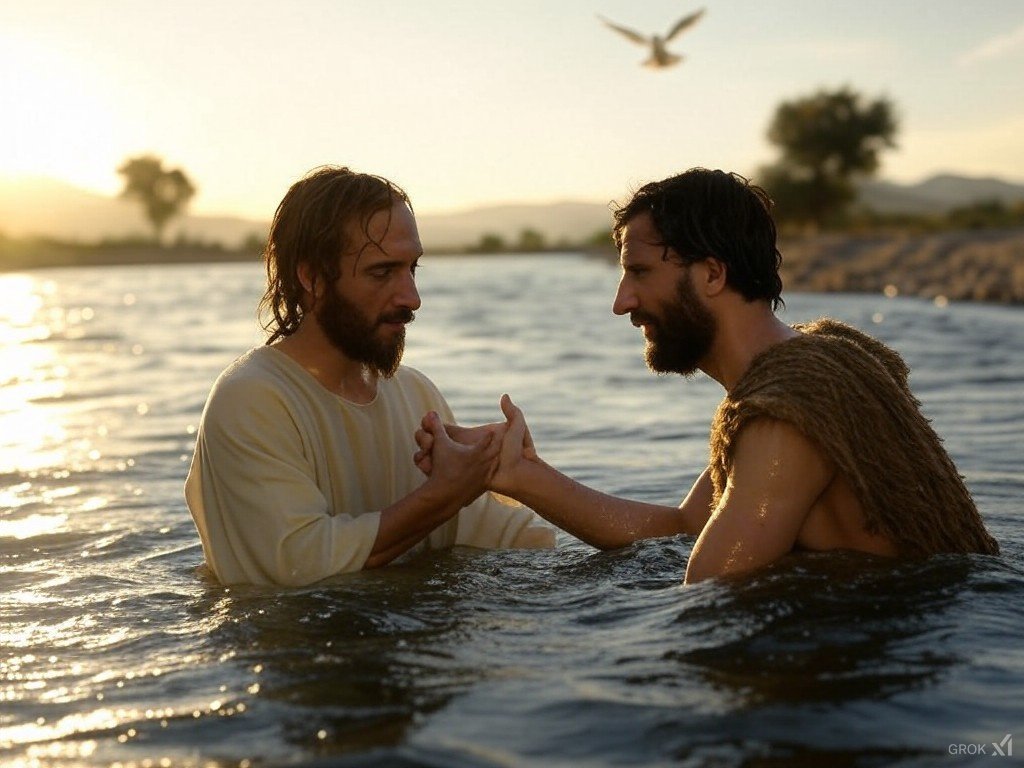
... in all things, perfected and completed. This is He who, in the manner of a dove, when our Lord was baptized, came and remained upon Him, dwelling in Christ full and entire, and not diminished in any measure or part. Rather, with His whole overflow He was copiously distributed and sent forth, so that from Him others might receive some enjoyment of His graces. Yet the source of the entire Holy Spirit remained in Christ, so that from Him streams of gifts and works might be drawn, while the Holy Spirit dwelt abundantly in Christ. For truly Isaiah, prophesying this, said, “And the Spirit of wisdom and understanding shall rest upon Him, the Spirit of counsel and might, the Spirit of knowledge and piety; and the Spirit of the fear of the Lord shall fill Him.” This same thing he also said in the person of the Lord Himself, in another place: “The Spirit of the Lord is upon me; because He has anointed me, He has sent me to preach the Gospel to the poor.” Similarly David says, “Therefore God, even Your God, has anointed You with the oil of gladness above Your fellows.” Of Him the Apostle Paul says, “For he who does not have the Spirit of Christ is none of His.” And, “Where the Spirit of t
Did early Christians teach that baptism brings the Holy Spirit?
Yes. Cyprian says that by baptism the Holy Spirit is received, and the Apostolic Constitutions say the baptized person is under the Holy Spirit. Origen, Tertullian, and the anonymous Treatise on Re-Baptism also connect baptism with the Spirit’s gift, though they do not all explain it the same way.
-
Cyprian, Epistles Direct teaching
For by baptism the Holy Spirit is received;
-
Apostolic Constitutions, Apostolic Constitutions Direct teaching
But every one that is baptized agreeably to the truth is separated from the diabolical spirit, and is under the Holy Spirit;
-
Tertullian, On Baptism Supporting witness
Luke 1:76 Thus, too, does the angel, the witness of baptism, make the paths straight for the Holy Spirit, who is about to come upon us, by the washing away of sins, which faith, sealed in (the name of) the Father, and the Son, and the Holy Spirit, obtains.
-
Tertullian, On Baptism Supporting witness
But it will suffice to have thus called at the outset those points in which withal is recognised that primary principle of baptism — which was even then fore-noted by the very attitude assumed for a type of baptism — that the Spirit of God, who hovered over (the waters) from the beginning, would continue to linger over the waters of the baptized.
-
Clement of Alexandria, The Instructor (Paedagogus) Supporting witness
Certainly not. But He is perfected by the washing — of baptism— alone, and is sanctified by the descent of the Spirit?
-
Anonymous, Treatise on Re-Baptism Supporting witness
Unless, perchance, in that former discussion also, about those who should only have been baptized in the name of Jesus Christ, you should decide that they can be saved even without the Holy Spirit, or that the Holy Spirit is not accustomed to be bestowed in this manner only, but by the imposition of the bishop's hands;
-
Anonymous, Treatise on Re-Baptism Supporting witness
...tized in the Spirit, so that these also may not seem to have anything less than those who are fully Christians, lest it should be necessary to ask what kind of baptism they received in the name of Jesus Christ. Unless perhaps, in that earlier discussion also, about those who had only been baptized in the name of Jesus Christ, you decide that they can be saved even without the Holy Spirit, or that the Holy Spirit is not usually given only in this way, but by the laying on of the bishop's hands, or even say that it is not the bishop alone who can give the Holy Spirit.
-
Victorinus, Commentary on the Apocalypse Background
... all things, perfected and completed. This is He who, after the manner of a dove, when our Lord was baptized, came and remained upon Him, dwelling in Christ full and entire, and not diminished in any measure or portion, but with His whole overflow copiously distributed and sent forth, so that from Him others might receive some enjoyment of His graces. The source of the entire Holy Spirit remained in Christ, so that from Him streams of gifts and works might be drawn, while the Holy Spirit dwelt abundantly in Christ. For truly Isaiah, prophesying this, said: “And the Spirit of wisdom and understanding shall rest upon Him, the Spirit of counsel and might, the Spirit of knowledge and piety; and the Spirit of the fear of the Lord shall fill Him.” This same thing he also said in the person of the Lord Himself in another place: “The Spirit of the Lord is upon me; because He has anointed me, He has sent me to preach the Gospel to the poor.” Similarly David says: “Therefore God, even Your God, has anointed You with the oil of gladness above Your fellows.” Of Him the Apostle Paul says: “For he who does not have the Spirit of Christ is none of His.” And, “Where the Spirit of the Lord is, t
-
Apostolic Constitutions, Apostolic Constitutions Supporting witness
...he same time. For the Comforter hates every lie, and the devil hates all truth. But everyone who is baptized according to the truth is separated from the devilish spirit and is under the Holy Spirit. And the Holy Spirit remains with him as long as he does good, and fills him with wisdom and understanding, and does not allow the wicked spirit to come near him, but watches over his ways. Therefore, woman, if, as you say, in the days of your separation you are without the Holy Spirit, then you are filled with the unclean one. For by neglecting prayer and reading, you will invite him to yourself, even if he were unwilling. For this spirit, more than all others, loves the ungrateful, the lazy, the careless, and the sleepy, since he himself, through ingratitude, became sick with an evil mind, and by this was deprived by God of his dignity, because he chose to be a devil rather than an archangel. Therefore, woman, avoid such empty words, and always remember God who created you, and pray to Him. For He is your Lord and the Lord of the universe. Meditate on His laws without paying attention to such things as natural cleansing, lawful union, childbirth, miscarriage, or a bodily defect, si
Did the Holy Spirit come before or after water baptism?
The early Christian writings do not give only one order. Acts 10 and Acts 11 show the Holy Spirit falling before water baptism, while Acts 8 and Acts 19 show the Spirit coming after prayer and the laying on of hands; writers like Irenaeus, Origen, and the Treatise on Re-Baptism use both patterns.
-
Acts 10:44 Direct teaching
While Peter was still speaking these words, the Holy Spirit fell upon all those who heard the word.
-
Acts 11:15 Direct teaching
And as I began to speak, the Holy Spirit fell upon them, as upon us at the beginning.
-
Acts 11:16 Direct teaching
Then remembered I the word of the Lord, how that he said, John indeed baptized with water; but ye shall be baptized with the Holy Ghost.
-
Irenaeus, Against Heresies: Book III Supporting witness
And therefore did he exclaim, “Can any man forbid water, that these should not be baptized, who have received the Holy Ghost as well as we?” He persuaded, at the same time, those that were with him, and pointed out that, unless the Holy Ghost had rested upon them, there might have been some one who would have raised objections to their baptism.
-
Anonymous, Treatise on Re-Baptism Direct teaching
And further, as you are not ignorant, the Holy Spirit is found to have been given to men who believe, by the Lord without baptism of water, as is contained in the Acts of the Apostles after this manner: While Peter was still speaking these words, the Holy Ghost fell upon all them who heard the word.
-
Anonymous, Treatise on Re-Baptism Direct teaching
.... Further, as you are not ignorant, the Holy Spirit is found to have been given by the Lord without baptism of water to men who believe, as it is written in Acts of the Apostles in this way: “While Peter was still speaking these words, the Holy Spirit fell on all who heard the word. And those of the circumcision who believed were astonished, as many as came with Peter, because the gift of the Holy Spirit had also been poured out on the Gentiles. For they heard them speak in tongues, and they magnified God. Then Peter answered, ‘Can any man forbid water, that these should not be baptized, who have received the Holy Spirit as well as we?’ And he commanded them to be baptized in the name of Jesus Christ.” Acts 10:44-48 Peter also later taught us very fully about these same Gentiles, saying: “And He made no difference between us and them, purifying their hearts by faith.” Acts 15:9 And so there will be no doubt that men may be baptized with the Holy Spirit without water, since you see that these were baptized before they were baptized with water. In this way, the declarations of both John and of our Lord Himself were fulfilled, since they received the grace of the promise both witho
-
Pamphilus, Exposition on the Acts of the Apostles Supporting witness
BB. Of baptism and the gift of the Holy Ghost conferred by means of the prayer of Paul on those who believed in Ephesus, and of the healing of the people.
More related quotations from this section 4 shown
-
Cyprian, Epistles Supporting witness
If one could baptize, he could also give the Holy Spirit.
-
Cyprian, Seventh Council of Carthage Supporting witness
If they can baptize, they can also bestow the Holy Spirit.
-
Dionysius of Alexandria, Epistles and Epistolary Fragments Supporting witness
Because they had already previously received the Holy Spirit from that very baptism.
-
Tertullian, On Baptism Background
Accordingly, in the Acts of the Apostles, we find that men who had John's baptism had not received the Holy Spirit, whom they knew not even by hearing.
How did early Christians explain Jesus baptizing with the Holy Spirit?
Early Christian writers repeatedly quoted John the Baptist’s words that Jesus would baptize with the Holy Spirit and fire. Tertullian, Origen, Hippolytus, Justin Martyr, Tatian, Irenaeus, and the Apostolic Constitutions all use this language, usually to contrast Christ’s gift with John’s water baptism.
-
Tertullian, On Baptism Direct teaching
But look, some say, the Lord came and did not baptize. For we read, "And yet He used not to baptize, but His disciples," in John 4:2. As if John had really preached that He would baptize with His own hands. Of course, his words are not to be understood that way, but simply as spoken in an ordinary manner. Just as, for example, we say, "The emperor set forth an edict," or, "The prefect cudgelled him." Does the emperor in person set it forth, or the prefect in person cudgel? One whose ministers do a thing is always said to do it. So, "He will baptize you," must be understood as meaning, "Through Him," or, "Into Him, you will be baptized." But let not the fact that He Himself did not baptize trouble anyone. For into whom should He baptize? Into repentance? Then what use do you make of His forerunner? Into remission of sins, which He used to give by a word? Into Himself, whom by humility He was concealing? Into the Holy Spirit, who had not yet descended from the Father? Into the Church, which His apostles had not yet founded? And so, with that same baptism of John, His disciples used to baptize as ministers, with which John had baptized before as forerunner. Let no one think it was wit
-
Origen, Commentary on John Direct teaching
...ll baptize? He did not baptize the logs on the altar in the days of Ahab, though they needed such a washing in order to be burned up when the Lord appeared in fire. No, he commanded the priests to do this for him, and not only once. For he says, "Do it a second time," and they did it a second time; and, "Do it a third time," and they did it a third time. If, then, he did not at that time baptize them himself but left the work to others, how was he to baptize at the time spoken of by Malachi? Christ, then, does not baptize with water, but His disciples do. He keeps for Himself the baptizing with the Holy Spirit and with fire. Now Heracleon takes the words of the Pharisees as clearly meaning that the office of baptizing belonged to the Christ and Elijah and to every prophet, for he uses these words: "Whose office alone it is to baptize." He is refuted by what we have just said, and especially by the fact that he takes the word "prophet" in a general sense, for he cannot show that any of the prophets baptized. He adds, correctly, that the Pharisees asked the question out of malice, and not from a desire to learn.
-
Origen, Commentary on John Direct teaching
...od, He is understood in different ways as living bread or as flesh. So also He, the same person, is baptism of water, and baptism of the Holy Spirit and of fire, and for some, also, of blood. It is of this last baptism, as some hold, that He speaks in the words of Luke 12:50, “I have a baptism to be baptized with, and how I am distressed until it is accomplished!” And this agrees with what the disciple John says in his Epistle, in 1 John 5:8, about the Spirit and the water and the blood being one. Again, He declares Himself to be the way and the door. But clearly, He is not the door to those to whom He is the way, and He is no longer the way to those to whom He is the door. Therefore, let all who are being instructed in the first lessons of the oracles of God, and who come to the voice of him who cries in the wilderness, “Make straight the way of the Lord,” the voice that sounds beyond the Jordan at the house of preparation, prepare themselves so that they may be ready to receive the spiritual word, brought home to them by the enlightening work of the Spirit. Since our subject requires us to gather together everything that relates to the Jordan, let us now look at the river. By
-
Origen, Commentary on John Supporting witness
...im for the salvation of men. This He did when, in bodily form like a dove, He flew to Him after the baptism. He remained on Him and did not pass Him by, as He might have done with men who were not able to bear His glory continually. Thus John, when explaining how he knew who Christ was, spoke not only of the descent of the Spirit on Jesus, but also of its remaining upon Him. For it is written that John said in John 1:32, “He who sent me to baptize said, ‘On whomever you shall see the Spirit descending and abiding upon Him, this is He that baptizes with the Holy Spirit and with fire.’” It is not said only, “On whomever you shall see the Spirit descending,” for the Spirit no doubt descended on others too, but “descending and abiding on Him.” Our examination of this point has been somewhat long, because we were eager to make it clear that if all things were made by Him, then the Spirit also was made through the Word, and is seen to be one of the “all things” that are inferior to their Maker. This view is too firmly established to be disturbed by a few words that may be brought forward to the opposite effect. If anyone should give credence to the Gospel according to the Hebrews, whe
-
Origen, Commentary on John Direct teaching
I baptized you with water, but He shall baptize you with the Holy Ghost.
-
Tertullian, On Baptism Direct teaching
and again, by saying that he baptized in repentance only, but that One would shortly come who would baptize in the Spirit and fire;
-
Hippolytus, Discourse on the Holy Theophany Direct teaching
I baptize with the baptism of repentance, but He confers the gift of adoption: He shall baptize you with the Holy Ghost, and with fire.
-
Irenaeus, Connection to Matthew 3:11 Supporting witness
John the Baptist points out, when he says of Christ, "He shall baptize you with the Holy Ghost and with fire, having His fan in His hand to cleanse His floor; and He will gather His fruit into the garner, but the chaff He will burn up with unquenchable fire."
-
Justin Martyr, Connection to Matthew 3:11 Supporting witness
`I baptize you with water to repentance; but He that is stronger than I shall come, whose shoes I am not worthy to bear: He shall baptize you with the Holy Ghost and with fire: whose fan is in His hand, and He will thoroughly purge His floor, and will gather the wheat into the barn; but the chaff He will burn up with unquenchable fire.'
-
Tatian, The Diatessaron Supporting witness
but he that sent me to baptize with water, he said to me, Upon whomsoever you shall behold the Spirit descending and lighting upon him, the same is he that 41 baptizes with the Holy Spirit.
-
Tatian, The Diatessaron Supporting witness
he will baptize you with the 26 Holy Spirit and fire: who takes the fan in his hand to cleanse his threshing-floors, [Arabic, p.
-
Origen, Commentary on John Direct teaching
He shall baptize you with the Holy Ghost, and with fire.
More related quotations from this section 4 shown
-
Acts 1:5 Direct teaching
For John truly baptized with water; but ye shall be baptized with the Holy Ghost not many days hence.
-
Mark 1:8 Direct teaching
I indeed have baptized you with water: but he shall baptize you with the Holy Ghost.
-
Matthew 3:11 Direct teaching
I indeed baptize you with water unto repentance. but he that cometh after me is mightier than I, whose shoes I am not worthy to bear: he shall baptize you with the Holy Ghost, and with fire:
-
Luke 3:16 Direct teaching
John answered, saying unto them all, I indeed baptize you with water; but one mightier than I cometh, the latchet of whose shoes I am not worthy to unloose: he shall baptize you with the Holy Ghost and with fire:
Common Questions
Did early Christians think baptism and the Holy Spirit were connected?
Yes. Many early Christian writers connected baptism with receiving the Holy Spirit, and several also tied it to the laying on of hands after baptism.
Did they always say the Holy Spirit comes at water baptism?
No. Some texts place the Spirit before water baptism, while others place it after baptism through the laying on of hands.
Which Bible passages mattered most on this topic?
Acts 1:5, Acts 2:4, Acts 10:44-48, Acts 11:15-17, Acts 19:2-6, Matthew 3:11, and John 1:33.
Source Index for Baptism in the Holy Spirit
The guided sections above show the strongest quotations. This compact index highlights 151 ranked source links from 170 compiled sources for deeper study.
Source index 151 ranked links shown
Early Christian Writings 80 shown of 99
Primary-source quotations from early Christian writers and church documents.
Bible Passages 71 included
Related Bible passages saved for comparison with the early Christian quotations.
Related Resources
 Course Lesson
What Was the Early Christian View on the Laying on of Hands for the Holy Spirit and Forgiveness of Sins in Baptism?
Open a related course lesson for more teaching connected with Baptism in the Holy Spirit.
Course Lesson
What Was the Early Christian View on the Laying on of Hands for the Holy Spirit and Forgiveness of Sins in Baptism?
Open a related course lesson for more teaching connected with Baptism in the Holy Spirit.
 Course Lesson
What Was the Early Christian View on the Laying on of Hands for the Holy Spirit and Forgiveness of Sins in Baptism?
Open a related course lesson for more teaching connected with Baptism in the Holy Spirit.
Course Lesson
What Was the Early Christian View on the Laying on of Hands for the Holy Spirit and Forgiveness of Sins in Baptism?
Open a related course lesson for more teaching connected with Baptism in the Holy Spirit.
 Course Lesson
Being Filled with the Holy Spirit
Open a related course lesson for more teaching connected with Baptism in the Holy Spirit.
Course Lesson
Being Filled with the Holy Spirit
Open a related course lesson for more teaching connected with Baptism in the Holy Spirit.
 Site Page
Pentecost and the Holy Spirit
Compare another early Christian topic page with related source quotations.
Site Page
The Filioque and the Holy Spirit
Compare another early Christian topic page with related source quotations.
Site Page
The Holy Spirit
Compare another early Christian topic page with related source quotations.
Site Page
Pentecost and the Holy Spirit
Compare another early Christian topic page with related source quotations.
Site Page
The Filioque and the Holy Spirit
Compare another early Christian topic page with related source quotations.
Site Page
The Holy Spirit
Compare another early Christian topic page with related source quotations.