
G26 — Agape (Love)
Greek agape, with New Testament and Septuagint usage links where indexed.
The Early Christian Study Bible · Free to use
Study the word. Hear its pronunciation.
Search 14,298 Greek and Hebrew entries—free. Explore definitions, indexed occurrences, and pronunciation audio where available, then follow the words back into your Bible.
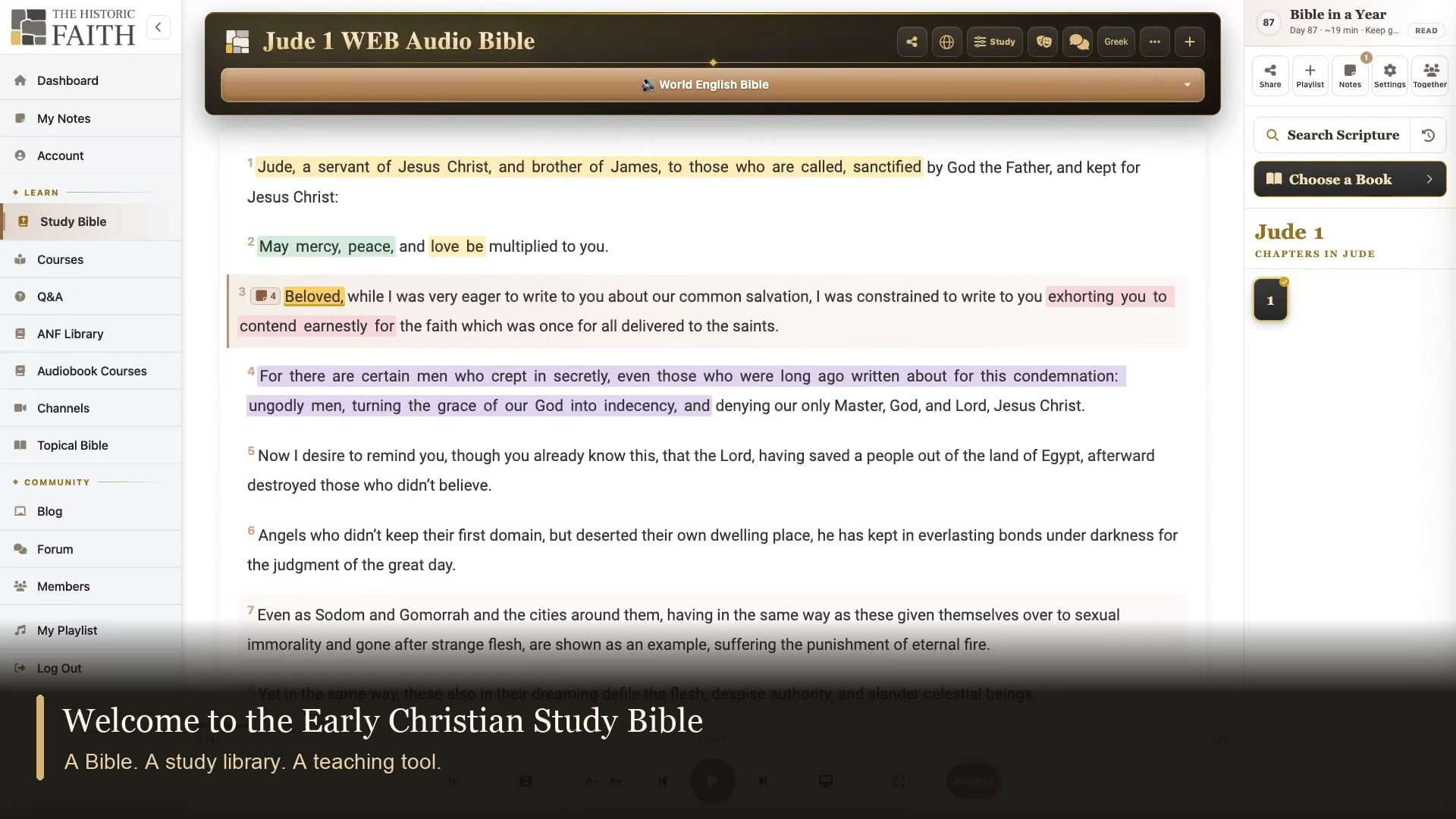
Click a word. Hear its pronunciation. Open the early Christian writings. Then see how to present and teach.
 Words. Writings.
Guided tour · 21:50 · Several Bible editions.
See the phone experience · 5:31
Strong's Exhaustive Concordance, first published by James Strong in 1890, indexes every word of the King James Version and assigns each underlying original-language word a number — G1–G5624 for the Greek New Testament and H1–H8674 for the Hebrew Old Testament. Look up any English word, find its Strong's number, and see the Greek or Hebrew word behind it, its definition, and the verses where it occurs. This free online edition covers 14,298 entries with 767,764 indexed occurrences — including the Septuagint, deuterocanonical books, and 1 Enoch, which no print edition of Strong's includes.
These entry points are the quickest way to see how a Strong's number opens into a word, meaning, and Bible usage.
Greek agape, with New Testament and Septuagint usage links where indexed.
Greek kyrios, a major New Testament and Septuagint word-study bridge.
Hebrew reshith, the word behind “beginning” in Genesis 1:1 and other Old Testament usages.
Browse the local Greek and Hebrew Strong's entries in fast pages, open an exact number, or narrow the index by language, range, and usage count.
| Number | Word | Definition | Usages | Range |
|---|---|---|---|---|
|
H7577 — rthuqah
Hebrew
|
רְתוּקָה (rthuqah)
rthuqah
|
rthuqah (reth-oo-kaw') n-f. 1. something fastened, i.e. a chain [feminine passive participle of H7576] | 1 | H7001-H8000 |
|
H7578 — rtheth
Hebrew
|
רְתֵת (rtheth)
rtheth
|
rtheth (reth-ayth') n-m. 1. terror [for H7374] | 1 | H7001-H8000 |
|
H7579 — sha'ab
Hebrew
|
שָׁאַב (sha'ab)
sha'ab
|
sha'ab (sahw-ab') v. 1. to bale up water [a primitive root] | 18 | H7001-H8000 |
|
H7580 — sha'ag
Hebrew
|
שָׁאַג (sha'ag)
sha'ag
|
sha'ag (shaw-ag') v. 1. to rumble or moan [a primitive root] | 17 | H7001-H8000 |
|
H7581 — shagah
Hebrew
|
שְׁאָגָה (shagah)
shagah
|
shagah (sheh-aw-gaw') n-f. 1. a rumbling or moan [from H7580] | 7 | H7001-H8000 |
|
H7582 — sha'ah
Hebrew
|
שָׁאָה (sha'ah)
sha'ah
|
sha'ah (shaw-aw') v. 1. to rush 2. (by implication) to desolate | 5 | H7001-H8000 |
|
H7583 — sha'ah
Hebrew
|
שָׁאָה (sha'ah)
sha'ah
|
sha'ah (shaw-aw') v. 1. to stun, i.e. (intransitively) be astonished [a primitive root (identical with H7582 through the idea of whirling to giddiness)] | 1 | H7001-H8000 |
|
H7584 — sha'avah
Hebrew
|
שַׁאֲוָה (sha'avah)
sha'avah
|
sha'avah (shah-av-aw') n-f. 1. a tempest (as rushing) [from H7582] | 1 | H7001-H8000 |
|
H7585 — sh'owl
Hebrew
|
שְׁאוֹל שְׁאוֹל (sh'owl)
sh'owl
|
sh'owl (sheh-ole') (or shol {sheh-ole'}) n-f. 1. Hades or the world of the dead (as if a subterranean retreat), including its accessories and inmates [from H7592] | 63 | H7001-H8000 |
|
H7586
Hebrew
|
שָׁא֖וּל
|
Sha'uwl (shaw-ool') n/p. 1. asked 2. Shaul, the name of an Edomite and two Israelites | 330 | H7001-H8000 |
|
H7587 — Sha'uwliy
Hebrew
|
שָׁאוּלִי (Sha'uwliy)
Sha'uwliy
|
Sha'uwliy (shaw-oo-lee') adj. 1. a Shaulite or descendant of Shaul [patronymic from H7856] | 1 | H7001-H8000 |
|
H7588 — sha'own
Hebrew
|
שָׁאוֹן (sha'own)
sha'own
|
sha'own (shaw-one') n-m. 1. uproar (as of rushing) 2. (by implication) destruction | 16 | H7001-H8000 |
|
H7589 — sh'at
Hebrew
|
שְׁאָט (sh'at)
sh'at
|
sh'at (sheh-awt') n-m. 1. contempt [from an unused root meaning to push aside] | 3 | H7001-H8000 |
|
H7590 — sha't
Hebrew
|
שָׁאטּ (sha't)
sha't
|
sha't (shawt) v. 1. one contemning [for active part of H7750] | 3 | H7001-H8000 |
|
H7591 — sh'iyah
Hebrew
|
שְׁאִיָה (sh'iyah)
sh'iyah
|
sh'iyah (sheh-ee-yaw') n-f. 1. desolation [from H7582] | 1 | H7001-H8000 |
|
H7592 — sha'al
Hebrew
|
שָׁאַל שָׁאֵל (sha'al)
sha'al
|
sha'al (shaw-al') (or shael {shaw-ale'}) v. 1. to inquire 2. (by implication) to request | 157 | H7001-H8000 |
|
H7593 — sh'el
Hebrew
|
שְׁאֵל (sh'el)
sh'el
|
sh'el (sheh-ale') v. 1. ask, demand, require [(Aramaic) corresponding to H7592] | 6 | H7001-H8000 |
|
H7594 — Sh'al
Hebrew
|
שְׁאָל (Sh'al)
Sh'al
|
Sh'al (sheh-awl') n/p. 1. request 2. Sheal, an Israelite | 1 | H7001-H8000 |
|
H7595 — sh'ela'
Hebrew
|
שְׁאֵלָא (sh'ela')
sh'ela'
|
sh'ela' (sheh-ay-law') n-f. 1. (properly) a question (at law), i.e. judicial decision or mandate [(Aramaic) from H7593] | 1 | H7001-H8000 |
|
H7596 — sh'elah
Hebrew
|
שְׁאֵלָה שֵׁלָה (sh'elah)
sh'elah
|
sh'elah (sheh-ay-law') (or shelah (1 Samuel 1:17)) n-f. 1. a petition 2. (by implication) a loan | 14 | H7001-H8000 |
|
H7597 — Sh'altiy'el
Hebrew
|
שְׁאַלתִּיאֵל שַׁלתִּיאֵל (Sh'altiy'el)
Sh'altiy'el
|
Sh'altiy'el (sheh-al-tee-ale') (or Shaltiy(el {shal-tee-ale'})) n/p. 1. I have asked God 2. Shealtiel, an Israelite | 9 | H7001-H8000 |
|
H7598 — Sh'altiy'el
Hebrew
|
שְׁאַלתִּיאֵל (Sh'altiy'el)
Sh'altiy'el
|
Sh'altiy'el (sheh-al-tee-ale') n/p. 1. Shealtiel [(Aramaic) corresponding to H7597] | 1 | H7001-H8000 |
|
H7599 — sha'an
Hebrew
|
שָׁאַן (sha'an)
sha'an
|
sha'an (shaw-an') v. 1. to loll, i.e. be peaceful [a primitive root] | 5 | H7001-H8000 |
|
H7600 — sha'anan
Hebrew
|
שַׁאֲנָן (sha'anan)
sha'anan
|
sha'anan (shah-an-awn') adj. 1. secure 2. in a bad sense, haughty | 10 | H7001-H8000 |
|
H7601 — sha'ac
Hebrew
|
שָׁאַס (sha'ac)
sha'ac
|
sha'ac (shaw-as') v. 1. to plunder [a primitive root] | 1 | H7001-H8000 |
|
H7602 — sha'aph
Hebrew
|
שָׁאַף (sha'aph)
sha'aph
|
sha'aph (shaw-af') v. 1. to inhale eagerly 2. (figuratively) to cover | 14 | H7001-H8000 |
|
H7603 — s'or
Hebrew
|
שְׂאוֹר (s'or)
s'or
|
s'or (seh-ore') n-m. 1. barm or yeast-cake (as swelling by fermentation) [from H7604] | 5 | H7001-H8000 |
|
H7604 — sha'ar
Hebrew
|
שָׁאַר (sha'ar)
sha'ar
|
sha'ar (shaw-ar') v. 1. (properly) to swell up, i.e. be (causatively, make) redundant [a primitive root] | 123 | H7001-H8000 |
|
H7605 — sh'ar
Hebrew
|
שְׁאָר (sh'ar)
sh'ar
|
sh'ar (sheh-awr') n-m. 1. a remainder [from H7604] | 25 | H7001-H8000 |
|
H7606 — sh'ar
Hebrew
|
שְׁאָר (sh'ar)
sh'ar
|
sh'ar (sheh-awr') n-m. 1. X whatsoever more, residue, rest [(Aramaic) corresponding to H7605] | 10 | H7001-H8000 |
|
H7607 — sh'er
Hebrew
|
שְׁאֵר (sh'er)
sh'er
|
sh'er (sheh-ayr') n-m. 1. flesh (as swelling out), as living or for food 2. (generally) food of any kind | 16 | H7001-H8000 |
|
H7608 — sha'arah
Hebrew
|
שַׁאֲרָה (sha'arah)
sha'arah
|
sha'arah (shah-ar-aw') n-f. 1. female kindred by blood [feminine of H7607] | 1 | H7001-H8000 |
|
H7609 — She'erah
Hebrew
|
שֶׁאֱרָה (She'erah)
She'erah
|
She'erah (sheh-er-aw') n/p. 1. Sheerah, an Israelitess [the same as H7608] | 1 | H7001-H8000 |
|
H7610
Hebrew
|
שְׁאָר יָשׁוּב
|
Sh'ar Yashuwb (sheh-awr'yaw-shoob') n/p. 1. a remnant will return 2. Shear-Jashub, the symbolic name of one of Isaiah's sons | 1 | H7001-H8000 |
|
H7611 — sh'eriyth
Hebrew
|
שְׁאֵרִיתּ (sh'eriyth)
sh'eriyth
|
sh'eriyth (sheh-ay-reeth') n-f. 1. a remainder or residual (surviving, final) portion [from H7604] | 66 | H7001-H8000 |
|
H7612 — she'th
Hebrew
|
שֵׁאתּ (she'th)
she'th
|
she'th (shayth) n-f. 1. devastation [from H7582] | 1 | H7001-H8000 |
|
H7613 — s'eth
Hebrew
|
שְׂאֵת (s'eth)
s'eth
|
s'eth (seh-ayth') n-f. 1. an elevation or leprous scab 2. (figuratively) elation or cheerfulness | 13 | H7001-H8000 |
|
H7614 — Shba'
Hebrew
|
שְׁבָא (Shba')
Shba'
|
Shba' (sheb-aw') n/l. 1. Sheba, the name of three early progenitors of tribes and of an Ethiopian district [of foreign origin] | 24 | H7001-H8000 |
|
H7615 — Shba'iy
Hebrew
|
שְׁבָאִי (Shba'iy)
Shba'iy
|
Shba'iy (sheb-aw-ee') adj. 1. a Shebaite or descendant of Sheba [patronymic from H7614] | 1 | H7001-H8000 |
|
H7616 — shabab
Hebrew
|
שָׁבָב (shabab)
shabab
|
shabab (shaw-bawb') n-m. 1. a fragment, i.e. ruin [from an unused root meaning to break up] | 1 | H7001-H8000 |
|
H7617 — shabah
Hebrew
|
שָׁבָה (shabah)
shabah
|
shabah (shaw-baw') v. 1. to transport into captivity [a primitive root] | 42 | H7001-H8000 |
|
H7618 — shbuw
Hebrew
|
שְׁבוּ (shbuw)
shbuw
|
shbuw (sheb-oo') n-f. 1. a gem (from its sparkle), probably the agate [from an unused root (probably identical with that of H7617 through the idea of subdivision into flashes or streamers) meaning to flame] | 2 | H7001-H8000 |
|
H7619 — Shbuw'el
Hebrew
|
שְׁבוּאֵל שׁוּבָאֵל (Shbuw'el)
Shbuw'el
|
Shbuw'el (sheb-oo-ale') (or Shuwbanel {shoo-baw-ale'}) n/p. 1. captive (or returned) of God 2. Shebuel or Shubael, the name of two Israelites | 5 | H7001-H8000 |
|
H7620 — shabuwa`
Hebrew
|
שָׁבוַּע שָׁבוַּע שֶׁבוּעָה (shabuwa`)
shabuwa`
|
shabuwa` (shaw-boo'-ah) (or shabuan {shaw-boo'-ah} also (feminine) shbu.ah {sheb-oo-aw'};) n-m. 1. literal, sevened, i.e. a week (specifically, of years) [(properly) passive participle of H7650 as a denominative of H7651] | 17 | H7001-H8000 |
|
H7621 — shbuw`ah
Hebrew
|
שְׁבוּעָה (shbuw`ah)
shbuw`ah
|
shbuw`ah (sheb-oo-aw') n-f. 1. (properly) something sworn, i.e. an oath [feminine passive participle of H7650] | 29 | H7001-H8000 |
|
H7622 — shbuwth
Hebrew
|
שְׁבוּת שְׁבִיתּ (shbuwth)
shbuwth
|
shbuwth (sheb-ooth') (or shbiyth {sheb-eeth'}) n-f. 1. exile 2. (concretely) prisoners | 26 | H7001-H8000 |
|
H7623 — shabach
Hebrew
|
שָׁבַח (shabach)
shabach
|
shabach (shaw-bakh') v. 1. (properly) to address in a loud tone, i.e. (specifically) loud 2. (figuratively) to pacify (as if by words) | 11 | H7001-H8000 |
|
H7624 — shbach
Hebrew
|
שְׁבַח (shbach)
shbach
|
shbach (sheb-akh') v. 1. to adulate, i.e. adore [(Aramaic) corresponding to H7623] | 5 | H7001-H8000 |
|
H7625 — shebat
Hebrew
|
שְׁבַט (shebat)
shebat
|
shebat (sheb-at') n-m. 1. a clan [(Aramaic) corresponding to H7626] | 1 | H7001-H8000 |
|
H7626 — shebet
Hebrew
|
שֵׁבֶט (shebet)
shebet
|
shebet (shay'-bet) n-m. 1. a scion, i.e. (literally) a stick (for punishing, writing, fighting, ruling, walking, etc.) or (figuratively) a clan [from an unused root probably meaning to branch off] | 178 | H7001-H8000 |
|
H7627 — Shbat
Hebrew
|
שְׁבָט (Shbat)
Shbat
|
Shbat (sheb-awt') n/t. 1. Shebat, a Jewish month [of foreign origin] | 1 | H7001-H8000 |
|
H7628 — shbiy
Hebrew
|
שְׁבִי (shbiy)
shbiy
|
shbiy (sheb-ee') n-f. 1. exiled 2. captured | 48 | H7001-H8000 |
|
H7629 — Shobiy
Hebrew
|
שׁוֹבִי (Shobiy)
Shobiy
|
Shobiy (sho-bee') n/p. 1. captor 2. Shobi, an Ammonite | 1 | H7001-H8000 |
|
H7630 — Shobay
Hebrew
|
שׁוֹבַי (Shobay)
Shobay
|
Shobay (sho-bah'-ee) n/p. 1. Shobai, an Israelite [for H7629] | 2 | H7001-H8000 |
|
H7631 — sbiyb
Hebrew
|
שְׂבִיבּ (sbiyb)
sbiyb
|
sbiyb (seb-eeb') n-m. 1. flame [(Aramaic) corresponding to H7632] | 2 | H7001-H8000 |
|
H7632 — shabiyb
Hebrew
|
שָׁבִיבּ (shabiyb)
shabiyb
|
shabiyb (shaw-beeb') n-m. 1. flame (as split into tongues) [from the same as H7616] | 1 | H7001-H8000 |
|
H7633 — shibyah
Hebrew
|
שִׁביָה (shibyah)
shibyah
|
shibyah (shib-yaw') n-f. 1. exile (abstractly or concretely and collectively) [feminine of H7628] | 9 | H7001-H8000 |
|
H7634 — Shobyah
Hebrew
|
שָׁביָה (Shobyah)
Shobyah
|
Shobyah (shob-yaw') n/p. 1. captivation 2. Shobjah, an Israelite | 1 | H7001-H8000 |
|
H7635 — shabiyl
Hebrew
|
שָׁבִיל (shabiyl)
shabiyl
|
shabiyl (shaw-beel') n-m. 1. a track or passage-way (as if flowing along) [from the same as H7640] | 2 | H7001-H8000 |
|
H7636 — shabiyc
Hebrew
|
שָׁבִיס (shabiyc)
shabiyc
|
shabiyc (shaw-beece') n-m. 1. a netting for the hair [from an unused root meaning to interweave] | 1 | H7001-H8000 |
|
H7637 — shbiy`iy
Hebrew
|
שְׁבִיעִי שֶׁבִעִי (shbiy`iy)
shbiy`iy
|
shbiy`iy (sheb-ee-ee') (or shbi iy {sheb-ee-ee'}) adj. 1. seventh [ordinal from H7657] | 93 | H7001-H8000 |
|
H7638 — sabak
Hebrew
|
שָׂבָך (sabak)
sabak
|
sabak (saw-bawk') n-m. 1. a netting (ornament to the capital of a column) [from an unused root meaning to intwine] | 1 | H7001-H8000 |
|
H7639 — sbakah
Hebrew
|
שְׂבָכָה (sbakah)
sbakah
|
sbakah (seb-aw-kaw') n-f. 1. a net-work, i.e (in hunting) a snare, (in architecture) a ballustrade 2. also a reticulated ornament to a pillar | 12 | H7001-H8000 |
|
H7640 — shebel
Hebrew
|
שׁוֹבֶל (shebel)
shebel
|
shebel (show'-bel) n-m. 1. a lady's train (as trailing after her) [from an unused root meaning to flow] | 1 | H7001-H8000 |
|
H7641 — shibbol
Hebrew
|
שִׁבּוֹל שִׁבּוֹלֶת (shibbol)
shibbol
|
shibbol (shib-bole) (or (feminine) shibboleth {shib-bo'-leth}) n-f. 1. a stream (as flowing) 2. also an ear of grain (as growing out) | 16 | H7001-H8000 |
|
H7642 — shabluwl
Hebrew
|
שַׁבלוּל (shabluwl)
shabluwl
|
shabluwl (shab-lool') n-m. 1. a snail (as if floating in its own slime) [from the same as H7640] | 1 | H7001-H8000 |
|
H7643 — Sbam
Hebrew
|
שְׂבָם שִׂבמָה (Sbam)
Sbam
|
Sbam (seb-awm') (or (feminine) Sibmah {sib-maw'}) n/l. 1. spice 2. Sebam or Sibmah, a place in Moab | 6 | H7001-H8000 |
|
H7644 — Shebna'
Hebrew
|
שֶׁבנָא שֶׁבנָה (Shebna')
Shebna'
|
Shebna' (sheb-naw') (or Shebnah {sheb-naw'}) n/p. 1. growth 2. Shebna or Shebnah, an Israelite | 9 | H7001-H8000 |
|
H7645 — Shbanyah
Hebrew
|
שְׁבַניָה שֶׁבַניָהוּ (Shbanyah)
Shbanyah
|
Shbanyah (sheb-an-yaw') (or Shbanyahuw {sheb-an-yaw'-hoo}) n/p. 1. Jah has grown (i.e. prospered) 2. Shebanjah, the name of three or four Israelites | 7 | H7001-H8000 |
|
H7646 — saba`
Hebrew
|
שָׂבַע שָׂבֵַע (saba`)
saba`
|
saba` (saw-bah') (or sabeay {saw-bay'-ah}) v. 1. to sate, i.e. fill to satisfaction (literally or figuratively) [a primitive root] | 92 | H7001-H8000 |
|
H7647 — saba`
Hebrew
|
שָׂבָע (saba`)
saba`
|
saba` (saw-baw') n-m. 1. copiousness [from H7646] | 8 | H7001-H8000 |
|
H7648 — soba`
Hebrew
|
שׂוֹבַע (soba`)
soba`
|
soba` (so'-bah) n-m. 1. satisfaction (of food or (figuratively) joy) [from H7646] | 8 | H7001-H8000 |
|
H7649 — sabea`
Hebrew
|
שָׂבֵַע (sabea`)
sabea`
|
sabea` (saw-bay'-ah) adj. 1. satiated (in a pleasant or disagreeable sense) [from H7646] | 10 | H7001-H8000 |
|
H7650 — shaba`
Hebrew
|
שָׁבַע (shaba`)
shaba`
|
shaba` (shaw-bah') v. 1. (properly) to be complete, but used only as a denominative from H7651 2. to seven oneself, i.e. swear (as if by repeating a declaration seven times) | 175 | H7001-H8000 |
|
H7651 — sheba`
Hebrew
|
שֶׁבַע שִׁבעָה (sheba`)
sheba`
|
sheba` (sheh'-bah) (or (masculine) shibrah {shib-aw'}) n-e. 1. a primitive cardinal number 2. seven (as the sacred full one) | 345 | H7001-H8000 |
|
H7652 — sheba`
Hebrew
|
שֶׁבַע (sheba`)
sheba`
|
sheba` (sheh'-bah) n/l. 1. seven 2. Sheba, the name of a place in Israel, and of two Israelites | 10 | H7001-H8000 |
|
H7653 — sib`ah
Hebrew
|
שִׂבעָה (sib`ah)
sib`ah
|
sib`ah (sib-aw') n-f. 1. satiety [feminine of H7647] | 1 | H7001-H8000 |
|
H7654 — sob`ah
Hebrew
|
שָׂבעָה (sob`ah)
sob`ah
|
sob`ah (sob-aw') n-f. 1. satiety [feminine of H7648] | 6 | H7001-H8000 |
|
H7655 — shib`ah
Hebrew
|
שִׁבעָה (shib`ah)
shib`ah
|
shib`ah (shib-aw') n-f. 1. seven (times) [(Aramaic) corresponding to H7651] | 6 | H7001-H8000 |
|
H7656 — Shib`ah
Hebrew
|
שִׁבעָה (Shib`ah)
Shib`ah
|
Shib`ah (shib-aw') n/l. 1. seven(-th) 2. Shebah, a well in Israel | 1 | H7001-H8000 |
|
H7657
Hebrew
|
שִׁבְעִ֥ים
|
shib`iym. (shib-eem') num. 1. seventy [multiple of H7651] | 90 | H7001-H8000 |
|
H7658 — shib`anah
Hebrew
|
שִׁבעָנָה (shib`anah)
shib`anah
|
shib`anah (shib-aw-naw') num. 1. seven [prol. for the masculine of H7651] | 1 | H7001-H8000 |
|
H7659 — shib`athayim
Hebrew
|
שִׁבעָתַיִם (shib`athayim)
shib`athayim
|
shib`athayim (shib-aw-thah'-yim) n-f. 1. seven- times [dual (adverbially) of H7651] | 6 | H7001-H8000 |
|
H7660 — shabats
Hebrew
|
שָׁבַץ (shabats)
shabats
|
shabats (shaw-bats') v. 1. to interweave (colored) threads in squares 2. (by implication) (of reticulation) to inchase gems in gold | 2 | H7001-H8000 |
|
H7661 — shabats
Hebrew
|
שָׁבָץ (shabats)
shabats
|
shabats (shaw-bawts') n-m. 1. entanglement, i.e. (figuratively) perplexity [from H7660] | 1 | H7001-H8000 |
|
H7662 — shbaq
Hebrew
|
שְׁבַק (shbaq)
shbaq
|
shbaq (sheb-ak') v. 1. to quit, i.e. allow to remain [(Aramaic) corresponding to the root of H7733] | 5 | H7001-H8000 |
|
H7663 — sabar
Hebrew
|
שָׂבַר שָׁבַר (sabar)
sabar
|
sabar (saw-bar') (erroneously shabar (Nehemiah 2:13,15)) v. 1. to scrutinize 2. (by implication, of watching) to expect (with hope and patience) | 8 | H7001-H8000 |
|
H7664 — seber
Hebrew
|
שֵׂבֶר (seber)
seber
|
seber (say'-ber) n-m. 1. expectation [from H7663] | 2 | H7001-H8000 |
|
H7665 — shabar
Hebrew
|
שָׁבַר (shabar)
shabar
|
shabar (shaw-bar') v. 1. to burst (literally or figuratively) [a primitive root] | 143 | H7001-H8000 |
|
H7666 — shabar
Hebrew
|
שָׁבַר (shabar)
shabar
|
shabar (shaw-bar') v. 1. to deal in grain [denominative from H7668] | 20 | H7001-H8000 |
|
H7667 — sheber
Hebrew
|
שֶׁבֶר שֵׁבֶר (sheber)
sheber
|
sheber (sheh'-ber) (or sheber {shay'-ber}) n-m. 1. a fracture, figuratively, ruin 2. specifically, a solution (of a dream) | 41 | H7001-H8000 |
|
H7668 — sheber
Hebrew
|
שֶׁבֶר (sheber)
sheber
|
sheber (sheh'-ber) n-m. 1. grain (as if broken into kernels) [the same as H7667] | 9 | H7001-H8000 |
|
H7669 — Sheber
Hebrew
|
שֶׁבֶר (Sheber)
Sheber
|
Sheber (sheh'-ber) n/p. 1. Sheber, an Israelite [the same as H7667] | 1 | H7001-H8000 |
|
H7670 — shibrown
Hebrew
|
שִׁברוֹן (shibrown)
shibrown
|
shibrown (shib-rone') n-m. 1. rupture, i.e. a pang 2. (figuratively) ruin | 2 | H7001-H8000 |
|
H7671 — Shbariym
Hebrew
|
שְׁבָרִים (Shbariym)
Shbariym
|
Shbariym (sheb-aw-reem') n/l. 1. ruins 2. Shebarim, a place in Israel | 1 | H7001-H8000 |
|
H7672 — shbash
Hebrew
|
שְׁבַשׁ (shbash)
shbash
|
shbash (sheb-ash') v. 1. to entangle, i.e. perplex [(Aramaic) corresponding to H7660] | 1 | H7001-H8000 |
|
H7673 — shabath
Hebrew
|
שָׁבַת (shabath)
shabath
|
shabath (shaw-bath') v. 1. to repose, i.e. desist from exertion 2. used in many implied relations (causative, figurative or specific) | 67 | H7001-H8000 |
|
H7674 — shebeth
Hebrew
|
שֶׁבֶת (shebeth)
shebeth
|
shebeth (sheh'-beth) n-f. 1. rest, interruption, cessation [from H7673] | 3 | H7001-H8000 |
|
H7675 — shebeth
Hebrew
|
שֶׁבֶת (shebeth)
shebeth
|
shebeth (sheh'-beth) n-f. 1. (properly) session 2. (concretely) an abode or locality | 4 | H7001-H8000 |
|
H7676 — shabbath
Hebrew
|
שַׁבָּת (shabbath)
shabbath
|
shabbath (shab-bawth') n-e. 1. intermission, i.e (specifically) the Sabbath [intensive from H7673] | 88 | H7001-H8000 |
|
H7677 — shabbathown
Hebrew
|
שַׁבָּתוֹן (shabbathown)
shabbathown
|
shabbathown (shab-baw-thone') n-m. 1. a sabbatism or special holiday [from H7676] | 10 | H7001-H8000 |
|
H7678 — Shabbthay
Hebrew
|
שַׁבְּתַי (Shabbthay)
Shabbthay
|
Shabbthay (shab-beth-ah'-ee) n/p. 1. restful 2. Shabbethai, the name of three Israelites | 3 | H7001-H8000 |
|
H7679 — saga'
Hebrew
|
שָׂגָא (saga')
saga'
|
saga' (saw-gaw') v. 1. to grow, i.e. (causatively) to enlarge, (figuratively) laud KJV: increase, magnify. | 2 | H7001-H8000 |
|
H7680 — sga'
Hebrew
|
שְׂגָא (sga')
sga'
|
sga' (seg-aw') v. 1. to increase [(Aramaic) corresponding to H7679] | 3 | H7001-H8000 |
|
H7681 — Shage'
Hebrew
|
שָׁגֵא (Shage')
Shage'
|
Shage' (shaw-gay') n/p. 1. erring 2. Shage, an Israelite | 1 | H7001-H8000 |
|
H7682 — sagab
Hebrew
|
שָׂגַב (sagab)
sagab
|
sagab (saw-gab') v. 1. to be lofty, especially inaccessible 2. (causatively) to make lofty | 20 | H7001-H8000 |
|
H7683 — shagag
Hebrew
|
שָׁגַג (shagag)
shagag
|
shagag (shaw-gag') v. 1. to stray, i.e. (figuratively) sin (with more or less apology) [a primitive root] | 4 | H7001-H8000 |
|
H7684 — shgagah
Hebrew
|
שְׁגָגָה (shgagah)
shgagah
|
shgagah (sheg-aw-gaw') n-f. 1. a mistake or inadvertent transgression [from H7683] | 18 | H7001-H8000 |
|
H7685 — sagah
Hebrew
|
שָׂגָה (sagah)
sagah
|
sagah (saw-gaw') v. 1. to enlarge (especially upward, also figuratively) [a primitive root] | 4 | H7001-H8000 |
|
H7686 — shagah
Hebrew
|
שָׁגָה (shagah)
shagah
|
shagah (shaw-gaw') v. 1. to stray (causatively, mislead), usually (figuratively) to mistake, especially (morally) to transgress 2. by extension (through the idea of intoxication) to reel, (figuratively) be enraptured | 19 | H7001-H8000 |
|
H7687 — Sguwb
Hebrew
|
שְׂגוּב (Sguwb)
Sguwb
|
Sguwb (seg-oob') n/p. 1. aloft 2. Segub, the name of two Israelites | 3 | H7001-H8000 |
|
H7688 — shagach
Hebrew
|
שָׁגַח (shagach)
shagach
|
shagach (shaw-gakh') v. 1. to peep, i.e. glance sharply at [a primitive root] | 3 | H7001-H8000 |
|
H7689 — saggiy'
Hebrew
|
שַׂגִּיא (saggiy')
saggiy'
|
saggiy' (sag-ghee') adj. 1. (superlatively) mighty [from H7679] | 2 | H7001-H8000 |
|
H7690 — saggiy'
Hebrew
|
שַׂגִּיא (saggiy')
saggiy'
|
saggiy' (sag-ghee') adj. 1. large (in size, quantity or number, also adverbial) [(Aramaic) corresponding to H7689] | 13 | H7001-H8000 |
|
H7691 — shgiy'ah
Hebrew
|
שְׁגִיאָה (shgiy'ah)
shgiy'ah
|
shgiy'ah (sheg-ee-aw') n-f. 1. a moral mistake [from H7686] | 1 | H7001-H8000 |
|
H7692 — shiggayown
Hebrew
|
שִׁגָּיוֹן שִׁגָּיוֹנָה (shiggayown)
shiggayown
|
shiggayown (shig-gaw-yone') (or shiggayonah {shig-gaw-yo-naw'}) n/p. 1. (properly) aberration, i.e. (technically) a dithyramb or rambling poem [from H7686] | 1 | H7001-H8000 |
|
H7693 — shagal
Hebrew
|
שָׁגַל (shagal)
shagal
|
shagal (shaw-gal') v. 1. to copulate with [a primitive root] | 4 | H7001-H8000 |
|
H7694 — shegal
Hebrew
|
שֵׁגָל (shegal)
shegal
|
shegal (shay-gawl') n-f. 1. a queen (from cohabitation) [from H7693] | 2 | H7001-H8000 |
|
H7695 — shegal
Hebrew
|
שֵׁגָל (shegal)
shegal
|
shegal (shay-gawl') n-f. 1. a (legitimate) queen [(Aramaic) corresponding to H7694] | 3 | H7001-H8000 |
|
H7696 — shaga`
Hebrew
|
שָׁגַע (shaga`)
shaga`
|
shaga` (shaw-gah') v. 1. to rave through insanity [a primitive root] | 6 | H7001-H8000 |
|
H7697 — shigga`own
Hebrew
|
שִׁגָּעוֹן (shigga`own)
shigga`own
|
shigga`own (shig-gaw-yone') n-m. 1. craziness [from H7696] | 3 | H7001-H8000 |
|
H7698 — sheger
Hebrew
|
שֶׁגֶר (sheger)
sheger
|
sheger (sheh'-ger) n-f. 1. the fetus (as finally expelled) [from an unused root probably meaning to eject] | 5 | H7001-H8000 |
|
H7699 — shad
Hebrew
|
שַׁד שׁוֹד (shad)
shad
|
shad (shad) (or shod {shode}) n-m. 1. the breast of a woman or animal (as bulging) [probably from H7736 (in its original sense) contracted] | 24 | H7001-H8000 |
|
H7700 — shed
Hebrew
|
שֵׁד (shed)
shed
|
shed (shade) n-m. 1. a doemon (as malignant) [from H7736] | 2 | H7001-H8000 |
|
H7701 — shod
Hebrew
|
שׁוֹד שׁוֹד (shod)
shod
|
shod (shode) (or showd (Job 5:21)) n-m. 1. violence, ravage [from H7736] | 24 | H7001-H8000 |
|
H7702 — sadad
Hebrew
|
שָׂדַד (sadad)
sadad
|
sadad (saw-dad') v. 1. to abrade, i.e. harrow a field [a primitive root] | 3 | H7001-H8000 |
|
H7703 — shadad
Hebrew
|
שָׁדַד (shadad)
shadad
|
shadad (shaw-dad') v. 1. (properly) to be burly 2. (figuratively) to be powerful | 47 | H7001-H8000 |
|
H7704 — sadeh
Hebrew
|
שָׂדֶה שָׂדַי (sadeh)
sadeh
|
sadeh (saw-deh') (or saday {saw-dah'-ee}) n-m. 1. a field (as flat) [from an unused root meaning to spread out] | 309 | H7001-H8000 |
|
H7705 — shiddah
Hebrew
|
שִׁדָּה (shiddah)
shiddah
|
shiddah (shid-dah') n-f. 1. a wife (as mistress of the house) [from H7703] | 1 | H7001-H8000 |
|
H7706 — Shadday
Hebrew
|
שַׁדַּי (Shadday)
Shadday
|
Shadday (shad-dah'-ee) n-m. 1. the Almighty [from H7703] | 48 | H7001-H8000 |
|
H7707 — Shdey'uwr
Hebrew
|
שְׁדֵיאוּר (Shdey'uwr)
Shdey'uwr
|
Shdey'uwr (shed-ay-oor') n/p. 1. spreader of light 2. Shedejur, an Israelite | 5 | H7001-H8000 |
|
H7708 — Siddiym
Hebrew
|
שִׂדִּים (Siddiym)
Siddiym
|
Siddiym (sid-deem') n/l. 1. flats 2. Siddim, a valley in Israel | 3 | H7001-H8000 |
|
H7709 — shdemah
Hebrew
|
שְׁדֵמָה (shdemah)
shdemah
|
shdemah (shed-ay-maw') n-f. 1. a cultivated field [apparently from H7704] | 5 | H7001-H8000 |
|
H7710 — shadaph
Hebrew
|
שָׁדַף (shadaph)
shadaph
|
shadaph (shaw-daf') v. 1. to scorch [a primitive root] | 3 | H7001-H8000 |
|
H7711 — shdephah
Hebrew
|
שְׁדֵפָה שִׁדָּפוֹן (shdephah)
shdephah
|
shdephah (shed-ay-faw') (or shiddaphown {shid-daw-fone'}) n-e. 1. blight [from H7710] | 6 | H7001-H8000 |
|
H7712 — shdar
Hebrew
|
שְׁדַר (shdar)
shdar
|
shdar (shed-ar') v. 1. to endeavor [(Aramaic) a primitive root] | 1 | H7001-H8000 |
|
H7713 — sderah
Hebrew
|
שְׂדֵרָה (sderah)
sderah
|
sderah (sed-ay-raw') n-f. 1. a row, i.e. rank (of soldiers), story (of rooms) [from an unused root meaning to regulate] | 4 | H7001-H8000 |
|
H7714 — Shadrak
Hebrew
|
שַׁדרַך (Shadrak)
Shadrak
|
Shadrak (shad-rak') n/p. 1. Shadrak, the Bab. name of one of Daniel's companions [probably of foreign origin] | 1 | H7001-H8000 |
|
H7715 — Shadrak
Hebrew
|
שַׁדרַך (Shadrak)
Shadrak
|
Shadrak (shad-rak') n/p. 1. Shadrach [(Aramaic) the same as H7714] | 13 | H7001-H8000 |
|
H7716 — seh
Hebrew
|
שֶׂה שֵׂי (seh)
seh
|
seh (seh) (or sey {say}) n-m. 1. a member of a flock, i.e. a sheep or goat [probably from H7582 through the idea of pushing out to graze] | 39 | H7001-H8000 |
|
H7717 — sahed
Hebrew
|
שָׂהֵד (sahed)
sahed
|
sahed (saw-hade') n-m. 1. a witness [from an unused root meaning to testify] | 1 | H7001-H8000 |
|
H7718 — shoham
Hebrew
|
שׁוֹהַם (shoham)
shoham
|
shoham (sho'-ham) n-m. 1. a gem, probably the beryl (from its pale green color) [from an unused root probably mean to blanch] | 11 | H7001-H8000 |
|
H7719 — Shoham
Hebrew
|
שׁוֹהַם (Shoham)
Shoham
|
Shoham (sho'-ham) n/p. 1. Shoham, an Israelite [the same as H7718] | 1 | H7001-H8000 |
|
H7720 — saharon
Hebrew
|
שַׂהֲרוֹן (saharon)
saharon
|
saharon (sah-har-one') n-m. 1. a round pendant for the neck [from the same as H5469] | 3 | H7001-H8000 |
|
H7721 — sow'
Hebrew
|
שׂוֹא (sow')
sow'
|
sow' (so) v. 1. a rising [from an unused root (akin to H5375 and H7722) meaning to rise] | 1 | H7001-H8000 |
|
H7722 — show'
Hebrew
|
שׁוֹא שׁוֹאָה שׁוֹאָה (show')
show'
|
show' (sho) (or (feminine) showtah {sho-aw'} or shoah {sho-aw'};) n-f. 1. a tempest 2. (by implication) devastation | 11 | H7001-H8000 |
|
H7723 — shav'
Hebrew
|
שָׁוא שַׁו (shav')
shav'
|
shav' (shawv) (or shav {shav}) n-m. 1. evil (as destructive), literally (ruin) or morally (especially guile) 2. figuratively idolatry (as false, subjective), uselessness (as deceptive, objective | 48 | H7001-H8000 |
|
H7724 — Shva'
Hebrew
|
שְׁוָא (Shva')
Shva'
|
Shva' (shev-aw') n/p. 1. false 2. Sheva, an Israelite | 2 | H7001-H8000 |
|
H7725 — shuwb
Hebrew
|
שׁוּב (shuwb)
shuwb
|
shuwb (shoob) v. 1. to turn back (hence, away) transitively or intransitively, literally or figuratively (not necessarily with the idea of return to the starting point) 2. (generally) to retreat | 949 | H7001-H8000 |
|
H7726 — showbab
Hebrew
|
שׁוֹבָב (showbab)
showbab
|
showbab (sho-bawb') adj. 1. apostate, i.e. idolatrous [from H7725] | 4 | H7001-H8000 |
No Strong's entries match that search.
Strong's works best when the number, original word, verse, and corpus stay connected.
Open a chapter and move from a word token to its Strong's page, parsing, and linked occurrences.
Greek Strong's entries can include New Testament, Septuagint, deuterocanonical, and 1 Enoch rows where indexed.
Dedicated Strong's pages can expose approved pronunciation audio beside the word-study data.
These are common words readers run into repeatedly, shown with an English meaning so the list is readable without already knowing the original languages.
Look up a word study by its transliteration — these are frequently searched Hebrew and Greek words. Each opens the matching Strong's entry, or lists the options when a spelling maps to several words.