
G26 — Agape (Love)
Greek agape, with New Testament and Septuagint usage links where indexed.
The Early Christian Study Bible · Free to use
Study the word. Hear its pronunciation.
Search 14,298 Greek and Hebrew entries—free. Explore definitions, indexed occurrences, and pronunciation audio where available, then follow the words back into your Bible.
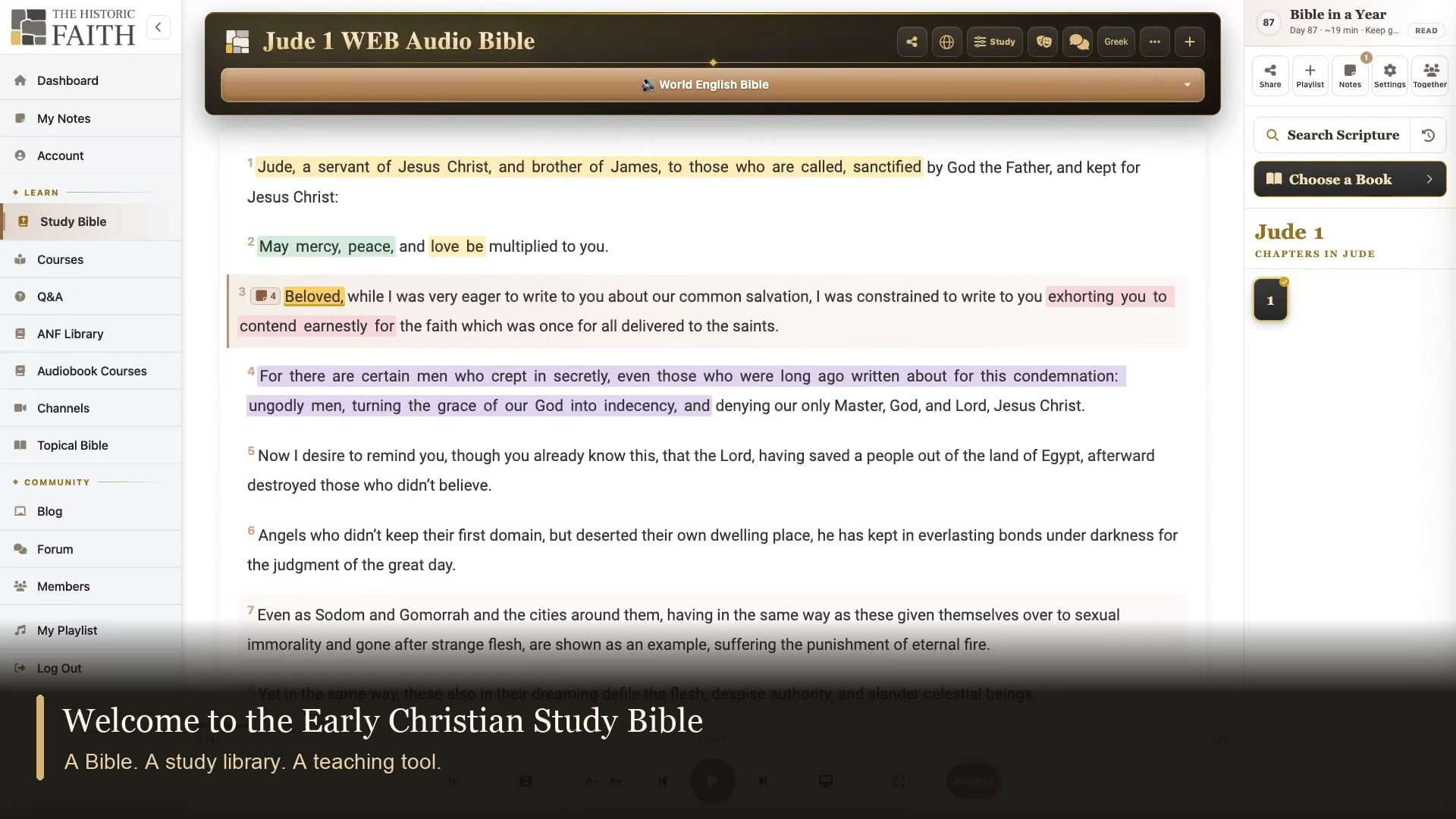
Click a word. Hear its pronunciation. Open the early Christian writings. Then see how to present and teach.
 Words. Writings.
Guided tour · 21:50 · Several Bible editions.
See the phone experience · 5:31
Strong's Exhaustive Concordance, first published by James Strong in 1890, indexes every word of the King James Version and assigns each underlying original-language word a number — G1–G5624 for the Greek New Testament and H1–H8674 for the Hebrew Old Testament. Look up any English word, find its Strong's number, and see the Greek or Hebrew word behind it, its definition, and the verses where it occurs. This free online edition covers 14,298 entries with 767,764 indexed occurrences — including the Septuagint, deuterocanonical books, and 1 Enoch, which no print edition of Strong's includes.
These entry points are the quickest way to see how a Strong's number opens into a word, meaning, and Bible usage.
Greek agape, with New Testament and Septuagint usage links where indexed.
Greek kyrios, a major New Testament and Septuagint word-study bridge.
Hebrew reshith, the word behind “beginning” in Genesis 1:1 and other Old Testament usages.
Browse the local Greek and Hebrew Strong's entries in fast pages, open an exact number, or narrow the index by language, range, and usage count.
| Number | Word | Definition | Usages | Range |
|---|---|---|---|---|
|
H6227 — `ashan
Hebrew
|
עָשָׁן (`ashan)
`ashan
|
`ashan (aw-shawn') n-m. 1. smoke, literally or figuratively (vapor, dust, anger) [from H6225] | 24 | H6001-H7000 |
|
H6228 — `Ashan
Hebrew
|
עָשָׁן (`Ashan)
`Ashan
|
`Ashan (aw-shawn') n/l. 1. Ashan, a place in Israel [the same as H6227] | 4 | H6001-H7000 |
|
H6229 — `asaq
Hebrew
|
עָשַׂק (`asaq)
`asaq
|
`asaq (aw-sak) v. 1. to press upon, i.e. quarrel [a primitive root (identical with H6231)] | 1 | H6001-H7000 |
|
H6230 — `eseq
Hebrew
|
עֵשֶׂק (`eseq)
`eseq
|
`eseq (ay'sek) n/l. 1. strife 2. a well that Isaac named | 1 | H6001-H7000 |
|
H6231 — `ashaq
Hebrew
|
עָשַׁק (`ashaq)
`ashaq
|
`ashaq (aw-shak') v. 1. to press upon, i.e. oppress, defraud, violate, overflow [a primitive root] | 35 | H6001-H7000 |
|
H6232 — `Esheq
Hebrew
|
עֵשֶׁק (`Esheq)
`Esheq
|
`Esheq (ay-shek') n/p. 1. oppression 2. Eshek, an Israelite | 1 | H6001-H7000 |
|
H6233 — `osheq
Hebrew
|
עוֹשֶׁק (`osheq)
`osheq
|
`osheq (o'-shek) n-m. 1. injury, fraud, (subjectively) distress, (concretely) unjust gain [from H6231] | 15 | H6001-H7000 |
|
H6234 — `oshqah
Hebrew
|
עָשׁקָה (`oshqah)
`oshqah
|
`oshqah (osh-kaw') n-f. 1. anguish [feminine of H6233] | 1 | H6001-H7000 |
|
H6235 — `eser
Hebrew
|
עֶשֶׂר עֲשָׂרָה (`eser)
`eser
|
`eser (eh'ser) (masculine of term aasarah {as-aw-raw'}) n-e. 1. ten (as an accumulation to the extent of the digits) [from H6237] | 157 | H6001-H7000 |
|
H6236
Hebrew
|
עֲשַׂר עֲשׂרָה
|
`asar , (as-ar') ((Aramaic) masculine aasrah (Aramaic). {as-raw'}) n-e. 1. ten [corresponding to H6235] | 5 | H6001-H7000 |
|
H6237 — `asar
Hebrew
|
עָשַׂר (`asar)
`asar
|
`asar (aw-sar') v. 1. to tithe, i.e. to take or give a tenth [a primitive root (ident. With H6238), to accumulate; but used only as denominative from H6235] | 7 | H6001-H7000 |
|
H6238 — `ashar
Hebrew
|
עָשַׁר (`ashar)
`ashar
|
`ashar (aw-shar') v. 1. (properly) to accumulate 2. chiefly (specifically) to grow (causatively, make) rich | 17 | H6001-H7000 |
|
H6239 — `osher
Hebrew
|
עוֹשֶׁר (`osher)
`osher
|
`osher (o'-sher) n-m. 1. wealth [from H6238] | 36 | H6001-H7000 |
|
H6240 — `asar
Hebrew
|
עָשָׂר (`asar)
`asar
|
`asar (aw-sawr') n-e. 1. ten 2. (only in combination), i.e. -teen | 290 | H6001-H7000 |
|
H6241 — `issarown
Hebrew
|
עִשָּׂרוֹן עִשָּׂרוֹן (`issarown)
`issarown
|
`issarown (is-saw-rone') (or oissaron {is-saw-rone'}) n-m. 1. (fractional) a tenth part [from H6235] | 22 | H6001-H7000 |
|
H6242 — `esriym
Hebrew
|
עֶשׂרִים (`esriym)
`esriym
|
`esriym (es-reem') n-e. 1. twenty 2. (ordinal) twentieth | 281 | H6001-H7000 |
|
H6243 — `esriyn
Hebrew
|
עֶשׂרִין (`esriyn)
`esriyn
|
`esriyn (es-reen') n-e. 1. twenty [(Aramaic) corresponding to H6242] | 1 | H6001-H7000 |
|
H6244 — `ashesh
Hebrew
|
עָשֵׁשׁ (`ashesh)
`ashesh
|
`ashesh (aw-shaysh') v. 1. probably to shrink, i.e. fail [a primitive root] | 3 | H6001-H7000 |
|
H6245 — `ashath
Hebrew
|
עָשַׁת (`ashath)
`ashath
|
`ashath (aw-shath') v. 1. probably to be sleek, i.e. glossy 2. hence (through the idea of polishing) to excogitate (as if forming in the mind) | 2 | H6001-H7000 |
|
H6246 — `ashith
Hebrew
|
עֲשִׁת (`ashith)
`ashith
|
`ashith (ash-eeth') v. 1. to purpose [(Aramaic) corresponding to H6245] | 1 | H6001-H7000 |
|
H6247 — `esheth
Hebrew
|
עֶשֶׁת (`esheth)
`esheth
|
`esheth (eh'-sheth) n-m. 1. a fabric [from H6245] | 1 | H6001-H7000 |
|
H6248 — `ashtuwth
Hebrew
|
עַשׁתּוּת (`ashtuwth)
`ashtuwth
|
`ashtuwth (ash-tooth') n-f. 1. cogitation [from H6245] | 1 | H6001-H7000 |
|
H6249 — `ashtey
Hebrew
|
עַשׁתֵּי (`ashtey)
`ashtey
|
`ashtey (ash-tay') n-e. 1. + eleven(-th) [apparently masculine plural construction of H6247 in the sense of an afterthought (used only in connection with H6240 in lieu of H259) eleven or (ordinal) eleventh] | 18 | H6001-H7000 |
|
H6250 — `eshtonah
Hebrew
|
עֶשׁתּוֹנָה (`eshtonah)
`eshtonah
|
`eshtonah (esh-to-naw') n-f. 1. thinking [from H6245] | 1 | H6001-H7000 |
|
H6251 — `ashtrah
Hebrew
|
עַשׁתְּרָה (`ashtrah)
`ashtrah
|
`ashtrah (ash-ter-aw') n-f. 1. increase [probably from H6238] | 4 | H6001-H7000 |
|
H6252 — `Ashtarowth
Hebrew
|
עַשׁתָּרוֹת עַשׁתָּרוֹת (`Ashtarowth)
`Ashtarowth
|
`Ashtarowth (ash-taw-roth') (or bAshtaroth {ash-taw-roth'}) n/p. 1. Ashtaroth, the name of a Sidonian deity, and of a place East of the Jordan [plural of H6251] | 12 | H6001-H7000 |
|
H6253 — `Ashtoreth
Hebrew
|
עַשׁתּוֹרֶת (`Ashtoreth)
`Ashtoreth
|
`Ashtoreth (ash-to'reth) n/p. 1. Ashtoreth, the Phoenician goddess of love (and increase) [probably for H6251] | 3 | H6001-H7000 |
|
H6254 — `Ashtrathiy
Hebrew
|
עַשׁתְּרָתִי (`Ashtrathiy)
`Ashtrathiy
|
`Ashtrathiy (ash-ter-aw-thee') adj. 1. an Ashterathite or inhabitant of Ashtaroth [patrial from H6252] | 1 | H6001-H7000 |
|
H6255
Hebrew
|
עַשׁתְּרוֹת קַרנַיִם
|
`Ashtroth Qarnayim (ash-ter-oth' kar-nah'-yim) n/l. 1. Ashtaroth of (the) double horns (a symbol of the deity) 2. Ashteroth-Karnaim, a place East of the Jordan | 1 | H6001-H7000 |
|
H6256 — `eth
Hebrew
|
עֵת (`eth)
`eth
|
`eth (ayth) n-f. 1. time, especially (adverb with preposition) now, when, etc [from H5703] | 258 | H6001-H7000 |
|
H6257 — `athad
Hebrew
|
עָתַד (`athad)
`athad
|
`athad (aw-thad') v. 1. to prepare [a primitive root] | 2 | H6001-H7000 |
|
H6258 — `attah
Hebrew
|
עַתּתָּה (`attah)
`attah
|
`attah (at-taw') adv. 1. at this time, whether adverb, conjunction or expletive [from H6256] | 422 | H6001-H7000 |
|
H6259 — `athuwd
Hebrew
|
עָתוּד (`athuwd)
`athuwd
|
`athuwd (aw-thood') adj. 1. prepared [passive participle of H6257] | 1 | H6001-H7000 |
|
H6260 — `attuwd
Hebrew
|
עַתּתּוּד עַתּתּוּד (`attuwd)
`attuwd
|
`attuwd (at-tood') (or sattud {at-tood'}) n-m. 1. prepared, i.e. full grown 2. spoken only (in plural) of he-goats, or (figuratively) leaders of the people | 29 | H6001-H7000 |
|
H6261 — `ittiy
Hebrew
|
עִתּתִּי (`ittiy)
`ittiy
|
`ittiy (it-tee') adj. 1. timely [from H6256] | 1 | H6001-H7000 |
|
H6262 — `Attay
Hebrew
|
עַתּתַּי (`Attay)
`Attay
|
`Attay (at-tah'ee) n/p. 1. Attai, the name of three Israelites [for H6261] | 4 | H6001-H7000 |
|
H6263 — `athiyd
Hebrew
|
עֲתִידּ (`athiyd)
`athiyd
|
`athiyd (ath-eed') adj. 1. prepared [(Aramaic) corresponding to H6264] | 1 | H6001-H7000 |
|
H6264 — `athiyd
Hebrew
|
עָתִידּ (`athiyd)
`athiyd
|
`athiyd (aw-theed') adj. 1. prepared 2. (by implication) skilful | 5 | H6001-H7000 |
|
H6265 — `Athayah
Hebrew
|
עֲתָיָה (`Athayah)
`Athayah
|
`Athayah (ath-aw-yaw') n/p. 1. Jah has helped 2. Athajah, an Israelite | 1 | H6001-H7000 |
|
H6266 — `athiyq
Hebrew
|
עָתִיק (`athiyq)
`athiyq
|
`athiyq (aw-theek') adj. 1. (properly) antique, i.e. venerable or splendid [from H6275] | 1 | H6001-H7000 |
|
H6267 — attiyq
Hebrew
|
עַתּתִּיק (attiyq)
attiyq
|
attiyq (at-teek') adj. 1. removed, i.e. weaned 2. also antique | 2 | H6001-H7000 |
|
H6268 — `attiyq
Hebrew
|
עַתּתִּיק (`attiyq)
`attiyq
|
`attiyq (at-teek') adj. 1. venerable [(Aramaic) corresponding to H6267] | 3 | H6001-H7000 |
|
H6269 — `Athak
Hebrew
|
עֲתָך (`Athak)
`Athak
|
`Athak (ath-awk') n/l. 1. lodging 2. Athak, a place in Israel | 1 | H6001-H7000 |
|
H6270 — `Athlay
Hebrew
|
עַתלַי (`Athlay)
`Athlay
|
`Athlay (ath-lah'ee) n/p. 1. constringent 2. Athlai, an Israelite | 1 | H6001-H7000 |
|
H6271 — `Athalyah
Hebrew
|
עֲתַליָה עֲתַליָהוּ (`Athalyah)
`Athalyah
|
`Athalyah (ath-al-yaw') (or mAthalyahuw {ath-al-yaw'-hoo}) n/p. 1. Jah has constrained 2. Athaljah, the name of an Israelitess and two Israelites | 17 | H6001-H7000 |
|
H6272 — `atham
Hebrew
|
עָתַם (`atham)
`atham
|
`atham (aw-tham) v. 1. probably to glow, i.e. (figuratively) be desolated [a primitive root] | 1 | H6001-H7000 |
|
H6273 — `Otnniy
Hebrew
|
עָתנִי (`Otnniy)
`Otnniy
|
`Otnniy (oth-nee') n/p. 1. forcible 2. Othni, an Israelite | 1 | H6001-H7000 |
|
H6274 — `Othniy'el
Hebrew
|
עָתנִיאֵל (`Othniy'el)
`Othniy'el
|
`Othniy'el (oth-nee-ale') n/p. 1. force of God 2. Othniel, an Israelite | 6 | H6001-H7000 |
|
H6275 — `athaq
Hebrew
|
עָתַק (`athaq)
`athaq
|
`athaq (aw-thak') v. 1. to remove (intransitive or transitive) figuratively, to grow old 2. specifically, to transcribe | 9 | H6001-H7000 |
|
H6276 — `atheq
Hebrew
|
עָתֵק (`atheq)
`atheq
|
`atheq (aw-thake') adj. 1. antique, i.e. valued [from H6275] | 1 | H6001-H7000 |
|
H6277 — `athaq
Hebrew
|
עָתָק (`athaq)
`athaq
|
`athaq (aw-thawk') adj. 1. impudent [from H6275 in the sense of license] | 4 | H6001-H7000 |
|
H6278
Hebrew
|
עֵת קָצִין
|
`Eth Qatsiyn (ayth kaw-tseen') n/l. 1. time of a judge 2. Eth-Katsin, a place in Israel | 1 | H6001-H7000 |
|
H6279 — `athar
Hebrew
|
עָתַר (`athar)
`athar
|
`athar (aw-thar') v. 1. to burn incense in worship, i.e. intercede (reciprocally, listen to prayer) [a primitive root (rather denominative from H6281)] | 19 | H6001-H7000 |
|
H6280 — `athar
Hebrew
|
עָתַר (`athar)
`athar
|
`athar (aw-thar') v. 1. to be (causatively, make) abundant [a primitive root] | 2 | H6001-H7000 |
|
H6281 — `Ether
Hebrew
|
עֶתֶר (`Ether)
`Ether
|
`Ether (eh'ther) n/l. 1. abundance 2. Ether, a place in Israel | 2 | H6001-H7000 |
|
H6282 — `athar
Hebrew
|
עָתָר (`athar)
`athar
|
`athar (aw-thawr') n-m. 1. incense (as increasing to a volume of smoke) 2. hence (from H6279) a worshipper | 2 | H6001-H7000 |
|
H6283 — `athereth
Hebrew
|
עֲתֶרֶת (`athereth)
`athereth
|
`athereth (ath-eh'-reth) n-f. 1. copiousness [from H6280] | 1 | H6001-H7000 |
|
H6284 — pa'ah
Hebrew
|
פָּאָה (pa'ah)
pa'ah
|
pa'ah (paw-aw') v. 1. to puff, i.e. blow away [a primitive root] | 1 | H6001-H7000 |
|
H6285 — pe'ah
Hebrew
|
פֵּאָה (pe'ah)
pe'ah
|
pe'ah (pay-aw') n-f. 1. (properly) mouth in a figurative sense, i.e. direction, region, extremity [feminine of H6311] | 59 | H6001-H7000 |
|
H6286 — pa'ar
Hebrew
|
פָּאַר (pa'ar)
pa'ar
|
pa'ar (paw-ar') v. 1. to gleam, i.e. (causatively) embellish 2. (figuratively) to boast | 14 | H6001-H7000 |
|
H6287 — p'er
Hebrew
|
פְּאֵר (p'er)
p'er
|
p'er (peh-ayr') n-m. 1. an embellishment, i.e. fancy head-dress [from H6286] | 7 | H6001-H7000 |
|
H6288 — p'orah
Hebrew
|
פְּאוֹרָה פּוֹרָאה פּוּארָה (p'orah)
p'orah
|
p'orah (peh-o-raw') (or pora'h {po-raw'} or pu'rah {poo-raw'};) n-f. 1. (properly) ornamentation, i.e. (plural) foliage (including the limbs) as bright green [from H6286] | 7 | H6001-H7000 |
|
H6289 — pa'ruwr
Hebrew
|
פָּארוּר (pa'ruwr)
pa'ruwr
|
pa'ruwr (paw-roor') n-m. 1. (properly) illuminated, i.e. a glow 2. as noun, a flush (of anxiety) | 2 | H6001-H7000 |
|
H6290 — Pa'ran
Hebrew
|
פָּארָן (Pa'ran)
Pa'ran
|
Pa'ran (paw-rawn') n/l. 1. ornamental 2. Paran, a desert of Arabia | 10 | H6001-H7000 |
|
H6291 — pag
Hebrew
|
פַּג (pag)
pag
|
pag (pag) n-m. 1. an unripe fig [from an unused root meaning to be torpid, i.e. crude] | 1 | H6001-H7000 |
|
H6292 — pigguwl
Hebrew
|
פִּגּוּל פִּגּוּל (pigguwl)
pigguwl
|
pigguwl (pig-gool') (or piggul {pig-gool'}) n-m. 1. (properly) fetid, i.e. (figuratively) unclean (ceremonially) [from an unused root meaning to stink] | 4 | H6001-H7000 |
|
H6293 — paga`
Hebrew
|
פָּגַע (paga`)
paga`
|
paga` (paw-gah') v. 1. to impinge, by accident or violence, or (figuratively) by importunity [a primitive root] | 43 | H6001-H7000 |
|
H6294 — pega`
Hebrew
|
פֶּגַע (pega`)
pega`
|
pega` (peh'-gah) n-m. 1. impact (casual) [from H6293] | 2 | H6001-H7000 |
|
H6295 — Pag`iy'el
Hebrew
|
פַּגעִיאֵל (Pag`iy'el)
Pag`iy'el
|
Pag`iy'el (pag-ee-ale') n/p. 1. accident of God 2. Pagiel, an Israelite | 5 | H6001-H7000 |
|
H6296 — pagar
Hebrew
|
פָּגַר (pagar)
pagar
|
pagar (paw-gar') v. 1. to relax, i.e. become exhausted [a primitive root] | 2 | H6001-H7000 |
|
H6297 — peger
Hebrew
|
פֶּגֶר (peger)
peger
|
peger (peh'gher) n-m. 1. a carcass (as limp), whether of man or beast 2. (figuratively) an idolatrous image | 21 | H6001-H7000 |
|
H6298 — pagash
Hebrew
|
פָּגַשׁ (pagash)
pagash
|
pagash (paw-gash') v. 1. to come in contact with, whether by accident or violence 2. (figuratively) to concur | 14 | H6001-H7000 |
|
H6299 — padah
Hebrew
|
פָּדָה (padah)
padah
|
padah (paw-daw') v. 1. to sever, i.e. ransom 2. gener. to release, preserve | 48 | H6001-H7000 |
|
H6300 — Pdah'el
Hebrew
|
פְּדַהאֵל (Pdah'el)
Pdah'el
|
Pdah'el (ped-ah-ale') n/p. 1. God has ransomed 2. Pedahel, an Israelite | 1 | H6001-H7000 |
|
H6301 — Pdahtsuwr
Hebrew
|
פְּדָהצּוּר (Pdahtsuwr)
Pdahtsuwr
|
Pdahtsuwr (ped-aw-tsoor') n/p. 1. a rock (i.e. God) has ransomed 2. Pedahtsur, an Israelite | 5 | H6001-H7000 |
|
H6302 — paduwy
Hebrew
|
פָּדוּי (paduwy)
paduwy
|
paduwy (paw-doo'ee) n-m. 1. as abstractly (in plural masculine) a ransom [passive participle of H6299. ransomed (and so occurring under H6299)] | 4 | H6001-H7000 |
|
H6303 — Padown
Hebrew
|
פָּדוֹן (Padown)
Padown
|
Padown (paw-done') n/p. 1. ransom 2. Padon, one of the Nethinim | 2 | H6001-H7000 |
|
H6304 — pduwth
Hebrew
|
פְּדוּת פְּדוּת (pduwth)
pduwth
|
pduwth (ped-ooth') (or pduth {ped-ooth'}) n-f. 1. distinction 2. also deliverance | 4 | H6001-H7000 |
|
H6305 — Pdayah
Hebrew
|
פְּדָיָה פְּדָיָהוּ (Pdayah)
Pdayah
|
Pdayah (ped-aw-yaw') (or Pdayahuw {ped-aw-yaw'-hoo}) n/p. 1. Jah has ransomed 2. Pedajah, the name of six Israelites | 8 | H6001-H7000 |
|
H6306 — pidyowm
Hebrew
|
פִּדיוֹם פִּדיוֹם פִּדיוֹן פִּדיוֹן (pidyowm)
pidyowm
|
pidyowm (pid-yome') (or pidyom {pid-yome'}; also pidyown {pid-yone'}; or pidyon {pid-yone'};) n-m. 1. a ransom 2. | 3 | H6001-H7000 |
|
H6307
Hebrew
|
אֲרָ֑ם
|
Paddan (pad-dawn') n/l. 1. the table-land of Aram 2. Paddan or Paddan-Aram, a region of Syria | 11 | H6001-H7000 |
|
H6308 — pada`
Hebrew
|
פָּדַע (pada`)
pada`
|
pada` (paw-dah') v. 1. to retrieve [a primitive root] | 1 | H6001-H7000 |
|
H6309 — peder
Hebrew
|
פֶּדֶר (peder)
peder
|
peder (peh'der) n-m. 1. suet [from an unused root meaning to be greasy] | 3 | H6001-H7000 |
|
H6310 — peh
Hebrew
|
פֶּה (peh)
peh
|
peh (peh) n-m. 1. the mouth (as the means of blowing), whether literal or figurative (particularly speech) 2. specifically edge, portion or side | 460 | H6001-H7000 |
|
H6311 — poh
Hebrew
|
פּוֹה פּוֹא פּוֹ (poh)
poh
|
poh (po) (or po' (Job 38:11)) adv. 1. this place (French ici), i.e. here or hence [probably from a primitive inseparable particle "p" (of demonstrative force) and H1931] | 57 | H6001-H7000 |
|
H6312 — Puw'ah
Hebrew
|
פּוּאָה פּוּוָּה (Puw'ah)
Puw'ah
|
Puw'ah (poo-aw') (or Puvvah {poov-vaw'}) n/p. 1. a blast 2. Puah or Puvvah, the name of two Israelites | 4 | H6001-H7000 |
|
H6313 — puwg
Hebrew
|
פּוּג (puwg)
puwg
|
puwg (poog) v. 1. to be sluggish [a primitive root] | 4 | H6001-H7000 |
|
H6314 — puwgah
Hebrew
|
פּוּגָה (puwgah)
puwgah
|
puwgah (poo-gaw') n-f. 1. intermission [from H6313] | 1 | H6001-H7000 |
|
H6315 — puwach
Hebrew
|
פּוַּח (puwach)
puwach
|
puwach (poo'akh) v. 1. to puff, i.e. blow with the breath or air 2. (hence) to fan (as a breeze), to utter, to kindle (a fire), to scoff | 14 | H6001-H7000 |
|
H6316 — Puwt
Hebrew
|
פּוּט (Puwt)
Puwt
|
Puwt (poot) n/g. 1. Put, a son of Ham, also the name of his descendants or their region, and of a Persian tribe [of foreign origin] | 7 | H6001-H7000 |
|
H6317 — Puwtiy'el
Hebrew
|
פּוּטִיאֵל (Puwtiy'el)
Puwtiy'el
|
Puwtiy'el (poo-tee-ale') n/p. 1. contempt of God 2. Putiel, an Israelite | 1 | H6001-H7000 |
|
H6318 — Powtiyphar
Hebrew
|
פּוֹטִיפַר (Powtiyphar)
Powtiyphar
|
Powtiyphar (po-tee-far') n/p. 1. Potiphar [of Egyptian derivation] | 2 | H6001-H7000 |
|
H6319
Hebrew
|
פּוֹטִי פֶרַע
|
Powtiy Phera` (po-tee feh'-rah) n/p. 1. Poti-Phera, an Egyptian [of Egyptian derivation] | 3 | H6001-H7000 |
|
H6320 — puwk
Hebrew
|
פּוּך (puwk)
puwk
|
puwk (pook) n-m. 1. dye (specifically, stibium for the eyes) [from an unused root meaning to paint] | 4 | H6001-H7000 |
|
H6321 — powl
Hebrew
|
פּוֹל (powl)
powl
|
powl (pole) n-m. 1. a bean (as plump) [from an unused root meaning to be thick] | 2 | H6001-H7000 |
|
H6322 — Puwl
Hebrew
|
פּוּל (Puwl)
Puwl
|
Puwl (pool) n/p. 1. Pul, the name of an Assyrian king and of an Ethiopian tribe [of foreign origin] | 3 | H6001-H7000 |
|
H6323 — puwn
Hebrew
|
פּוּן (puwn)
puwn
|
puwn (poon) v. 1. be distracted [a primitive root meaning to turn, i.e. be perplexed] | 1 | H6001-H7000 |
|
H6324 — Puwniy
Hebrew
|
פּוּנִי (Puwniy)
Puwniy
|
Puwniy (poo-nee') adj. 1. a Punite (collectively) or descendants of an unknown Pun [patronymically from an unused name meaning a turn] | 1 | H6001-H7000 |
|
H6325 — Puwnon
Hebrew
|
פּוּנוֹן (Puwnon)
Puwnon
|
Puwnon (poo-none') n/l. 1. perplexity 2. Punon, a place in the Desert | 2 | H6001-H7000 |
|
H6326 — Puw`ah
Hebrew
|
פּוּעָה (Puw`ah)
Puw`ah
|
Puw`ah (poo-aw') n/p. 1. brilliancy 2. Puah, an Israelitess | 1 | H6001-H7000 |
|
H6327 — puwts
Hebrew
|
פּוּץ (puwts)
puwts
|
puwts (poots) v. 1. to dash in pieces, literally or figuratively (especially to disperse) [a primitive root] | 66 | H6001-H7000 |
|
H6328 — puwq
Hebrew
|
פּוּק (puwq)
puwq
|
puwq (pook) v. 1. to waver [a primitive root] | 2 | H6001-H7000 |
|
H6329 — puwq
Hebrew
|
פּוּק (puwq)
puwq
|
puwq (pook) v. 1. to issue, i.e. furnish 2. causatively, to secure | 7 | H6001-H7000 |
|
H6330 — puwqah
Hebrew
|
פּוּקָה (puwqah)
puwqah
|
puwqah (poo-kaw') n-f. 1. a stumbling-block [from H6328] | 1 | H6001-H7000 |
|
H6331 — puwr
Hebrew
|
פּוּר (puwr)
puwr
|
puwr (poor) v. 1. to crush [a primitive root] | 3 | H6001-H7000 |
|
H6332 — Puwr
Hebrew
|
פּוּר פּוּרִים פּוּרִים (Puwr)
Puwr
|
Puwr (poor) (also (plural) Puwriym {poo-reem'} or Puriym {poo-reem'};) n-m. 1. a lot (as by means of a broken piece) [from H6331] | 7 | H6001-H7000 |
|
H6333 — puwrah
Hebrew
|
פּוּרָה (puwrah)
puwrah
|
puwrah (poo-raw') n-f. 1. a wine-press (as crushing the grapes) [from H6331] | 2 | H6001-H7000 |
|
H6334 — Powratha'
Hebrew
|
פּוֹרָתָא (Powratha')
Powratha'
|
Powratha' (po-raw-thaw') n/p. 1. Poratha, a son of Haman [of Persian origin] | 1 | H6001-H7000 |
|
H6335 — puwsh
Hebrew
|
פּוּשׁ (puwsh)
puwsh
|
puwsh (poosh) v. 1. to spread 2. (figuratively) act proudly | 4 | H6001-H7000 |
|
H6336 — Puwthiy
Hebrew
|
פּוּתִי (Puwthiy)
Puwthiy
|
Puwthiy (poo-thee') adj. 1. a Puthite (collectively) or descendants of an unknown Puth [patronymically from an unused name meaning a hinge] | 1 | H6001-H7000 |
|
H6337 — paz
Hebrew
|
פָּז (paz)
paz
|
paz (pawz) n-m. 1. pure (gold) 2. (hence) gold itself (as refined) | 9 | H6001-H7000 |
|
H6338 — pazaz
Hebrew
|
פָּזַז (pazaz)
pazaz
|
pazaz (paw-zaz') v. 1. to refine (gold) [a primitive root] | 1 | H6001-H7000 |
|
H6339 — pazaz
Hebrew
|
פָּזַז (pazaz)
pazaz
|
pazaz (paw-zaz') v. 1. to solidify (as if by refining) 2. also to spring (as if separating the limbs) | 2 | H6001-H7000 |
|
H6340 — pazar
Hebrew
|
פָּזַר (pazar)
pazar
|
pazar (paw-zar') v. 1. to scatter, whether in enmity or bounty [a primitive root] | 10 | H6001-H7000 |
|
H6341 — pach
Hebrew
|
פַּח (pach)
pach
|
pach (pakh) n-m. 1. a (metallic) sheet (as pounded thin) 2. also a spring net (as spread out like a lamina) | 25 | H6001-H7000 |
|
H6342 — pachad
Hebrew
|
פָּחַד (pachad)
pachad
|
pachad (paw-kkad') v. 1. to be startled (by a sudden alarm) 2. (hence) to fear in general | 25 | H6001-H7000 |
|
H6343 — pachad
Hebrew
|
פַּחַד (pachad)
pachad
|
pachad (pakh'-ad) n-m. 1. a (sudden) alarm 2. (properly) the object feared | 48 | H6001-H7000 |
|
H6344 — pachad
Hebrew
|
פַּחַד (pachad)
pachad
|
pachad (pakh'-ad) n-m. 1. a testicle (as a cause of shame akin to fear) [the same as H6343] | 1 | H6001-H7000 |
|
H6345 — pachdah
Hebrew
|
פַּחדָּה (pachdah)
pachdah
|
pachdah (pakh-daw') n-f. 1. alarm (i.e. awe) [feminine of H6343] | 1 | H6001-H7000 |
|
H6346 — pechah
Hebrew
|
פֶּחָה (pechah)
pechah
|
pechah (peh-khaw') n-m. 1. a prefect (of a city or small district) [of foreign origin] | 27 | H6001-H7000 |
|
H6347 — pechah
Hebrew
|
פֶּחָה (pechah)
pechah
|
pechah (peh-khaw') n-m. 1. captain, governor [(Aramaic) corresponding to H6346] | 10 | H6001-H7000 |
|
H6348 — pachaz
Hebrew
|
פָּחַז (pachaz)
pachaz
|
pachaz (paw-khaz') v. 1. to bubble up or froth (as boiling water), i.e. (figuratively) to be unimportant [a primitive root] | 2 | H6001-H7000 |
|
H6349 — pachaz
Hebrew
|
פַּחַז (pachaz)
pachaz
|
pachaz (pakh'-az) n-m. 1. ebullition, i.e. froth (figuratively, lust) [from H6348] | 1 | H6001-H7000 |
|
H6350 — pachazuwth
Hebrew
|
פַּחֲזוּת (pachazuwth)
pachazuwth
|
pachazuwth (pakh-az-ooth') n-f. 1. frivolity [from H6348] | 1 | H6001-H7000 |
|
H6351 — pachach
Hebrew
|
פָּחַח (pachach)
pachach
|
pachach (paw-khakh') v. 1. to batter out 2. but used only as denominative from H6341, to spread a net | 1 | H6001-H7000 |
|
H6352 — pecham
Hebrew
|
פֶּחָם (pecham)
pecham
|
pecham (peh-khawm') n-m. 1. a coal, whether charred or live [perhaps from an unused root probably meaning to be black] | 3 | H6001-H7000 |
|
H6353 — pechar
Hebrew
|
פֶּחָר (pechar)
pechar
|
pechar (peh-khawr') n-m. 1. a potter [(Aramaic) from an unused root probably meaning to fashion] | 1 | H6001-H7000 |
|
H6354 — pachath
Hebrew
|
פַּחַת (pachath)
pachath
|
pachath (pakh'-ath) n-m. 1. a pit, especially for catching animals [probably from an unused root apparently meaning to dig] | 8 | H6001-H7000 |
|
H6355
Hebrew
|
פַּחַת מוֹאָב
|
Pachath Mow'ab (pakh'-ath mo-awb') n/p. 1. pit of Moab 2. Pachath-Moab, an Israelite | 6 | H6001-H7000 |
|
H6356 — pchetheth
Hebrew
|
פְּחֶתֶת (pchetheth)
pchetheth
|
pchetheth (pekh-eh'-theth) n-f. 1. a hole (by mildew in a garment) [from the same as H6354] | 1 | H6001-H7000 |
|
H6357 — pitdah
Hebrew
|
פִּטדָּה (pitdah)
pitdah
|
pitdah (pit-daw') n-f. 1. a gem, probably the topaz [of foreign derivation] | 4 | H6001-H7000 |
|
H6358 — patuwr
Hebrew
|
פָּטוּר (patuwr)
patuwr
|
patuwr (paw-toor') subv. 1. opened, i.e. (as noun) a bud [passive participle of H6362] | 4 | H6001-H7000 |
|
H6359 — patiyr
Hebrew
|
פָּטִיר (patiyr)
patiyr
|
patiyr (paw-teer') adj. 1. open, i.e. unoccupied [from H6362] | 1 | H6001-H7000 |
|
H6360 — pattiysh
Hebrew
|
פַּטִּישׁ (pattiysh)
pattiysh
|
pattiysh (pat-teesh') n-m. 1. a hammer [intensively from an unused root meaning to pound] | 3 | H6001-H7000 |
|
H6361 — pattiysh
Hebrew
|
פַּטִּישׁ (pattiysh)
pattiysh
|
pattiysh (pat-teesh') n-m. 1. a gown (as if hammered out wide) [(Aramaic) from a root corresponding to that of H6360] | 1 | H6001-H7000 |
|
H6362 — patar
Hebrew
|
פָּטַר (patar)
patar
|
patar (paw-tar') v. 1. to cleave or burst through, i.e. (causatively) to emit, whether literal or figurative (gape) [a primitive root] | 4 | H6001-H7000 |
|
H6363 — peter
Hebrew
|
פֶּטֶר פִּטרָה (peter)
peter
|
peter (peh'-ter) (or pitrah {pit-raw'}) n-m. 1. a fissure 2. (concretely) a firstling (as opening the matrix) | 10 | H6001-H7000 |
|
H6364 — Piy-Beceth
Hebrew
|
פִּי ־ בֶּסֶת (Piy-Beceth)
Piy-Beceth
|
Piy-Beceth (pee beh'-seth) n/l. 1. Pi-Beseth, a place in Egypt [of Egyptian origin] | 1 | H6001-H7000 |
|
H6365 — piyd
Hebrew
|
פִּידּ (piyd)
piyd
|
piyd (peed) n-m. 1. (figuratively) misfortune [from an unused root probably meaning to pierce] | 3 | H6001-H7000 |
|
H6366 — peyah
Hebrew
|
פֵּיָה פִּיָה (peyah)
peyah
|
peyah (pay-aw') (or piyah {pee-yaw'}) n-f. 1. an edge [feminine of H6310] | 1 | H6001-H7000 |
|
H6367
Hebrew
|
פִּי הַחִרוֹת
|
Pi ha-Chiyroth (pee hah-khee-roth') n/l. 1. mouth of the gorges 2. Pi-ha-Chiroth, a place in Egypt | 4 | H6001-H7000 |
|
H6368 — piyach
Hebrew
|
פִּיַח (piyach)
piyach
|
piyach (pee'-akh) n-m. 1. a powder (as easily puffed away), i.e. ashes or dust [from H6315] | 2 | H6001-H7000 |
|
H6369 — Piykol
Hebrew
|
פִּיכּוֹל (Piykol)
Piykol
|
Piykol (pee-kole') n/p. 1. mouth of all 2. Picol, a Philistine | 3 | H6001-H7000 |
|
H6370 — piylegesh
Hebrew
|
פִּילֶגֶשׁ פִּלֶגֶשׁ (piylegesh)
piylegesh
|
piylegesh (pee-leh'-ghesh) (or pilegesh {pee-leh'-ghesh}) n-f. 1. a concubine 2. (masculine) a paramour, gigolo | 35 | H6001-H7000 |
|
H6371 — piymah
Hebrew
|
פִּימָה (piymah)
piymah
|
piymah (pee-maw') n-f. 1. obesity [probably from an unused root meaning to be plump] | 1 | H6001-H7000 |
|
H6372 — Piynchac
Hebrew
|
פִּינְחָס (Piynchac)
Piynchac
|
Piynchac (pee-nekh-aws') n/p. 1. mouth of a serpent 2. Pinechas, the name of three Israelites | 24 | H6001-H7000 |
|
H6373 — piynon
Hebrew
|
פִּינוֹן (piynon)
piynon
|
piynon (pee-none') n/p. 1. Pinon, an Idumaean [probably the same as H6325] | 2 | H6001-H7000 |
|
H6374 — piyphiyah
Hebrew
|
פִּיפִיָה (piyphiyah)
piyphiyah
|
piyphiyah (pee-fee-yaw') n-f. 1. an edge or tooth [for H6366] | 2 | H6001-H7000 |
|
H6375 — piyq
Hebrew
|
פִּיק (piyq)
piyq
|
piyq (peek) n-m. 1. a tottering [from H6329] | 1 | H6001-H7000 |
|
H6376 — Piyshown
Hebrew
|
פִּישׁוֹן (Piyshown)
Piyshown
|
Piyshown (pee-shone') n/l. 1. dispersive 2. Pishon, a river of Eden | 1 | H6001-H7000 |
No Strong's entries match that search.
Strong's works best when the number, original word, verse, and corpus stay connected.
Open a chapter and move from a word token to its Strong's page, parsing, and linked occurrences.
Greek Strong's entries can include New Testament, Septuagint, deuterocanonical, and 1 Enoch rows where indexed.
Dedicated Strong's pages can expose approved pronunciation audio beside the word-study data.
These are common words readers run into repeatedly, shown with an English meaning so the list is readable without already knowing the original languages.
Look up a word study by its transliteration — these are frequently searched Hebrew and Greek words. Each opens the matching Strong's entry, or lists the options when a spelling maps to several words.