
G26 — Agape (Love)
Greek agape, with New Testament and Septuagint usage links where indexed.
The Early Christian Study Bible · Free to use
Study the word. Hear its pronunciation.
Search 14,298 Greek and Hebrew entries—free. Explore definitions, indexed occurrences, and pronunciation audio where available, then follow the words back into your Bible.
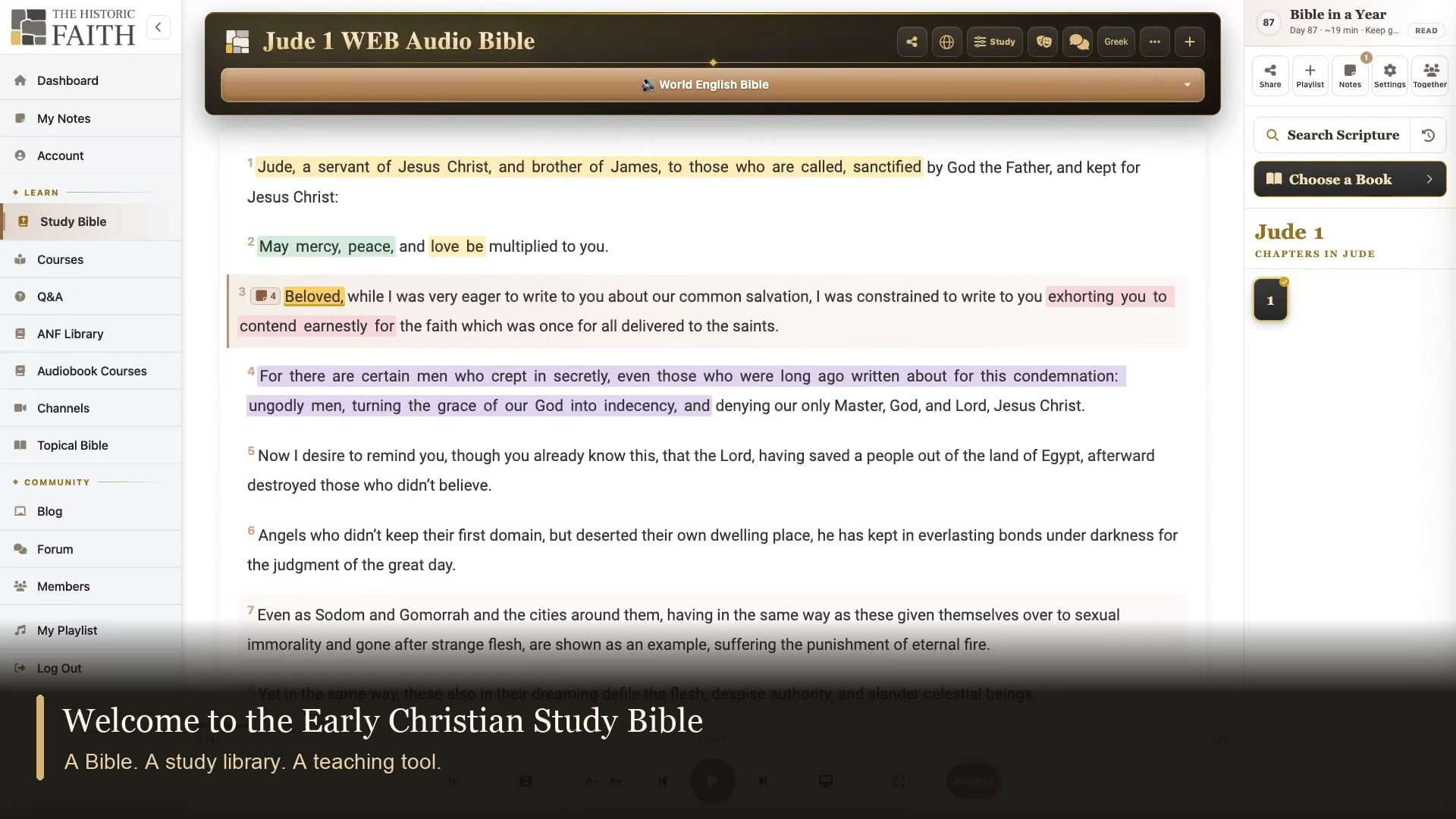
Click a word. Hear its pronunciation. Open the early Christian writings. Then see how to present and teach.
 Words. Writings.
Guided tour · 21:50 · Several Bible editions.
See the phone experience · 5:31
Strong's Exhaustive Concordance, first published by James Strong in 1890, indexes every word of the King James Version and assigns each underlying original-language word a number — G1–G5624 for the Greek New Testament and H1–H8674 for the Hebrew Old Testament. Look up any English word, find its Strong's number, and see the Greek or Hebrew word behind it, its definition, and the verses where it occurs. This free online edition covers 14,298 entries with 767,764 indexed occurrences — including the Septuagint, deuterocanonical books, and 1 Enoch, which no print edition of Strong's includes.
These entry points are the quickest way to see how a Strong's number opens into a word, meaning, and Bible usage.
Greek agape, with New Testament and Septuagint usage links where indexed.
Greek kyrios, a major New Testament and Septuagint word-study bridge.
Hebrew reshith, the word behind “beginning” in Genesis 1:1 and other Old Testament usages.
Browse the local Greek and Hebrew Strong's entries in fast pages, open an exact number, or narrow the index by language, range, and usage count.
| Number | Word | Definition | Usages | Range |
|---|---|---|---|---|
|
H5927
Hebrew
|
יַֽעֲלֶ֣ה
|
`alah (aw-law') v. 1. to ascend, intransitively (be high) or actively (mount) 2. used in a great variety of senses, primary and secondary, literal and figurative (as follow) | 817 | H5001-H6000 |
|
H5928 — `alah
Hebrew
|
עֲלָה (`alah)
`alah
|
`alah (al-law') n-f. 1. a holocaust [(Aramaic) corresponding to H5930] | 1 | H5001-H6000 |
|
H5929 — `aleh
Hebrew
|
עָלֶה (`aleh)
`aleh
|
`aleh (aw-leh') n-m. 1. a leaf (as coming up on a tree) 2. collectively, foliage | 13 | H5001-H6000 |
|
H5930 — `olah
Hebrew
|
עוֹלָה עוֹלָה (`olah)
`olah
|
`olah (o-law') (or mowlah {o-law'}) n-f. 1. a step or (collectively, stairs, as ascending) 2. usually a holocaust (as going up in smoke) | 262 | H5001-H6000 |
|
H5931 — `illah
Hebrew
|
עִלָּה (`illah)
`illah
|
`illah (il-law') n-f. 1. a pretext (as arising artificially) [(Aramaic) feminine from a root corresponding to H5927] | 2 | H5001-H6000 |
|
H5932 — `alvah
Hebrew
|
עַלוָה (`alvah)
`alvah
|
`alvah (al-vaw') n-f. 1. moral perverseness [for H5766] | 1 | H5001-H6000 |
|
H5933 — `Alvah
Hebrew
|
עַלוָה עַליָה (`Alvah)
`Alvah
|
`Alvah (al-vaw') (or Alyah {al-yaw'}) n/p. 1. Alvah or Aljah, an Idumaean [the same as H5932] | 2 | H5001-H6000 |
|
H5934 — `aluwm
Hebrew
|
עָלוּם (`aluwm)
`aluwm
|
`aluwm (aw-loom') n-m. 1. (only in plural as abstract) adolescence 2. (figuratively) vigor | 4 | H5001-H6000 |
|
H5935 — `Alvan
Hebrew
|
עַלוָן עַליָן (`Alvan)
`Alvan
|
`Alvan (al-vawn') (or sAlyan {al-yawn'}) n/p. 1. lofty 2. Alvan or Aljan, an Idumaean | 2 | H5001-H6000 |
|
H5936 — `aluwqah
Hebrew
|
עֲלוּקָה (`aluwqah)
`aluwqah
|
`aluwqah (al-oo-kaw') n-f. 1. the leech [feminine passive participle of an unused root meaning to suck] | 1 | H5001-H6000 |
|
H5937 — `alaz
Hebrew
|
עָלַז (`alaz)
`alaz
|
`alaz (aw-laz') v. 1. to jump for joy, i.e. exult [a primitive root] | 16 | H5001-H6000 |
|
H5938 — `alez
Hebrew
|
עָלֵז (`alez)
`alez
|
`alez (aw-laze') adj. 1. exultant [from H5937] | 1 | H5001-H6000 |
|
H5939 — `alatah
Hebrew
|
עֲלָטָה (`alatah)
`alatah
|
`alatah (al-aw-taw') n-f. 1. dusk [feminine from an unused root meaning to cover] | 4 | H5001-H6000 |
|
H5940 — `eliy
Hebrew
|
עֱלִי (`eliy)
`eliy
|
`eliy (el-ee') n-m. 1. a pestle (as lifted) [from H5927] | 1 | H5001-H6000 |
|
H5941 — `Eliy
Hebrew
|
עֵלִי (`Eliy)
`Eliy
|
`Eliy (ay-lee') n/p. 1. lofty 2. Eli, an Israelite high-priest | 30 | H5001-H6000 |
|
H5942 — `illiy
Hebrew
|
עִלִּי (`illiy)
`illiy
|
`illiy (il-lee') adj. 1. high 2. i.e. comparative | 2 | H5001-H6000 |
|
H5943 — `illay
Hebrew
|
עִלַּי (`illay)
`illay
|
`illay (il-lah'-ee) adj. 1. supreme (i.e. God) [(Aramaic) corresponding to H5942] | 10 | H5001-H6000 |
|
H5944 — `aliyah
Hebrew
|
עֲלִיָה (`aliyah)
`aliyah
|
`aliyah (al-ee-yaw') n-f. 1. something lofty, i.e. a stair-way 2. also a second-story room (or even one on the roof) | 20 | H5001-H6000 |
|
H5945 — elyown
Hebrew
|
עֶליוֹן (elyown)
elyown
|
elyown (el-yone') adj. 1. an elevation, i.e. (adj.) lofty (compar.) 2. as title, the Supreme | 53 | H5001-H6000 |
|
H5946 — `elyown
Hebrew
|
עֶליוֹן (`elyown)
`elyown
|
`elyown (el-yone') adj. 1. the Supreme [(Aramaic) corresponding to H5945] | 4 | H5001-H6000 |
|
H5947 — `alliyz
Hebrew
|
עַלִּיז (`alliyz)
`alliyz
|
`alliyz (al-leez') adj. 1. exultant [from H5937] | 7 | H5001-H6000 |
|
H5948 — `aliyl
Hebrew
|
עֲלִיל (`aliyl)
`aliyl
|
`aliyl (al-eel') n-m. 1. probably a crucible (as working over the metal) [from H5953 in the sense of completing] | 1 | H5001-H6000 |
|
H5949 — `aliylah
Hebrew
|
עֲלִילָה עֲלִלָה (`aliylah)
`aliylah
|
`aliylah (al-ee-law') (or malilah {al-ee-law'}) n-f. 1. an exploit (of God), or a performance (of man, often in a bad sense) 2. (by implication) an opportunity | 24 | H5001-H6000 |
|
H5950 — `aliyliyah
Hebrew
|
עֲלִילִיָה (`aliyliyah)
`aliyliyah
|
`aliyliyah (al-ee-lee-yaw') n-f. 1. (miraculous) execution [for H5949] | 1 | H5001-H6000 |
|
H5951 — `aliytsuwth
Hebrew
|
עֲלִיצּוּת (`aliytsuwth)
`aliytsuwth
|
`aliytsuwth (al-ee-tsooth') n-f. 1. exultation [from H5970] | 1 | H5001-H6000 |
|
H5952 — `alliyth
Hebrew
|
עַלִּיתּ (`alliyth)
`alliyth
|
`alliyth (al-leeth') n-f. 1. a second-story room [from H5927] | 1 | H5001-H6000 |
|
H5953 — `alal
Hebrew
|
עָלַל (`alal)
`alal
|
`alal (aw-lal') v. 1. to effect thoroughly 2. specifically, to glean (also figuratively) | 17 | H5001-H6000 |
|
H5954 — `alal
Hebrew
|
עֲלַל (`alal)
`alal
|
`alal (al-al') v. 1. causatively, to introduce [(Aramaic) corresponding to H5953 (in the sense of thrusting oneself in), to enter] | 13 | H5001-H6000 |
|
H5955 — `olelah
Hebrew
|
עוֹלֵלָה (`olelah)
`olelah
|
`olelah (o-lay-law') n-f. 1. only in plural gleanings 2. by extens. gleaning-time | 6 | H5001-H6000 |
|
H5956 — `alam
Hebrew
|
עָלַם (`alam)
`alam
|
`alam (aw-lam') v. 1. to veil from sight, i.e. conceal (literally or figuratively) [a primitive root] | 27 | H5001-H6000 |
|
H5957 — `alam
Hebrew
|
עָלַם (`alam)
`alam
|
`alam (aw-lam') n-m. 1. remote time, i.e. the future or past indefinitely 2. often adverb, forever | 15 | H5001-H6000 |
|
H5958 — `elem
Hebrew
|
עֶלֶם (`elem)
`elem
|
`elem (eh'-lem) n-m. 1. (properly) something kept out of sight, i.e. a lad [from H5956] | 2 | H5001-H6000 |
|
H5959 — `almah
Hebrew
|
עַלמָה (`almah)
`almah
|
`almah (al-maw') n-f. 1. a lass (as veiled or private) [feminine of H5958] | 7 | H5001-H6000 |
|
H5960 — `Almown
Hebrew
|
עַלמוֹן (`Almown)
`Almown
|
`Almown (al-mone') n/l. 1. hidden 2. Almon, a place in Israel | 1 | H5001-H6000 |
|
H5961 — `Alamowth
Hebrew
|
עֲלָמוֹת (`Alamowth)
`Alamowth
|
`Alamowth (al-aw-moth') n-f. 1. (properly) girls, i.e. the soprano or female voice, perhaps falsetto [plural of H5959] | 1 | H5001-H6000 |
|
H5962 — `Almiy
Hebrew
|
עַלמִי (`Almiy)
`Almiy
|
`Almiy (al-mee') n/g. 1. an Elamite or inhabitant of Elam [(Aramaic) patrial from a name corresponding to H5867 contracted] | 1 | H5001-H6000 |
|
H5963
Hebrew
|
עַלמוֹן דִּבלָתָימָה
|
`Almon Diblathaymah (al-mone' dib-law-thaw'-yem-aw) n/l. 1. Almon towards Diblathajim 2. Almon-Diblathajemah, a place in Moab | 2 | H5001-H6000 |
|
H5964 — `Alemeth
Hebrew
|
עָלֶמֶת (`Alemeth)
`Alemeth
|
`Alemeth (aw-leh'-meth) n/p. 1. a covering 2. Alemeth, the name of a place in Israel and of two Israelites | 4 | H5001-H6000 |
|
H5965 — `alac
Hebrew
|
עָלַס (`alac)
`alac
|
`alac (aw-las') v. 1. to leap for joy, i.e. exult, wave joyously [a primitive root] | 3 | H5001-H6000 |
|
H5966 — `ala`
Hebrew
|
עָלַע (`ala`)
`ala`
|
`ala` (aw-lah') v. 1. to sip up [a prim root] | 1 | H5001-H6000 |
|
H5967
Hebrew
|
עֲלַע
|
`ala` ; (al-ah') n-f. 1. a rib [(Aramaic) corresponding to H6763] | 1 | H5001-H6000 |
|
H5968 — `alaph
Hebrew
|
עָלַף (`alaph)
`alaph
|
`alaph (aw-laf') v. 1. to veil or cover 2. (figuratively) to be languid | 5 | H5001-H6000 |
|
H5969 — `ulpeh
Hebrew
|
עוּלפֶּה (`ulpeh)
`ulpeh
|
`ulpeh (ool-peh') subv. 1. an envelope, i.e. (figuratively) mourning [from H5968] | 1 | H5001-H6000 |
|
H5970 — `alats
Hebrew
|
עָלַץ (`alats)
`alats
|
`alats (aw-lats') v. 1. to jump for joy, i.e. exult [a primitive root] | 8 | H5001-H6000 |
|
H5971 — `am
Hebrew
|
עַם (`am)
`am
|
`am (am) n-m. 1. a people (as a congregated unit) 2. specifically, a tribe (as those of Israel) | 1,655 | H5001-H6000 |
|
H5972 — `am
Hebrew
|
עַם (`am)
`am
|
`am (am) n-m. 1. people [(Aramaic) corresponding to H5971] | 14 | H5001-H6000 |
|
H5973 — `im
Hebrew
|
עִם (`im)
`im
|
`im (eem) prep. 1. adverb or preposition, with (i.e. in conjunction with), in varied applications 2. specifically, equally with | 918 | H5001-H6000 |
|
H5974 — `im
Hebrew
|
עִם (`im)
`im
|
`im (eem) prep. 1. by, from, like, to(-ward), with [(Aramaic) corresponding to H5973] | 20 | H5001-H6000 |
|
H5975
Hebrew
|
עֹמֵ֧ד
|
`amad (aw-mad') v. 1. to stand, in various relations (literal and figurative, intransitive and transitive) [a primitive root] | 496 | H5001-H6000 |
|
H5976 — `amad
Hebrew
|
עָמַד (`amad)
`amad
|
`amad (aw-mad') v. 1. to shake [for H4571] | 1 | H5001-H6000 |
|
H5977 — `omed
Hebrew
|
עוֹמֶד (`omed)
`omed
|
`omed (o'-med) n-m. 1. a spot (as being fixed) [from H5975] | 9 | H5001-H6000 |
|
H5978 — `immad
Hebrew
|
עִמָּד (`immad)
`immad
|
`immad (im-mawd') prep. 1. along with [prol. for H5973] | 44 | H5001-H6000 |
|
H5979 — `emdah
Hebrew
|
עֶמדָּה (`emdah)
`emdah
|
`emdah (em-daw') n-f. 1. a station, i.e. domicile [from H5975] | 1 | H5001-H6000 |
|
H5980 — `ummah
Hebrew
|
עוּמָּה (`ummah)
`ummah
|
`ummah (oom-maw') n-f. 1. conjunction, i.e. society 2. mostly adverb or preposition (with prepositional prefix), near, beside, along with | 28 | H5001-H6000 |
|
H5981 — `Ummah
Hebrew
|
עוּמָּה (`Ummah)
`Ummah
|
`Ummah (oom-maw') n/l. 1. association 2. Ummah, a place in Israel | 1 | H5001-H6000 |
|
H5982 — `ammuwd
Hebrew
|
עַמּוּד עַמּוּד (`ammuwd)
`ammuwd
|
`ammuwd (am-mood') (or ammud {am-mood'}) n-m. 1. a column (as standing) 2. also a stand, i.e. platform | 84 | H5001-H6000 |
|
H5983 — `Ammown
Hebrew
|
עַמּוֹן (`Ammown)
`Ammown
|
`Ammown (am-mone') n/p. 1. tribal, i.e. inbred 2. Ammon, a son of Lot | 98 | H5001-H6000 |
|
H5984 — `Ammowniy
Hebrew
|
עַמּוֹנִי (`Ammowniy)
`Ammowniy
|
`Ammowniy (am-mo-nee') adj. 1. an Ammonite or (the adjective) Ammonitish [patronymically from H5983] | 17 | H5001-H6000 |
|
H5985 — Ammowniyth
Hebrew
|
עַמּוֹנִיתּ (Ammowniyth)
Ammowniyth
|
Ammowniyth (am-mo-neeth') adj. 1. an Ammonitess [feminine of H5984] | 4 | H5001-H6000 |
|
H5986 — `Amowc
Hebrew
|
עָמוֹס (`Amowc)
`Amowc
|
`Amowc (aw-moce') n/p. 1. burdensome 2. Amos, an Israelite prophet | 7 | H5001-H6000 |
|
H5987 — `Amowq
Hebrew
|
עָמוֹק (`Amowq)
`Amowq
|
`Amowq (aw-moke') n/p. 1. deep 2. Amok, an Israelite | 2 | H5001-H6000 |
|
H5988 — `Ammiy'el
Hebrew
|
עַמִּיאֵל (`Ammiy'el)
`Ammiy'el
|
`Ammiy'el (am-mee-ale') n/p. 1. people of God 2. Ammiel, the name of three or four Israelites | 6 | H5001-H6000 |
|
H5989 — `Ammiyhuwd
Hebrew
|
עַמִּיהוּד (`Ammiyhuwd)
`Ammiyhuwd
|
`Ammiyhuwd (am-mee-hood') n/p. 1. people of splendor 2. Ammihud, the name of three Israelites | 9 | H5001-H6000 |
|
H5990 — `Ammiyzabad
Hebrew
|
עַמִּיזָבָד (`Ammiyzabad)
`Ammiyzabad
|
`Ammiyzabad (am-mee-zaw-bawd') n/p. 1. people of endowment 2. Ammizabad, an Israelite | 1 | H5001-H6000 |
|
H5991 — `Ammiychuwr
Hebrew
|
עַמִּיחוּר (`Ammiychuwr)
`Ammiychuwr
|
`Ammiychuwr (am-mee-khoor') n/p. 1. people of nobility 2. Ammichur, a Syrian prince | 1 | H5001-H6000 |
|
H5992 — `Ammiynadab
Hebrew
|
עַמִּינָדָב (`Ammiynadab)
`Ammiynadab
|
`Ammiynadab (am-mee-naw-dawb') n/p. 1. people of liberality 2. Amminadab, the name of four Israelites | 12 | H5001-H6000 |
|
H5993
Hebrew
|
עַמִּי נָדִיבּ
|
`Ammiy Nadiyb (am-mee' naw-deeb') n/p. 1. my people (is) liberal 2. Ammi-Nadib, probably an Israelite | 0 | H5001-H6000 |
|
H5994 — `amiyq
Hebrew
|
עֲמִיק (`amiyq)
`amiyq
|
`amiyq (am-eek') adj. 1. profound, i.e. unsearchable, deep [(Aramaic) corresponding to H6012] | 1 | H5001-H6000 |
|
H5995 — `amiyr
Hebrew
|
עָמִיר (`amiyr)
`amiyr
|
`amiyr (aw-meer') n-m. 1. a bunch of grain [from H6014] | 4 | H5001-H6000 |
|
H5996 — `Ammiyshadday
Hebrew
|
עַמִּישַׁדַּי (`Ammiyshadday)
`Ammiyshadday
|
`Ammiyshadday (am-mee-shad-dah'ee) n/p. 1. people of (the) Almighty 2. Ammishaddai, an Israelite | 5 | H5001-H6000 |
|
H5997 — `amiyth
Hebrew
|
עָמִיתּ (`amiyth)
`amiyth
|
`amiyth (aw-meeth') n-m. 1. companionship 2. hence (concretely) a comrade or kindred man | 10 | H5001-H6000 |
|
H5998 — `amal
Hebrew
|
עָמַל (`amal)
`amal
|
`amal (aw-mal') v. 1. to toil, i.e. work severely and with irksomeness [a primitive root] | 11 | H5001-H6000 |
|
H5999 — `amal
Hebrew
|
עָמָל (`amal)
`amal
|
`amal (aw-mawl') n-e. 1. toil, i.e. wearing effort 2. (hence) worry, wheth. of body or mind | 54 | H5001-H6000 |
|
H6000 — `Amal
Hebrew
|
עָמָל (`Amal)
`Amal
|
`Amal (aw-mawl') n/p. 1. Amal, an Israelite [the same as H5999] | 1 | H5001-H6000 |
|
H6001 — `amel
Hebrew
|
עָמֵל (`amel)
`amel
|
`amel (aw-male') adj. 1. toiling 2. (concretely) a laborer | 9 | H6001-H7000 |
|
H6002 — `Amaleq
Hebrew
|
עֲמָלֵק (`Amaleq)
`Amaleq
|
`Amaleq (am-aw-lake') n/p. 1. Amalek, a descendant of Esau 2. also his posterity and their country | 37 | H6001-H7000 |
|
H6003 — `Amaleqiy
Hebrew
|
עֲמָלֵקִי (`Amaleqiy)
`Amaleqiy
|
`Amaleqiy (am-aw-lay-kee') adj. 1. an Amalekite, (collectively) the Amalekites 2. descendants of Amalek | 12 | H6001-H7000 |
|
H6004 — `amam
Hebrew
|
עָמַם (`amam)
`amam
|
`amam (aw-mam') v. 1. to associate 2. (by implication) to overshadow (by huddling together) | 3 | H6001-H7000 |
|
H6005 — `Immanuw'el
Hebrew
|
עִמָּנוּאֵל (`Immanuw'el)
`Immanuw'el
|
`Immanuw'el (im-maw-noo-ale') n/p. 1. with us (is) God 2. Immanuel, a type name of Isaiah's son | 2 | H6001-H7000 |
|
H6006 — `amac
Hebrew
|
עָמַס עָמַשׂ (`amac)
`amac
|
`amac (aw-mas') (or mamas {aw-mas'}) v. 1. to load, i.e. impose a burden (or figuratively, infliction) [a primitive root] | 9 | H6001-H7000 |
|
H6007 — `Amacyah
Hebrew
|
עֲמַסיָה (`Amacyah)
`Amacyah
|
`Amacyah (am-as-yaw') n/p. 1. Jah has loaded 2. Amasjah, an Israelite | 1 | H6001-H7000 |
|
H6008 — `Am`ad
Hebrew
|
עַמעָד (`Am`ad)
`Am`ad
|
`Am`ad (am-awd') n/l. 1. people of time 2. Amad, a place in Israel | 1 | H6001-H7000 |
|
H6009 — `amaq
Hebrew
|
עָמַק (`amaq)
`amaq
|
`amaq (aw-mak') v. 1. to be (causatively, make) deep (literally or figuratively) [a primitive root] | 9 | H6001-H7000 |
|
H6010 — `emeq
Hebrew
|
עֵמֶק (`emeq)
`emeq
|
`emeq (ay'-mek) n-m. 1. a vale (i.e. broad depression) [from H6009] | 64 | H6001-H7000 |
|
H6011 — `omeq
Hebrew
|
עוֹמֶק (`omeq)
`omeq
|
`omeq (o'-mek) n-m. 1. depth [from H6009] | 1 | H6001-H7000 |
|
H6012 — `ameq
Hebrew
|
עָמֵק (`ameq)
`ameq
|
`ameq (aw-make') adj. 1. deep (literally or figuratively) [from H6009] | 4 | H6001-H7000 |
|
H6013 — `amoq
Hebrew
|
עָמוֹק (`amoq)
`amoq
|
`amoq (aw-moke') adj. 1. deep (literally or figuratively) [from H6009] | 16 | H6001-H7000 |
|
H6014 — `amar
Hebrew
|
עָמַר (`amar)
`amar
|
`amar (aw-mar') v. 1. (properly) apparently to heap 2. (figuratively) to chastise (as if piling blows) | 3 | H6001-H7000 |
|
H6015 — `amar
Hebrew
|
עֲמַר (`amar)
`amar
|
`amar (am-ar') n-m. 1. wool [(Aramaic) corresponding to H6785] | 1 | H6001-H7000 |
|
H6016 — `omer
Hebrew
|
עוֹמֶר (`omer)
`omer
|
`omer (o'-mer) n-m. 1. (properly) a heap, i.e. a sheaf 2. also an omer, as a dry measure | 14 | H6001-H7000 |
|
H6017 — `Amorah
Hebrew
|
עֲמוֹרָה (`Amorah)
`Amorah
|
`Amorah (am-o-raw') n/l. 1. a (ruined) heap 2. Amorah, a place in Israel | 19 | H6001-H7000 |
|
H6018 — `Omriy
Hebrew
|
עָמרִי (`Omriy)
`Omriy
|
`Omriy (om-ree') n/p. 1. heaping 2. Omri, an Israelite | 16 | H6001-H7000 |
|
H6019 — `Amram
Hebrew
|
עַמרָם (`Amram)
`Amram
|
`Amram (am-rawm') n/p. 1. high people 2. Amram, the name of two Israelites | 12 | H6001-H7000 |
|
H6020 — `Amramiy
Hebrew
|
עַמרָמִי (`Amramiy)
`Amramiy
|
`Amramiy (am-raw-mee') adj. 1. an Amramite or descendant of Amram [from H6019] | 2 | H6001-H7000 |
|
H6021 — `Amasa'
Hebrew
|
עֲמָשָׂא (`Amasa')
`Amasa'
|
`Amasa' (am-aw-saw') n/p. 1. burden 2. Amasa, the name of two Israelites | 12 | H6001-H7000 |
|
H6022 — `Amasay
Hebrew
|
עֲמָשַׂי (`Amasay)
`Amasay
|
`Amasay (am-aw-sah'-ee) n/p. 1. burdensome 2. Amasai, the name of three Israelites | 5 | H6001-H7000 |
|
H6023 — `Amashcay
Hebrew
|
עֲמַשׁסַי (`Amashcay)
`Amashcay
|
`Amashcay (am-ash-sah'-ee) n/p. 1. burdensome 2. Amashsay, an Israelite | 1 | H6001-H7000 |
|
H6024 — `Anab
Hebrew
|
עֲנָב (`Anab)
`Anab
|
`Anab (an-awb') n/l. 1. fruit 2. Anab, a place in Israel | 2 | H6001-H7000 |
|
H6025 — `enab
Hebrew
|
עֵנָב (`enab)
`enab
|
`enab (ay-nawb') n-m. 1. a grape [from an unused root probably meaning to bear fruit] | 17 | H6001-H7000 |
|
H6026 — `anag
Hebrew
|
עָנַג (`anag)
`anag
|
`anag (aw-nag') v. 1. to be soft or pliable, i.e. (figuratively) effeminate or luxurious [a primitive root] | 10 | H6001-H7000 |
|
H6027 — `oneg
Hebrew
|
עוֹנֶג (`oneg)
`oneg
|
`oneg (o'-neg) n-m. 1. luxury [from H6026] | 2 | H6001-H7000 |
|
H6028 — `anog
Hebrew
|
עָנוֹג (`anog)
`anog
|
`anog (aw-nogue') adj. 1. luxurious [from H6026] | 3 | H6001-H7000 |
|
H6029 — `anad
Hebrew
|
עָנַד (`anad)
`anad
|
`anad (aw-nad') v. 1. to lace fast [a primitive root] | 2 | H6001-H7000 |
|
H6030 — `anah
Hebrew
|
עָנָה (`anah)
`anah
|
`anah (aw-naw') v. 1. (properly) to eye 2. (generally) to heed, i.e. pay attention | 316 | H6001-H7000 |
|
H6031 — `anah
Hebrew
|
עָנָה (`anah)
`anah
|
`anah (aw-naw') v. 1. to depress literally or figuratively, transitive or intransitive (in various applications, as follows) [a primitive root (possibly rather ident. with H6030 through the idea of looking down or browbeating)] | 80 | H6001-H7000 |
|
H6032 — `anah
Hebrew
|
עֲנָה (`anah)
`anah
|
`anah (an-aw') v. 1. answer, speak [(Aramaic) corresponding to H6030] | 28 | H6001-H7000 |
|
H6033 — `anah
Hebrew
|
עֲנָה (`anah)
`anah
|
`anah (an-aw') adj. 1. poor [(Aramaic) corresponding to H6031] | 1 | H6001-H7000 |
|
H6034 — `Anah
Hebrew
|
עֲנָה (`Anah)
`Anah
|
`Anah (an-aw') n/p. 1. an answer 2. Anah, the name of two Edomites and one Edomitess | 10 | H6001-H7000 |
|
H6035 — `anav
Hebrew
|
עָנָו עָנָיו (`anav)
`anav
|
`anav (aw-nawv') (or (by intermixture with H6041) Aanayv {aw-nawv'}) n-m. 1. depressed (figuratively), in mind (gentle) or circumstances (needy, especially saintly) [from H6031] | 24 | H6001-H7000 |
|
H6036 — `Anuwb
Hebrew
|
עָנוּב (`Anuwb)
`Anuwb
|
`Anuwb (aw-noob') n/p. 1. borne (as fruit) 2. Anub, an Israelite | 1 | H6001-H7000 |
|
H6037 — `anvah
Hebrew
|
עַנוָה (`anvah)
`anvah
|
`anvah (an-vaw') n-f. 1. mildness (royal) 2. (concretely) oppressed | 2 | H6001-H7000 |
|
H6038 — `anavah
Hebrew
|
עֲנָוָה (`anavah)
`anavah
|
`anavah (an-aw-vaw') n-f. 1. condescension, human and subjective (modesty), or divine and objective (clemency) [from H6035] | 4 | H6001-H7000 |
|
H6039 — `enuwth
Hebrew
|
עֱנוּת (`enuwth)
`enuwth
|
`enuwth (en-ooth') n-f. 1. affliction [from H6031] | 1 | H6001-H7000 |
|
H6040 — `oniy
Hebrew
|
עֳנִי (`oniy)
`oniy
|
`oniy (on-ee') n-m. 1. depression, i.e. misery [from H6031] | 37 | H6001-H7000 |
|
H6041 — `aniy
Hebrew
|
עָנִי (`aniy)
`aniy
|
`aniy (aw-nee') adj. 1. depressed, in mind or circumstances (practically the same as H6035, although the margin constantly disputes this, making H6035 subjective and H6041 objective) [from H6031] | 68 | H6001-H7000 |
|
H6042 — `Unniy
Hebrew
|
עוּנִּי (`Unniy)
`Unniy
|
`Unniy (oon-nee') n/p. 1. afflicted 2. Unni, the name of two Israelites | 3 | H6001-H7000 |
|
H6043 — `Anayah
Hebrew
|
עֲנָיָה (`Anayah)
`Anayah
|
`Anayah (an-aw-yaw') n/p. 1. Jah has answered 2. Anajah, the name of two Israelites | 2 | H6001-H7000 |
|
H6044 — `Aniym
Hebrew
|
עָנִים (`Aniym)
`Aniym
|
`Aniym (aw-neem') n/l. 1. fountains 2. Anim, a place in Israel | 1 | H6001-H7000 |
|
H6045 — `inyan
Hebrew
|
עִניָן (`inyan)
`inyan
|
`inyan (in-yawn') n-m. 1. bustle 2. (generally) employment | 8 | H6001-H7000 |
|
H6046 — `Anem
Hebrew
|
עָנֵם (`Anem)
`Anem
|
`Anem (aw-name') n/l. 1. two fountains 2. Anem, a place in Israel | 1 | H6001-H7000 |
|
H6047 — `Anamim
Hebrew
|
עֲנָמִים (`Anamim)
`Anamim
|
`Anamim (an-aw-meem') n/p. 1. Anamim, a son of Mizraim and his descendants, with their country [as if plural of some Egyptian word] | 2 | H6001-H7000 |
|
H6048 — `Anammelek
Hebrew
|
עֲנַמֶּלֶך (`Anammelek)
`Anammelek
|
`Anammelek (an-am-meh'-lek) n/t. 1. Anammelek, an Assyrian deity [of foreign origin] | 1 | H6001-H7000 |
|
H6049 — `anan
Hebrew
|
עָנַן (`anan)
`anan
|
`anan (aw-nan') v. 1. to cover 2. used only as a denominative from H6051, to cloud over | 11 | H6001-H7000 |
|
H6050 — `anan
Hebrew
|
עֲנַן (`anan)
`anan
|
`anan (an-an') n-m. 1. cloud [(Aramaic) corresponding to H6051] | 1 | H6001-H7000 |
|
H6051 — `anan
Hebrew
|
עָנָן (`anan)
`anan
|
`anan (aw-nawn') n-m. 1. a cloud (as covering the sky), i.e. the nimbus or thunder-cloud [from H6049] | 80 | H6001-H7000 |
|
H6052 — `Anan
Hebrew
|
עָנָן (`Anan)
`Anan
|
`Anan (aw-nawn') n/p. 1. cloud 2. Anan, an Israelite | 1 | H6001-H7000 |
|
H6053 — `ananah
Hebrew
|
עֲנָנָה (`ananah)
`ananah
|
`ananah (an-aw-naw') n-f. 1. cloudiness [feminine of H6051] | 1 | H6001-H7000 |
|
H6054 — `Ananiy
Hebrew
|
עֲנָנִי (`Ananiy)
`Ananiy
|
`Ananiy (an-aw-nee') n/p. 1. cloudy 2. Anani, an Israelite | 1 | H6001-H7000 |
|
H6055 — `Ananyah
Hebrew
|
עֲנַניָה (`Ananyah)
`Ananyah
|
`Ananyah (an-an-yaw') n/l. 1. Jah has covered 2. Ananjah, the name of an Israelite and of a place in Israel | 2 | H6001-H7000 |
|
H6056 — `anaph
Hebrew
|
עֲנַף עֶנֶף (`anaph)
`anaph
|
`anaph (an-af') ((Aramaic) or deneph (Aramaic) {eh'-nef}) n-m. 1. a twig (as covering the limbs) [corresponding to H6057] | 3 | H6001-H7000 |
|
H6057 — `anaph
Hebrew
|
עָנָף (`anaph)
`anaph
|
`anaph (aw-nawf') n-m. 1. a twig (as covering the limbs) [from an unused root meaning to cover] | 7 | H6001-H7000 |
|
H6058 — `aneph
Hebrew
|
עָנֵף (`aneph)
`aneph
|
`aneph (aw-nafe') adj. 1. branching [from the same as H6057] | 1 | H6001-H7000 |
|
H6059 — `anaq
Hebrew
|
עָנַק (`anaq)
`anaq
|
`anaq (aw-nak') v. 1. (properly) to choke 2. used only as denominative from H6060, to collar, i.e. adorn with a necklace | 2 | H6001-H7000 |
|
H6060 — `anaq
Hebrew
|
עָנָק (`anaq)
`anaq
|
`anaq (aw-nawk') n-m. 1. a necklace (as if strangling) [from H6059] | 3 | H6001-H7000 |
|
H6061 — `Anaq
Hebrew
|
עָנָק (`Anaq)
`Anaq
|
`Anaq (aw-nawk') n/p. 1. Anak, a Canaanite [the same as H6060] | 8 | H6001-H7000 |
|
H6062 — `Anaqiy
Hebrew
|
עֲנָקִי (`Anaqiy)
`Anaqiy
|
`Anaqiy (an-aw-kee') adj. 1. an Anakite or descendant of Anak [patronymically from H6061] | 9 | H6001-H7000 |
|
H6063 — `Aner
Hebrew
|
עָנֵר (`Aner)
`Aner
|
`Aner (aw-nare') n/l. 1. Aner, a Amorite, also a place in Israel [probably for H5288] | 3 | H6001-H7000 |
|
H6064 — `anash
Hebrew
|
עָנַשׁ (`anash)
`anash
|
`anash (aw-nash') v. 1. (properly) to urge 2. (by implication) to inflict a penalty | 8 | H6001-H7000 |
|
H6065 — `anash
Hebrew
|
עֲנַשׁ (`anash)
`anash
|
`anash (an-ash') v. 1. a mulct [(Aramaic) corresponding to H6066] | 1 | H6001-H7000 |
|
H6066 — `onesh
Hebrew
|
עוֹנֶשׁ (`onesh)
`onesh
|
`onesh (o'-nesh) n-m. 1. a fine [from H6064] | 2 | H6001-H7000 |
|
H6067 — `Anath
Hebrew
|
עֲנָת (`Anath)
`Anath
|
`Anath (an-awth') n/p. 1. answer 2. Anath, an Israelite | 2 | H6001-H7000 |
|
H6068 — `Anathowth
Hebrew
|
עֲנָתוֹת (`Anathowth)
`Anathowth
|
`Anathowth (an-aw-thoth') n/l. 1. Anathoth, the name of two Israelites 2. also of a place in Israel | 15 | H6001-H7000 |
|
H6069 — `Anthothiy
Hebrew
|
עַנתּוֹתִי עַנְּתוֹתִי (`Anthothiy)
`Anthothiy
|
`Anthothiy (an-tho-thee') (or rAnnthowthiy {an-ne-tho-thee'}) adj. 1. a Antothite or inhabitant of Anathoth [patrial from H6068] | 5 | H6001-H7000 |
|
H6070 — `Anthothiyah
Hebrew
|
עַנתּוֹתִיָה (`Anthothiyah)
`Anthothiyah
|
`Anthothiyah (an-tho-thee-yaw') n/p. 1. answers of Jah 2. Anthothijah, an Israelite | 1 | H6001-H7000 |
|
H6071 — `aciyc
Hebrew
|
עָסִיס (`aciyc)
`aciyc
|
`aciyc (aw-sees') n-m. 1. must or fresh grape-juice (as just trodden out) [from H6072] | 5 | H6001-H7000 |
|
H6072 — `acac
Hebrew
|
עָסַס (`acac)
`acac
|
`acac (aw-sas') v. 1. to squeeze out juice 2. (figuratively) to trample | 1 | H6001-H7000 |
|
H6073 — `ophe'
Hebrew
|
עֳפֶא (`ophe')
`ophe'
|
`ophe' (of-eh') n-m. 1. a bough (as covering the tree) [from an unused root meaning to cover] | 1 | H6001-H7000 |
|
H6074
Hebrew
|
עֳפִי
|
`ophiy , (of-ee') n-m. 1. a twig 2. bough, i.e. (collectively) foliage | 3 | H6001-H7000 |
|
H6075 — `aphal
Hebrew
|
עָפַל (`aphal)
`aphal
|
`aphal (aw-fal') v. 1. to swell 2. (figuratively) be elated | 2 | H6001-H7000 |
|
H6076 — `ophel
Hebrew
|
עוֹפֶל (`ophel)
`ophel
|
`ophel (o'-fel) n-m. 1. a tumor 2. also a mound, i.e. fortress | 9 | H6001-H7000 |
No Strong's entries match that search.
Strong's works best when the number, original word, verse, and corpus stay connected.
Open a chapter and move from a word token to its Strong's page, parsing, and linked occurrences.
Greek Strong's entries can include New Testament, Septuagint, deuterocanonical, and 1 Enoch rows where indexed.
Dedicated Strong's pages can expose approved pronunciation audio beside the word-study data.
These are common words readers run into repeatedly, shown with an English meaning so the list is readable without already knowing the original languages.
Look up a word study by its transliteration — these are frequently searched Hebrew and Greek words. Each opens the matching Strong's entry, or lists the options when a spelling maps to several words.