
G26 — Agape (Love)
Greek agape, with New Testament and Septuagint usage links where indexed.
The Early Christian Study Bible · Free to use
Study the word. Hear its pronunciation.
Search 14,298 Greek and Hebrew entries—free. Explore definitions, indexed occurrences, and pronunciation audio where available, then follow the words back into your Bible.
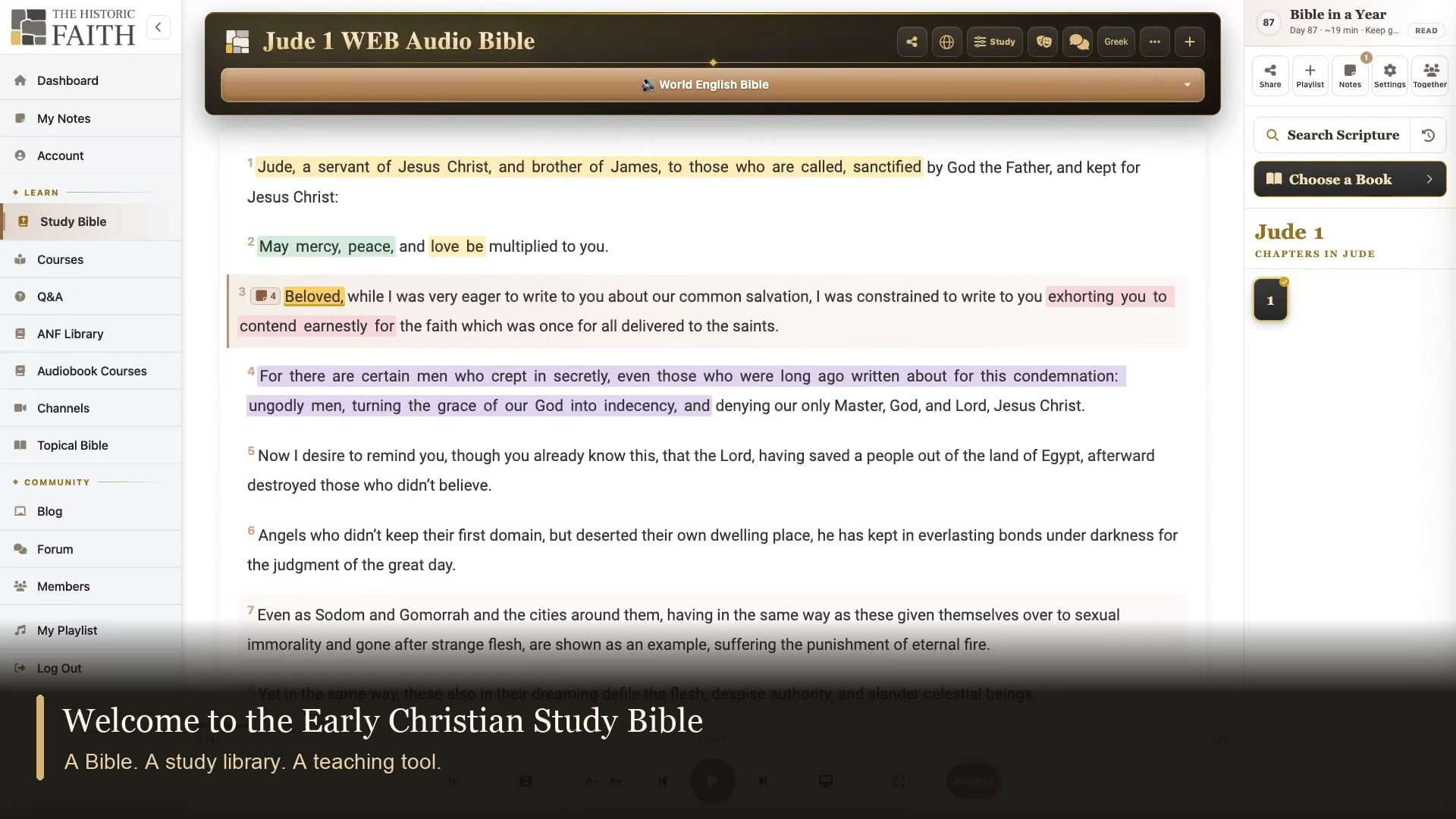
Click a word. Hear its pronunciation. Open the early Christian writings. Then see how to present and teach.
 Words. Writings.
Guided tour · 21:50 · Several Bible editions.
See the phone experience · 5:31
Strong's Exhaustive Concordance, first published by James Strong in 1890, indexes every word of the King James Version and assigns each underlying original-language word a number — G1–G5624 for the Greek New Testament and H1–H8674 for the Hebrew Old Testament. Look up any English word, find its Strong's number, and see the Greek or Hebrew word behind it, its definition, and the verses where it occurs. This free online edition covers 14,298 entries with 767,764 indexed occurrences — including the Septuagint, deuterocanonical books, and 1 Enoch, which no print edition of Strong's includes.
These entry points are the quickest way to see how a Strong's number opens into a word, meaning, and Bible usage.
Greek agape, with New Testament and Septuagint usage links where indexed.
Greek kyrios, a major New Testament and Septuagint word-study bridge.
Hebrew reshith, the word behind “beginning” in Genesis 1:1 and other Old Testament usages.
Browse the local Greek and Hebrew Strong's entries in fast pages, open an exact number, or narrow the index by language, range, and usage count.
| Number | Word | Definition | Usages | Range |
|---|---|---|---|---|
|
H5777 — `owphereth
Hebrew
|
עוֹפֶרֶת עוֹפֶרֶת (`owphereth)
`owphereth
|
`owphereth (o-feh'-reth) (or mophereth {o-feh'-reth}) n-m. 1. lead (from its dusty color) [feminine participle active of H6080] | 9 | H5001-H6000 |
|
H5778 — `Owphay
Hebrew
|
עוֹפַי (`Owphay)
`Owphay
|
`Owphay (o-fah'-ee) n/p. 1. birdlike 2. Ephai, an Israelite | 1 | H5001-H6000 |
|
H5779 — `uwts
Hebrew
|
עוּץ (`uwts)
`uwts
|
`uwts (oots) v. 1. to consult [a primitive root] | 2 | H5001-H6000 |
|
H5780 — `Uwts
Hebrew
|
עוּץ (`Uwts)
`Uwts
|
`Uwts (oots) n/l. 1. consultation 2. Uts, a son of Aram, also a Seirite, and the regions settled by them | 8 | H5001-H6000 |
|
H5781 — `uwq
Hebrew
|
עוּק (`uwq)
`uwq
|
`uwq (ook) v. 1. to pack [a primitive root] | 1 | H5001-H6000 |
|
H5782 — `uwr
Hebrew
|
עוּר (`uwr)
`uwr
|
`uwr (oor) v. 1. to wake (literally or figuratively) [a primitive root (rather identical with H5783 through the idea of opening the eyes)] | 65 | H5001-H6000 |
|
H5783 — `uwr
Hebrew
|
עוּר (`uwr)
`uwr
|
`uwr (oor) v. 1. to (be) bare [a primitive root] | 1 | H5001-H6000 |
|
H5784 — `uwr
Hebrew
|
עוּר (`uwr)
`uwr
|
`uwr (oor) n-m. 1. chaff [(Aramaic) chaff (as the naked husk)] | 1 | H5001-H6000 |
|
H5785 — `owr
Hebrew
|
עוֹר (`owr)
`owr
|
`owr (ore) n-m. 1. skin (as naked) 2. (by implication) hide, leather | 82 | H5001-H6000 |
|
H5786 — `avar
Hebrew
|
עָוַר (`avar)
`avar
|
`avar (aw-var') v. 1. to blind [a primitive root (rather denominatively from H5785 through the idea of a film over the eyes)] | 5 | H5001-H6000 |
|
H5787 — `ivver
Hebrew
|
עִוֵּר (`ivver)
`ivver
|
`ivver (iv-vare') adj. 1. blind (literally or figuratively) [intensive from H5786] | 23 | H5001-H6000 |
|
H5788 — `ivvarown
Hebrew
|
עִוָּרוֹן עַוֶּרֶת (`ivvarown)
`ivvarown
|
`ivvarown (iv-vaw-rone') (and (feminine) avvereth {av-veh'-reth}) n-m. 1. blindness [from H5787] | 3 | H5001-H6000 |
|
H5789 — `uwsh
Hebrew
|
עוּשׁ (`uwsh)
`uwsh
|
`uwsh (oosh) v. 1. to hasten [a primitive root] | 1 | H5001-H6000 |
|
H5790 — `uwth
Hebrew
|
עוּת (`uwth)
`uwth
|
`uwth (ooth) v. 1. to hasten, i.e. succor [for H5789] | 1 | H5001-H6000 |
|
H5791 — `avath
Hebrew
|
עָוַת (`avath)
`avath
|
`avath (aw-vath') v. 1. to wrest [a primitive root] | 10 | H5001-H6000 |
|
H5792 — `avvathah
Hebrew
|
עַוָּתָה (`avvathah)
`avvathah
|
`avvathah (av-vaw-thaw') n-f. 1. oppression [from H5791] | 1 | H5001-H6000 |
|
H5793 — `Uwthay
Hebrew
|
עוּתַי (`Uwthay)
`Uwthay
|
`Uwthay (oo-thah'-ee) n/p. 1. succoring 2. Uthai, the name of two Israelites | 2 | H5001-H6000 |
|
H5794 — `az
Hebrew
|
עַז (`az)
`az
|
`az (az) adj. 1. strong, vehement, harsh [from H5810] | 23 | H5001-H6000 |
|
H5795 — `ez
Hebrew
|
עֵז (`ez)
`ez
|
`ez (aze) n-f. 1. a she-goat (as strong), but masculine in plural (which also is used ellipt. for goat's hair) [from H5810] | 74 | H5001-H6000 |
|
H5796 — `ez
Hebrew
|
עֵז (`ez)
`ez
|
`ez (aze) n-f. 1. goat [(Aramaic) corresponding to H5795] | 1 | H5001-H6000 |
|
H5797 — `oz
Hebrew
|
עוֹז עוֹז (`oz)
`oz
|
`oz (oze) (or (fully) rowz {oze}) n-m. 1. strength in various applications (force, security, majesty, praise) [from H5810] | 92 | H5001-H6000 |
|
H5798 — `Uzza'
Hebrew
|
עוּזָּא עוּזָּה (`Uzza')
`Uzza'
|
`Uzza' (ooz-zaw') (or (Uzzah {ooz-zaw'})) n/l. 1. strength 2. Uzza or Uzzah, the name of five Israelites | 14 | H5001-H6000 |
|
H5799 — `aza'zel
Hebrew
|
עֲזָאזֵל (`aza'zel)
`aza'zel
|
`aza'zel (az-aw-zale') n-m. 1. goat of departure 2. the scapegoat | 3 | H5001-H6000 |
|
H5800 — `azab
Hebrew
|
עָזַב (`azab)
`azab
|
`azab (aw-zab') v. 1. to loosen, i.e. relinquish, permit, etc [a primitive root] | 206 | H5001-H6000 |
|
H5801 — `izzabown
Hebrew
|
עִזָּבוֹן (`izzabown)
`izzabown
|
`izzabown (iz-zaw-bone') n-m. 1. trade, i.e. the place (mart) or the payment (revenue) [from H5800 in the sense of letting go (for a price, i.e. selling)] | 7 | H5001-H6000 |
|
H5802 — `Azbuwq
Hebrew
|
עַזבּוּק (`Azbuwq)
`Azbuwq
|
`Azbuwq (az-book') n/p. 1. stern depopulator 2. Azbuk, an Israelite | 1 | H5001-H6000 |
|
H5803 — `Azgad
Hebrew
|
עַזגָּד (`Azgad)
`Azgad
|
`Azgad (az-gawd') n/p. 1. stern troop 2. Azgad, an Israelite | 4 | H5001-H6000 |
|
H5804 — `Azzah
Hebrew
|
עַזָּה (`Azzah)
`Azzah
|
`Azzah (az-zaw') n-f. 1. strong 2. Azzah, a place in Israel | 20 | H5001-H6000 |
|
H5805 — `azuwbah
Hebrew
|
עֲזוּבָה (`azuwbah)
`azuwbah
|
`azuwbah (az-oo-baw') n-f. 1. desertion (of inhabitants) [feminine passive participle of H5800] | 1 | H5001-H6000 |
|
H5806 — `Azuwbah
Hebrew
|
עֲזוּבָה (`Azuwbah)
`Azuwbah
|
`Azuwbah (az-oo-baw') n/p. 1. Azubah, the name of two Israelitesses [the same as H5805] | 4 | H5001-H6000 |
|
H5807 — `ezuwz
Hebrew
|
עֱזוּז (`ezuwz)
`ezuwz
|
`ezuwz (ez-ooz') n-m. 1. forcibleness [from H5810] | 3 | H5001-H6000 |
|
H5808 — `izzuwz
Hebrew
|
עִזּוּז (`izzuwz)
`izzuwz
|
`izzuwz (iz-zooz') adj. 1. forcible 2. collectively and concretely, an army | 2 | H5001-H6000 |
|
H5809 — `Azzuwr
Hebrew
|
עַזּוּר עַזּוּר (`Azzuwr)
`Azzuwr
|
`Azzuwr (az-zoor') (or mAzzur {az-zoor'}) n/p. 1. helpful 2. Azzur, the name of three Israelites | 3 | H5001-H6000 |
|
H5810 — `azaz
Hebrew
|
עָזַז (`azaz)
`azaz
|
`azaz (aw-zaz') v. 1. to be stout (literally or figuratively) [a primitive root] | 12 | H5001-H6000 |
|
H5811 — `Azaz
Hebrew
|
עָזָז (`Azaz)
`Azaz
|
`Azaz (aw-zawz') n/p. 1. strong 2. Azaz, an Israelite | 1 | H5001-H6000 |
|
H5812 — `Azazyahuw
Hebrew
|
עֲזַזיָהוּ (`Azazyahuw)
`Azazyahuw
|
`Azazyahuw (az-az-yaw'-hoo) n/p. 1. Jah has strengthened 2. Azazjah, the name of three Israelites | 3 | H5001-H6000 |
|
H5813 — `Uzziy
Hebrew
|
עוּזִּי (`Uzziy)
`Uzziy
|
`Uzziy (ooz-zee') n/p. 1. forceful 2. Uzzi, the name of six Israelites | 11 | H5001-H6000 |
|
H5814 — `Uzziya'
Hebrew
|
עוּזִּיָא (`Uzziya')
`Uzziya'
|
`Uzziya' (ooz-zee-yaw') n/p. 1. Uzzija, an Israelite [perhaps for H5818] | 1 | H5001-H6000 |
|
H5815 — `Aziy'el
Hebrew
|
עֲזִיאֵל (`Aziy'el)
`Aziy'el
|
`Aziy'el (az-ee-ale') n/p. 1. strengthened of God 2. Aziel, an Israelite | 1 | H5001-H6000 |
|
H5816 — `Uzziy'el
Hebrew
|
עוּזִּיאֵל (`Uzziy'el)
`Uzziy'el
|
`Uzziy'el (ooz-zee-ale') n/p. 1. strength of God 2. Uzziel, the name of six Israelites | 16 | H5001-H6000 |
|
H5817 — `Ozziy'eliy
Hebrew
|
עָזִּיאֵלִי (`Ozziy'eliy)
`Ozziy'eliy
|
`Ozziy'eliy (oz-zee-ay-lee') adj. 1. an Uzzielite (collectively) or descendants of Uzziel [patronymically from H5816] | 2 | H5001-H6000 |
|
H5818 — `Uzziyah
Hebrew
|
עוּזִּיָה עוּזִּיָהוּ (`Uzziyah)
`Uzziyah
|
`Uzziyah (ooz-zee-yaw') (or Uzziyahuw {ooz-zee-yaw'-hoo}) n/p. 1. strength of Jah 2. Uzzijah, the name of five Israelites | 26 | H5001-H6000 |
|
H5819 — `Aziyza'
Hebrew
|
עֲזִיזָא (`Aziyza')
`Aziyza'
|
`Aziyza' (az-ee-zaw') n/p. 1. strengthfulness 2. Aziza, an Israelite | 1 | H5001-H6000 |
|
H5820 — `Azmaveth
Hebrew
|
עַזמָוֶת (`Azmaveth)
`Azmaveth
|
`Azmaveth (az-maw'-veth) n/l. 1. strong one of death 2. Azmaveth, the name of three Israelites and of a place in Israel | 8 | H5001-H6000 |
|
H5821 — `Azzan
Hebrew
|
עַזָּן (`Azzan)
`Azzan
|
`Azzan (az-zawn') n/p. 1. strong one 2. Azzan, an Israelite | 1 | H5001-H6000 |
|
H5822 — `ozniyah
Hebrew
|
עָזנִיָה (`ozniyah)
`ozniyah
|
`ozniyah (oz-nee-yaw') n-f. 1. probably the sea-eagle (from its strength) [probably feminine of H5797] | 2 | H5001-H6000 |
|
H5823 — `azaq
Hebrew
|
עָזַק (`azaq)
`azaq
|
`azaq (aw-zak') v. 1. to grub over [a primitive root] | 1 | H5001-H6000 |
|
H5824 — `izqa'
Hebrew
|
עִזקָא (`izqa')
`izqa'
|
`izqa' (iz-kaw') n-f. 1. a signet-ring (as engraved) [(Aramaic) from a root corresponding to H5823] | 1 | H5001-H6000 |
|
H5825 — `Azeqah
Hebrew
|
עֲזֵקָה (`Azeqah)
`Azeqah
|
`Azeqah (az-ay-kaw') n/l. 1. tilled 2. Azekah, a place in Israel | 7 | H5001-H6000 |
|
H5826 — `azar
Hebrew
|
עָזַר (`azar)
`azar
|
`azar (aw-zar') v. 1. to surround, i.e. protect or aid [a primitive root] | 77 | H5001-H6000 |
|
H5827 — `Ezer
Hebrew
|
עֶזֶר (`Ezer)
`Ezer
|
`Ezer (eh'-zer) n/p. 1. help 2. Ezer, the name of two Israelites | 1 | H5001-H6000 |
|
H5828 — `ezer
Hebrew
|
עֵזֶר (`ezer)
`ezer
|
`ezer (ay'-zer) n-m. 1. aid [from H5826] | 21 | H5001-H6000 |
|
H5829 — `Ezer
Hebrew
|
עֵזֶר (`Ezer)
`Ezer
|
`Ezer (ay'-zer) n/p. 1. Ezer, the name of four Israelites [the same as H5828] | 4 | H5001-H6000 |
|
H5830 — `Ezra'
Hebrew
|
עֶזרָא (`Ezra')
`Ezra'
|
`Ezra' (ez-raw') n/p. 1. Ezra, an Israelite [a variation of H5833] | 22 | H5001-H6000 |
|
H5831 — `Ezra'
Hebrew
|
עֶזרָא (`Ezra')
`Ezra'
|
`Ezra' (ez-raw') n/p. 1. Ezra, an Israelite [(Aramaic) corresponding to H5830] | 3 | H5001-H6000 |
|
H5832 — `Azar'el
Hebrew
|
עֲזַראֵל (`Azar'el)
`Azar'el
|
`Azar'el (az-ar-ale') n/p. 1. God has helped 2. Azarel, the name of five Israelites | 6 | H5001-H6000 |
|
H5833 — `ezrah
Hebrew
|
עֶזרָה עֶזרָת (`ezrah)
`ezrah
|
`ezrah (ez-raw') (or mezrath (Psa. 60)) n-f. 1. aid [feminine of H5828] | 25 | H5001-H6000 |
|
H5834 — `Ezrah
Hebrew
|
עֶזרָה (`Ezrah)
`Ezrah
|
`Ezrah (ez-raw') n/p. 1. Ezrah, an Israelite [the same as H5833] | 1 | H5001-H6000 |
|
H5835 — `azarah
Hebrew
|
עֲזָרָה (`azarah)
`azarah
|
`azarah (az-aw-raw') n-f. 1. an inclosure 2. also a border | 6 | H5001-H6000 |
|
H5836 — `Ezriy
Hebrew
|
עֶזרִי (`Ezriy)
`Ezriy
|
`Ezriy (ez-ree') n/p. 1. helpful 2. Ezri, an Israelite | 1 | H5001-H6000 |
|
H5837 — `Azriy'el
Hebrew
|
עַזרִיאֵל (`Azriy'el)
`Azriy'el
|
`Azriy'el (az-ree-ale') n/p. 1. help of God 2. Azriel, the name of three Israelites | 3 | H5001-H6000 |
|
H5838 — `Azaryah
Hebrew
|
עֲזַריָה עֲזַריָהוּ (`Azaryah)
`Azaryah
|
`Azaryah (az-ar-yaw') (or mAzaryahuw {az-ar-yaw'-hoo}) n/p. 1. Jah has helped 2. Azarjah, the name of nineteen Israelites | 44 | H5001-H6000 |
|
H5839 — `Azaryah
Hebrew
|
עֲזַריָה (`Azaryah)
`Azaryah
|
`Azaryah (az-ar-yaw') n/p. 1. Azarjah, one of Daniel's companions [(Aramaic) corresponding to H5838] | 1 | H5001-H6000 |
|
H5840 — `Azriyqam
Hebrew
|
עַזרִיקָם (`Azriyqam)
`Azriyqam
|
`Azriyqam (az-ree-kawm') n/p. 1. help of an enemy 2. Azrikam, the name of four Israelites | 6 | H5001-H6000 |
|
H5841 — `Azzathiy
Hebrew
|
עַזָּתִי (`Azzathiy)
`Azzathiy
|
`Azzathiy (az-zaw-thee') adj. 1. an Azzathite or inhabitant of Azzah [patrial from H5804] | 2 | H5001-H6000 |
|
H5842 — `et
Hebrew
|
עֵט (`et)
`et
|
`et (ate) n-m. 1. a stylus or marking stick [from H5860 (contracted) in the sense of swooping, i.e. side-long stroke] | 4 | H5001-H6000 |
|
H5843 — `eta'
Hebrew
|
עֵטָא (`eta')
`eta'
|
`eta' (ay-taw') n-f. 1. prudence [(Aramaic) from H3272] | 1 | H5001-H6000 |
|
H5844 — `atah
Hebrew
|
עָטָה (`atah)
`atah
|
`atah (aw-taw') v. 1. to wrap, i.e. cover, veil, cloth, or roll [a primitive root] | 15 | H5001-H6000 |
|
H5845 — `atiyn
Hebrew
|
עֲטִין (`atiyn)
`atiyn
|
`atiyn (at-een') n-m. 1. a receptacle (for milk, i.e. pail 2. (figuratively) breast) | 1 | H5001-H6000 |
|
H5846 — `atiyshah
Hebrew
|
עֲטִישָׁה (`atiyshah)
`atiyshah
|
`atiyshah (at-ee-shaw') n-f. 1. sneezing [from an unused root meaning to sneeze] | 1 | H5001-H6000 |
|
H5847 — `atalleph
Hebrew
|
עֲטַלֵּף (`atalleph)
`atalleph
|
`atalleph (at-al-lafe') n-m. 1. a bat [of uncertain derivation] | 3 | H5001-H6000 |
|
H5848 — `ataph
Hebrew
|
עָטַף (`ataph)
`ataph
|
`ataph (aw-taf') v. 1. to shroud, i.e. clothe (whether transitive or reflex.) 2. hence (from the idea of darkness) to languish | 14 | H5001-H6000 |
|
H5849 — `atar
Hebrew
|
עָטַר (`atar)
`atar
|
`atar (aw-tar') v. 1. to encircle (for attack or protection) 2. especially to crown (literally or figuratively) | 7 | H5001-H6000 |
|
H5850 — `atarah
Hebrew
|
עֲטָרָה (`atarah)
`atarah
|
`atarah (at-aw-raw') n-f. 1. a crown [from H5849] | 23 | H5001-H6000 |
|
H5851 — `Atarah
Hebrew
|
עֲטָרָה (`Atarah)
`Atarah
|
`Atarah (at-aw-raw') n/p. 1. Atarah, an Israelitess [the same as H5850] | 1 | H5001-H6000 |
|
H5852 — `Atarowth
Hebrew
|
עֲטָרוֹת עֲטָרוֹת (`Atarowth)
`Atarowth
|
`Atarowth (at-aw-roth') (or Ataroth {at-aw-roth'}) n/l. 1. Ataroth, the name (thus simply) of two places in Israel [plural of H5850] | 6 | H5001-H6000 |
|
H5853
Hebrew
|
עַטרוֹת אַדָּר
|
`Atrowth 'Addar (at-roth' ad-dawr') n/l. 1. crowns of Addar 2. Atroth-Addar, a place in Israel | 2 | H5001-H6000 |
|
H5854
Hebrew
|
עַטרוֹת בֵּיתּ יוֹאָב
|
`Atrowth beyth Yow'ab (at-roth' bayth yo-awb') n/l. 1. crowns of the house of Joab 2. Atroth-beth-Joab, a place in Israel | 0 | H5001-H6000 |
|
H5855
Hebrew
|
עַטרוֹת שׁוֹפָן
|
`Atrowth Showphan (at-roth' sho-fawn') n/l. 1. crowns of Shophan 2. Atroth-Shophan, a place in Israel | 1 | H5001-H6000 |
|
H5856 — `iy
Hebrew
|
עִי (`iy)
`iy
|
`iy (ee) n-m. 1. a ruin (as if overturned) [from H5753] | 4 | H5001-H6000 |
|
H5857 — `Ay
Hebrew
|
עַי עַיָא עַיָת (`Ay)
`Ay
|
`Ay (ah'ee) (or (feminine) uAya( (Neh. 11) n/l. 1. Ai, Aja or Ajath, a place in Israel [for H5856] | 33 | H5001-H6000 |
|
H5858 — `Eybal
Hebrew
|
עֵיבָּל (`Eybal)
`Eybal
|
`Eybal (ay-bawl') n/l. 1. bare 2. Ebal, a mountain of Israel | 8 | H5001-H6000 |
|
H5859 — `Iyown
Hebrew
|
עִיוֹן (`Iyown)
`Iyown
|
`Iyown (ee-yone') n/l. 1. ruin 2. Ijon, a place in Israel | 3 | H5001-H6000 |
|
H5860 — `iyt
Hebrew
|
עִיטּ (`iyt)
`iyt
|
`iyt (eet) v. 1. to swoop down upon (literally or figuratively) [a primitive root] | 2 | H5001-H6000 |
|
H5861 — `ayit
Hebrew
|
עַיִט (`ayit)
`ayit
|
`ayit (ah'-yit) n-m. 1. a hawk or other bird of prey [from H5860] | 6 | H5001-H6000 |
|
H5862 — `Eytam
Hebrew
|
עֵיטָּם (`Eytam)
`Eytam
|
`Eytam (ay-tawm') n/l. 1. hawk-ground 2. Etam, a place in Israel | 5 | H5001-H6000 |
|
H5863
Hebrew
|
עִיֵי הָעֲבָרִים
|
`Iyey ha-`Abariym (ee-yay' haw-ab-aw-reem') n/l. 1. ruins of the passers 2. Ije-ha-Abarim, a place near Israel | 2 | H5001-H6000 |
|
H5864 — `Iyiym
Hebrew
|
עִיִים (`Iyiym)
`Iyiym
|
`Iyiym (ee-yeem') n/l. 1. ruins 2. Ijim, a place in the Desert | 2 | H5001-H6000 |
|
H5865 — `eylowm
Hebrew
|
עֵילוֹם (`eylowm)
`eylowm
|
`eylowm (ay-lome') n-m. 1. ever [for H5769] | 1 | H5001-H6000 |
|
H5866 — `Iylay
Hebrew
|
עִילַי (`Iylay)
`Iylay
|
`Iylay (ee-lah'-ee) n/p. 1. elevated 2. Ilai, an Israelite | 1 | H5001-H6000 |
|
H5867 — `Eylam
Hebrew
|
עֵילָם עוֹלָם (`Eylam)
`Eylam
|
`Eylam (ay-lawm') (or mOwlam (Ezra 10:2; Jeremiah 49:36)) n/l. 1. hidden, i.e. distant 2. Elam, a son of Shem and his descendants, with their country | 27 | H5001-H6000 |
|
H5868 — `ayam
Hebrew
|
עֲיָם (`ayam)
`ayam
|
`ayam (ah-yawm') n-m. 1. probably meaning strength [of doubtful origin and authenticity] | 1 | H5001-H6000 |
|
H5869 — `ayin
Hebrew
|
עַיִן (`ayin)
`ayin
|
`ayin (ah'-yin) n-e. 1. an eye (literally or figuratively) 2. by analogy, a fountain (as the eye of the landscape) | 827 | H5001-H6000 |
|
H5870 — `ayin
Hebrew
|
עַיִן (`ayin)
`ayin
|
`ayin (ah'-yin) n-f. 1. an eye [(Aramaic) corresponding to H5869] | 4 | H5001-H6000 |
|
H5871 — `Ayin
Hebrew
|
עַיִן (`Ayin)
`Ayin
|
`Ayin (ah'-yin) n/l. 1. fountain 2. Ajin, the name (thus simply) of two places in Israel | 5 | H5001-H6000 |
|
H5872
Hebrew
|
עֵין גֶּדִי
|
`Eyn Gediy (ane geh'-dee) n/l. 1. fountain of a kid 2. En-Gedi, a place in Israel | 6 | H5001-H6000 |
|
H5873
Hebrew
|
עֵין גַּנִּים
|
`Eyn Ganniym (ane gan-neem') n/l. 1. fountain of gardens 2. En-Gannim, a place in Israel | 3 | H5001-H6000 |
|
H5874 — `Eyn-Do'r,
Hebrew
|
עֵין ־ דּאוֹר עֵין דּוֹר עֵין ־ דּוֹר (`Eyn-Do'r,)
`Eyn-Do'r,
|
`Eyn-Do'r, (ane-dore') (or mEyn Dowr {ane dore} or Eyn-Dor {ane-dore'};) n/l. 1. fountain of dwelling 2. En-Dor, a place in Israel | 3 | H5001-H6000 |
|
H5875
Hebrew
|
עֵין הַקּוֹרֵא
|
`Eyn haq-Qowre' (ane-hak-ko-ray') n/l. 1. fountain of One calling 2. En-hak-Kore, a place near Israel | 1 | H5001-H6000 |
|
H5876
Hebrew
|
עֵין חַדָּה
|
`Eyn Chaddah (ane khad-daw') n/l. 1. fountain of sharpness 2. En-Chaddah, a place in Israel | 1 | H5001-H6000 |
|
H5877
Hebrew
|
עֵין חָצוֹר
|
`Eyn Chatsowr (ane khaw-tsore') n/l. 1. fountain of a village 2. En-Chatsor, a place in Israel | 1 | H5001-H6000 |
|
H5878
Hebrew
|
עֵין חֲרוֹד
|
`Eyn Charod (ane khar-ode') n/l. 1. fountain of trembling 2. En-Charod, a place in Israel | 1 | H5001-H6000 |
|
H5879 — `Eynayim
Hebrew
|
עֵינַיִם עֵינָם (`Eynayim)
`Eynayim
|
`Eynayim (ay-nah'-yim) (or mEynam {ay-nawm'}) n/l. 1. double fountain 2. Enajim or Enam, a place in Israel | 3 | H5001-H6000 |
|
H5880
Hebrew
|
עֵין מִשׁפָּט
|
`Eyn Mishpat (ane mish-pawt') n/l. 1. fountain of judgment 2. En-Mishpat, a place near Israel | 1 | H5001-H6000 |
|
H5881 — `Eynan
Hebrew
|
עֵינָן (`Eynan)
`Eynan
|
`Eynan (ay-nawn') n/p. 1. having eyes 2. Enan, an Israelite | 5 | H5001-H6000 |
|
H5882
Hebrew
|
עֵין עֶגלַיִם
|
`Eyn `Eglayim (ane eg-lah'-yim) n/l. 1. fountain of two calves 2. En-Eglajim, a place in Israel | 1 | H5001-H6000 |
|
H5883
Hebrew
|
עֵין רוֹגֵל
|
`Eyn Rogel (ane ro-gale') n/l. 1. fountain of a traveller 2. En-Rogel, a place near Jerusalem | 4 | H5001-H6000 |
|
H5884
Hebrew
|
עֵין רִמּוֹן
|
`Eyn Rimmown (ane rim-mone') n/l. 1. fountain of a pomegranate 2. En-Rimmon, a place in Israel | 1 | H5001-H6000 |
|
H5885
Hebrew
|
עֵין שֶׁמֶשׁ
|
`Eyn Shemesh (ane sheh'-mesh) n/l. 1. fountain of the sun 2. En-Shemesh, a place in Israel | 2 | H5001-H6000 |
|
H5886
Hebrew
|
עֵין תַּנִּים
|
`Eyn Tanniym (ane tan-neem') n/l. 1. fountain of jackals 2. En-Tannim, a pool near Jerusalem | 0 | H5001-H6000 |
|
H5887
Hebrew
|
עֵין תַּפּוַּח
|
`Eyn Tappuwach (ane tap-poo'-akh) n/l. 1. fountain of an apple-tree 2. En-Tappuach, a place in Israel | 1 | H5001-H6000 |
|
H5888 — `ayeph
Hebrew
|
עָיֵף (`ayeph)
`ayeph
|
`ayeph (aw-yafe') v. 1. to languish [a primitive root] | 1 | H5001-H6000 |
|
H5889 — `ayeph
Hebrew
|
עָיֵף (`ayeph)
`ayeph
|
`ayeph (aw-yafe') adj. 1. languid [from H5888] | 17 | H5001-H6000 |
|
H5890 — `eyphah
Hebrew
|
עֵיפָה (`eyphah)
`eyphah
|
`eyphah (ay-faw') n-f. 1. obscurity (as if from covering) [feminine from H5774] | 2 | H5001-H6000 |
|
H5891 — `Eyphah
Hebrew
|
עֵיפָה (`Eyphah)
`Eyphah
|
`Eyphah (ay-faw') n/p. 1. Ephah, the name of a son of Midian, and of the region settled by him 2. also of an Israelite and of an Israelitess | 5 | H5001-H6000 |
|
H5892 — `iyr
Hebrew
|
עִיר עָר עָיַר (`iyr)
`iyr
|
`iyr (eer) (or (in the plural) par {awr} or ayar (Judges 10:4)) n-m. 1. a city (a place guarded by waking or a watch) in the widest sense (even of a mere encampment or post) [from H5782] | 934 | H5001-H6000 |
|
H5893 — `Iyr
Hebrew
|
עִיר (`Iyr)
`Iyr
|
`Iyr (eer) n/p. 1. Ir, an Israelite [the same as H5892] | 2 | H5001-H6000 |
|
H5894 — `iyr
Hebrew
|
עִיר (`iyr)
`iyr
|
`iyr (eer) n-m. 1. a watcher, i.e. an angel (as guardian) [(Aramaic) from a root corresponding to H5782] | 3 | H5001-H6000 |
|
H5895 — `ayir
Hebrew
|
עַיִר (`ayir)
`ayir
|
`ayir (ah'-yeer) n-m. 1. (properly) a young donkey (as just broken to a load) 2. (hence) an donkey's colt | 8 | H5001-H6000 |
|
H5896 — `Iyra'
Hebrew
|
עִירָא (`Iyra')
`Iyra'
|
`Iyra' (ee-raw') n/p. 1. wakefulness 2. Ira, the name of three Israelites | 6 | H5001-H6000 |
|
H5897 — `Iyrad
Hebrew
|
עִירָד (`Iyrad)
`Iyrad
|
`Iyrad (ee-rawd') n/p. 1. fugitive 2. Irad, an antediluvian | 1 | H5001-H6000 |
|
H5898
Hebrew
|
עִיר הַמֶּלַח
|
`Iyr ham-Melach (eer ham-meh'-lakh) n/l. 1. city of (the) salt 2. Ir-ham-Melach, a place near Israel | 1 | H5001-H6000 |
|
H5899
Hebrew
|
עִיר הַתּתְּמָרִים
|
`Iyr hat-Tmariym (eer hat-tem-aw-reem') n/l. 1. city of the palmtrees 2. Ir-hat-Temarim, a place in Israel | 0 | H5001-H6000 |
|
H5900 — `Iyruw
Hebrew
|
עִירוּ (`Iyruw)
`Iyruw
|
`Iyruw (ee-roo') n/p. 1. a citizen 2. Iru, an Israelite | 1 | H5001-H6000 |
|
H5901 — `Iyriy
Hebrew
|
עִירִי (`Iyriy)
`Iyriy
|
`Iyriy (ee-ree') n/p. 1. urbane 2. Iri, an Israelite | 1 | H5001-H6000 |
|
H5902 — Iyram
Hebrew
|
עִירָם (Iyram)
Iyram
|
Iyram (ee-rawm') n/p. 1. city-wise 2. Iram, an Idumaean | 2 | H5001-H6000 |
|
H5903 — `eyrom
Hebrew
|
עֵירוֹם עֵרוֹם (`eyrom)
`eyrom
|
`eyrom (ay-rome') (or merom {ay-rome'}) adj. 1. nudity [from H6191] | 10 | H5001-H6000 |
|
H5904
Hebrew
|
עִיר נָחָשׁ
|
`Iyr Nachash (eer naw-khawsh') n/p. 1. city of a serpent 2. Ir-Nachash, a place in Israel | 1 | H5001-H6000 |
|
H5905
Hebrew
|
עִיר שֶׁמֶשׁ
|
`Iyr Shemesh (eer sheh'-mesh) n/l. 1. city of the sun 2. Ir-Shemesh, a place in Israel | 1 | H5001-H6000 |
|
H5906 — `Ayish
Hebrew
|
עַיִשׁ עָשׁ (`Ayish)
`Ayish
|
`Ayish (ah'-yish) (or mAsh {awsh}) n-f. 1. the constellation of the Great Bear (perhaps from its migration through the heavens) [from H5789] | 2 | H5001-H6000 |
|
H5907 — `Akbowr
Hebrew
|
עַכבּוֹר (`Akbowr)
`Akbowr
|
`Akbowr (ak-bore') n/p. 1. Akbor, the name of an Idumaean and of two Israelites [probably for H5909] | 7 | H5001-H6000 |
|
H5908 — `akkabiysh
Hebrew
|
עַכָּבִישׁ (`akkabiysh)
`akkabiysh
|
`akkabiysh (ak-kaw-beesh') n-m. 1. a spider (as weaving a network) [probably from an unused root in the literal sense of entangling] | 2 | H5001-H6000 |
|
H5909 — `akbar
Hebrew
|
עַכבָּר (`akbar)
`akbar
|
`akbar (ak-bawr') n-m. 1. a mouse (as nibbling) [probably from the same as H5908 in the secondary sense of attacking] | 6 | H5001-H6000 |
|
H5910 — `Akkow
Hebrew
|
עַכּוֹ (`Akkow)
`Akkow
|
`Akkow (ak-ko') n/l. 1. Akko (from its situation on a bay) [apparently from an unused root meaning to hem in] | 1 | H5001-H6000 |
|
H5911 — `Alowr
Hebrew
|
עָכוֹר (`Alowr)
`Alowr
|
`Alowr (aw-kore') n-m. 1. troubled 2. Akor, the name of a place in Israel | 5 | H5001-H6000 |
|
H5912 — `Akan
Hebrew
|
עָכָן (`Akan)
`Akan
|
`Akan (aw-kawn') n/p. 1. troublesome 2. Akan, an Israelite | 6 | H5001-H6000 |
|
H5913 — `akac
Hebrew
|
עָכַס (`akac)
`akac
|
`akac (aw-kas') v. 1. to put on anklets [a primitive root, properly, to tie, specifically, with fetters; but used only as denominative from H5914] | 1 | H5001-H6000 |
|
H5914 — `ekec
Hebrew
|
עֶכֶס (`ekec)
`ekec
|
`ekec (eh'-kes) n-m. 1. a fetter 2. (hence) an anklet | 2 | H5001-H6000 |
|
H5915 — `Akcah
Hebrew
|
עַכסָה (`Akcah)
`Akcah
|
`Akcah (ak-saw') n/p. 1. anklet 2. Aksah, an Israelitess | 5 | H5001-H6000 |
|
H5916 — `akar
Hebrew
|
עָכַר (`akar)
`akar
|
`akar (aw-kar') v. 1. (properly) to roil water 2. (figuratively) to disturb or affict | 13 | H5001-H6000 |
|
H5917 — `Akar
Hebrew
|
עָכָר (`Akar)
`Akar
|
`Akar (aw-kawr') n/p. 1. troublesome 2. Akar, an Israelite | 1 | H5001-H6000 |
|
H5918 — `Okran
Hebrew
|
עָכרָן (`Okran)
`Okran
|
`Okran (ok-rawn') n/p. 1. muddler 2. Okran, an Israelite | 5 | H5001-H6000 |
|
H5919 — `akshuwb
Hebrew
|
עַכשׁוּב (`akshuwb)
`akshuwb
|
`akshuwb (ak-shoob') n-m. 1. an asp (from lurking coiled up) [probably from an unused root meaning to coil] | 1 | H5001-H6000 |
|
H5920 — `al
Hebrew
|
עַל (`al)
`al
|
`al (al) adv. 1. (properly) the top 2. (specifically) the highest (i.e. God) | 4 | H5001-H6000 |
|
H5921
Hebrew
|
עַל
|
`al (al) prep. 1. above, over, upon, or against (yet always in this last relation with a downward aspect) in a great variety of applications (as follow) [(properly) the same as H5920 used as a preposi | 4,479 | H5001-H6000 |
|
H5922 — `al
Hebrew
|
עַל (`al)
`al
|
`al (al) prep. 1. about, against, concerning, for, (there-)fore, from, in, X more, of, (there-, up-)on, (in-)to, + why with [(Aramaic) corresponding to H5921] | 86 | H5001-H6000 |
|
H5923 — `ol
Hebrew
|
עוֹל עוֹל (`ol)
`ol
|
`ol (ole) (or mowl {ole}) n-m. 1. a yoke (as imposed on the neck), literally or figuratively [from H5953] | 34 | H5001-H6000 |
|
H5924 — `ella'
Hebrew
|
עֵלָּא (`ella')
`ella'
|
`ella' (ale-law') adv. 1. above [(Aramaic) from H5922] | 1 | H5001-H6000 |
|
H5925 — `Ulla'
Hebrew
|
עוּלָּא (`Ulla')
`Ulla'
|
`Ulla' (ool-law') n/p. 1. burden 2. Ulla, an Israelite | 1 | H5001-H6000 |
|
H5926 — `illeg
Hebrew
|
עִלֵּג (`illeg)
`illeg
|
`illeg (il-layg') adj. 1. stuttering [from an unused root meaning to stutter] | 1 | H5001-H6000 |
No Strong's entries match that search.
Strong's works best when the number, original word, verse, and corpus stay connected.
Open a chapter and move from a word token to its Strong's page, parsing, and linked occurrences.
Greek Strong's entries can include New Testament, Septuagint, deuterocanonical, and 1 Enoch rows where indexed.
Dedicated Strong's pages can expose approved pronunciation audio beside the word-study data.
These are common words readers run into repeatedly, shown with an English meaning so the list is readable without already knowing the original languages.
Look up a word study by its transliteration — these are frequently searched Hebrew and Greek words. Each opens the matching Strong's entry, or lists the options when a spelling maps to several words.