
G26 — Agape (Love)
Greek agape, with New Testament and Septuagint usage links where indexed.
The Early Christian Study Bible · Free to use
Study the word. Hear its pronunciation.
Search 14,298 Greek and Hebrew entries—free. Explore definitions, indexed occurrences, and pronunciation audio where available, then follow the words back into your Bible.
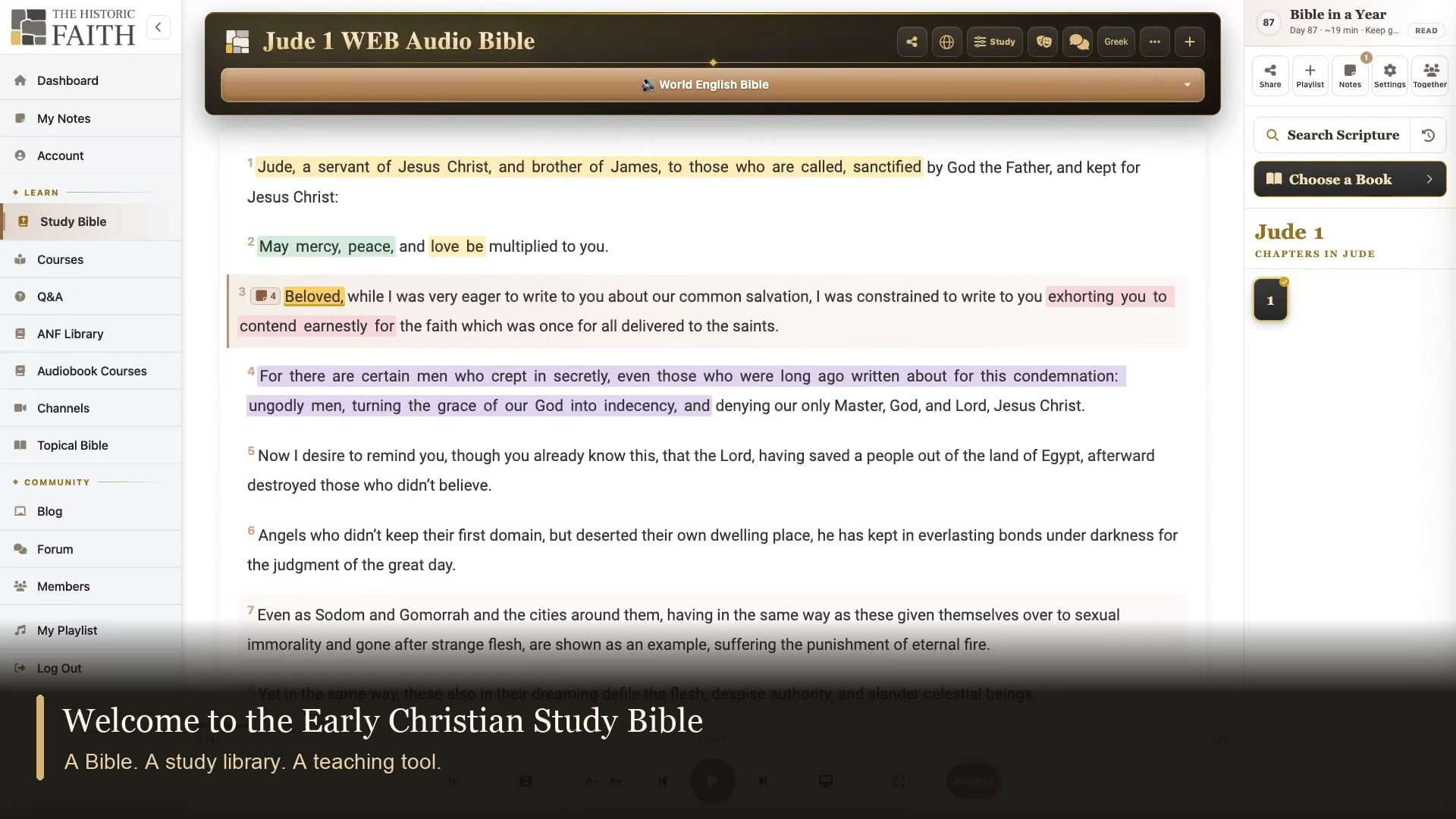
Click a word. Hear its pronunciation. Open the early Christian writings. Then see how to present and teach.
 Words. Writings.
Guided tour · 21:50 · Several Bible editions.
See the phone experience · 5:31
Strong's Exhaustive Concordance, first published by James Strong in 1890, indexes every word of the King James Version and assigns each underlying original-language word a number — G1–G5624 for the Greek New Testament and H1–H8674 for the Hebrew Old Testament. Look up any English word, find its Strong's number, and see the Greek or Hebrew word behind it, its definition, and the verses where it occurs. This free online edition covers 14,298 entries with 767,764 indexed occurrences — including the Septuagint, deuterocanonical books, and 1 Enoch, which no print edition of Strong's includes.
These entry points are the quickest way to see how a Strong's number opens into a word, meaning, and Bible usage.
Greek agape, with New Testament and Septuagint usage links where indexed.
Greek kyrios, a major New Testament and Septuagint word-study bridge.
Hebrew reshith, the word behind “beginning” in Genesis 1:1 and other Old Testament usages.
Browse the local Greek and Hebrew Strong's entries in fast pages, open an exact number, or narrow the index by language, range, and usage count.
| Number | Word | Definition | Usages | Range |
|---|---|---|---|---|
|
H4727 — miqqach
Hebrew
|
מִקָּח (miqqach)
miqqach
|
miqqach (mik-kawkh') n-m. 1. reception [from H3947] | 1 | H4001-H5000 |
|
H4728 — maqqachah
Hebrew
|
מַקָּחָה (maqqachah)
maqqachah
|
maqqachah (mak-kaw-khaw') n-f. 1. something received, i.e. merchandise (purchased) [from H3947] | 1 | H4001-H5000 |
|
H4729 — miqtar
Hebrew
|
מִקטָּר (miqtar)
miqtar
|
miqtar (mik-tawr') n-m. 1. something to fume (incense) on i.e. a hearth place [from H6999] | 1 | H4001-H5000 |
|
H4730 — miqtereth
Hebrew
|
מִקטֶּרֶת (miqtereth)
miqtereth
|
miqtereth (mik-teh'-reth) n-f. 1. something to fume (incense) in, i.e. a coal-pan [feminine of H4729] | 2 | H4001-H5000 |
|
H4731 — maqqel
Hebrew
|
מַקֵּל מַקְּלָה (maqqel)
maqqel
|
maqqel (mak-kale;) (or (feminine) maqqlah {mak-kel-aw'}) n-m. 1. a shoot, i.e. stick (with leaves on, or for walking, striking, guiding, divining) [from an unused root meaning apparently to germinate] | 16 | H4001-H5000 |
|
H4732 — Miqlowth
Hebrew
|
מִקלוֹת (Miqlowth)
Miqlowth
|
Miqlowth (mik-lohth') n/p. 1. rods 2. Mikloth, a place in the Desert | 4 | H4001-H5000 |
|
H4733 — miqlat
Hebrew
|
מִקלָט (miqlat)
miqlat
|
miqlat (mik-lawt') n-m. 1. an asylum (as a receptacle) [from H7038 in the sense of taking in] | 20 | H4001-H5000 |
|
H4734 — miqla`ath
Hebrew
|
מִקלַעַת (miqla`ath)
miqla`ath
|
miqla`ath (mik-lah'-ath) n-f. 1. a sculpture (probably in bas-relief) [from H7049] | 4 | H4001-H5000 |
|
H4735 — miqneh
Hebrew
|
מִקנֶה (miqneh)
miqneh
|
miqneh (mik-neh') n-m. 1. something bought, i.e. property, but only livestock 2. abstractly, acquisition | 64 | H4001-H5000 |
|
H4736 — miqnah
Hebrew
|
מִקנָה (miqnah)
miqnah
|
miqnah (mik-naw') n-f. 1. (properly) a buying, i.e. acquisition 2. (concretely) a piece of property (land or living) | 13 | H4001-H5000 |
|
H4737 — Miqneyahuw
Hebrew
|
מִקנֵיָהוּ (Miqneyahuw)
Miqneyahuw
|
Miqneyahuw (mik-nay-yaw'-hoo) n/p. 1. possession of Jah 2. Miknejah, an Israelite | 2 | H4001-H5000 |
|
H4738 — miqcam
Hebrew
|
מִקסָם (miqcam)
miqcam
|
miqcam (mik-sawn') n-m. 1. an augury [from H7080] | 2 | H4001-H5000 |
|
H4739 — Maqats
Hebrew
|
מָקַץ (Maqats)
Maqats
|
Maqats (maw-kats') n/l. 1. end 2. Makats, a place in Israel | 1 | H4001-H5000 |
|
H4740 — maqtsowa`
Hebrew
|
מַקצּוַֹע מַקצּוַֹע מַקצּוֹעָה (maqtsowa`)
maqtsowa`
|
maqtsowa` (mak-tso'-ah) (or maqtsoa {mak-tso-ah} or (feminine) maqtso-ah {mak-tso-aw'};) n-m. 1. an angle or recess [from H7106 in the denominative sense of bending] | 10 | H4001-H5000 |
|
H4741 — maqtsu`ah
Hebrew
|
מַקצּוּעָה (maqtsu`ah)
maqtsu`ah
|
maqtsu`ah (mak-tsoo-aw') n-f. 1. a scraper, i.e. a carving chisel [from H7106] | 1 | H4001-H5000 |
|
H4742 — mquts`ah
Hebrew
|
מְקוּצעָה (mquts`ah)
mquts`ah
|
mquts`ah (mek-oots-aw') n-f. 1. an angle [from H7106 in the denominative sense of bending] | 2 | H4001-H5000 |
|
H4743 — maqaq
Hebrew
|
מָקַק (maqaq)
maqaq
|
maqaq (maw-kak') v. 1. to melt 2. (figuratively) to flow, dwindle, vanish | 7 | H4001-H5000 |
|
H4744 — miqra'
Hebrew
|
מִקרָא (miqra')
miqra'
|
miqra' (mik-raw') n-m. 1. something called out, i.e. a public meeting (the act, the persons, or the place) 2. also a rehearsal | 22 | H4001-H5000 |
|
H4745 — miqreh
Hebrew
|
מִקרֶה (miqreh)
miqreh
|
miqreh (mik-reh') n-m. 1. something met with, i.e. an accident or fortune [from H7136] | 8 | H4001-H5000 |
|
H4746 — mqareh
Hebrew
|
מְקָרֶה (mqareh)
mqareh
|
mqareh (mek-aw-reh') n-m. 1. (properly) something meeting, i.e. a frame (of timbers) [from H7136] | 1 | H4001-H5000 |
|
H4747 — mqerah
Hebrew
|
מְקֵרָה (mqerah)
mqerah
|
mqerah (mek-ay-raw') n-f. 1. a cooling off [from the same as H7119] | 2 | H4001-H5000 |
|
H4748 — miqsheh
Hebrew
|
מִקשֶׁה (miqsheh)
miqsheh
|
miqsheh (mik-sheh') n-m. 1. something turned (rounded), i.e. a curl (of tresses) [from H7185 in the sense of knotting up round and hard] | 1 | H4001-H5000 |
|
H4749 — miqshah
Hebrew
|
מִקשָׁה (miqshah)
miqshah
|
miqshah (mik-shaw') n-f. 1. rounded work, i.e. moulded by hammering (repousse) [feminine of H4748] | 9 | H4001-H5000 |
|
H4750 — miqshah
Hebrew
|
מִקשָׁה (miqshah)
miqshah
|
miqshah (mik-shaw') n-f. 1. (literally) a cucumbered field, i.e. a cucumber patch [denominative from H7180] | 1 | H4001-H5000 |
|
H4751 — mar
Hebrew
|
מַר מָרָה (mar)
mar
|
mar (mar) (or (feminine) marah {maw-raw'}) adj. 1. (literally or figuratively) bitter 2. (as noun) bitterness | 35 | H4001-H5000 |
|
H4752 — mar
Hebrew
|
מַר (mar)
mar
|
mar (mar) n-m. 1. a drop [from H4843 in its original sense of distillation] | 1 | H4001-H5000 |
|
H4753 — more
Hebrew
|
מוֹר מוֹר (more)
more
|
more (mor) (or mowr {more}) n-m. 1. myrrh (as distilling in drops, and also as bitter) [from H4843] | 11 | H4001-H5000 |
|
H4754 — mara'
Hebrew
|
מָרָא (mara')
mara'
|
mara' (maw-raw') v. 1. to rebel 2. hence (through the idea of maltreating) to whip, i.e. lash (self with wings, as the ostrich in running) | 2 | H4001-H5000 |
|
H4755 — Mara'
Hebrew
|
מָרָא (Mara')
Mara'
|
Mara' (maw-raw') n/p. 1. bitter 2. Mara, a symbolic name of Naomi | 1 | H4001-H5000 |
|
H4756 — mare'
Hebrew
|
מָרֵא (mare')
mare'
|
mare' (maw-ray') n-m. 1. a master [(Aramaic) from a root corresponding to H4754 in the sense of domineering] | 4 | H4001-H5000 |
|
H4757
Hebrew
|
מְראוֹדַך בַּלאָדָן
|
Mro'dak Bal'adan (mer-o-dak' bal-aw-dawn') n/p. 1. Merodak-Baladan, a Babylonian king [of foreign derivation] | 1 | H4001-H5000 |
|
H4758 — mar'eh
Hebrew
|
מַראֶה (mar'eh)
mar'eh
|
mar'eh (mar-eh') n-m. 1. a view (the act of seeing) 2. also an appearance (the thing seen), whether (real) a shape (especially if handsome, comeliness | 82 | H4001-H5000 |
|
H4759 — mar'ah
Hebrew
|
מַראָה (mar'ah)
mar'ah
|
mar'ah (mar-aw') n-f. 1. a vision 2. (causatively) a mirror | 11 | H4001-H5000 |
|
H4760 — mur'ah
Hebrew
|
מוּראָה (mur'ah)
mur'ah
|
mur'ah (moor-aw') n-f. 1. something conspicuous, i.e. the craw of a bird (from its prominence) [apparently feminine passive causative participle of H7200] | 1 | H4001-H5000 |
|
H4761 — mar'ashah
Hebrew
|
מַראָשָׁה (mar'ashah)
mar'ashah
|
mar'ashah (mar-aw-shaw') adv. 1. (properly) headship, i.e. (plural for collective) dominion [denominative from H7218] | 1 | H4001-H5000 |
|
H4762 — Mar'eshah
Hebrew
|
מַראֵשָׁה מַרֵשָׁה (Mar'eshah)
Mar'eshah
|
Mar'eshah (mar-ay-shaw') (or Mareshah {mar-ay-shaw'}) n/l. 1. summit 2. Mareshah, the name of two Israelites and of a place in Israel | 8 | H4001-H5000 |
|
H4763 — mra'ashah
Hebrew
|
מְרַאֲשָׁה (mra'ashah)
mra'ashah
|
mra'ashah (mer-ah-ash-aw') adv. 1. (properly) a headpiece, i.e. (plural for adverbial) at (or as) the head-rest (or pillow) [formed like H4761] | 8 | H4001-H5000 |
|
H4764 — Merab
Hebrew
|
מֵרָב (Merab)
Merab
|
Merab (may-rawb') n/p. 1. increase 2. Merab, a daughter of Saul | 3 | H4001-H5000 |
|
H4765 — marbad
Hebrew
|
מַרבַּד (marbad)
marbad
|
marbad (mar-bad') n-m. 1. a coverlet [from H7234] | 2 | H4001-H5000 |
|
H4766 — marbeh
Hebrew
|
מַרבֶּה (marbeh)
marbeh
|
marbeh (mar-beh') n-m. 1. (properly) increasing 2. as noun, greatness, or (adverbially) greatly | 2 | H4001-H5000 |
|
H4767 — mirbah
Hebrew
|
מִרבָּה (mirbah)
mirbah
|
mirbah (meer-baw') n-f. 1. abundance, i.e. a great quantity [from H7235] | 1 | H4001-H5000 |
|
H4768 — marbiyth
Hebrew
|
מַרבִּיתּ (marbiyth)
marbiyth
|
marbiyth (mar-beeth') n-f. 1. a multitude 2. also offspring | 5 | H4001-H5000 |
|
H4769 — marbets
Hebrew
|
מַרבֵּץ (marbets)
marbets
|
marbets (mar-bates') n-m. 1. a reclining place, i.e. fold (for flocks) [from H7257] | 2 | H4001-H5000 |
|
H4770 — marbeq
Hebrew
|
מַרבֵּק (marbeq)
marbeq
|
marbeq (mar-bake') n-m. 1. a stall (for cattle) [from an unused root meaning to tie up] | 4 | H4001-H5000 |
|
H4771 — margowa`
Hebrew
|
מַרגּוַֹע (margowa`)
margowa`
|
margowa` (mar-go'-ah) n-m. 1. a resting place [from H7280] | 1 | H4001-H5000 |
|
H4772 — marglah
Hebrew
|
מַרגְּלָה (marglah)
marglah
|
marglah (mar-ghel-aw') n-f. 1. (plural for collective) a footpiece, i.e. (adverbially) at the foot, or (direct.) the foot itself [denominative from H7272] | 5 | H4001-H5000 |
|
H4773 — margemah
Hebrew
|
מַרגֵּמָה (margemah)
margemah
|
margemah (mar-gay-maw') n-f. 1. a stone-heap [from H7275] | 1 | H4001-H5000 |
|
H4774 — marge`ah
Hebrew
|
מַרגֵּעָה (marge`ah)
marge`ah
|
marge`ah (mar-gay-aw') n-f. 1. rest [from H7280] | 1 | H4001-H5000 |
|
H4775 — marad
Hebrew
|
מָרַד (marad)
marad
|
marad (maw-rad') v. 1. to rebel [a primitive root] | 23 | H4001-H5000 |
|
H4776 — mrad
Hebrew
|
מְרַד (mrad)
mrad
|
mrad (mer-ad') n-m. 1. rebellion [(Aramaic) from a root corresponding to H4775] | 1 | H4001-H5000 |
|
H4777 — mered
Hebrew
|
מֶרֶד (mered)
mered
|
mered (meh'-red) n-m. 1. rebellion [from H4775] | 1 | H4001-H5000 |
|
H4778 — Mered
Hebrew
|
מֶרֶד (Mered)
Mered
|
Mered (meh'-red) n/p. 1. Mered, an Israelite [the same as H4777] | 2 | H4001-H5000 |
|
H4779 — marad
Hebrew
|
מָרָד (marad)
marad
|
marad (maw-rawd') adj. 1. rebellious [(Aramaic) from the same as H4776] | 2 | H4001-H5000 |
|
H4780 — marduwth
Hebrew
|
מַרדּוּת (marduwth)
marduwth
|
marduwth (mar-dooth') n-f. 1. rebelliousness [from H4775] | 1 | H4001-H5000 |
|
H4781 — Mrodak
Hebrew
|
מְרוֹדָך (Mrodak)
Mrodak
|
Mrodak (mer-o-dawk') n/p. 1. Merodak, a Babylonian idol [of foreign derivation] | 1 | H4001-H5000 |
|
H4782 — Mordkay
Hebrew
|
מָרדְּכַי (Mordkay)
Mordkay
|
Mordkay (mor-dek-ah'-ee) n/p. 1. Mordecai, an Israelite [of foreign derivation] | 52 | H4001-H5000 |
|
H4783 — murdaph
Hebrew
|
מוּרדָּף (murdaph)
murdaph
|
murdaph (moor-dawf') n-m. 1. persecuted [from H7291] | 1 | H4001-H5000 |
|
H4784 — marah
Hebrew
|
מָרָה (marah)
marah
|
marah (maw-raw') v. 1. to be (causatively, make) bitter (or unpleasant) 2. (figuratively) to rebel (or resist | 43 | H4001-H5000 |
|
H4785 — Marah
Hebrew
|
מָרָה (Marah)
Marah
|
Marah (maw-raw') n/p. 1. bitter 2. Marah, a place in the Desert | 3 | H4001-H5000 |
|
H4786 — morah
Hebrew
|
מוֹרָה (morah)
morah
|
morah (mo-raw') n-f. 1. bitterness, i.e. (figuratively) trouble [from H4843] | 1 | H4001-H5000 |
|
H4787 — morrah
Hebrew
|
מָררָה (morrah)
morrah
|
morrah (mor-raw') n-f. 1. trouble [a form of H4786] | 1 | H4001-H5000 |
|
H4788 — maruwd
Hebrew
|
מָרוּד (maruwd)
maruwd
|
maruwd (maw-rood') n-m. 1. an outcast 2. (abstractly) destitution | 3 | H4001-H5000 |
|
H4789 — Merowz
Hebrew
|
מֵרוֹז (Merowz)
Merowz
|
Merowz (may-roze') n/l. 1. Meroz, a place in Israel [of uncertain derivation] | 1 | H4001-H5000 |
|
H4790 — mrowach
Hebrew
|
מְרוַֹח (mrowach)
mrowach
|
mrowach (mer-o-akh') n-m. 1. bruised, i.e. emasculated [from H4799] | 1 | H4001-H5000 |
|
H4791 — marowm
Hebrew
|
מָרוֹם (marowm)
marowm
|
marowm (maw-rome') n-m. 1. altitude 2. (concretely) an elevated place | 52 | H4001-H5000 |
|
H4792 — Merowm
Hebrew
|
מֵרוֹם (Merowm)
Merowm
|
Merowm (may-rome') n/l. 1. height 2. Merom, a lake in Israel | 2 | H4001-H5000 |
|
H4793 — merowts
Hebrew
|
מֵרוֹץ (merowts)
merowts
|
merowts (may-rotes') n-m. 1. a run (the trial of speed) [from H7323] | 1 | H4001-H5000 |
|
H4794 — mruwtsah
Hebrew
|
מְרוּצָה מְרוּצָה (mruwtsah)
mruwtsah
|
mruwtsah (mer-oo-tsaw') (or mrutsah {mer-oo-tsaw'}) n-f. 1. a race (the act), whether the manner or the progress [feminine of H4793] | 3 | H4001-H5000 |
|
H4795 — maruwq
Hebrew
|
מָרוּק (maruwq)
maruwq
|
maruwq (maw-rook') n-m. 1. (properly) rubbed 2. but used abstractly, a rubbing (with perfumery) | 1 | H4001-H5000 |
|
H4796 — Marowth
Hebrew
|
מָרוֹת (Marowth)
Marowth
|
Marowth (maw-rohth') n/p. 1. bitter springs 2. Maroth, a place in Israel | 1 | H4001-H5000 |
|
H4797 — mirzach
Hebrew
|
מִרזַח (mirzach)
mirzach
|
mirzach (meer-zakh') n-m. 1. a cry, i.e. (of job), a revel [from an unused root meaning to scream] | 1 | H4001-H5000 |
|
H4798 — marzeach
Hebrew
|
מַרזֵַח (marzeach)
marzeach
|
marzeach (mar-zay'-akh) n-m. 1. a cry, i.e. (of grief) a lamentation [formed like H4797] | 1 | H4001-H5000 |
|
H4799 — marach
Hebrew
|
מָרַח (marach)
marach
|
marach (maw-rakh') v. 1. (properly) to soften by rubbing or pressure 2. hence (medicinally) to apply as an emollient | 1 | H4001-H5000 |
|
H4800 — merchab
Hebrew
|
מֶרחָב (merchab)
merchab
|
merchab (mer-khawb') n-m. 1. enlargement, either literally (an open space, usually in a good sense), or figuratively (liberty) [from H7337] | 6 | H4001-H5000 |
|
H4801 — merchaq
Hebrew
|
מֶרחָק (merchaq)
merchaq
|
merchaq (mer-khawk') n-m. 1. remoteness 2. (concretely) a distant place | 18 | H4001-H5000 |
|
H4802 — marchesheth
Hebrew
|
מַרחֶשֶׁת (marchesheth)
marchesheth
|
marchesheth (mar-kheh'-sheth) n-f. 1. a stew-pan [from H7370] | 2 | H4001-H5000 |
|
H4803 — marat
Hebrew
|
מָרַט (marat)
marat
|
marat (maw-rat') v. 1. to polish 2. (by implication) to make bald (the head), to gall (the shoulder) | 11 | H4001-H5000 |
|
H4804 — mrat
Hebrew
|
מְרַט (mrat)
mrat
|
mrat (mer-at') v. 1. to pull off [(Aramaic) corresponding to H4803] | 1 | H4001-H5000 |
|
H4805 — mriy
Hebrew
|
מְרִי (mriy)
mriy
|
mriy (mer-ee') n-m. 1. bitterness 2. (figuratively) rebellion | 21 | H4001-H5000 |
|
H4806 — mriy'
Hebrew
|
מְרִיא (mriy')
mriy'
|
mriy' (mer-ee') n-m. 1. stall-fed 2. often (as noun) a beeve | 8 | H4001-H5000 |
|
H4807
Hebrew
|
מְרִיבּ בַּעַל
|
Mriyb Ba`al (mer-eeb' bah'-al) n/p. 1. quarreller of Baal, Merib-Baal, an epithet of Gideon [from H7378 and H1168] | 2 | H4001-H5000 |
|
H4808 — mriybah
Hebrew
|
מְרִיבָּה (mriybah)
mriybah
|
mriybah (mer-ee-baw') n-f. 1. quarrel [from H7378] | 7 | H4001-H5000 |
|
H4809 — Mriybah
Hebrew
|
מְרִיבָּה (Mriybah)
Mriybah
|
Mriybah (mer-ee-baw') n/l. 1. Meribah, the name of two places in the Desert [the same as H4808] | 6 | H4001-H5000 |
|
H4810
Hebrew
|
מְרִי בַּעַל
|
Mriy Ba`al (mer-ee' bah'-al) n/p. 1. rebellion of (i.e. against) Baal 2. Meri-Baal, an epithet of Gideon | 1 | H4001-H5000 |
|
H4811 — Mrayah
Hebrew
|
מְרָיָה (Mrayah)
Mrayah
|
Mrayah (mer-aw-yaw') n/p. 1. rebellion 2. Merajah, an Israelite | 1 | H4001-H5000 |
|
H4812 — Mrayowth
Hebrew
|
מְרָיוֹת (Mrayowth)
Mrayowth
|
Mrayowth (mer-aw-yohth') n/p. 1. rebellious 2. Merajoth, the name of two Israelites | 7 | H4001-H5000 |
|
H4813 — Miryam
Hebrew
|
מִריָם (Miryam)
Miryam
|
Miryam (meer-yawm') n/p. 1. rebelliously 2. Mirjam, the name of two Israelitesses | 13 | H4001-H5000 |
|
H4814 — mriyruwth
Hebrew
|
מְרִירוּת (mriyruwth)
mriyruwth
|
mriyruwth (mer-ee-rooth') n-f. 1. bitterness, i.e. (figuratively) grief [from H4843] | 1 | H4001-H5000 |
|
H4815 — mriyriy
Hebrew
|
מְרִירִי (mriyriy)
mriyriy
|
mriyriy (mer-ee-ree') adj. 1. bitter, i.e. poisonous [from H4843] | 1 | H4001-H5000 |
|
H4816 — morek
Hebrew
|
מוֹרֶך (morek)
morek
|
morek (mo'-rek) n-m. 1. softness, i.e. (figuratively) fear [perhaps from H7401] | 1 | H4001-H5000 |
|
H4817 — merkab
Hebrew
|
מֶרכָּב (merkab)
merkab
|
merkab (mer-kawb') n-m. 1. a chariot 2. also a seat (in a vehicle) | 3 | H4001-H5000 |
|
H4818 — merkabah
Hebrew
|
מֶרכָּבָה (merkabah)
merkabah
|
merkabah (mer-kaw-baw') n-f. 1. a chariot [feminine of H4817] | 41 | H4001-H5000 |
|
H4819 — markoleth
Hebrew
|
מַרכּוֹלֶת (markoleth)
markoleth
|
markoleth (mar-ko'-leth) n-f. 1. a mart [from H7402] | 1 | H4001-H5000 |
|
H4820 — mirmah
Hebrew
|
מִרמָה (mirmah)
mirmah
|
mirmah (meer-maw') n-f. 1. fraud [from H7411 in the sense of deceiving] | 38 | H4001-H5000 |
|
H4821 — Mirmah
Hebrew
|
מִרמָה (Mirmah)
Mirmah
|
Mirmah (meer-maw') n/p. 1. Mirmah, an Israelite [the same as H4820] | 1 | H4001-H5000 |
|
H4822 — Mremowth
Hebrew
|
מְרֵמוֹת (Mremowth)
Mremowth
|
Mremowth (mer-ay-mohth') n/p. 1. heights 2. Meremoth, the name of two Israelites | 6 | H4001-H5000 |
|
H4823 — mirmac
Hebrew
|
מִרמָס (mirmac)
mirmac
|
mirmac (meer-mawce') n-m. 1. abasement (the act or the thing) [from H7429] | 7 | H4001-H5000 |
|
H4824 — Meronothiy
Hebrew
|
מֵרוֹנוֹתִי (Meronothiy)
Meronothiy
|
Meronothiy (may-ro-no-thee') adj. 1. a Meronothite, or inhabitant of some (otherwise unknown) Meronoth [patrial from an unused noun] | 2 | H4001-H5000 |
|
H4825 — Merec
Hebrew
|
מֶרֶס (Merec)
Merec
|
Merec (meh'-res) n/p. 1. Meres, a Persian [of foreign derivation] | 1 | H4001-H5000 |
|
H4826 — Marcna'
Hebrew
|
מַרסְנָא (Marcna')
Marcna'
|
Marcna' (mar-sen-aw') n/p. 1. Marsena, a Persian [of foreign derivation] | 1 | H4001-H5000 |
|
H4827 — mera`
Hebrew
|
מֵרַע (mera`)
mera`
|
mera` (may-rah') prt. 1. used as (abstract) noun, wickedness [from H7489] | 1 | H4001-H5000 |
|
H4828 — merea`
Hebrew
|
מֵרֵַע (merea`)
merea`
|
merea` (may-ray'-ah) n-m. 1. a friend [from H7462 in the sense of companionship] | 7 | H4001-H5000 |
|
H4829 — mir`eh
Hebrew
|
מִרעֶה (mir`eh)
mir`eh
|
mir`eh (meer-eh') n-m. 1. pasture (the place or the act) 2. also the haunt of wild animals | 11 | H4001-H5000 |
|
H4830 — mir`iyth
Hebrew
|
מִרעִיתּ (mir`iyth)
mir`iyth
|
mir`iyth (meer-eeth') n-f. 1. pasturage 2. (concretely) a flock | 10 | H4001-H5000 |
|
H4831 — Mar`alah
Hebrew
|
מַרעֲלָה (Mar`alah)
Mar`alah
|
Mar`alah (mar-al-aw') n/l. 1. perhaps, earthquake 2. Maralah, a place in Israel | 1 | H4001-H5000 |
|
H4832 — marpe'
Hebrew
|
מַרפֵּא (marpe')
marpe'
|
marpe' (mar-pay') n-m. 1. (properly) curative 2. (literally, concretely) a medicine | 15 | H4001-H5000 |
|
H4833 — mirpas
Hebrew
|
מִרפָּשׂ (mirpas)
mirpas
|
mirpas (meer-paws') n-m. 1. muddled water [from H7515] | 1 | H4001-H5000 |
|
H4834 — marats
Hebrew
|
מָרַץ (marats)
marats
|
marats (maw-rats') v. 1. (properly) to press, i.e. (figuratively) to be pungent or vehement 2. to irritate | 4 | H4001-H5000 |
|
H4835 — mrutsah
Hebrew
|
מְרוּצָה (mrutsah)
mrutsah
|
mrutsah (mer-oo-tsaw') n-f. 1. oppression [from H7533] | 1 | H4001-H5000 |
|
H4836 — martsea`
Hebrew
|
מַרצֵַּע (martsea`)
martsea`
|
martsea` (mar-tsay'-ah) n-m. 1. an awl [from H7527] | 2 | H4001-H5000 |
|
H4837 — martsepheth
Hebrew
|
מַרצֶּפֶת (martsepheth)
martsepheth
|
martsepheth (mar-tseh'-feth) n-f. 1. a pavement [from H7528] | 1 | H4001-H5000 |
|
H4838 — maraq
Hebrew
|
מָרַק (maraq)
maraq
|
maraq (maw-rak') v. 1. to polish 2. (by implication) to sharpen | 3 | H4001-H5000 |
|
H4839 — maraq
Hebrew
|
מָרָק (maraq)
maraq
|
maraq (maw-rawk') n-m. 1. soup (as if a rinsing) [from H4838] | 2 | H4001-H5000 |
|
H4840 — merqach
Hebrew
|
מֶרקָח (merqach)
merqach
|
merqach (mer-kawkh') n-m. 1. a spicy herb [from H7543] | 1 | H4001-H5000 |
|
H4841 — merqachah
Hebrew
|
מֶרקָחָה (merqachah)
merqachah
|
merqachah (mer-kaw-khaw') n-f. 1. (abstractly) a seasoning (with spicery) 2. (concretely) an unguent-kettle (for preparing spiced oil) | 2 | H4001-H5000 |
|
H4842 — mirqachath
Hebrew
|
מִרקַחַת (mirqachath)
mirqachath
|
mirqachath (meer-kakh'-ath) n-f. 1. an aromatic unguent 2. also an unguent-pot | 3 | H4001-H5000 |
|
H4843 — marar
Hebrew
|
מָרַר (marar)
marar
|
marar (maw-rar') v. 1. to be (causatively, make) bitter (literally or figuratively) [a primitive root, properly, to trickle (see H4752); but used only as a denominative from H4751] | 14 | H4001-H5000 |
|
H4844 — mror
Hebrew
|
מְרוֹר מְרוֹר (mror)
mror
|
mror (mer-ore') (or mrowr {mer-ore'}) n-m. 1. a bitter herb [from H4843] | 3 | H4001-H5000 |
|
H4845 — mrerah
Hebrew
|
מְרֵרָה (mrerah)
mrerah
|
mrerah (mer-ay-raw') n-f. 1. bile (from its bitterness) [from H4843] | 1 | H4001-H5000 |
|
H4846 — mrorah
Hebrew
|
מְרוֹרָה מְרוֹרָה (mrorah)
mrorah
|
mrorah (mer-o-raw') (or mrowrah {mer-o-raw'}) n-f. 1. (properly) bitterness 2. (concretely) a bitter thing | 4 | H4001-H5000 |
|
H4847 — Mrariy
Hebrew
|
מְרָרִי (Mrariy)
Mrariy
|
Mrariy (mer-aw-ree') n/p. 1. bitter 2. Merari, an Israelite | 38 | H4001-H5000 |
|
H4848 — Mrariy
Hebrew
|
מְרָרִי (Mrariy)
Mrariy
|
Mrariy (mer-aw-ree') adj. 1. a Merarite (collectively), or decendants of Merari [from H4847] | 1 | H4001-H5000 |
|
H4849 — mirsha`ath
Hebrew
|
מִרשַׁעַת (mirsha`ath)
mirsha`ath
|
mirsha`ath (meer-shah'-ath) n-f. 1. a female wicked doer [from H7561] | 1 | H4001-H5000 |
|
H4850 — Mrathayim
Hebrew
|
מְרָתַיִם (Mrathayim)
Mrathayim
|
Mrathayim (mer-aw-thah'-yim) n/p. 1. double bitterness 2. Merathajim, an epithet of Babylon | 1 | H4001-H5000 |
|
H4851 — Mash
Hebrew
|
מַשׁ (Mash)
Mash
|
Mash (mash) n/p. 1. Mash, a son of Aram, and the people descended from him [of foreign derivation] | 1 | H4001-H5000 |
|
H4852 — Mesha'
Hebrew
|
מֵשָׁא (Mesha')
Mesha'
|
Mesha' (may-shaw') n/l. 1. Mesha, a place in Arabia [of foreign derivation] | 1 | H4001-H5000 |
|
H4853 — massa'
Hebrew
|
מַשָּׂא (massa')
massa'
|
massa' (mas-saw') n-m. 1. a burden 2. specifically, tribute, or (abstractly) porterage | 59 | H4001-H5000 |
|
H4854 — Massa'
Hebrew
|
מַשָּׂא (Massa')
Massa'
|
Massa' (mas-saw') n/p. 1. burden 2. Massa, a son of Ishmael | 2 | H4001-H5000 |
|
H4855 — mashsha'
Hebrew
|
מַשָּׁא (mashsha')
mashsha'
|
mashsha' (mash-shaw') n-m. 1. a loan 2. (by implication) interest on a debt | 3 | H4001-H5000 |
|
H4856 — masso'
Hebrew
|
מַשּׂוֹא (masso')
masso'
|
masso' (mas-so') n-m. 1. partiality (as a lifting up) [from H5375] | 1 | H4001-H5000 |
|
H4857 — mash'ab
Hebrew
|
מַשׁאָב (mash'ab)
mash'ab
|
mash'ab (mash-awb') n-m. 1. a trough for cattle to drink from [from H7579] | 1 | H4001-H5000 |
|
H4858 — massa'ah
Hebrew
|
מַשָּׂאָה (massa'ah)
massa'ah
|
massa'ah (mas-saw-aw') n-f. 1. a conflagration (from the rising of smoke) [from H5375] | 1 | H4001-H5000 |
|
H4859 — mashsha'ah
Hebrew
|
מַשָּׁאָה (mashsha'ah)
mashsha'ah
|
mashsha'ah (mash-shaw-aw') n-f. 1. a loan [feminine of H4855] | 2 | H4001-H5000 |
|
H4860 — mashsha'own
Hebrew
|
מַשָּׁאוֹן (mashsha'own)
mashsha'own
|
mashsha'own (mash-shaw-ohn') n-m. 1. dissimulation [from H5377] | 1 | H4001-H5000 |
|
H4861 — Mish'al
Hebrew
|
מִשׁאָל (Mish'al)
Mish'al
|
Mish'al (mish-awl') n/l. 1. request 2. Mishal, a place in Israel | 2 | H4001-H5000 |
|
H4862 — mish'alah
Hebrew
|
מִשׁאָלָה (mish'alah)
mish'alah
|
mish'alah (mish-aw-law') n-f. 1. a request [from H7592] | 2 | H4001-H5000 |
|
H4863 — mish'ereth
Hebrew
|
מִשׁאֶרֶת (mish'ereth)
mish'ereth
|
mish'ereth (mish-eh'-reth) n-f. 1. a kneading-trough (in which the dough rises) [from H7604 in the original sense of swelling] | 4 | H4001-H5000 |
|
H4864 — mas'eth
Hebrew
|
מַשׂאֵת (mas'eth)
mas'eth
|
mas'eth (mas-ayth') n-f. 1. (properly, abstractly) a raising (as of the hands in prayer), or a rising (of flame) 2. (figuratively) an utterance | 14 | H4001-H5000 |
|
H4865 — mishbtsah
Hebrew
|
מִשׁבְּצָה (mishbtsah)
mishbtsah
|
mishbtsah (mish-bets-aw') n-f. 1. a brocade 2. by analogy, a (reticulated) setting of a gem | 9 | H4001-H5000 |
|
H4866 — mishber
Hebrew
|
מִשׁבֵּר (mishber)
mishber
|
mishber (mish-bare') n-m. 1. the orifice of the womb (from which the fetus breaks forth) [from H7665] | 3 | H4001-H5000 |
|
H4867 — mishbar
Hebrew
|
מִשׁבָּר (mishbar)
mishbar
|
mishbar (mish-bawr') n-m. 1. a breaker (of the sea) [from H7665] | 5 | H4001-H5000 |
|
H4868 — mishbath
Hebrew
|
מִשׁבָּת (mishbath)
mishbath
|
mishbath (mish-bawth') n-m. 1. cessation, i.e. destruction [from H7673] | 1 | H4001-H5000 |
|
H4869 — misgab
Hebrew
|
מִשׂגָּב (misgab)
misgab
|
misgab (mis-gawb') n-m. 1. (properly) a cliff (or other lofty or inaccessible place) 2. abstractly, altitude | 16 | H4001-H5000 |
|
H4870 — mishgeh
Hebrew
|
מִשׁגֶּה (mishgeh)
mishgeh
|
mishgeh (mish-gay') n-m. 1. an error [from H7686] | 1 | H4001-H5000 |
|
H4871 — mashah
Hebrew
|
מָשָׁה (mashah)
mashah
|
mashah (maw-shaw') v. 1. to pull out (literally or figuratively) [a primitive root] | 3 | H4001-H5000 |
|
H4872 — Mosheh
Hebrew
|
מוֹשֶׁה (Mosheh)
Mosheh
|
Mosheh (mo-sheh') n/p. 1. drawing out (of the water), i.e. rescued 2. Mosheh, the Israelite lawgiver | 703 | H4001-H5000 |
|
H4873 — Mosheh
Hebrew
|
מוֹשֶׁה (Mosheh)
Mosheh
|
Mosheh (mo-sheh') n/p. 1. Moses [(Aramaic) corresponding to H4872] | 1 | H4001-H5000 |
|
H4874 — mashsheh
Hebrew
|
מַשֶּׁה (mashsheh)
mashsheh
|
mashsheh (mash-sheh') n-m. 1. a debt [from H5383] | 1 | H4001-H5000 |
|
H4875 — mshow'ah
Hebrew
|
מְשׁוֹאָה מְשׁוֹאָה (mshow'ah)
mshow'ah
|
mshow'ah (meh-o-aw') (or mshoah {mesh-o-aw'}) n-f. 1. a ruin 2. (abstractly) the act of ruining | 3 | H4001-H5000 |
|
H4876 — masshuw'ah
Hebrew
|
מַשּׁוּאָה מַשּׁוּאָה (masshuw'ah)
masshuw'ah
|
masshuw'ah (mash-shoo-aw') (or mashshu ah {mash-shoo-aw'}) n-f. 1. ruin [for H4875] | 2 | H4001-H5000 |
No Strong's entries match that search.
Strong's works best when the number, original word, verse, and corpus stay connected.
Open a chapter and move from a word token to its Strong's page, parsing, and linked occurrences.
Greek Strong's entries can include New Testament, Septuagint, deuterocanonical, and 1 Enoch rows where indexed.
Dedicated Strong's pages can expose approved pronunciation audio beside the word-study data.
These are common words readers run into repeatedly, shown with an English meaning so the list is readable without already knowing the original languages.
Look up a word study by its transliteration — these are frequently searched Hebrew and Greek words. Each opens the matching Strong's entry, or lists the options when a spelling maps to several words.