
G26 — Agape (Love)
Greek agape, with New Testament and Septuagint usage links where indexed.
The Early Christian Study Bible · Free to use
Study the word. Hear its pronunciation.
Search 14,298 Greek and Hebrew entries—free. Explore definitions, indexed occurrences, and pronunciation audio where available, then follow the words back into your Bible.
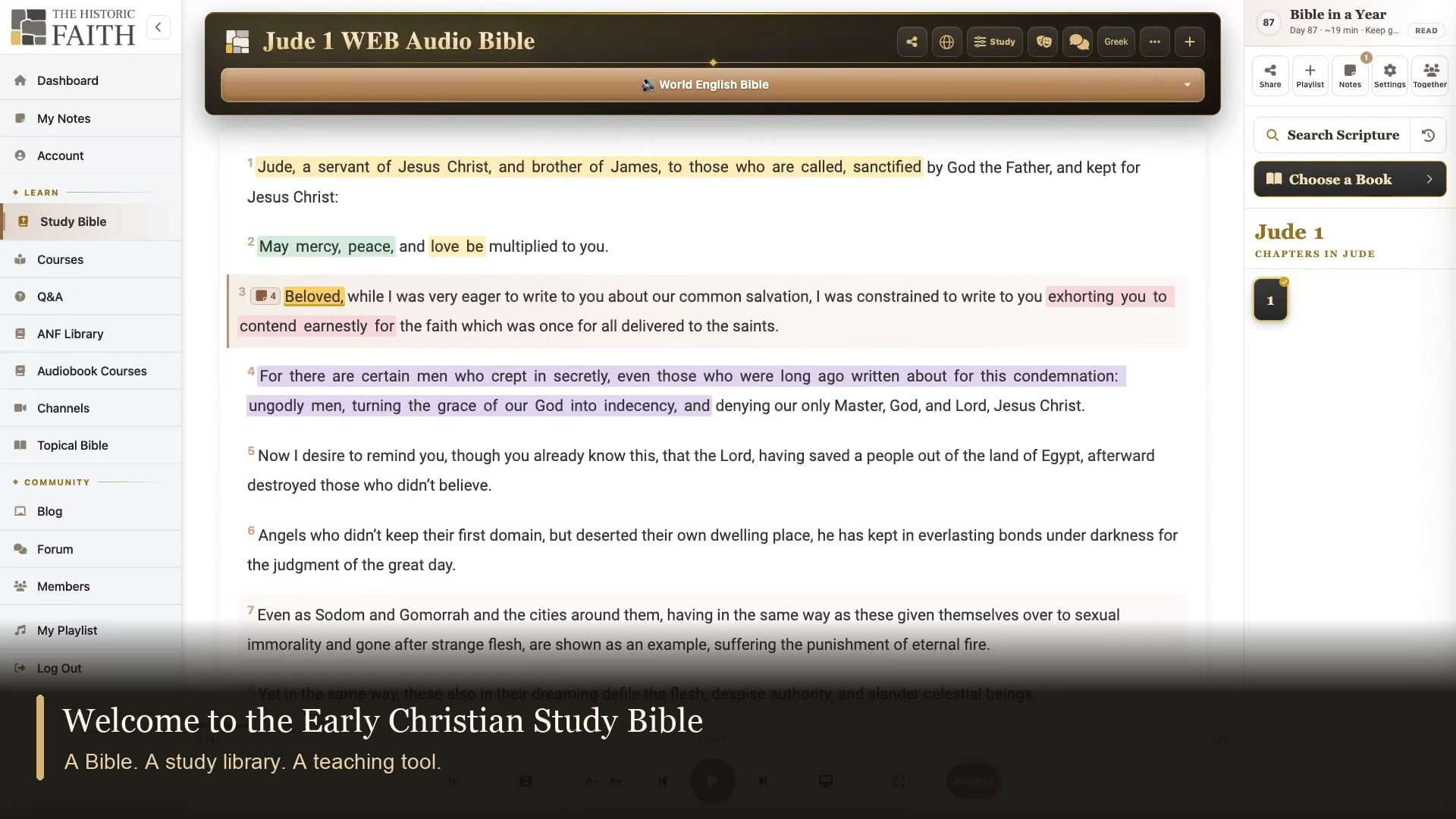
Click a word. Hear its pronunciation. Open the early Christian writings. Then see how to present and teach.
 Words. Writings.
Guided tour · 21:50 · Several Bible editions.
See the phone experience · 5:31
Strong's Exhaustive Concordance, first published by James Strong in 1890, indexes every word of the King James Version and assigns each underlying original-language word a number — G1–G5624 for the Greek New Testament and H1–H8674 for the Hebrew Old Testament. Look up any English word, find its Strong's number, and see the Greek or Hebrew word behind it, its definition, and the verses where it occurs. This free online edition covers 14,298 entries with 767,764 indexed occurrences — including the Septuagint, deuterocanonical books, and 1 Enoch, which no print edition of Strong's includes.
These entry points are the quickest way to see how a Strong's number opens into a word, meaning, and Bible usage.
Greek agape, with New Testament and Septuagint usage links where indexed.
Greek kyrios, a major New Testament and Septuagint word-study bridge.
Hebrew reshith, the word behind “beginning” in Genesis 1:1 and other Old Testament usages.
Browse the local Greek and Hebrew Strong's entries in fast pages, open an exact number, or narrow the index by language, range, and usage count.
| Number | Word | Definition | Usages | Range |
|---|---|---|---|---|
|
H8627 — tqan
Hebrew
|
תְּקַן (tqan)
tqan
|
tqan (tek-an') v. 1. to straighten up, i.e. confirm [(Aramaic) corresponding to H8626] | 1 | H8001-H9000 |
|
H8628 — taqa`
Hebrew
|
תָּקַע (taqa`)
taqa`
|
taqa` (taw-kah') v. 1. to clatter, i.e. slap (the hands together), clang (an instrument) 2. (by analogy) to drive (a nail or tent-pin, a dart, etc.) | 62 | H8001-H9000 |
|
H8629 — teqa`
Hebrew
|
תֵּקַע (teqa`)
teqa`
|
teqa` (tay-kah') n-m. 1. a blast of a trumpet [from H8628] | 1 | H8001-H9000 |
|
H8630 — taqaph
Hebrew
|
תָּקַף (taqaph)
taqaph
|
taqaph (taw-kaf') v. 1. to overpower [a primitive root] | 3 | H8001-H9000 |
|
H8631 — tqeph
Hebrew
|
תְּקֵף (tqeph)
tqeph
|
tqeph (tek-afe') v. 1. to become (causatively, make) mighty or (figuratively) obstinate [(Aramaic) corresponding to H8630] | 5 | H8001-H9000 |
|
H8632 — tqoph
Hebrew
|
תְּקוֹף (tqoph)
tqoph
|
tqoph (tek-ofe') n-m. 1. power [(Aramaic) corresponding to H8633] | 2 | H8001-H9000 |
|
H8633 — toqeph
Hebrew
|
תּוֹקֶף (toqeph)
toqeph
|
toqeph (to'-kef) n-m. 1. might or (figuratively) positiveness [from H8630] | 3 | H8001-H9000 |
|
H8634 — Tar'alah
Hebrew
|
תַּראֲלָה (Tar'alah)
Tar'alah
|
Tar'alah (tar-al-aw') n/l. 1. a reeling 2. Taralah, a place in Israel | 1 | H8001-H9000 |
|
H8635 — tarbuwth
Hebrew
|
תַּרבּוּת (tarbuwth)
tarbuwth
|
tarbuwth (tar-booth') n-f. 1. multiplication, i.e. progeny [from H7235] | 1 | H8001-H9000 |
|
H8636 — tarbiyth
Hebrew
|
תַּרבִּיתּ (tarbiyth)
tarbiyth
|
tarbiyth (tar-beeth') n-f. 1. multiplication, i.e. percentage or bonus in addition to principal [from H7235] | 6 | H8001-H9000 |
|
H8637 — tirgal
Hebrew
|
תִּרגַּל (tirgal)
tirgal
|
tirgal (teer-gal') v. 1. to cause to walk [a denominative from H7270] | 1 | H8001-H9000 |
|
H8638 — tirgam
Hebrew
|
תִּרגַּם (tirgam)
tirgam
|
tirgam (teer-gam') v. 1. to transfer, i.e. translate [a denominative from H7275 in the sense of throwing over] | 1 | H8001-H9000 |
|
H8639 — tardemah
Hebrew
|
תַּרדֵּמָה (tardemah)
tardemah
|
tardemah (tar-day-maw') n-f. 1. a lethargy 2. (by implication) trance | 7 | H8001-H9000 |
|
H8640 — Tirhaqah
Hebrew
|
תִּרהָקָה (Tirhaqah)
Tirhaqah
|
Tirhaqah (teer-haw'-kaw) n/p. 1. Tirhakah, a king of Kush [of foreign derivation] | 2 | H8001-H9000 |
|
H8641 — truwmah
Hebrew
|
תְּרוּמָה תְּרוּמָה (truwmah)
truwmah
|
truwmah (ter-oo-maw') (or trumah (Deuteronomy 12:11)) n-f. 1. a present (as offered up), especially in sacrifice or as tribute [from H7311] | 63 | H8001-H9000 |
|
H8642 — truwmiyah
Hebrew
|
תְּרוּמִיָה (truwmiyah)
truwmiyah
|
truwmiyah (ter-oo-mee-yaw') n-f. 1. a sacrificial offering [formed as H8641] | 1 | H8001-H9000 |
|
H8643 — truw`ah
Hebrew
|
תְּרוּעָה (truw`ah)
truw`ah
|
truw`ah (ter-oo-aw') n-f. 1. clamor, i.e. acclamation of joy or a battle-cry 2. especially clangor of trumpets, as an alarum | 33 | H8001-H9000 |
|
H8644 — truwphah
Hebrew
|
תְּרוּפָה (truwphah)
truwphah
|
truwphah (ter-oo-faw') n-f. 1. a remedy [from H7322 in the sense of its congener H7495] | 1 | H8001-H9000 |
|
H8645 — tirzah
Hebrew
|
תִּרזָה (tirzah)
tirzah
|
tirzah (teer-zaw') n-f. 1. a species of tree (apparently from its slenderness), perhaps the cypress [probably from H7329] | 1 | H8001-H9000 |
|
H8646 — Terach
Hebrew
|
תֶּרַח (Terach)
Terach
|
Terach (teh'-rakh) n/l. 1. Terach, the father of Abraham 2. also a place in the Desert | 11 | H8001-H9000 |
|
H8647 — Tirchanah
Hebrew
|
תִּרחֲנָה (Tirchanah)
Tirchanah
|
Tirchanah (teer-khan-aw') n/p. 1. Tirchanah, an Israelite [of uncertain derivation] | 1 | H8001-H9000 |
|
H8648 — treyn
Hebrew
|
תְּרֵין תַּרתֵּין (treyn)
treyn
|
treyn (ter-ane') ((Aramaic) feminine tarteyn {tar-tane'}) n-e. 1. two [corresponding to H8147] | 4 | H8001-H9000 |
|
H8649 — tormah
Hebrew
|
תָּרמָה תַּרמוּת תַּרמִיתּ (tormah)
tormah
|
tormah (tor-maw') (and tarmuwth {tar-mooth'} or tarmiyth {tar-meeth'};) n-f. 1. fraud [from H7411] | 6 | H8001-H9000 |
|
H8650 — toren
Hebrew
|
תּוֹרֶן (toren)
toren
|
toren (to'-ren) n-m. 1. a pole (as a mast or flag-staff) [probably for H766] | 3 | H8001-H9000 |
|
H8651 — tra`
Hebrew
|
תְּרַע (tra`)
tra`
|
tra` (ter-ah') n-m. 1. a door 2. (by implication) a palace | 2 | H8001-H9000 |
|
H8652 — tara`
Hebrew
|
תָּרָע (tara`)
tara`
|
tara` (taw-raw') n-m. 1. a doorkeeper [(Aramaic) from H8651] | 1 | H8001-H9000 |
|
H8653 — tar`elah
Hebrew
|
תַּרעֵלָה (tar`elah)
tar`elah
|
tar`elah (tar-ay-law') n-f. 1. reeling [from H7477] | 3 | H8001-H9000 |
|
H8654 — Tir`athiy
Hebrew
|
תִּרעָתִי (Tir`athiy)
Tir`athiy
|
Tir`athiy (teer-aw-thee') n/p. 1. a Tirathite or inhabitant of an unknown Tirah [patrial from an unused name meaning gate] | 1 | H8001-H9000 |
|
H8655 — traphiym
Hebrew
|
תְּרָפִים (traphiym)
traphiym
|
traphiym (ter-aw-feme') n-m. 1. a healer 2. Teraphim (singular or plural) a family idol | 15 | H8001-H9000 |
|
H8656 — Tirtsah
Hebrew
|
תִּרצָּה (Tirtsah)
Tirtsah
|
Tirtsah (teer-tsaw') n/p. 1. delightsomeness 2. Tirtsah, a place in Israel | 17 | H8001-H9000 |
|
H8657 — Teresh
Hebrew
|
תֶּרֶשׁ (Teresh)
Teresh
|
Teresh (teh'-resh) n/p. 1. Teresh, a eunuch of Xerxes [of foreign derivation] | 2 | H8001-H9000 |
|
H8658 — tarshiysh
Hebrew
|
תַּרשִׁישׁ (tarshiysh)
tarshiysh
|
tarshiysh (tar-sheesh') n-m. 1. a gem, perhaps the topaz [probably of foreign derivation] | 7 | H8001-H9000 |
|
H8659 — Tarshiysh
Hebrew
|
תַּרשִׁישׁ (Tarshiysh)
Tarshiysh
|
Tarshiysh (tar-sheesh') n/l. 1. Tarshish, a place on the Mediterranean 2. (hence) the ephithet of a merchant vessel (as if for or from that port) | 24 | H8001-H9000 |
|
H8660 — Tirshatha'
Hebrew
|
תִּרשָׁתָא (Tirshatha')
Tirshatha'
|
Tirshatha' (teer-shaw-thaw') n-m. 1. the title of a Persian deputy or governor [of foreign derivation] | 5 | H8001-H9000 |
|
H8661 — Tartan
Hebrew
|
תַּרתָּן (Tartan)
Tartan
|
Tartan (tar-tawn') n-m. 1. Tartan, an Assyrian [of foreign derivation] | 2 | H8001-H9000 |
|
H8662 — Tartaq
Hebrew
|
תַּרתָּק (Tartaq)
Tartaq
|
Tartaq (tar-tawk') n/t. 1. Tartak, a deity of the Avvites [of foreign derivation] | 1 | H8001-H9000 |
|
H8663 — tshu'ah
Hebrew
|
תְּשׁוּאָה (tshu'ah)
tshu'ah
|
tshu'ah (tesh-oo-aw') n-f. 1. a crashing or loud clamor [from H7722] | 4 | H8001-H9000 |
|
H8664 — Tishbiy
Hebrew
|
תִּשׁבִּי (Tishbiy)
Tishbiy
|
Tishbiy (tish-bee') adj. 1. a Tishbite or inhabitant of Tishbeh (in Gilead) [patrial from an unused name meaning recourse] | 6 | H8001-H9000 |
|
H8665 — tashbets
Hebrew
|
תַּשׁבֵּץ (tashbets)
tashbets
|
tashbets (tash-bates') n-m. 1. checkered stuff (as reticulated) [from H7660] | 1 | H8001-H9000 |
|
H8666 — tshuwbah
Hebrew
|
תְּשׁוּבָה תֶּשׁוּבָה (tshuwbah)
tshuwbah
|
tshuwbah (tesh-oo-baw') (or tshubah {tesh-oo-baw'}) n-f. 1. a recurrence (of time or place) 2. a reply (as returned) | 8 | H8001-H9000 |
|
H8667 — tsuwmeth
Hebrew
|
תְּשׂוּמֶת (tsuwmeth)
tsuwmeth
|
tsuwmeth (tes-oo-meth') n-f. 1. a deposit, i.e. pledging [from H7760] | 1 | H8001-H9000 |
|
H8668 — tshuw`ah
Hebrew
|
תְּשׁוּעָה תְּשׁוּעָה (tshuw`ah)
tshuw`ah
|
tshuw`ah (tesh-oo-aw') (or tshuah {tesh-oo-aw'}) n-f. 1. rescue (literal or figurative, pers., national or spir.) [from H7768 in the sense of H3467] | 32 | H8001-H9000 |
|
H8669 — tshuwqah
Hebrew
|
תְּשׁוּקָה (tshuwqah)
tshuwqah
|
tshuwqah (tesh-oo-kaw') n-f. 1. a longing [from H7783 in the original sense of stretching out after] | 3 | H8001-H9000 |
|
H8670 — tshuwrah
Hebrew
|
תְּשׁוּרָה (tshuwrah)
tshuwrah
|
tshuwrah (tesh-oo-raw') n-f. 1. a gift [from H7788 in the sense of arrival] | 1 | H8001-H9000 |
|
H8671 — tshiy`iy
Hebrew
|
תְּשִׁיעִי (tshiy`iy)
tshiy`iy
|
tshiy`iy (tesh-ee-ee') adj. 1. ninth [ord. from H8672] | 17 | H8001-H9000 |
|
H8672 — tesha`
Hebrew
|
תֵּשַׁע תִּשׁעָה (tesha`)
tesha`
|
tesha` (tay'-shah) (or (masculine) tishtah {tish-aw'}) n-e. 1. nine or (ord.) ninth [perhaps from H8159 through the idea of a turn to the next or full number ten] | 57 | H8001-H9000 |
|
H8673 — tish`iym
Hebrew
|
תִּשׁעִים (tish`iym)
tish`iym
|
tish`iym (tish-eem') num. 1. ninety [multiple from H8672] | 20 | H8001-H9000 |
|
H8674 — Tattnay
Hebrew
|
תַּתּתְּנַי (Tattnay)
Tattnay
|
Tattnay (tat-ten-ah'-ee) n/p. 1. Tattenai, a Persian [of foreign derivation] | 4 | H8001-H9000 |
No Strong's entries match that search.
Strong's works best when the number, original word, verse, and corpus stay connected.
Open a chapter and move from a word token to its Strong's page, parsing, and linked occurrences.
Greek Strong's entries can include New Testament, Septuagint, deuterocanonical, and 1 Enoch rows where indexed.
Dedicated Strong's pages can expose approved pronunciation audio beside the word-study data.
These are common words readers run into repeatedly, shown with an English meaning so the list is readable without already knowing the original languages.
Look up a word study by its transliteration — these are frequently searched Hebrew and Greek words. Each opens the matching Strong's entry, or lists the options when a spelling maps to several words.