
G26 — Agape (Love)
Greek agape, with New Testament and Septuagint usage links where indexed.
The Early Christian Study Bible · Free to use
Study the word. Hear its pronunciation.
Search 14,298 Greek and Hebrew entries—free. Explore definitions, indexed occurrences, and pronunciation audio where available, then follow the words back into your Bible.
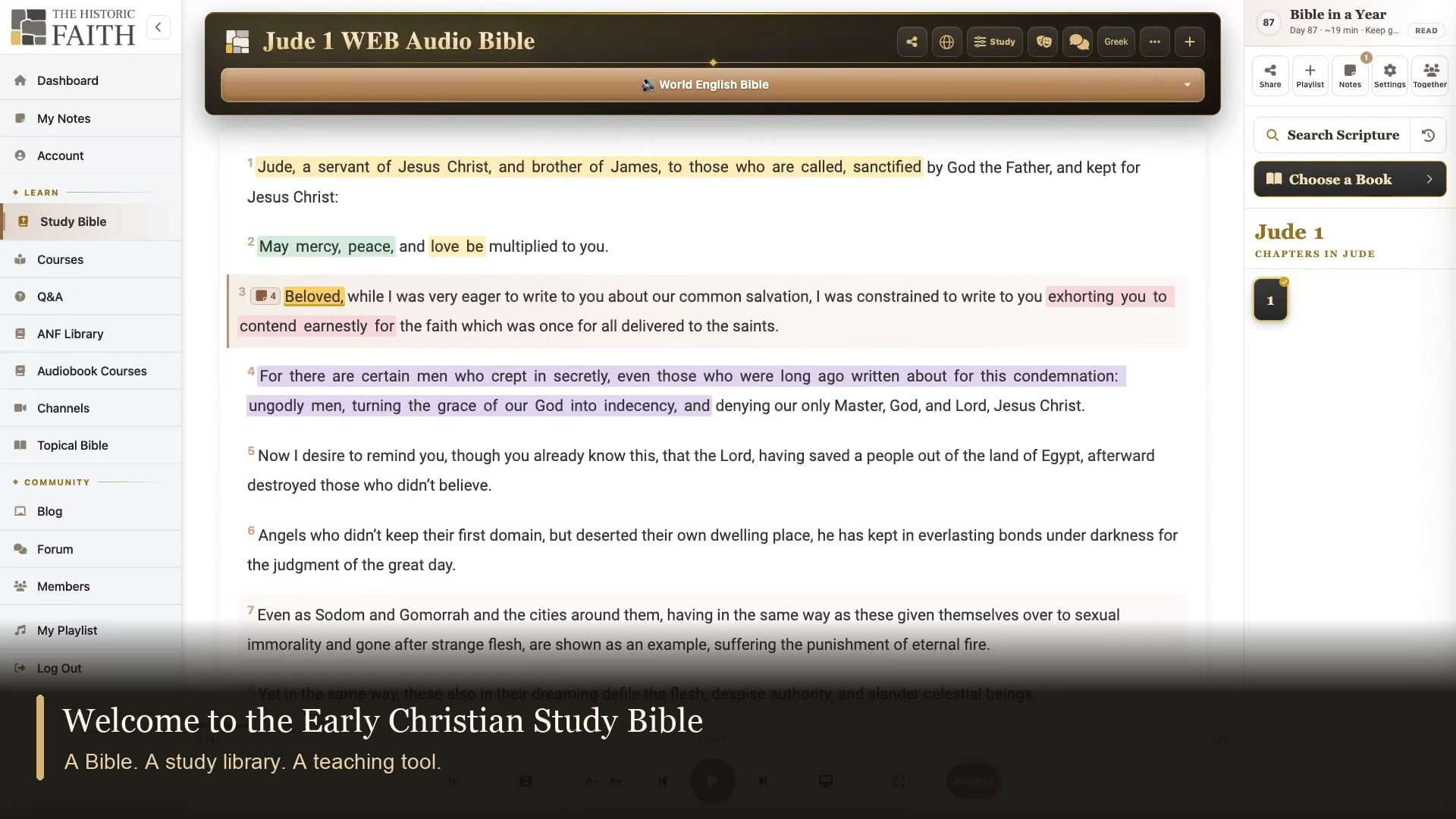
Click a word. Hear its pronunciation. Open the early Christian writings. Then see how to present and teach.
 Words. Writings.
Guided tour · 21:50 · Several Bible editions.
See the phone experience · 5:31
Strong's Exhaustive Concordance, first published by James Strong in 1890, indexes every word of the King James Version and assigns each underlying original-language word a number — G1–G5624 for the Greek New Testament and H1–H8674 for the Hebrew Old Testament. Look up any English word, find its Strong's number, and see the Greek or Hebrew word behind it, its definition, and the verses where it occurs. This free online edition covers 14,298 entries with 767,764 indexed occurrences — including the Septuagint, deuterocanonical books, and 1 Enoch, which no print edition of Strong's includes.
These entry points are the quickest way to see how a Strong's number opens into a word, meaning, and Bible usage.
Greek agape, with New Testament and Septuagint usage links where indexed.
Greek kyrios, a major New Testament and Septuagint word-study bridge.
Hebrew reshith, the word behind “beginning” in Genesis 1:1 and other Old Testament usages.
Browse the local Greek and Hebrew Strong's entries in fast pages, open an exact number, or narrow the index by language, range, and usage count.
| Number | Word | Definition | Usages | Range |
|---|---|---|---|---|
|
H6377 — Piythown
Hebrew
|
פִּיתּוֹן (Piythown)
Piythown
|
Piythown (pee-thone') n/p. 1. expansive 2. Pithon, an Israelite | 2 | H6001-H7000 |
|
H6378 — pak
Hebrew
|
פַּך (pak)
pak
|
pak (pak) n-m. 1. a flask (from which a liquid may flow) [from H6379] | 3 | H6001-H7000 |
|
H6379 — pakah
Hebrew
|
פָּכָה (pakah)
pakah
|
pakah (paw-kaw') v. 1. to pour [a primitive root] | 1 | H6001-H7000 |
|
H6380
Hebrew
|
פּוֹכֶרֶת צְּבָיִים
|
Pokereth Tsbayiym (po-keh'-reth tseb-aw-yeem') n/p. 1. trap of gazelles 2. Pokereth-Tsebajim, one of the "servants of Solomon" | 2 | H6001-H7000 |
|
H6381 — pala'
Hebrew
|
פָּלָא (pala')
pala'
|
pala' (paw-law') v. 1. (properly, literally or figuratively) perhaps to separate, i.e. distinguish 2. (by implication) to be great, difficult, wonderful | 69 | H6001-H7000 |
|
H6382 — pele'
Hebrew
|
פֶּלֶא (pele')
pele'
|
pele' (peh'-leh) n-m. 1. a miracle [from H6381] | 13 | H6001-H7000 |
|
H6383 — pil'iy
Hebrew
|
פִּלאִי פָּלִיא (pil'iy)
pil'iy
|
pil'iy (pil-ee') (or paliy' {paw-lee'}) adj. 1. remarkable [from H6381] | 2 | H6001-H7000 |
|
H6384 — Pallu'iy
Hebrew
|
פַּלּוּאִי (Pallu'iy)
Pallu'iy
|
Pallu'iy (pal-loo-ee') adj. 1. a Palluite (collectively) or descendants of Pallu [patronymically from H6396] | 1 | H6001-H7000 |
|
H6385 — palag
Hebrew
|
פָּלַג (palag)
palag
|
palag (paw-lag') v. 1. to split (literally or figuratively) [a primitive root] | 4 | H6001-H7000 |
|
H6386 — plag
Hebrew
|
פְּלַג (plag)
plag
|
plag (pel-ag') v. 1. divided [(Aramaic) corresponding to H6385] | 1 | H6001-H7000 |
|
H6387 — plag
Hebrew
|
פְּלַג (plag)
plag
|
plag (pel-ag') n-m. 1. a half [(Aramaic) from H6386] | 1 | H6001-H7000 |
|
H6388 — peleg
Hebrew
|
פֶּלֶג (peleg)
peleg
|
peleg (peh'-leg) n-m. 1. a rill (i.e. small channel of water, as in irrigation) [from H6385] | 10 | H6001-H7000 |
|
H6389 — Peleg
Hebrew
|
פֶּלֶג (Peleg)
Peleg
|
Peleg (peh'-leg) n/p. 1. earthquake 2. Peleg, a son of Shem | 7 | H6001-H7000 |
|
H6390 — plaggah
Hebrew
|
פְּלַגָּה (plaggah)
plaggah
|
plaggah (pel-ag-gaw') n-f. 1. a runlet, i.e. gully [from H6385] | 1 | H6001-H7000 |
|
H6391 — pluggah
Hebrew
|
פְּלוּגָּה (pluggah)
pluggah
|
pluggah (pel-oog-gaw') n-f. 1. a section [from H6385] | 3 | H6001-H7000 |
|
H6392 — pluggah
Hebrew
|
פְּלוּגָּה (pluggah)
pluggah
|
pluggah (pel-oog-gaw') n-f. 1. division [(Aramaic) corresponding to H6391] | 1 | H6001-H7000 |
|
H6393 — pladah
Hebrew
|
פְּלָדָה (pladah)
pladah
|
pladah (pel-aw-daw') n-f. 1. a cleaver, i.e. iron armature (of a chariot) [from an unused root meaning to divide] | 1 | H6001-H7000 |
|
H6394 — Pildash
Hebrew
|
פִּלדָּשׁ (Pildash)
Pildash
|
Pildash (pil-dawsh') n/p. 1. Pildash, a relative of Abraham [of uncertain derivation] | 1 | H6001-H7000 |
|
H6395 — palah
Hebrew
|
פָּלָה (palah)
palah
|
palah (paw-law') v. 1. to distinguish (literally or figuratively) [a primitive root] | 7 | H6001-H7000 |
|
H6396 — Palluw'
Hebrew
|
פַּלּוּא (Palluw')
Palluw'
|
Palluw' (pal-loo') n/p. 1. distinguished 2. Pallu, an Israelite | 5 | H6001-H7000 |
|
H6397 — Plowniy
Hebrew
|
פְּלוֹנִי (Plowniy)
Plowniy
|
Plowniy (pel-o-nee') adj. 1. a Pelonite or inhabitant of an unknown Palon [patronymically from an unused name (from H6395) meaning separate] | 3 | H6001-H7000 |
|
H6398 — palach
Hebrew
|
פָּלַח (palach)
palach
|
palach (paw-lakh') v. 1. to slice, i.e. break open or pierce [a primitive root] | 5 | H6001-H7000 |
|
H6399 — plach
Hebrew
|
פְּלַח (plach)
plach
|
plach (pel-akh') v. 1. to serve or worship [(Aramaic) corresponding to H6398] | 10 | H6001-H7000 |
|
H6400 — pelach
Hebrew
|
פֶּלַח (pelach)
pelach
|
pelach (peh'-lakh) n-f. 1. a slice [from H6398] | 6 | H6001-H7000 |
|
H6401 — Pilcha'
Hebrew
|
פִּלחָא (Pilcha')
Pilcha'
|
Pilcha' (pil-khaw') n/p. 1. slicing 2. Pilcha, an Israelite | 1 | H6001-H7000 |
|
H6402 — polchan
Hebrew
|
פָּלחָן (polchan)
polchan
|
polchan (pol-khawn') n-m. 1. worship [(Aramaic) from H6399] | 1 | H6001-H7000 |
|
H6403 — palat
Hebrew
|
פָּלַט (palat)
palat
|
palat (paw-lat') v. 1. to slip out, i.e. escape 2. causatively, to deliver | 23 | H6001-H7000 |
|
H6404 — Pelet
Hebrew
|
פֶּלֶט (Pelet)
Pelet
|
Pelet (peh'-let) n/p. 1. escape 2. Pelet, the name of two Israelites | 2 | H6001-H7000 |
|
H6405 — pallet
Hebrew
|
פַּלֵּט (pallet)
pallet
|
pallet (pal-late') n-m. 1. escape [from H6403] | 3 | H6001-H7000 |
|
H6406 — Paltiy
Hebrew
|
פַּלטִּי (Paltiy)
Paltiy
|
Paltiy (pal-tee') n/p. 1. delivered 2. Palti, the name of two Israelites | 2 | H6001-H7000 |
|
H6407 — Paltiy
Hebrew
|
פַּלטִּי (Paltiy)
Paltiy
|
Paltiy (pal-tee') adj. 1. a Paltite or descendant of Palti [patronymically from H6406] | 1 | H6001-H7000 |
|
H6408 — Piltay
Hebrew
|
פִּלטַּי (Piltay)
Piltay
|
Piltay (pil-tah'-ee) n/p. 1. Piltai, an Israelite [for H6407] | 1 | H6001-H7000 |
|
H6409 — Paltiy'el
Hebrew
|
פַּלטִּיאֵל (Paltiy'el)
Paltiy'el
|
Paltiy'el (pal-tee-ale') n/p. 1. deliverance of God 2. Paltiel, the name of two Israelites | 2 | H6001-H7000 |
|
H6410 — Platyah
Hebrew
|
פְּלַטיָה פְּלַטיָהוּ (Platyah)
Platyah
|
Platyah (pel-at-yaw') (or Platyahuw {pel-at-yaw'-hoo}) n/p. 1. Jah has delivered 2. Pelatjah, the name of four Israelites | 5 | H6001-H7000 |
|
H6411 — Playah
Hebrew
|
פְּלָיָה פְּלָאיָה (Playah)
Playah
|
Playah (pel-aw-yaw') (or Pla.yah {pel-aw-yaw'}) n/p. 1. Jah has distinguished 2. Pelajah, the name of three Israelites | 3 | H6001-H7000 |
|
H6412 — paliyt
Hebrew
|
פָּלִיטּ פָּלֵיטּ פָּלֵט (paliyt)
paliyt
|
paliyt (paw-leet') (or paleyt {paw-late'} or palet {paw-late'};) n-m. 1. a refugee [from H6403] | 22 | H6001-H7000 |
|
H6413 — pleytah
Hebrew
|
פְּלֵיטָּה פְּלֵטָה (pleytah)
pleytah
|
pleytah (pel-ay-taw') (or pletah {pel-ay-taw'}) n-f. 1. deliverance 2. (concretely) an escaped portion | 28 | H6001-H7000 |
|
H6414 — paliyl
Hebrew
|
פָּלִיל (paliyl)
paliyl
|
paliyl (paw-leel') n-m. 1. a magistrate [from H6419] | 3 | H6001-H7000 |
|
H6415 — pliylah
Hebrew
|
פְּלִילָה (pliylah)
pliylah
|
pliylah (pel-ee-law') n-f. 1. justice [feminine of H6414] | 1 | H6001-H7000 |
|
H6416 — pliyliy
Hebrew
|
פְּלִילִי (pliyliy)
pliyliy
|
pliyliy (pel-ee-lee') adj. 1. judicial [from H6414] | 1 | H6001-H7000 |
|
H6417 — pliyliyah
Hebrew
|
פְּלִילִיָה (pliyliyah)
pliyliyah
|
pliyliyah (pel-ee-lee-yaw') n-f. 1. judicature [feminine of H6416] | 1 | H6001-H7000 |
|
H6418 — pelek
Hebrew
|
פֶּלֶך (pelek)
pelek
|
pelek (peh'-lek) n-m. 1. a circuit (i.e. district) 2. also a spindle (as whirled) | 9 | H6001-H7000 |
|
H6419 — palal
Hebrew
|
פָּלַל (palal)
palal
|
palal (paw-lal') v. 1. to judge (officially or mentally) 2. by extension, to intercede, pray | 82 | H6001-H7000 |
|
H6420 — Palal
Hebrew
|
פָּלָל (Palal)
Palal
|
Palal (paw-lawl') n/p. 1. judge 2. Palal, an Israelite | 1 | H6001-H7000 |
|
H6421 — Plalyah
Hebrew
|
פְּלַליָה (Plalyah)
Plalyah
|
Plalyah (pel-al-yaw') n/p. 1. Jah has judged 2. Pelaljah, an Israelite | 1 | H6001-H7000 |
|
H6422 — palmowniy
Hebrew
|
פַּלמוֹנִי (palmowniy)
palmowniy
|
palmowniy (pal-mo-nee') p/x. 1. a certain one, i.e. so-and-so [probably for H6423] | 1 | H6001-H7000 |
|
H6423 — ploniy
Hebrew
|
פְּלוֹנִי (ploniy)
ploniy
|
ploniy (pel-o-nee') p/x. 1. such a one, i.e. a specified person [from H6395] | 3 | H6001-H7000 |
|
H6424 — palac
Hebrew
|
פָּלַס (palac)
palac
|
palac (paw-las') v. 1. (properly) to roll flat, i.e. prepare (a road) 2. also to revolve, i.e. weigh (mentally) | 6 | H6001-H7000 |
|
H6425 — pelec
Hebrew
|
פֶּלֶס (pelec)
pelec
|
pelec (peh'-les) n-m. 1. a balance [from H6424] | 2 | H6001-H7000 |
|
H6426 — palats
Hebrew
|
פָּלַץ (palats)
palats
|
palats (paw-lats') v. 1. (properly) perhaps to rend 2. (by implication) to quiver | 1 | H6001-H7000 |
|
H6427 — pallatsuwth
Hebrew
|
פַּלָּצוּת (pallatsuwth)
pallatsuwth
|
pallatsuwth (pal-law-tsooth') n-f. 1. affright [from H6426] | 4 | H6001-H7000 |
|
H6428 — palash
Hebrew
|
פָּלַשׁ (palash)
palash
|
palash (paw-lash') v. 1. to roll (in dust) [a primitive root] | 4 | H6001-H7000 |
|
H6429 — Plesheth
Hebrew
|
פְּלֶשֶׁת (Plesheth)
Plesheth
|
Plesheth (pel-eh'-sheth) n/l. 1. rolling, i.e. migratory 2. Pelesheth, a region of Syria | 8 | H6001-H7000 |
|
H6430 — Plishtiy
Hebrew
|
פְּלִשׁתִּי (Plishtiy)
Plishtiy
|
Plishtiy (pel-ish-tee') adj. 1. a Pelishtite or inhabitant of Pelesheth [patrial from H6429] | 243 | H6001-H7000 |
|
H6431 — Peleth
Hebrew
|
פֶּלֶת (Peleth)
Peleth
|
Peleth (peh'-leth) n/p. 1. swiftness 2. Peleth, the name of two Israelites | 2 | H6001-H7000 |
|
H6432 — Plethiy
Hebrew
|
פְּלֵתִי (Plethiy)
Plethiy
|
Plethiy (pel-ay-thee') adj. 1. a courier (collectively) or official messenger [from the same form as H6431] | 7 | H6001-H7000 |
|
H6433 — pum
Hebrew
|
פּוּם (pum)
pum
|
pum (poom) n-m. 1. the mouth (literally or figuratively) [(Aramaic) probably for H6310] | 6 | H6001-H7000 |
|
H6434 — pen
Hebrew
|
פֵּן (pen)
pen
|
pen (pane) n-m. 1. an angle (of a street or wall) [from an unused root meaning to turn] | 1 | H6001-H7000 |
|
H6435 — pen
Hebrew
|
פֵּן (pen)
pen
|
pen (pane) adv. 1. (properly) removal 2. used only (in the construction) adverb as conjunction, lest | 125 | H6001-H7000 |
|
H6436 — pannag
Hebrew
|
פַּנַּג (pannag)
pannag
|
pannag (pan-nag') n-m. 1. probably pastry [of uncertain derivation] | 1 | H6001-H7000 |
|
H6437 — panah
Hebrew
|
פָּנָה (panah)
panah
|
panah (paw-naw') v. 1. to turn 2. (by implication) to face, i.e. appear, look, etc | 128 | H6001-H7000 |
|
H6438 — pinnah
Hebrew
|
פִּנָּה (pinnah)
pinnah
|
pinnah (pin-naw') n-f. 1. an angle 2. (by implication) a pinnacle | 29 | H6001-H7000 |
|
H6439 — Pnuw'el
Hebrew
|
פְּנוּאֵל פְּנִיאֵל (Pnuw'el)
Pnuw'el
|
Pnuw'el (pen-oo-ale') (or (more properly,) Pniylel {pen-oo-ale'}) n/l. 1. face of God 2. Penuel or Peniel, a place East of Jordan | 8 | H6001-H7000 |
|
H6440 — paniym
Hebrew
|
פָּנִים (paniym)
paniym
|
paniym (paw-neem') (plural (but always as singular) of an unused noun (paneh {paw-neh'})) n-m. 1. the face (as the part that turns) 2. (with prepositional prefix, as a preposition) before, etc. | 1,885 | H6001-H7000 |
|
H6441 — pniymah
Hebrew
|
פְּנִימָה (pniymah)
pniymah
|
pniymah (pen-ee'-maw) adv. 1. faceward, i.e. indoors [from H6440 with directive enclitic] | 13 | H6001-H7000 |
|
H6442 — pniymiy
Hebrew
|
פְּנִימִי (pniymiy)
pniymiy
|
pniymiy (pen-ee-mee') adj. 1. interior [from H6440] | 29 | H6001-H7000 |
|
H6443 — paniyn
Hebrew
|
פָּנִין פָּנִי (paniyn)
paniyn
|
paniyn (paw-neen') (or paniy {paw-nee'}) n-m. 1. probably a pearl (as round) [from the same as H6434] | 6 | H6001-H7000 |
|
H6444 — Pninnah
Hebrew
|
פְּנִנָּה (Pninnah)
Pninnah
|
Pninnah (pen-in-naw') n/p. 1. Peninnah, an Israelitess [probably feminine from H6443 contraction] | 2 | H6001-H7000 |
|
H6445 — panaq
Hebrew
|
פָּנַק (panaq)
panaq
|
panaq (paw-nak') v. 1. to enervate [a primitive root] | 1 | H6001-H7000 |
|
H6446 — pac
Hebrew
|
פַּס (pac)
pac
|
pac (pas) n-m. 1. (properly) the palm (of the hand) or sole (of the foot) 2. (by implication) (plural) a long and sleeved tunic (perhaps simply a wide one | 5 | H6001-H7000 |
|
H6447 — pac
Hebrew
|
פַּס (pac)
pac
|
pac (pas) n-m. 1. the palm (of the hand, as being spread out) [(Aramaic) from a root corresponding to H6461] | 2 | H6001-H7000 |
|
H6448 — pacag
Hebrew
|
פָּסַג (pacag)
pacag
|
pacag (paw-sag') v. 1. to cut up, i.e. (figuratively) contemplate [a primitive root] | 1 | H6001-H7000 |
|
H6449 — Picgah
Hebrew
|
פִּסגָּה (Picgah)
Picgah
|
Picgah (pis-gaw') n/l. 1. a cleft 2. Pisgah, a mt. East of Jordan | 7 | H6001-H7000 |
|
H6450
Hebrew
|
פַּס דַּמִּים
|
Pac Dammiym (pas dam-meem') n/l. 1. palm (i.e. dell) of bloodshed 2. Pas-Dammim, a place in Israel | 1 | H6001-H7000 |
|
H6451 — piccah
Hebrew
|
פִּסָּה (piccah)
piccah
|
piccah (pis-saw') n-f. 1. expansion, i.e. abundance [from H6461] | 1 | H6001-H7000 |
|
H6452 — pacach
Hebrew
|
פָּסַח (pacach)
pacach
|
pacach (paw-sakh') v. 1. to hop, i.e. (figuratively) skip over (or spare) 2. (by implication) to hesitate | 7 | H6001-H7000 |
|
H6453 — pecach
Hebrew
|
פֶּסַח (pecach)
pecach
|
pecach (peh'-sakh) n-m. 1. a pretermission, i.e. exemption 2. used only techically of the Jewish Passover (the festival or the victim) | 46 | H6001-H7000 |
|
H6454 — Paceach
Hebrew
|
פָּסֵַח (Paceach)
Paceach
|
Paceach (paw-say'-akh) n/p. 1. limping 2. Paseach, the name of two Israelites | 4 | H6001-H7000 |
|
H6455 — picceach
Hebrew
|
פִּסֵַּח (picceach)
picceach
|
picceach (pis-say'-akh) adj. 1. lame [from H6452] | 13 | H6001-H7000 |
|
H6456 — pciyl
Hebrew
|
פְּסִיל (pciyl)
pciyl
|
pciyl (pes-eel') n-m. 1. an idol [from H6458] | 23 | H6001-H7000 |
|
H6457 — Pacak
Hebrew
|
פָּסַך (Pacak)
Pacak
|
Pacak (paw-sak') n/p. 1. divider 2. Pasak, an Israelite | 1 | H6001-H7000 |
|
H6458 — pacal
Hebrew
|
פָּסַל (pacal)
pacal
|
pacal (paw-sal') v. 1. to carve, whether wood or stone [a primitive root] | 6 | H6001-H7000 |
|
H6459 — pecel
Hebrew
|
פֶּסֶל (pecel)
pecel
|
pecel (peh'-sel) n-m. 1. an idol [from H6458] | 31 | H6001-H7000 |
|
H6460 — pcanteriyn
Hebrew
|
פְּסַנטֵּרִין פְּסַנתֵּרִין (pcanteriyn)
pcanteriyn
|
pcanteriyn (pes-an-tay-reen') ((Aramaic) or pcanteriyn {pes-an-tay-reen'}) n-m. 1. a lyre [a transliteration of the Greek psalterion] | 4 | H6001-H7000 |
|
H6461 — pacac
Hebrew
|
פָּסַס (pacac)
pacac
|
pacac (paw-sas') v. 1. probably to disperse, i.e. (intransitive) disappear [a primitive root] | 1 | H6001-H7000 |
|
H6462 — Picpah
Hebrew
|
פִּספָּה (Picpah)
Picpah
|
Picpah (pis-paw') n/p. 1. dispersion 2. Pispah, an Israelite | 1 | H6001-H7000 |
|
H6463 — pa`ah
Hebrew
|
פָּעָה (pa`ah)
pa`ah
|
pa`ah (paw-aw') v. 1. to scream [a primitive root] | 1 | H6001-H7000 |
|
H6464 — Pa`uw
Hebrew
|
פָּעוּ פָּעִי (Pa`uw)
Pa`uw
|
Pa`uw (paw-oo') (or Pamiy {paw-ee'}) n/l. 1. screaming 2. Pau or Pai, a place in Edom | 2 | H6001-H7000 |
|
H6465 — P`owr
Hebrew
|
פְּעוֹר (P`owr)
P`owr
|
P`owr (peh-ore') n/l. 1. a gap 2. Peor, a mountain East of Jordan | 4 | H6001-H7000 |
|
H6466 — pa`al
Hebrew
|
פָּעַל (pa`al)
pa`al
|
pa`al (paw-al') v. 1. to do or make (systematically and habitually), especially to practise [a primitive root] | 55 | H6001-H7000 |
|
H6467 — po`al
Hebrew
|
פּוֹעַל (po`al)
po`al
|
po`al (po'-al) n-m. 1. (concretely) an act or work [from H6466] | 38 | H6001-H7000 |
|
H6468 — p`ullah
Hebrew
|
פְּעוּלָּה (p`ullah)
p`ullah
|
p`ullah (peh-ool-law') n-f. 1. (abstractly) work [feminine passive participle of H6466] | 14 | H6001-H7000 |
|
H6469 — Pull`thay
Hebrew
|
פְּעוּלְּתַי (Pull`thay)
Pull`thay
|
Pull`thay (peh-ool-leh-thah'-ee) n/p. 1. laborious 2. Peullethai, an Israelite | 1 | H6001-H7000 |
|
H6470 — pa`am
Hebrew
|
פָּעַם (pa`am)
pa`am
|
pa`am (paw-am') v. 1. to tap, i.e. beat regularly 2. (hence, generally) to impel or agitate | 5 | H6001-H7000 |
|
H6471 — pa`am
Hebrew
|
פַּעַם פַּעֲמָה (pa`am)
pa`am
|
pa`am (pah'-am) (or (feminine) pa amah {pah-am-aw'};) n-f. 1. a stroke, literally or figuratively (in various applications, as follow) [from H6470] | 108 | H6001-H7000 |
|
H6472 — pa`amon
Hebrew
|
פַּעֲמוֹן (pa`amon)
pa`amon
|
pa`amon (pah-am-one') n-m. 1. a bell (as struck) [from H6471] | 4 | H6001-H7000 |
|
H6473 — pa`ar
Hebrew
|
פָּעַר (pa`ar)
pa`ar
|
pa`ar (paw-ar') v. 1. to yawn, i.e. open wide (literally or figuratively) [a primitive root] | 4 | H6001-H7000 |
|
H6474 — Pa`aray
Hebrew
|
פַּעֲרַי (Pa`aray)
Pa`aray
|
Pa`aray (pah-ar-ah'-ee) n/p. 1. yawning 2. Paarai, an Israelite | 1 | H6001-H7000 |
|
H6475 — patsah
Hebrew
|
פָּצָה (patsah)
patsah
|
patsah (paw-tsaw') v. 1. to rend, i.e. open (especially the mouth) [a primitive root] | 15 | H6001-H7000 |
|
H6476 — patsach
Hebrew
|
פָּצַח (patsach)
patsach
|
patsach (paw-tsakh') v. 1. to break out (in joyful sound) [a primitive root] | 8 | H6001-H7000 |
|
H6477 — ptsiyrah
Hebrew
|
פְּצִירָה (ptsiyrah)
ptsiyrah
|
ptsiyrah (pets-ee-raw') n-f. 1. bluntness [from H6484] | 1 | H6001-H7000 |
|
H6478 — patsal
Hebrew
|
פָּצַל (patsal)
patsal
|
patsal (paw-tsal') v. 1. to peel [a primitive root] | 2 | H6001-H7000 |
|
H6479 — ptsalah
Hebrew
|
פְּצָלָה (ptsalah)
ptsalah
|
ptsalah (pets-aw-law') n-f. 1. a peeling [from H6478] | 1 | H6001-H7000 |
|
H6480 — patsam
Hebrew
|
פָּצַם (patsam)
patsam
|
patsam (paw-tsam') v. 1. to rend (by earthquake) [a primitive root] | 1 | H6001-H7000 |
|
H6481 — patsa`
Hebrew
|
פָּצַע (patsa`)
patsa`
|
patsa` (paw-tsah') v. 1. to split, i.e. wound [a primitive root] | 3 | H6001-H7000 |
|
H6482 — petsa`
Hebrew
|
פֶּצַע (petsa`)
petsa`
|
petsa` (peh'-tsah) n-m. 1. a wound [from H6481] | 7 | H6001-H7000 |
|
H6483 — Pitstsets
Hebrew
|
פִּצֵּץ (Pitstsets)
Pitstsets
|
Pitstsets (pits-tsates') n/p. 1. dispersive 2. Pitstsets, a priest | 1 | H6001-H7000 |
|
H6484 — patsar
Hebrew
|
פָּצַר (patsar)
patsar
|
patsar (paw-tsar') v. 1. to peck at, i.e. (figuratively) stun or dull [a primitive root] | 7 | H6001-H7000 |
|
H6485 — paqad
Hebrew
|
פָּקַד (paqad)
paqad
|
paqad (paw-kad') v. 1. to visit (with friendly or hostile intent) 2. (by analogy) to oversee, muster, charge, care for, miss, deposit, etc | 268 | H6001-H7000 |
|
H6486 — pquddah
Hebrew
|
פְּקוּדָּה (pquddah)
pquddah
|
pquddah (pek-ood-daw') n-f. 1. visitation (in many senses, chiefly official) [feminine passive participle of H6485] | 30 | H6001-H7000 |
|
H6487 — piqqadown
Hebrew
|
פִּקָּדוֹן (piqqadown)
piqqadown
|
piqqadown (pik-kaw-done') n-m. 1. a deposit [from H6485] | 3 | H6001-H7000 |
|
H6488 — pqiduth
Hebrew
|
פְּקִדוּת (pqiduth)
pqiduth
|
pqiduth (pek-ee-dooth') n-f. 1. supervision [from H6496] | 1 | H6001-H7000 |
|
H6489 — Pqowd
Hebrew
|
פְּקוֹד (Pqowd)
Pqowd
|
Pqowd (pek-ode') n/l. 1. punishment 2. Pekod, a symbolic name for Babylonia | 2 | H6001-H7000 |
|
H6490 — piqquwd
Hebrew
|
פִּקּוּד פִּקּוּד (piqquwd)
piqquwd
|
piqquwd (pik-kood') (or piqqud {pik-kood'}) n-m. 1. (properly) appointed, i.e. a mandate (of God 2. plural only, collectively, for the Law) | 24 | H6001-H7000 |
|
H6491 — paqach
Hebrew
|
פָּקַח (paqach)
paqach
|
paqach (paw-kakh') v. 1. to open (the senses, especially the eyes) 2. (figuratively) to be observant | 18 | H6001-H7000 |
|
H6492 — Peqach
Hebrew
|
פֶּקַח (Peqach)
Peqach
|
Peqach (peh'-kakh) n/p. 1. watch 2. Pekach, an Israelite king | 11 | H6001-H7000 |
|
H6493 — piqqeach
Hebrew
|
פִּקֵַּח (piqqeach)
piqqeach
|
piqqeach (pik-kay'-akh) adj. 1. clear-sighted 2. (figuratively) intelligent | 2 | H6001-H7000 |
|
H6494 — Pqachyah
Hebrew
|
פְּקַחיָה (Pqachyah)
Pqachyah
|
Pqachyah (pek-akh-yaw') n/p. 1. Jah has observed 2. Pekachjah, an Israelite king | 3 | H6001-H7000 |
|
H6495 — pqach-qowach
Hebrew
|
פְּקַח ־ קוַֹח (pqach-qowach)
pqach-qowach
|
pqach-qowach (pek-akh-ko'-akh) n-m. 1. opening (of a dungeon), i.e. jail-delivery (figuratively, salvation for sin) [from H6491 redoubled] | 1 | H6001-H7000 |
|
H6496 — paqiyd
Hebrew
|
פָּקִידּ (paqiyd)
paqiyd
|
paqiyd (paw-keed') n-m. 1. a superintendent (civil, military or religious) [from H6485] | 13 | H6001-H7000 |
|
H6497 — peqa`
Hebrew
|
פֶּקַע (peqa`)
peqa`
|
peqa` (peh'-kah) n-m. 1. only used as an architectural term of an ornament similar to H6498, a semi-globe [from an unused root meaning to burst] | 2 | H6001-H7000 |
|
H6498 — paqqu`ah
Hebrew
|
פַּקּוּעָה (paqqu`ah)
paqqu`ah
|
paqqu`ah (pak-koo-aw') n-f. 1. the wild cucumber (from splitting open to shed its seeds) [from the same as H6497] | 1 | H6001-H7000 |
|
H6499 — par
Hebrew
|
פַּר פָּר (par)
par
|
par (par) (or par {pawr}) n-m. 1. a bullock (apparently as breaking forth in wild strength, or perhaps as dividing the hoof) [from H6565] | 119 | H6001-H7000 |
|
H6500 — para'
Hebrew
|
פָּרָא (para')
para'
|
para' (paw-raw') v. 1. to bear fruit [a primitive root] | 1 | H6001-H7000 |
|
H6501 — pere'
Hebrew
|
פֶּרֶא פֶּרֶה (pere')
pere'
|
pere' (peh'-reh) (or pereh (Jeremiah 2:24)) n-m. 1. the onager [from H6500 in the secondary sense of running wild] | 10 | H6001-H7000 |
|
H6502 — Pir'am
Hebrew
|
פִּראָם (Pir'am)
Pir'am
|
Pir'am (pir-awm') n/p. 1. wildly 2. Piram, a Canaanite | 1 | H6001-H7000 |
|
H6503 — Parbar
Hebrew
|
פַּרבָּר פַּרוָר (Parbar)
Parbar
|
Parbar (par-bawr') (or Parvar {par-vawr'}) n/l. 1. Parbar or Parvar, a quarter of Jerusalem [of foreign origin] | 2 | H6001-H7000 |
|
H6504 — parad
Hebrew
|
פָּרַד (parad)
parad
|
parad (paw-rad') v. 1. to break through, i.e. spread or separate (oneself) [a primitive root] | 26 | H6001-H7000 |
|
H6505 — pered
Hebrew
|
פֶּרֶד (pered)
pered
|
pered (peh'-red) n-m. 1. a mule (perhaps from his lonely habits) [from H6504] | 13 | H6001-H7000 |
|
H6506 — pirdah
Hebrew
|
פִּרדָּה (pirdah)
pirdah
|
pirdah (pir-daw') n-f. 1. a she-mule [feminine of H6505] | 3 | H6001-H7000 |
|
H6507 — prudah
Hebrew
|
פְּרוּדָה (prudah)
prudah
|
prudah (per-oo-daw') n-f. 1. something separated, i.e. a kernel [feminine passive participle of H6504] | 1 | H6001-H7000 |
|
H6508 — pardec
Hebrew
|
פַּרדֵּס (pardec)
pardec
|
pardec (par-dace') n-m. 1. a park [of foreign origin] | 3 | H6001-H7000 |
|
H6509 — parah
Hebrew
|
פָּרָה (parah)
parah
|
parah (paw-raw') v. 1. to bear fruit (literally or figuratively) [a primitive root] | 28 | H6001-H7000 |
|
H6510 — parah
Hebrew
|
פָּרָה (parah)
parah
|
parah (paw-raw') n-f. 1. a heifer [feminine of H6499] | 22 | H6001-H7000 |
|
H6511 — Parah
Hebrew
|
פָּרָה (Parah)
Parah
|
Parah (paw-raw') n/l. 1. Parah, a place in Israel [the same as H6510] | 1 | H6001-H7000 |
|
H6512 — perah
Hebrew
|
פֵּרָה (perah)
perah
|
perah (pay-raw') n-f. 1. a hole (as broken, i.e. dug) [from H6331] | 0 | H6001-H7000 |
|
H6513 — Purah
Hebrew
|
פּוּרָה (Purah)
Purah
|
Purah (poo-raw') n/p. 1. foliage 2. Purah, an Israelite | 2 | H6001-H7000 |
|
H6514 — Pruwda'
Hebrew
|
פְּרוּדָא פְּרִידָּא (Pruwda')
Pruwda'
|
Pruwda' (per-oo-daw') (or Priyda {per-ee-daw'}) n/p. 1. dispersion 2. Peruda or Perida, one of "Solomon's servants" | 2 | H6001-H7000 |
|
H6515 — Paruwach
Hebrew
|
פָּרוַּח (Paruwach)
Paruwach
|
Paruwach (paw-roo'-akh) n/p. 1. blossomed 2. Paruach, an Israelite | 1 | H6001-H7000 |
|
H6516 — Parvayim
Hebrew
|
פַּרוַיִם (Parvayim)
Parvayim
|
Parvayim (par-vah'-yim) n/l. 1. Parvajim, an Oriental region [of foreign origin] | 1 | H6001-H7000 |
|
H6517 — paruwr
Hebrew
|
פָּרוּר (paruwr)
paruwr
|
paruwr (paw-roor') n-m. 1. a skillet (as flat or deep) [passive participle of H6565 in the sense of spreading out] | 3 | H6001-H7000 |
|
H6518 — paraz
Hebrew
|
פָּרָז (paraz)
paraz
|
paraz (paw-rawz') n-m. 1. a chieftain [from an unused root meaning to separate, i.e. decide] | 1 | H6001-H7000 |
|
H6519 — prazah
Hebrew
|
פְּרָזָה (prazah)
prazah
|
prazah (per-aw-zaw') n-f. 1. an open country [from the same as H6518] | 3 | H6001-H7000 |
|
H6520 — prazown
Hebrew
|
פְּרָזוֹן (prazown)
prazown
|
prazown (per-aw-zone') n-m. 1. magistracy, i.e. leadership 2. (concretely) chieftains | 2 | H6001-H7000 |
|
H6521 — praziy
Hebrew
|
פְּרָזִי פְּרוֹזִי (praziy)
praziy
|
praziy (per-aw-zee') (or prowziy {per-o-zee'}) n-m. 1. a rustic [from H6519] | 3 | H6001-H7000 |
|
H6522 — Prizziy
Hebrew
|
פְּרִזִּי (Prizziy)
Prizziy
|
Prizziy (per-iz-zee') adj. 1. inhabitant of the open country 2. a Perizzite, one of the Canaanitish tribes | 23 | H6001-H7000 |
|
H6523 — parzel
Hebrew
|
פַּרזֶל (parzel)
parzel
|
parzel (par-zel') n-m. 1. iron [(Aramaic) corresponding to H1270] | 14 | H6001-H7000 |
|
H6524 — parach
Hebrew
|
פָּרַח (parach)
parach
|
parach (paw-rakh') v. 1. to break forth as a bud, i.e. bloom 2. (generally) to spread | 33 | H6001-H7000 |
|
H6525 — perach
Hebrew
|
פֶּרַח (perach)
perach
|
perach (peh'-rakh) n-m. 1. a calyx (natural or artificial) 2. (generally) bloom | 15 | H6001-H7000 |
|
H6526 — pirchach
Hebrew
|
פִּרחַח (pirchach)
pirchach
|
pirchach (pir-khakh') n-m. 1. progeny, i.e. a brood [from H6524] | 1 | H6001-H7000 |
No Strong's entries match that search.
Strong's works best when the number, original word, verse, and corpus stay connected.
Open a chapter and move from a word token to its Strong's page, parsing, and linked occurrences.
Greek Strong's entries can include New Testament, Septuagint, deuterocanonical, and 1 Enoch rows where indexed.
Dedicated Strong's pages can expose approved pronunciation audio beside the word-study data.
These are common words readers run into repeatedly, shown with an English meaning so the list is readable without already knowing the original languages.
Look up a word study by its transliteration — these are frequently searched Hebrew and Greek words. Each opens the matching Strong's entry, or lists the options when a spelling maps to several words.