
G26 — Agape (Love)
Greek agape, with New Testament and Septuagint usage links where indexed.
The Early Christian Study Bible · Free to use
Study the word. Hear its pronunciation.
Search 14,298 Greek and Hebrew entries—free. Explore definitions, indexed occurrences, and pronunciation audio where available, then follow the words back into your Bible.
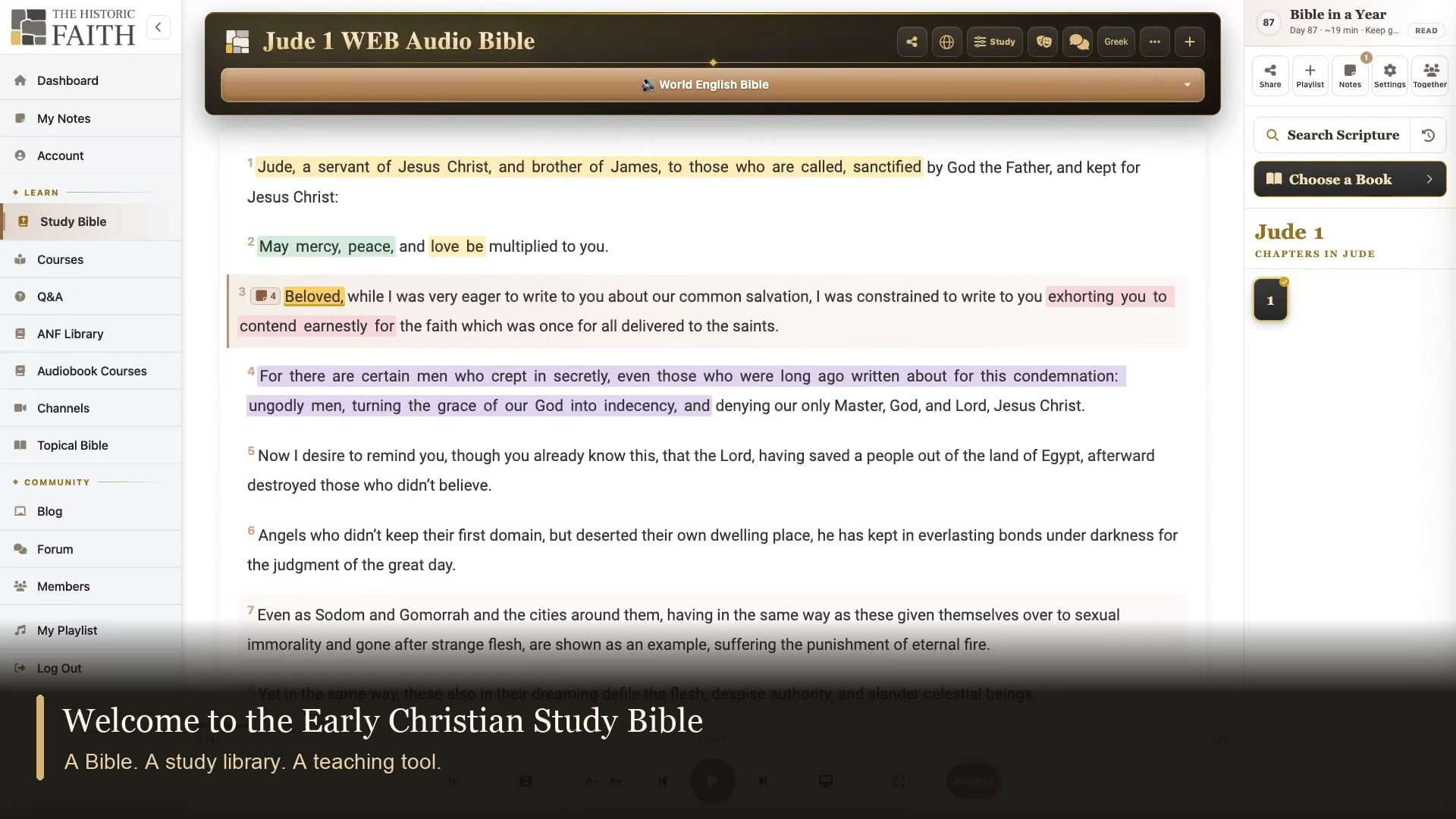
Click a word. Hear its pronunciation. Open the early Christian writings. Then see how to present and teach.
 Words. Writings.
Guided tour · 21:50 · Several Bible editions.
See the phone experience · 5:31
Strong's Exhaustive Concordance, first published by James Strong in 1890, indexes every word of the King James Version and assigns each underlying original-language word a number — G1–G5624 for the Greek New Testament and H1–H8674 for the Hebrew Old Testament. Look up any English word, find its Strong's number, and see the Greek or Hebrew word behind it, its definition, and the verses where it occurs. This free online edition covers 14,298 entries with 767,764 indexed occurrences — including the Septuagint, deuterocanonical books, and 1 Enoch, which no print edition of Strong's includes.
These entry points are the quickest way to see how a Strong's number opens into a word, meaning, and Bible usage.
Greek agape, with New Testament and Septuagint usage links where indexed.
Greek kyrios, a major New Testament and Septuagint word-study bridge.
Hebrew reshith, the word behind “beginning” in Genesis 1:1 and other Old Testament usages.
Browse the local Greek and Hebrew Strong's entries in fast pages, open an exact number, or narrow the index by language, range, and usage count.
| Number | Word | Definition | Usages | Range |
|---|---|---|---|---|
|
H5327 — natsah
Hebrew
|
נָצָה (natsah)
natsah
|
natsah (naw-tsaw') v. 1. (properly) to go forth 2. (by implication) to be expelled | 9 | H5001-H6000 |
|
H5328 — nitstsah
Hebrew
|
נִצָּה (nitstsah)
nitstsah
|
nitstsah (nits-tsaw') n-f. 1. a blossom [feminine of H5322] | 2 | H5001-H6000 |
|
H5329 — natsach
Hebrew
|
נָצַח (natsach)
natsach
|
natsach (naw-tsakh') v. 1. (properly) to glitter from afar 2. to be eminent (as a superintendent, especially of the Temple services and its music) | 10 | H5001-H6000 |
|
H5330 — ntsach
Hebrew
|
נְצַח (ntsach)
ntsach
|
ntsach (nets-akh') v. 1. to become chief [(Aramaic) corresponding to H5329] | 1 | H5001-H6000 |
|
H5331 — netsach
Hebrew
|
נֶצַח נֵצַח (netsach)
netsach
|
netsach (neh'-tsakh) (or netsach {nay'-tsakh};) n-m. 1. (properly) a goal, i.e. the bright object at a distance travelled towards 2. hence (figuratively), splendor, or (subjectively) truthfulness, or (objectively) confidence | 42 | H5001-H6000 |
|
H5332 — Netsach
Hebrew
|
נֵצַח (Netsach)
Netsach
|
Netsach (nay'-tsakh) n-m. 1. juice of the grape (as blood red) [probably identical with H5331, through the idea of brilliancy of color] | 2 | H5001-H6000 |
|
H5333 — ntsiyb
Hebrew
|
נְצִיבּ נְצִב (ntsiyb)
ntsiyb
|
ntsiyb (nets-eeb') (or ntsib {nets-eeb'}) n-m. 1. something stationary, i.e. a prefect, a military post, a statue [from H5324] | 10 | H5001-H6000 |
|
H5334 — Ntsiyb
Hebrew
|
נְצִיבּ (Ntsiyb)
Ntsiyb
|
Ntsiyb (nets-eeb') n/l. 1. station 2. Netsib, a place in Israel | 1 | H5001-H6000 |
|
H5335 — ntsiyach
Hebrew
|
נְצִיַח (ntsiyach)
ntsiyach
|
ntsiyach (nets-ee'-akh) n/p. 1. conspicuous 2. Netsiach, a Temple- servant | 2 | H5001-H6000 |
|
H5336 — natsiyr
Hebrew
|
נָצִיר (natsiyr)
natsiyr
|
natsiyr (naw-tsere') adj. 1. (properly) conservative 2. but used passively, delivered | 1 | H5001-H6000 |
|
H5337 — natsal
Hebrew
|
נָצַל (natsal)
natsal
|
natsal (naw-tsal') v. 1. to snatch away, whether in a good or a bad sense [a primitive root] | 193 | H5001-H6000 |
|
H5338 — ntsal
Hebrew
|
נְצַל (ntsal)
ntsal
|
ntsal (nets-al') v. 1. to extricate [(Aramaic) corresponding to H5337] | 3 | H5001-H6000 |
|
H5339 — nitstsan
Hebrew
|
נִצָּן (nitstsan)
nitstsan
|
nitstsan (nits-tsawn') n-m. 1. a blossom [from H5322] | 1 | H5001-H6000 |
|
H5340 — natsats
Hebrew
|
נָצַץ (natsats)
natsats
|
natsats (naw-tsats') v. 1. to glare, i.e. be bright- colored [a primitive root] | 1 | H5001-H6000 |
|
H5341 — natsar
Hebrew
|
נָצַר (natsar)
natsar
|
natsar (naw-tsar') v. 1. to guard, in a good sense (to protect, maintain, obey, etc.) or a bad one (to conceal, etc.) [a primitive root] | 60 | H5001-H6000 |
|
H5342 — netser
Hebrew
|
נֵצֶר (netser)
netser
|
netser (nay'-tser) n-m. 1. a shoot 2. (figuratively) a descendant | 4 | H5001-H6000 |
|
H5343 — nqe'
Hebrew
|
נְקֵא (nqe')
nqe'
|
nqe' (nek-ay') adj. 1. clean [(Aramaic) from a root corresponding to H5352] | 1 | H5001-H6000 |
|
H5344 — naqab
Hebrew
|
נָקַב (naqab)
naqab
|
naqab (naw-kab') v. 1. to puncture, literally (to perforate, with more or less violence) or figuratively (to specify, designate, libel) [a primitive root] | 24 | H5001-H6000 |
|
H5345 — neqeb
Hebrew
|
נֶקֶב (neqeb)
neqeb
|
neqeb (neh'keb) n-m. 1. pipe [a bezel (for a gem)] | 1 | H5001-H6000 |
|
H5346 — Neqeb
Hebrew
|
נֶקֶב (Neqeb)
Neqeb
|
Neqeb (neh'-keb) n/l. 1. dell 2. Nekeb, a place in Israel | 1 | H5001-H6000 |
|
H5347 — nqebah
Hebrew
|
נְקֵבָה (nqebah)
nqebah
|
nqebah (nek-ay-baw') n-f. 1. female (from the sexual form) [from H5344] | 22 | H5001-H6000 |
|
H5348 — naqod
Hebrew
|
נָקוֹד (naqod)
naqod
|
naqod (naw-kode') adj. 1. spotted [from an unused root meaning to mark (by puncturing or branding)] | 7 | H5001-H6000 |
|
H5349 — noqed
Hebrew
|
נוֹקֵד (noqed)
noqed
|
noqed (no-kade') n-m. 1. a spotter (of sheep or cattle), i.e. the owner or tender (who thus marks them) [active participle from the same as H5348] | 2 | H5001-H6000 |
|
H5350 — niqqud
Hebrew
|
נִקּוּד (niqqud)
niqqud
|
niqqud (nik-kood') n-m. 1. a crumb (as broken to spots) 2. also a biscuit (as pricked) | 3 | H5001-H6000 |
|
H5351 — nquddah
Hebrew
|
נְקוּדָּה (nquddah)
nquddah
|
nquddah (ned-ood-daw') n-f. 1. a boss [feminine of H5348] | 1 | H5001-H6000 |
|
H5352 — naqah
Hebrew
|
נָקָה (naqah)
naqah
|
naqah (naw-kaw') v. 1. to be (or make) clean (literally or figuratively) 2. (by implication) (in an adverse sense) to be bare, i.e. extirpated | 33 | H5001-H6000 |
|
H5353 — Nqowda'
Hebrew
|
נְקוֹדָא (Nqowda')
Nqowda'
|
Nqowda' (nek-o-daw') n/p. 1. distinction 2. Nekoda, a Temple-servant | 4 | H5001-H6000 |
|
H5354 — naqat
Hebrew
|
נָקַט (naqat)
naqat
|
naqat (naw-kat') v. 1. to loathe [a primitive root] | 1 | H5001-H6000 |
|
H5355 — naqiy
Hebrew
|
נָקִי נָקִיא (naqiy)
naqiy
|
naqiy (naw-kee') (or naqiyi (Joel 4:19; Jonah [1:14)) adj. 1. innocent [from H5352] | 42 | H5001-H6000 |
|
H5356 — niqqayown
Hebrew
|
נִקָּיוֹן נִקָּיוֹן (niqqayown)
niqqayown
|
niqqayown (nik-kaw-yone') (or niqqayon {nik-kaw-yone'}) n-m. 1. clearness (literally or figuratively) [from H5352] | 5 | H5001-H6000 |
|
H5357 — naqiyq
Hebrew
|
נָקִיק (naqiyq)
naqiyq
|
naqiyq (naw-keek') n-m. 1. a cleft [from an unused root meaning to bore] | 3 | H5001-H6000 |
|
H5358 — naqam
Hebrew
|
נָקַם (naqam)
naqam
|
naqam (naw-kam') v. 1. to grudge, i.e. avenge or punish [a primitive root] | 31 | H5001-H6000 |
|
H5359 — naqam
Hebrew
|
נָקָם (naqam)
naqam
|
naqam (naw-kawm') n-m. 1. revenge [from H5358] | 17 | H5001-H6000 |
|
H5360 — nqamah
Hebrew
|
נְקָמָה (nqamah)
nqamah
|
nqamah (nek-aw-maw') n-f. 1. avengement, whether the act of the passion [feminine of H5359] | 22 | H5001-H6000 |
|
H5361 — naqa`
Hebrew
|
נָקַע (naqa`)
naqa`
|
naqa` (naw-kah') v. 1. to feel aversion [a primitive root] | 3 | H5001-H6000 |
|
H5362
Hebrew
|
תַקִּ֔פוּ
|
naqaph (naw-kaf') v. 1. to strike with more or less violence (beat, fell, corrode) 2. (by implication) (of attack) to knock together, i.e. surround or circulate | 19 | H5001-H6000 |
|
H5363 — noqeph
Hebrew
|
נוֹקֶף (noqeph)
noqeph
|
noqeph (no'-kef) n-m. 1. a threshing (of olives) [from H5362] | 2 | H5001-H6000 |
|
H5364 — niqpah
Hebrew
|
נִקפָּה (niqpah)
niqpah
|
niqpah (nik-paw') n-f. 1. probably a rope (as encircling) [from H5362] | 1 | H5001-H6000 |
|
H5365 — naqar
Hebrew
|
נָקַר (naqar)
naqar
|
naqar (naw-kar') v. 1. to bore (penetrate, quarry) [a primitive root] | 6 | H5001-H6000 |
|
H5366 — nqarah
Hebrew
|
נְקָרָה (nqarah)
nqarah
|
nqarah (nek-aw-raw') n-f. 1. cleft, clift [from H5365, a fissure] | 2 | H5001-H6000 |
|
H5367 — naqash
Hebrew
|
נָקַשׁ (naqash)
naqash
|
naqash (naw-kash') v. 1. to entrap (with a noose), literally or figuratively [a primitive root] | 5 | H5001-H6000 |
|
H5368 — nqash
Hebrew
|
נְקַשׁ (nqash)
nqash
|
nqash (nek-ash') v. 1. to knock [(Aramaic) corresponding to H5367, but used in the sense of H5362] | 1 | H5001-H6000 |
|
H5369 — Ner
Hebrew
|
נֵר (Ner)
Ner
|
Ner (nare) n/p. 1. lamp 2. Ner, an Israelite | 16 | H5001-H6000 |
|
H5370 — Nergal
Hebrew
|
נֵרגַּל (Nergal)
Nergal
|
Nergal (nare-gal') n/p. 1. Nergal, a Cuthite deity [of foreign origin] | 1 | H5001-H6000 |
|
H5371
Hebrew
|
נֵרגַּל שַׁראֶצֶר
|
Nergal Shar'etser (nare-gal' shar-eh'-tser) n/p. 1. Nergal-Sharetser, the name of two Babylonians [from H5370 and H8272] | 2 | H5001-H6000 |
|
H5372 — nirgan
Hebrew
|
נִרגָּן (nirgan)
nirgan
|
nirgan (neer-gawn') v. 1. a slanderer [from an unused root meaning to roll to pieces] | 4 | H5001-H6000 |
|
H5373 — nerd
Hebrew
|
נֵרדּ (nerd)
nerd
|
nerd (nayrd) n-m. 1. nard, an aromatic [of foreign origin] | 3 | H5001-H6000 |
|
H5374 — Neriyah
Hebrew
|
נֵרִיָה נֵרִיָהוּ (Neriyah)
Neriyah
|
Neriyah (nay-ree-yaw') (or Neriyahuw {nay-ree-yaw'-hoo}) n/p. 1. light of Jah 2. Nerijah, an Israelite | 10 | H5001-H6000 |
|
H5375 — nasa'
Hebrew
|
נָשָׂא נָסָה (nasa')
nasa'
|
nasa' (naw-saw') (or nacah (Psalm 4)) v. 1. to lift, in a great variety of applications, literal and figurative, absol. and rel. (as follows) [a primitive root] | 611 | H5001-H6000 |
|
H5376 — nsa'
Hebrew
|
נְשָׂא (nsa')
nsa'
|
nsa' (nes-aw') v. 1. carry away, make insurrection, take [(Aramaic) corresponding to H5375] | 3 | H5001-H6000 |
|
H5377 — nasha'
Hebrew
|
נָשָׁא (nasha')
nasha'
|
nasha' (naw-shaw') v. 1. to lead astray, i.e. (mentally) to delude, or (morally) to seduce [a primitive root] | 15 | H5001-H6000 |
|
H5378 — nasha'
Hebrew
|
נָשָׁא (nasha')
nasha'
|
nasha' (naw-shaw') v. 1. to lend on interest 2. (by implication) to demand payment for debt | 3 | H5001-H6000 |
|
H5379 — nisse'th
Hebrew
|
נִשֵּׂאתּ (nisse'th)
nisse'th
|
nisse'th (nis-sayth') v-xxp. 1. something taken, i.e. a present [passive participle feminine of H5375] | 1 | H5001-H6000 |
|
H5380 — nashab
Hebrew
|
נָשַׁב (nashab)
nashab
|
nashab (naw-shab') v. 1. to blow 2. (by implication) to disperse | 3 | H5001-H6000 |
|
H5381 — nasag
Hebrew
|
נָשַׂג (nasag)
nasag
|
nasag (naw-sag') v. 1. to reach (literally or figuratively) [a primitive root] | 47 | H5001-H6000 |
|
H5382 — nashah
Hebrew
|
נָשָׁה (nashah)
nashah
|
nashah (naw-shaw') v. 1. to forget 2. (figuratively) to neglect | 6 | H5001-H6000 |
|
H5383 — nashah
Hebrew
|
נָשָׁה (nashah)
nashah
|
nashah (naw-shaw') v. 1. to lend or (by reciprocity) borrow on security or interest [a primitive root (rather identical with H5382, in the sense of H5378)] | 12 | H5001-H6000 |
|
H5384 — nasheh
Hebrew
|
נָשֶׁה (nasheh)
nasheh
|
nasheh (naw-sheh') n-m. 1. rheumatic or crippled (from the incident to Jacob) [from H5382, in the sense of failure] | 1 | H5001-H6000 |
|
H5385 — nsuw'ah
Hebrew
|
נְשׂוּאָה נְשׂוּאָה (nsuw'ah)
nsuw'ah
|
nsuw'ah (nes-oo-aw') (or rather, nsutah {nes-oo-aw'}) n-f. 1. something borne, i.e. a load [feminine. passive participle of H5375] | 1 | H5001-H6000 |
|
H5386 — nshiy
Hebrew
|
נְשִׁי (nshiy)
nshiy
|
nshiy (nesh-ee') n-m. 1. a debt [from H5383] | 1 | H5001-H6000 |
|
H5387 — nasiy'
Hebrew
|
נָשִׂיא נָשִׂא (nasiy')
nasiy'
|
nasiy' (naw-see') (or nasi' {naw-see'}) n-m. 1. (properly) an exalted one, i.e. a king or sheik 2. also a rising mist | 120 | H5001-H6000 |
|
H5388 — nshiyah
Hebrew
|
נְשִׁיָה (nshiyah)
nshiyah
|
nshiyah (nesh-ee-yaw') n-f. 1. oblivion [from H5382] | 1 | H5001-H6000 |
|
H5389 — nashiyn
Hebrew
|
נָשִׁין (nashiyn)
nashiyn
|
nashiyn (naw-sheen') n-f. 1. women [(Aramaic) irregular plural feminine of H606] | 1 | H5001-H6000 |
|
H5390 — nshiyqah
Hebrew
|
נְשִׁיקָה (nshiyqah)
nshiyqah
|
nshiyqah (nesh-ee-kaw') n-f. 1. a kiss [from H5401] | 2 | H5001-H6000 |
|
H5391 — nashak
Hebrew
|
נָשַׁך (nashak)
nashak
|
nashak (naw-shak') v. 1. to strike with a sting (as a serpent) 2. (figuratively) to oppress with interest on a loan | 14 | H5001-H6000 |
|
H5392 — neshek
Hebrew
|
נֶשֶׁך (neshek)
neshek
|
neshek (neh'-shek) n-m. 1. interest on a debt [from H5391] | 10 | H5001-H6000 |
|
H5393 — nishkah
Hebrew
|
נִשׁכָּה (nishkah)
nishkah
|
nishkah (nish-kaw') n-f. 1. a cell [for H3957] | 3 | H5001-H6000 |
|
H5394 — nashal
Hebrew
|
נָשַׁל (nashal)
nashal
|
nashal (naw-shal') v. 1. to pluck off, i.e. divest, eject or drop [a primitive root] | 7 | H5001-H6000 |
|
H5395 — nasham
Hebrew
|
נָשַׁם (nasham)
nasham
|
nasham (naw-sham') v. 1. (properly) to blow away, i.e. destroy [a primitive root] | 1 | H5001-H6000 |
|
H5396 — nishma'
Hebrew
|
נִשׁמָא (nishma')
nishma'
|
nishma' (nish-maw') n-f. 1. vital breath [(Aramaic) corresponding to H5397] | 1 | H5001-H6000 |
|
H5397 — nshamah
Hebrew
|
נְשָׁמָה (nshamah)
nshamah
|
nshamah (nesh-aw-maw') n-f. 1. a puff, i.e. wind, angry or vital breath, divine inspiration, intellect. or (concretely) an animal [from H5395] | 24 | H5001-H6000 |
|
H5398 — nashaph
Hebrew
|
נָשַׁף (nashaph)
nashaph
|
nashaph (naw-shaf') v. 1. to breeze, i.e. blow up fresh (as the wind) [a primitive root] | 2 | H5001-H6000 |
|
H5399 — nesheph
Hebrew
|
נֶשֶׁף (nesheph)
nesheph
|
nesheph (neh'-shef) n-m. 1. (properly) a breeze 2. (by implication) dusk (when the evening breeze prevails) | 12 | H5001-H6000 |
|
H5400 — nasaq
Hebrew
|
נָשַׂק (nasaq)
nasaq
|
nasaq (naw-sak') v. 1. to catch fire [a primitive root] | 3 | H5001-H6000 |
|
H5401 — nashaq
Hebrew
|
נָשַׁק (nashaq)
nashaq
|
nashaq (naw-shak') v. 1. to kiss 2. (literally or figuratively) touch | 35 | H5001-H6000 |
|
H5402 — nesheq
Hebrew
|
נֶשֶׁק נֵשֶׁק (nesheq)
nesheq
|
nesheq (neh'-shek) (or nesheq {nay'-shek}) n-m. 1. military equipment, i.e. (collectively) arms (offensive or defensive), or (concretely) an arsenal [from H5401] | 10 | H5001-H6000 |
|
H5403 — nshar
Hebrew
|
נְשַׁר (nshar)
nshar
|
nshar (nesh-ar') n-m. 1. an eagle [(Aramaic) corresponding to H5404] | 2 | H5001-H6000 |
|
H5404 — nesher
Hebrew
|
נֶשֶׁר (nesher)
nesher
|
nesher (neh'-sher) n-m. 1. the eagle (or other large bird of prey) [from an unused root meaning to lacerate] | 26 | H5001-H6000 |
|
H5405 — nashath
Hebrew
|
נָשַׁת (nashath)
nashath
|
nashath (naw-shath') v. 1. (properly) to eliminate, i.e. (intransitively) to dry up [a primitive root] | 3 | H5001-H6000 |
|
H5406 — nishtvan
Hebrew
|
נִשׁתְּוָן (nishtvan)
nishtvan
|
nishtvan (nish-tev-awn') n-m. 1. an epistle [probably of Persian origin] | 2 | H5001-H6000 |
|
H5407 — nishtvan
Hebrew
|
נִשׁתְּוָן (nishtvan)
nishtvan
|
nishtvan (nish-tev-awn') n-m. 1. letter [(Aramaic) corresponding to H5406] | 3 | H5001-H6000 |
|
H5408 — nathach
Hebrew
|
נָתַח (nathach)
nathach
|
nathach (naw-thakh') v. 1. to dismember [a primitive root] | 9 | H5001-H6000 |
|
H5409 — nethach
Hebrew
|
נֵתַח (nethach)
nethach
|
nethach (nay'-thakh) n-m. 1. a fragment [from H5408] | 9 | H5001-H6000 |
|
H5410 — nathiyb
Hebrew
|
נָתִיבּ נְתִיבָּה נְתִבָה (nathiyb)
nathiyb
|
nathiyb (naw-theeb') (or (feminine) nthiybah {neth-ee-baw'} or nthibah (Jeremiah 6:16)) n-e. 1. a (beaten) track [from an unused root meaning to tramp] | 26 | H5001-H6000 |
|
H5411 — Nathiyn
Hebrew
|
נָתִין נָתוּן (Nathiyn)
Nathiyn
|
Nathiyn (naw-theen') (or Nathuwn (Ezra 8:17)) n-m. 1. one given, i.e. (in the plural only) the Nethinim, or Temple-servants (as given to that duty) [from H5414] | 15 | H5001-H6000 |
|
H5412 — Nthiyn
Hebrew
|
נְתִין (Nthiyn)
Nthiyn
|
Nthiyn (netheen') n-m. 1. Nethinims [(Aramaic) corresponding to H5411] | 1 | H5001-H6000 |
|
H5413 — nathak
Hebrew
|
נָתַך (nathak)
nathak
|
nathak (naw-thak') v. 1. to flow forth (literally or figuratively) 2. (by implication) to liquify | 19 | H5001-H6000 |
|
H5414 — nathan
Hebrew
|
נָתַן (nathan)
nathan
|
nathan (naw-than') v. 1. to give, used with greatest latitude of application (put, make, etc.) [a primitive root] | 1,816 | H5001-H6000 |
|
H5415 — nthan
Hebrew
|
נְתַן (nthan)
nthan
|
nthan (neth-an') v. 1. give [(Aramaic) corresponding to H5414] | 6 | H5001-H6000 |
|
H5416 — Nathan
Hebrew
|
נָתָן (Nathan)
Nathan
|
Nathan (naw-thawn') n/p. 1. given 2. Nathan, the name of five Israelites | 38 | H5001-H6000 |
|
H5417 — Nthane'l
Hebrew
|
נְתַנאֵל (Nthane'l)
Nthane'l
|
Nthane'l (neth-an-ale') n/p. 1. given of God 2. Nethanel, the name of ten Israelites | 14 | H5001-H6000 |
|
H5418 — Nthanyah
Hebrew
|
נְתַניָה נְתַניָהוּ (Nthanyah)
Nthanyah
|
Nthanyah (neth-an-yaw') (or Nthanyahuw {neth-an-yaw'-hoo}) n/p. 1. given of Jah 2. Nethanjah, the name of four Israelites | 20 | H5001-H6000 |
|
H5419 — Nthan-Melek
Hebrew
|
נְתַן ־ מֶלֶך (Nthan-Melek)
Nthan-Melek
|
Nthan-Melek (neth-an' meh'-lek) n/p. 1. given of (the) king 2. Nethan-Melek, an Israelite | 1 | H5001-H6000 |
|
H5420 — nathac
Hebrew
|
נָתַס (nathac)
nathac
|
nathac (naw-thas') v. 1. to tear up [a primitive root] | 1 | H5001-H6000 |
|
H5421 — natha`
Hebrew
|
נָתַע (natha`)
natha`
|
natha` (naw-thah') v. 1. to tear out [for H5422] | 1 | H5001-H6000 |
|
H5422 — nathats
Hebrew
|
נָתַץ (nathats)
nathats
|
nathats (naw-thats') v. 1. to tear down [a primitive root] | 41 | H5001-H6000 |
|
H5423 — nathaq
Hebrew
|
נָתַק (nathaq)
nathaq
|
nathaq (naw-thak') v. 1. to tear off [a primitive root] | 26 | H5001-H6000 |
|
H5424 — netheq
Hebrew
|
נֶתֶק (netheq)
netheq
|
netheq (neh'-thek) n-m. 1. scurf [from H5423] | 9 | H5001-H6000 |
|
H5425 — nathar
Hebrew
|
נָתַר (nathar)
nathar
|
nathar (naw-thar') v. 1. to jump, i.e. be violently agitated 2. causatively, to terrify, shake off, untie | 8 | H5001-H6000 |
|
H5426 — nther
Hebrew
|
נְתַר (nther)
nther
|
nther (neth-ar') v. 1. shake off [(Aramaic) corresponding to H5425] | 1 | H5001-H6000 |
|
H5427 — nether
Hebrew
|
נֶתֶר (nether)
nether
|
nether (neh'-ther) n-m. 1. mineral potash (so called from effervescing with acid) [from H5425] | 2 | H5001-H6000 |
|
H5428 — nathash
Hebrew
|
נָתַשׁ (nathash)
nathash
|
nathash (naw-thash') v. 1. to tear away [a primitive root] | 19 | H5001-H6000 |
|
H5429 — c'ah
Hebrew
|
סְאָה (c'ah)
c'ah
|
c'ah (seh-aw') n-f. 1. a seah, or certain measure (as determinative) for grain [from an unused root meaning to define] | 6 | H5001-H6000 |
|
H5430 — c'own
Hebrew
|
סְאוֹן (c'own)
c'own
|
c'own (seh-own') n-m. 1. perhaps a military boot (as a protection from mud [from H5431] | 1 | H5001-H6000 |
|
H5431 — ca'an
Hebrew
|
סָאַן (ca'an)
ca'an
|
ca'an (saw-an') v. 1. to shoe, i.e. (active participle) a soldier shod [a primitive root, to be miry; used only as denominative from H5430] | 1 | H5001-H6000 |
|
H5432 — ca'c'ah
Hebrew
|
סַאסְאָה (ca'c'ah)
ca'c'ah
|
ca'c'ah (sah-seh-aw') v. 1. measurement, i.e. moderation [for H5429] | 1 | H5001-H6000 |
|
H5433 — caba'
Hebrew
|
סָבָא (caba')
caba'
|
caba' (saw-baw') v. 1. to quaff to satiety, i.e. become tipsy [a primitive root] | 5 | H5001-H6000 |
|
H5434 — Cba'
Hebrew
|
סְבָא (Cba')
Cba'
|
Cba' (seb-aw') n/l. 1. Seba, a son of Cush, and the country settled by him [of foreign origin] | 4 | H5001-H6000 |
|
H5435 — cobe'
Hebrew
|
סוֹבֶא (cobe')
cobe'
|
cobe' (so'-beh) n-m. 1. potation, concretely (wine), or abstractly (carousal) [from H5433] | 3 | H5001-H6000 |
|
H5436 — Cba'iy
Hebrew
|
סְבָאִי (Cba'iy)
Cba'iy
|
Cba'iy (seb-aw-ee') n/g. 1. a Sebaite, or inhabitant of Seba [patrial from H5434] | 2 | H5001-H6000 |
|
H5437 — cabab
Hebrew
|
סָבַב (cabab)
cabab
|
cabab (saw-bab') v. 1. to revolve, surround, or border 2. used in various applications, literally and figuratively (as follows) | 148 | H5001-H6000 |
|
H5438 — cibbah
Hebrew
|
סִבָּה (cibbah)
cibbah
|
cibbah (sib-baw') n-f. 1. a (providential) turn (of affairs) [from H5437] | 1 | H5001-H6000 |
|
H5439 — cabiyb
Hebrew
|
סָבִיבּ סֶבִיבָּה (cabiyb)
cabiyb
|
cabiyb (saw-beeb') (or (feminine) cbiybah {seb-ee-baw'}) adj. 1. (as noun) a circle, neighbour, or environs 2. but chiefly (as adverb, with or without preposition) around | 282 | H5001-H6000 |
|
H5440 — cabak
Hebrew
|
סָבַך (cabak)
cabak
|
cabak (saw-bak') v. 1. to entwine [a primitive root] | 2 | H5001-H6000 |
|
H5441 — cobek
Hebrew
|
סוֹבֶך (cobek)
cobek
|
cobek (so'-bek) n-m. 1. a copse [from H5440] | 1 | H5001-H6000 |
|
H5442 — cbak
Hebrew
|
סְבָך (cbak)
cbak
|
cbak (seb-awk') n-m. 1. thick(-et) [from H5440, a copse] | 4 | H5001-H6000 |
|
H5443 — cabbka'
Hebrew
|
סַבְּכָא שַׂבְּכָא (cabbka')
cabbka'
|
cabbka' (sab-bek-aw') ((Aramaic) or sabbka) n-f. 1. a lyre [from a root corresponding to H5440] | 4 | H5001-H6000 |
|
H5444 — Cibbkay
Hebrew
|
סִבְּכַי (Cibbkay)
Cibbkay
|
Cibbkay (sib-bek-ah'-ee) n/p. 1. copse-like 2. Sibbecai, an Israelite | 4 | H5001-H6000 |
|
H5445 — cabal
Hebrew
|
סָבַל (cabal)
cabal
|
cabal (saw-bal') v. 1. to carry (literally or figuratively), or (reflexively) be burdensome 2. specifically, to be gravid | 8 | H5001-H6000 |
|
H5446 — cbal
Hebrew
|
סְבַל (cbal)
cbal
|
cbal (seb-al') v. 1. to erect [(Aramaic) corresponding to H5445] | 1 | H5001-H6000 |
|
H5447 — cebel
Hebrew
|
סֵבֶל (cebel)
cebel
|
cebel (say'-bel) n-m. 1. a load (literally or figuratively) [from H5445] | 3 | H5001-H6000 |
|
H5448 — cobel
Hebrew
|
סוֹבֶל סוּבָּל (cobel)
cobel
|
cobel (so'-bel) ((only in the form cubbal {soob-bawl'})) n-m. 1. a load (figuratively) [from H5445] | 3 | H5001-H6000 |
|
H5449 — cabbal
Hebrew
|
סַבָּל (cabbal)
cabbal
|
cabbal (sab-bawl') n-m. 1. a porter [from H5445] | 5 | H5001-H6000 |
|
H5450 — cbalah
Hebrew
|
סְבָלָה (cbalah)
cbalah
|
cbalah (seb-aw-law') n-f. 1. porterage [from H5447] | 6 | H5001-H6000 |
|
H5451 — cibboleth
Hebrew
|
סִבּוֹלֶת (cibboleth)
cibboleth
|
cibboleth (sib-bo'-leth) n-f. 1. an ear of grain [for H7641] | 1 | H5001-H6000 |
|
H5452 — cbar
Hebrew
|
סְבַר (cbar)
cbar
|
cbar (seb-ar') v. 1. to bear in mind, i.e. hope [(Aramaic) a primitive root] | 1 | H5001-H6000 |
|
H5453 — Cibrayim
Hebrew
|
סִברַיִם (Cibrayim)
Cibrayim
|
Cibrayim (sib-rah'-yim) n/l. 1. double hope 2. Sibrajim, a place in Syria | 1 | H5001-H6000 |
|
H5454 — Cabta'
Hebrew
|
סַבתָּא סַבתָּה (Cabta')
Cabta'
|
Cabta' (sab-taw') (or Cabtah {sab-taw'}) n/p. 1. Sabta or Sabtah, the name of a son of Cush, and the country occupied by his posterity [probably of foreign derivation] | 2 | H5001-H6000 |
|
H5455 — Cabtka'
Hebrew
|
סַבתְּכָא (Cabtka')
Cabtka'
|
Cabtka' (sab-tek-aw') n/p. 1. Sabteca, the name of a son of Cush, and the region settled by him [probably of foreign derivation] | 2 | H5001-H6000 |
|
H5456 — cagad
Hebrew
|
סָגַד (cagad)
cagad
|
cagad (saw-gad') v. 1. to prostrate oneself (in homage) [a primitive root] | 4 | H5001-H6000 |
|
H5457 — cgid
Hebrew
|
סְגִד (cgid)
cgid
|
cgid (seg-eed') v. 1. worship [(Aramaic) corresponding to H5456] | 11 | H5001-H6000 |
|
H5458 — cgowr
Hebrew
|
סְגוֹר (cgowr)
cgowr
|
cgowr (seg-ore') n-m. 1. (properly) shut up, i.e. the breast (as inclosing the heart) 2. (also) gold (as generally shut up safely) | 2 | H5001-H6000 |
|
H5459 — cgullah
Hebrew
|
סְגוּלָּה (cgullah)
cgullah
|
cgullah (seg-ool-law') n-f. 1. wealth (as closely shut up) [feminine passive participle of an unused root meaning to shut up] | 8 | H5001-H6000 |
|
H5460 — cgan
Hebrew
|
סְגַן (cgan)
cgan
|
cgan (seg-an') n-m. 1. governor [(Aramaic) corresponding to H5461] | 5 | H5001-H6000 |
|
H5461 — cagan
Hebrew
|
סָגָן (cagan)
cagan
|
cagan (saw-gawn') n-m. 1. a prefect of a province [from an unused root meaning to superintend] | 16 | H5001-H6000 |
|
H5462 — cagar
Hebrew
|
סָגַר (cagar)
cagar
|
cagar (saw-gar') v. 1. to shut up 2. (figuratively) to surrender | 87 | H5001-H6000 |
|
H5463 — cgar
Hebrew
|
סְגַר (cgar)
cgar
|
cgar (seg-ar') v. 1. shut up [(Aramaic) corresponding to H5462] | 1 | H5001-H6000 |
|
H5464 — cagriyd
Hebrew
|
סַגרִידּ (cagriyd)
cagriyd
|
cagriyd (sag-reed') n-m. 1. a pouring rain [probably from H5462 in the sense of sweeping away] | 1 | H5001-H6000 |
|
H5465 — cad
Hebrew
|
סַד (cad)
cad
|
cad (sad) n-m. 1. the stocks [from an unused root meaning to estop] | 2 | H5001-H6000 |
|
H5466 — cadiyn
Hebrew
|
סָדִין (cadiyn)
cadiyn
|
cadiyn (saw-deen') n-m. 1. a wrapper, i.e. shirt [from an unused root meaning to envelop] | 4 | H5001-H6000 |
|
H5467 — Cdom
Hebrew
|
סְדוֹם (Cdom)
Cdom
|
Cdom (sed-ome') n/l. 1. burnt (i.e. volcanic or bituminous) district 2. Sedom, a place near the Dead Sea | 38 | H5001-H6000 |
|
H5468 — ceder
Hebrew
|
סֶדֶר (ceder)
ceder
|
ceder (seh'-der) n-m. 1. order [from an unused root meaning to arrange] | 1 | H5001-H6000 |
|
H5469 — cahar
Hebrew
|
סַהַר (cahar)
cahar
|
cahar (cah'-har) n-m. 1. roundness [from an unused root meaning to be round] | 1 | H5001-H6000 |
|
H5470 — cohar
Hebrew
|
סוֹהַר (cohar)
cohar
|
cohar (so'-har) n-m. 1. a dungeon (as surrounded by walls) [from the same as H5469] | 6 | H5001-H6000 |
|
H5471 — Cow'
Hebrew
|
סוֹא (Cow')
Cow'
|
Cow' (so) n/p. 1. So, an Egyptian king [of foreign derivation] | 1 | H5001-H6000 |
|
H5472 — cuwg
Hebrew
|
סוּג (cuwg)
cuwg
|
cuwg (soog) v. 1. (properly) to flinch 2. (by implication) to go back, literally (to retreat) or figuratively (to apostatize) | 14 | H5001-H6000 |
|
H5473 — cuwg
Hebrew
|
סוּג (cuwg)
cuwg
|
cuwg (soog) v. 1. to hem in, i.e. bind [a primitive root (probably rather identical with H5472 through the idea of shrinking from a hedge] | 1 | H5001-H6000 |
|
H5474 — cuwgar
Hebrew
|
סוּגַר (cuwgar)
cuwgar
|
cuwgar (soo-gar') n-m. 1. an inclosure, i.e. cage (for an animal) [from H5462] | 1 | H5001-H6000 |
|
H5475 — cowd
Hebrew
|
סוֹד (cowd)
cowd
|
cowd (sode) n-m. 1. a session, i.e. company of persons (in close deliberation) 2. (by implication) intimacy, consultation, a secret | 21 | H5001-H6000 |
|
H5476 — Cowdiy
Hebrew
|
סוֹדִי (Cowdiy)
Cowdiy
|
Cowdiy (so-dee') n/p. 1. a confidant 2. Sodi, an Israelite | 1 | H5001-H6000 |
No Strong's entries match that search.
Strong's works best when the number, original word, verse, and corpus stay connected.
Open a chapter and move from a word token to its Strong's page, parsing, and linked occurrences.
Greek Strong's entries can include New Testament, Septuagint, deuterocanonical, and 1 Enoch rows where indexed.
Dedicated Strong's pages can expose approved pronunciation audio beside the word-study data.
These are common words readers run into repeatedly, shown with an English meaning so the list is readable without already knowing the original languages.
Look up a word study by its transliteration — these are frequently searched Hebrew and Greek words. Each opens the matching Strong's entry, or lists the options when a spelling maps to several words.