
G26 — Agape (Love)
Greek agape, with New Testament and Septuagint usage links where indexed.
The Early Christian Study Bible · Free to use
Study the word. Hear its pronunciation.
Search 14,298 Greek and Hebrew entries—free. Explore definitions, indexed occurrences, and pronunciation audio where available, then follow the words back into your Bible.
Click a word. Hear its pronunciation. Open the early Christian writings. Then see how to present and teach.
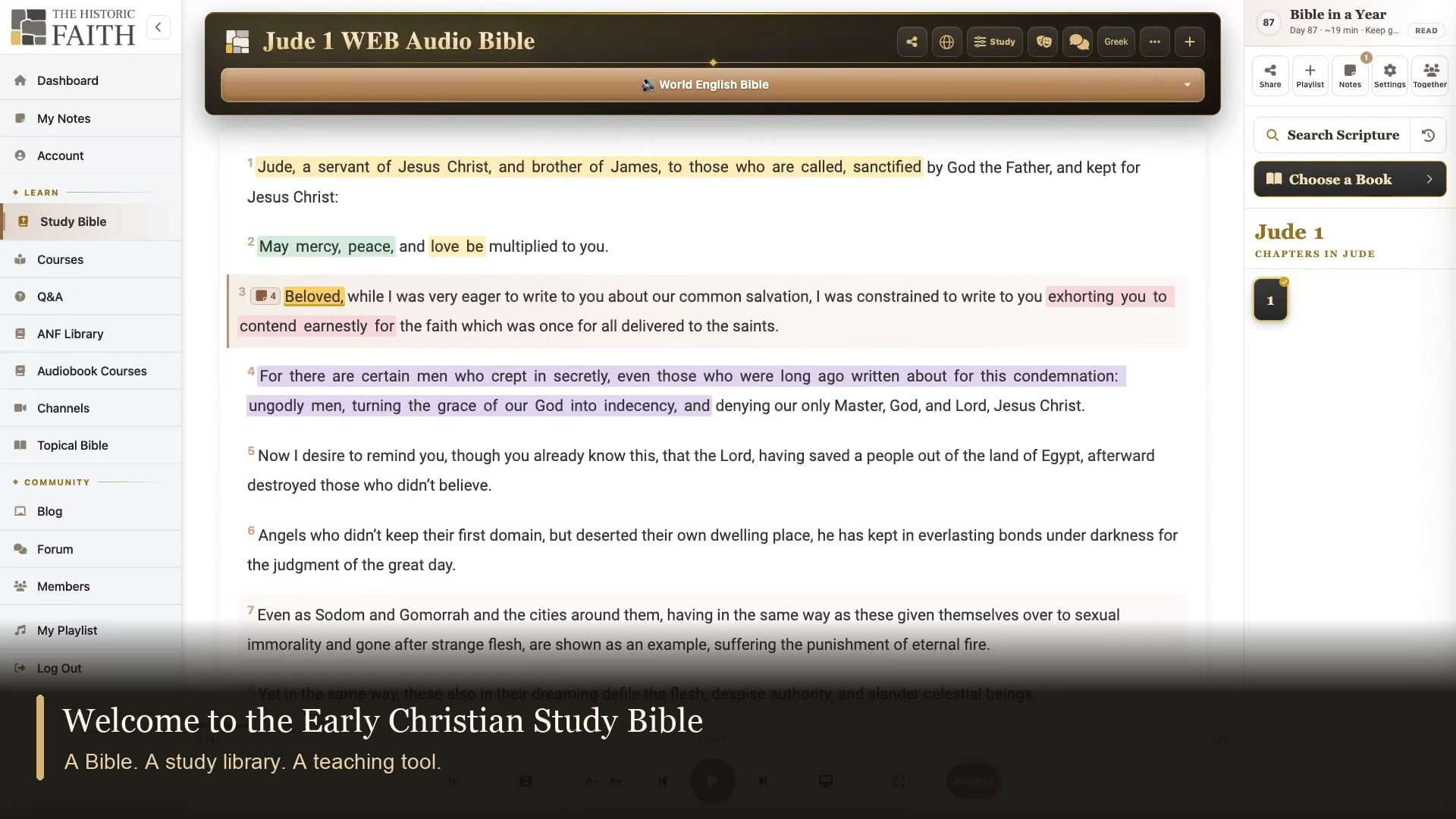 Words. Writings.
Guided tour · 21:50 · Several Bible editions.
See the phone experience · 5:31
Strong's Exhaustive Concordance, first published by James Strong in 1890, indexes every word of the King James Version and assigns each underlying original-language word a number — G1–G5624 for the Greek New Testament and H1–H8674 for the Hebrew Old Testament. Look up any English word, find its Strong's number, and see the Greek or Hebrew word behind it, its definition, and the verses where it occurs. This free online edition covers 14,298 entries with 767,764 indexed occurrences — including the Septuagint, deuterocanonical books, and 1 Enoch, which no print edition of Strong's includes.
These entry points are the quickest way to see how a Strong's number opens into a word, meaning, and Bible usage.
Greek agape, with New Testament and Septuagint usage links where indexed.
Greek kyrios, a major New Testament and Septuagint word-study bridge.
Hebrew reshith, the word behind “beginning” in Genesis 1:1 and other Old Testament usages.
Browse the local Greek and Hebrew Strong's entries in fast pages, open an exact number, or narrow the index by language, range, and usage count.
| Number | Word | Definition | Usages | Range |
|---|---|---|---|---|
|
H5177 — Nachshown
Hebrew
|
נַחשׁוֹן (Nachshown)
Nachshown
|
Nachshown (nakh-shone') n/p. 1. enchanter 2. Nachshon, an Israelite | 9 | H5001-H6000 |
|
H5178 — nchosheth
Hebrew
|
נְחוֹשֶׁת (nchosheth)
nchosheth
|
nchosheth (nekh-o'-sheth) n-m. 1. copper 2. (hence) something made of copper, i.e. a coin, a shackle | 119 | H5001-H6000 |
|
H5179 — Nchushta'
Hebrew
|
נְחוּשׁתָּא (Nchushta')
Nchushta'
|
Nchushta' (nekh-oosh-taw') n/p. 1. copper 2. Nechushta, an Israelitess | 1 | H5001-H6000 |
|
H5180 — Nchushtan
Hebrew
|
נְחוּשׁתָּן (Nchushtan)
Nchushtan
|
Nchushtan (nekh-oosh-tawn') n/t. 1. something made of copper, i.e. the copper serpent of the Desert [from H5178] | 1 | H5001-H6000 |
|
H5181 — nachath
Hebrew
|
נָחַת (nachath)
nachath
|
nachath (naw-khath') v. 1. to sink, i.e. descend 2. causatively, to press or lead down | 8 | H5001-H6000 |
|
H5182 — nchath
Hebrew
|
נְחַת (nchath)
nchath
|
nchath (nekh-ath') v. 1. to descend 2. causatively, to bring away, deposit, depose | 6 | H5001-H6000 |
|
H5183 — Nachath
Hebrew
|
נַחַת (Nachath)
Nachath
|
Nachath (nakh'-ath) n-e. 1. a descent, i.e. an imposition 2. (unfavorably) punishment | 8 | H5001-H6000 |
|
H5184 — Nachath
Hebrew
|
נַחַת (Nachath)
Nachath
|
Nachath (nakh'-ath) n/p. 1. quiet 2. Nachath, the name of an Edomite and of two Israelites | 5 | H5001-H6000 |
|
H5185 — nacheth
Hebrew
|
נָחֵת (nacheth)
nacheth
|
nacheth (naw-khayth') adj. 1. descending [from H5181] | 1 | H5001-H6000 |
|
H5186 — natah
Hebrew
|
נָטָה (natah)
natah
|
natah (naw-taw') v. 1. to stretch or spread out 2. (by implication) to bend away (including moral deflection) | 206 | H5001-H6000 |
|
H5187 — ntiyl
Hebrew
|
נְטִיל (ntiyl)
ntiyl
|
ntiyl (net-eel') adj. 1. laden [from H5190] | 1 | H5001-H6000 |
|
H5188 — ntiyphah
Hebrew
|
נְטִיפָה (ntiyphah)
ntiyphah
|
ntiyphah (net-ee-faw') n-f. 1. a pendant for the ears (especially of pearls) [from H5197] | 2 | H5001-H6000 |
|
H5189 — ntiyshah
Hebrew
|
נְטִישָׁה (ntiyshah)
ntiyshah
|
ntiyshah (net-ee-shaw') n-f. 1. a tendril (as an offshoot) [from H5203] | 3 | H5001-H6000 |
|
H5190 — natal
Hebrew
|
נָטַל (natal)
natal
|
natal (naw-tal') v. 1. to lift 2. (by implication) to impose | 4 | H5001-H6000 |
|
H5191 — ntal
Hebrew
|
נְטַל (ntal)
ntal
|
ntal (net-al') v. 1. to raise [(Aramaic) corresponding to H5190] | 2 | H5001-H6000 |
|
H5192 — netel
Hebrew
|
נֵטֶל (netel)
netel
|
netel (nay'-tel) n-m. 1. a burden [] | 1 | H5001-H6000 |
|
H5193 — nata`
Hebrew
|
נָטַע (nata`)
nata`
|
nata` (naw-tah') v. 1. (properly) to strike in, i.e. fix 2. specifically, to plant (literally or figuratively) | 55 | H5001-H6000 |
|
H5194 — neta`
Hebrew
|
נֶטַע (neta`)
neta`
|
neta` (neh'-tah) n-m. 1. a plant 2. collectively, a plantation | 4 | H5001-H6000 |
|
H5195 — natia`
Hebrew
|
נָטִיַע (natia`)
natia`
|
natia` (naw-tee'-ah) n-m. 1. a plant [from H5193] | 1 | H5001-H6000 |
|
H5196 — Nta`iym
Hebrew
|
נְטָעִים (Nta`iym)
Nta`iym
|
Nta`iym (net-aw-eem') n/l. 1. Netaim, a place in Israel [plural of H5194] | 1 | H5001-H6000 |
|
H5197 — nataph
Hebrew
|
נָטַף (nataph)
nataph
|
nataph (naw-taf') v. 1. to ooze, i.e. distil gradually 2. (by implication) to fall in drops | 14 | H5001-H6000 |
|
H5198 — nataph
Hebrew
|
נָטָף (nataph)
nataph
|
nataph (naw-tawf') n-m. 1. a drop 2. specifically, an aromatic gum (probably stacte) | 2 | H5001-H6000 |
|
H5199 — Ntophah
Hebrew
|
נְטוֹפָה (Ntophah)
Ntophah
|
Ntophah (net-o-faw') n/l. 1. distillation 2. Netophah, a place in Israel | 2 | H5001-H6000 |
|
H5200 — Ntophathiy
Hebrew
|
נְטוֹפָתִי (Ntophathiy)
Ntophathiy
|
Ntophathiy (net-o-faw-thee') adj. 1. a Netophathite, or inhabitant of Netophah [patronymic from H5199] | 10 | H5001-H6000 |
|
H5201 — natar
Hebrew
|
נָטַר (natar)
natar
|
natar (naw-tar') v. 1. to guard 2. (figuratively) to cherish (anger) | 8 | H5001-H6000 |
|
H5202 — ntar
Hebrew
|
נְטַר (ntar)
ntar
|
ntar (net-ar') v. 1. to retain [(Aramaic) corresponding to H5201] | 1 | H5001-H6000 |
|
H5203 — natash
Hebrew
|
נָטַשׁ (natash)
natash
|
natash (naw-tash') v. 1. (properly) to pound, i.e. smite 2. (by implication) (as if beating out, and thus expanding) to disperse | 39 | H5001-H6000 |
|
H5204 — niy
Hebrew
|
נִי (niy)
niy
|
niy (nee) n-m. 1. lamentation [a doubtful word, apparently from H5091] | 1 | H5001-H6000 |
|
H5205 — niyd
Hebrew
|
נִידּ (niyd)
niyd
|
niyd (need) n-m. 1. motion (of the lips in speech) [from H5110] | 1 | H5001-H6000 |
|
H5206 — niydah
Hebrew
|
נִידָּה (niydah)
niydah
|
niydah (nee-daw') n-f. 1. removal, i.e. exile [feminine of H5205] | 1 | H5001-H6000 |
|
H5207 — nichowach
Hebrew
|
נִיחוַֹח נִיחוַֹח (nichowach)
nichowach
|
nichowach (nee-kho'-akh) (or niychoach {nee-kho'-akh}) n-m. 1. (properly) restful, i.e. pleasant 2. abstractly, delight | 43 | H5001-H6000 |
|
H5208 — niychowach
Hebrew
|
נִיחוַֹח נִיחוַֹח (niychowach)
niychowach
|
niychowach (nee-kho'-akh) ((Aramaic) or (shorter) niychoach (Aramaic) {nee-kho'-akh}) n-m. 1. pleasure [corresponding to H5207] | 2 | H5001-H6000 |
|
H5209 — niyn
Hebrew
|
נִין (niyn)
niyn
|
niyn (neen) n-m. 1. progeny [from H5125] | 3 | H5001-H6000 |
|
H5210 — Niynveh
Hebrew
|
נִינְוֵה (Niynveh)
Niynveh
|
Niynveh (nee-nev-ay') n/l. 1. Nineveh, the capital of Assyria [of foreign origin] | 16 | H5001-H6000 |
|
H5211 — niyc
Hebrew
|
נִיס (niyc)
niyc
|
niyc (neece) prt. 1. fugitive [from H5127] | 1 | H5001-H6000 |
|
H5212 — Niycan
Hebrew
|
נִיסָן (Niycan)
Niycan
|
Niycan (nee-sawn') n/t. 1. Nisan, the first month of the Jewish sacred year [probably of foreign origin] | 2 | H5001-H6000 |
|
H5213 — niytsowts
Hebrew
|
נִיצּוֹץ (niytsowts)
niytsowts
|
niytsowts (nee-tsotes') n-m. 1. a spark [from H5340] | 1 | H5001-H6000 |
|
H5214 — niyr
Hebrew
|
נִיר (niyr)
niyr
|
niyr (neer) v. 1. to till the soil [a root probably identical with that of H5216, through the idea of the gleam of a fresh furrow] | 2 | H5001-H6000 |
|
H5215 — niyr
Hebrew
|
נִיר נִר (niyr)
niyr
|
niyr (neer) (or nir {neer}) n-m. 1. (properly) plowing, i.e. (concretely) freshly plowed land [from H5214] | 4 | H5001-H6000 |
|
H5216 — niyr
Hebrew
|
נִיר נִר נֵיר נֵר נֵרָה (niyr)
niyr
|
niyr (neer) (or nir {neer} also neyr {nare}; or ner {nare}; or (feminine) nerah {nay-raw'};) n-m. 1. H5135) properly, meaning to glisten 2. a lamp (i.e. the burner) or light (literally or figuratively) | 42 | H5001-H6000 |
|
H5217 — naka'
Hebrew
|
נָכָא (naka')
naka'
|
naka' (naw-kaw') v. 1. to smite, i.e. drive away [a primitive root] | 1 | H5001-H6000 |
|
H5218 — nake'
Hebrew
|
נָכֵא נָכָא (nake')
nake'
|
nake' (naw-kay') (or nakat {naw-kaw'}) adj. 1. smitten, i.e. (figuratively) afflicted [from H5217] | 4 | H5001-H6000 |
|
H5219 — nko'th
Hebrew
|
נְכאוֹת (nko'th)
nko'th
|
nko'th (nek-ohth') n-f. 1. (properly) a smiting, i.e. (concretely) an aromatic gum (perhaps styrax) (as powdered) [from H5218] | 2 | H5001-H6000 |
|
H5220 — neked
Hebrew
|
נֶכֶד (neked)
neked
|
neked (neh'-ked) n-m. 1. offspring [from an unused root meaning to propagate] | 3 | H5001-H6000 |
|
H5221 — nakah
Hebrew
|
נָכָה (nakah)
nakah
|
nakah (naw-kaw') v. 1. to strike (lightly or severely, literally or figuratively) [a primitive root] | 460 | H5001-H6000 |
|
H5222 — nekeh
Hebrew
|
נֵכֶה (nekeh)
nekeh
|
nekeh (nay-keh') adj. 1. a smiter, i.e. (figuratively) traducer [from H5221] | 1 | H5001-H6000 |
|
H5223 — nakeh
Hebrew
|
נָכֶה (nakeh)
nakeh
|
nakeh (naw-keh') adj. 1. contrite, lame [smitten, i.e. (literally) maimed, or (figuratively) dejected] | 3 | H5001-H6000 |
|
H5224 — Nkow
Hebrew
|
נְכוֹ (Nkow)
Nkow
|
Nkow (nek-o') n/p. 1. Neko, an Egyptian king [probably of Egyptian origin] | 3 | H5001-H6000 |
|
H5225 — Nakown
Hebrew
|
נָכוֹן (Nakown)
Nakown
|
Nakown (naw-kone') n/p. 1. prepared 2. Nakon, probably an Israelite | 1 | H5001-H6000 |
|
H5226 — nekach
Hebrew
|
נֵכַח (nekach)
nekach
|
nekach (nay'-kakh) adj. 1. (properly) the fore part 2. used adverbially, opposite | 2 | H5001-H6000 |
|
H5227 — nokach
Hebrew
|
נוֹכַח (nokach)
nokach
|
nokach (no'-kakh) adj. 1. (properly) the front part 2. used adverbially (especially with preposition), opposite, in front of, forward, in behalf of | 22 | H5001-H6000 |
|
H5228 — nakoach
Hebrew
|
נָכוַֹח (nakoach)
nakoach
|
nakoach (naw-ko'-akh) adj. 1. straightforward, i.e. (figuratively), equitable, correct, or (abstractly), integrity [from the same as H5226] | 4 | H5001-H6000 |
|
H5229 — nkochah
Hebrew
|
נְכוֹחָה (nkochah)
nkochah
|
nkochah (nek-o-khaw') adj. 1. (properly) straightforwardness, i.e. (figuratively) integrity, or (concretely) a truth [feminine of H5228] | 4 | H5001-H6000 |
|
H5230 — nakal
Hebrew
|
נָכַל (nakal)
nakal
|
nakal (naw-kal') v. 1. to defraud, i.e. act treacherously [a prim root] | 4 | H5001-H6000 |
|
H5231 — nekel
Hebrew
|
נֵכֶל (nekel)
nekel
|
nekel (nay'-kel) n-m. 1. deceit [from H5230] | 1 | H5001-H6000 |
|
H5232 — nkac
Hebrew
|
נְכַס (nkac)
nkac
|
nkac (nek-as') n-m. 1. goods [(Aramaic) corresponding to H5233] | 2 | H5001-H6000 |
|
H5233 — nekec
Hebrew
|
נֶכֶס (nekec)
nekec
|
nekec (neh'-kes) n-m. 1. treasure [from an unused root meaning to accumulate] | 5 | H5001-H6000 |
|
H5234 — nakar
Hebrew
|
נָכַר (nakar)
nakar
|
nakar (naw-kar') v. 1. (properly) to scrutinize, i.e. look intently at 2. hence (with recognition implied), to acknowledge, be acquainted with, care for, respect, revere, or (with suspicion implied), to disregard, ignore, be strange toward, reject, resign, dissimulate (as if... | 47 | H5001-H6000 |
|
H5235 — neker
Hebrew
|
נֶכֶר נוֹכֶר (neker)
neker
|
neker (neh'-ker) (or noker {no'-ker}) n-m. 1. something strange, i.e. unexpected calamity [from H5234] | 1 | H5001-H6000 |
|
H5236 — nekar
Hebrew
|
נֵכָר (nekar)
nekar
|
nekar (nay-kawr') n-m. 1. foreign, or (concretely) a foreigner, or (abstractly) heathendom [' from H5234] | 35 | H5001-H6000 |
|
H5237 — nokriy
Hebrew
|
נָכרִי (nokriy)
nokriy
|
nokriy (nok-ree') adj. 1. strange, in a variety of degrees and applications (foreign, non-relative, adulterous, different, wonderful) [from H5235 (second form)] | 46 | H5001-H6000 |
|
H5238 — nkoth
Hebrew
|
נְכוֹת (nkoth)
nkoth
|
nkoth (nek-oth') n-f. 1. spicery 2. (generally) valuables | 2 | H5001-H6000 |
|
H5239 — nalah
Hebrew
|
נָלָה (nalah)
nalah
|
nalah (naw-law') v. 1. to complete [apparently a primitive root] | 1 | H5001-H6000 |
|
H5240 — nmibzeh
Hebrew
|
נְמִבזֶה (nmibzeh)
nmibzeh
|
nmibzeh (nem-ib-zeh') prt. 1. vile [from H959, despised] | 1 | H5001-H6000 |
|
H5241 — Nmuw'el
Hebrew
|
נְמוּאֵל (Nmuw'el)
Nmuw'el
|
Nmuw'el (nem-oo-ale') n/p. 1. Nemuel, the name of two Israelites [apparently for H3223] | 3 | H5001-H6000 |
|
H5242 — Nmuw'eliy
Hebrew
|
נְמוּאֵלִי (Nmuw'eliy)
Nmuw'eliy
|
Nmuw'eliy (nem-oo-ay-lee') adj. 1. a Nemuelite, or descendant of Nemuel [from H5241] | 1 | H5001-H6000 |
|
H5243 — namal
Hebrew
|
נָמַל (namal)
namal
|
namal (naw-mal') v. 1. to become clipped or (specifically) circumcised [a primitive root] | 4 | H5001-H6000 |
|
H5244 — nmalah
Hebrew
|
נְמָלָה (nmalah)
nmalah
|
nmalah (nem-aw-law') n-f. 1. an ant (probably from its almost bisected form) [feminine from H5243] | 2 | H5001-H6000 |
|
H5245 — nmar
Hebrew
|
נְמַר (nmar)
nmar
|
nmar (nem-ar') n-m. 1. leopard [(Aramaic) corresponding to H5246] | 1 | H5001-H6000 |
|
H5246 — namer
Hebrew
|
נָמֵר (namer)
namer
|
namer (naw-mare') n-m. 1. and thus to spot or stain as if by dripping 2. a leopard (from its stripes) | 6 | H5001-H6000 |
|
H5247 — Nimrah
Hebrew
|
נִמרָה (Nimrah)
Nimrah
|
Nimrah (nim-raw') n/l. 1. clear water 2. Nimrah, a place East of the Jordan | 1 | H5001-H6000 |
|
H5248 — Nimrowd
Hebrew
|
נִמרוֹד נִמרוֹד (Nimrowd)
Nimrowd
|
Nimrowd (nim-rode') (or Nimrod {nim-rode'}) n/p. 1. Nimrod, a son of Cush [probably of foreign origin] | 4 | H5001-H6000 |
|
H5249 — Nimriym
Hebrew
|
נִמרִים (Nimriym)
Nimriym
|
Nimriym (nim-reem') n/l. 1. clear waters 2. Nimrim, a place East of the Jordan | 2 | H5001-H6000 |
|
H5250 — Nimshiy
Hebrew
|
נִמשִׁי (Nimshiy)
Nimshiy
|
Nimshiy (nim-shee') n/p. 1. extricated 2. Nimshi, the (grand-)father of Jehu | 5 | H5001-H6000 |
|
H5251 — nec
Hebrew
|
נֵס (nec)
nec
|
nec (nace) n-m. 1. a flag 2. (also) a sail | 21 | H5001-H6000 |
|
H5252 — ncibbah
Hebrew
|
נְסִבָּה (ncibbah)
ncibbah
|
ncibbah (nes-ib-baw') n-f. 1. (properly) an environment, i.e. circumstance or turn of affairs [feminine participle passive of H5437] | 1 | H5001-H6000 |
|
H5253 — nacag
Hebrew
|
נָסַג (nacag)
nacag
|
nacag (naw-sag') v. 1. to retreat [a primitive root] | 9 | H5001-H6000 |
|
H5254 — nacah
Hebrew
|
נָסָה (nacah)
nacah
|
nacah (naw-saw') v. 1. to test 2. (by implication) to attempt | 34 | H5001-H6000 |
|
H5255 — nacach
Hebrew
|
נָסַח (nacach)
nacach
|
nacach (naw-sakh') v. 1. to tear away [a primitive root] | 4 | H5001-H6000 |
|
H5256 — ncach
Hebrew
|
נְסַח (ncach)
ncach
|
ncach (nes-akh') v. 1. pull down [(Aramaic) corresponding to H5255] | 1 | H5001-H6000 |
|
H5257 — nciyk
Hebrew
|
נְסִיכּ (nciyk)
nciyk
|
nciyk (nes-eek') n-m. 1. (properly) something poured out, i.e. a libation 2. (also) a molten image | 6 | H5001-H6000 |
|
H5258 — nacak
Hebrew
|
נָסַך (nacak)
nacak
|
nacak (naw-sak') v. 1. to pour out, especially a libation, or to cast (metal) 2. by analogy, to anoint a king | 24 | H5001-H6000 |
|
H5259 — nacak
Hebrew
|
נָסַך (nacak)
nacak
|
nacak (naw-sak') v. 1. to interweave, i.e. (figuratively) to overspread [a primitive root (probably identical with H5258 through the idea of fusion)] | 1 | H5001-H6000 |
|
H5260 — ncak
Hebrew
|
נְסַך (ncak)
ncak
|
ncak (nes-ak') v. 1. to pour out a libation [(Aramaic) corresponding to H5258] | 1 | H5001-H6000 |
|
H5261 — ncak
Hebrew
|
נְסַך (ncak)
ncak
|
ncak (nes-ak') n-m. 1. a libation [(Aramaic) corresponding to H5262] | 1 | H5001-H6000 |
|
H5262 — necek
Hebrew
|
נֶסֶך נֵסֶך (necek)
necek
|
necek (neh'-sek) (or necek {nay'-sek}) n-m. 1. a libation 2. also a cast idol | 62 | H5001-H6000 |
|
H5263 — nacac
Hebrew
|
נָסַס (nacac)
nacac
|
nacac (naw-sas') v. 1. to wane, i.e. be sick [a primitive root] | 1 | H5001-H6000 |
|
H5264 — nacac
Hebrew
|
נָסַס (nacac)
nacac
|
nacac (naw-sas') v. 1. to gleam from afar, i.e. to be conspicuous as a signal 2. or rather perhaps a denominative from H5251 (and identical with H5263, through the idea of a flag as fluttering in the wind) | 1 | H5001-H6000 |
|
H5265 — naca`
Hebrew
|
נָסַע (naca`)
naca`
|
naca` (naw-sah') v. 1. (properly) to pull up, especially the tent-pins, i.e. start on a journey [a primitive root] | 140 | H5001-H6000 |
|
H5266 — nacaq
Hebrew
|
נָסַק (nacaq)
nacaq
|
nacaq (naw-sak') v. 1. to go up [a primitive root] | 1 | H5001-H6000 |
|
H5267 — ncaq
Hebrew
|
נְסַק (ncaq)
ncaq
|
ncaq (nes-ak') v. 1. take up [(Aramaic) corresponding to H5266] | 2 | H5001-H6000 |
|
H5268 — Nicrok
Hebrew
|
נִסרוֹך (Nicrok)
Nicrok
|
Nicrok (nis-roke') n/p. 1. Nisrok, a Babylonian idol [of foreign origin] | 2 | H5001-H6000 |
|
H5269 — Ne`ah
Hebrew
|
נֵעָה (Ne`ah)
Ne`ah
|
Ne`ah (nay-aw') n/l. 1. motion 2. Neah, a place in Israel | 1 | H5001-H6000 |
|
H5270 — No`ah
Hebrew
|
נוֹעָה (No`ah)
No`ah
|
No`ah (no-aw') n/p. 1. movement 2. Noah, an Israelitess | 4 | H5001-H6000 |
|
H5271 — na`uwr
Hebrew
|
נָעוּר נָעוּר נְעוּרָה (na`uwr)
na`uwr
|
na`uwr (naw-oor') (or naur {naw-oor'} and (feminine) nturah {neh- oo-raw'};) n-f. 1. (only in plural collectively or emphatic form) youth, the state (juvenility) or the persons (young people) [(properly) passive participle from H5288 as denominative] | 46 | H5001-H6000 |
|
H5272 — N`iy'el
Hebrew
|
נְעִיאֵל (N`iy'el)
N`iy'el
|
N`iy'el (neh-ee-ale') n/l. 1. moved of God 2. Neiel, a place in Israel | 1 | H5001-H6000 |
|
H5273 — na`iym
Hebrew
|
נָעִים (na`iym)
na`iym
|
na`iym (naw-eem') adj. 1. delightful (objective or subjective, literal or figurative) [from H5276] | 13 | H5001-H6000 |
|
H5274 — na`al
Hebrew
|
נָעַל (na`al)
na`al
|
na`al (naw-al') v. 1. (properly) to fasten up, i.e. with a bar or cord 2. hence (denominative from H5275), to sandal, i.e. furnish with slippers | 7 | H5001-H6000 |
|
H5275 — na`al
Hebrew
|
נַעַל נַעֲלָה (na`al)
na`al
|
na`al (nah'-al) (or (feminine) na alah {nah-al-aw'};) n-f. 1. (properly) a sandal tongue 2. by extens. a sandal or slipper (sometimes as a symbol of occupancy, a refusal to marry, or of something valueless) | 22 | H5001-H6000 |
|
H5276 — na`em
Hebrew
|
נָעֵם (na`em)
na`em
|
na`em (naw-ame') v. 1. to be agreeable (literally or figuratively) [a primitive root] | 8 | H5001-H6000 |
|
H5277 — Na`am
Hebrew
|
נַעַם (Na`am)
Na`am
|
Na`am (nah'-am) n/p. 1. pleasure 2. Naam, an Israelite | 1 | H5001-H6000 |
|
H5278 — no`am
Hebrew
|
נוֹעַם (no`am)
no`am
|
no`am (no'-am) n-m. 1. agreeableness, i.e. delight, suitableness, splendor or grace [from H5276] | 7 | H5001-H6000 |
|
H5279 — Na`amah
Hebrew
|
נַעֲמָה (Na`amah)
Na`amah
|
Na`amah (nah-am-aw') n/p. 1. pleasantness 2. Naamah, the name of an antediluvian woman, of an Ammonitess, and of a place in Israel | 5 | H5001-H6000 |
|
H5280 — Na`amiy
Hebrew
|
נַעֲמִי (Na`amiy)
Na`amiy
|
Na`amiy (nah-am-ee') adj. 1. a Naamanite, or descendant of Naaman (collectively) [patronymic from H5283] | 1 | H5001-H6000 |
|
H5281 — No`omiy
Hebrew
|
נָעֳמִי (No`omiy)
No`omiy
|
No`omiy (no-om-ee') n/p. 1. pleasant 2. Noomi, an Israelitess | 20 | H5001-H6000 |
|
H5282 — na`aman
Hebrew
|
נַעֲמָן (na`aman)
na`aman
|
na`aman (nah-am-awn') n-m. 1. pleasantness (plural as concrete) [from H5276] | 1 | H5001-H6000 |
|
H5283 — Na`aman
Hebrew
|
נַעֲמָן (Na`aman)
Na`aman
|
Na`aman (nah-am-awn') n/p. 1. Naaman, the name of an Israelite and of a Damascene [the same as H5282] | 14 | H5001-H6000 |
|
H5284 — Na`amathiy
Hebrew
|
נַעֲמָתִי (Na`amathiy)
Na`amathiy
|
Na`amathiy (nah-am-aw-thee') adj. 1. a Naamathite, or inhabitant of Naamah [patrial from a place corresponding in name (but not identical) with H5279] | 4 | H5001-H6000 |
|
H5285 — na`atsuwts
Hebrew
|
נַעֲצוּץ (na`atsuwts)
na`atsuwts
|
na`atsuwts (nah-ats-oots') n-m. 1. probably a brier 2. (by implication) a thicket of thorny bushes | 2 | H5001-H6000 |
|
H5286 — na`ar
Hebrew
|
נָעַר (na`ar)
na`ar
|
na`ar (naw-ar') v. 1. to growl [a primitive root] | 1 | H5001-H6000 |
|
H5287 — na`ar
Hebrew
|
נָעַר (na`ar)
na`ar
|
na`ar (naw-ar') v. 1. to tumble about [a primitive root (probably identical with H5286, through the idea of the rustling of mane, which usually accompanies the lion's roar)] | 9 | H5001-H6000 |
|
H5288 — na`ar
Hebrew
|
נַעַר (na`ar)
na`ar
|
na`ar (nah'-ar) n-m. 1. (concretely) a boy (as active), from the age of infancy to adolescence 2. (by implication) a servant | 221 | H5001-H6000 |
|
H5289 — na`ar
Hebrew
|
נַעַר (na`ar)
na`ar
|
na`ar (nah'-ar) n-m. 1. a wanderer [from H5287 in its derivative sense of tossing about] | 1 | H5001-H6000 |
|
H5290 — no`ar
Hebrew
|
נוֹעַר (no`ar)
no`ar
|
no`ar (no'-ar) n-m. 1. (abstractly) boyhood [from H5287] | 4 | H5001-H6000 |
|
H5291 — na`arah
Hebrew
|
נַעֲרָה (na`arah)
na`arah
|
na`arah (nah-ar-aw') n-f. 1. a girl (from infancy to adolescence) [feminine of H5288] | 57 | H5001-H6000 |
|
H5292 — Na`arah
Hebrew
|
נַעֲרָה (Na`arah)
Na`arah
|
Na`arah (nah-ar-aw') n/p. 1. Naarah, the name of an Israelitess, and of a place in Israel [the same as H5291] | 3 | H5001-H6000 |
|
H5293 — Na`aray
Hebrew
|
נַעֲרַי (Na`aray)
Na`aray
|
Na`aray (nah-ar-ah'-ee) n/p. 1. youthful 2. Naarai, an Israelite | 1 | H5001-H6000 |
|
H5294 — Ne`aryah
Hebrew
|
נְעַריָה (Ne`aryah)
Ne`aryah
|
Ne`aryah (neh-ar-yaw') n/p. 1. servant of Jah 2. Nearjah, the name of two Israelites | 3 | H5001-H6000 |
|
H5295 — Na`aran
Hebrew
|
נַעֲרָן (Na`aran)
Na`aran
|
Na`aran (nah-ar-awn') n/l. 1. juvenile 2. Naaran, a place in Israel | 1 | H5001-H6000 |
|
H5296 — n`oreth
Hebrew
|
נְעוֹרֶת (n`oreth)
n`oreth
|
n`oreth (neh-o'-reth) n-f. 1. something shaken out, i.e. tow (as the refuse of flax) [from H5287] | 2 | H5001-H6000 |
|
H5297 — Noph
Hebrew
|
נוֹף (Noph)
Noph
|
Noph (nofe) n/l. 1. Noph, the capital of Upper Egypt [a variation of H4644] | 7 | H5001-H6000 |
|
H5298 — Nepheg
Hebrew
|
נֶפֶג (Nepheg)
Nepheg
|
Nepheg (neh'-feg) n/p. 1. a sprout 2. Nepheg, the name of two Israelites | 4 | H5001-H6000 |
|
H5299 — naphah
Hebrew
|
נָפָה (naphah)
naphah
|
naphah (naw-faw') n-f. 1. a height 2. also a sieve | 4 | H5001-H6000 |
|
H5300 — Nphuwshciym
Hebrew
|
נְפוּשׁסִים (Nphuwshciym)
Nphuwshciym
|
Nphuwshciym (nef-oo-shes-eem') n/p. 1. Nephushesim, a Temple- servant [for H5304] | 2 | H5001-H6000 |
|
H5301 — naphach
Hebrew
|
נָפַח (naphach)
naphach
|
naphach (naw-fakh') v. 1. to puff (in various applications) 2. (literally) to inflate, blow hard, scatter, kindle, expire | 12 | H5001-H6000 |
|
H5302 — Nophach
Hebrew
|
נוֹפַח (Nophach)
Nophach
|
Nophach (no'-fakh) n/l. 1. a gust 2. Nophach, a place in Moab | 1 | H5001-H6000 |
|
H5303 — nphiyl
Hebrew
|
נְפִיל נְפִל (nphiyl)
nphiyl
|
nphiyl (nef-eel') (or nphil {nef-eel'}) n-m. 1. (properly) a feller, i.e. a bully or tyrant [from H5307] | 2 | H5001-H6000 |
|
H5304 — Nphiyciym
Hebrew
|
נְפִיסִים (Nphiyciym)
Nphiyciym
|
Nphiyciym (nef-ee-seem') n/p. 1. expansions 2. Nephisim, a Temple-servant | 0 | H5001-H6000 |
|
H5305 — Naphiysh
Hebrew
|
נָפִישׁ (Naphiysh)
Naphiysh
|
Naphiysh (naw-feesh') n/p. 1. refreshed 2. Naphish, a son of Ishmael, and his posterity | 3 | H5001-H6000 |
|
H5306 — nophek
Hebrew
|
נוֹפֶך (nophek)
nophek
|
nophek (no'-fek) n-m. 1. shining 2. a gem, probably the garnet | 4 | H5001-H6000 |
|
H5307 — naphal
Hebrew
|
נָפַל (naphal)
naphal
|
naphal (naw-fal') v. 1. to fall, in a great variety of applications (intransitive or causative, literal or figurative) [a primitive root] | 403 | H5001-H6000 |
|
H5308 — nphal
Hebrew
|
נְפַל (nphal)
nphal
|
nphal (nef-al') v. 1. fall (down) 2. have occasion | 11 | H5001-H6000 |
|
H5309 — nephel
Hebrew
|
נֶפֶל נֵפֶל (nephel)
nephel
|
nephel (neh'-fel) (or nephel {nay'-fel}) n-m. 1. something fallen, i.e. an abortion [from H5307] | 3 | H5001-H6000 |
|
H5310 — naphats
Hebrew
|
נָפַץ (naphats)
naphats
|
naphats (naw-fats') v. 1. to dash to pieces, or scatter [a primitive root] | 17 | H5001-H6000 |
|
H5311 — nephets
Hebrew
|
נֶפֶץ (nephets)
nephets
|
nephets (neh'-fets) n-m. 1. a storm (as dispersing) [from H5310] | 1 | H5001-H6000 |
|
H5312 — nphaq
Hebrew
|
נְפַק (nphaq)
nphaq
|
nphaq (nef-ak') v. 1. to issue 2. causatively, to bring out | 9 | H5001-H6000 |
|
H5313 — niphqa'
Hebrew
|
נִפקָא (niphqa')
niphqa'
|
niphqa' (nif-kaw') n-f. 1. an outgo, i.e. expense [(Aramaic) from H5312] | 2 | H5001-H6000 |
|
H5314 — naphash
Hebrew
|
נָפַשׁ (naphash)
naphash
|
naphash (naw-fash') v. 1. to breathe 2. passively, to be breathed upon, i.e. (figuratively) refreshed (as if by a current of air) | 3 | H5001-H6000 |
|
H5315 — nephesh
Hebrew
|
נֶפֶשׁ (nephesh)
nephesh
|
nephesh (neh'-fesh) n-f. 1. (properly) a breathing creature, i.e. animal of (abstractly) vitality 2. used very widely in a literal, accommodated or figurative sense (bodily or mental) | 683 | H5001-H6000 |
|
H5316 — nepheth
Hebrew
|
נֶפֶת (nepheth)
nepheth
|
nepheth (neh'-feth) n-f. 1. a height [for H5299] | 1 | H5001-H6000 |
|
H5317 — nopheth
Hebrew
|
נוֹפֶת (nopheth)
nopheth
|
nopheth (no'-feth) n-m. 1. a dripping i.e. of honey (from the comb) [from H5130 in the sense of shaking to pieces] | 5 | H5001-H6000 |
|
H5318 — Nephtowach
Hebrew
|
נֶפתּוַֹח (Nephtowach)
Nephtowach
|
Nephtowach (nef-to'-akh) n/l. 1. opened, i.e. a spring 2. Nephtoach, a place in Israel | 2 | H5001-H6000 |
|
H5319 — naphtuwl
Hebrew
|
נַפתּוּל (naphtuwl)
naphtuwl
|
naphtuwl (naf-tool') n-m. 1. (properly) wrestled 2. but ued (in the plural) transitively, a struggle | 1 | H5001-H6000 |
|
H5320 — Naphtuchiym
Hebrew
|
נַפתּוּחִים (Naphtuchiym)
Naphtuchiym
|
Naphtuchiym (naf-too-kheem) n/g. 1. Naptuhim [plural of foreign origin, Naphtuchim, an Egyptian tribe] | 2 | H5001-H6000 |
|
H5321 — Naphtaliy
Hebrew
|
נַפתָּלִי (Naphtaliy)
Naphtaliy
|
Naphtaliy (naf-taw-lee') n/l. 1. my wrestling 2. Naphtali, a son of Jacob, with the tribe descended from him, and its territory | 47 | H5001-H6000 |
|
H5322 — nets
Hebrew
|
נֵץ (nets)
nets
|
nets (nayts) n-m. 1. a flower (from its brilliancy) 2. also a hawk (from it flashing speed) | 4 | H5001-H6000 |
|
H5323 — natsa'
Hebrew
|
נָצָא (natsa')
natsa'
|
natsa' (naw-tsaw') v. 1. to go away [a primitive root] | 1 | H5001-H6000 |
|
H5324 — natsab
Hebrew
|
נָצַב (natsab)
natsab
|
natsab (naw-tsab') v. 1. to station, in various applications (literally or figuratively) [a prim root] | 75 | H5001-H6000 |
|
H5325 — nitstsab
Hebrew
|
נִצָּב (nitstsab)
nitstsab
|
nitstsab (nits-twawb') n-m. 1. fixed, i.e. a handle [passive participle of H5324] | 1 | H5001-H6000 |
|
H5326 — nitsbah
Hebrew
|
נִצבָּה (nitsbah)
nitsbah
|
nitsbah (nits-baw') n-f. 1. fixedness, i.e. firmness [(Aramaic) from a root corresponding to H5324] | 1 | H5001-H6000 |
No Strong's entries match that search.
Strong's works best when the number, original word, verse, and corpus stay connected.
Open a chapter and move from a word token to its Strong's page, parsing, and linked occurrences.
Greek Strong's entries can include New Testament, Septuagint, deuterocanonical, and 1 Enoch rows where indexed.
Dedicated Strong's pages can expose approved pronunciation audio beside the word-study data.
These are common words readers run into repeatedly, shown with an English meaning so the list is readable without already knowing the original languages.
Look up a word study by its transliteration — these are frequently searched Hebrew and Greek words. Each opens the matching Strong's entry, or lists the options when a spelling maps to several words.