
G26 — Agape (Love)
Greek agape, with New Testament and Septuagint usage links where indexed.
The Early Christian Study Bible · Free to use
Study the word. Hear its pronunciation.
Search 14,298 Greek and Hebrew entries—free. Explore definitions, indexed occurrences, and pronunciation audio where available, then follow the words back into your Bible.
Click a word. Hear its pronunciation. Open the early Christian writings. Then see how to present and teach.
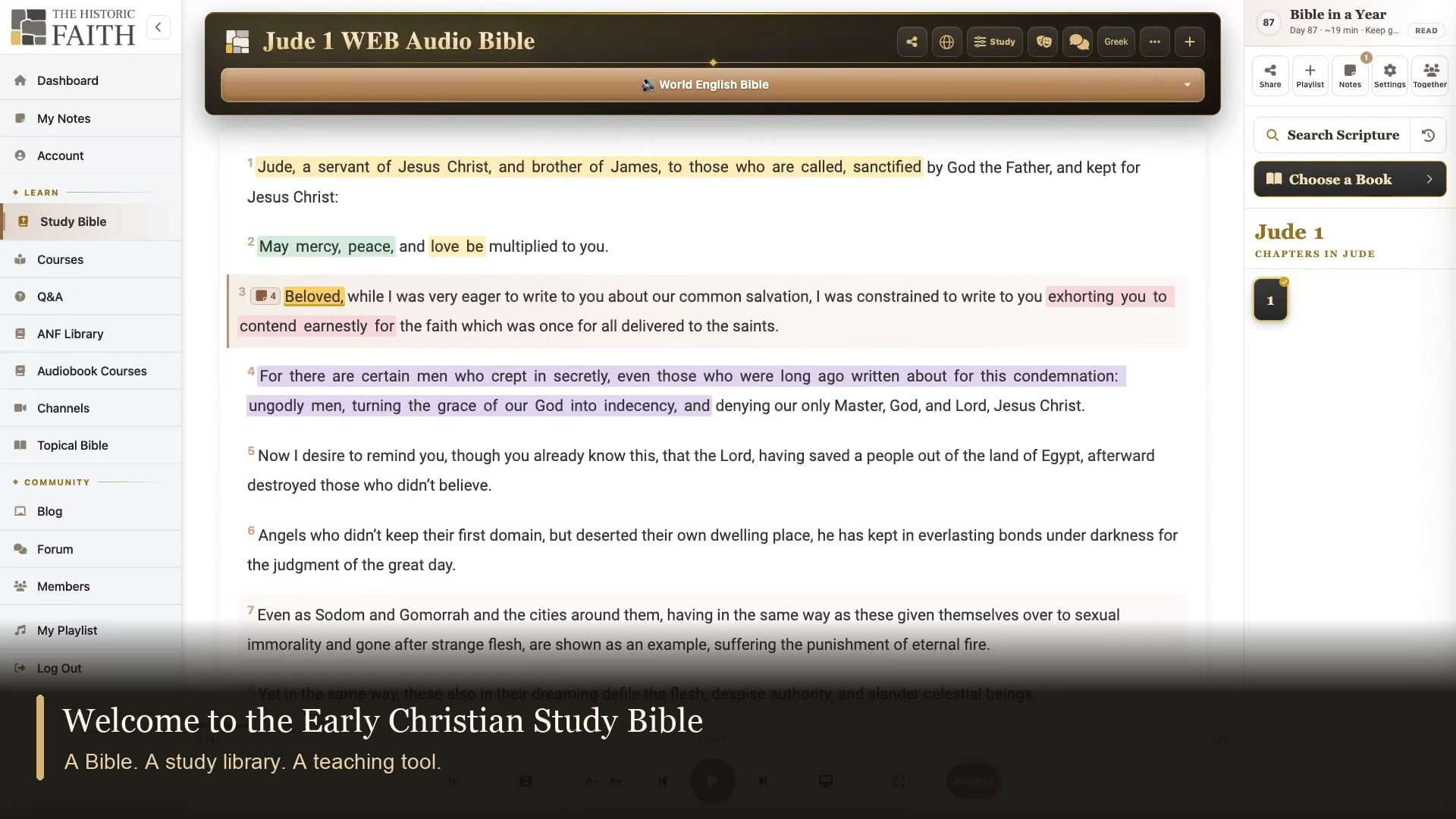 Words. Writings.
Guided tour · 21:50 · Several Bible editions.
See the phone experience · 5:31
Strong's Exhaustive Concordance, first published by James Strong in 1890, indexes every word of the King James Version and assigns each underlying original-language word a number — G1–G5624 for the Greek New Testament and H1–H8674 for the Hebrew Old Testament. Look up any English word, find its Strong's number, and see the Greek or Hebrew word behind it, its definition, and the verses where it occurs. This free online edition covers 14,298 entries with 767,764 indexed occurrences — including the Septuagint, deuterocanonical books, and 1 Enoch, which no print edition of Strong's includes.
These entry points are the quickest way to see how a Strong's number opens into a word, meaning, and Bible usage.
Greek agape, with New Testament and Septuagint usage links where indexed.
Greek kyrios, a major New Testament and Septuagint word-study bridge.
Hebrew reshith, the word behind “beginning” in Genesis 1:1 and other Old Testament usages.
Browse the local Greek and Hebrew Strong's entries in fast pages, open an exact number, or narrow the index by language, range, and usage count.
| Number | Word | Definition | Usages | Range |
|---|---|---|---|---|
|
H5027 — nabat
Hebrew
|
נָבַט (nabat)
nabat
|
nabat (naw-bat') n/p. 1. to scan, i.e. look intently at 2. (by implication) to regard with pleasure, favor or care | 67 | H5001-H6000 |
|
H5028 — Nbat
Hebrew
|
נְבָט (Nbat)
Nbat
|
Nbat (neb-awt') n/p. 1. regard 2. Nebat, the father of Jeroboam I | 25 | H5001-H6000 |
|
H5029 — nbiy'
Hebrew
|
נְבִיא (nbiy')
nbiy'
|
nbiy' (neb-ee') n-m. 1. a prophet [(Aramaic) corresponding to H5030] | 3 | H5001-H6000 |
|
H5030 — nabiy'
Hebrew
|
נָבִיא (nabiy')
nabiy'
|
nabiy' (naw-bee') n-m. 1. a prophet 2. (generally) inspired man | 287 | H5001-H6000 |
|
H5031 — nbiy'ah
Hebrew
|
נְבִיאָה (nbiy'ah)
nbiy'ah
|
nbiy'ah (neb-ee-yaw') n-f. 1. a prophetess 2. (generally) inspired woman | 6 | H5001-H6000 |
|
H5032 — Nbayowth
Hebrew
|
נְבָיוֹת נֶבָיוֹת (Nbayowth)
Nbayowth
|
Nbayowth (neb-aw-yoth') (or Nbayoth {neb-aw-yoth'}) n/p. 1. fruitfulnesses 2. Nebajoth, a son of Ismael, and the country settled by him | 5 | H5001-H6000 |
|
H5033 — nebek
Hebrew
|
נֵבֶך (nebek)
nebek
|
nebek (nay'-bek) n-m. 1. a fountain [from an unused root meaning to burst forth] | 1 | H5001-H6000 |
|
H5034 — nabel
Hebrew
|
נָבֵל (nabel)
nabel
|
nabel (naw-bale') v. 1. to wilt 2. (generally) to fall away, fail, faint | 21 | H5001-H6000 |
|
H5035 — nebel
Hebrew
|
נֶבֶל נֵבֶל (nebel)
nebel
|
nebel (neh'-bel) (or nebel {nay'-bel}) n-m. 1. a skin-bag for liquids (from collapsing when empty) 2. (hence) a vase (as similar in shape when full) | 37 | H5001-H6000 |
|
H5036 — nabal
Hebrew
|
נָבָל (nabal)
nabal
|
nabal (naw-bawl') adj. 1. stupid 2. wicked (especially impious) | 18 | H5001-H6000 |
|
H5037 — Nabal
Hebrew
|
נָבָל (Nabal)
Nabal
|
Nabal (naw-bawl') n/p. 1. dolt 2. Nabal, an Israelite | 18 | H5001-H6000 |
|
H5038 — nbelah
Hebrew
|
נְבֵלָה (nbelah)
nbelah
|
nbelah (neb-ay-law') n-f. 1. a flabby thing, i.e. a carcass or carrion (human or bestial, often collectively) 2. (figuratively) an idol | 41 | H5001-H6000 |
|
H5039 — nbalah
Hebrew
|
נְבָלָה (nbalah)
nbalah
|
nbalah (neb-aw-law') n-f. 1. foolishness, i.e. (morally) wickedness 2. concretely, a crime | 13 | H5001-H6000 |
|
H5040 — nabluwth
Hebrew
|
נַבלוּת (nabluwth)
nabluwth
|
nabluwth (nab-looth') n-f. 1. (properly) disgrace, i.e. the (female) pudenda [from H5036] | 1 | H5001-H6000 |
|
H5041 — Nballat
Hebrew
|
נְבַלָּט (Nballat)
Nballat
|
Nballat (neb-al-lawt') n/l. 1. foolish secrecy 2. Neballat, a place in Israel | 1 | H5001-H6000 |
|
H5042 — naba`
Hebrew
|
נָבַע (naba`)
naba`
|
naba` (naw-bah') v. 1. to gush forth 2. (figuratively) to utter (good or bad words) | 11 | H5001-H6000 |
|
H5043 — nebrsha'
Hebrew
|
נֶברְשָׁא (nebrsha')
nebrsha'
|
nebrsha' (neb-reh-shaw') n-f. 1. a light 2. plural (collectively) a chandelier | 1 | H5001-H6000 |
|
H5044 — Nibshan
Hebrew
|
נִבשָׁן (Nibshan)
Nibshan
|
Nibshan (nib-shawn') n/l. 1. Nibshan, a place in Israel [of uncertain derivation] | 1 | H5001-H6000 |
|
H5045 — negeb
Hebrew
|
נֶגֶב (negeb)
negeb
|
negeb (neh'-gheb) n-m. 1. the south (from its drought) 2. specifically, the Negeb or southern district of Judah, occasionally, Egypt (as south to Israel) | 98 | H5001-H6000 |
|
H5046
Hebrew
|
הִגִּ֣יד
|
nagad (naw-gad') v. 1. (properly) to front, i.e. stand boldly out opposite 2. (by implication) (causatively), to manifest | 343 | H5001-H6000 |
|
H5047 — ngad
Hebrew
|
נְגַד (ngad)
ngad
|
ngad (neg-ad') v. 1. to flow (through the idea of clearing the way) [(Aramaic) corresponding to H5046] | 1 | H5001-H6000 |
|
H5048 — neged
Hebrew
|
נֶגֶד (neged)
neged
|
neged (neh'-ghed) adj. 1. a front, i.e. part opposite 2. specifically a counterpart, or mate | 142 | H5001-H6000 |
|
H5049 — neged
Hebrew
|
נֶגֶד (neged)
neged
|
neged (neh'-ghed) prep. 1. opposite [(Aramaic) corresponding to H5048] | 1 | H5001-H6000 |
|
H5050 — nagahh
Hebrew
|
נָגַהּ (nagahh)
nagahh
|
nagahh (naw-gah') v. 1. to glitter 2. causatively, to illuminate | 6 | H5001-H6000 |
|
H5051 — nogahh
Hebrew
|
נוֹגַהּ (nogahh)
nogahh
|
nogahh (no'-gah) n-f. 1. brilliancy (literally or figuratively) [from H5050] | 19 | H5001-H6000 |
|
H5052 — Nogahh
Hebrew
|
נוֹגַהּ (Nogahh)
Nogahh
|
Nogahh (no'-gah) n/p. 1. Nogah, a son of David [the same as H5051] | 2 | H5001-H6000 |
|
H5053 — nogahh
Hebrew
|
נוֹגַהּ (nogahh)
nogahh
|
nogahh (no'-gah) n-f. 1. dawn [(Aramaic) corresponding to H5051] | 1 | H5001-H6000 |
|
H5054 — ngohah
Hebrew
|
נְגוֹהָה (ngohah)
ngohah
|
ngohah (neg-o-haw') n-f. 1. splendor [feminine of H5051] | 1 | H5001-H6000 |
|
H5055 — nagach
Hebrew
|
נָגַח (nagach)
nagach
|
nagach (naw-gakh') v. 1. to but with the horns 2. (figuratively) to war against | 10 | H5001-H6000 |
|
H5056 — naggach
Hebrew
|
נַגָּח (naggach)
naggach
|
naggach (nag-gawkh') adj. 1. butting, i.e. vicious [from H5055] | 2 | H5001-H6000 |
|
H5057 — nagiyd
Hebrew
|
נָגִידּ נָגִד (nagiyd)
nagiyd
|
nagiyd (naw-gheed') (or nagid {naw-gheed'}) n-m. 1. a commander (as occupying the front), either civil, military or religious 2. (generally, abstractly and plural), honorable themes | 44 | H5001-H6000 |
|
H5058 — ngiynah
Hebrew
|
נְגִינָה נְגִינַת (ngiynah)
ngiynah
|
ngiynah (neg-ee-naw') (or ngiynath (Psalm 61:title)) n-f. 1. (properly) instrumental music 2. (by implication) a stringed instrument | 7 | H5001-H6000 |
|
H5059 — nagan
Hebrew
|
נָגַן (nagan)
nagan
|
nagan (naw-gan') v. 1. (properly) to thrum, i.e. beat a tune with the fingers 2. (especially) to play on a stringed instrument | 12 | H5001-H6000 |
|
H5060 — naga`
Hebrew
|
נָגַע (naga`)
naga`
|
naga` (naw-gah') v. 1. (properly) to touch, i.e. lay the hand upon (for any purpose 2. (euphemism) to lie with a woman) | 142 | H5001-H6000 |
|
H5061 — nega`
Hebrew
|
נֶגַע (nega`)
nega`
|
nega` (neh'-gah) n-m. 1. a blow 2. (figuratively) an infliction | 62 | H5001-H6000 |
|
H5062 — nagaph
Hebrew
|
נָגַף (nagaph)
nagaph
|
nagaph (naw-gaf') v. 1. to push, gore, defeat, stub (the toe), inflict (a disease) [a primitive root] | 46 | H5001-H6000 |
|
H5063 — negeph
Hebrew
|
נֶגֶף (negeph)
negeph
|
negeph (neh'-ghef) n-m. 1. a trip (of the foot) 2. (figuratively) an infliction (of disease) | 7 | H5001-H6000 |
|
H5064 — nagar
Hebrew
|
נָגַר (nagar)
nagar
|
nagar (naw-gar') v. 1. to flow 2. (figuratively) to stretch out | 10 | H5001-H6000 |
|
H5065 — nagas
Hebrew
|
נָגַשׂ (nagas)
nagas
|
nagas (naw-gas') v. 1. to drive (an animal, a workman, a debtor, an army) 2. (by implication) to tax, harass, tyrannize | 23 | H5001-H6000 |
|
H5066 — nagash
Hebrew
|
נָגַשׁ (nagash)
nagash
|
nagash (naw-gash') v. 1. to be or come (causatively, bring) near (for any purpose) 2. euphemistically, to lie with a woman | 112 | H5001-H6000 |
|
H5067 — ned
Hebrew
|
נֵד (ned)
ned
|
ned (nade) n-m. 1. a mound, i.e. wave [from H5110 in the sense of piling up] | 6 | H5001-H6000 |
|
H5068 — nadab
Hebrew
|
נָדַב (nadab)
nadab
|
nadab (naw-dab') v. 1. to impel 2. (hence) to volunteer (as a soldier), to present spontaneously | 15 | H5001-H6000 |
|
H5069 — ndab
Hebrew
|
נְדַב (ndab)
ndab
|
ndab (ned-ab') v. 1. be (or give) liberal(-ly) [(Aramaic) corresponding to H5068] | 3 | H5001-H6000 |
|
H5070 — Nadab
Hebrew
|
נָדָב (Nadab)
Nadab
|
Nadab (naw-dawb') n/p. 1. liberal 2. Nadab, the name of four Israelites | 20 | H5001-H6000 |
|
H5071 — ndabah
Hebrew
|
נְדָבָה (ndabah)
ndabah
|
ndabah (ned-aw-baw') n-f. 1. (properly, abstractly) spontaneity 2. (adjectively) spontaneous | 25 | H5001-H6000 |
|
H5072 — Ndabyah
Hebrew
|
נְדַביָה (Ndabyah)
Ndabyah
|
Ndabyah (ned-ab-yaw') n/p. 1. largess of Jah 2. Nedabjah, an Israelite | 1 | H5001-H6000 |
|
H5073 — nidbak
Hebrew
|
נִדבָּך (nidbak)
nidbak
|
nidbak (nid-bawk') n-m. 1. a layer (of building materials) [(Aramaic) from a root meaning to stick] | 1 | H5001-H6000 |
|
H5074 — nadad
Hebrew
|
נָדַד (nadad)
nadad
|
nadad (naw-dad') v. 1. (properly) to wave to and fro (rarely to flap up and down) 2. (figuratively) to rove, flee, or (causatively) to drive away | 26 | H5001-H6000 |
|
H5075 — ndad
Hebrew
|
נְדַד (ndad)
ndad
|
ndad (ned-ad') v. 1. to depart [(Aramaic) corresponding to H5074] | 1 | H5001-H6000 |
|
H5076 — nadud
Hebrew
|
נָדוּד (nadud)
nadud
|
nadud (naw-dood') n-m. 1. (properly) tossed 2. abstractly, a rolling (on the bed) | 1 | H5001-H6000 |
|
H5077 — nadah
Hebrew
|
נָדָה נָדָא (nadah)
nadah
|
nadah (naw-daw') (or nada (2 Kings 17:21)) v. 1. (properly) to toss 2. (figuratively) to exclude, i.e. banish, postpone, prohibit | 3 | H5001-H6000 |
|
H5078 — nedeh
Hebrew
|
נֵדֶה (nedeh)
nedeh
|
nedeh (nay'-deh) n-m. 1. a bounty (for prostitution) [from H5077 in the sense of freely flinging money] | 1 | H5001-H6000 |
|
H5079 — niddah
Hebrew
|
נִדָּה (niddah)
niddah
|
niddah (nid-daw') n-f. 1. (properly) rejection 2. (by implication) impurity | 24 | H5001-H6000 |
|
H5080 — nadach
Hebrew
|
נָדַח (nadach)
nadach
|
nadach (naw-dakh') v. 1. to push off 2. used in a great variety of applications, literally and figuratively (to expel, mislead, strike, inflict, etc.) | 50 | H5001-H6000 |
|
H5081 — nadiyb
Hebrew
|
נָדִיבּ (nadiyb)
nadiyb
|
nadiyb (naw-deeb') adj. 1. (properly) voluntary, i.e. generous 2. (hence) magnanimous | 26 | H5001-H6000 |
|
H5082 — ndiybah
Hebrew
|
נְדִיבָּה (ndiybah)
ndiybah
|
ndiybah (ned-ee-baw') n-f. 1. (properly) nobility, i.e. reputation [feminine of H5081] | 1 | H5001-H6000 |
|
H5083 — nadan
Hebrew
|
נָדָן (nadan)
nadan
|
nadan (naw-dawn') n-m. 1. a present (for prostitution) [probably from an unused root meaning to give] | 1 | H5001-H6000 |
|
H5084 — nadan
Hebrew
|
נָדָן (nadan)
nadan
|
nadan (naw-dawn') n-m. 1. a sheath (of a sword) [of uncertain derivation] | 1 | H5001-H6000 |
|
H5085 — nidneh
Hebrew
|
נִדנֶה (nidneh)
nidneh
|
nidneh (nid-neh') n-m. 1. a sheath 2. (figuratively) the body (as the receptacle of the soul) | 1 | H5001-H6000 |
|
H5086 — nadaph
Hebrew
|
נָדַף (nadaph)
nadaph
|
nadaph (naw-daf') v. 1. to shove asunder, i.e. disperse [a primitive root] | 8 | H5001-H6000 |
|
H5087 — nadar
Hebrew
|
נָדַר (nadar)
nadar
|
nadar (naw-dar') v. 1. to promise (pos., to do or give something to God) [a primitive root] | 28 | H5001-H6000 |
|
H5088 — neder
Hebrew
|
נֶדֶר נֵדֶר (neder)
neder
|
neder (neh'-der) (or neder {nay'-der}) n-m. 1. a promise (to God) 2. (concretely) a thing promised | 57 | H5001-H6000 |
|
H5089 — noahh
Hebrew
|
נוַֹהּ (noahh)
noahh
|
noahh (no'-ah) n-m. 1. lamentation [from an unused root meaning to lament] | 1 | H5001-H6000 |
|
H5090 — nahag
Hebrew
|
נָהַג (nahag)
nahag
|
nahag (naw-hag') v. 1. to drive forth (a person, an animal or chariot), i.e. to lead, carry away 2. (reflexively) to proceed (i.e. to impel or guide oneself) | 31 | H5001-H6000 |
|
H5091 — nahah
Hebrew
|
נָהָה (nahah)
nahah
|
nahah (naw-haw') v. 1. to groan, i.e. bewail 2. hence (through the idea of crying aloud), to assemble (as if on proclamation) | 3 | H5001-H6000 |
|
H5092 — nhiy
Hebrew
|
נְהִי (nhiy)
nhiy
|
nhiy (neh-hee') n-m. 1. an elegy [from H5091] | 7 | H5001-H6000 |
|
H5093 — nihyah
Hebrew
|
נִהיָה (nihyah)
nihyah
|
nihyah (nih-yaw') n-f. 1. lamentation [feminine of H5092] | 1 | H5001-H6000 |
|
H5094 — nhiyr
Hebrew
|
נְהִיר נְהִירוּ (nhiyr)
nhiyr
|
nhiyr (neh-heere') ((Aramaic) or nehiyruw (Aramaic) {neh-hee-roo'}) n-m. 1. illumination, i.e. (figuratively) wisdom [from the same as H5105] | 3 | H5001-H6000 |
|
H5095 — nahal
Hebrew
|
נָהַל (nahal)
nahal
|
nahal (naw-hal') v. 1. (properly) to run with a sparkle, i.e. flow 2. hence (transitively), to conduct, and (by inference) to protect, sustain | 10 | H5001-H6000 |
|
H5096 — Nahalal
Hebrew
|
נַהֲלָל נַהֲלוֹל (Nahalal)
Nahalal
|
Nahalal (nah-hal-awl') (or Nahalol {nah-hal-ole'}) n/l. 1. Nahalal or Nahalol, a place in Israel [the same as H5097] | 3 | H5001-H6000 |
|
H5097 — nahalol
Hebrew
|
נַחֲלוֹל (nahalol)
nahalol
|
nahalol (nah-hal-ole') n-m. 1. pasture [from H5095] | 1 | H5001-H6000 |
|
H5098 — naham
Hebrew
|
נָהַם (naham)
naham
|
naham (naw-ham') v. 1. to growl [a primitive root] | 5 | H5001-H6000 |
|
H5099 — naham
Hebrew
|
נַהַם (naham)
naham
|
naham (nah'-ham) n-m. 1. a snarl [from H5098] | 2 | H5001-H6000 |
|
H5100 — nhamah
Hebrew
|
נְהָמָה (nhamah)
nhamah
|
nhamah (neh-haw-maw') n-f. 1. snarling [feminine of H5099] | 2 | H5001-H6000 |
|
H5101 — nahaq
Hebrew
|
נָהַק (nahaq)
nahaq
|
nahaq (naw-hak') v. 1. to bray (as an ass), scream (from hunger) [a primitive root] | 2 | H5001-H6000 |
|
H5102 — nahar
Hebrew
|
נָהַר (nahar)
nahar
|
nahar (naw-har') v. 1. to sparkle, i.e. (figuratively) be cheerful 2. hence (from the sheen of a running stream) to flow, i.e. (figuratively) assemble | 6 | H5001-H6000 |
|
H5103 — nhar
Hebrew
|
נְהַר (nhar)
nhar
|
nhar (neh-har') n-m. 1. a river, especially the Euphrates [(Aramaic) from a root corresponding to H5102] | 13 | H5001-H6000 |
|
H5104 — nahar
Hebrew
|
נָהָר (nahar)
nahar
|
nahar (naw-hawr') n-m. 1. a stream (including the sea 2. expec. the Nile, Euphrates, etc.) | 108 | H5001-H6000 |
|
H5105 — nharah
Hebrew
|
נְהָרָה (nharah)
nharah
|
nharah (neh-haw-raw') n-f. 1. daylight [from H5102 in its original sense] | 1 | H5001-H6000 |
|
H5106 — nuw'
Hebrew
|
נוּא (nuw')
nuw'
|
nuw' (noo) v. 1. to refuse, forbid, dissuade, or neutralize [a primitive root] | 7 | H5001-H6000 |
|
H5107 — nuwb
Hebrew
|
נוּב (nuwb)
nuwb
|
nuwb (noob) v. 1. to germinate 2. (figuratively) to flourish | 4 | H5001-H6000 |
|
H5108 — nowb
Hebrew
|
נוֹב נֵיבּ (nowb)
nowb
|
nowb (nobe) (or neyb {nabe}) n-m. 1. produce, literally or figuratively [from H5107] | 2 | H5001-H6000 |
|
H5109 — Nowbay
Hebrew
|
נוֹבַי (Nowbay)
Nowbay
|
Nowbay (no-bah'ee) n/p. 1. fruitful 2. Nobai, an Israelite | 1 | H5001-H6000 |
|
H5110 — nuwd
Hebrew
|
נוּד (nuwd)
nuwd
|
nuwd (nood) v. 1. to nod, i.e. waver 2. (figuratively) to wander, flee, disappear | 24 | H5001-H6000 |
|
H5111 — nuwd
Hebrew
|
נוּד (nuwd)
nuwd
|
nuwd (nood) v. 1. to flee [(Aramaic) corresponding to H5116] | 1 | H5001-H6000 |
|
H5112 — nowd
Hebrew
|
נוֹד נוֹד (nowd)
nowd
|
nowd (node) ((only defect. nod {node})) n-m. 1. exile [from H5110] | 1 | H5001-H6000 |
|
H5113 — Nowd
Hebrew
|
נוֹד (Nowd)
Nowd
|
Nowd (node) n/l. 1. vagrancy 2. Nod, the land of Cain | 1 | H5001-H6000 |
|
H5114 — Nowdab
Hebrew
|
נוֹדָב (Nowdab)
Nowdab
|
Nowdab (no-dawb') n/p. 1. noble 2. Nodab, an Arab tribe | 1 | H5001-H6000 |
|
H5115 — navah
Hebrew
|
נָוָה (navah)
navah
|
navah (naw-vaw') v. 1. to rest (as at home) 2. causatively (through the implied idea of beauty), to celebrate (with praises) | 2 | H5001-H6000 |
|
H5116 — naveh
Hebrew
|
נָוֶה נָוָה (naveh)
naveh
|
naveh (naw-veh') (or (feminine) navah {naw-vaw'}) adj. 1. (adjectively) at home 2. (by implication of satisfaction) lovely | 34 | H5001-H6000 |
|
H5117 — nuwach
Hebrew
|
נוַּח (nuwach)
nuwach
|
nuwach (noo'-akh) v. 1. to rest, i.e. settle down 2. used in a great variety of applications, literal and figurative, intransitive, transitive and causative (to dwell, stay, let fall, place, let alone, withdraw, give comfort, etc.) | 71 | H5001-H6000 |
|
H5118 — nuwach
Hebrew
|
נוַּח נוַֹח (nuwach)
nuwach
|
nuwach (noo'-akh) (or nowach {no'-akh}) n-m. 1. quiet [from H5117] | 2 | H5001-H6000 |
|
H5119 — Nowchah
Hebrew
|
נוֹחָה (Nowchah)
Nowchah
|
Nowchah (no-chaw') n/p. 1. quietude 2. Nochah, an Israelite | 1 | H5001-H6000 |
|
H5120 — nuwt
Hebrew
|
נוּט (nuwt)
nuwt
|
nuwt (noot) v. 1. be moved [to quake] | 1 | H5001-H6000 |
|
H5121 — Naviyth
Hebrew
|
נָוִיתּ (Naviyth)
Naviyth
|
Naviyth (naw-veeth') n/l. 1. residence 2. Navith, a place in Israel | 5 | H5001-H6000 |
|
H5122 — nvaluw
Hebrew
|
נְוָלוּ נְוָלִי (nvaluw)
nvaluw
|
nvaluw (nev-aw-loo') ((Aramaic) or nvaliy (Aramaic) {nev-aw-lee'}) n-f. 1. a sink [from an unused root probably meaning to be foul] | 3 | H5001-H6000 |
|
H5123 — nuwm
Hebrew
|
נוּם (nuwm)
nuwm
|
nuwm (noom) v. 1. to slumber (from drowsiness) [a primitive root] | 6 | H5001-H6000 |
|
H5124 — nuwmah
Hebrew
|
נוּמָה (nuwmah)
nuwmah
|
nuwmah (noo-maw') n-f. 1. sleepiness [from H5123] | 1 | H5001-H6000 |
|
H5125 — nuwn
Hebrew
|
נוּן (nuwn)
nuwn
|
nuwn (noon) v. 1. to resprout, i.e. propagate by shoots 2. (figuratively) to be perpetual | 1 | H5001-H6000 |
|
H5126 — Nuwn
Hebrew
|
נוּן נוֹן (Nuwn)
Nuwn
|
Nuwn (noon) (or Nown (1 Chronicles 7:27)) n/p. 1. perpetuity, Nun or Non, the father of Joshua [from H5125] | 30 | H5001-H6000 |
|
H5127 — nuwc
Hebrew
|
נוּס (nuwc)
nuwc
|
nuwc (noos) v. 1. to flit, i.e. vanish away (subside, escape 2. causatively, chase, impel, deliver) | 142 | H5001-H6000 |
|
H5128 — nuwa`
Hebrew
|
נוַּע (nuwa`)
nuwa`
|
nuwa` (noo'-ah) v. 1. to waver, in a great variety of applications, literally and figuratively (as subjoined) [a primitive root] | 36 | H5001-H6000 |
|
H5129 — Now`adyah
Hebrew
|
נוֹעַדיָה (Now`adyah)
Now`adyah
|
Now`adyah (no-ad-yaw') n/p. 1. convened of Jah 2. Noadjah, the name of an Israelite, and a false prophetess | 2 | H5001-H6000 |
|
H5130 — nuwph
Hebrew
|
נוּף (nuwph)
nuwph
|
nuwph (noof) v. 1. to quiver (i.e. vibrate up and down, or rock to and fro) 2. used in a great variety of applications (including sprinkling, beckoning, rubbing, bastinadoing, sawing, waving, etc.) | 35 | H5001-H6000 |
|
H5131 — nowph
Hebrew
|
נוֹף (nowph)
nowph
|
nowph (nofe) n-m. 1. elevation [from H5130] | 1 | H5001-H6000 |
|
H5132 — nuwts
Hebrew
|
נוּץ (nuwts)
nuwts
|
nuwts (noots) v. 1. (properly) to flash 2. (hence) to blossom (from the brilliancy of color) | 3 | H5001-H6000 |
|
H5133 — nowtsah
Hebrew
|
נוֹצָה נוֹצָה (nowtsah)
nowtsah
|
nowtsah (no-tsaw') (or notsah {no-tsaw'}) n-f. 1. a pinion (or wing feather) 2. often (collectively) plumage | 4 | H5001-H6000 |
|
H5134 — nuwq
Hebrew
|
נוּק (nuwq)
nuwq
|
nuwq (nook) v. 1. to suckle [a primitive root] | 1 | H5001-H6000 |
|
H5135 — nuwr
Hebrew
|
נוּר (nuwr)
nuwr
|
nuwr (noor) n-e. 1. fire [(Aramaic) from an unused root (corresponding to that of H5216) meaning to shine] | 14 | H5001-H6000 |
|
H5136 — nuwsh
Hebrew
|
נוּשׁ (nuwsh)
nuwsh
|
nuwsh (noosh) v. 1. to be sick, i.e. (figuratively) distressed [a primitive root] | 1 | H5001-H6000 |
|
H5137 — nazah
Hebrew
|
נָזָה (nazah)
nazah
|
nazah (naw-zaw') v. 1. to spirt, i.e. besprinkle (especially in expiation) [a primitive root] | 22 | H5001-H6000 |
|
H5138 — naziyd
Hebrew
|
נָזִידּ (naziyd)
naziyd
|
naziyd (naw-zeed') n-m. 1. something boiled, i.e. soup [from H2102] | 6 | H5001-H6000 |
|
H5139 — naziyr
Hebrew
|
נָזִיר נָזִר (naziyr)
naziyr
|
naziyr (naw-zeer') (or nazir {naw-zeer'}) n-m. 1. separate, i.e. consecrated (as prince, a Nazirite) 2. hence (figuratively from the latter) an unpruned vine (like an unshorn Nazirite) | 16 | H5001-H6000 |
|
H5140 — nazal
Hebrew
|
נָזַל (nazal)
nazal
|
nazal (naw-zal') v. 1. to drip, or shed by trickling [a primitive root] | 16 | H5001-H6000 |
|
H5141 — nexem
Hebrew
|
נֶזֶם (nexem)
nexem
|
nexem (neh'-zem) n-m. 1. a nose-ring [from an unused root of uncertain meaning] | 16 | H5001-H6000 |
|
H5142 — nzaq
Hebrew
|
נְזַק (nzaq)
nzaq
|
nzaq (nez-ak') v. 1. to suffer (causatively, inflict) loss [(Aramaic) corresponding to the root of H5143] | 4 | H5001-H6000 |
|
H5143 — nezeq
Hebrew
|
נֵזֶק (nezeq)
nezeq
|
nezeq (nay'zek) n-m. 1. loss [from an unused root meaning to injure] | 1 | H5001-H6000 |
|
H5144 — nazar
Hebrew
|
נָזַר (nazar)
nazar
|
nazar (naw-zar') v. 1. to hold aloof, i.e. (intransitivey) abstain (from food and drink, from impurity, and even from divine worship (i.e. apostatize)) 2. specifically, to set apart (to sacred purposes), i.e. devote | 10 | H5001-H6000 |
|
H5145 — nezer
Hebrew
|
נֶזֶר נֵזֶר (nezer)
nezer
|
nezer (neh'-zer) (or nezer {nay'-zer}) n-m. 1. (properly) something set apart 2. (abstractly) dedication (of a priet or Nazirite) | 22 | H5001-H6000 |
|
H5146 — Noach
Hebrew
|
נוַֹח (Noach)
Noach
|
Noach (no'-akh) n/p. 1. rest 2. Noach, the patriarch of the flood | 39 | H5001-H6000 |
|
H5147 — Nachbiy
Hebrew
|
נַחבִּי (Nachbiy)
Nachbiy
|
Nachbiy (nakh-bee') n/p. 1. occult 2. Nachbi, an Israelite | 1 | H5001-H6000 |
|
H5148 — nachah
Hebrew
|
נָחָה (nachah)
nachah
|
nachah (naw-khaw') v. 1. to guide 2. (by implication) to transport (into exile, or as colonists) | 39 | H5001-H6000 |
|
H5149 — Nchuwm
Hebrew
|
נְחוּם (Nchuwm)
Nchuwm
|
Nchuwm (neh-khoom') n/p. 1. comforted 2. Nechum, an Israelite | 1 | H5001-H6000 |
|
H5150 — nichuwm
Hebrew
|
נִחוּם נִחוּם (nichuwm)
nichuwm
|
nichuwm (nee-khoom') (or nichum {nee-khoom'}) n-m. 1. (properly) consoled 2. abstractly, solace | 3 | H5001-H6000 |
|
H5151 — Nachuwm
Hebrew
|
נַחוּם (Nachuwm)
Nachuwm
|
Nachuwm (nakh-oom') n/p. 1. comfortable 2. Nachum, an Israelite prophet | 1 | H5001-H6000 |
|
H5152 — Nachowr
Hebrew
|
נָחוֹר (Nachowr)
Nachowr
|
Nachowr (naw-khore') n/p. 1. snorer 2. Nochor, the name of the grandfather and a brother of Abraham | 17 | H5001-H6000 |
|
H5153 — nachuwsh
Hebrew
|
נָחוּשׁ (nachuwsh)
nachuwsh
|
nachuwsh (naw-khoosh') adj. 1. or from the red color of the throat of a serpent (H5175, as denominative) when hissing) 2. coppery, i.e. (figuratively) hard | 1 | H5001-H6000 |
|
H5154 — nchuwshah
Hebrew
|
נְחוּשָׁה נְחוּשָׁה (nchuwshah)
nchuwshah
|
nchuwshah (nekh-oo-shaw') (or nchushah {nekh-oo-shaw'}) n-f. 1. copper [feminine of H5153] | 10 | H5001-H6000 |
|
H5155 — nchiylah
Hebrew
|
נְחִילָה (nchiylah)
nchiylah
|
nchiylah (nekh-ee-law') n-f. 1. a flute [probably denominative from H2485] | 0 | H5001-H6000 |
|
H5156 — nchiyr
Hebrew
|
נְחִיר (nchiyr)
nchiyr
|
nchiyr (nekh-eer') n-m. 1. a nostril [from the same as H5170] | 1 | H5001-H6000 |
|
H5157 — nachal
Hebrew
|
נָחַל (nachal)
nachal
|
nachal (naw-khal') v. 1. to inherit (as a (figurative) mode of descent) 2. (generally) to occupy | 56 | H5001-H6000 |
|
H5158 — nachal
Hebrew
|
נַחַל נַחלָה נַחֲלָה (nachal)
nachal
|
nachal (nakh'-al) (or (feminine) nachlah (Psalm 124:4)) n-m. 1. a stream, especially a winter torrent 2. (by implication) a (narrow) valley (in which a brook runs) | 123 | H5001-H6000 |
|
H5159 — nachalah
Hebrew
|
נַחֲלָה (nachalah)
nachalah
|
nachalah (nakh-al-aw') n-f. 1. (properly) something inherited 2. (abstractly) occupancy | 191 | H5001-H6000 |
|
H5160 — Nachaliy'el
Hebrew
|
נַחֲלִיאֵל (Nachaliy'el)
Nachaliy'el
|
Nachaliy'el (nakh-al-ee-ale') n/l. 1. valley of God 2. Nachaliel, a place in the Desert | 1 | H5001-H6000 |
|
H5161 — Nechelamiy
Hebrew
|
נֶחֱלָמִי (Nechelamiy)
Nechelamiy
|
Nechelamiy (nekh-el-aw-mee') adj. 1. dreamed 2. a Nechelamite, or descendant of Nechlam | 3 | H5001-H6000 |
|
H5162 — nacham
Hebrew
|
נָחַם (nacham)
nacham
|
nacham (naw-kham') v. 1. (properly) to sigh, i.e. breathe strongly 2. (by implication) to be sorry | 100 | H5001-H6000 |
|
H5163 — Nacham
Hebrew
|
נַחַם (Nacham)
Nacham
|
Nacham (nakh'-am) n/p. 1. consolation 2. Nacham, an Israelite | 1 | H5001-H6000 |
|
H5164 — nocham
Hebrew
|
נוֹחַם (nocham)
nocham
|
nocham (no'-kham) n-m. 1. ruefulness, i.e. desistance [from H5162] | 1 | H5001-H6000 |
|
H5165 — nechamah
Hebrew
|
נֶחָמָה (nechamah)
nechamah
|
nechamah (nekh-aw-maw') n-f. 1. consolation [from H5162] | 2 | H5001-H6000 |
|
H5166 — Nchemyah
Hebrew
|
נְחֶמיָה (Nchemyah)
Nchemyah
|
Nchemyah (nekh-em-yaw') n/p. 1. consolation of Jah 2. Nechemjah, the name of three Israelites | 8 | H5001-H6000 |
|
H5167 — Nachamaniy
Hebrew
|
נַחֲמָנִי (Nachamaniy)
Nachamaniy
|
Nachamaniy (nakh-am-aw-nee') n/p. 1. consolatory 2. Nachamani, an Israelite | 1 | H5001-H6000 |
|
H5168 — nachnuw
Hebrew
|
נַחנוּ (nachnuw)
nachnuw
|
nachnuw (nakh-noo') p/p. 1. we [for H587] | 5 | H5001-H6000 |
|
H5169 — nachats
Hebrew
|
נָחַץ (nachats)
nachats
|
nachats (naw-khats') v. 1. to be urgent [a primitive root] | 1 | H5001-H6000 |
|
H5170 — nachar
Hebrew
|
נַחַר נַחֲרָה (nachar)
nachar
|
nachar (nakh'-ar) (and (feminine) nacharah {nakh-ar-aw'}) n-e. 1. a snorting [from an unused root meaning to snort or snore] | 2 | H5001-H6000 |
|
H5171 — Nacharay
Hebrew
|
נַחֲרַי נַחרַי (Nacharay)
Nacharay
|
Nacharay (nakh-ar-ah'-ee) (or Nachray {nakh-rah'-ee}) n/p. 1. snorer 2. Nacharai or Nachrai, an Israelite | 2 | H5001-H6000 |
|
H5172 — nachash
Hebrew
|
נָחַשׁ (nachash)
nachash
|
nachash (naw-khash') v. 1. (properly) to hiss, i.e. whisper a (magic) spell 2. (generally) to prognosticate | 9 | H5001-H6000 |
|
H5173 — nachash
Hebrew
|
נַחַשׁ (nachash)
nachash
|
nachash (nakh'-ash) n-m. 1. an incantation or augury [from H5172] | 2 | H5001-H6000 |
|
H5174 — nchash
Hebrew
|
נְחָשׁ (nchash)
nchash
|
nchash (nekh-awsh') n-m. 1. copper [(Aramaic) corresponding to H5154] | 9 | H5001-H6000 |
|
H5175 — nachash
Hebrew
|
נָחָשׁ (nachash)
nachash
|
nachash (naw-khawsh') n-m. 1. a snake (from its hiss) [from H5172] | 28 | H5001-H6000 |
|
H5176 — Nachash
Hebrew
|
נָחָשׁ (Nachash)
Nachash
|
Nachash (naw-khawsh') n/p. 1. Nachash, the name of two persons apparently non-Israelite [the same as H5175] | 8 | H5001-H6000 |
No Strong's entries match that search.
Strong's works best when the number, original word, verse, and corpus stay connected.
Open a chapter and move from a word token to its Strong's page, parsing, and linked occurrences.
Greek Strong's entries can include New Testament, Septuagint, deuterocanonical, and 1 Enoch rows where indexed.
Dedicated Strong's pages can expose approved pronunciation audio beside the word-study data.
These are common words readers run into repeatedly, shown with an English meaning so the list is readable without already knowing the original languages.
Look up a word study by its transliteration — these are frequently searched Hebrew and Greek words. Each opens the matching Strong's entry, or lists the options when a spelling maps to several words.