
G26 — Agape (Love)
Greek agape, with New Testament and Septuagint usage links where indexed.
The Early Christian Study Bible · Free to use
Study the word. Hear its pronunciation.
Search 14,298 Greek and Hebrew entries—free. Explore definitions, indexed occurrences, and pronunciation audio where available, then follow the words back into your Bible.
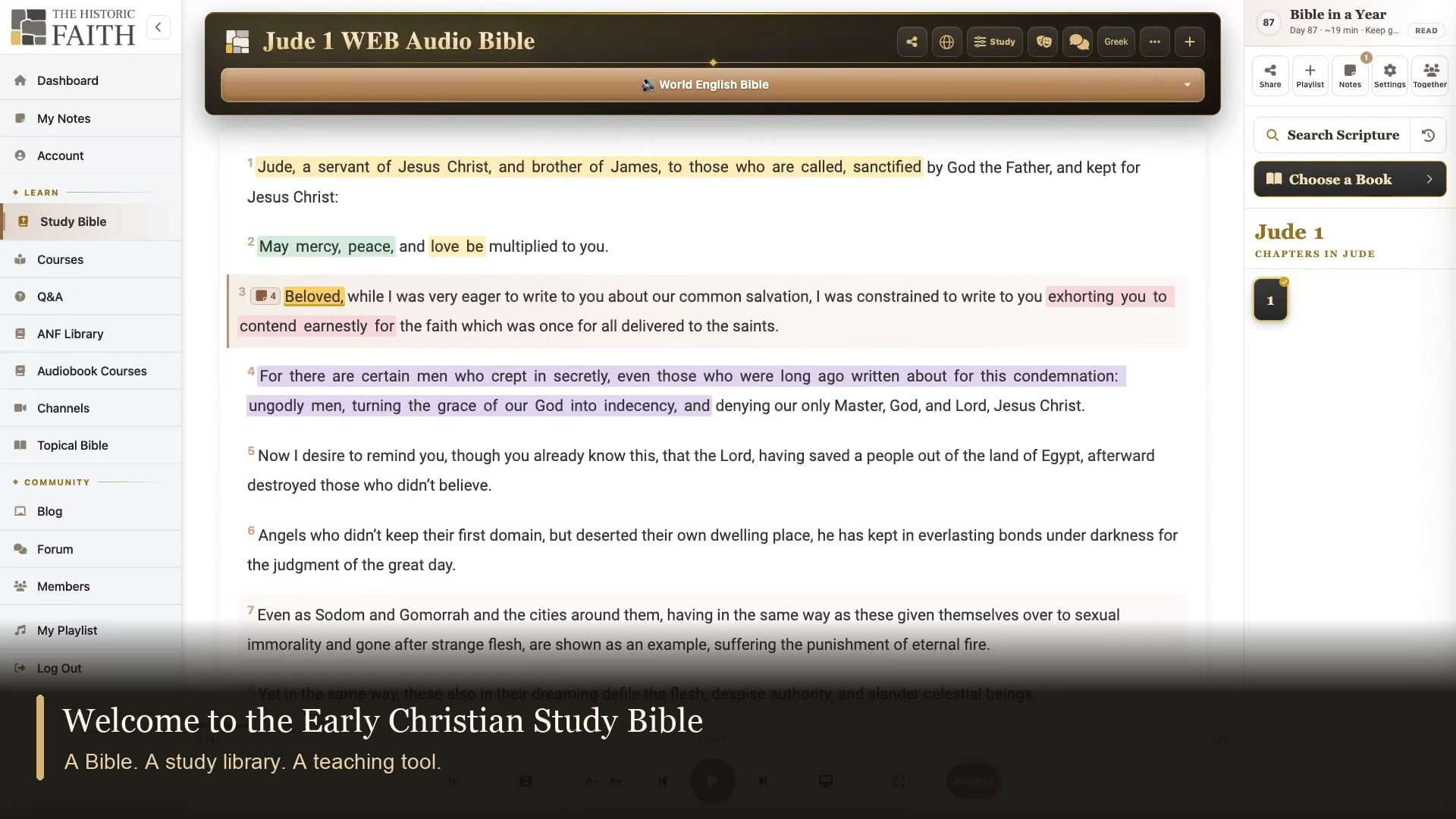
Click a word. Hear its pronunciation. Open the early Christian writings. Then see how to present and teach.
 Words. Writings.
Guided tour · 21:50 · Several Bible editions.
See the phone experience · 5:31
Strong's Exhaustive Concordance, first published by James Strong in 1890, indexes every word of the King James Version and assigns each underlying original-language word a number — G1–G5624 for the Greek New Testament and H1–H8674 for the Hebrew Old Testament. Look up any English word, find its Strong's number, and see the Greek or Hebrew word behind it, its definition, and the verses where it occurs. This free online edition covers 14,298 entries with 767,764 indexed occurrences — including the Septuagint, deuterocanonical books, and 1 Enoch, which no print edition of Strong's includes.
These entry points are the quickest way to see how a Strong's number opens into a word, meaning, and Bible usage.
Greek agape, with New Testament and Septuagint usage links where indexed.
Greek kyrios, a major New Testament and Septuagint word-study bridge.
Hebrew reshith, the word behind “beginning” in Genesis 1:1 and other Old Testament usages.
Browse the local Greek and Hebrew Strong's entries in fast pages, open an exact number, or narrow the index by language, range, and usage count.
| Number | Word | Definition | Usages | Range |
|---|---|---|---|---|
|
H4427 — malak
Hebrew
|
מָלַך (malak)
malak
|
malak (maw-lak') v. 1. to reign 2. (inceptively) to ascend the throne | 284 | H4001-H5000 |
|
H4428 — melek
Hebrew
|
מֶלֶך (melek)
melek
|
melek (meh'-lek) n-m. 1. a king [from H4427] | 1,920 | H4001-H5000 |
|
H4429 — Melek
Hebrew
|
מֶלֶך (Melek)
Melek
|
Melek (meh'-lek) n/p. 1. king 2. Melek, the name of two Israelites | 4 | H4001-H5000 |
|
H4430 — melek
Hebrew
|
מֶלֶך (melek)
melek
|
melek (meh'-lek) n-m. 1. a king [(Aramaic) corresponding to H4428] | 131 | H4001-H5000 |
|
H4431 — mlak
Hebrew
|
מְלַך (mlak)
mlak
|
mlak (mel-ak') n-m. 1. counsel [(Aramaic) from a root corresponding to H4427 in the sense of consultation] | 1 | H4001-H5000 |
|
H4432 — Molek
Hebrew
|
מוֹלֶך (Molek)
Molek
|
Molek (mo'-lek) n/p. 1. Molek (i.e. king), the chief deity of the Ammonites [from H4427] | 9 | H4001-H5000 |
|
H4433 — malka'
Hebrew
|
מַלכָּא (malka')
malka'
|
malka' (mal-kaw') n-f. 1. a queen [(Aramaic) corresponding to H4436] | 1 | H4001-H5000 |
|
H4434 — malkodeth
Hebrew
|
מַלכּוֹדֶת (malkodeth)
malkodeth
|
malkodeth (mal-ko'-deth) n-f. 1. a snare [from H3920] | 1 | H4001-H5000 |
|
H4435 — Milkah
Hebrew
|
מִלכָּה (Milkah)
Milkah
|
Milkah (mil-kaw') n/p. 1. queen 2. Milcah, the name of a Hebrewess and of an Israelite | 10 | H4001-H5000 |
|
H4436 — malkah
Hebrew
|
מַלכָּה (malkah)
malkah
|
malkah (mal-kaw') n-f. 1. a queen [feminine of H4428] | 34 | H4001-H5000 |
|
H4437 — malkuw
Hebrew
|
מַלכּוּ (malkuw)
malkuw
|
malkuw (mal-koo') n-f. 1. dominion {abstractly or concretely} | 43 | H4001-H5000 |
|
H4438 — malkuwth
Hebrew
|
מַלכּוּת מַלכּוּת מַלכּוּיָה (malkuwth)
malkuwth
|
malkuwth (mal-kooth') (or malkuth {mal-kooth'} or (in plural) malkuyah {mal-koo-yah'};) n-f. 1. a rule 2. (concretely) a dominion | 82 | H4001-H5000 |
|
H4439 — Malkiy'el
Hebrew
|
מַלכִּיאֵל (Malkiy'el)
Malkiy'el
|
Malkiy'el (mal-kee-ale') n/p. 1. king of (i.e. appointed by) God 2. Malkiel, an Israelite | 3 | H4001-H5000 |
|
H4440 — Malkiy'eliy
Hebrew
|
מַלכִּיאֵלִי (Malkiy'eliy)
Malkiy'eliy
|
Malkiy'eliy (mal-kee-ay-lee') adj. 1. a Malkielite or descendant of Malkiel [patronymical from H4439] | 1 | H4001-H5000 |
|
H4441 — Malkiyah
Hebrew
|
מַלכִּיָה מַלכִּיָהוּ (Malkiyah)
Malkiyah
|
Malkiyah (mal-kee-yaw') (or Malkiyahuw (Jer. 38)) n/p. 1. king of (i.e. appointed by) Jah 2. Malkijah, the name of ten Israelites | 15 | H4001-H5000 |
|
H4442 — Malkiy-Tsedeq
Hebrew
|
מַלכִּי ־ צֶּדֶק (Malkiy-Tsedeq)
Malkiy-Tsedeq
|
Malkiy-Tsedeq (mal-kee-tseh'-dek) n/p. 1. king of right 2. Malki-Tsedek, an early king in Israel | 2 | H4001-H5000 |
|
H4443 — Malkiyram
Hebrew
|
מַלכִּירָם (Malkiyram)
Malkiyram
|
Malkiyram (mal-kee-rawm') n/p. 1. king of a high one (i.e. of exaltation) 2. Malkiram, an Israelite | 1 | H4001-H5000 |
|
H4444 — Malkiyshuwa`
Hebrew
|
מַלכִּישׁוַּע (Malkiyshuwa`)
Malkiyshuwa`
|
Malkiyshuwa` (mal-kee-shoo'-ah) n/p. 1. king of wealth 2. Malkishua, an Israelite | 5 | H4001-H5000 |
|
H4445 — Malkam
Hebrew
|
מַלכָּם מִלכּוֹם (Malkam)
Malkam
|
Malkam (mal-kawm') (or Milkowm {mil-kome'}) n/p. 1. Malcam or Milcom, the national idol of the Ammonites [from H4428 for H4432] | 5 | H4001-H5000 |
|
H4446 — mleketh
Hebrew
|
מְלֶכֶת (mleketh)
mleketh
|
mleketh (mel-eh'-keth) n-f. 1. a queen [from H4427] | 5 | H4001-H5000 |
|
H4447 — Moleketh
Hebrew
|
מוֹלֶכֶת (Moleketh)
Moleketh
|
Moleketh (mo-leh'-keth) n/p. 1. queen 2. Moleketh, an Israelitess | 1 | H4001-H5000 |
|
H4448 — malal
Hebrew
|
מָלַל (malal)
malal
|
malal (maw-lal') v. 1. to speak (mostly poetical) or say [a primitive root] | 5 | H4001-H5000 |
|
H4449 — mlal
Hebrew
|
מְלַל (mlal)
mlal
|
mlal (mel-al') v. 1. to speak [(Aramaic) corresponding to H4448] | 5 | H4001-H5000 |
|
H4450 — Milalay
Hebrew
|
מִלֲלַי (Milalay)
Milalay
|
Milalay (mee-lal-ah'-ee) n/p. 1. talkative 2. Milalai, an Israelite | 1 | H4001-H5000 |
|
H4451 — malmad
Hebrew
|
מַלמָד (malmad)
malmad
|
malmad (mal-mawd') n-m. 1. a goad for oxen [from H3925] | 1 | H4001-H5000 |
|
H4452 — malats
Hebrew
|
מָלַץ (malats)
malats
|
malats (maw-lats') v. 1. to be smooth, i.e. (figuratively) pleasant [a primitive root] | 1 | H4001-H5000 |
|
H4453 — meltsar
Hebrew
|
מֶלצָּר (meltsar)
meltsar
|
meltsar (mel-tsawr') n-m. 1. the butler or other officer in the Babylonian court [of Persian derivation] | 2 | H4001-H5000 |
|
H4454 — malaq
Hebrew
|
מָלַק (malaq)
malaq
|
malaq (maw-lak') v. 1. to crack a joint 2. (by implication) to wring the neck of a fowl (without separating it) | 2 | H4001-H5000 |
|
H4455 — malqowach
Hebrew
|
מַלקוַֹח (malqowach)
malqowach
|
malqowach (mal-ko'-akh) n-m. 1. transitively (in dual) the jaws (as taking food) 2. intransitively, spoil (and captives) (as taken) | 8 | H4001-H5000 |
|
H4456 — malqowsh
Hebrew
|
מַלקוֹשׁ (malqowsh)
malqowsh
|
malqowsh (mal-koshe') n-m. 1. the spring rain 2. (figuratively) eloquence | 8 | H4001-H5000 |
|
H4457 — melqach
Hebrew
|
מֶלקָח מַלקָח (melqach)
melqach
|
melqach (mel-kawkh') (or malqach {mal-kawkh'}) n-m. 1. (only in dual) tweezers [from H3947] | 6 | H4001-H5000 |
|
H4458 — meltachah
Hebrew
|
מֶלתָּחָה (meltachah)
meltachah
|
meltachah (mel-taw-khaw') n-f. 1. a wardrobe (i.e. room where clothing is spread) [from an unused root meaning to spread out] | 1 | H4001-H5000 |
|
H4459 — malta`ah
Hebrew
|
מַלתָּעָה (malta`ah)
malta`ah
|
malta`ah (mal-taw-aw') n-f. 1. a grinder, i.e. back tooth [transp. for H4973] | 1 | H4001-H5000 |
|
H4460 — mammgurah
Hebrew
|
מַמְּגוּרָה (mammgurah)
mammgurah
|
mammgurah (mam-meg-oo-raw') n-f. 1. a granary [from H4048 (in the sense of depositing)] | 1 | H4001-H5000 |
|
H4461 — memad
Hebrew
|
מֵמַד (memad)
memad
|
memad (may-mad') n-m. 1. a measure [from H4058] | 1 | H4001-H5000 |
|
H4462 — Mmuwkan
Hebrew
|
מְמוּכָן מוֹמוּכָן (Mmuwkan)
Mmuwkan
|
Mmuwkan (mem-oo-kawn') (or (transp.) Mowmukan (Esther 1:16)) n/p. 1. Memucan or Momucan, a Persian satrap [of Persian derivation] | 3 | H4001-H5000 |
|
H4463 — mamowth
Hebrew
|
מָמוֹת (mamowth)
mamowth
|
mamowth (maw-mothe') n-m. 1. a mortal disease 2. (concretely) a corpse | 2 | H4001-H5000 |
|
H4464 — mamzer
Hebrew
|
מַמזֵר (mamzer)
mamzer
|
mamzer (mam-zare') n-m. 1. a mongrel, i.e. born of a Jewish father and a heathen mother [from an unused root meaning to alienate] | 2 | H4001-H5000 |
|
H4465 — mimkar
Hebrew
|
מִמכָּר (mimkar)
mimkar
|
mimkar (mim-kawr') n-m. 1. merchandise 2. abstractly, a selling | 10 | H4001-H5000 |
|
H4466 — mimkereth
Hebrew
|
מִמכֶּרֶת (mimkereth)
mimkereth
|
mimkereth (mim-keh'-reth) n-f. 1. a sale [feminine of H4465] | 1 | H4001-H5000 |
|
H4467
Hebrew
|
מַמְלַכְתּוֹ֙
|
mamlakah (mam-law-kaw') n-f. 1. dominion 2. (abstractly) the estate (rule) | 113 | H4001-H5000 |
|
H4468 — mamlakuwth
Hebrew
|
מַמלָכוּת (mamlakuwth)
mamlakuwth
|
mamlakuwth (mam-law-kooth') n-m. 1. kingdom, reign [a form of H4467 and equiv. to it] | 9 | H4001-H5000 |
|
H4469 — mamcak
Hebrew
|
מַמסָך (mamcak)
mamcak
|
mamcak (mam-sawk') n-m. 1. mixture, i.e. (specifically) wine mixed (with water or spices) [from H4537] | 2 | H4001-H5000 |
|
H4470 — memer
Hebrew
|
מֶמֶר (memer)
memer
|
memer (meh'-mer) n-m. 1. sorrow [from an unused root meaning to grieve] | 1 | H4001-H5000 |
|
H4471 — Mamre'
Hebrew
|
מַמרֵא (Mamre')
Mamre'
|
Mamre' (mam-ray') n/l. 1. lusty 2. Mamre, an Amorite | 10 | H4001-H5000 |
|
H4472 — mamror
Hebrew
|
מַמרוֹר (mamror)
mamror
|
mamror (mam-rore') n-m. 1. a bitterness, i.e. (figuratively) calamity [from H4843] | 1 | H4001-H5000 |
|
H4473 — mimshach
Hebrew
|
מִמשַׁח (mimshach)
mimshach
|
mimshach (mim-shakh') n-m. 1. outspread (i.e. with outstretched wings) [from H4886, in the sense of expansion] | 1 | H4001-H5000 |
|
H4474 — mimshal
Hebrew
|
מִמשָׁל (mimshal)
mimshal
|
mimshal (mim-shawl') n-m. 1. a ruler or (abstractly) rule [from H4910] | 3 | H4001-H5000 |
|
H4475 — memshalah
Hebrew
|
מֶמשָׁלָה (memshalah)
memshalah
|
memshalah (mem-shaw-law') n-f. 1. rule 2. (concretely, in plural) a realm or a ruler | 16 | H4001-H5000 |
|
H4476 — mimshaq
Hebrew
|
מִמשָׁק (mimshaq)
mimshaq
|
mimshaq (mim-shawk') n-m. 1. a possession [from the same as H4943] | 1 | H4001-H5000 |
|
H4477 — mamtaq
Hebrew
|
מַמתַּק (mamtaq)
mamtaq
|
mamtaq (mam-tak') n-m. 1. something sweet (literally or figuratively) [from H4985] | 2 | H4001-H5000 |
|
H4478 — man
Hebrew
|
מָן (man)
man
|
man (mawn) n-m. 1. (literally) a whatness (so to speak), i.e. manna (so called from the question about it) [from H4100] | 12 | H4001-H5000 |
|
H4479 — man
Hebrew
|
מָן (man)
man
|
man (mawn) p/i. 1. who or what (properly, interrogatively, hence, also indefinitely and relatively) [(Aramaic) from H4101] | 10 | H4001-H5000 |
|
H4480 — min
Hebrew
|
מִן מִנִּי מִנֵּי (min)
min
|
min (min) (or minniy {min-nee'} or minney (constructive plural) {min-nay'}; (Isaiah 30:11)) prep. 1. (properly) a part of 2. (hence, prepositionally) from or out of (in many senses) | 1,093 | H4001-H5000 |
|
H4481 — min
Hebrew
|
מִן (min)
min
|
min (min) prep. 1. according, after, + because, + before, by, for, from, X him, X more than, (out) of, part, since, X these, to, upon, + when [(Aramaic) corresponding to H4480] | 83 | H4001-H5000 |
|
H4482 — men
Hebrew
|
מֵן (men)
men
|
men (mane) n-m. 1. a part 2. (hence) a musical chord (as parted into strings) | 2 | H4001-H5000 |
|
H4483 — mna'
Hebrew
|
מְנָא מְנָה (mna')
mna'
|
mna' (men-aw') ((Aramaic) or mnah (Aramaic) {men-aw'}) v. 1. to count, appoint [corresponding to H4487] | 5 | H4001-H5000 |
|
H4484 — mene'
Hebrew
|
מְנֵא (mene')
mene'
|
mene' (men-ay') n-m. 1. numbered [(Aramaic) passive participle of H4483] | 2 | H4001-H5000 |
|
H4485 — mangiynah
Hebrew
|
מַנגִּינָה (mangiynah)
mangiynah
|
mangiynah (man-ghee-naw') n-f. 1. a satire [from H5059] | 1 | H4001-H5000 |
|
H4486 — manda`
Hebrew
|
מַנדַּע (manda`)
manda`
|
manda` (man-dah') n-m. 1. wisdom or intelligence [(Aramaic) corresponding to H4093] | 4 | H4001-H5000 |
|
H4487 — manah
Hebrew
|
מָנָה (manah)
manah
|
manah (maw-naw') v. 1. (properly) to weigh out 2. (by implication) to allot or constitute officially | 27 | H4001-H5000 |
|
H4488 — maneh
Hebrew
|
מָנֶה (maneh)
maneh
|
maneh (maw-neh') n-m. 1. (properly) a fixed weight or measured amount, i.e. (techn.) a maneh or mina [from H4487] | 5 | H4001-H5000 |
|
H4489 — moneh
Hebrew
|
מוֹנֶה (moneh)
moneh
|
moneh (mo-neh') n-m. 1. (properly) something weighed out, i.e. (figuratively) a portion of time, i.e. an instance [from H4487] | 2 | H4001-H5000 |
|
H4490 — manah
Hebrew
|
מָנָה (manah)
manah
|
manah (maw-naw') n-f. 1. (properly) something weighed out 2. (generally) a division | 14 | H4001-H5000 |
|
H4491 — minhag
Hebrew
|
מִנהָג (minhag)
minhag
|
minhag (min-hawg') n-m. 1. the driving (of a chariot) [from H5090] | 1 | H4001-H5000 |
|
H4492 — minharah
Hebrew
|
מִנהָרָה (minharah)
minharah
|
minharah (min-haw-raw') n-f. 1. (properly) a channel or fissure 2. (by implication) a cavern | 1 | H4001-H5000 |
|
H4493 — manowd
Hebrew
|
מָנוֹד (manowd)
manowd
|
manowd (maw-node') n-m. 1. shaking [from H5110 a nodding or toss (of the head in derision)] | 1 | H4001-H5000 |
|
H4494 — manowach
Hebrew
|
מָנוַֹח (manowach)
manowach
|
manowach (maw-no'-akh) n-m. 1. quiet 2. (concretely) a settled spot | 7 | H4001-H5000 |
|
H4495 — Manowach
Hebrew
|
מָנוַֹח (Manowach)
Manowach
|
Manowach (maw-no'-akh) n/p. 1. rest 2. Manoach, an Israelite | 14 | H4001-H5000 |
|
H4496 — mnuwchah
Hebrew
|
מְנוּחָה מְנוּחָה (mnuwchah)
mnuwchah
|
mnuwchah (men-oo-khaw') (or mnuchah {men-oo-khaw'}) n-f. 1. repose 2. (adverbially) peacefully | 21 | H4001-H5000 |
|
H4497 — manown
Hebrew
|
מָנוֹן (manown)
manown
|
manown (maw-nohn') n-m. 1. a continuator, i.e. heir [from H5125] | 1 | H4001-H5000 |
|
H4498 — manowc
Hebrew
|
מָנוֹס (manowc)
manowc
|
manowc (maw-noce') n-m. 1. a retreat (literally or figuratively) 2. abstractly, a fleeing | 8 | H4001-H5000 |
|
H4499 — mnuwcah
Hebrew
|
מְנוּסָה מְנוּסָה (mnuwcah)
mnuwcah
|
mnuwcah (men-oo-saw') (or mnucah {men-oo-saw'}) n-f. 1. retreat [feminine of H4498] | 2 | H4001-H5000 |
|
H4500 — manowr
Hebrew
|
מָנוֹר (manowr)
manowr
|
manowr (maw-nore') n-m. 1. a yoke (properly, for plowing), i.e. the frame of a loom [from H5214] | 4 | H4001-H5000 |
|
H4501 — mnowrah
Hebrew
|
מְנוֹרָה מְנוֹרָה (mnowrah)
mnowrah
|
mnowrah (men-o-raw') (or mnorah {men-o-raw'}) n-f. 1. a chandelier [feminine of H4500 (in the original sense of H5216)] | 31 | H4001-H5000 |
|
H4502 — minnzar
Hebrew
|
מִנְּזָר (minnzar)
minnzar
|
minnzar (min-ez-awr') n-m. 1. a prince [from H5144] | 1 | H4001-H5000 |
|
H4503 — minchah
Hebrew
|
מִנחָה (minchah)
minchah
|
minchah (min-khaw') n-f. 1. a donation 2. euphemistically, tribute | 194 | H4001-H5000 |
|
H4504 — minchah
Hebrew
|
מִנחָה (minchah)
minchah
|
minchah (min-khaw') n-f. 1. a sacrificial offering [(Aramaic) corresponding to H4503] | 2 | H4001-H5000 |
|
H4505 — Mnachem
Hebrew
|
מְנַחֵם (Mnachem)
Mnachem
|
Mnachem (men-akh-ame') n/p. 1. comforter 2. Menachem, an Israelite | 8 | H4001-H5000 |
|
H4506 — Manachath
Hebrew
|
מָנַחַת (Manachath)
Manachath
|
Manachath (maw-nakh'-ath) n/l. 1. rest 2. Manachath, the name of an Edomite and of a place in Moab | 3 | H4001-H5000 |
|
H4507 — Mniy
Hebrew
|
מְנִי (Mniy)
Mniy
|
Mniy (men-ee') n/p. 1. the Apportioner, i.e. Fate (as an idol) [from H4487] | 1 | H4001-H5000 |
|
H4508 — Minniy
Hebrew
|
מִנִּי (Minniy)
Minniy
|
Minniy (min-nee') n/l. 1. Minni, an Armenian province [of foreign derivation] | 1 | H4001-H5000 |
|
H4509 — Minyamiyn
Hebrew
|
מִניָמִין (Minyamiyn)
Minyamiyn
|
Minyamiyn (min-yaw-meen') n/p. 1. from (the) right hand 2. Minjamin, the name of two Israelites | 3 | H4001-H5000 |
|
H4510 — minyan
Hebrew
|
מִניָן (minyan)
minyan
|
minyan (min-yawn') n-m. 1. enumeration [(Aramaic) from H4483] | 1 | H4001-H5000 |
|
H4511 — Minniyth
Hebrew
|
מִנִּיתּ (Minniyth)
Minniyth
|
Minniyth (min-neeth') n/l. 1. enumeration 2. Minnith, a place East of the Jordan | 2 | H4001-H5000 |
|
H4512 — minleh
Hebrew
|
מִנלֶה (minleh)
minleh
|
minleh (min-leh') n-m. 1. completion, i.e. (in produce) wealth [from H5239] | 1 | H4001-H5000 |
|
H4513 — mana`
Hebrew
|
מָנַע (mana`)
mana`
|
mana` (maw-nah') v. 1. to debar (negatively or positively) from benefit or injury [a primitive root] | 29 | H4001-H5000 |
|
H4514 — man`uwl
Hebrew
|
מַנעוּל מַנעוּל (man`uwl)
man`uwl
|
man`uwl (man-ool') (or maniul {man-ool'}) n-m. 1. a bolt [from H5274] | 6 | H4001-H5000 |
|
H4515 — man`al
Hebrew
|
מַנעָל (man`al)
man`al
|
man`al (man-awl') n-m. 1. a bolt [from H5274] | 1 | H4001-H5000 |
|
H4516 — man`am
Hebrew
|
מַנעַם (man`am)
man`am
|
man`am (man-am') n-m. 1. a delicacy [from H5276] | 1 | H4001-H5000 |
|
H4517 — mna`na`
Hebrew
|
מְנַענַע (mna`na`)
mna`na`
|
mna`na` (men-ah-ah') n-m. 1. a sistrum (so called from its rattling sound) [from H5128] | 1 | H4001-H5000 |
|
H4518 — mnaqqiyth
Hebrew
|
מְנַקִּיתּ (mnaqqiyth)
mnaqqiyth
|
mnaqqiyth (men-ak-keeth') n-f. 1. a sacrificial basin (for holding blood) [from H5352] | 4 | H4001-H5000 |
|
H4519 — Mnashsheh
Hebrew
|
מְנַשֶּׁה (Mnashsheh)
Mnashsheh
|
Mnashsheh (men-ash-sheh') n/p. 1. causing to forget 2. Menashsheh, a grandson of Jacob, also the tribe descended from him, and its territory | 133 | H4001-H5000 |
|
H4520 — Mnashshiy
Hebrew
|
מְנַשִּׁי (Mnashshiy)
Mnashshiy
|
Mnashshiy (men-ash-shee') adj. 1. a Menashshite or descendant of Menashsheh [from H4519] | 4 | H4001-H5000 |
|
H4521 — mnath
Hebrew
|
מְנָת (mnath)
mnath
|
mnath (men-awth') n-f. 1. an allotment (by courtesy, law or providence) [from H4487] | 7 | H4001-H5000 |
|
H4522 — mac
Hebrew
|
מַס מִס (mac)
mac
|
mac (mas) (or mic {mees}) n-m. 1. (properly) a burden (as causing to faint), i.e. a tax in the form of forced labor [from H4549] | 22 | H4001-H5000 |
|
H4523 — mac
Hebrew
|
מָס (mac)
mac
|
mac (mawce) adj. 1. fainting, i.e. (figuratively) disconsolate [from H4549] | 1 | H4001-H5000 |
|
H4524 — mecab
Hebrew
|
מֵסַב מֶסִבִּים מֶסִבּוֹת (mecab)
mecab
|
mecab (may-sab') (plural masculine mcibbiym {mes-ib-beem'} or feminine mcibbowth {mes-ib-bohth'};) n-m. 1. a divan (as enclosing the room) 2. abstractly (adverbial) around | 5 | H4001-H5000 |
|
H4525 — macger
Hebrew
|
מַסגֵּר (macger)
macger
|
macger (mas-gare') n-m. 1. a fastener, i.e. (of a person) a smith, (of a thing) a prison [from H5462] | 7 | H4001-H5000 |
|
H4526 — micgereth
Hebrew
|
מִסגֶּרֶת (micgereth)
micgereth
|
micgereth (mis-gheh'-reth) n-f. 1. something enclosing, i.e. a margin (of a region, of a panel) 2. (concretely) a stronghold | 14 | H4001-H5000 |
|
H4527 — maccad
Hebrew
|
מַסַּד (maccad)
maccad
|
maccad (mas-sad') n-m. 1. a foundation [from H3245] | 1 | H4001-H5000 |
|
H4528 — micdrown
Hebrew
|
מִסדְּרוֹן (micdrown)
micdrown
|
micdrown (mis-der-ohn') n-m. 1. a colonnade or internal portico (from its rows of pillars) [from the same as H5468] | 1 | H4001-H5000 |
|
H4529 — macah
Hebrew
|
מָסָה (macah)
macah
|
macah (maw-saw') v. 1. to dissolve [a primitive root] | 4 | H4001-H5000 |
|
H4530 — miccah
Hebrew
|
מִסָּה (miccah)
miccah
|
miccah (mis-saw') n-f. 1. abundance 2. (adverbially) liberally | 1 | H4001-H5000 |
|
H4531 — maccah
Hebrew
|
מַסָּה (maccah)
maccah
|
maccah (mas-saw') n-f. 1. a testing, of men (judicial) or of God (querulous) [from H5254] | 5 | H4001-H5000 |
|
H4532 — Maccah
Hebrew
|
מַסָּה (Maccah)
Maccah
|
Maccah (mas-saw') n/l. 1. Massah, a place in the Desert [the same as H4531] | 4 | H4001-H5000 |
|
H4533 — macveh
Hebrew
|
מַסוֶה (macveh)
macveh
|
macveh (mas-veh') n-m. 1. a veil [apparently from an unused root meaning to cover] | 3 | H4001-H5000 |
|
H4534 — mcuwkah
Hebrew
|
מְסוּכָה (mcuwkah)
mcuwkah
|
mcuwkah (mes-oo-kaw') n-f. 1. a hedge [for H4881] | 1 | H4001-H5000 |
|
H4535 — maccach
Hebrew
|
מַסָּח (maccach)
maccach
|
maccach (mas-sawkh') adv. 1. a cordon, (adverbially) or (as a) military barrier [from H5255 in the sense of staving off] | 1 | H4001-H5000 |
|
H4536 — micchar
Hebrew
|
מִסחָר (micchar)
micchar
|
micchar (mis-khawr') n-m. 1. trade [from H5503] | 1 | H4001-H5000 |
|
H4537 — macak
Hebrew
|
מָסַך (macak)
macak
|
macak (maw-sak') v. 1. to mix, especially wine (with spices) [a primitive root] | 5 | H4001-H5000 |
|
H4538 — mecek
Hebrew
|
מֶסֶך (mecek)
mecek
|
mecek (meh'-sek) n-m. 1. a mixture, i.e. of wine with spices [from H4537] | 1 | H4001-H5000 |
|
H4539 — macak
Hebrew
|
מָסָך (macak)
macak
|
macak (maw-sawk') n-m. 1. a cover, i.e. veil [from H5526] | 25 | H4001-H5000 |
|
H4540 — mcukkah
Hebrew
|
מְסוּכָּה (mcukkah)
mcukkah
|
mcukkah (mes-ook-kaw') n-f. 1. a covering, i.e. garniture [from H5526] | 1 | H4001-H5000 |
|
H4541 — maccekah
Hebrew
|
מַסֵּכָה (maccekah)
maccekah
|
maccekah (mas-say-kaw') n-f. 1. (properly) a pouring over, i.e. fusion of metal (especially a cast image) 2. (by implication) a libation, i.e. league | 28 | H4001-H5000 |
|
H4542 — micken
Hebrew
|
מִסכֵּן (micken)
micken
|
micken (mis-kane') adj. 1. indigent [from H5531] | 3 | H4001-H5000 |
|
H4543 — micknah
Hebrew
|
מִסכְּנָה (micknah)
micknah
|
micknah (mis-ken-aw') n-f. 1. a storehouse [by transp. from H3664] | 7 | H4001-H5000 |
|
H4544 — mickenuth
Hebrew
|
מִסכֵּנוּת (mickenuth)
mickenuth
|
mickenuth (mis-kay-nooth') n-f. 1. indigence [from H4542] | 1 | H4001-H5000 |
|
H4545 — macceketh
Hebrew
|
מַסֶּכֶת (macceketh)
macceketh
|
macceketh (mas-seh'-keth) n-f. 1. something expanded, i.e. the warp in a loom (as stretched out to receive the woof) [from H5259 in the sense of spreading out] | 2 | H4001-H5000 |
|
H4546 — mcillah
Hebrew
|
מְסִלָּה (mcillah)
mcillah
|
mcillah (mes-il-law') n-f. 1. a thoroughfare (as turnpiked), literally or figuratively 2. specifically a viaduct, a staircase | 26 | H4001-H5000 |
|
H4547 — macluwl
Hebrew
|
מַסלוּל (macluwl)
macluwl
|
macluwl (mas-lool') n-m. 1. a thoroughfare (as turnpiked) [from H5549] | 1 | H4001-H5000 |
|
H4548 — macmer
Hebrew
|
מַסמֵר מִסמֵר מַסמְרָה מִסמְרָה (macmer)
macmer
|
macmer (mas-mare') (or micmer {mis-mare'} also (feminine) macmrah {mas-mer-aw'}; or micmrah {mis-mer-aw'}; or even masmrah (Ecclesiastes 12:11)) n-f. 1. a peg (as bristling from the surface) [from H5568] | 4 | H4001-H5000 |
|
H4549 — macac
Hebrew
|
מָסַס (macac)
macac
|
macac (maw-sas') v. 1. to liquefy 2. (figuratively) to waste (with disease), to faint (with fatigue, fear or grief) | 20 | H4001-H5000 |
|
H4550 — macca`
Hebrew
|
מַסַּע (macca`)
macca`
|
macca` (mas-sah') n-m. 1. a departure (from striking the tents), i.e. march (not necessarily a single day's travel) 2. (by implication) a station (or point of departure) | 11 | H4001-H5000 |
|
H4551 — macca`
Hebrew
|
מַסָּע (macca`)
macca`
|
macca` (mas-saw') n-m. 1. a missile (spear or arrow) 2. also a quarry (whence stones are, as it were, ejected) | 2 | H4001-H5000 |
|
H4552 — mic`ad
Hebrew
|
מִסעָד (mic`ad)
mic`ad
|
mic`ad (mis-awd') n-m. 1. a balustrade (for stairs) [' from H5582] | 1 | H4001-H5000 |
|
H4553 — micepd
Hebrew
|
מִספֵּד (micepd)
micepd
|
micepd (mis-pade') n-m. 1. a lamentation [from H5594] | 13 | H4001-H5000 |
|
H4554 — micpow'
Hebrew
|
מִספּוֹא (micpow')
micpow'
|
micpow' (mis-po') n-m. 1. fodder [from an unused root meaning to collect] | 5 | H4001-H5000 |
|
H4555 — micpachah
Hebrew
|
מִספָּחָה (micpachah)
micpachah
|
micpachah (mis-paw-khaw') n-f. 1. a veil (as spread out) [from H5596] | 2 | H4001-H5000 |
|
H4556 — micpachath
Hebrew
|
מִספַּחַת (micpachath)
micpachath
|
micpachath (mis-pakh'-ath) n-f. 1. scruf (as spreading over the surface) [from H5596] | 3 | H4001-H5000 |
|
H4557 — micpar
Hebrew
|
מִספָּר (micpar)
micpar
|
micpar (mis-pawr') n-m. 1. a number 2. (definite) arithmetical number | 129 | H4001-H5000 |
|
H4558 — Micpar
Hebrew
|
מִספָּר (Micpar)
Micpar
|
Micpar (mis-pawr') n/p. 1. number 2. Mispar, an Israelite | 1 | H4001-H5000 |
|
H4559 — Micpereth
Hebrew
|
מִספֶּרֶת (Micpereth)
Micpereth
|
Micpereth (mis-peh'-reth) n/p. 1. enumeration 2. Mispereth, an Israelite | 1 | H4001-H5000 |
|
H4560 — macar
Hebrew
|
מָסַר (macar)
macar
|
macar (maw-sar') v. 1. to sunder, i.e. (transitively) set apart, or (reflex.) apostatize [a primitive root] | 2 | H4001-H5000 |
|
H4561 — mocar
Hebrew
|
מוֹסָר (mocar)
mocar
|
mocar (mo-sawr') n-m. 1. admonition [from H3256] | 1 | H4001-H5000 |
|
H4562 — macoreth
Hebrew
|
מָסוֹרֶת (macoreth)
macoreth
|
macoreth (maw-so'-reth) n-f. 1. a band [from H631] | 1 | H4001-H5000 |
|
H4563 — mictowr
Hebrew
|
מִסתּוֹר (mictowr)
mictowr
|
mictowr (mis-tore') n-m. 1. a refuge [from H5641] | 1 | H4001-H5000 |
|
H4564 — macter
Hebrew
|
מַסתֵּר (macter)
macter
|
macter (mas-tare') n-m. 1. (properly) a hider, i.e. (abstractly) a hiding, i.e. aversion [from H5641] | 1 | H4001-H5000 |
|
H4565 — mictar
Hebrew
|
מִסתָּר (mictar)
mictar
|
mictar (mis-tawr') n-m. 1. (properly) a concealer, i.e. a covert [from H5641] | 10 | H4001-H5000 |
|
H4566 — ma`bad
Hebrew
|
מַעבָּד (ma`bad)
ma`bad
|
ma`bad (mah-bawd') n-m. 1. an act [from H5647] | 1 | H4001-H5000 |
|
H4567 — ma`bad
Hebrew
|
מַעבָּד (ma`bad)
ma`bad
|
ma`bad (mah-bawd') n-m. 1. an act [(Aramaic) corresponding to H4566] | 1 | H4001-H5000 |
|
H4568 — ma`abeh
Hebrew
|
מַעֲבֶה (ma`abeh)
ma`abeh
|
ma`abeh (mah-ab-eh') n-m. 1. (properly) compact (part of soil), i.e. loam [from H5666] | 1 | H4001-H5000 |
|
H4569 — ma`abar
Hebrew
|
מַעֲבָר מַעֲבָרָה (ma`abar)
ma`abar
|
ma`abar (mah-ab-awr') (or feminine mapabarah {mah-ab-aw-raw'}) n-m. 1. a crossing-place (of a river, a ford 2. of a mountain, a pass) | 11 | H4001-H5000 |
|
H4570 — ma`gal
Hebrew
|
מַעגָּל מַעגָּלָה (ma`gal)
ma`gal
|
ma`gal (mah-gawl') (or feminine mapgalah {mah-gaw-law'}) n-m. 1. a track (literally or figuratively) 2. also a rampart (as circular) | 16 | H4001-H5000 |
|
H4571 — ma`ad
Hebrew
|
מָעַד (ma`ad)
ma`ad
|
ma`ad (maw-ad') v. 1. to waver [a primitive root] | 6 | H4001-H5000 |
|
H4572 — Ma`aday
Hebrew
|
מַעֲדַי (Ma`aday)
Ma`aday
|
Ma`aday (mah-ad-ah'-ee) n/p. 1. ornamental 2. Maadai, an Israelite | 1 | H4001-H5000 |
|
H4573 — Ma`adyah
Hebrew
|
מַעַדיָה (Ma`adyah)
Ma`adyah
|
Ma`adyah (mah-ad-yaw') n/p. 1. ornament of Jah 2. Maadjah, an Israelite | 1 | H4001-H5000 |
|
H4574 — ma`adan
Hebrew
|
מַעֲדָן מַעֲדַנָּה (ma`adan)
ma`adan
|
ma`adan (mah-ad-awn') (or (feminine) maadannah {mah-ad-an-naw'}) n-m. 1. a delicacy or (abstractly) pleasure (adverbially, cheerfully) [from H5727] | 4 | H4001-H5000 |
|
H4575 — ma`adannah
Hebrew
|
מַעֲדַנָּה (ma`adannah)
ma`adannah
|
ma`adannah (mah-ad-an-naw') n-f. 1. a bond, i.e. group [by transitive from H6029] | 1 | H4001-H5000 |
|
H4576 — ma`der
Hebrew
|
מַעדֵּר (ma`der)
ma`der
|
ma`der (mah-dare') n-m. 1. a (weeding) hoe [from H5737] | 1 | H4001-H5000 |
No Strong's entries match that search.
Strong's works best when the number, original word, verse, and corpus stay connected.
Open a chapter and move from a word token to its Strong's page, parsing, and linked occurrences.
Greek Strong's entries can include New Testament, Septuagint, deuterocanonical, and 1 Enoch rows where indexed.
Dedicated Strong's pages can expose approved pronunciation audio beside the word-study data.
These are common words readers run into repeatedly, shown with an English meaning so the list is readable without already knowing the original languages.
Look up a word study by its transliteration — these are frequently searched Hebrew and Greek words. Each opens the matching Strong's entry, or lists the options when a spelling maps to several words.