
G26 — Agape (Love)
Greek agape, with New Testament and Septuagint usage links where indexed.
The Early Christian Study Bible · Free to use
Study the word. Hear its pronunciation.
Search 14,298 Greek and Hebrew entries—free. Explore definitions, indexed occurrences, and pronunciation audio where available, then follow the words back into your Bible.
Click a word. Hear its pronunciation. Open the early Christian writings. Then see how to present and teach.
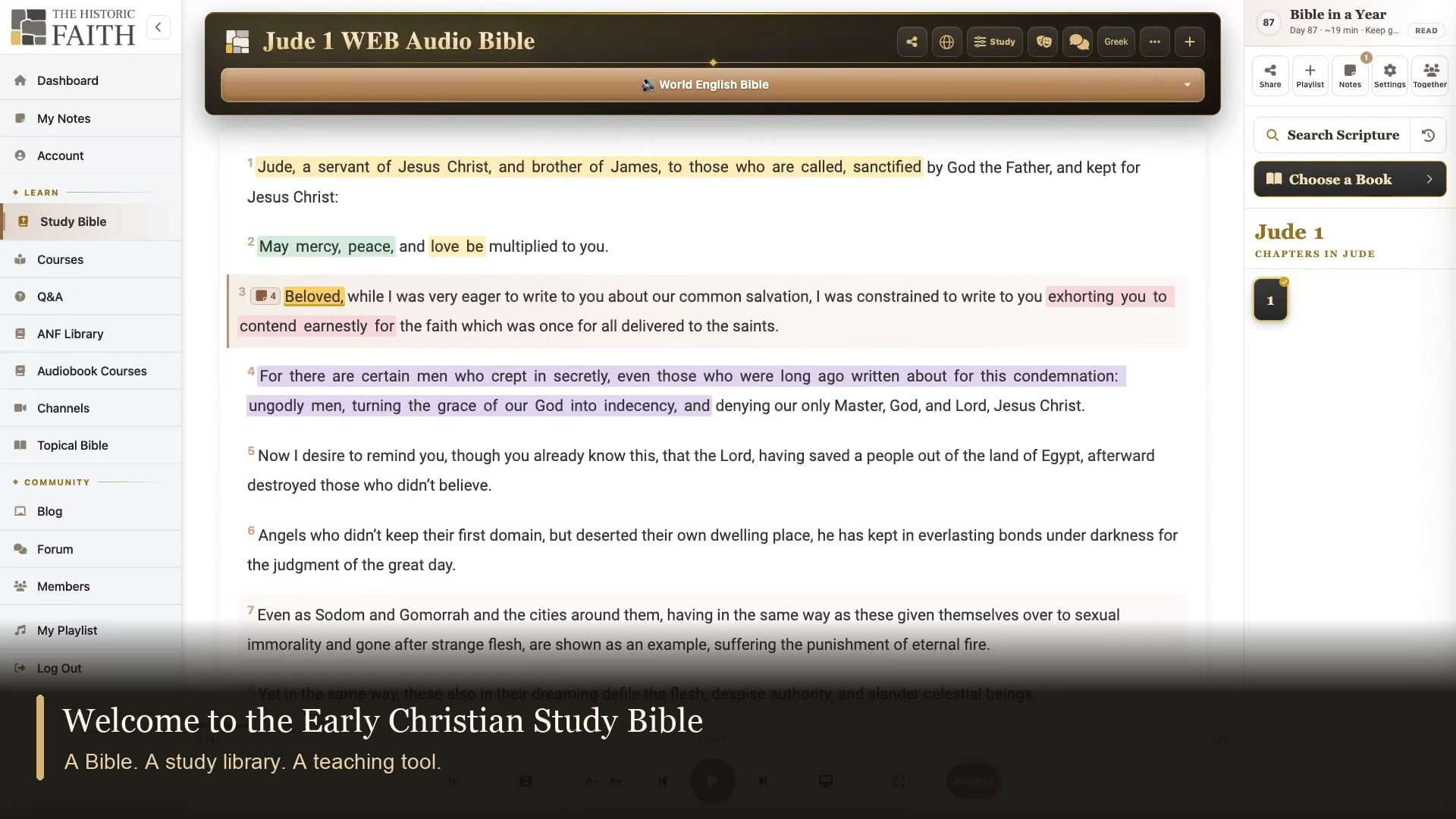 Words. Writings.
Guided tour · 21:50 · Several Bible editions.
See the phone experience · 5:31
Strong's Exhaustive Concordance, first published by James Strong in 1890, indexes every word of the King James Version and assigns each underlying original-language word a number — G1–G5624 for the Greek New Testament and H1–H8674 for the Hebrew Old Testament. Look up any English word, find its Strong's number, and see the Greek or Hebrew word behind it, its definition, and the verses where it occurs. This free online edition covers 14,298 entries with 767,764 indexed occurrences — including the Septuagint, deuterocanonical books, and 1 Enoch, which no print edition of Strong's includes.
These entry points are the quickest way to see how a Strong's number opens into a word, meaning, and Bible usage.
Greek agape, with New Testament and Septuagint usage links where indexed.
Greek kyrios, a major New Testament and Septuagint word-study bridge.
Hebrew reshith, the word behind “beginning” in Genesis 1:1 and other Old Testament usages.
Browse the local Greek and Hebrew Strong's entries in fast pages, open an exact number, or narrow the index by language, range, and usage count.
| Number | Word | Definition | Usages | Range |
|---|---|---|---|---|
|
H3827 — labbah
Hebrew
|
לַבָּה (labbah)
labbah
|
labbah (lab-baw') n-f. 1. flame [for H3852] | 1 | H3001-H4000 |
|
H3828 — lbownah
Hebrew
|
לְבוֹנָה לֶבוֹנָה (lbownah)
lbownah
|
lbownah (leb-o-naw') (or lbonah {leb-o-naw'};) n-f. 1. frankincense (from its whiteness or perhaps that of its smoke) [from H3836] | 21 | H3001-H4000 |
|
H3829 — Lbownah
Hebrew
|
לְבוֹנָה (Lbownah)
Lbownah
|
Lbownah (leb-o-naw') n/l. 1. Lebonah, a place in Israel [the same as H3828] | 1 | H3001-H4000 |
|
H3830 — lbuwsh
Hebrew
|
לְבוּשׁ לְבוּשׁ (lbuwsh)
lbuwsh
|
lbuwsh (leb-oosh') (or lbush {leb-oosh'}) n-m. 1. a garment (literally or figuratively) 2. (by implication) (euphem.) a wife | 32 | H3001-H4000 |
|
H3831 — lbuwsh
Hebrew
|
לְבוּשׁ (lbuwsh)
lbuwsh
|
lbuwsh (leb-oosh') n-m. 1. garment [(Aramaic) corresponding to H3830] | 2 | H3001-H4000 |
|
H3832 — labat
Hebrew
|
לָבַט (labat)
labat
|
labat (law-bat') v. 1. to overthrow 2. intransposed, to fall | 3 | H3001-H4000 |
|
H3833 — labiy'
Hebrew
|
לָבִיא לְבִיָא לְבָאִים לְבָאוֹת (labiy')
labiy'
|
labiy' (law-bee') (or (Ezekiel 19:2)) n-f. 1. a lion (properly, a lioness as the fiercer (although not a roarer)) [from an unused root men. to roar] | 14 | H3001-H4000 |
|
H3834 — labiybah
Hebrew
|
לָבִיבָּה לְבִבָה (labiybah)
labiybah
|
labiybah (law-bee-baw') (or rather lbibah {leb-ee-baw'}) n-f. 1. a cake (either as fried or turned) [from H3823 in its original sense of fatness (or perhaps of folding)] | 3 | H3001-H4000 |
|
H3835 — laban
Hebrew
|
לָבַן (laban)
laban
|
laban (law-ban') v. 1. to be (or become) white 2. (as denominative from H3843) to make bricks | 8 | H3001-H4000 |
|
H3836 — laban
Hebrew
|
לָבָן לָבֵן (laban)
laban
|
laban (law-bawn') (or (Genesis 49:12)) adj. 1. white [from H3835] | 24 | H3001-H4000 |
|
H3837 — Laban
Hebrew
|
לָבָן (Laban)
Laban
|
Laban (law-bawn') n/l. 1. Laban, a Mesopotamian 2. also a place in the Desert | 47 | H3001-H4000 |
|
H3838 — Lbana'
Hebrew
|
לְבָנָא לֶבָנָה (Lbana')
Lbana'
|
Lbana' (leb-aw-naw') (or Lbanah {leb-aw-naw'}) n/p. 1. Lebana or Lebanah, one of the Nethinim [the same as H3842] | 2 | H3001-H4000 |
|
H3839 — libneh
Hebrew
|
לִבנֶה (libneh)
libneh
|
libneh (lib-neh') n-m. 1. some sort of whitish tree, perhaps the storax [from H3835] | 2 | H3001-H4000 |
|
H3840 — libnah
Hebrew
|
לִבנָה (libnah)
libnah
|
libnah (lib-naw') n-f. 1. (properly) whiteness 2. (by implication) transparency | 1 | H3001-H4000 |
|
H3841 — Libnah
Hebrew
|
לִבנָה (Libnah)
Libnah
|
Libnah (lib-naw') n/l. 1. Libnah, a place in the Desert and one in Israel [the same as H3839] | 17 | H3001-H4000 |
|
H3842 — lbanah
Hebrew
|
לְבָנָה (lbanah)
lbanah
|
lbanah (leb-aw-naw') n-f. 1. (properly) (the) white, i.e. the moon [from H3835] | 3 | H3001-H4000 |
|
H3843 — lbenah
Hebrew
|
לְבֵנָה (lbenah)
lbenah
|
lbenah (leb-ay-naw') n-f. 1. a brick (from the whiteness of the clay) [from H3835] | 10 | H3001-H4000 |
|
H3844 — Lbanown
Hebrew
|
לְבָנוֹן (Lbanown)
Lbanown
|
Lbanown (leb-aw-nohn') n/l. 1. (the) white mountain (from its snow) 2. Lebanon, a mountain range in Israel | 64 | H3001-H4000 |
|
H3845 — Libniy
Hebrew
|
לִבנִי (Libniy)
Libniy
|
Libniy (lib-nee') n/p. 1. white 2. Libni, an Israelite | 5 | H3001-H4000 |
|
H3846 — Libniy
Hebrew
|
לִבנִי (Libniy)
Libniy
|
Libniy (lib-nee') adj. 1. a Libnite or descendants of Libni (collectively) [patronymically from H3845] | 2 | H3001-H4000 |
|
H3847 — labash
Hebrew
|
לָבַשׁ לָבֵשׁ (labash)
labash
|
labash (law-bash') (or labesh {law-bashe'}) v. 1. (properly) wrap around 2. (by implication) to put on a garment or clothe (oneself, or another), literally or figuratively | 103 | H3001-H4000 |
|
H3848 — lbash
Hebrew
|
לְבַשׁ (lbash)
lbash
|
lbash (leb-ash') v. 1. clothe [(Aramaic) corresponding to H3847] | 3 | H3001-H4000 |
|
H3849 — log
Hebrew
|
לוֹג (log)
log
|
log (lohg) n-m. 1. a log or measure for liquids [from an unused root apparently meaning to deepen or hollow (like H3537)] | 5 | H3001-H4000 |
|
H3850 — Lod
Hebrew
|
לוֹד (Lod)
Lod
|
Lod (lode) n/l. 1. Lod, a place in Israel [from an unused root of uncertain signification] | 4 | H3001-H4000 |
|
H3851 — lahab
Hebrew
|
לַהַב (lahab)
lahab
|
lahab (lah'-hab) n-m. 1. a flash 2. (figuratively) a sharply polished blade or point of a weapon | 10 | H3001-H4000 |
|
H3852 — lehabah
Hebrew
|
לֶהָבָה לַהֶבֶת (lehabah)
lehabah
|
lehabah (leh-aw-baw') (or lahebeth {lah-eh'-beth}) n-f. 1. meaning the same as H3851 [feminine of H3851] | 19 | H3001-H4000 |
|
H3853 — Lhabiym
Hebrew
|
לְהָבִים (Lhabiym)
Lhabiym
|
Lhabiym (leh-haw-beem') n-m. 1. flames 2. Lehabim, a son of Mizrain, and his descendants | 2 | H3001-H4000 |
|
H3854 — lahag
Hebrew
|
לַהַג (lahag)
lahag
|
lahag (lah'-hag) n-m. 1. intense mental application [from an unused root meaning to be eager] | 1 | H3001-H4000 |
|
H3855 — Lahad
Hebrew
|
לַהַד (Lahad)
Lahad
|
Lahad (lah'-had) n/p. 1. Lahad, an Israelite [from an unused root meaning to glow or else to be earnest] | 1 | H3001-H4000 |
|
H3856 — lahahh
Hebrew
|
לָהַהּ (lahahh)
lahahh
|
lahahh (law-hah') v. 1. (by implication) to be rabid 2. (figuratively) to be insane | 2 | H3001-H4000 |
|
H3857 — lahat
Hebrew
|
לָהַט (lahat)
lahat
|
lahat (law-hat') v. 1. (properly) to lick 2. (by implication) to blaze | 11 | H3001-H4000 |
|
H3858 — lahat
Hebrew
|
לַהַט (lahat)
lahat
|
lahat (lah'-hat) n-m. 1. a blaze 2. (from the idea of enwrapping) magic (as covert) | 2 | H3001-H4000 |
|
H3859 — laham
Hebrew
|
לָהַם (laham)
laham
|
laham (law-ham') v. 1. (properly) to burn in, i.e. (figuratively) to rankle [a primitive root] | 2 | H3001-H4000 |
|
H3860 — lahen
Hebrew
|
לָהֵן (lahen)
lahen
|
lahen (law-hane') conj. 1. popularly for if 2. (hence) therefore | 1 | H3001-H4000 |
|
H3861 — lawhen
Hebrew
|
לָהֵן (lawhen)
lawhen
|
lawhen (law-hane') conj. 1. therefore 2. also except | 11 | H3001-H4000 |
|
H3862 — lahaqah
Hebrew
|
לַהֲקָה (lahaqah)
lahaqah
|
lahaqah (lah-hak-aw') n-f. 1. an assembly [probably from an unused root meaning to gather] | 1 | H3001-H4000 |
|
H3863 — luw'
Hebrew
|
לוּא לוּא לוּ (luw')
luw'
|
luw' (loo) (or lu {loo} or luw {loo};) conj. 1. if 2. (by implication) (interj. as a wish) would that! | 21 | H3001-H4000 |
|
H3864 — Luwbiy
Hebrew
|
לוּבִי לוּבִּי (Luwbiy)
Luwbiy
|
Luwbiy (loo-bee') (or Lubbiy (Daniel 11:43)) n/g. 1. apparently a Libyan or inhabitant of interior Africa (only in plural) [partrial from a name probably derived from an unused root meaning to thirst, i.e. a dry region] | 4 | H3001-H4000 |
|
H3865 — Luwd
Hebrew
|
לוּד (Luwd)
Luwd
|
Luwd (lood) n/g. 1. Lud, the name of two nations [probably of foreign derivation] | 5 | H3001-H4000 |
|
H3866 — Luwdiy
Hebrew
|
לוּדִי לוּדִיִי (Luwdiy)
Luwdiy
|
Luwdiy (loo-dee') (or Luwdiyiy {loo-dee-ee'}) adj. 1. a Ludite or inhabitants of Lud (only in plural) [patrial from H3865] | 3 | H3001-H4000 |
|
H3867 — lavah
Hebrew
|
לָוָה (lavah)
lavah
|
lavah (law-vaw') v. 1. (properly) to twine 2. (by implication) to unite, to remain | 22 | H3001-H4000 |
|
H3868 — luwz
Hebrew
|
לוּז (luwz)
luwz
|
luwz (looz) v. 1. to turn aside, i.e. (literally) to depart, (figuratively) be perverse [a primitive root] | 6 | H3001-H4000 |
|
H3869 — luwz
Hebrew
|
לוּז (luwz)
luwz
|
luwz (looz) n-m. 1. some kind of nut-tree, perhaps the almond [probably of foreign origin] | 1 | H3001-H4000 |
|
H3870 — Luwz
Hebrew
|
לוּז (Luwz)
Luwz
|
Luwz (looz) n/l. 1. Luz, the name of two places in Israel [probably from H3869 (as growing there)] | 7 | H3001-H4000 |
|
H3871 — luwach
Hebrew
|
לוַּח לוַּח (luwach)
luwach
|
luwach (loo'-akh) (or luach {loo'-akh}) n-m. 1. probably meaning to glisten 2. a tablet (as polished), of stone, wood or metal | 33 | H3001-H4000 |
|
H3872 — Luwchiyth
Hebrew
|
לוּחִיתּ לוּחוֹת (Luwchiyth)
Luwchiyth
|
Luwchiyth (loo-kheeth') (or Luchowth (Jeremiah 48:5)) n/l. 1. floored 2. Luchith, a place East of the Jordan | 2 | H3001-H4000 |
|
H3873 — Lowchesh
Hebrew
|
לוֹחֵשׁ (Lowchesh)
Lowchesh
|
Lowchesh (lo-khashe') n/p. 1. (the) enchanter 2. Lochesh, an Israelite | 2 | H3001-H4000 |
|
H3874 — luwt
Hebrew
|
לוּט (luwt)
luwt
|
luwt (loot) v. 1. to wrap up [a primitive root] | 3 | H3001-H4000 |
|
H3875 — lowt
Hebrew
|
לוֹט (lowt)
lowt
|
lowt (lote) n-m. 1. a veil [from H3874] | 1 | H3001-H4000 |
|
H3876 — Lowt
Hebrew
|
לוֹט (Lowt)
Lowt
|
Lowt (lote) n/p. 1. Lot, Abraham's nephew [the same as H3875] | 30 | H3001-H4000 |
|
H3877 — Lowtan
Hebrew
|
לוֹטָן (Lowtan)
Lowtan
|
Lowtan (lo-tawn') n/p. 1. covering 2. Lotan, an Idumaean | 5 | H3001-H4000 |
|
H3878 — Leviy
Hebrew
|
לֵוִי (Leviy)
Leviy
|
Leviy (lay-vee') n/p. 1. attached 2. Levi, a son of Jacob | 61 | H3001-H4000 |
|
H3879 — Leviy
Hebrew
|
לֵוִי (Leviy)
Leviy
|
Leviy (lay-vee') n-m. 1. Levite [(Aramaic) corresponding to H3880] | 4 | H3001-H4000 |
|
H3880 — livyah
Hebrew
|
לִויָה (livyah)
livyah
|
livyah (liv-yaw') n-f. 1. something attached, i.e. a wreath [from H3867] | 2 | H3001-H4000 |
|
H3881 — Leviyiy
Hebrew
|
לֵוִיִי לֵוִי (Leviyiy)
Leviyiy
|
Leviyiy (lay-vee-ee') (or Leviy {lay-vee'}) adj. 1. a Levite or descendant of Levi [patronymically from H3878] | 258 | H3001-H4000 |
|
H3882 — livyathan
Hebrew
|
לִויָתָן (livyathan)
livyathan
|
livyathan (liv-yaw-thawn') n-m. 1. a wreathed animal, i.e. a serpent (especially the crocodile or some other large sea- monster) 2. (figuratively) the constellation of the dragon | 5 | H3001-H4000 |
|
H3883 — luwl
Hebrew
|
לוּל (luwl)
luwl
|
luwl (lool) n-m. 1. a spiral step [from an unused root meaning to fold back] | 1 | H3001-H4000 |
|
H3884 — luwle'
Hebrew
|
לוּלֵא לוּלֵי (luwle')
luwle'
|
luwle' (loo-lay') (or luwley {loo lay'}) cond. 1. if not [from H3863 and H3808] | 14 | H3001-H4000 |
|
H3885 — luwn
Hebrew
|
לוּן לִין (luwn)
luwn
|
luwn (loon) (or liyn {leen}) v. 1. to stop (usually over night) 2. (by implication) to stay permanently | 78 | H3001-H4000 |
|
H3886 — luwa`
Hebrew
|
לוַּע (luwa`)
luwa`
|
luwa` (loo'-ah) v. 1. to gulp 2. (figuratively) to be rash | 2 | H3001-H4000 |
|
H3887 — luwts
Hebrew
|
לוּץ (luwts)
luwts
|
luwts (loots) v. 1. (properly) to make mouths at, i.e. to scoff 2. (hence, from the effort to pronounce a foreign language) to interpret | 26 | H3001-H4000 |
|
H3888 — luwsh
Hebrew
|
לוּשׁ (luwsh)
luwsh
|
luwsh (loosh) v. 1. to knead [a primitive root] | 5 | H3001-H4000 |
|
H3889 — Luwsh
Hebrew
|
לוּשׁ (Luwsh)
Luwsh
|
Luwsh (loosh) n/l. 1. kneading 2. Lush, a place in Israel | 1 | H3001-H4000 |
|
H3890 — lvath
Hebrew
|
לְוָת (lvath)
lvath
|
lvath (lev-awth') prep. 1. (properly) adhesion, i.e. (as preposition) with [(Aramaic) from a root corresponding to H3867] | 1 | H3001-H4000 |
|
H3891 — lzuwth
Hebrew
|
לְזוּת (lzuwth)
lzuwth
|
lzuwth (lez-ooth') n-f. 1. perverseness [from H3868] | 1 | H3001-H4000 |
|
H3892 — lach
Hebrew
|
לַח (lach)
lach
|
lach (lakh) adj. 1. fresh, i.e. unused or undried [from an unused root meaning to be new] | 6 | H3001-H4000 |
|
H3893 — leach
Hebrew
|
לֵַח (leach)
leach
|
leach (lay'-akh) n-m. 1. freshness, i.e. vigor [from the same as H3892] | 1 | H3001-H4000 |
|
H3894 — lachuwm
Hebrew
|
לָחוּם לָחוּם (lachuwm)
lachuwm
|
lachuwm (law-khoom') (or lachum {law-khoom'}) n-m. 1. (properly) eaten, i.e. food 2. also flesh, i.e. body | 2 | H3001-H4000 |
|
H3895 — lchiy
Hebrew
|
לְחִי (lchiy)
lchiy
|
lchiy (lekh-ee') n-m. 1. the cheek (from its fleshiness) 2. (hence) the jaw-bone | 20 | H3001-H4000 |
|
H3896 — Lechiy
Hebrew
|
לֶחִי (Lechiy)
Lechiy
|
Lechiy (lekh'-ee) n/l. 1. Lechi, a place in Israel [a form of H3895] | 3 | H3001-H4000 |
|
H3897 — lachak
Hebrew
|
לָחַך (lachak)
lachak
|
lachak (law-khak') v. 1. to lick [a primitive root] | 5 | H3001-H4000 |
|
H3898 — lacham
Hebrew
|
לָחַם (lacham)
lacham
|
lacham (law-kham') v. 1. to feed on 2. (figuratively) to consume | 171 | H3001-H4000 |
|
H3899 — lechem
Hebrew
|
לֶחֶם (lechem)
lechem
|
lechem (lekh'-em) n-m. 1. food (for man or beast), especially bread, or grain (for making it) [from H3898] | 277 | H3001-H4000 |
|
H3900 — lchem
Hebrew
|
לְחֶם (lchem)
lchem
|
lchem (lekh-em') n-m. 1. feast [(Aramaic) corresponding to H3899] | 1 | H3001-H4000 |
|
H3901 — lachem
Hebrew
|
לָחֶם (lachem)
lachem
|
lachem (law-khem') n-m. 1. war [from H3898, battle] | 1 | H3001-H4000 |
|
H3902 — Lachmiy
Hebrew
|
לַחמִי (Lachmiy)
Lachmiy
|
Lachmiy (lakh-mee') n/p. 1. foodful 2. Lachmi, an Israelite | 1 | H3001-H4000 |
|
H3903 — Lachmac
Hebrew
|
לַחמָס לַחמָם (Lachmac)
Lachmac
|
Lachmac (lakh-maws') (probably by erroneous transcription for Lachmam {lakh-mawm'}) n/l. 1. food-like 2. Lachmam or Lachmas, a place in Israel | 1 | H3001-H4000 |
|
H3904 — lchenah
Hebrew
|
לְחֵנָה (lchenah)
lchenah
|
lchenah (lekh-ay-naw') n-f. 1. a concubine [(Aramaic) from an unused root of uncertain meaning] | 3 | H3001-H4000 |
|
H3905 — lachats
Hebrew
|
לָחַץ (lachats)
lachats
|
lachats (law-khats') v. 1. (properly) to press, i.e. (figuratively) to distress [a primitive root] | 18 | H3001-H4000 |
|
H3906 — lachats
Hebrew
|
לַחַץ (lachats)
lachats
|
lachats (lakh'-ats) n-m. 1. distress [from H3905] | 10 | H3001-H4000 |
|
H3907 — lachash
Hebrew
|
לָחַשׁ (lachash)
lachash
|
lachash (law-khash') v. 1. to whisper 2. (by implication) to mumble a spell (as a magician) | 3 | H3001-H4000 |
|
H3908 — lachash
Hebrew
|
לַחַשׁ (lachash)
lachash
|
lachash (lakh'-ash) n-m. 1. (properly) a whisper 2. (by positive implication) a private prayer | 5 | H3001-H4000 |
|
H3909 — lat
Hebrew
|
לָט (lat)
lat
|
lat (lawt) n-m. 1. (properly) covered 2. (generally) secret (also secrecy) | 6 | H3001-H4000 |
|
H3910 — lot
Hebrew
|
לוֹט (lot)
lot
|
lot (lote) n-m. 1. a gum (from its sticky nature), probably ladanum [probably from H3874] | 2 | H3001-H4000 |
|
H3911 — lta'ah
Hebrew
|
לְטָאָה (lta'ah)
lta'ah
|
lta'ah (let-aw-aw') n-f. 1. a kind of lizard (from its covert habits) [from an unused root meaning to hide] | 1 | H3001-H4000 |
|
H3912 — Ltuwshim
Hebrew
|
לְטוּשִׁם (Ltuwshim)
Ltuwshim
|
Ltuwshim (let-oo-sheem') n/g. 1. hammered (i.e. oppressed) ones 2. Letushim, an Arabian tribe | 1 | H3001-H4000 |
|
H3913 — latash
Hebrew
|
לָטַשׁ (latash)
latash
|
latash (law-tash') v. 1. (properly) to hammer out (an edge), i.e. to sharpen [a primitive root] | 5 | H3001-H4000 |
|
H3914 — loyah
Hebrew
|
לוֹיָה (loyah)
loyah
|
loyah (lo-yaw') n-f. 1. a wreath [a form of H3880] | 3 | H3001-H4000 |
|
H3915 — layil
Hebrew
|
לַיִל לֵיל לַיְלָה (layil)
layil
|
layil (lah'-yil) (or (Isaiah 21:11)) n-m. 1. (properly) a twist (away of the light), i.e. night 2. (figuratively) adversity | 223 | H3001-H4000 |
|
H3916 — leylya'
Hebrew
|
לֵילְיָא (leylya')
leylya'
|
leylya' (lay-leh-yaw') n-m. 1. night [(Aramaic) corresponding to H3815] | 5 | H3001-H4000 |
|
H3917 — liyliyth
Hebrew
|
לִילִיתּ (liyliyth)
liyliyth
|
liyliyth (lee-leeth') n-f. 1. a night spectre [from H3915] | 1 | H3001-H4000 |
|
H3918 — layish
Hebrew
|
לַיִשׁ (layish)
layish
|
layish (lah'-yish) n-m. 1. a lion (from his destructive blows) [from H3888 in the sense of crushing] | 3 | H3001-H4000 |
|
H3919 — Layish
Hebrew
|
לַיִשׁ (Layish)
Layish
|
Layish (lah'-yish) n/l. 1. Laish, the name of two places in Israel [the same as H3918] | 6 | H3001-H4000 |
|
H3920 — lakad
Hebrew
|
לָכַד (lakad)
lakad
|
lakad (law-kad') v. 1. to catch (in a net, trap or pit) 2. (generally) to capture or occupy | 112 | H3001-H4000 |
|
H3921 — leked
Hebrew
|
לֶכֶד (leked)
leked
|
leked (leh'ked) n-m. 1. something to capture with, i.e. a noose [from H3920] | 1 | H3001-H4000 |
|
H3922 — lekah
Hebrew
|
לֵכָה (lekah)
lekah
|
lekah (lay-kaw') n/l. 1. a journey 2. Lekah, a place in Israel | 1 | H3001-H4000 |
|
H3923 — Lachiysh
Hebrew
|
לָכִישׁ (Lachiysh)
Lachiysh
|
Lachiysh (law-keesh') n/l. 1. Lakish, a place in Israel [from an unused root of uncertain meaning] | 22 | H3001-H4000 |
|
H3924 — lula'ah
Hebrew
|
לוּלָאָה (lula'ah)
lula'ah
|
lula'ah (loo-law-aw') n-f. 1. a loop [from the same as H3883] | 7 | H3001-H4000 |
|
H3925 — lamad
Hebrew
|
לָמַד (lamad)
lamad
|
lamad (law-mad') v. 1. (properly) to goad 2. (by implication) to teach (the rod being an Oriental incentive) | 79 | H3001-H4000 |
|
H3926 — lmow
Hebrew
|
לְמוֹ (lmow)
lmow
|
lmow (lem-o') prep. 1. to or for [a prol. and separable form of the prepositional prefix] | 7 | H3001-H4000 |
|
H3927 — Lmuw'el
Hebrew
|
לְמוּאֵל לְמוֹאֵל (Lmuw'el)
Lmuw'el
|
Lmuw'el (lem-oo-ale') (or Lmow el {lem-o-ale'};) n/p. 1. (name) (belonging) to God 2. Lemuel or Lemoel, a symbolic name of Solomon | 2 | H3001-H4000 |
|
H3928 — limmuwd
Hebrew
|
לִמּוּד לִמּוּד (limmuwd)
limmuwd
|
limmuwd (lim-mood') (or limmud {lim-mood'};) adj. 1. instructed [from H3925] | 5 | H3001-H4000 |
|
H3929 — Lemek
Hebrew
|
לֶמֶך (Lemek)
Lemek
|
Lemek (leh'-mek) n/p. 1. Lemek, the name of two antediluvian patriarchs [from an unused root of uncertain meaning] | 10 | H3001-H4000 |
|
H3930 — loa`
Hebrew
|
לוַֹע (loa`)
loa`
|
loa` (lo'ah) n-m. 1. the gullet [from H3886] | 1 | H3001-H4000 |
|
H3931 — la`ab
Hebrew
|
לָעַב (la`ab)
la`ab
|
la`ab (law-ab') v. 1. to deride [a primitive root] | 1 | H3001-H4000 |
|
H3932
Hebrew
|
לָֽעֲגָ֣ה
|
la`ag (law-ag') v. 1. to deride 2. (by implication) (as if imitating a foreigner) to speak unintelligibly | 18 | H3001-H4000 |
|
H3933 — la`ag
Hebrew
|
לַעַג (la`ag)
la`ag
|
la`ag (lah'-ag) n-m. 1. derision, scoffing [from H3932] | 7 | H3001-H4000 |
|
H3934 — la`eg
Hebrew
|
לָעֵג (la`eg)
la`eg
|
la`eg (law-ayg') adj. 1. a buffoon 2. also a foreigner | 2 | H3001-H4000 |
|
H3935 — La`dah
Hebrew
|
לַעדָּה (La`dah)
La`dah
|
La`dah (lah-daw') n/p. 1. Ladah, an Israelite [from an unused root of uncertain meaning] | 1 | H3001-H4000 |
|
H3936 — La`dan
Hebrew
|
לַעדָּן (La`dan)
La`dan
|
La`dan (lah-dawn') n/p. 1. Ladan, the name of two Israelites [from the same as H3935] | 5 | H3001-H4000 |
|
H3937 — la`az
Hebrew
|
לָעַז (la`az)
la`az
|
la`az (law-az') v. 1. to speak in a foreign tongue [a primitive root] | 1 | H3001-H4000 |
|
H3938 — la`at
Hebrew
|
לָעַט (la`at)
la`at
|
la`at (law-at') v. 1. to swallow greedily 2. causatively, to feed | 1 | H3001-H4000 |
|
H3939 — la`anah
Hebrew
|
לַעֲנָה (la`anah)
la`anah
|
la`anah (lah-an-aw') n-f. 1. wormwood (regarded as poisonous, and therefore accursed) [from an unused root supposed to mean to curse] | 8 | H3001-H4000 |
|
H3940 — lappiyd
Hebrew
|
לַפִּידּ לַפִּד (lappiyd)
lappiyd
|
lappiyd (lap-peed') (or lappid {lap-peed'}) n-m. 1. a flambeau, lamp or flame [from an unused root probably meaning to shine] | 13 | H3001-H4000 |
|
H3941 — Lappiydowth
Hebrew
|
לַפִּידּוֹת (Lappiydowth)
Lappiydowth
|
Lappiydowth (lap-pee-doth') n/p. 1. Lappidoth, the husband of Deborah [feminine plural of H3940] | 1 | H3001-H4000 |
|
H3942 — liphnay
Hebrew
|
לִפנַי (liphnay)
liphnay
|
liphnay (lif-nah'ee) prep. 1. anterior [from the prepositional prefix (to or for) and H6440] | 1 | H3001-H4000 |
|
H3943 — laphath
Hebrew
|
לָפַת (laphath)
laphath
|
laphath (law-fath') v. 1. (properly) to bend 2. (by implication) to clasp | 3 | H3001-H4000 |
|
H3944 — latsown
Hebrew
|
לָצוֹן (latsown)
latsown
|
latsown (law-tsone') n-m. 1. derision [from H3887] | 3 | H3001-H4000 |
|
H3945 — latsats
Hebrew
|
לָצַץ (latsats)
latsats
|
latsats (law-tsats') v. 1. to deride [a primitive root] | 1 | H3001-H4000 |
|
H3946 — Laqquwm
Hebrew
|
לַקוּם (Laqquwm)
Laqquwm
|
Laqquwm (lak-koom') n/l. 1. perhaps fortification 2. Lakkum, a place in Israel | 1 | H3001-H4000 |
|
H3947
Hebrew
|
וַיִּקַּ֛ח
|
laqach (law-kakh') v. 1. to take (in the widest variety of applications) [a primitive root] | 909 | H3001-H4000 |
|
H3948 — leqach
Hebrew
|
לֶקַח (leqach)
leqach
|
leqach (leh'-kakh) n-m. 1. (properly) something received, i.e. (mentally) instruction (whether on the part of the teacher or hearer) 2. (in an active and sinister sense) enticement, ensnarement | 9 | H3001-H4000 |
|
H3949 — Liqchiy
Hebrew
|
לִקחִי (Liqchiy)
Liqchiy
|
Liqchiy (lik-khee') n/p. 1. learned 2. Likchi, an Israelite | 1 | H3001-H4000 |
|
H3950 — laqat
Hebrew
|
לָקַט (laqat)
laqat
|
laqat (law-kat') v. 1. (properly) to pick up 2. (generally) to gather | 34 | H3001-H4000 |
|
H3951 — leqet
Hebrew
|
לֶקֶט (leqet)
leqet
|
leqet (leh'-ket) n-m. 1. the gleaning [from H3950] | 2 | H3001-H4000 |
|
H3952 — laqaq
Hebrew
|
לָקַק (laqaq)
laqaq
|
laqaq (law-kak') v. 1. to lick or lap [a primitive root] | 5 | H3001-H4000 |
|
H3953 — laqash
Hebrew
|
לָקַשׁ (laqash)
laqash
|
laqash (law-kash') v. 1. to gather the after crop [a primitive root] | 1 | H3001-H4000 |
|
H3954 — leqesh
Hebrew
|
לֶקֶשׁ (leqesh)
leqesh
|
leqesh (leh'-kesh) n-m. 1. the after crop [from H3953] | 1 | H3001-H4000 |
|
H3955 — lshad
Hebrew
|
לְשַׁד (lshad)
lshad
|
lshad (lesh-ad') n-m. 1. apparently juice, i.e. (figuratively) vigor 2. also a sweet or fat cake | 2 | H3001-H4000 |
|
H3956 — lashown
Hebrew
|
לָשׁוֹן לָשׁוֹן לְשׁוֹנָה (lashown)
lashown
|
lashown (law-shone') (or lashon {law-shone'} also (in plural) feminine lshonah {lesh-o-naw'};) n-m. 1. the tongue (of man or animals), used literally (as the instrument of licking, eating, or speech), and figuratively (speech, an ingot, a fork of flame, a cove of water) [from... | 115 | H3001-H4000 |
|
H3957 — lishkah
Hebrew
|
לִשׁכָּה (lishkah)
lishkah
|
lishkah (lish-kaw') n-f. 1. a room in a building (whether for storage, eating, or lodging) [from an unused root of uncertain meaning] | 41 | H3001-H4000 |
|
H3958 — leshem
Hebrew
|
לֶשֶׁם (leshem)
leshem
|
leshem (leh'-shem) n-m. 1. a gem, perhaps the jacinth [from an unused root of uncertain meaning] | 2 | H3001-H4000 |
|
H3959 — Leshem
Hebrew
|
לֶשֶׁם (Leshem)
Leshem
|
Leshem (leh'-shem) n/l. 1. Leshem, a place in Israel [the same as H3958] | 1 | H3001-H4000 |
|
H3960 — lashan
Hebrew
|
לָשַׁן (lashan)
lashan
|
lashan (law-shan') v. 1. to wag the tongue, i.e. to calumniate [a primitive root, properly, to lick; but used only as a denominative from H3956] | 2 | H3001-H4000 |
|
H3961 — lishshan
Hebrew
|
לִשָּׁן (lishshan)
lishshan
|
lishshan (lish-shawn') n-m. 1. speech, i.e. a nation [(Aramaic) corresponding to H3956] | 7 | H3001-H4000 |
|
H3962 — Lesha`
Hebrew
|
לֶשַׁע (Lesha`)
Lesha`
|
Lesha` (leh'-shah) n/l. 1. a boiling spring 2. Lesha, a place probably East of the Jordan | 1 | H3001-H4000 |
|
H3963 — lethek
Hebrew
|
לֶתֶך (lethek)
lethek
|
lethek (leh'-thek) n-m. 1. a measure for things dry [from an unused root of uncertain meaning] | 1 | H3001-H4000 |
|
H3964 — ma'
Hebrew
|
מָא (ma')
ma'
|
ma' (maw) p/i. 1. (as indef.) that [(Aramaic) corresponding to H4100] | 1 | H3001-H4000 |
|
H3965 — ma`abuwc
Hebrew
|
מַאֲבוּס (ma`abuwc)
ma`abuwc
|
ma`abuwc (mah-ab-ooce') n-m. 1. a granary [from H75] | 1 | H3001-H4000 |
|
H3966 — m`od
Hebrew
|
מְאוֹד (m`od)
m`od
|
m`od (meh-ode') adj. 1. (properly) vehemence 2. (with or without preposition) vehemently | 278 | H3001-H4000 |
|
H3967 — me'ah
Hebrew
|
מֵאָה מֵאיָה (me'ah)
me'ah
|
me'ah (may-aw') (or metyah {may-yaw'}) n-f. 1. a hundred 2. also as a multiplicative and a fraction | 511 | H3001-H4000 |
|
H3968 — Me'ah
Hebrew
|
מֵאָה (Me'ah)
Me'ah
|
Me'ah (may-aw') n-f. 1. Meah, a tower in Jerusalem [the same as H3967] | 2 | H3001-H4000 |
|
H3969 — ma'ah
Hebrew
|
מְאָה (ma'ah)
ma'ah
|
ma'ah (meh-aw') n-f. 1. hundred [(Aramaic) corresponding to H3967] | 3 | H3001-H4000 |
|
H3970 — ma'avay
Hebrew
|
מַאֲוַי (ma'avay)
ma'avay
|
ma'avay (mah-av-ah'ee) n-m. 1. a desire [from H183] | 1 | H3001-H4000 |
|
H3971 — m'uwm
Hebrew
|
מאוּם מוּם (m'uwm)
m'uwm
|
m'uwm (moom) (usually muwm {moom}) n-m. 1. (physically or morally) a blemish [as if passive participle from an unused root probably meaning to stain] | 19 | H3001-H4000 |
|
H3972 — muwmah
Hebrew
|
מְאוּמָה (muwmah)
muwmah
|
muwmah (meh-oo'-maw) n-f. 1. (properly) a speck or point 2. (by implication) something | 32 | H3001-H4000 |
|
H3973 — ma'owc
Hebrew
|
מָאוֹס (ma'owc)
ma'owc
|
ma'owc (maw-oce') n-m. 1. refuse [from H3988] | 2 | H3001-H4000 |
|
H3974 — ma'owr
Hebrew
|
מָאוֹר מָאוֹר מְאוֹרָה מְאוֹרָה (ma'owr)
ma'owr
|
ma'owr (maw-ore') (or maor {maw-ore'} also (in plural) feminine mpowrah {meh-o-raw'}; or morah {meh-o-raw'};) n-m. 1. (properly) a luminous body or luminary 2. (abstractly) light (as an element) | 16 | H3001-H4000 |
|
H3975 — muwrah
Hebrew
|
מְאוּרָה (muwrah)
muwrah
|
muwrah (meh-oo-raw') n-f. 1. something lighted, i.e. an aperture 2. (by implication) a crevice or hole (of a serpent) | 1 | H3001-H4000 |
|
H3976 — mo'zen
Hebrew
|
מוֹאזֵן (mo'zen)
mo'zen
|
mo'zen (mo-zane') n-m. 1. (only in the dual) a pair of scales [from H239] | 15 | H3001-H4000 |
No Strong's entries match that search.
Strong's works best when the number, original word, verse, and corpus stay connected.
Open a chapter and move from a word token to its Strong's page, parsing, and linked occurrences.
Greek Strong's entries can include New Testament, Septuagint, deuterocanonical, and 1 Enoch rows where indexed.
Dedicated Strong's pages can expose approved pronunciation audio beside the word-study data.
These are common words readers run into repeatedly, shown with an English meaning so the list is readable without already knowing the original languages.
Look up a word study by its transliteration — these are frequently searched Hebrew and Greek words. Each opens the matching Strong's entry, or lists the options when a spelling maps to several words.