
G26 — Agape (Love)
Greek agape, with New Testament and Septuagint usage links where indexed.
The Early Christian Study Bible · Free to use
Study the word. Hear its pronunciation.
Search 14,298 Greek and Hebrew entries—free. Explore definitions, indexed occurrences, and pronunciation audio where available, then follow the words back into your Bible.
Click a word. Hear its pronunciation. Open the early Christian writings. Then see how to present and teach.
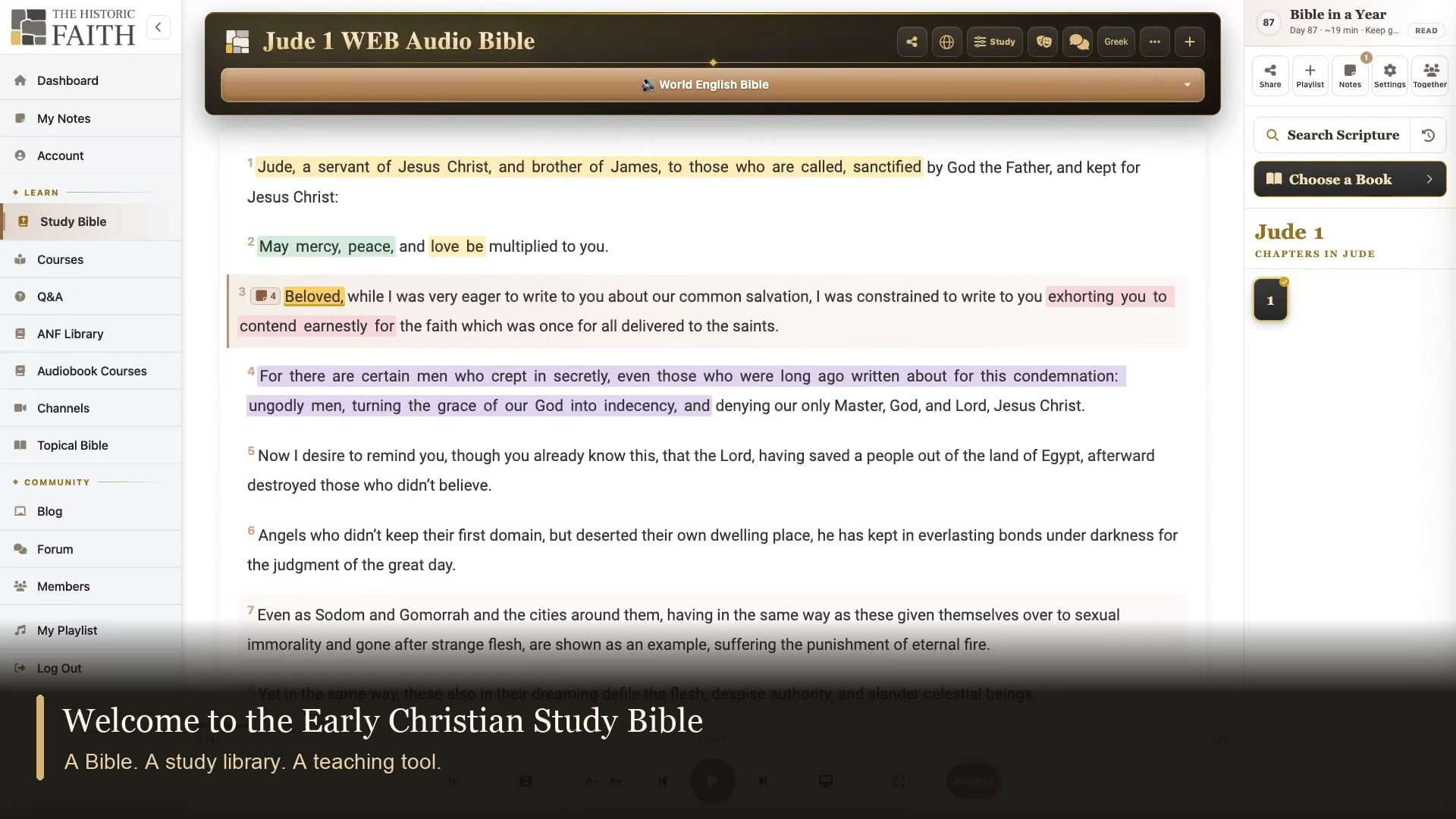 Words. Writings.
Guided tour · 21:50 · Several Bible editions.
See the phone experience · 5:31
Strong's Exhaustive Concordance, first published by James Strong in 1890, indexes every word of the King James Version and assigns each underlying original-language word a number — G1–G5624 for the Greek New Testament and H1–H8674 for the Hebrew Old Testament. Look up any English word, find its Strong's number, and see the Greek or Hebrew word behind it, its definition, and the verses where it occurs. This free online edition covers 14,298 entries with 767,764 indexed occurrences — including the Septuagint, deuterocanonical books, and 1 Enoch, which no print edition of Strong's includes.
These entry points are the quickest way to see how a Strong's number opens into a word, meaning, and Bible usage.
Greek agape, with New Testament and Septuagint usage links where indexed.
Greek kyrios, a major New Testament and Septuagint word-study bridge.
Hebrew reshith, the word behind “beginning” in Genesis 1:1 and other Old Testament usages.
Browse the local Greek and Hebrew Strong's entries in fast pages, open an exact number, or narrow the index by language, range, and usage count.
| Number | Word | Definition | Usages | Range |
|---|---|---|---|---|
|
H3377 — Yareb
Hebrew
|
יָרֵב (Yareb)
Yareb
|
Yareb (yaw-rabe') n-m. 1. he will contend 2. Jareb, a symbolical name for Assyria | 2 | H3001-H4000 |
|
H3378 — Yrubba`al
Hebrew
|
יְרוּבַּעַל (Yrubba`al)
Yrubba`al
|
Yrubba`al (yer-oob-bah'-al) n/p. 1. Baal will contend 2. Jerubbaal, a symbol. name of Gideon | 13 | H3001-H4000 |
|
H3379 — Yarob`am
Hebrew
|
יָרָבעָם (Yarob`am)
Yarob`am
|
Yarob`am (yaw-rob-awm') n/p. 1. (the) people will contend 2. Jarobam, the name of two Israelite kings | 95 | H3001-H4000 |
|
H3380 — Yrubbesheth
Hebrew
|
יְרוּבֶּשֶׁת (Yrubbesheth)
Yrubbesheth
|
Yrubbesheth (yer-oob-beh'-sheth) n/p. 1. shame (i.e. the idol) will contend 2. Jerubbesheth, a symbolic name for Gideon | 1 | H3001-H4000 |
|
H3381 — yarad
Hebrew
|
יָרַד (yarad)
yarad
|
yarad (yaw-rad') v. 1. to descend 2. (literally) to go downwards | 344 | H3001-H4000 |
|
H3382 — Yered
Hebrew
|
יֶרֶד (Yered)
Yered
|
Yered (yeh'-red) n/p. 1. a descent 2. Jered, the name of an antediluvian, and of an Israelite | 7 | H3001-H4000 |
|
H3383 — Yarden
Hebrew
|
יַרדֵּן (Yarden)
Yarden
|
Yarden (yar-dane') n/l. 1. a descender 2. Jarden, the principal river of Israel | 164 | H3001-H4000 |
|
H3384 — yarah
Hebrew
|
יָרָה יָרָא (yarah)
yarah
|
yarah (yaw-raw') (or (2 Chronicles 26:15)) v. 1. (properly) to flow as water 2. (hence) to rain | 74 | H3001-H4000 |
|
H3385 — Yruw'el
Hebrew
|
יְרוּאֵל (Yruw'el)
Yruw'el
|
Yruw'el (yer-oo-ale') n/l. 1. founded of God 2. Jeruel, a place in Israel | 1 | H3001-H4000 |
|
H3386 — Yarowach
Hebrew
|
יָרוַֹח (Yarowach)
Yarowach
|
Yarowach (yaw-ro'-akh) n/p. 1. (born at the) new moon 2. Jaroach, an Israelite | 1 | H3001-H4000 |
|
H3387 — yarowq
Hebrew
|
יָרוֹק (yarowq)
yarowq
|
yarowq (yaw-roke') n-m. 1. green, i.e. an herb [from H3417] | 1 | H3001-H4000 |
|
H3388 — Yruwsha'
Hebrew
|
יְרוּשָׁא יְרוּשָׁה (Yruwsha')
Yruwsha'
|
Yruwsha' (yer-oo-shaw') (or Yaruwshah {yer-oo-shaw'}) n/p. 1. possessed 2. Jerusha or Jerushah, as Israelitess | 2 | H3001-H4000 |
|
H3389 — Yruwshalaim
Hebrew
|
יְרוּשָׁלִַם יְרוּשָׁלַיִם (Yruwshalaim)
Yruwshalaim
|
Yruwshalaim (yer-oo-shaw-lah'-im) (rarely Yruwshalayim {yer-oo- shaw-lah'-yim}) n/l. 1. founded peaceful 2. Jerushalaim or Jerushalem, the capital city of Israel | 600 | H3001-H4000 |
|
H3390 — Yruwshalem
Hebrew
|
יְרוּשָׁלֵם (Yruwshalem)
Yruwshalem
|
Yruwshalem (yer-oo-shaw-lame') n/l. 1. founded peaceful 2. Jerushalem, the capital city of Israel | 25 | H3001-H4000 |
|
H3391 — yerach
Hebrew
|
יֶרַח (yerach)
yerach
|
yerach (yeh'-rakh) n-m. 1. a lunation, i.e. month [from a unused root of uncertain signification] | 13 | H3001-H4000 |
|
H3392 — Yerach
Hebrew
|
יֶרַח (Yerach)
Yerach
|
Yerach (yeh'-rakh) n/p. 1. Jerach, an Arabian patriarch [the same as H3391] | 2 | H3001-H4000 |
|
H3393 — yrach
Hebrew
|
יְרַח (yrach)
yrach
|
yrach (yeh-rakh') n-m. 1. a month [(Aramaic) corresponding to H3391] | 2 | H3001-H4000 |
|
H3394 — yareach
Hebrew
|
יָרֵַח (yareach)
yareach
|
yareach (yaw-ray'-akh) (or Yrechow) n-m. 1. the moon [from the same unused root as H3391] | 26 | H3001-H4000 |
|
H3395 — Yrocham
Hebrew
|
יְרוֹחָם (Yrocham)
Yrocham
|
Yrocham (yer-o-khawm') n/p. 1. compassionate 2. Jerocham, the name of seven or eight Israelites | 10 | H3001-H4000 |
|
H3396 — Yrachm'el
Hebrew
|
יְרַחמְאֵל (Yrachm'el)
Yrachm'el
|
Yrachm'el (yer-akh-meh-ale') n/p. 1. God will compassionate 2. Jerachmeel, the name of three Israelites | 8 | H3001-H4000 |
|
H3397 — Yrachm'eliy
Hebrew
|
יְרַחמְאֵלִי (Yrachm'eliy)
Yrachm'eliy
|
Yrachm'eliy (yer-akh-meh-ay-lee') adj. 1. a Jerachmeelite or descendant of Jerachmeel [patronymically from H3396] | 2 | H3001-H4000 |
|
H3398 — Yarcha`
Hebrew
|
יַרחָע (Yarcha`)
Yarcha`
|
Yarcha` (yar-khaw') n/p. 1. Jarcha, an Egyptian [probably of Egyptian origin] | 2 | H3001-H4000 |
|
H3399 — yarat
Hebrew
|
יָרַט (yarat)
yarat
|
yarat (yaw-rat') v. 1. to precipitate or hurl (rush) headlong 2. (intransitively) to be rash | 2 | H3001-H4000 |
|
H3400 — Yriy'el
Hebrew
|
יְרִיאֵל (Yriy'el)
Yriy'el
|
Yriy'el (yer-ee-ale') n/p. 1. thrown of God 2. Jeriel, an Israelite | 1 | H3001-H4000 |
|
H3401 — yariyb
Hebrew
|
יָרִיבּ (yariyb)
yariyb
|
yariyb (yaw-rebe') n-m. 1. (literally) he will contend 2. (properly, adjective) contentious | 3 | H3001-H4000 |
|
H3402 — Yariyb
Hebrew
|
יָרִיבּ (Yariyb)
Yariyb
|
Yariyb (yaw-rebe') n/p. 1. Jarib, the name of three Israelites [the same as H3401] | 3 | H3001-H4000 |
|
H3403 — Yriybay
Hebrew
|
יְרִיבַּי (Yriybay)
Yriybay
|
Yriybay (yer-eeb-ah'ee) n/p. 1. contentious 2. Jeribai, an Israelite | 1 | H3001-H4000 |
|
H3404 — Yriyah
Hebrew
|
יְרִיָה יְרִיָהוּ (Yriyah)
Yriyah
|
Yriyah (yer-ee-yaw') (or Yriyahuw {yer-ee-yaw'-hoo}) n/p. 1. Jah will throw 2. Jerijah, an Israelite | 3 | H3001-H4000 |
|
H3405 — Yriychow
Hebrew
|
יְרִיחוֹ יְרֵחוֹ יְרִיחוֹה (Yriychow)
Yriychow
|
Yriychow (yer-ee-kho') (or Yrechow {yer-ay-kho'} or variation (1 Kings 16:34)) n/l. 1. fragrant 2. Jericho or Jerecho, a place in Israel | 53 | H3001-H4000 |
|
H3406 — Yriymowth
Hebrew
|
יְרִימוֹת יְרֵימוֹת יְרֵמוֹת (Yriymowth)
Yriymowth
|
Yriymowth (yer-ee-mohth') (or Yreymowth {yer-ay-mohth'} or Yremowth {yer-ay-mohth'};) n/p. 1. elevations 2. Jerimoth or Jeremoth, the name of twelve Israelites | 14 | H3001-H4000 |
|
H3407 — yriy`ah
Hebrew
|
יְרִיעָה (yriy`ah)
yriy`ah
|
yriy`ah (yer-ee-aw') n-f. 1. a hanging (as tremulous) [from H3415] | 32 | H3001-H4000 |
|
H3408 — Yriy`owth
Hebrew
|
יְרִיעוֹת (Yriy`owth)
Yriy`owth
|
Yriy`owth (yer-ee-ohth') n/p. 1. curtains 2. Jerioth, an Israelitess | 1 | H3001-H4000 |
|
H3409 — yarek
Hebrew
|
יָרֵך (yarek)
yarek
|
yarek (yaw-rake') n-f. 1. the thigh (from its fleshy softness) 2. by euphem. the generative parts | 32 | H3001-H4000 |
|
H3410 — yarka'
Hebrew
|
יַרכָּא (yarka')
yarka'
|
yarka' (yar-kaw') n-f. 1. a thigh [(Aramaic) corresponding to H3411] | 1 | H3001-H4000 |
|
H3411 — yrekah
Hebrew
|
יְרֵכָה (yrekah)
yrekah
|
yrekah (yer-ay-kaw') n-f. 1. (properly) the flank 2. (figuratively) the rear or recess, i.e. "ends of the earth" | 28 | H3001-H4000 |
|
H3412 — Yarmuwth
Hebrew
|
יַרמוּת (Yarmuwth)
Yarmuwth
|
Yarmuwth (yar-mooth') n/l. 1. elevation 2. Jarmuth, the name of two places in Israel | 7 | H3001-H4000 |
|
H3413 — Yremay
Hebrew
|
יְרֵמַי (Yremay)
Yremay
|
Yremay (yer-ay-mah'-ee) n/p. 1. elevated 2. Jeremai, an Israelite | 1 | H3001-H4000 |
|
H3414 — Yirmyah
Hebrew
|
יִרמְיָה יִרמְיָהוּ (Yirmyah)
Yirmyah
|
Yirmyah (yir-meh-yaw') (or Yirmyahuw {yir-meh-yaw'-hoo}) n/p. 1. Jah will rise 2. Jirmejah, the name of eight or nine Israelites | 133 | H3001-H4000 |
|
H3415 — yara`
Hebrew
|
יָרַע (yara`)
yara`
|
yara` (yaw-rah') v. 1. (properly) to be broken up (with any violent action) i.e. (figuratively) to fear [a primitive root] | 10 | H3001-H4000 |
|
H3416 — Yirp'el
Hebrew
|
יִרפְּאֵל (Yirp'el)
Yirp'el
|
Yirp'el (yir-peh-ale') n/l. 1. God will heal 2. Jirpeel, a place in Israel | 1 | H3001-H4000 |
|
H3417 — yaraq
Hebrew
|
יָרַק (yaraq)
yaraq
|
yaraq (yaw-rak') v. 1. to spit [a primitive root] | 2 | H3001-H4000 |
|
H3418 — yereq
Hebrew
|
יֶרֶק (yereq)
yereq
|
yereq (yeh'-rek) n-m. 1. (properly) pallor 2. (hence) the yellowish green of young and sickly vegetation | 6 | H3001-H4000 |
|
H3419 — yaraq
Hebrew
|
יָרָק (yaraq)
yaraq
|
yaraq (yaw-rawk') n-m. 1. (properly) green 2. (concretely) a vegetable | 5 | H3001-H4000 |
|
H3420 — yeraqown
Hebrew
|
יֵרָקוֹן (yeraqown)
yeraqown
|
yeraqown (yay-raw-kone') n-m. 1. paleness, whether of persons (from fright), or of plants (from drought) [from H3418] | 6 | H3001-H4000 |
|
H3421 — Yorq`am
Hebrew
|
יָרקְעָם (Yorq`am)
Yorq`am
|
Yorq`am (yor-keh-awm') n/p. 1. people will be poured forth 2. Jorkeam, a place in Israel | 1 | H3001-H4000 |
|
H3422 — yraqraq
Hebrew
|
יְרַקרַק (yraqraq)
yraqraq
|
yraqraq (yer-ak-rak') adj. 1. yellowishness [from the same as H3418] | 3 | H3001-H4000 |
|
H3423 — yarash
Hebrew
|
יָרַשׁ יָרֵשׁ (yarash)
yarash
|
yarash (yaw-rash') (or yaresh {yaw-raysh'}) v. 1. to occupy (by driving out previous tenants, and possessing in their place) 2. (by implication) to seize, to rob, to inherit | 204 | H3001-H4000 |
|
H3424 — yreshah
Hebrew
|
יְרֵשָׁה (yreshah)
yreshah
|
yreshah (yer-ay-shaw') n-f. 1. occupancy [from H3423] | 1 | H3001-H4000 |
|
H3425 — yrushah
Hebrew
|
יְרוּשָּׁה (yrushah)
yrushah
|
yrushah (yer-oosh-shaw') n-f. 1. something occupied 2. a conquest | 12 | H3001-H4000 |
|
H3426 — yesh
Hebrew
|
יֵשׁ (yesh)
yesh
|
yesh (yaysh) subv. 1. entity 2. used adverbially or as a copula for the substantive verb (H1961) | 129 | H3001-H4000 |
|
H3427
Hebrew
|
וַיֵּ֥שֶׁב
|
yashab (yaw-shab') v. 1. (properly) to sit down (specifically as judge. in ambush, in quiet) 2. (by implication) to dwell, to remain | 978 | H3001-H4000 |
|
H3428 — Yesheb'ab
Hebrew
|
יֶשֶׁבאָב (Yesheb'ab)
Yesheb'ab
|
Yesheb'ab (yeh-sheb-awb') n/p. 1. seat of (his) father 2. Jeshebab, an Israelite | 1 | H3001-H4000 |
|
H3429
Hebrew
|
יוֹשֵׁב בַּשֶּׁבֶת
|
Yosheb bash-Shebeth (yo-shabe' bash-sheh'-beth) n/p. 1. sitting in the seat 2. Josheb-bash-Shebeth, an Israelite | 0 | H3001-H4000 |
|
H3430
Hebrew
|
יִשׁבּוֹ בְּנוֹב
|
Yishbow b-Nob (yish-bo'beh-nobe) n/p. 1. his dwelling (is) in Nob 2. Jishbo-be-Nob, a Philistine | 1 | H3001-H4000 |
|
H3431 — Yishbach
Hebrew
|
יִשׁבַּח (Yishbach)
Yishbach
|
Yishbach (yish-bakh') n/p. 1. he will praise 2. Jishbach, an Israelite | 1 | H3001-H4000 |
|
H3432 — Yashubiy
Hebrew
|
יָשׁוּבִי (Yashubiy)
Yashubiy
|
Yashubiy (yaw-shoo-bee') adj. 1. a Jashubite, or descendant of Jashub [patronymically from H3437] | 1 | H3001-H4000 |
|
H3433
Hebrew
|
יָשׁוּבִי לֶחֶם יוֹשֶׁבֵי לֶחֶם
|
Yashubiy Lechem (yaw-shoo-bee' leh'-khem) n/p. 1. returner of bread 2. Jashubi-Lechem, an Israelite | 1 | H3001-H4000 |
|
H3434 — Yashob`am
Hebrew
|
יָשָׁבעָם (Yashob`am)
Yashob`am
|
Yashob`am (yaw-shob-awm') n/p. 1. people will return 2. Jashobam, the name of two or three Israelites | 3 | H3001-H4000 |
|
H3435 — Yishbaq
Hebrew
|
יִשׁבָּק (Yishbaq)
Yishbaq
|
Yishbaq (yish-bawk') n/p. 1. he will leave 2. Jishbak, a son of Abraham | 2 | H3001-H4000 |
|
H3436 — Yoshbqashah
Hebrew
|
יָשׁבְּקָשָׁה (Yoshbqashah)
Yoshbqashah
|
Yoshbqashah (yosh-bek-aw-shaw') n/p. 1. a hard seat 2. Joshbekashah, an Israelite | 2 | H3001-H4000 |
|
H3437 — Yashuwb
Hebrew
|
יָשׁוּב יָשִׁיבּ (Yashuwb)
Yashuwb
|
Yashuwb (yaw-shoob') (or Yashiyb {yaw-sheeb'}) n/p. 1. he will return 2. Jashub, the name of two Israelites | 3 | H3001-H4000 |
|
H3438 — Yishvah
Hebrew
|
יִשׁוָה (Yishvah)
Yishvah
|
Yishvah (yish-vaw') n/p. 1. he will level 2. Jishvah, an Israelite | 2 | H3001-H4000 |
|
H3439 — Yshowchayah
Hebrew
|
יְשׁוֹחָיָה (Yshowchayah)
Yshowchayah
|
Yshowchayah (yesh-o-khaw-yaw') n/p. 1. Jah will empty 2. Jeshochajah, an Israelite | 1 | H3001-H4000 |
|
H3440 — Yishviy
Hebrew
|
יִשׁוִי (Yishviy)
Yishviy
|
Yishviy (yish-vee') n/p. 1. level 2. Jishvi, the name of two Israelites | 4 | H3001-H4000 |
|
H3441 — Yishviy
Hebrew
|
יִשׁוִי (Yishviy)
Yishviy
|
Yishviy (yish-vee') adj. 1. a Jishvite (collectively) or descendants of Jishvi [patronymically from H3440] | 1 | H3001-H4000 |
|
H3442 — Yeshuwa`
Hebrew
|
יֵשׁוַּע (Yeshuwa`)
Yeshuwa`
|
Yeshuwa` (yay-shoo'-ah) n/l. 1. he will save 2. Jeshua, the name of ten Israelites, also of a place in Israel | 29 | H3001-H4000 |
|
H3443 — Yeshuwa`
Hebrew
|
יֵשׁוַּע (Yeshuwa`)
Yeshuwa`
|
Yeshuwa` (yay-shoo'-ah) n/p. 1. Jeshua [(Aramaic) corresponding to H3442] | 1 | H3001-H4000 |
|
H3444 — yshuw`ah
Hebrew
|
יְשׁוּעָה (yshuw`ah)
yshuw`ah
|
yshuw`ah (yesh-oo'-aw) n-f. 1. something saved, i.e. (abstractly) deliverance 2. (hence) aid, victory, prosperity | 77 | H3001-H4000 |
|
H3445 — yeshach
Hebrew
|
יֶשַׁח (yeshach)
yeshach
|
yeshach (yeh'-shakh) n-m. 1. hunger [from an unused root meaning to gape (as the empty stomach)] | 1 | H3001-H4000 |
|
H3446 — Yischaq
Hebrew
|
יִשׂחָק (Yischaq)
Yischaq
|
Yischaq (yis-khawk') n/p. 1. he will laugh 2. Jischak, the heir of Abraham | 4 | H3001-H4000 |
|
H3447 — yashat
Hebrew
|
יָשַׁט (yashat)
yashat
|
yashat (yaw-shat') v. 1. to extend [a primitive root] | 3 | H3001-H4000 |
|
H3448 — Yishay
Hebrew
|
יִשַׁי אִישַׁי (Yishay)
Yishay
|
Yishay (yee-shah'-ee) (by Aramaic Iyshay {ee-shah'-ee}) n/p. 1. extant 2. Jishai, David's father | 39 | H3001-H4000 |
|
H3449 — Yishshiyah
Hebrew
|
יִשִּׁיָה יִשִּׁיָהוּ (Yishshiyah)
Yishshiyah
|
Yishshiyah (yish-shee-yaw') (or Yishshiyahuw {yish-shee-yaw'-hoo}) n/p. 1. Jah will lend 2. Jishshijah, the name of five Israelites | 6 | H3001-H4000 |
|
H3450 — Ysiyma'el
Hebrew
|
יְשִׂימִאֵל (Ysiyma'el)
Ysiyma'el
|
Ysiyma'el (yes-eem-aw-ale') n/p. 1. God will place 2. Jesimael, an Israelite | 1 | H3001-H4000 |
|
H3451 — yshiymah
Hebrew
|
יְשִׁימָה (yshiymah)
yshiymah
|
yshiymah (yesh-ee-maw') n-f. 1. desolation [from H3456] | 0 | H3001-H4000 |
|
H3452 — yshiymown
Hebrew
|
יְשִׁימוֹן (yshiymown)
yshiymown
|
yshiymown (yesh-ee-mone') n-m. 1. a desolation [from H3456] | 13 | H3001-H4000 |
|
H3453 — yashiysh
Hebrew
|
יָשִׁישׁ (yashiysh)
yashiysh
|
yashiysh (yaw-sheesh') adj. 1. an old man [from H3486] | 4 | H3001-H4000 |
|
H3454 — Yshiyshay
Hebrew
|
יְשִׁישָׁי (Yshiyshay)
Yshiyshay
|
Yshiyshay (yesh-ee-shah'-ee) n/p. 1. aged 2. Jeshishai, an Israelite | 1 | H3001-H4000 |
|
H3455 — yasam
Hebrew
|
יָשַׂם (yasam)
yasam
|
yasam (yaw-sam') v. 1. to place 2. intransitively, to be placed | 1 | H3001-H4000 |
|
H3456 — yasham
Hebrew
|
יָשַׁם (yasham)
yasham
|
yasham (yaw-sham') v. 1. to lie waste [a primitive root] | 4 | H3001-H4000 |
|
H3457 — Yishma'
Hebrew
|
יִשׁמָא (Yishma')
Yishma'
|
Yishma' (yish-maw') n/p. 1. desolate 2. Jishma, an Israelite | 1 | H3001-H4000 |
|
H3458 — Yishma`e'l
Hebrew
|
יִשׁמָעֵאל (Yishma`e'l)
Yishma`e'l
|
Yishma`e'l (yish-maw-ale') n/p. 1. God will hear 2. Jishmael, the name of Abraham's oldest son, and of five Israelites | 44 | H3001-H4000 |
|
H3459 — Yishma`e'liy
Hebrew
|
יִשׁמָעֵאלִי (Yishma`e'liy)
Yishma`e'liy
|
Yishma`e'liy (yish-maw-ay-lee') adj. 1. a Jishmaelite or descendant of Jishmael [patronymically from H3458] | 8 | H3001-H4000 |
|
H3460 — Yishma`yah
Hebrew
|
יִשׁמַעיָה יִשׁמַעיָהוּ (Yishma`yah)
Yishma`yah
|
Yishma`yah (yish-mah-yaw') (or Yishmacyahuw {yish-mah-yaw'-hoo}) n/p. 1. Jah will hear 2. Jishmajah, the name of two Israelites | 2 | H3001-H4000 |
|
H3461 — Yishmray
Hebrew
|
יִשׁמְרַי (Yishmray)
Yishmray
|
Yishmray (yish-mer-ah'-ee) n/p. 1. preservative 2. Jishmerai, an Israelite | 1 | H3001-H4000 |
|
H3462 — yashen
Hebrew
|
יָשֵׁן (yashen)
yashen
|
yashen (yaw-shane') v. 1. (properly) to be slack or languid 2. (by implication) to sleep | 19 | H3001-H4000 |
|
H3463 — yashen
Hebrew
|
יָשֵׁן (yashen)
yashen
|
yashen (yaw-shane') adj. 1. sleepy [from H3462] | 9 | H3001-H4000 |
|
H3464 — Yashen
Hebrew
|
יָשֵׁן (Yashen)
Yashen
|
Yashen (yaw-shane') n/p. 1. Jashen, an Israelite [the same as H3463] | 1 | H3001-H4000 |
|
H3465 — yashan
Hebrew
|
יָשָׁן (yashan)
yashan
|
yashan (yaw-shawn') adj. 1. old [from H3462] | 6 | H3001-H4000 |
|
H3466 — Yshanah
Hebrew
|
יְשָׁנָה (Yshanah)
Yshanah
|
Yshanah (yesh-aw-naw') n/p. 1. Jeshanah, a place in Israel [feminine of H3465] | 1 | H3001-H4000 |
|
H3467 — yasha`
Hebrew
|
יָשַׁע (yasha`)
yasha`
|
yasha` (yaw-shah') v. 1. (properly) to be open, wide or free 2. (by implication) to be safe | 198 | H3001-H4000 |
|
H3468 — yesha`
Hebrew
|
יֶשַׁע יֵשַׁע (yesha`)
yesha`
|
yesha` (yeh'-shah) (or yeshai {yay'-shah}) n-m. 1. liberty, deliverance, prosperity [from H3467] | 35 | H3001-H4000 |
|
H3469 — Yish`iy
Hebrew
|
יִשׁעִי (Yish`iy)
Yish`iy
|
Yish`iy (yish-ee') n/p. 1. saving 2. Jishi, the name of four Israelites | 4 | H3001-H4000 |
|
H3470 — Ysha`yah
Hebrew
|
יְשַׁעיָה יְשַׁעיָהוּ (Ysha`yah)
Ysha`yah
|
Ysha`yah (yesh-ah-yaw') (or Yshayahuw {yesh-ah-yaw'-hoo}) n/p. 1. Jah has saved 2. Jeshajah, the name of seven Israelites | 39 | H3001-H4000 |
|
H3471 — yashpheh
Hebrew
|
יָשׁפֵה (yashpheh)
yashpheh
|
yashpheh (yaw-shef-ay') n-m. 1. a gem supposed to be jasper (from the resemblance in name) [from an unused root meaning to polish] | 3 | H3001-H4000 |
|
H3472 — Yishpah
Hebrew
|
יִשׁפָּה (Yishpah)
Yishpah
|
Yishpah (yish-paw') n/p. 1. he will scratch 2. Jishpah, an Israelite | 1 | H3001-H4000 |
|
H3473 — Yishpan
Hebrew
|
יִשׁפָּן (Yishpan)
Yishpan
|
Yishpan (yish-pawn') n/p. 1. he will hide 2. Jishpan, an Israelite | 1 | H3001-H4000 |
|
H3474 — yashar
Hebrew
|
יָשַׁר (yashar)
yashar
|
yashar (yaw-shar') v. 1. to be straight or even 2. (figuratively) to be (causatively, to make) right, pleasant, prosperous | 25 | H3001-H4000 |
|
H3475 — Yesher
Hebrew
|
יֵשֶׁר (Yesher)
Yesher
|
Yesher (yay'-sher) n/p. 1. the right 2. Jesher, an Israelite | 1 | H3001-H4000 |
|
H3476 — yosher
Hebrew
|
יוֹשֶׁר (yosher)
yosher
|
yosher (yo'-sher) n-m. 1. the right [from H3474] | 14 | H3001-H4000 |
|
H3477 — yashar
Hebrew
|
יָשָׁר (yashar)
yashar
|
yashar (yaw-shawr') adj. 1. straight {literally or figuratively} | 120 | H3001-H4000 |
|
H3478
Hebrew
|
יִשְׂרָאֵ֑ל
|
Yisra'el (yis-raw-ale') n/p. 1. he will rule as God 2. Jisrael, a symbolical name of Jacob | 2,230 | H3001-H4000 |
|
H3479 — Yisra'el
Hebrew
|
יִשׂרָאֵל (Yisra'el)
Yisra'el
|
Yisra'el (yis-raw-ale') n/p. 1. Israel [(Aramaic) corresponding to H3478] | 7 | H3001-H4000 |
|
H3480 — Ysar'elah
Hebrew
|
יְשַׂראֵלָה (Ysar'elah)
Ysar'elah
|
Ysar'elah (yes-ar-ale'-aw) n/p. 1. right towards God 2. Jesarelah, an Israelite | 1 | H3001-H4000 |
|
H3481 — Yisr'eliy
Hebrew
|
יִשׂרְאֵלִי (Yisr'eliy)
Yisr'eliy
|
Yisr'eliy (yis-reh-ay-lee') adj. 1. a Jisreelite or descendant of Jisrael [patronymically from H3478] | 2 | H3001-H4000 |
|
H3482 — Yisr'eliyth
Hebrew
|
יִשׂרְאֵלִיתּ (Yisr'eliyth)
Yisr'eliyth
|
Yisr'eliyth (yis-reh-ay-leeth') adj. 1. a Jisreelitess or female descendant of Jisrael [feminine of H3481] | 2 | H3001-H4000 |
|
H3483 — yishrah
Hebrew
|
יִשׁרָה (yishrah)
yishrah
|
yishrah (yish-raw') n-f. 1. rectitude [feminine or H3477] | 1 | H3001-H4000 |
|
H3484 — Yshuruwn
Hebrew
|
יְשׁוּרוּן (Yshuruwn)
Yshuruwn
|
Yshuruwn (yesh-oo-roon') n/p. 1. upright 2. Jeshurun, a symbol. name for Israel | 4 | H3001-H4000 |
|
H3485 — Yissaskar
Hebrew
|
יִשָּׂשׂכָּר (Yissaskar)
Yissaskar
|
Yissaskar (yis-saw-kawr') ((strictly yis-saws-kawr')) n/p. 1. he will bring a reward 2. Jissaskar, a son of Jacob | 40 | H3001-H4000 |
|
H3486 — yashesh
Hebrew
|
יָשֵׁשׁ (yashesh)
yashesh
|
yashesh (yaw-shaysh') adj. 1. gray-haired, i.e. an aged man [from an unused root meaning to blanch] | 1 | H3001-H4000 |
|
H3487 — yath
Hebrew
|
יַת (yath)
yath
|
yath (yath) prt. 1. self (but as a sign of the object of a verb) [(Aramaic) corresponding to H853] | 1 | H3001-H4000 |
|
H3488 — ythiyb
Hebrew
|
יְתִב (ythiyb)
ythiyb
|
ythiyb (yeth-eeb') v. 1. to sit or dwell [(Aramaic) corresponding to H3427] | 5 | H3001-H4000 |
|
H3489 — yathed
Hebrew
|
יָתֵד (yathed)
yathed
|
yathed (yaw-thade') n-f. 1. a peg [from an unused root meaning to pin through or fast] | 19 | H3001-H4000 |
|
H3490 — yathowm
Hebrew
|
יָתוֹם (yathowm)
yathowm
|
yathowm (yaw-thome') n-m. 1. a bereaved person [from an unused root meaning to be lonely] | 42 | H3001-H4000 |
|
H3491 — yathuwr
Hebrew
|
יָתוּר (yathuwr)
yathuwr
|
yathuwr (yaw-thoor') v. 1. (properly) what is left 2. (by implication) a gleaning | 1 | H3001-H4000 |
|
H3492 — Yattiyr
Hebrew
|
יַתּתִּיר (Yattiyr)
Yattiyr
|
Yattiyr (yat-teer') n/l. 1. redundant 2. Jattir, a place in Israel | 4 | H3001-H4000 |
|
H3493 — yattiyr
Hebrew
|
יַתּתִּיר (yattiyr)
yattiyr
|
yattiyr (yat-teer') adj. 1. preeminent 2. as an adverb, very | 8 | H3001-H4000 |
|
H3494 — Yithlah
Hebrew
|
יִתלָה (Yithlah)
Yithlah
|
Yithlah (yith-law') n/l. 1. it will hang, i.e. be high 2. Jithlah, a place in Israel | 1 | H3001-H4000 |
|
H3495 — Yithmah
Hebrew
|
יִתמָה (Yithmah)
Yithmah
|
Yithmah (yith-maw') n/p. 1. orphanage 2. Jithmah, an Israelite | 1 | H3001-H4000 |
|
H3496 — Yathniy'el
Hebrew
|
יַתנִיאֵל (Yathniy'el)
Yathniy'el
|
Yathniy'el (yath-nee-ale') n/p. 1. continued of God 2. Jathniel, an Israelite | 1 | H3001-H4000 |
|
H3497 — Yithnan
Hebrew
|
יִתנָן (Yithnan)
Yithnan
|
Yithnan (yith-nawn') n/l. 1. extensive 2. Jithnan, a place in Israel | 1 | H3001-H4000 |
|
H3498 — yathar
Hebrew
|
יָתַר (yathar)
yathar
|
yathar (yaw-thar') v. 1. to jut over or exceed 2. (by implication) to excel | 101 | H3001-H4000 |
|
H3499 — yether
Hebrew
|
יֶתֶר (yether)
yether
|
yether (yeh'-ther) n-m. 1. (properly) an overhanging 2. (by implication) an excess, superiority, remainder | 95 | H3001-H4000 |
|
H3500 — Yether
Hebrew
|
יֶתֶר (Yether)
Yether
|
Yether (yeh'-ther) n/p. 1. Jether, the name of five or six Israelites and of one Midianite [the same as H3499] | 7 | H3001-H4000 |
|
H3501 — Yithra'
Hebrew
|
יִתרָא (Yithra')
Yithra'
|
Yithra' (yith-raw') n/p. 1. Jithra, an Israelite (or Ishmaelite) [by variation for H3502] | 1 | H3001-H4000 |
|
H3502 — yithrah
Hebrew
|
יִתרָה (yithrah)
yithrah
|
yithrah (yith-raw') n-f. 1. (properly) excellence 2. (by implication) wealth | 2 | H3001-H4000 |
|
H3503 — Yithrow
Hebrew
|
יִתרוֹ (Yithrow)
Yithrow
|
Yithrow (yith-ro') n/p. 1. his excellence 2. Jethro, Moses' father-in-law | 9 | H3001-H4000 |
|
H3504 — yithrown
Hebrew
|
יִתרוֹן (yithrown)
yithrown
|
yithrown (yith-rone') n-m. 1. preeminence, gain [from H3498] | 9 | H3001-H4000 |
|
H3505 — Yithriy
Hebrew
|
יִתרִי (Yithriy)
Yithriy
|
Yithriy (yith-ree') adj. 1. a Jithrite or descendant of Jether [patronymically from H3500] | 3 | H3001-H4000 |
|
H3506 — Yithran
Hebrew
|
יִתרָן (Yithran)
Yithran
|
Yithran (yith-rawn') n/p. 1. excellent 2. Jithran, the name of an Edomite and of an Israelite | 3 | H3001-H4000 |
|
H3507 — Yithr`am
Hebrew
|
יִתרְעָם (Yithr`am)
Yithr`am
|
Yithr`am (yith-reh-awm') n/p. 1. excellence of people 2. Jithream, a son of David | 2 | H3001-H4000 |
|
H3508 — yothereth
Hebrew
|
יוֹתֶרֶת (yothereth)
yothereth
|
yothereth (yo-theh'-reth) n-f. 1. the lobe or flap of the liver (as if redundant or outhanging) [feminine active participle of H3498] | 11 | H3001-H4000 |
|
H3509 — Ytheyh
Hebrew
|
יְתֵת (Ytheyh)
Ytheyh
|
Ytheyh (yeh-thayth') n/p. 1. Jetheth, an Edomite [of uncertain derivation] | 2 | H3001-H4000 |
|
H3510 — ka'ab
Hebrew
|
כָּאַב (ka'ab)
ka'ab
|
ka'ab (kaw-ab') v. 1. (properly) to feel pain 2. (by implication) to grieve | 8 | H3001-H4000 |
|
H3511 — k'eb
Hebrew
|
כְּאֵב (k'eb)
k'eb
|
k'eb (keh-abe') n-m. 1. suffering (physical or mental), adversity [from H3510] | 6 | H3001-H4000 |
|
H3512 — ka'ah
Hebrew
|
כָּאָה (ka'ah)
ka'ah
|
ka'ah (kaw-aw') v. 1. to despond [a primitive root] | 3 | H3001-H4000 |
|
H3513 — kabad
Hebrew
|
כָּבַד כָּבֵד (kabad)
kabad
|
kabad (kaw-bad') (or kabed {kaw-bade'}) v. 1. to be heavy, i.e. in a bad sense (burdensome, severe, dull) or in a good sense (numerous, rich, honorable 2. causatively, to make weighty (in the same two senses) | 107 | H3001-H4000 |
|
H3514 — kobed
Hebrew
|
כּוֹבֶד (kobed)
kobed
|
kobed (ko'-bed) n-m. 1. weight, multitude, vehemence [from H3513] | 4 | H3001-H4000 |
|
H3515 — kabed
Hebrew
|
כָּבֵד (kabed)
kabed
|
kabed (kaw-bade') adj. 1. heavy 2. figuratively in a good sense (numerous) or in a bad sense (severe, difficult, stupid) | 39 | H3001-H4000 |
|
H3516 — kabed
Hebrew
|
כָּבֵד (kabed)
kabed
|
kabed (kaw-bade') n-f. 1. the liver (as the heaviest of the viscera) [the same as H3515] | 14 | H3001-H4000 |
|
H3517 — kbeduth
Hebrew
|
כְּבֵדוּת (kbeduth)
kbeduth
|
kbeduth (keb-ay-dooth') n-f. 1. difficulty [feminine of H3515] | 1 | H3001-H4000 |
|
H3518 — kabah
Hebrew
|
כָּבָה (kabah)
kabah
|
kabah (kaw-baw') v. 1. to expire or (causatively) to extinguish (fire, light, anger) [a primitive root] | 24 | H3001-H4000 |
|
H3519 — kabowd
Hebrew
|
כָּבוֹד כָּבוֹד (kabowd)
kabowd
|
kabowd (kaw-bode') (rarely kabod {kaw-bode'}) n-m. 1. (properly) weight, but only figuratively in a good sense, splendor or copiousness [from H3513] | 189 | H3001-H4000 |
|
H3520 — kbuwddah
Hebrew
|
כְּבוּדָּה (kbuwddah)
kbuwddah
|
kbuwddah (keb-ood-daw') n-f. 1. weightiness, i.e. magnificence, wealth [irreg. feminine passive participle of H3513] | 3 | H3001-H4000 |
|
H3521 — Kabuwl
Hebrew
|
כָּבוּל (Kabuwl)
Kabuwl
|
Kabuwl (kaw-bool') n/l. 1. sterile 2. Cabul, the name of two places in Israel | 2 | H3001-H4000 |
|
H3522 — Kabbown
Hebrew
|
כַּבּוֹן (Kabbown)
Kabbown
|
Kabbown (kab-bone') n/l. 1. hilly 2. Cabon, a place in Israel | 1 | H3001-H4000 |
|
H3523 — kbiyr
Hebrew
|
כְּבִיר (kbiyr)
kbiyr
|
kbiyr (keb-eer) n-m. 1. a matrass (of intertwined materials) [from H3527 in the original sense of plaiting] | 2 | H3001-H4000 |
|
H3524 — kabbiyr
Hebrew
|
כַּבִּיר (kabbiyr)
kabbiyr
|
kabbiyr (kab-beer') adj. 1. vast, whether in extent (figuratively, of power, mighty 2. of time, aged), or in number, many | 9 | H3001-H4000 |
|
H3525 — kebel
Hebrew
|
כֶּבֶל (kebel)
kebel
|
kebel (keh'-bel) n-m. 1. a fetter [from an unused root meaning to twine or braid together] | 2 | H3001-H4000 |
|
H3526 — kabac
Hebrew
|
כָּבַס (kabac)
kabac
|
kabac (kaw-bas') v. 1. to trample 2. (hence) to wash (properly, by stamping with the feet), whether literal (including the fulling process) or figurative | 48 | H3001-H4000 |
No Strong's entries match that search.
Strong's works best when the number, original word, verse, and corpus stay connected.
Open a chapter and move from a word token to its Strong's page, parsing, and linked occurrences.
Greek Strong's entries can include New Testament, Septuagint, deuterocanonical, and 1 Enoch rows where indexed.
Dedicated Strong's pages can expose approved pronunciation audio beside the word-study data.
These are common words readers run into repeatedly, shown with an English meaning so the list is readable without already knowing the original languages.
Look up a word study by its transliteration — these are frequently searched Hebrew and Greek words. Each opens the matching Strong's entry, or lists the options when a spelling maps to several words.