
G26 — Agape (Love)
Greek agape, with New Testament and Septuagint usage links where indexed.
The Early Christian Study Bible · Free to use
Study the word. Hear its pronunciation.
Search 14,298 Greek and Hebrew entries—free. Explore definitions, indexed occurrences, and pronunciation audio where available, then follow the words back into your Bible.
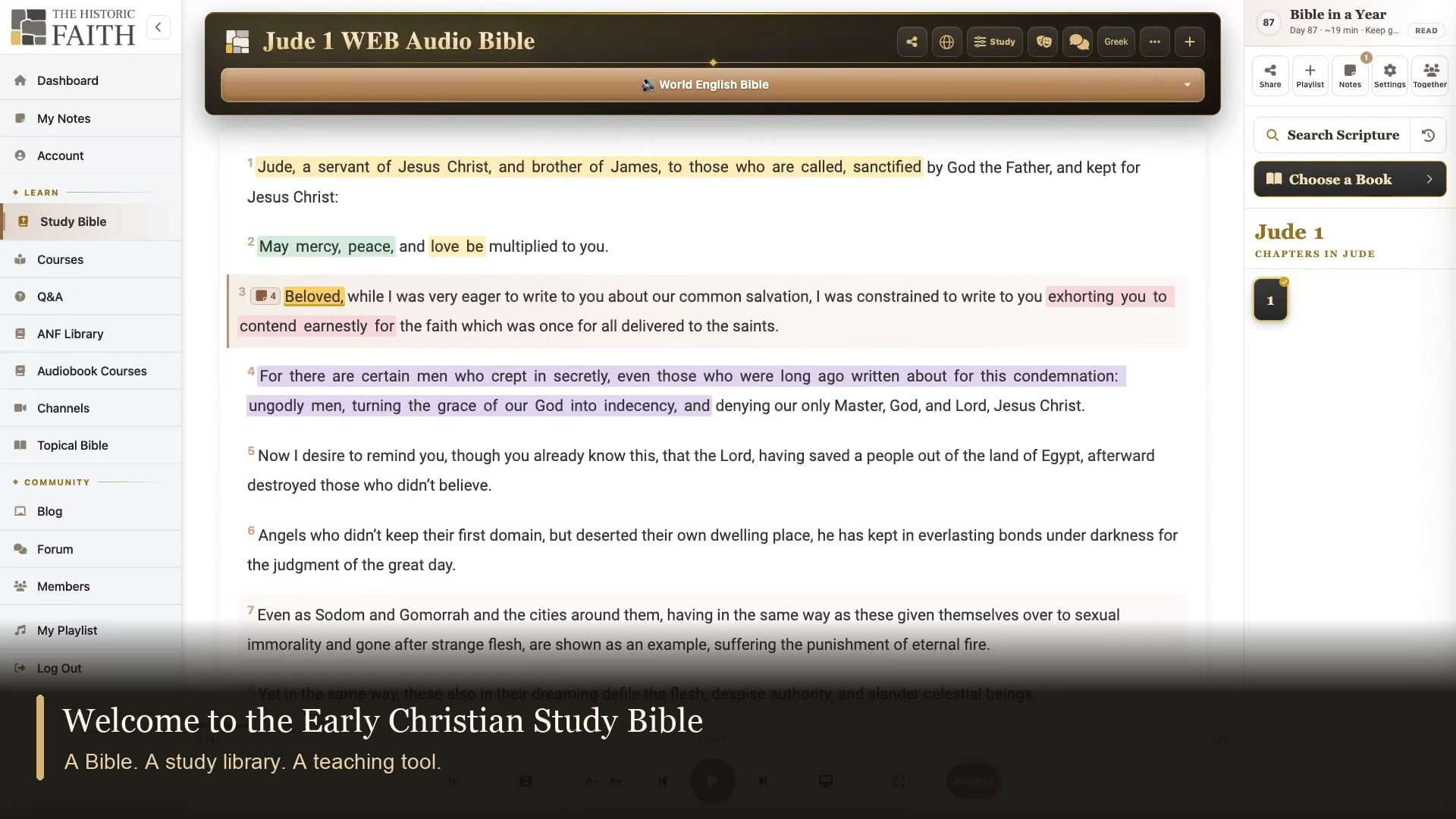
Click a word. Hear its pronunciation. Open the early Christian writings. Then see how to present and teach.
 Words. Writings.
Guided tour · 21:50 · Several Bible editions.
See the phone experience · 5:31
Strong's Exhaustive Concordance, first published by James Strong in 1890, indexes every word of the King James Version and assigns each underlying original-language word a number — G1–G5624 for the Greek New Testament and H1–H8674 for the Hebrew Old Testament. Look up any English word, find its Strong's number, and see the Greek or Hebrew word behind it, its definition, and the verses where it occurs. This free online edition covers 14,298 entries with 767,764 indexed occurrences — including the Septuagint, deuterocanonical books, and 1 Enoch, which no print edition of Strong's includes.
These entry points are the quickest way to see how a Strong's number opens into a word, meaning, and Bible usage.
Greek agape, with New Testament and Septuagint usage links where indexed.
Greek kyrios, a major New Testament and Septuagint word-study bridge.
Hebrew reshith, the word behind “beginning” in Genesis 1:1 and other Old Testament usages.
Browse the local Greek and Hebrew Strong's entries in fast pages, open an exact number, or narrow the index by language, range, and usage count.
| Number | Word | Definition | Usages | Range |
|---|---|---|---|---|
|
H2027 — hereg
Hebrew
|
הֶרֶג (hereg)
hereg
|
hereg (heh'-reg) n-m. 1. slaughter [from H2026] | 5 | H2001-H3000 |
|
H2028 — haregah
Hebrew
|
הֲרֵגָה (haregah)
haregah
|
haregah (har-ay-gaw') n-f. 1. slaughter [feminine of H2027] | 5 | H2001-H3000 |
|
H2029 — harah
Hebrew
|
הָרָה (harah)
harah
|
harah (haw-raw') v. 1. to be (or become) pregnant, conceive (literally or figuratively) [a primitive root] | 43 | H2001-H3000 |
|
H2030 — hareh
Hebrew
|
הָרֶה הָרִי (hareh)
hareh
|
hareh (haw-reh') (or hariy (Hosea 14:1)) n-f. 1. pregnant [from H2029] | 15 | H2001-H3000 |
|
H2031 — harhor
Hebrew
|
הַרהוֹר (harhor)
harhor
|
harhor (har-hor') n-m. 1. a mental conception [(Aramaic) from a root corresponding to H2029] | 1 | H2001-H3000 |
|
H2032 — herown
Hebrew
|
הֵרוֹן הֵרָיוֹן (herown)
herown
|
herown (hay-rone') (or herayown {hay-raw-yone'}) n-m. 1. pregnancy [from H2029] | 3 | H2001-H3000 |
|
H2033 — Harowriy
Hebrew
|
הֲרוֹרִי (Harowriy)
Harowriy
|
Harowriy (har-o-ree') n/l. 1. a Harorite or mountaineer [another form for H2043] | 1 | H2001-H3000 |
|
H2034 — hariycah
Hebrew
|
הֲרִיסָה (hariycah)
hariycah
|
hariycah (har-ee-saw') n-f. 1. something demolished [from H2040] | 1 | H2001-H3000 |
|
H2035 — hariycuwth
Hebrew
|
הֲרִיסוּת (hariycuwth)
hariycuwth
|
hariycuwth (har-ee-sooth') n-f. 1. demolition [from H2040] | 1 | H2001-H3000 |
|
H2036 — Horam
Hebrew
|
הוֹרָם (Horam)
Horam
|
Horam (ho-rawm') n/p. 1. high 2. Horam, a Canaanitish king | 1 | H2001-H3000 |
|
H2037 — Harum
Hebrew
|
הָרוּם (Harum)
Harum
|
Harum (haw-room') n/p. 1. high 2. Harum, an Israelite | 1 | H2001-H3000 |
|
H2038 — harmown
Hebrew
|
הַרמוֹן (harmown)
harmown
|
harmown (har-mone') n/l. 1. a castle (from its height) [from the same as H2036] | 1 | H2001-H3000 |
|
H2039 — Haran
Hebrew
|
הָרָן (Haran)
Haran
|
Haran (haw-rawn') n/l. 1. mountaineer 2. Haran, the name of two men | 6 | H2001-H3000 |
|
H2040 — harac
Hebrew
|
הָרַס (harac)
harac
|
harac (haw-ras') v. 1. to pull down or in pieces, break, &Š destroy [a primitive root] | 42 | H2001-H3000 |
|
H2041 — herec
Hebrew
|
הֶרֶס (herec)
herec
|
herec (heh'-res) n-m. 1. demolition [from H2040] | 1 | H2001-H3000 |
|
H2042 — harar
Hebrew
|
הָרָר (harar)
harar
|
harar (haw-rawr') n-m. 1. a mountain [from an unused root meaning to loom up] | 12 | H2001-H3000 |
|
H2043 — Harariy
Hebrew
|
הֲרָרִי הָרָרִי הָארָרִי (Harariy)
Harariy
|
Harariy (hah-raw-ree') (or Harariy (2 Samuel 23:11)) adj. 1. a mountaineer [apparently from H2042] | 4 | H2001-H3000 |
|
H2044 — Hashem
Hebrew
|
הָשֵׁם (Hashem)
Hashem
|
Hashem (haw-shame') n/p. 1. wealthy 2. Hashem, an Israelite | 1 | H2001-H3000 |
|
H2045 — hashma`uwth
Hebrew
|
הַשׁמָעוּת (hashma`uwth)
hashma`uwth
|
hashma`uwth (hashmaw-ooth') n-f. 1. announcement [from H8085] | 1 | H2001-H3000 |
|
H2046 — hittuwk
Hebrew
|
הִתּתּוּך (hittuwk)
hittuwk
|
hittuwk (hit-took') n-m. 1. a melting [from H5413] | 1 | H2001-H3000 |
|
H2047 — Hathak
Hebrew
|
הֲתָך (Hathak)
Hathak
|
Hathak (hath-awk') n/p. 1. Hathak, a Persian eunuch [probably of foreign origin] | 4 | H2001-H3000 |
|
H2048 — hathal
Hebrew
|
הָתַל (hathal)
hathal
|
hathal (haw-thal') v. 1. to deride 2. (by implication) to cheat | 9 | H2001-H3000 |
|
H2049 — hathol
Hebrew
|
הָתוֹל (hathol)
hathol
|
hathol (haw-thole') n-m. 1. a derision [from H2048 (only in plural collectively)] | 1 | H2001-H3000 |
|
H2050 — hathath'
Hebrew
|
הָתַת (hathath')
hathath'
|
hathath' (haw-thath') v. 1. (properly) to break in upon, i.e. to assail [a primitive root] | 1 | H2001-H3000 |
|
H2051 — Vdan
Hebrew
|
וְדָן (Vdan)
Vdan
|
Vdan (ved-awn') n/l. 1. Vedan (or Aden), a place in Arabia [perhaps for H5730] | 1 | H2001-H3000 |
|
H2052 — Vaheb
Hebrew
|
וָהֵב (Vaheb)
Vaheb
|
Vaheb (vaw-habe') n/l. 1. Vaheb, a place in Moab [of uncertain derivation] | 1 | H2001-H3000 |
|
H2053 — vav
Hebrew
|
וָו (vav)
vav
|
vav (vaw) n-m. 1. hook [probably a hook (the name of the sixth Heb. letter)] | 13 | H2001-H3000 |
|
H2054 — vazar
Hebrew
|
וָזָר (vazar)
vazar
|
vazar (vaw-zawr') adj. 1. crime [presumed to be from an unused root meaning to bear guilt] | 1 | H2001-H3000 |
|
H2055 — Vayzatha'
Hebrew
|
וַיְזָתָא (Vayzatha')
Vayzatha'
|
Vayzatha' (vah-yez-aw'-thaw) n/p. 1. Vajezatha, a son of Haman [of foreign origin] | 1 | H2001-H3000 |
|
H2056 — valad
Hebrew
|
וָלָד (valad)
valad
|
valad (vaw-lawd') n-m. 1. a boy [for H3206] | 1 | H2001-H3000 |
|
H2057 — Vanyah
Hebrew
|
וַניָה (Vanyah)
Vanyah
|
Vanyah (van-yaw') n/p. 1. Vanjah, an Israelite [perhaps for H6043] | 1 | H2001-H3000 |
|
H2058 — Vophciy
Hebrew
|
וָפסִי (Vophciy)
Vophciy
|
Vophciy (vof-see') n/p. 1. additional 2. Vophsi, an &Š Israelite | 1 | H2001-H3000 |
|
H2059 — Vashniy
Hebrew
|
וַשׁנִי (Vashniy)
Vashniy
|
Vashniy (vash-nee') n/p. 1. weak 2. Vashni, an Israelite | 1 | H2001-H3000 |
|
H2060 — Vashtiy
Hebrew
|
וַשׁתִּי (Vashtiy)
Vashtiy
|
Vashtiy (vash-tee') n/p. 1. Vashti, the queen of Xerxes [of Persian origin] | 10 | H2001-H3000 |
|
H2061 — z'eb
Hebrew
|
זְאֵב (z'eb)
z'eb
|
z'eb (zeh-abe') n-m. 1. a wolf [from an unused root meaning to be yellow] | 7 | H2001-H3000 |
|
H2062 — Ze'eb
Hebrew
|
זְאֵב (Ze'eb)
Ze'eb
|
Ze'eb (zeh-abe') n/p. 1. Zeeb, a Midianitish prince [the same as H2061] | 3 | H2001-H3000 |
|
H2063 — zo'th
Hebrew
|
זוֹאתּ (zo'th)
zo'th
|
zo'th (zothe') p/d. 1. this (often used adverb) [irregular feminine of H2089] | 569 | H2001-H3000 |
|
H2064 — zabad
Hebrew
|
זָבַד (zabad)
zabad
|
zabad (zaw-bad') v. 1. to confer [a primitive root] | 1 | H2001-H3000 |
|
H2065 — zebed
Hebrew
|
זֶבֶד (zebed)
zebed
|
zebed (zeh'-bed) n-m. 1. a gift [from H2064] | 1 | H2001-H3000 |
|
H2066 — Zabad
Hebrew
|
זָבָד (Zabad)
Zabad
|
Zabad (zaw-bawd') n/p. 1. giver 2. Zabad, the name of seven Israelites | 8 | H2001-H3000 |
|
H2067 — Zabdiy
Hebrew
|
זַבדִּי (Zabdiy)
Zabdiy
|
Zabdiy (zab-dee') n/p. 1. giving 2. Zabdi, the name of four &Š Israelites | 6 | H2001-H3000 |
|
H2068 — Zabdiy'el
Hebrew
|
זַבדִּיאֵל (Zabdiy'el)
Zabdiy'el
|
Zabdiy'el (zab-dee-ale') n/p. 1. gift of God [from H2065 and H410] | 2 | H2001-H3000 |
|
H2069 — Zbadyah
Hebrew
|
זְבַדיָה זֶבַדיָהוּ (Zbadyah)
Zbadyah
|
Zbadyah (zeb-ad-yaw') (or Zbadyahuw {zeb-ad-yaw'-hoo}) n/p. 1. Jah has given 2. Zebadjah, the name of nine Israelites | 9 | H2001-H3000 |
|
H2070 — zbuwb
Hebrew
|
זְבוּב (zbuwb)
zbuwb
|
zbuwb (zeb-oob') n-m. 1. a fly (especially one of a stinging nature) [from an unused root (meaning to flit)] | 2 | H2001-H3000 |
|
H2071 — Zabuwd
Hebrew
|
זָבוּד (Zabuwd)
Zabuwd
|
Zabuwd (zaw-bood') n/p. 1. given, Zabud, an Israelite [from H2064] | 1 | H2001-H3000 |
|
H2072 — Zabbuwd
Hebrew
|
זַבּוּד (Zabbuwd)
Zabbuwd
|
Zabbuwd (zab-bood') n/p. 1. given 2. Zabbud, an Israelite | 1 | H2001-H3000 |
|
H2073 — zbuwl
Hebrew
|
זְבוּל זֶבוּל (zbuwl)
zbuwl
|
zbuwl (ze-bool') (or zbul {zeb-ool'}) n-m. 1. a residence [from H2082] | 5 | H2001-H3000 |
|
H2074 — Zbuwluwn
Hebrew
|
זְבוּלוּן זֶבוּלוּן זֶבוּלוּן (Zbuwluwn)
Zbuwluwn
|
Zbuwluwn (zeb-oo-loon') (or Zbuluwn {zeb-oo-loon'}or Zbuwlun {zeb-oo-loon'};) n/p. 1. habitation 2. Zebulon, a son of Jacob | 43 | H2001-H3000 |
|
H2075 — Zbuwloniy
Hebrew
|
זְבוּלוֹנִי (Zbuwloniy)
Zbuwloniy
|
Zbuwloniy (zeb-oo-lo-nee') adj. 1. a Zebulonite or descendant of Zebulun [patronymically from H2074] | 3 | H2001-H3000 |
|
H2076 — zabach
Hebrew
|
זָבַח (zabach)
zabach
|
zabach (zaw-bakh') v. 1. to slaughter an animal (usually in sacrifice) [a primitive root] | 127 | H2001-H3000 |
|
H2077 — zebach
Hebrew
|
זֶבַח (zebach)
zebach
|
zebach (zeh'-bakh) n-m. 1. (properly) a slaughter, i.e. the flesh of an animal 2. (by implication) a sacrifice (the victim or the act) | 153 | H2001-H3000 |
|
H2078 — Zebach
Hebrew
|
זֶבַח (Zebach)
Zebach
|
Zebach (zeh'-bakh) n/p. 1. sacrifice 2. Zebach, a Midianitish prince | 9 | H2001-H3000 |
|
H2079 — Zabbay
Hebrew
|
זַבַּי (Zabbay)
Zabbay
|
Zabbay (zab-bah'-ee) n/p. 1. Zabbai (or Zaccai), an Israelite [probably by orthographical error for H2140] | 2 | H2001-H3000 |
|
H2080 — Zbiydah
Hebrew
|
זְבִידָּה (Zbiydah)
Zbiydah
|
Zbiydah (zeb-ee-daw') n/p. 1. giving 2. Zebidah, an Israelitess | 1 | H2001-H3000 |
|
H2081 — Zbiyna'
Hebrew
|
זְבִינָא (Zbiyna')
Zbiyna'
|
Zbiyna' (zeb-ee-naw') n/p. 1. gainfulness 2. Zebina, an Israelite | 1 | H2001-H3000 |
|
H2082 — zabal
Hebrew
|
זָבַל (zabal)
zabal
|
zabal (zaw-bal') v. 1. apparently properly, to inclose, i.e. to reside [a primitive root] | 1 | H2001-H3000 |
|
H2083 — Zbul
Hebrew
|
זְבוּל (Zbul)
Zbul
|
Zbul (zeb-ool') n/p. 1. dwelling 2. Zebul, an Israelite | 5 | H2001-H3000 |
|
H2084 — zban
Hebrew
|
זְבַן (zban)
zban
|
zban (zeb-an') v. 1. to acquire by purchase [(Aramaic) corresponding to the root of H2081] | 1 | H2001-H3000 |
|
H2085 — zag
Hebrew
|
זָג (zag)
zag
|
zag (zawg) n-m. 1. the skin of a grape [from an unused root probably meaning to inclose] | 1 | H2001-H3000 |
|
H2086 — zed
Hebrew
|
זֵד (zed)
zed
|
zed (zade') n-m. 1. arrogant [from H2102] | 13 | H2001-H3000 |
|
H2087 — zadown
Hebrew
|
זָדוֹן (zadown)
zadown
|
zadown (zaw-done') n-m. 1. arrogance [from H2102] | 11 | H2001-H3000 |
|
H2088 — zeh
Hebrew
|
זֶה (zeh)
zeh
|
zeh (zeh) p/d. 1. the masculine demonstrative pronoun, this or that [a primitive word] | 1,061 | H2001-H3000 |
|
H2089 — zeh
Hebrew
|
זֶה (zeh)
zeh
|
zeh (zeh) n-m. 1. a sheep [(1 Samuel by permutation for H7716] | 0 | H2001-H3000 |
|
H2090 — zoh
Hebrew
|
זוֹה (zoh)
zoh
|
zoh (zo) p/d. 1. this or that [for H2088] | 12 | H2001-H3000 |
|
H2091 — zahab
Hebrew
|
זָהָב (zahab)
zahab
|
zahab (zaw-hawb') n-m. 1. gold 2. (figuratively) golden, something gold-colored (i.e. yellow) such as oil or a clear, sunny sky | 336 | H2001-H3000 |
|
H2092 — zaham
Hebrew
|
זָהַם (zaham)
zaham
|
zaham (zaw-ham') v. 1. to be rancid, i.e. (transitively) to loathe [a primitive root] | 1 | H2001-H3000 |
|
H2093 — Zaham
Hebrew
|
זַהַם (Zaham)
Zaham
|
Zaham (zah'-ham) n/p. 1. loathing 2. Zaham, an Israelite | 1 | H2001-H3000 |
|
H2094 — zahar
Hebrew
|
זָהַר (zahar)
zahar
|
zahar (zaw-har') v. 1. to gleam 2. (figuratively) to enlighten (by caution) | 19 | H2001-H3000 |
|
H2095 — zhar
Hebrew
|
זְהַר (zhar)
zhar
|
zhar (zeh-har') v. 1. (passively) be admonished [(Aramaic) corresponding to H2094] | 1 | H2001-H3000 |
|
H2096 — zohar
Hebrew
|
זוֹהַר (zohar)
zohar
|
zohar (zo'-har) n-m. 1. brilliancy [from H2094] | 2 | H2001-H3000 |
|
H2097 — zow
Hebrew
|
זוֹ (zow)
zow
|
zow (zo) p/d. 1. this or that [for H2088] | 1 | H2001-H3000 |
|
H2098 — zuw
Hebrew
|
זוּ (zuw)
zuw
|
zuw (zoo) p/d. 1. this or that [for H2088] | 15 | H2001-H3000 |
|
H2099 — Ziv
Hebrew
|
זִו (Ziv)
Ziv
|
Ziv (zeev') n/p. 1. (properly) brightness, i.e. (figuratively) the month of flowers 2. Ziv (corresponding to Ijar or May) | 2 | H2001-H3000 |
|
H2100 — zuwb
Hebrew
|
זוּב (zuwb)
zuwb
|
zuwb (zoob) v. 1. to flow freely (as water), i.e. (specifically) to have a (sexual) flux 2. (figuratively) to waste away | 41 | H2001-H3000 |
|
H2101 — zowb
Hebrew
|
זוֹב (zowb)
zowb
|
zowb (zobe) n-m. 1. a seminal or menstrual flux [from H2100] | 10 | H2001-H3000 |
|
H2102 — zuwd
Hebrew
|
זוּד זִידּ (zuwd)
zuwd
|
zuwd (zood) (or (by permutation) ziyd {zeed}) v. 1. to seethe 2. (figuratively) to be insolent | 10 | H2001-H3000 |
|
H2103 — zuwd
Hebrew
|
זוּד (zuwd)
zuwd
|
zuwd (zood) v. 1. to be proud [(Aramaic) corresponding to H2102] | 1 | H2001-H3000 |
|
H2104 — Zuwziym
Hebrew
|
זוּזִים (Zuwziym)
Zuwziym
|
Zuwziym (zoo-zeem') n-m. 1. prominent 2. Zuzites, an aboriginal tribe of Israel | 1 | H2001-H3000 |
|
H2105 — Zowcheth
Hebrew
|
זוֹחֵת (Zowcheth)
Zowcheth
|
Zowcheth (zo-khayth') n/p. 1. Zocheth, an Israelite [of uncertain origin] | 1 | H2001-H3000 |
|
H2106 — zaviyth
Hebrew
|
זָוִיתּ (zaviyth)
zaviyth
|
zaviyth (zaw-veeth') n-f. 1. an angle (as projecting) 2. (by implication) a corner-column (or anta) | 2 | H2001-H3000 |
|
H2107 — zuwl
Hebrew
|
זוּל (zuwl)
zuwl
|
zuwl (zool) v. 1. probably to shake out 2. (by implication) to scatter profusely | 2 | H2001-H3000 |
|
H2108 — zuwlah
Hebrew
|
זוּלָה (zuwlah)
zuwlah
|
zuwlah (zoo-law') adj. 1. probably scattering, i.e. removal 2. used adverbially, except | 16 | H2001-H3000 |
|
H2109 — zuwn
Hebrew
|
זוּן (zuwn)
zuwn
|
zuwn (zoon) v. 1. perhaps properly, to be plump, i.e. (transitively) to nourish [a primitive root] | 1 | H2001-H3000 |
|
H2110 — zuwn
Hebrew
|
זוּן (zuwn)
zuwn
|
zuwn (zoon) v. 1. feed [(Aramaic) corresponding to H2109] | 1 | H2001-H3000 |
|
H2111 — zuwa`
Hebrew
|
זוַּע (zuwa`)
zuwa`
|
zuwa` (zoo'-ah) v. 1. (properly) to shake off, i.e. (figuratively) to agitate (as with fear) [a primitive root] | 3 | H2001-H3000 |
|
H2112 — zuwa`
Hebrew
|
זוַּע (zuwa`)
zuwa`
|
zuwa` (zoo'-ah) v. 1. to shake (with fear) [(Aramaic) corresponding to H2111] | 2 | H2001-H3000 |
|
H2113 — zva`ah
Hebrew
|
זְוָעָה (zva`ah)
zva`ah
|
zva`ah (zev-aw-aw') n-f. 1. agitation, fear [from H2111] | 6 | H2001-H3000 |
|
H2114 — zuwr
Hebrew
|
זוּר (zuwr)
zuwr
|
zuwr (zoor) v. 1. to turn aside (especially for lodging) 2. hence to be a foreigner, strange, profane | 76 | H2001-H3000 |
|
H2115 — zuwr
Hebrew
|
זוּר (zuwr)
zuwr
|
zuwr (zoor) v. 1. to press together, &Š tighten [a primitive root] | 3 | H2001-H3000 |
|
H2116 — zuwreh
Hebrew
|
זוּרֶה (zuwreh)
zuwreh
|
zuwreh (zoo-reh') n-m. 1. trodden on [from H2115] | 1 | H2001-H3000 |
|
H2117 — zaza'
Hebrew
|
זָזָא (zaza')
zaza'
|
zaza' (zaw-zaw') n/p. 1. prominent 2. Zaza, an Israelite | 1 | H2001-H3000 |
|
H2118 — zachach
Hebrew
|
זָחַח (zachach)
zachach
|
zachach (zaw-khakh') v. 1. to shove or displace [a primitive root] | 2 | H2001-H3000 |
|
H2119 — zachal
Hebrew
|
זָחַל (zachal)
zachal
|
zachal (zaw-khal') v. 1. to crawl 2. (by implication) to fear | 3 | H2001-H3000 |
|
H2120 — Zocheleth
Hebrew
|
זוֹחֶלֶת (Zocheleth)
Zocheleth
|
Zocheleth (zo-kheh'-leth) n/p. 1. crawling (i.e. serpent) 2. Zocheleth, a boundary stone in. Israel | 1 | H2001-H3000 |
|
H2121 — zeydown
Hebrew
|
זֵידּוֹן (zeydown)
zeydown
|
zeydown (zay-dohn') adj. 1. boiling of water, i.e. wave [from H2102] | 1 | H2001-H3000 |
|
H2122 — ziyv
Hebrew
|
זִיו (ziyv)
ziyv
|
ziyv (zeev) n-m. 1. (figuratively) cheerfulness [(Aramaic) corresponding to H2099] | 6 | H2001-H3000 |
|
H2123 — ziyz
Hebrew
|
זִיז (ziyz)
ziyz
|
ziyz (zeez) n-m. 1. fulness of the breast 2. also a moving creature | 3 | H2001-H3000 |
|
H2124 — Ziyza'
Hebrew
|
זִיזָא (Ziyza')
Ziyza'
|
Ziyza' (zee-zaw') n/p. 1. prominence 2. Ziza, the name of two Israelites | 2 | H2001-H3000 |
|
H2125 — Ziyzah
Hebrew
|
זִיזָה (Ziyzah)
Ziyzah
|
Ziyzah (zee-zaw') n/p. 1. Zizah, an Israelite [another form for H2124] | 1 | H2001-H3000 |
|
H2126 — Ziyna'
Hebrew
|
זִינָא (Ziyna')
Ziyna'
|
Ziyna' (zee-naw') n/p. 1. well-fed 2. Zina, an Israelite | 1 | H2001-H3000 |
|
H2127 — Ziya`
Hebrew
|
זִיַע (Ziya`)
Ziya`
|
Ziya` (zee'-ah) n/p. 1. agitation 2. Zia, an Israelite | 1 | H2001-H3000 |
|
H2128 — Ziyph
Hebrew
|
זִיף (Ziyph)
Ziyph
|
Ziyph (zeef) n/l. 1. flowing 2. Ziph, the name of a place in Israel | 9 | H2001-H3000 |
|
H2129 — Ziyphah
Hebrew
|
זִיפָה (Ziyphah)
Ziyphah
|
Ziyphah (zee-faw') n/p. 1. a flowing 2. Ziphah, an Israelite | 1 | H2001-H3000 |
|
H2130 — Ziyphiy
Hebrew
|
זִיפִי (Ziyphiy)
Ziyphiy
|
Ziyphiy (zee-fee') n-m. 1. a Ziphite or inhabitant of Ziph [patrial from H2128] | 2 | H2001-H3000 |
|
H2131 — ziyqah
Hebrew
|
זִיקָה זִק זֵק (ziyqah)
ziyqah
|
ziyqah (zee-kaw') ((Isa. 50)) n-m. 1. (properly) what leaps forth, i.e. flash of fire, or a burning arrow 2. (from the original sense of the root) a bond | 6 | H2001-H3000 |
|
H2132 — zayith
Hebrew
|
זַיִת (zayith)
zayith
|
zayith (zay'-yith) n-m. 1. an olive (as yielding illuminating oil), the tree, the branch or the berry [probably from an unused root (akin to H2099)] | 36 | H2001-H3000 |
|
H2133 — Zeythan
Hebrew
|
זֵיתָּן (Zeythan)
Zeythan
|
Zeythan (zay-thawn') n/p. 1. olive grove 2. Zethan, an Israelite | 1 | H2001-H3000 |
|
H2134 — zak
Hebrew
|
זַך (zak)
zak
|
zak (zak) adj. 1. clear [from H2141] | 11 | H2001-H3000 |
|
H2135 — zakah
Hebrew
|
זָכָה (zakah)
zakah
|
zakah (zaw-kaw') v. 1. to be translucent 2. (figuratively) to be innocent | 8 | H2001-H3000 |
|
H2136 — zakuw
Hebrew
|
זָכוּ (zakuw)
zakuw
|
zakuw (zaw-koo') n-f. 1. purity [(Aramaic) from a root corresponding to H2135] | 1 | H2001-H3000 |
|
H2137 — zkuwkiyth
Hebrew
|
זְכוּכִיתּ (zkuwkiyth)
zkuwkiyth
|
zkuwkiyth (zek-oo-keeth) n-f. 1. (properly) transparency, i.e. glass [from H2135] | 1 | H2001-H3000 |
|
H2138 — zakuwr
Hebrew
|
זָכוּר (zakuwr)
zakuwr
|
zakuwr (zaw-koor') n-m. 1. a male (of man or animals) [(properly) passive participle of H2142, but used for H2145] | 4 | H2001-H3000 |
|
H2139 — Zakkuwr
Hebrew
|
זַכּוּר (Zakkuwr)
Zakkuwr
|
Zakkuwr (zaw-koor') n/p. 1. mindful 2. Zakkur, the name of seven Israelites | 9 | H2001-H3000 |
|
H2140 — Zakkay
Hebrew
|
זַכַּי (Zakkay)
Zakkay
|
Zakkay (zak-kah'-ee) n/p. 1. pure 2. Zakkai, an Israelite | 2 | H2001-H3000 |
|
H2141 — zakak
Hebrew
|
זָכַך (zakak)
zakak
|
zakak (zaw-kak') v. 1. to be transparent or clean (phys. or morally) [a primitive root] | 4 | H2001-H3000 |
|
H2142 — zakar
Hebrew
|
זָכַר (zakar)
zakar
|
zakar (zaw-kar') v. 1. (properly) to mark (so as to be recognized), i.e. to remember 2. (by implication) to mention | 221 | H2001-H3000 |
|
H2143 — zeker
Hebrew
|
זֵכֶר זֶכֶר (zeker)
zeker
|
zeker (zay'-ker) (or zeker {zeh'-ker}) n-m. 1. a memento, abstr. recollection (rarely if ever) 2. (by implication) commemoration | 23 | H2001-H3000 |
|
H2144 — Zeker
Hebrew
|
זֶכֶר (Zeker)
Zeker
|
Zeker (zeh'-ker) n/p. 1. Zeker, an Israelite [the same as H2143] | 1 | H2001-H3000 |
|
H2145 — zakar
Hebrew
|
זָכָר (zakar)
zakar
|
zakar (zaw-kawr') adj. 1. (properly) remembered, i.e. a male (of man or animals, as being the most noteworthy sex) [from H2142] | 80 | H2001-H3000 |
|
H2146 — zikrown
Hebrew
|
זִכרוֹן (zikrown)
zikrown
|
zikrown (zik-rone') n-m. 1. a memento (or memorable thing, day or writing) [from H2142] | 22 | H2001-H3000 |
|
H2147 — Zikriy
Hebrew
|
זִכרִי (Zikriy)
Zikriy
|
Zikriy (zik-ree') n/p. 1. memorable 2. Zicri, the name of twelve Israelites | 12 | H2001-H3000 |
|
H2148 — Zkaryah
Hebrew
|
זְכַריָה זְכַריָהוּ (Zkaryah)
Zkaryah
|
Zkaryah (zek-ar-yaw') (or Zkaryahuw {zek-ar-yaw'-hoo}) n/p. 1. Jah has remembered 2. Zecarjah, the name of twenty-nine Israelites | 43 | H2001-H3000 |
|
H2149 — zulluwth
Hebrew
|
זוּלּוּת (zulluwth)
zulluwth
|
zulluwth (zool-looth') n-m. 1. (properly) a shaking, i.e. perhaps a tempest [from H2151] | 1 | H2001-H3000 |
|
H2150 — zalzal
Hebrew
|
זַלזַל (zalzal)
zalzal
|
zalzal (zal-zal') n-m. 1. tremulous, i.e. a twig [by reduplication from H2151] | 1 | H2001-H3000 |
|
H2151 — zalal
Hebrew
|
זָלַל (zalal)
zalal
|
zalal (zaw-lal') v. 1. to shake (as in the wind), i.e. to quake 2. (figuratively) to be loose morally, worthless or prodigal | 8 | H2001-H3000 |
|
H2152 — zal`aphah
Hebrew
|
זַלעָפָה זִלעָפָה (zal`aphah)
zal`aphah
|
zal`aphah (zal-aw-faw') (or ziliaphaph {zil-aw-faw'}) n-f. 1. a glow (of wind or anger) 2. also a famine (as consuming) | 3 | H2001-H3000 |
|
H2153 — Zilpah
Hebrew
|
זִלפָּה (Zilpah)
Zilpah
|
Zilpah (zil-paw) n/p. 1. fragrant dropping 2. Zilpah, Leah's maid | 7 | H2001-H3000 |
|
H2154 — zimmah
Hebrew
|
זִמָּה זַמָּה (zimmah)
zimmah
|
zimmah (zim-maw') (or zammah {zam-maw'}) v. 1. a plan, especially a bad one [from H2161] | 27 | H2001-H3000 |
|
H2155 — Zimmah
Hebrew
|
זִמָּה (Zimmah)
Zimmah
|
Zimmah (zim-maw') n/p. 1. Zimmah, the name of two Israelites [the same as H2154] | 3 | H2001-H3000 |
|
H2156 — zmowrah
Hebrew
|
זְמוֹרָה זְמוֹרָה זְמוֹר (zmowrah)
zmowrah
|
zmowrah (zem-o-raw') (or zmorah {zem-o-raw'} (feminine) and zmor {zem-ore'} (masculine);) n-e. 1. a twig (as pruned) [from H2168] | 5 | H2001-H3000 |
|
H2157 — Zamzom
Hebrew
|
זַמזוֹם (Zamzom)
Zamzom
|
Zamzom (zam-zome') n/p. 1. intriguing 2. a Zamzumite, or native tribe of Israel | 1 | H2001-H3000 |
|
H2158 — zamiyr
Hebrew
|
זָמִיר זָמִר זְמִרָה (zamiyr)
zamiyr
|
zamiyr (zaw-meer') (or zamir {zaw-meer'} and (feminine) zmirah {zem-ee-raw'};) n-m. 1. a song to be accompanied with instrumental music [from H2167] | 6 | H2001-H3000 |
|
H2159 — zamiyr
Hebrew
|
זָמִיר (zamiyr)
zamiyr
|
zamiyr (zaw-meer') n-m. 1. a twig (as pruned) [from H2168] | 1 | H2001-H3000 |
|
H2160 — Zmiyrah
Hebrew
|
זְמִירָה (Zmiyrah)
Zmiyrah
|
Zmiyrah (zem-ee-raw') n/p. 1. song 2. Zemirah, an Israelite | 1 | H2001-H3000 |
|
H2161 — zamam
Hebrew
|
זָמַם (zamam)
zamam
|
zamam (zaw-mam') v. 1. to plan, usually in a bad sense [a primitive root] | 13 | H2001-H3000 |
|
H2162 — zamam
Hebrew
|
זָמָם (zamam)
zamam
|
zamam (zaw-mawm') n-m. 1. a plot [from H2161] | 1 | H2001-H3000 |
|
H2163 — zaman
Hebrew
|
זָמַן (zaman)
zaman
|
zaman (zaw-man') v. 1. to fix (a time) [a primitive root] | 3 | H2001-H3000 |
|
H2164 — zman
Hebrew
|
זְמַן (zman)
zman
|
zman (zem-an') v. 1. to agree (on a time and place) [(Aramaic) corresponding to H2163] | 1 | H2001-H3000 |
|
H2165 — zman
Hebrew
|
זְמָן (zman)
zman
|
zman (zem-awn') n-m. 1. an appointed occasion [from H2163] | 4 | H2001-H3000 |
|
H2166 — zman
Hebrew
|
זְמָן (zman)
zman
|
zman (zem-awn') n-m. 1. the same as H2165 [(Aramaic) from H2165] | 11 | H2001-H3000 |
|
H2167 — zamar
Hebrew
|
זָמַר (zamar)
zamar
|
zamar (zaw-mar') v. 1. (properly) to touch the strings or parts of a musical instrument, i.e. play upon it 2. to make music, accompanied by the voice | 41 | H2001-H3000 |
|
H2168 — zamar
Hebrew
|
זָמַר (zamar)
zamar
|
zamar (zaw-mar') v. 1. to trim (a vine) [a primitive root] | 3 | H2001-H3000 |
|
H2169 — zemer
Hebrew
|
זֶמֶר (zemer)
zemer
|
zemer (zeh'-mer) n-m. 1. a gazelle (from its lightly touching the ground) [apparently from H2167 or H2168] | 1 | H2001-H3000 |
|
H2170 — zmar
Hebrew
|
זְמָר (zmar)
zmar
|
zmar (zem-awr') n-m. 1. instrumental music [(Aramaic) from a root corresponding to H2167] | 4 | H2001-H3000 |
|
H2171 — zammar
Hebrew
|
זַמָּר (zammar)
zammar
|
zammar (zam-mawr') n-m. 1. an instrumental musician [(Aramaic) from the same as H2170] | 1 | H2001-H3000 |
|
H2172 — zimrah
Hebrew
|
זִמרָה (zimrah)
zimrah
|
zimrah (zim-raw') n-f. 1. a musical piece or song to be accompanied by an instrument [from H2167] | 4 | H2001-H3000 |
|
H2173 — zimrah
Hebrew
|
זִמרָה (zimrah)
zimrah
|
zimrah (zim-raw') n-f. 1. pruned (i.e. choice) fruit [from H2168] | 1 | H2001-H3000 |
|
H2174 — Zimriy
Hebrew
|
זִמרִי (Zimriy)
Zimriy
|
Zimriy (zim-ree') n/p. 1. musical 2. Zimri, the name of five Israelites, and of an Arabian tribe | 13 | H2001-H3000 |
|
H2175 — Zimran
Hebrew
|
זִמרָן (Zimran)
Zimran
|
Zimran (zim-rawn') n/p. 1. musical 2. Zimran, a son of Abraham by Keturah | 2 | H2001-H3000 |
|
H2176 — zimrath
Hebrew
|
זִמרָת (zimrath)
zimrath
|
zimrath (zim-rawth') n-f. 1. instrumental music 2. (by implication) praise | 3 | H2001-H3000 |
No Strong's entries match that search.
Strong's works best when the number, original word, verse, and corpus stay connected.
Open a chapter and move from a word token to its Strong's page, parsing, and linked occurrences.
Greek Strong's entries can include New Testament, Septuagint, deuterocanonical, and 1 Enoch rows where indexed.
Dedicated Strong's pages can expose approved pronunciation audio beside the word-study data.
These are common words readers run into repeatedly, shown with an English meaning so the list is readable without already knowing the original languages.
Look up a word study by its transliteration — these are frequently searched Hebrew and Greek words. Each opens the matching Strong's entry, or lists the options when a spelling maps to several words.