
G26 — Agape (Love)
Greek agape, with New Testament and Septuagint usage links where indexed.
The Early Christian Study Bible · Free to use
Study the word. Hear its pronunciation.
Search 14,298 Greek and Hebrew entries—free. Explore definitions, indexed occurrences, and pronunciation audio where available, then follow the words back into your Bible.
Click a word. Hear its pronunciation. Open the early Christian writings. Then see how to present and teach.
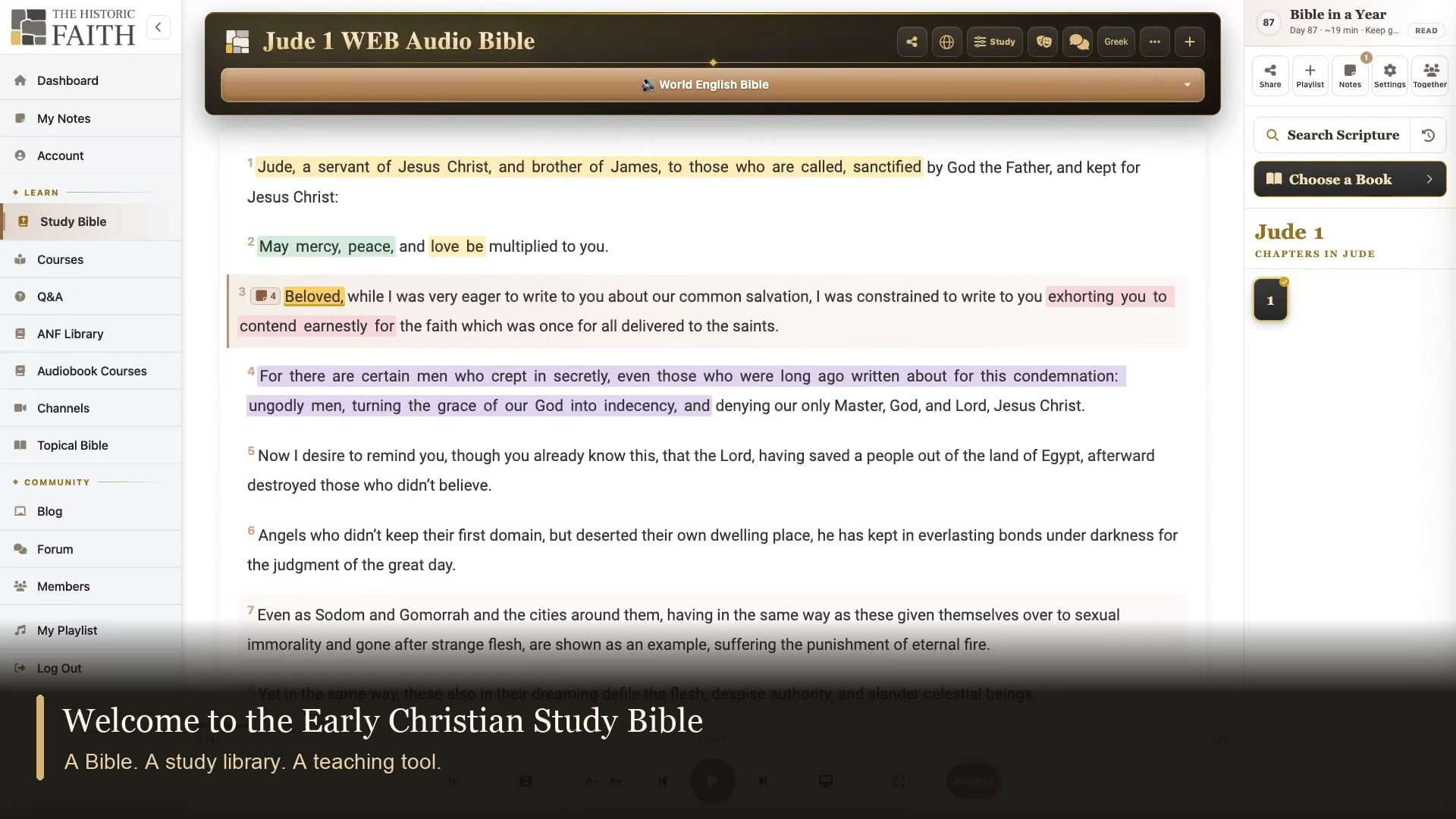 Words. Writings.
Guided tour · 21:50 · Several Bible editions.
See the phone experience · 5:31
Strong's Exhaustive Concordance, first published by James Strong in 1890, indexes every word of the King James Version and assigns each underlying original-language word a number — G1–G5624 for the Greek New Testament and H1–H8674 for the Hebrew Old Testament. Look up any English word, find its Strong's number, and see the Greek or Hebrew word behind it, its definition, and the verses where it occurs. This free online edition covers 14,298 entries with 767,764 indexed occurrences — including the Septuagint, deuterocanonical books, and 1 Enoch, which no print edition of Strong's includes.
These entry points are the quickest way to see how a Strong's number opens into a word, meaning, and Bible usage.
Greek agape, with New Testament and Septuagint usage links where indexed.
Greek kyrios, a major New Testament and Septuagint word-study bridge.
Hebrew reshith, the word behind “beginning” in Genesis 1:1 and other Old Testament usages.
Browse the local Greek and Hebrew Strong's entries in fast pages, open an exact number, or narrow the index by language, range, and usage count.
| Number | Word | Definition | Usages | Range |
|---|---|---|---|---|
|
H1577 — gamuwl
Hebrew
|
גָּמוּל (gamuwl)
gamuwl
|
gamuwl (gaw-mool') n/p. 1. rewarded 2. Gamul, an Israelite | 1 | H1001-H2000 |
|
H1578 — gmuwlah
Hebrew
|
גְּמוּלָה (gmuwlah)
gmuwlah
|
gmuwlah (ghem-oo-law') n-f. 1. meaning the same [feminine of H1576] | 3 | H1001-H2000 |
|
H1579 — Gimzow
Hebrew
|
גִּמזוֹ (Gimzow)
Gimzow
|
Gimzow (ghim-zo') n/l. 1. Gimzo, a place in Israel [of uncertain derivation] | 1 | H1001-H2000 |
|
H1580 — gamal
Hebrew
|
גָּמַל (gamal)
gamal
|
gamal (gaw-mal') v. 1. to treat a person (well or ill), i.e. benefit or requite 2. (by implication) (of toil), to ripen, i.e. (specifically) to wean | 32 | H1001-H2000 |
|
H1581 — gamal
Hebrew
|
גָּמָל (gamal)
gamal
|
gamal (gaw-mawl') n-e. 1. a camel [apparently from H1580 (in the sense of labor or burden-bearing)] | 51 | H1001-H2000 |
|
H1582 — Gmalliy
Hebrew
|
גְּמַלִּי (Gmalliy)
Gmalliy
|
Gmalliy (ghem-al-lee') n/p. 1. camel-driver 2. Gemalli, an Israelite | 1 | H1001-H2000 |
|
H1583 — Gamliy'el
Hebrew
|
גַּמלִיאֵל (Gamliy'el)
Gamliy'el
|
Gamliy'el (gam-lee-ale') n/p. 1. reward of God 2. Gamliel, an Israelite | 5 | H1001-H2000 |
|
H1584 — gamar
Hebrew
|
גָּמַר (gamar)
gamar
|
gamar (gaw-mar') v. 1. to end (in the sense of completion or failure) [a primitive root] | 5 | H1001-H2000 |
|
H1585 — gmar
Hebrew
|
גְּמַר (gmar)
gmar
|
gmar (ghem-ar') v. 1. perfect [(Aramaic) corresponding to H1584] | 1 | H1001-H2000 |
|
H1586 — Gomer
Hebrew
|
גּוֹמֶר (Gomer)
Gomer
|
Gomer (go'-mer) n/p. 1. completion 2. Gomer, the name of a son of Japheth and of his descendants | 6 | H1001-H2000 |
|
H1587 — Gmaryah
Hebrew
|
גְּמַריָה גְּמַריָהוּ (Gmaryah)
Gmaryah
|
Gmaryah (ghem-ar-yaw') (or Gmaryahuw {ghem-ar-yaw'-hoo}) n/p. 1. Jah has perfected 2. Gemarjah, the name of two Israelites | 5 | H1001-H2000 |
|
H1588 — gan
Hebrew
|
גַּן (gan)
gan
|
gan (gan) n-e. 1. a garden (as fenced) [from H1598] | 37 | H1001-H2000 |
|
H1589 — ganab
Hebrew
|
גָּנַב (ganab)
ganab
|
ganab (gaw-nab') v. 1. (literally or figuratively) to thieve 2. (by implication) to deceive | 36 | H1001-H2000 |
|
H1590 — gannab
Hebrew
|
גַּנָּב (gannab)
gannab
|
gannab (gaw-nab') n-m. 1. a stealer [from H1589] | 17 | H1001-H2000 |
|
H1591 — gnebah
Hebrew
|
גְּנֵבָה (gnebah)
gnebah
|
gnebah (ghen-ay-baw') n-f. 1. stealing 2. (concretely) something stolen | 2 | H1001-H2000 |
|
H1592 — Gnubath
Hebrew
|
גְּנוּבַת (Gnubath)
Gnubath
|
Gnubath (ghen-oo-bath') n/p. 1. theft 2. Genubath, an Edomitish prince | 1 | H1001-H2000 |
|
H1593 — gannah
Hebrew
|
גַּנָּה (gannah)
gannah
|
gannah (gan-naw') n-f. 1. a garden [feminine of H1588] | 12 | H1001-H2000 |
|
H1594 — ginnah
Hebrew
|
גִּנָּה (ginnah)
ginnah
|
ginnah (ghin-naw') n-f. 1. garden [another form for H1593] | 4 | H1001-H2000 |
|
H1595 — genez
Hebrew
|
גֶּנֶז (genez)
genez
|
genez (gheh'-nez) n-m. 1. treasure 2. (by implication) a coffer | 3 | H1001-H2000 |
|
H1596 — gnaz
Hebrew
|
גְּנַז (gnaz)
gnaz
|
gnaz (ghen-az') n-m. 1. treasure [(Aramaic) corresponding to H1595] | 3 | H1001-H2000 |
|
H1597 — ginzak
Hebrew
|
גִּנזַך (ginzak)
ginzak
|
ginzak (ghin-zak') n-m. 1. a treasury [prolonged from H1595] | 1 | H1001-H2000 |
|
H1598 — ganan
Hebrew
|
גָּנַן (ganan)
ganan
|
ganan (gaw-nan') v. 1. to hedge about 2. (generally) protect | 7 | H1001-H2000 |
|
H1599 — Ginnthown
Hebrew
|
גִּנְּתוֹן גִּנְּתוֹ (Ginnthown)
Ginnthown
|
Ginnthown (ghin-neth-one) (or Ginnthow {ghin-neth-o'}) n/p. 1. gardener 2. Ginnethon or Ginnetho, an Israelite | 3 | H1001-H2000 |
|
H1600 — ga`ah
Hebrew
|
גָּעָה (ga`ah)
ga`ah
|
ga`ah (gaw-aw') v. 1. to bellow (as cattle) [a primitive root] | 2 | H1001-H2000 |
|
H1601 — Go`ah
Hebrew
|
גּוֹעָה (Go`ah)
Go`ah
|
Go`ah (go-aw') n/l. 1. lowing 2. Goah, a place near Jerusalem | 1 | H1001-H2000 |
|
H1602 — ga`al
Hebrew
|
גָּעַל (ga`al)
ga`al
|
ga`al (gaw-al') v. 1. to detest 2. (by implication) to reject | 9 | H1001-H2000 |
|
H1603 — Ga`al
Hebrew
|
גַּעַל (Ga`al)
Ga`al
|
Ga`al (gah'-al) n/p. 1. loathing 2. Gaal, an Israelite | 9 | H1001-H2000 |
|
H1604 — go`al
Hebrew
|
גּוֹעַל (go`al)
go`al
|
go`al (go'-al) n-m. 1. abhorrence [from H1602] | 1 | H1001-H2000 |
|
H1605 — ga`ar
Hebrew
|
גָּעַר (ga`ar)
ga`ar
|
ga`ar (gaw-ar') v. 1. to chide [a primitive root] | 13 | H1001-H2000 |
|
H1606 — g`arah
Hebrew
|
גְּעָרָה (g`arah)
g`arah
|
g`arah (gheh-aw-raw') n-f. 1. a chiding [from H1605] | 14 | H1001-H2000 |
|
H1607 — ga`ash
Hebrew
|
גָּעַשׁ (ga`ash)
ga`ash
|
ga`ash (gaw-ash') v. 1. move, shake, toss, trouble [a primitive root to agitate violently] | 7 | H1001-H2000 |
|
H1608 — Ga`ash
Hebrew
|
גַּעַשׁ (Ga`ash)
Ga`ash
|
Ga`ash (ga'-ash) n/l. 1. a quaking 2. Gaash, a hill in Israel | 4 | H1001-H2000 |
|
H1609 — Ga`tam
Hebrew
|
גַּעתָּם (Ga`tam)
Ga`tam
|
Ga`tam (gah-tawm') n/p. 1. Gatam, an Edomite [of uncertain derivation] | 3 | H1001-H2000 |
|
H1610 — gaph
Hebrew
|
גַּף (gaph)
gaph
|
gaph (gaf) n-m. 1. the back 2. by extensive the body or self | 3 | H1001-H2000 |
|
H1611 — gaph
Hebrew
|
גַּף (gaph)
gaph
|
gaph (gaf) n-f. 1. a wing [(Aramaic) corresponding to H1610] | 2 | H1001-H2000 |
|
H1612 — gephen
Hebrew
|
גֶּפֶן (gephen)
gephen
|
gephen (gheh'-fen) n-m. 1. a vine (as twining), especially the grape [from an unused root meaning to bend] | 53 | H1001-H2000 |
|
H1613 — gopher
Hebrew
|
גּוֹפֶר (gopher)
gopher
|
gopher (go'-fer) n-m. 1. a kind of tree or wood (as used for building), apparently the cypress [from an unused root, probably meaning to house in] | 1 | H1001-H2000 |
|
H1614 — gophriyth
Hebrew
|
גָּפרִיתּ (gophriyth)
gophriyth
|
gophriyth (gof-reeth') n-f. 1. (properly) cypress- resin 2. by analogy, sulphur (as equally inflammable) | 7 | H1001-H2000 |
|
H1615 — gir
Hebrew
|
גִּר (gir)
gir
|
gir (gheer) n-m. 1. lime (from being burned in a kiln) [perhaps from H3564] | 1 | H1001-H2000 |
|
H1616 — ger
Hebrew
|
גֵּר גֵּיר (ger)
ger
|
ger (gare) (or (fully) geyr (gare)) n-m. 1. (properly) a guest 2. (by implication) a foreigner | 83 | H1001-H2000 |
|
H1617 — Gera'
Hebrew
|
גֵּרָא (Gera')
Gera'
|
Gera' (gay-raw') n/p. 1. a grain 2. Gera, the name of six Israelites | 9 | H1001-H2000 |
|
H1618 — garab
Hebrew
|
גָּרָב (garab)
garab
|
garab (gaw-rawb') n-m. 1. scurf (from itching) [from an unused root meaning to scratch] | 3 | H1001-H2000 |
|
H1619 — Gareb
Hebrew
|
גָּרֵב (Gareb)
Gareb
|
Gareb (gaw-rabe') n/l. 1. scabby 2. Gareb, the name of an Israelite, also of a hill near Jerusalem | 3 | H1001-H2000 |
|
H1620 — gargar
Hebrew
|
גַּרגַּר (gargar)
gargar
|
gargar (gar-gar') n-m. 1. a berry (as if a pellet of rumination) [by reduplication from H1641] | 1 | H1001-H2000 |
|
H1621 — gargrowth
Hebrew
|
גַּרגְּרוֹת (gargrowth)
gargrowth
|
gargrowth (gar-gher-owth') n-f. 1. the throat (as used in rumination) [feminine plural from H1641] | 4 | H1001-H2000 |
|
H1622 — Girgashiy
Hebrew
|
גִּרגָּשִׁי (Girgashiy)
Girgashiy
|
Girgashiy (ghir-gaw-shee') adj. 1. a Girgashite, one of the native tribes of Canaan [patrial from an unused name (of uncertain derivation)] | 7 | H1001-H2000 |
|
H1623 — garad
Hebrew
|
גָּרַד (garad)
garad
|
garad (gaw-rad') v. 1. to abrade [a primitive root] | 1 | H1001-H2000 |
|
H1624 — garah
Hebrew
|
גָּרָה (garah)
garah
|
garah (gaw-raw') v. 1. (properly) to grate, i.e. (figuratively) to anger [a primitive root] | 13 | H1001-H2000 |
|
H1625 — gerah
Hebrew
|
גֵּרָה (gerah)
gerah
|
gerah (gay-raw') n-f. 1. the cud (as scraping the throat) [from H1641] | 9 | H1001-H2000 |
|
H1626 — gerah
Hebrew
|
גֵּרָה (gerah)
gerah
|
gerah (gay-raw') n-f. 1. (properly) (like H1620) a kernel (round as if scraped), i.e. a gerah or small weight (and coin) [from H1641 (as in H1625)] | 5 | H1001-H2000 |
|
H1627 — garown
Hebrew
|
גָּרוֹן גָּרוֹן (garown)
garown
|
garown (gaw-rone') (or (shortened) garon {gaw-rone'}) n-m. 1. the throat (as roughened by swallowing) [from H1641] | 8 | H1001-H2000 |
|
H1628 — geruwth
Hebrew
|
גֵּרוּת (geruwth)
geruwth
|
geruwth (gay-rooth') n-f. 1. a (temporary) residence [from H1481] | 1 | H1001-H2000 |
|
H1629 — garaz
Hebrew
|
גָּרַז (garaz)
garaz
|
garaz (gaw-raz') v. 1. to cut off [a primitive root] | 1 | H1001-H2000 |
|
H1630 — Griziym
Hebrew
|
גְּרִזִים (Griziym)
Griziym
|
Griziym (gher-ee-zeem') n/l. 1. Gerizim, a mountain of Israel [plural of an unused noun from H1629, cut up (i.e. rocky)] | 4 | H1001-H2000 |
|
H1631 — garzen
Hebrew
|
גַּרזֶן (garzen)
garzen
|
garzen (gar-zen') n-m. 1. an axe [from H1629] | 4 | H1001-H2000 |
|
H1632 — garol
Hebrew
|
גָּרוֹל (garol)
garol
|
garol (gaw-role') adj. 1. harsh [from the same as H1486] | 1 | H1001-H2000 |
|
H1633 — garam
Hebrew
|
גָּרַם (garam)
garam
|
garam (gaw-ram') v. 1. (causative) to bone, i.e. denude (by extensive, craunch) the bones [a primitive root, to be spare or skeleton-like; used only as a denominative from H1634] | 3 | H1001-H2000 |
|
H1634 — gerem
Hebrew
|
גֶּרֶם (gerem)
gerem
|
gerem (gheh'-rem) n-m. 1. a bone (as the skeleton of the body) 2. (hence) self, i.e. (figuratively) very | 5 | H1001-H2000 |
|
H1635 — gerem
Hebrew
|
גֶּרֶם (gerem)
gerem
|
gerem (gheh'-rem) n-m. 1. a bone [(Aramaic) corresponding to H1634] | 1 | H1001-H2000 |
|
H1636 — Garmiy
Hebrew
|
גַּרמִי (Garmiy)
Garmiy
|
Garmiy (gar-mee') adj. 1. bony, i.e. strong [from H1634] | 1 | H1001-H2000 |
|
H1637 — goren
Hebrew
|
גּוֹרֶן (goren)
goren
|
goren (go'-ren) n-m. 1. a threshing- floor (as made even) 2. by analogy, any open area | 36 | H1001-H2000 |
|
H1638 — garac
Hebrew
|
גָּרַס (garac)
garac
|
garac (gaw-ras') v. 1. to crush 2. (intransitively and figuratively) to dissolve | 2 | H1001-H2000 |
|
H1639 — gara`
Hebrew
|
גָּרַע (gara`)
gara`
|
gara` (gaw-rah') v. 1. to scrape off 2. (by implication) to shave, remove, lessen, withhold | 21 | H1001-H2000 |
|
H1640 — garaph
Hebrew
|
גָּרַף (garaph)
garaph
|
garaph (gaw-raf') v. 1. to bear off violently [a primitive root] | 1 | H1001-H2000 |
|
H1641 — garar
Hebrew
|
גָּרַר (garar)
garar
|
garar (gaw-rar') v. 1. to drag off roughly 2. (by implication) to bring up the cud (i.e. ruminate) | 5 | H1001-H2000 |
|
H1642 — Grar
Hebrew
|
גְּרָר (Grar)
Grar
|
Grar (gher-awr') n/l. 1. a rolling country 2. Gerar, a Philistine city | 10 | H1001-H2000 |
|
H1643 — geres
Hebrew
|
גֶּרֶשׂ (geres)
geres
|
geres (gheh'-res) n-m. 1. a kernel (collectively), i.e. grain [from an unused root meaning to husk] | 2 | H1001-H2000 |
|
H1644 — garash
Hebrew
|
גָּרַשׁ (garash)
garash
|
garash (gaw-rash') v. 1. to drive out from a possession 2. especially to expatriate or divorce | 44 | H1001-H2000 |
|
H1645 — geresh
Hebrew
|
גֶּרֶשׁ (geresh)
geresh
|
geresh (gheh'-resh) n-m. 1. produce (as if expelled) [from H1644] | 1 | H1001-H2000 |
|
H1646 — grushah
Hebrew
|
גְּרוּשָׁה (grushah)
grushah
|
grushah (gher-oo-shaw') n-f. 1. (abstractly) dispossession [feminine passive participle of H1644] | 1 | H1001-H2000 |
|
H1647 — Gershom
Hebrew
|
גֵּרְשׁוֹם (Gershom)
Gershom
|
Gershom (gay-resh-ome') n/p. 1. Gereshom, the name of four Israelites [for H1648] | 13 | H1001-H2000 |
|
H1648 — Gershown
Hebrew
|
גֵּרְשׁוֹן גֵּרְשׁוֹם (Gershown)
Gershown
|
Gershown (gay-resh-one') (or Gershowm {gay-resh-ome'}) n/p. 1. a refugee 2. Gereshon or Gereshom, an Israelite | 18 | H1001-H2000 |
|
H1649 — Gershunniy
Hebrew
|
גֵּרְשׁוּנִּי (Gershunniy)
Gershunniy
|
Gershunniy (gay-resh-oon-nee') adj. 1. a Gereshonite or descendant of Gereshon [patronymically from H1648] | 12 | H1001-H2000 |
|
H1650 — Gshuwr
Hebrew
|
גְּשׁוּר (Gshuwr)
Gshuwr
|
Gshuwr (ghesh-oor') n/p. 1. bridge 2. Geshur, a district of Syria | 9 | H1001-H2000 |
|
H1651 — Gshuwriy
Hebrew
|
גְּשׁוּרִי (Gshuwriy)
Gshuwriy
|
Gshuwriy (ghe-shoo-ree') adj. 1. a Geshurite (also collectively) or inhabitants of Geshur [patrial from H1650] | 6 | H1001-H2000 |
|
H1652 — gasham
Hebrew
|
גָּשַׁם (gasham)
gasham
|
gasham (gaw-sham') v. 1. to shower violently [a primitive root] | 1 | H1001-H2000 |
|
H1653 — geshem
Hebrew
|
גֶּשֶׁם (geshem)
geshem
|
geshem (gheh'-shem) n-m. 1. a shower [from H1652] | 33 | H1001-H2000 |
|
H1654 — Geshem
Hebrew
|
גֶּשֶׁם גַּשׁמוּ (Geshem)
Geshem
|
Geshem (gheh'-shem) (or (prolonged) Gashmuw {gash-moo'}) n/p. 1. Geshem or Gashmu, an Arabian [the same as H1653] | 4 | H1001-H2000 |
|
H1655 — geshem
Hebrew
|
גֶּשֶׁם (geshem)
geshem
|
geshem (gheh'-shem) n-m. 1. the body {used in a peculiar sense, probably for the figurative idea of a hard rain.} | 5 | H1001-H2000 |
|
H1656 — goshem
Hebrew
|
גּוֹשֶׁם (goshem)
goshem
|
goshem (go'-shem) n-m. 1. equivalent to H1653 [from H1652] | 1 | H1001-H2000 |
|
H1657 — Goshen
Hebrew
|
גּוֹשֶׁן (Goshen)
Goshen
|
Goshen (go'-shen) n/l. 1. Goshen, the residence of the Israelites in Egypt 2. also a place in Israel | 14 | H1001-H2000 |
|
H1658 — Gishpa'
Hebrew
|
גִּשׁפָּא (Gishpa')
Gishpa'
|
Gishpa' (ghish-paw') n/p. 1. Gishpa, an Israelite [of uncertain derivation] | 1 | H1001-H2000 |
|
H1659 — gashash
Hebrew
|
גָּשַׁשׁ (gashash)
gashash
|
gashash (gaw-shash') v. 1. apparently to feel about [a primitive root] | 1 | H1001-H2000 |
|
H1660 — gath
Hebrew
|
גַּת (gath)
gath
|
gath (gath) n-f. 1. a wine-press (or vat for holding the grapes in pressing them) [probably from H5059 (in the sense of treading out grapes)] | 5 | H1001-H2000 |
|
H1661 — Gath
Hebrew
|
גַּת (Gath)
Gath
|
Gath (gath) n/l. 1. Gath, a Philistine city [the same as H1660] | 30 | H1001-H2000 |
|
H1662 — Gath-ha-Chepher
Hebrew
|
גַּת ־ הַחֵפֶר גִּתּתָּה ־ חֵפֶר (Gath-ha-Chepher)
Gath-ha-Chepher
|
Gath-ha-Chepher (gath-hah-khay'-fer) (or (abridged) Gittah-Chepher {ghit-taw-khay'-fer}) n/l. 1. Gath-Chepher, a place in Israel [from H1660 and H2658 with the article inserted; wine- press of (the) well] | 2 | H1001-H2000 |
|
H1663 — Gittiy
Hebrew
|
גִּתּתִּי (Gittiy)
Gittiy
|
Gittiy (ghit-tee') adj. 1. a Gittite or inhabitant of Gath [patrial from H1661] | 10 | H1001-H2000 |
|
H1664 — Gittayim
Hebrew
|
גִּתּתַּיִם (Gittayim)
Gittayim
|
Gittayim (ghit-tah'-yim) n/l. 1. double wine-press 2. Gittajim, a place in Israel | 2 | H1001-H2000 |
|
H1665 — Gittiyth
Hebrew
|
גִּתּתִּיתּ (Gittiyth)
Gittiyth
|
Gittiyth (ghit-teeth') n-f. 1. a Gittite harp [feminine of H1663] | 0 | H1001-H2000 |
|
H1666 — Gether
Hebrew
|
גֶּתֶר (Gether)
Gether
|
Gether (gheh'-ther) n/p. 1. Gether, a son of Aram, and the region settled by him [of uncertain derivation] | 2 | H1001-H2000 |
|
H1667 — Gath-Rimmown
Hebrew
|
גַּת ־ רִמּוֹן (Gath-Rimmown)
Gath-Rimmown
|
Gath-Rimmown (gath-rim-mone') n/l. 1. wine-press of (the) pomegranate 2. Gath-Rimmon, a place in Israel | 4 | H1001-H2000 |
|
H1668 — da'
Hebrew
|
דָּא (da')
da'
|
da' (daw) p/d. 1. this [(Aramaic) corresponding to H2088] | 4 | H1001-H2000 |
|
H1669 — da'ab
Hebrew
|
דָּאַב (da'ab)
da'ab
|
da'ab (daw-ab') v. 1. to pine [a primitive root] | 3 | H1001-H2000 |
|
H1670 — d'abah
Hebrew
|
דְּאָבָה (d'abah)
d'abah
|
d'abah (deh-aw-baw') n-f. 1. (properly) pining 2. by analogy, fear | 1 | H1001-H2000 |
|
H1671 — d'abown
Hebrew
|
דְּאָבוֹן (d'abown)
d'abown
|
d'abown (deh-aw-bone') n-m. 1. pining [from H1669] | 1 | H1001-H2000 |
|
H1672 — da'ag
Hebrew
|
דָּאַג (da'ag)
da'ag
|
da'ag (daw-ag') v. 1. be anxious [a primitive root] | 7 | H1001-H2000 |
|
H1673 — Do'eg
Hebrew
|
דּוֹאֵג דּוֹאֵג (Do'eg)
Do'eg
|
Do'eg (do-ayg') (or (fully) Dowoeg {do-ayg'}) n/p. 1. anxious 2. Doeg, an Edomite | 4 | H1001-H2000 |
|
H1674 — d'agah
Hebrew
|
דְּאָגָה (d'agah)
d'agah
|
d'agah (deh-aw-gaw') n-f. 1. anxiety [from H1672] | 6 | H1001-H2000 |
|
H1675 — da'ah
Hebrew
|
דָּאָה (da'ah)
da'ah
|
da'ah (daw-aw') v. 1. to dart, i.e. fly rapidly [a primitive root] | 4 | H1001-H2000 |
|
H1676 — da'ah
Hebrew
|
דָּאָה (da'ah)
da'ah
|
da'ah (daw-aw') n-f. 1. the kite (from its rapid flight) [from H1675] | 1 | H1001-H2000 |
|
H1677 — dob
Hebrew
|
דּוֹב דּוֹב (dob)
dob
|
dob (dobe) (or (fully) dowb {dobe}) n-e. 1. the bear (as slow) [from H1680] | 12 | H1001-H2000 |
|
H1678 — dob
Hebrew
|
דּוֹב (dob)
dob
|
dob (dobe) n-m. 1. bear [(Aramaic) corresponding to H1677] | 1 | H1001-H2000 |
|
H1679 — dobe'
Hebrew
|
דּוֹבֶא (dobe')
dobe'
|
dobe' (do'-beh) n-m. 1. quiet [from an unused root (probably meaning to be sluggish, i.e. restful)] | 1 | H1001-H2000 |
|
H1680 — dabab
Hebrew
|
דָּבַב (dabab)
dabab
|
dabab (daw-bab') v. 1. to move slowly, i.e. glide [a primitive root] | 1 | H1001-H2000 |
|
H1681 — dibbah
Hebrew
|
דִּבָּה (dibbah)
dibbah
|
dibbah (dib-baw') n-f. 1. slander [from H1680 (in the sense of furtive motion)] | 9 | H1001-H2000 |
|
H1682 — dbowrah
Hebrew
|
דְּבוֹרָה דֶּבוֹרָה (dbowrah)
dbowrah
|
dbowrah (deb-o-raw') (or (shortened) dborah {deb-o-raw'}) n-f. 1. the bee (from its systematic instincts) [from H1696 (in the sense of orderly motion)] | 4 | H1001-H2000 |
|
H1683 — Dbowrah
Hebrew
|
דְּבוֹרָה דֶּבוֹרָה (Dbowrah)
Dbowrah
|
Dbowrah (deb-o-raw') (or (shortened) Dborah {deb-o-raw'}) n/p. 1. Deborah, the name of two Hebrewesses [the same as H1682] | 10 | H1001-H2000 |
|
H1684 — dbach
Hebrew
|
דְּבַח (dbach)
dbach
|
dbach (deb-akh') v. 1. to sacrifice (an animal) [(Aramaic) corresponding to H2076] | 1 | H1001-H2000 |
|
H1685 — dbach
Hebrew
|
דְּבַח (dbach)
dbach
|
dbach (deb-akh') n-m. 1. a sacrifice [(Aramaic) from H1684] | 1 | H1001-H2000 |
|
H1686 — dibyown
Hebrew
|
דִּביוֹן חֶריוֹן (dibyown)
dibyown
|
dibyown (dib-yone') (in the margin for the textual reading, cheryown {kher-yone'} (both in the plural only)) n-m. 1. probably some cheap vegetable, perhaps a bulbous root [of uncertain derivation] | 0 | H1001-H2000 |
|
H1687 — dbiyr
Hebrew
|
דְּבִיר דֶּבִר (dbiyr)
dbiyr
|
dbiyr (deb-eer') (or (shortened) dbir {deb-eer'}) n-m. 1. the shrine or innermost part of the sanctuary [from H1696 (apparently in the sense of oracle)] | 16 | H1001-H2000 |
|
H1688 — Dbiyr
Hebrew
|
דְּבִיר דְּבִר (Dbiyr)
Dbiyr
|
Dbiyr (deb-eer') (or (shortened) Dbir (Josh. 13)) n/l. 1. Debir, the name of an Amoritish king and of two places in Israel [the same as H1687] | 12 | H1001-H2000 |
|
H1689 — Diblah
Hebrew
|
דִּבלָה (Diblah)
Diblah
|
Diblah (dib-law') n/l. 1. Diblah, a place in Syria [probably an orthographical error for H7247] | 1 | H1001-H2000 |
|
H1690 — dbelah
Hebrew
|
דְּבֵלָה (dbelah)
dbelah
|
dbelah (deb-ay-law') n-f. 1. a cake of pressed figs [from an unused root (akin to H2082) probably meaning to press together] | 5 | H1001-H2000 |
|
H1691 — Diblayim
Hebrew
|
דִּבלַיִם (Diblayim)
Diblayim
|
Diblayim (dib-lah'-yim) n/p. 1. two cakes 2. Diblajim, a symbolic name | 1 | H1001-H2000 |
|
H1692 — dabaq
Hebrew
|
דָּבַק (dabaq)
dabaq
|
dabaq (daw-bak') v. 1. (properly) to impinge, i.e. cling or adhere 2. (figuratively) to catch by pursuit | 52 | H1001-H2000 |
|
H1693 — dbaq
Hebrew
|
דְּבַק (dbaq)
dbaq
|
dbaq (deb-ak') v. 1. to stick to [(Aramaic) corresponding to H1692] | 1 | H1001-H2000 |
|
H1694 — debeq
Hebrew
|
דֶּבֶק (debeq)
debeq
|
debeq (deh'-bek) n-m. 1. a joint 2. (by implication) solder | 3 | H1001-H2000 |
|
H1695 — dabeq
Hebrew
|
דָּבֵק (dabeq)
dabeq
|
dabeq (daw-bake') adj. 1. adhering [from H1692] | 3 | H1001-H2000 |
|
H1696
Hebrew
|
וַיְדַבֵּ֥ר
|
dabar (daw-bar') v. 1. perhaps properly, to arrange 2. but used figuratively (of words), to speak | 1,049 | H1001-H2000 |
|
H1697
Hebrew
|
וּדְבָרִ֖ים
|
dabar (daw-baw') n-m. 1. a word 2. (by implication) a matter (as spoken of) or thing | 1,287 | H1001-H2000 |
|
H1698 — deber
Hebrew
|
דֶּבֶר (deber)
deber
|
deber (deh'-ber) n-m. 1. a pestilence [from H1696 (in the sense of destroying)] | 48 | H1001-H2000 |
|
H1699 — dober
Hebrew
|
דּוֹבֶר דִּבֵּר (dober)
dober
|
dober (do'-ber) n-m. 1. a pasture (from its arrangement of the flock) [from H1696 (in its original sense)] | 3 | H1001-H2000 |
|
H1700 — dibrah
Hebrew
|
דִּברָה (dibrah)
dibrah
|
dibrah (dib-raw') n-m. 1. a reason, suit or style [feminine of H1697] | 5 | H1001-H2000 |
|
H1701 — dibrah
Hebrew
|
דִּברָה (dibrah)
dibrah
|
dibrah (dib-raw') n-f. 1. intent, sake [(Aramaic) corresponding to H1700] | 2 | H1001-H2000 |
|
H1702 — dobrah
Hebrew
|
דּוֹבְרָה (dobrah)
dobrah
|
dobrah (do-ber-aw') n-f. 1. a raft [feminine active participle of H1696 in the sense of driving] | 1 | H1001-H2000 |
|
H1703 — dabbarah
Hebrew
|
דַּבָּרָה (dabbarah)
dabbarah
|
dabbarah (dab-baw-raw') n-f. 1. a word [intensive from H1696] | 1 | H1001-H2000 |
|
H1704 — Dibriy
Hebrew
|
דִּברִי (Dibriy)
Dibriy
|
Dibriy (dib-ree') n/p. 1. wordy 2. Dibri, an Israelite | 1 | H1001-H2000 |
|
H1705 — Dabrath
Hebrew
|
דָּבְרַת (Dabrath)
Dabrath
|
Dabrath (daw-ber-ath') n/l. 1. Daberath, a place in Israel [from H1697 (perhaps in the sense of H1699)] | 3 | H1001-H2000 |
|
H1706 — dbash
Hebrew
|
דְּבַשׁ (dbash)
dbash
|
dbash (deb-ash') n-m. 1. honey (from its stickiness) 2. by analogy, syrup | 54 | H1001-H2000 |
|
H1707 — dabbesheth
Hebrew
|
דַּבֶּשֶׁת (dabbesheth)
dabbesheth
|
dabbesheth (dab-beh'-sheth) n-f. 1. a sticky mass, i.e. the hump of a camel [intensive from the same as H1706] | 1 | H1001-H2000 |
|
H1708 — Dabbesheth
Hebrew
|
דַּבֶּשֶׁת (Dabbesheth)
Dabbesheth
|
Dabbesheth (dab-beh'-sheth) n/l. 1. Dabbesheth, a place in Israel [the same as H1707] | 1 | H1001-H2000 |
|
H1709 — dag
Hebrew
|
דָּג דָּאגּ (dag)
dag
|
dag (dawg) (or (fully) dag (Nehemiah 13:16)) n-m. 1. a fish (as prolific) 2. or perhaps rather from H1672 (as timid) | 18 | H1001-H2000 |
|
H1710 — dagah
Hebrew
|
דָּגָה (dagah)
dagah
|
dagah (daw-gaw') n-f. 1. fish [feminine of H1709, and meaning the same] | 13 | H1001-H2000 |
|
H1711 — dagah
Hebrew
|
דָּגָה (dagah)
dagah
|
dagah (daw-gaw') v. 1. to spawn, i.e. become numerous [a primitive root, to move rapidly; used only as a denominative from H1709] | 1 | H1001-H2000 |
|
H1712 — Dagown
Hebrew
|
דָּגוֹן (Dagown)
Dagown
|
Dagown (daw-gohn') n/p. 1. the fish-god 2. Dagon, a Philistine deity | 7 | H1001-H2000 |
|
H1713 — dagal
Hebrew
|
דָּגַל (dagal)
dagal
|
dagal (daw-gal') v. 1. to flaunt, i.e. raise a flag 2. (figuratively) to be conspicuous | 4 | H1001-H2000 |
|
H1714 — degel
Hebrew
|
דֶּגֶל (degel)
degel
|
degel (deh'-gel) n-m. 1. a flag [from H1713] | 14 | H1001-H2000 |
|
H1715 — dagan
Hebrew
|
דָּגָן (dagan)
dagan
|
dagan (daw-gawn') n-m. 1. (properly) increase, i.e. grain [from H1711] | 40 | H1001-H2000 |
|
H1716 — dagar
Hebrew
|
דָּגַר (dagar)
dagar
|
dagar (daw-gar') v. 1. gather, sit [a primitive root, to brood over eggs or young] | 2 | H1001-H2000 |
|
H1717 — dad
Hebrew
|
דַּד (dad)
dad
|
dad (dad) n-m. 1. the breast (as the seat of love, or from its shape) [apparently from the same as H1730] | 4 | H1001-H2000 |
|
H1718 — dadah
Hebrew
|
דָּדָה (dadah)
dadah
|
dadah (daw-daw') v. 1. to walk gently [a doubtful root] | 2 | H1001-H2000 |
|
H1719 — Ddan
Hebrew
|
דְּדָן דֶּדָנֶה (Ddan)
Ddan
|
Ddan (ded-awn') (or (prolonged) Ddaneh (Ezekiel 25:13)) n/l. 1. Dedan, the name of two Cushites and of their territory [of uncertain derivation] | 10 | H1001-H2000 |
|
H1720 — Ddaniym
Hebrew
|
דְּדָנִים (Ddaniym)
Ddaniym
|
Ddaniym (ded-aw-neem') adj. 1. Dedanites, the descendants or inhabitants of Dedan [plural of H1719 (as patrial)] | 1 | H1001-H2000 |
|
H1721 — Dodaniym
Hebrew
|
דּוֹדָנִים רוֹדָנִים (Dodaniym)
Dodaniym
|
Dodaniym (do-daw-neem') (or (by orthographical error) Rodaniym (1 Chronicles 1:7)) n/p. 1. Dodanites, or descendants of a son of Javan [a plural of uncertain derivation] | 2 | H1001-H2000 |
|
H1722 — dhab
Hebrew
|
דְּהַב (dhab)
dhab
|
dhab (deh-hab') n-m. 1. gold [(Aramaic) corresponding to H2091] | 23 | H1001-H2000 |
|
H1723 — Dahava`
Hebrew
|
דַּהֲוָא (Dahava`)
Dahava`
|
Dahava` (dah-hav-aw') n/g. 1. Dahava, a people colonized in Samaria [(Aramaic) of uncertain derivation] | 1 | H1001-H2000 |
|
H1724 — daham
Hebrew
|
דָּהַם (daham)
daham
|
daham (daw-ham') v. 1. to be dumb, i.e. (figuratively) dumbfounded [a primitive root] | 1 | H1001-H2000 |
|
H1725 — dahar
Hebrew
|
דָּהַר (dahar)
dahar
|
dahar (daw-har') v. 1. to curvet or move irregularly [a primitive root] | 1 | H1001-H2000 |
|
H1726 — dahahar
Hebrew
|
דַּהֲהַר (dahahar)
dahahar
|
dahahar (dah-hah-har') n-f. 1. a gallop [by reduplication from H1725] | 1 | H1001-H2000 |
No Strong's entries match that search.
Strong's works best when the number, original word, verse, and corpus stay connected.
Open a chapter and move from a word token to its Strong's page, parsing, and linked occurrences.
Greek Strong's entries can include New Testament, Septuagint, deuterocanonical, and 1 Enoch rows where indexed.
Dedicated Strong's pages can expose approved pronunciation audio beside the word-study data.
These are common words readers run into repeatedly, shown with an English meaning so the list is readable without already knowing the original languages.
Look up a word study by its transliteration — these are frequently searched Hebrew and Greek words. Each opens the matching Strong's entry, or lists the options when a spelling maps to several words.