
G26 — Agape (Love)
Greek agape, with New Testament and Septuagint usage links where indexed.
The Early Christian Study Bible · Free to use
Study the word. Hear its pronunciation.
Search 14,298 Greek and Hebrew entries—free. Explore definitions, indexed occurrences, and pronunciation audio where available, then follow the words back into your Bible.
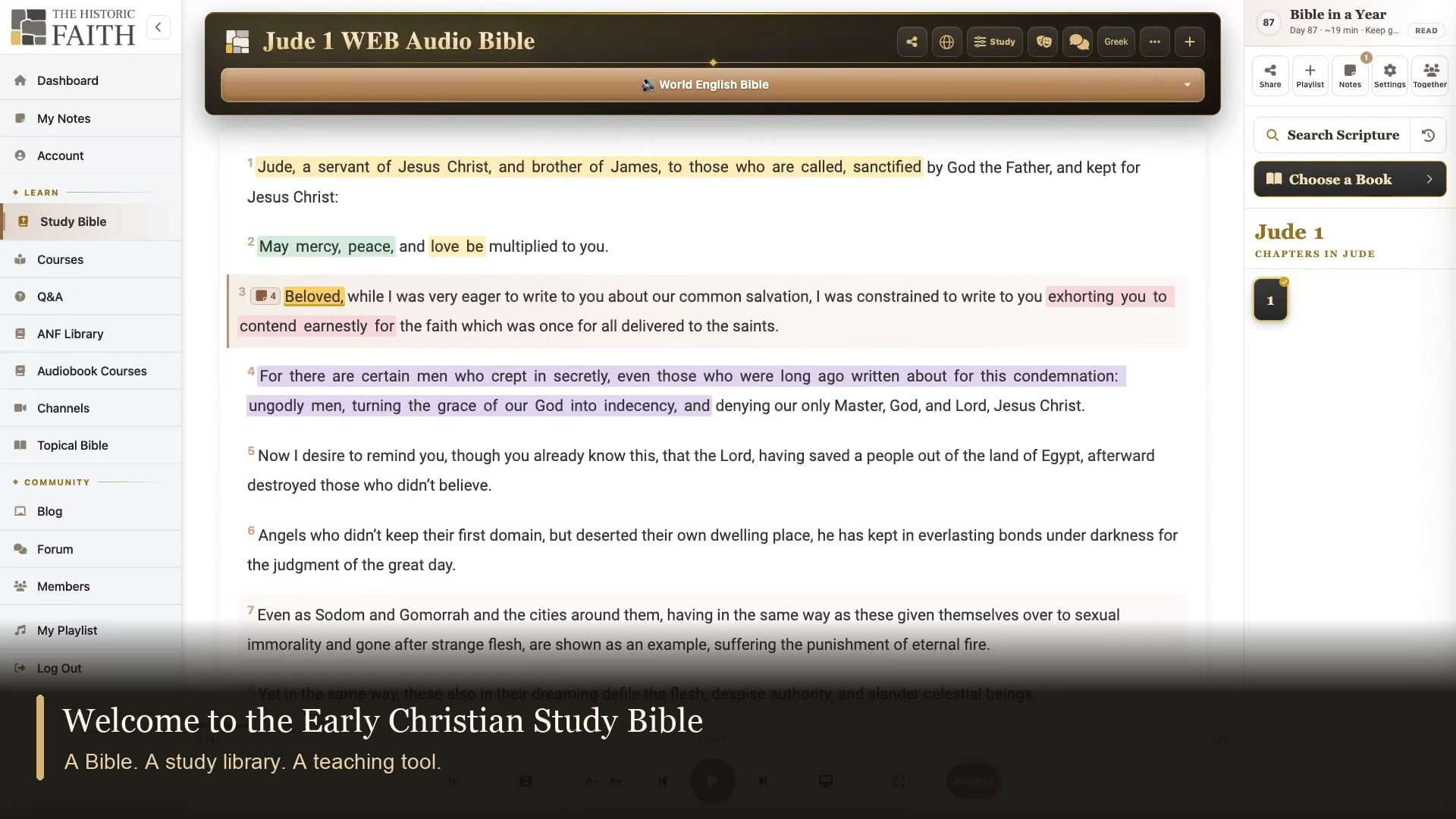
Click a word. Hear its pronunciation. Open the early Christian writings. Then see how to present and teach.
 Words. Writings.
Guided tour · 21:50 · Several Bible editions.
See the phone experience · 5:31
Strong's Exhaustive Concordance, first published by James Strong in 1890, indexes every word of the King James Version and assigns each underlying original-language word a number — G1–G5624 for the Greek New Testament and H1–H8674 for the Hebrew Old Testament. Look up any English word, find its Strong's number, and see the Greek or Hebrew word behind it, its definition, and the verses where it occurs. This free online edition covers 14,298 entries with 767,764 indexed occurrences — including the Septuagint, deuterocanonical books, and 1 Enoch, which no print edition of Strong's includes.
These entry points are the quickest way to see how a Strong's number opens into a word, meaning, and Bible usage.
Greek agape, with New Testament and Septuagint usage links where indexed.
Greek kyrios, a major New Testament and Septuagint word-study bridge.
Hebrew reshith, the word behind “beginning” in Genesis 1:1 and other Old Testament usages.
Browse the local Greek and Hebrew Strong's entries in fast pages, open an exact number, or narrow the index by language, range, and usage count.
| Number | Word | Definition | Usages | Range |
|---|---|---|---|---|
|
H977 — bachar
Hebrew
|
בָּחַר (bachar)
bachar
|
bachar (baw-khar') v. 1. (properly) to try 2. (by implication) select | 162 | H1-H1000 |
|
H978 — Bacharuwmiy
Hebrew
|
בַּחֲרוּמִי (Bacharuwmiy)
Bacharuwmiy
|
Bacharuwmiy (bakh-ar-oo-mee') adj. 1. a Bacharumite or inhabitant of Bachurim [patrial from H980 (by transposition)] | 1 | H1-H1000 |
|
H979 — bchurowth
Hebrew
|
בְּחוּרוֹת בְּחוּרוֹת בְּחוּרִים (bchurowth)
bchurowth
|
bchurowth (bekh-oo-rothe') (or bchuwrowth {bekh-oo-roth'}) n-f. 1. youth (collectively and abstractly) [feminine plural of H970; also (masculine plural) bchuriym {bekh-oo-reem'}] | 3 | H1-H1000 |
|
H980 — Bachuriym
Hebrew
|
בַּחוּרִים בַּחוּרִים (Bachuriym)
Bachuriym
|
Bachuriym (bakh-oo-reem') (or Bachuwriym {bakh-oo-reem'}) n/l. 1. young men 2. Bachurim, a place in Israel | 5 | H1-H1000 |
|
H981 — bata'
Hebrew
|
בָּטָא בָּטָה (bata')
bata'
|
bata' (baw-taw') (or batah {baw-taw'}) v. 1. to babble 2. (hence) to vociferate angrily | 3 | H1-H1000 |
|
H982 — batach
Hebrew
|
בָּטַח (batach)
batach
|
batach (baw-takh') v. 1. (properly) to hie for refuge (but not so precipitately as H2620) 2. (figuratively) to trust, be confident or sure | 117 | H1-H1000 |
|
H983 — betach
Hebrew
|
בֶּטַח (betach)
betach
|
betach (beh'takh) n-m. 1. (properly) a place of refuge 2. (abstract) safety, both the fact (security) and the feeling (trust) | 41 | H1-H1000 |
|
H984 — Betach
Hebrew
|
בֶּטַח (Betach)
Betach
|
Betach (beh'takh) n/l. 1. Betach, a place in Syria [the same as H983] | 1 | H1-H1000 |
|
H985 — bitchah
Hebrew
|
בִּטחָה (bitchah)
bitchah
|
bitchah (bit-khaw') n-f. 1. trust [feminine of H984] | 1 | H1-H1000 |
|
H986 — bittachown
Hebrew
|
בִּטָּחוֹן (bittachown)
bittachown
|
bittachown (bit-taw-khone') n-m. 1. trust [from H982] | 3 | H1-H1000 |
|
H987 — battuchowth
Hebrew
|
בַּטּוּחוֹת (battuchowth)
battuchowth
|
battuchowth (bat-too-khoth') n-f. 1. security [feminine plural from H982] | 1 | H1-H1000 |
|
H988 — batel
Hebrew
|
בָּטֵל (batel)
batel
|
batel (baw-tale') v. 1. to desist from labor [a primitive root] | 1 | H1-H1000 |
|
H989 — btel
Hebrew
|
בְּטֵל (btel)
btel
|
btel (bet-ale') v. 1. to stop [(Aramaic) corresponding to H988] | 5 | H1-H1000 |
|
H990 — beten
Hebrew
|
בֶּטֶן (beten)
beten
|
beten (beh'-ten) n-f. 1. the belly, especially the womb 2. also the bosom or body of anything | 72 | H1-H1000 |
|
H991 — Beten
Hebrew
|
בֶּטֶן (Beten)
Beten
|
Beten (beh'-ten) n/l. 1. Beten. a place in Israel [the same as H990] | 1 | H1-H1000 |
|
H992 — boten
Hebrew
|
בּוֹטֶן (boten)
boten
|
boten (bo'-ten) n-m. 1. (only in plural) a pistachio-nut (from its form) [from H990] | 1 | H1-H1000 |
|
H993 — Btoniym
Hebrew
|
בְּטוֹנִים (Btoniym)
Btoniym
|
Btoniym (bet-o-neem') n/l. 1. hollows [probably plural from H992] | 1 | H1-H1000 |
|
H994 — biy
Hebrew
|
בִּי (biy)
biy
|
biy (bee) adv. 1. (properly, a noun) a request 2. (used only adverbially, always with "my Lord") | 12 | H1-H1000 |
|
H995 — biyn
Hebrew
|
בִּין (biyn)
biyn
|
biyn (bene) v. 1. to separate mentally (or distinguish) 2. (generally) understand | 161 | H1-H1000 |
|
H996 — beyn
Hebrew
|
בֵּין (beyn)
beyn
|
beyn (bane) ((sometimes in the plural masculine or feminine)) prep. 1. a distinction 2. (but used only as a prep) between (repeated before each noun, often with other particles) | 248 | H1-H1000 |
|
H997 — beyn
Hebrew
|
בֵּין (beyn)
beyn
|
beyn (bane) prep. 1. among, between [(Aramaic) corresponding to H996] | 2 | H1-H1000 |
|
H998 — biynah
Hebrew
|
בִּינָה (biynah)
biynah
|
biynah (bee-naw') n-f. 1. understanding [from H995] | 38 | H1-H1000 |
|
H999 — biynah
Hebrew
|
בִּינָה (biynah)
biynah
|
biynah (bee-naw') n-f. 1. knowledge [(Aramaic) corresponding to H998] | 1 | H1-H1000 |
|
H1000 — beytsah
Hebrew
|
בֵּיצָּה (beytsah)
beytsah
|
beytsah (bay-tsaw') n-f. 1. an egg (from its whiteness) [from the same as H948] | 4 | H1-H1000 |
|
H1001 — biyra'
Hebrew
|
בִּירָא (biyra')
biyra'
|
biyra' (bee-raw') n-f. 1. a palace [(Aramaic) corresponding to H1002] | 1 | H1001-H2000 |
|
H1002 — biyrah
Hebrew
|
בִּירָה (biyrah)
biyrah
|
biyrah (bee-raw') n-f. 1. a castle or palace [of foreign origin] | 16 | H1001-H2000 |
|
H1003 — biyraniyth
Hebrew
|
בִּירָנִיתּ (biyraniyth)
biyraniyth
|
biyraniyth (bee-raw-neeth') n-f. 1. a fortress [from H1002] | 2 | H1001-H2000 |
|
H1004 — bayith
Hebrew
|
בַּיִת (bayith)
bayith
|
bayith (bah'-yith) n-m. 1. a house (in the greatest variation of applications, especially family, etc.) [probably from H1129 abbreviated] | 1,719 | H1001-H2000 |
|
H1005 — bayith
Hebrew
|
בַּיִת (bayith)
bayith
|
bayith (bah-yith) n-m. 1. house [(Aramaic) corresponding to H1004] | 38 | H1001-H2000 |
|
H1006 — Bayith
Hebrew
|
בַּיִת (Bayith)
Bayith
|
Bayith (bah'-yith) n/l. 1. Bajith, a place in Israel [the same as H1004] | 1 | H1001-H2000 |
|
H1007
Hebrew
|
בֵּיתּ אָוֶן
|
Beyth 'Aven (bayth aw'-ven) n/l. 1. house of vanity 2. Beth- Aven, a place in Israel | 7 | H1001-H2000 |
|
H1008 — Beyth-'El
Hebrew
|
בֵּיתּ ־ אֵל (Beyth-'El)
Beyth-'El
|
Beyth-'El (bayth-ale') n/l. 1. house of God 2. Beth-El, a place in Israel | 63 | H1001-H2000 |
|
H1009
Hebrew
|
בֵּיתּ אַרבֵּאל
|
Beyth 'Arbe'l (bayth ar-bale') n/l. 1. house of God's ambush 2. Beth-Arbel, a place in Israel | 2 | H1001-H2000 |
|
H1010
Hebrew
|
בֵּיתּ בַּעַל מְעוֹן בֵּיתּ מְעוֹן
|
Beyth Ba`al M`own (bayth bah'-al me-own') n/l. 1. house of Baal of (the) habitation of (apparently by transposition) 2. or (shorter) Beyth M own {bayth me-own'} | 2 | H1001-H2000 |
|
H1011
Hebrew
|
בֵּיתּ בִּראִי
|
Beyth Bir`iy (bayth bir-ee') n/l. 1. house of a creative one 2. Beth-Biri, a place in Israel | 1 | H1001-H2000 |
|
H1012
Hebrew
|
בֵּיתּ בָּרָה
|
Beyth Barah (bayth baw-raw') n/l. 1. house of (the) ford 2. Beth-Barah, a place in Israel | 1 | H1001-H2000 |
|
H1013 — Beyth-Gader
Hebrew
|
בֵּיתּ ־ גָּדֵר (Beyth-Gader)
Beyth-Gader
|
Beyth-Gader (bayth-gaw-dare') n/l. 1. house of (the) wall 2. Beth-Gader, a place in Israel | 1 | H1001-H2000 |
|
H1014
Hebrew
|
בֵּיתּ גָּמוּל
|
Beyth Gamuwl (bayth gaw-mool') n/l. 1. house of (the) weaned 2. Beth-Gamul, a place East of the Jordan | 1 | H1001-H2000 |
|
H1015
Hebrew
|
בֵּיתּ דִּבלָתַיִם
|
Beyth Diblathayim (bayth dib-law-thah'-yim) n/l. 1. house of (the) two figcakes 2. Beth-Diblathajim, a place East of the Jordan | 1 | H1001-H2000 |
|
H1016 — Beyth-Dagown
Hebrew
|
בֵּיתּ ־ דָּגוֹן (Beyth-Dagown)
Beyth-Dagown
|
Beyth-Dagown (bayth-daw-gohn') n/l. 1. house of Dagon 2. Beth-Dagon, the name of two places in Israel | 2 | H1001-H2000 |
|
H1017
Hebrew
|
בֵּיתּ הָאֱלִי
|
Beyth ha-'Eliy (bayth haw-el-ee') adj. 1. a Beth-elite, or inhabitant of Bethel [patrial from H1008 with the article interposed] | 1 | H1001-H2000 |
|
H1018
Hebrew
|
בֵּיתּ הָאֵצֶל
|
Beyth ha-'etsel (bayth haw-ay'-tsel) n/l. 1. house of the side 2. Beth-ha-Etsel, a place in Israel | 0 | H1001-H2000 |
|
H1019
Hebrew
|
בֵּיתּ הַגִּלגָּל
|
Beyth hag-Gllgal (bayth hag-gil gawl') n/l. 1. house of Gilgal (or rolling) 2. Beth-hag-Gilgal, a place in Israel | 0 | H1001-H2000 |
|
H1020
Hebrew
|
בֵּיתּ הַיְשִׁימוֹת
|
Beyth ha-Yshiy-mowth (bayth hah-yesh-ee-moth') n/l. 1. house of the deserts 2. Beth-ha- Jeshimoth, a town East of the Jordan | 4 | H1001-H2000 |
|
H1021
Hebrew
|
בֵּיתּ הַך ־ כֶּרֶם
|
Beyth hak-Kerem (bayth hak-keh'-rem) n/l. 1. house of the vineyard 2. Beth-hak-Kerem, a place in Israel | 2 | H1001-H2000 |
|
H1022
Hebrew
|
בֵּיתּ הַלַּחמִי
|
Beyth hal-Lachmiy (bayth hal-lakh-mee') adj. 1. a Beth-lechemite, or native of Bethlechem [patrial from H1035 with the article inserted] | 4 | H1001-H2000 |
|
H1023
Hebrew
|
בֵּיתּ הַמֶּרחָק
|
Beyth ham-Merchaq (bayth ham-mer-khawk') n/l. 1. house of the breadth 2. Beth-ham-Merchak, a place in Israel | 0 | H1001-H2000 |
|
H1024
Hebrew
|
בֵּיתּ הַמַּרכָּבוֹת בֵּיתּ מַרכָּבוֹת
|
Beyth ham-Marka-bowth (bayth ham-mar-kaw-both') (or (shortened) Beyth Mar-kabowth {bayth mar-kaw-both'}) n/l. 1. place of (the) chariots 2. Beth-ham-Markaboth or Beth-Markaboth, a place in Israel | 2 | H1001-H2000 |
|
H1025
Hebrew
|
בֵּיתּ הָעֵמֶק
|
Beyth ha-`Emeq (bayth haw-Ay'-mek) n/l. 1. house of the valley 2. Beth-ha-Emek, a place in Israel | 1 | H1001-H2000 |
|
H1026
Hebrew
|
בֵּיתּ הָעֲרָבָה
|
Beyth ha-`Arabah (bayth haw-ar-aw-baw) n/l. 1. house of the Desert 2. Beth-ha-Arabah, a place in Israel | 3 | H1001-H2000 |
|
H1027
Hebrew
|
בֵּיתּ הָרָם
|
Beyth ha-Ram (bayth haw-rawm') n/l. 1. house of the height 2. Beth-ha-Ram, a place East of the Jordan | 1 | H1001-H2000 |
|
H1028
Hebrew
|
בֵּיתּ הָרָן
|
Beyth ha-Ran (bayth haw-rawn') n/l. 1. Beth-ha-Ram, a place East of the Jordan [probably for H1027] | 1 | H1001-H2000 |
|
H1029
Hebrew
|
בֵּיתּ הַשִּׁטָּה
|
Beyth hash-Shittah (bayth hash-shit-taw') n/l. 1. house of the acacia 2. Beth-hash-Shittah, a place in Israel | 1 | H1001-H2000 |
|
H1030
Hebrew
|
בֵּיתּ הַשִּׁמשִׁי
|
Beyth hash-Shimshiy (bayth hash-shim-shee') adj. 1. a Beth-shimshite, or inhabitant of Bethshemesh [patrial from H1053 with the article inserted] | 2 | H1001-H2000 |
|
H1031
Hebrew
|
בֵּיתּ חָגלָה
|
Beyth Choglah (bayth chog-law') n/l. 1. house of a partridge 2. Beth-Choglah, a place in Israel | 3 | H1001-H2000 |
|
H1032
Hebrew
|
בֵּיתּ חוֹרוֹן
|
Beyth Chowrown (bayth kho-rone') n/l. 1. house of hollowness 2. Beth-Choron, the name of two adjoining places in Israel | 13 | H1001-H2000 |
|
H1033
Hebrew
|
בֵּיתּ כַּר
|
Beyth Kar (bayth kar) n/l. 1. house of pasture 2. Beth-Car, a place in Israel | 1 | H1001-H2000 |
|
H1034
Hebrew
|
בֵּיתּ לְבָאוֹת
|
Beyth Lba'owth (bayth leb-aw-oth') n/l. 1. house of lionesses 2. Beth-Lebaoth, a place in Israel | 1 | H1001-H2000 |
|
H1035
Hebrew
|
בֵּיתּ לֶחֶם
|
Beyth Lechem (bayth leh'-khem) n/l. 1. house of bread 2. Beth- Lechem, a place in Israel | 39 | H1001-H2000 |
|
H1036
Hebrew
|
בֵּיתּ לְעַפרָה
|
Beyth l-`Aphrah (bayth le-af-raw') n/l. 1. house to (i.e. of) dust 2. Beth-le-Aphrah, a place in Israel | 1 | H1001-H2000 |
|
H1037
Hebrew
|
בֵּיתּ מִלּוֹא בֵּיתּ מִלּוֹא
|
Beyth Millow' (bayth mil-lo') (or Beyth Mil-loh {bayth mil-lo'}) n/l. 1. house of (the) rampart 2. Beth-Millo, the name of two citadels | 0 | H1001-H2000 |
|
H1038
Hebrew
|
בֵּיתּ מַעֲכָה
|
Beyth Ma`akah (bayth mah-ak-aw') n/l. 1. house of Maakah 2. Beth-Maakah, a place in Israel | 2 | H1001-H2000 |
|
H1039
Hebrew
|
בֵּיתּ נִמרָה
|
Beyth Nimrah (bayth nim-raw') n/l. 1. house of (the) leopard 2. Beth-Nimrah, a place east of the Jordan | 2 | H1001-H2000 |
|
H1040
Hebrew
|
בֵּיתּ עֵדֶן
|
Beyth `Eden (bayth ay'-den) n/l. 1. house of pleasure 2. Beth-Eden, a place in Syria | 0 | H1001-H2000 |
|
H1041
Hebrew
|
בֵּיתּ עַזמָוֶת
|
Beyth `Azmaveth (bayth az-maw'-veth) n/l. 1. house of Azmaveth, a place in Israel [from H1004 and H5820] | 1 | H1001-H2000 |
|
H1042
Hebrew
|
בֵּיתּ עֲנוֹת
|
Beyth `Anowth (bayth an-oth') n/l. 1. house of replies 2. Beth-Anoth, a place in Israel | 1 | H1001-H2000 |
|
H1043
Hebrew
|
בֵּיתּ עֲנָת
|
Beyth `Anath (bayth an-awth') n/l. 1. Beth-Anath, a place in Israel [an orthographical variation for H1042] | 2 | H1001-H2000 |
|
H1044
Hebrew
|
בֵּיתּ עֵקֶד
|
Beyth `Eqed (bayth ay'-ked) n/l. 1. house of (the) binding (for sheep-shearing) 2. Beth-Eked, a place in Israel | 1 | H1001-H2000 |
|
H1045
Hebrew
|
בֵּיתּ עַשׁתָּרוֹת
|
Beyth `Ashtarowth (bayth ash-taw-roth') n/l. 1. house of Ashtoreths 2. Beth-Ashtaroth, a place in Israel | 0 | H1001-H2000 |
|
H1046
Hebrew
|
בֵּיתּ פֶּלֶט
|
Beyth Pelet (bayth peh'-let) n/l. 1. house of escape 2. Beth- Palet, a place in Israel | 2 | H1001-H2000 |
|
H1047
Hebrew
|
בֵּיתּ פְּעוֹר
|
Beyth P`owr (bayth pe-ore') n/l. 1. house of Peor 2. Beth- Peor, a place East of the Jordan | 4 | H1001-H2000 |
|
H1048
Hebrew
|
בֵּיתּ פַּצֵּץ
|
Beyth Patstsets (bayth pats-tsates') n/l. 1. house of dispersion 2. Beth-Patstsets, a place in Israel | 1 | H1001-H2000 |
|
H1049
Hebrew
|
בֵּיתּ צּוּר
|
Beyth Tsuwr (bayth tsoor') n/l. 1. house of (the) rock 2. Beth-Tsur, a place in Israel | 4 | H1001-H2000 |
|
H1050
Hebrew
|
בֵּיתּ רְחוֹב
|
Beyth Rchowb (bayth re-khobe') n/l. 1. house of (the) street 2. Beth-Rechob, a place in Israel | 2 | H1001-H2000 |
|
H1051
Hebrew
|
בֵּיתּ רָפָא
|
Beyth Rapha' (bayth raw-faw') n/p. 1. house of (the) giant 2. Beth-Rapha, an Israelite | 1 | H1001-H2000 |
|
H1052
Hebrew
|
בֵּיתּ שְׁאָן בֵּיתּ שָׁן
|
Beyth Sh'an (bayth she-awn') (or Beyth Shan {bayth shawn'}) n/l. 1. house of ease 2. Beth-Shean or Beth-Shan, a place in Israel | 8 | H1001-H2000 |
|
H1053
Hebrew
|
בֵּיתּ שֶׁמֶשׁ
|
Beyth Shemesh (bayth sheh'-mesh) n/l. 1. house of (the) sun 2. Beth-Shemesh, a place in Israel | 19 | H1001-H2000 |
|
H1054
Hebrew
|
בַּיתּ תַּפּוַּח
|
Beth Tappuwach (bayth tap-poo'-akh) n/l. 1. house of (the) apple 2. Beth-Tappuach, a place in Israel | 1 | H1001-H2000 |
|
H1055 — biythan
Hebrew
|
בִּיתָּן (biythan)
biythan
|
biythan (bee-thawn') n-m. 1. a palace (i.e. large house) [probably from H1004] | 3 | H1001-H2000 |
|
H1056 — Baka'
Hebrew
|
בָּכָא (Baka')
Baka'
|
Baka' (baw-kaw') n/l. 1. Baca, a valley in Israel [from H1058, weeping] | 1 | H1001-H2000 |
|
H1057 — baka'
Hebrew
|
בָּכָא (baka')
baka'
|
baka' (baw-kaw') n-m. 1. the weeping tree (some gum- distilling tree, perhaps the balsam) [the same as H1056] | 4 | H1001-H2000 |
|
H1058 — bakah
Hebrew
|
בָּכָה (bakah)
bakah
|
bakah (baw-kaw') v. 1. to weep 2. (generally) to bemoan | 100 | H1001-H2000 |
|
H1059 — bekeh
Hebrew
|
בֶּכֶה (bekeh)
bekeh
|
bekeh (beh'-keh) n-m. 1. a weeping [from H1058] | 1 | H1001-H2000 |
|
H1060 — bkowr
Hebrew
|
בְּכוֹר (bkowr)
bkowr
|
bkowr (bek-ore') n-m. 1. firstborn 2. (hence) chief | 97 | H1001-H2000 |
|
H1061 — bikkuwr
Hebrew
|
בִּכּוּר (bikkuwr)
bikkuwr
|
bikkuwr (bik-koor') n-m. 1. the first-fruits of the crop [from H1069] | 17 | H1001-H2000 |
|
H1062 — bkowrah
Hebrew
|
בְּכוֹרָה בְּכוֹרָה (bkowrah)
bkowrah
|
bkowrah (bek-o-raw') (or (short) bkorah {bek-o-raw'}) n-f. 1. the firstling of man or beast 2. abstractly primogeniture | 12 | H1001-H2000 |
|
H1063 — bikkuwrah
Hebrew
|
בִּכּוּרָה (bikkuwrah)
bikkuwrah
|
bikkuwrah (bik-koo-raw') n-f. 1. the early fig [feminine of H1061] | 2 | H1001-H2000 |
|
H1064 — Bkowrath
Hebrew
|
בְּכוֹרַת (Bkowrath)
Bkowrath
|
Bkowrath (bek-o-rath') n/p. 1. primogeniture 2. Bekorath, an Israelite | 1 | H1001-H2000 |
|
H1065 — Bkiy
Hebrew
|
בְּכִי (Bkiy)
Bkiy
|
Bkiy (bek-ee') n-m. 1. a weeping 2. by analogy, a dripping | 29 | H1001-H2000 |
|
H1066 — Bokiym
Hebrew
|
בּוֹכִּים (Bokiym)
Bokiym
|
Bokiym (bo-keem') n/l. 1. (with the article) the weepers 2. Bo-kim, a place in Israel | 2 | H1001-H2000 |
|
H1067 — bekiyrah
Hebrew
|
בְּכִירָה (bekiyrah)
bekiyrah
|
bekiyrah (bek-ee-raw') n-f. 1. the eldest daughter [feminine from H1069] | 6 | H1001-H2000 |
|
H1068 — bkiyth
Hebrew
|
בְּכִיתּ (bkiyth)
bkiyth
|
bkiyth (bek-eeth') n-f. 1. a weeping [from H1058] | 1 | H1001-H2000 |
|
H1069 — bakar
Hebrew
|
בָּכַר (bakar)
bakar
|
bakar (baw-kar') v. 1. (properly) to burst the womb 2. (causatively) bear or make early fruit (of woman or tree) | 3 | H1001-H2000 |
|
H1070 — beker
Hebrew
|
בֶּכֶר (beker)
beker
|
beker (beh'-ker) n-m. 1. a young camel [from H1069 (in the sense of youth)] | 1 | H1001-H2000 |
|
H1071 — Beker
Hebrew
|
בֶּכֶר (Beker)
Beker
|
Beker (beh'-ker) n/p. 1. Beker, the name of two Israelites [the same as H1070] | 4 | H1001-H2000 |
|
H1072 — bikrah
Hebrew
|
בִּכרָה (bikrah)
bikrah
|
bikrah (bik-raw') n-f. 1. a young she-camel [feminine of H1070] | 1 | H1001-H2000 |
|
H1073 — bakkurah
Hebrew
|
בַּכּוּרָה (bakkurah)
bakkurah
|
bakkurah (bak-koo-raw') n-f. 1. a first- ripe fig [by orthographical variation for H1063] | 1 | H1001-H2000 |
|
H1074 — Bokruw
Hebrew
|
בּוֹכְרוּ (Bokruw)
Bokruw
|
Bokruw (bo-ker-oo') n/p. 1. first-born 2. Bokeru, an Israelite | 2 | H1001-H2000 |
|
H1075 — Bikriy
Hebrew
|
בִּכרִי (Bikriy)
Bikriy
|
Bikriy (bik-ree') n/p. 1. youth-ful 2. Bikri, an Israelite | 8 | H1001-H2000 |
|
H1076 — Bakriy
Hebrew
|
בַּכרִי (Bakriy)
Bakriy
|
Bakriy (bak-ree') adj. 1. a Bakrite (collectively) or descendants of Beker [patronymically from H1071] | 1 | H1001-H2000 |
|
H1077 — bal
Hebrew
|
בַּל (bal)
bal
|
bal (bal) adv. 1. (properly) a failure 2. (by implication) nothing | 54 | H1001-H2000 |
|
H1078 — Bel
Hebrew
|
בֵּל (Bel)
Bel
|
Bel (bale) n/p. 1. Bel, the Baal of the Babylonians [by contraction for H1168] | 3 | H1001-H2000 |
|
H1079 — bal
Hebrew
|
בָּל (bal)
bal
|
bal (bawl) n-m. 1. (properly) anxiety 2. (by implication) the heart (as its seat) | 1 | H1001-H2000 |
|
H1080 — bla'
Hebrew
|
בְּלָא (bla')
bla'
|
bla' (bel-aw') v. 1. to afflict [(Aramaic) corresponding to H1086 (but used only in a mental sense)] | 1 | H1001-H2000 |
|
H1081 — Bal'adan
Hebrew
|
בַּלאֲדָן (Bal'adan)
Bal'adan
|
Bal'adan (bal-ad-awn') n/p. 1. Bel (is his) lord 2. Baladan, the name of a Babylonian prince | 2 | H1001-H2000 |
|
H1082 — balag
Hebrew
|
בָּלַג (balag)
balag
|
balag (baw-lag') v. 1. to break off or loose (in a favorable or unfavorable sense) 2. desist (from grief) or invade (with destruction) | 4 | H1001-H2000 |
|
H1083 — Bilgah
Hebrew
|
בִּלגָּה (Bilgah)
Bilgah
|
Bilgah (bil-gaw') n/p. 1. desistance 2. Bilgah, the name of two Israelites | 3 | H1001-H2000 |
|
H1084 — Bilgay
Hebrew
|
בִּלגַּי (Bilgay)
Bilgay
|
Bilgay (bil-gah'ee) n/p. 1. desistant 2. Bilgai, an Israelite | 1 | H1001-H2000 |
|
H1085 — Bildad
Hebrew
|
בִּלדַּד (Bildad)
Bildad
|
Bildad (bil-dad') n/p. 1. Bildad, one of Job's friends [of uncertain derivation] | 5 | H1001-H2000 |
|
H1086 — balah
Hebrew
|
בָּלָה (balah)
balah
|
balah (baw-law') v. 1. to fail 2. (by implication) to wear out, decay (causatively, consume, spend) | 15 | H1001-H2000 |
|
H1087 — baleh
Hebrew
|
בָּלֶה (baleh)
baleh
|
baleh (baw-leh') adj. 1. worn out [from H1086] | 3 | H1001-H2000 |
|
H1088 — Balah
Hebrew
|
בָּלָה (Balah)
Balah
|
Balah (baw-law') n/l. 1. failure 2. Balah, a place in Israel | 1 | H1001-H2000 |
|
H1089 — balahh
Hebrew
|
בָּלַה (balahh)
balahh
|
balahh (baw-lah') v. 1. to palpitate 2. (hence) (causatively) to terrify | 1 | H1001-H2000 |
|
H1090 — Bilhah
Hebrew
|
בִּלהָה (Bilhah)
Bilhah
|
Bilhah (bil-haw') n/p. 1. timid 2. Bilhah, the name of one of Jacob's concubines | 11 | H1001-H2000 |
|
H1091 — ballahah
Hebrew
|
בַּלָּהָה (ballahah)
ballahah
|
ballahah (bal-law-haw') n-f. 1. alarm 2. (hence) destruction | 10 | H1001-H2000 |
|
H1092 — Bilhan
Hebrew
|
בִּלהָן (Bilhan)
Bilhan
|
Bilhan (bil-hawn') n/p. 1. timid 2. Bilhan, the name of an Edomite and of an Israelite | 3 | H1001-H2000 |
|
H1093 — blow
Hebrew
|
בְּלוֹ (blow)
blow
|
blow (bel-o') n-m. 1. excise (on articles consumed) [(Aramaic) from a root corresponding to H1086] | 3 | H1001-H2000 |
|
H1094 — blow'
Hebrew
|
בְּלוֹא בְּלוֹי (blow')
blow'
|
blow' (bel-o') (or (fully) blowy {bel-o'ee}) n-m. 1. (only in plural construction) rags [from H1086] | 2 | H1001-H2000 |
|
H1095 — Beltsha'tstsar
Hebrew
|
בֵּלטְּשַׁאצַּר (Beltsha'tstsar)
Beltsha'tstsar
|
Beltsha'tstsar (bale-tesh-ats-tsar') n/p. 1. Belteshatstsar, the Babylonian name of Daniel [of foreign derivation] | 2 | H1001-H2000 |
|
H1096 — Beltsha'tstsar
Hebrew
|
בֵּלטְּשַׁאצַּר (Beltsha'tstsar)
Beltsha'tstsar
|
Beltsha'tstsar (bale-tesh-ats-tsar') n/p. 1. Belteshazzar [(Aramaic) corresponding to H1095] | 6 | H1001-H2000 |
|
H1097 — bliy
Hebrew
|
בְּלִי (bliy)
bliy
|
bliy (bel-ee') adv. 1. (properly) failure 2. nothing or destruction | 58 | H1001-H2000 |
|
H1098 — bliyl
Hebrew
|
בְּלִיל (bliyl)
bliyl
|
bliyl (bel-eel') n-m. 1. mixed 2. (specifically) feed (for cattle) | 3 | H1001-H2000 |
|
H1099 — bliymah
Hebrew
|
בְּלִימָה (bliymah)
bliymah
|
bliymah (bel-ee-mah') n-m. 1. (as indef.) nothing whatever [from H1097 and H4100] | 1 | H1001-H2000 |
|
H1100 — bliya`al
Hebrew
|
בְּלִיַעַל (bliya`al)
bliya`al
|
bliya`al (bel-e-yah'-al) n-m. 1. without profit, worthlessness 2. by extension, destruction, wickedness (often in connection with H0376, H0802, H1121, etc.) | 26 | H1001-H2000 |
|
H1101 — balal
Hebrew
|
בָּלַל (balal)
balal
|
balal (baw-lal') v. 1. to overflow (specifically with oil.) 2. (by implication) to mix | 41 | H1001-H2000 |
|
H1102 — balam
Hebrew
|
בָּלַם (balam)
balam
|
balam (baw-lam') v. 1. to muzzle [a primitive root] | 1 | H1001-H2000 |
|
H1103 — balac
Hebrew
|
בָּלַס (balac)
balac
|
balac (baw-las') v. 1. to pinch sycamore figs (a process necessary to ripen them) [a primitive root] | 1 | H1001-H2000 |
|
H1104 — bala`
Hebrew
|
בָּלַע (bala`)
bala`
|
bala` (baw-lah') v. 1. to make away with 2. (specifically) to take by swallowing, to devour | 48 | H1001-H2000 |
|
H1105 — bela`
Hebrew
|
בֶּלַע (bela`)
bela`
|
bela` (beh'-lah) n-m. 1. a gulp 2. (figuratively) destruction | 2 | H1001-H2000 |
|
H1106 — Bela`
Hebrew
|
בֶּלַע (Bela`)
Bela`
|
Bela` (beh'-lah) n/l. 1. Bela, the name of a place, also of an Edomite and of two Israelites [the same as H1105] | 14 | H1001-H2000 |
|
H1107 — bil`adey
Hebrew
|
בִּלעֲדֵי בַּלעֲדֵי (bil`adey)
bil`adey
|
bil`adey (bil-ad-ay') (or balmadey {bal-ad-ay'}) prt. 1. not till 2. (as preposition or adverb) except, without, besides | 16 | H1001-H2000 |
|
H1108 — Bal`iy
Hebrew
|
בַּלעִי (Bal`iy)
Bal`iy
|
Bal`iy (bel-ee') adj. 1. Belaites [patronymically from H1106] | 1 | H1001-H2000 |
|
H1109 — Bil`am
Hebrew
|
בִּלעָם (Bil`am)
Bil`am
|
Bil`am (bil-awm') n/l. 1. not (of the) people 2. foreigner | 57 | H1001-H2000 |
|
H1110 — balaq
Hebrew
|
בָּלַק (balaq)
balaq
|
balaq (baw-lak') v. 1. to annihilate [a primitive root] | 2 | H1001-H2000 |
|
H1111 — Balaq
Hebrew
|
בָּלָק (Balaq)
Balaq
|
Balaq (baw-lawk') n/p. 1. waster 2. Balak, a Moabitish king | 40 | H1001-H2000 |
|
H1112 — Belsha'tstsar
Hebrew
|
בֵּלשַׁאצַּר בֵּלאשַׁצַר (Belsha'tstsar)
Belsha'tstsar
|
Belsha'tstsar (bale-shats-tsar') (or Belshatstsar {bale-shats-tsar'}) n/p. 1. Belshatstsar, a Babylonian king [of foreign origin] | 1 | H1001-H2000 |
|
H1113 — Belsha'tstsar
Hebrew
|
בֵּלשַׁאצַּר (Belsha'tstsar)
Belsha'tstsar
|
Belsha'tstsar (bale-shats-tsar') n/p. 1. Belshazzar [(Aramaic) corresponding to H1112] | 7 | H1001-H2000 |
|
H1114 — Bilshan
Hebrew
|
בִּלשָׁן (Bilshan)
Bilshan
|
Bilshan (bil-shawn') n/p. 1. Bilshan, an Israelite [of uncertain derivation] | 2 | H1001-H2000 |
|
H1115 — biltiy
Hebrew
|
בִּלתִּי (biltiy)
biltiy
|
biltiy (bil-tee') adj. 1. (properly) a failure of 2. (used only as a negative particle, usually with a prepositional prefix) not, except, without, unless, besides, because not, until, etc | 107 | H1001-H2000 |
|
H1116 — bamah
Hebrew
|
בָּמָה (bamah)
bamah
|
bamah (bam-maw') n-f. 1. an elevation [from an unused root (meaning to be high)] | 93 | H1001-H2000 |
|
H1117 — Bamah
Hebrew
|
בָּמָה (Bamah)
Bamah
|
Bamah (baw-maw') n/l. 1. Bamah, a place in Israel [the same as H1116] | 1 | H1001-H2000 |
|
H1118 — Bimhal
Hebrew
|
בִּמהָל (Bimhal)
Bimhal
|
Bimhal (bim-hawl') n/p. 1. with pruning 2. Bimhal, an Israelite | 1 | H1001-H2000 |
|
H1119 — bmow
Hebrew
|
בְּמוֹ (bmow)
bmow
|
bmow (bem-o') prep. 1. in, with, by, etc [prolongation for prepositional prefix] | 9 | H1001-H2000 |
|
H1120 — Bamowth
Hebrew
|
בָּמוֹת בָּמוֹת בַּעַל (Bamowth)
Bamowth
|
Bamowth (baw-moth') n/l. 1. heights of Baal 2. Bamoth or Bamoth-Baal, a place East of the Jordan | 4 | H1001-H2000 |
|
H1121 — ben
Hebrew
|
בֵּן (ben)
ben
|
ben (bane) n-m. 1. a son (as a builder of the family name), in the widest sense (of literal and figurative relationship, including grandson, subject, nation, quality or condition, etc., (like H0001 H0251, etc.)) [from H1129] | 3,640 | H1001-H2000 |
|
H1122 — Ben
Hebrew
|
בֵּן (Ben)
Ben
|
Ben (bane) n/p. 1. Ben, an Israelite [the same as H1121] | 1 | H1001-H2000 |
|
H1123 — ben
Hebrew
|
בֵּן (ben)
ben
|
ben (bane) n-m. 1. child, son, young [(Aramaic) corresponding to H1121] | 10 | H1001-H2000 |
|
H1124 — bna'
Hebrew
|
בְּנָא בְּנָה (bna')
bna'
|
bna' (ben-aw') ((Aramaic) or bnah (Aramaic) {ben-aw'}) v. 1. to build [corresponding to H1129] | 19 | H1001-H2000 |
|
H1125 — Ben-'Abiynadab
Hebrew
|
בֶּן ־ אֲבִינָדָב (Ben-'Abiynadab)
Ben-'Abiynadab
|
Ben-'Abiynadab (ben-ab-ee'-naw-dawb') n/p. 1. (the) son of Abinadab 2. Ben-Abinadab, an Israelite | 1 | H1001-H2000 |
|
H1126 — Ben-'Owniy
Hebrew
|
בֶּן ־ אוֹנִי (Ben-'Owniy)
Ben-'Owniy
|
Ben-'Owniy (ben-o-nee') n/p. 1. son of my sorrow 2. Ben-Oni, the original name of Benjamin | 1 | H1001-H2000 |
No Strong's entries match that search.
Strong's works best when the number, original word, verse, and corpus stay connected.
Open a chapter and move from a word token to its Strong's page, parsing, and linked occurrences.
Greek Strong's entries can include New Testament, Septuagint, deuterocanonical, and 1 Enoch rows where indexed.
Dedicated Strong's pages can expose approved pronunciation audio beside the word-study data.
These are common words readers run into repeatedly, shown with an English meaning so the list is readable without already knowing the original languages.
Look up a word study by its transliteration — these are frequently searched Hebrew and Greek words. Each opens the matching Strong's entry, or lists the options when a spelling maps to several words.