
G26 — Agape (Love)
Greek agape, with New Testament and Septuagint usage links where indexed.
The Early Christian Study Bible · Free to use
Study the word. Hear its pronunciation.
Search 14,298 Greek and Hebrew entries—free. Explore definitions, indexed occurrences, and pronunciation audio where available, then follow the words back into your Bible.
Click a word. Hear its pronunciation. Open the early Christian writings. Then see how to present and teach.
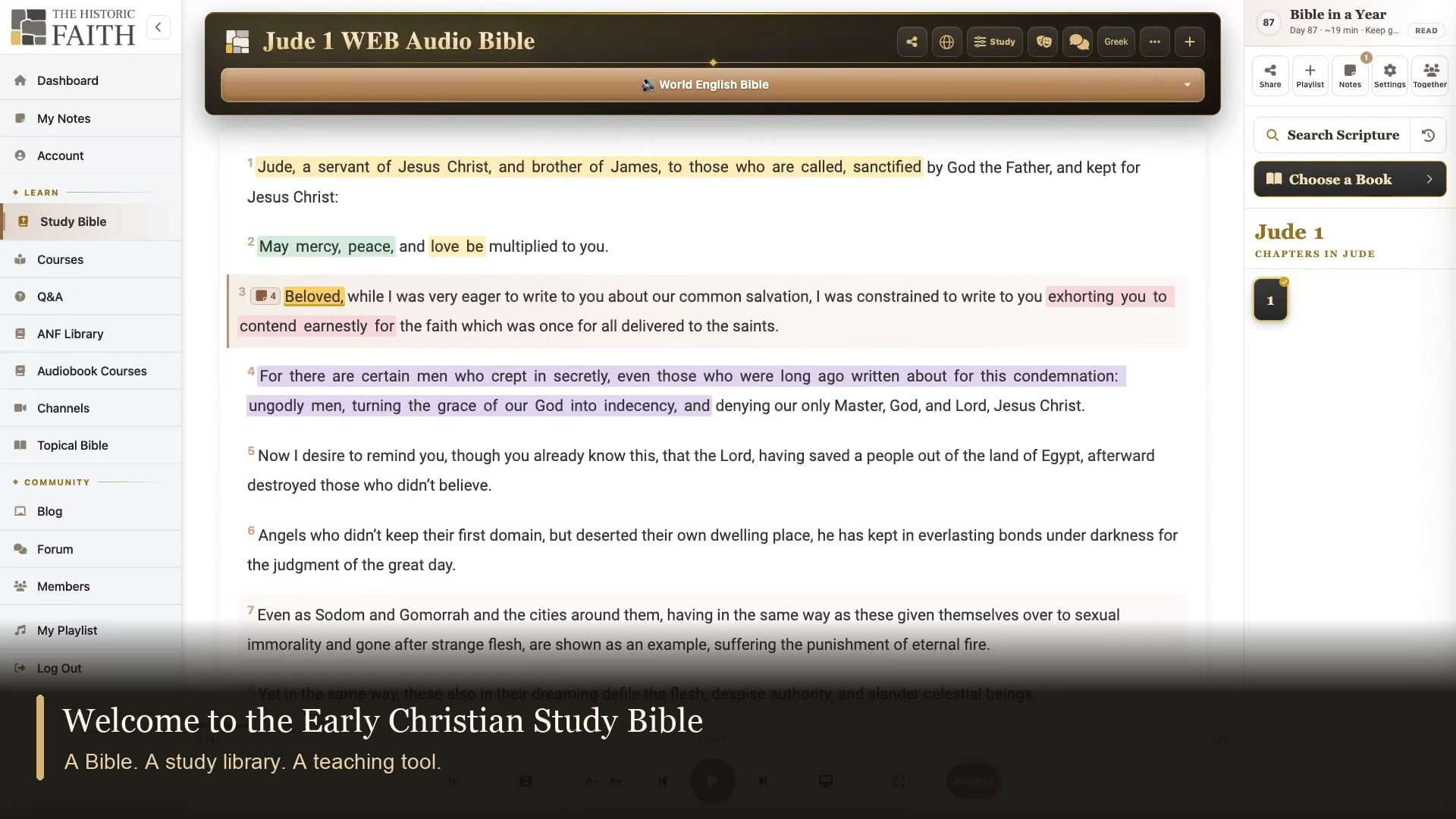 Words. Writings.
Guided tour · 21:50 · Several Bible editions.
See the phone experience · 5:31
Strong's Exhaustive Concordance, first published by James Strong in 1890, indexes every word of the King James Version and assigns each underlying original-language word a number — G1–G5624 for the Greek New Testament and H1–H8674 for the Hebrew Old Testament. Look up any English word, find its Strong's number, and see the Greek or Hebrew word behind it, its definition, and the verses where it occurs. This free online edition covers 14,298 entries with 767,764 indexed occurrences — including the Septuagint, deuterocanonical books, and 1 Enoch, which no print edition of Strong's includes.
These entry points are the quickest way to see how a Strong's number opens into a word, meaning, and Bible usage.
Greek agape, with New Testament and Septuagint usage links where indexed.
Greek kyrios, a major New Testament and Septuagint word-study bridge.
Hebrew reshith, the word behind “beginning” in Genesis 1:1 and other Old Testament usages.
Browse the local Greek and Hebrew Strong's entries in fast pages, open an exact number, or narrow the index by language, range, and usage count.
| Number | Word | Definition | Usages | Range |
|---|---|---|---|---|
|
H227
Hebrew
|
אָ֣ז
|
az (awz) adv. 1. at that time or place 2. (as a conjunction) therefore | 134 | H1-H1000 |
|
H228 — aza'
Hebrew
|
אֲזָא אֲזָה (aza')
aza'
|
aza' (az-zaw') ((Aramaic) or iazah (Aramaic) {az-aw'}) v. 1. to kindle 2. (by implication) to heat | 2 | H1-H1000 |
|
H229 — Ezbay
Hebrew
|
אֶזבַּי (Ezbay)
Ezbay
|
Ezbay (ez-bah'ee) n/p. 1. hyssop-like 2. Ezbai, an Israelite | 1 | H1-H1000 |
|
H230 — azad
Hebrew
|
אֲזָד (azad)
azad
|
azad (az-zawd') v. 1. firm [(Aramaic) of uncertain derivation] | 2 | H1-H1000 |
|
H231 — ezowb
Hebrew
|
אֵזוֹב (ezowb)
ezowb
|
ezowb (ay-zobe') n-m. 1. hyssop [probably of foreign derivation] | 10 | H1-H1000 |
|
H232 — ezowr
Hebrew
|
אֵזוֹר (ezowr)
ezowr
|
ezowr (ay-zore') n-m. 1. something girt 2. a belt, also a band | 12 | H1-H1000 |
|
H233 — azay
Hebrew
|
אֲזַי (azay)
azay
|
azay (az-ah'ee) adv. 1. at that time [probably from H227] | 3 | H1-H1000 |
|
H234 — azkarah
Hebrew
|
אַזכָּרָה (azkarah)
azkarah
|
azkarah (az-kaw-raw') n-f. 1. a reminder 2. specifically remembrance- offering | 7 | H1-H1000 |
|
H235 — azal
Hebrew
|
אָזַל (azal)
azal
|
azal (aw-zal') v. 1. to go away 2. (hence) to disappear | 6 | H1-H1000 |
|
H236 — azal
Hebrew
|
אֲזַל (azal)
azal
|
azal (az-al') v. 1. to depart [(Aramaic) the same as H235] | 7 | H1-H1000 |
|
H237 — ezel
Hebrew
|
אֶזֶל (ezel)
ezel
|
ezel (eh'-zel) n/l. 1. departure 2. Ezel, a memorial stone in Israel | 1 | H1-H1000 |
|
H238 — azan
Hebrew
|
אָזַן (azan)
azan
|
azan (aw-zan') v. 1. to broaden out the ear (with the hand) 2. (by implication) to listen | 42 | H1-H1000 |
|
H239 — azan
Hebrew
|
אָזַן (azan)
azan
|
azan (aw-zan') v. 1. to weigh 2. (figuratively) ponder | 0 | H1-H1000 |
|
H240 — azen
Hebrew
|
אָזֵן (azen)
azen
|
azen (aw-zane') n-m. 1. a spade or paddle (as having a broad end) [from H238] | 1 | H1-H1000 |
|
H241 — ozen
Hebrew
|
אוֹזֶן (ozen)
ozen
|
ozen (o'-zen) n-f. 1. broadness 2. (concretely) the ear (from its form in man) | 179 | H1-H1000 |
|
H242
Hebrew
|
אוּזֵּן שֶׁאֱרָה
|
Uzzen She'erah (ooz-zane' sheh-er-aw') n/l. 1. plat of Sheerah (i.e. settled by him) 2. Uzzen-Sheerah, a place in Israel | 1 | H1-H1000 |
|
H243
Hebrew
|
אַזנוֹת תָּבוֹר
|
Aznowth Tabowr (az-noth' taw-bore') n/l. 1. flats (i.e. tops) of Tabor (i.e. situated on it) 2. Aznoth-Tabor, a place in Israel | 1 | H1-H1000 |
|
H244 — Ozniy
Hebrew
|
אָזנִי (Ozniy)
Ozniy
|
Ozniy (oz-nee') n/p. 1. having (quick) ears 2. Ozni, an Israelite | 1 | H1-H1000 |
|
H245 — Azanyah
Hebrew
|
אֲזַניָה (Azanyah)
Azanyah
|
Azanyah (az-an-yaw') n/p. 1. heard by Jah 2. Azanjah, an Israelite | 1 | H1-H1000 |
|
H246 — aziqqiym
Hebrew
|
אֲזִקִּים (aziqqiym)
aziqqiym
|
aziqqiym (az-ik-keem') n-m. 1. manacles [a variation for H2131] | 2 | H1-H1000 |
|
H247 — azar
Hebrew
|
אָזַר (azar)
azar
|
azar (aw-zar') v. 1. to belt [a primitive root] | 15 | H1-H1000 |
|
H248 — ezrowa`
Hebrew
|
אֶזרוַֹע (ezrowa`)
ezrowa`
|
ezrowa` (ez-ro'-a) n-f. 1. the arm [a variation for H2220] | 2 | H1-H1000 |
|
H249 — ezrach
Hebrew
|
אֶזרָח (ezrach)
ezrach
|
ezrach (ez-rawkh') n-m. 1. a spontaneous growth 2. native (tree or persons) | 17 | H1-H1000 |
|
H250 — Ezrachiy
Hebrew
|
אֶזרָחִי (Ezrachiy)
Ezrachiy
|
Ezrachiy (ez-raw-khee') adj. 1. an Ezrachite or descendant of Zerach [patronymic from H2246] | 1 | H1-H1000 |
|
H251 — ach
Hebrew
|
אָח (ach)
ach
|
ach (awkh) n-m. 1. a brother (used in the widest sense of literal relationship and metaphorical affinity or resemblance (like H0001)) [a primitive word] | 572 | H1-H1000 |
|
H252 — ach
Hebrew
|
אַח (ach)
ach
|
ach (akh) n-m. 1. brother [(Aramaic) corresponding to H251] | 1 | H1-H1000 |
|
H253 — ach
Hebrew
|
אָח (ach)
ach
|
ach (awkh) inj. 1. Oh! (expressive of grief or surprise) [a variation for H162] | 2 | H1-H1000 |
|
H254 — ach
Hebrew
|
אָח (ach)
ach
|
ach (awkh) n-f. 1. a fire-pot or chafing dish [of uncertain derivation] | 2 | H1-H1000 |
|
H255 — oach
Hebrew
|
אוַֹח (oach)
oach
|
oach (o'-akh) n-m. 1. a howler or lonesome wild animal [probably from H253] | 1 | H1-H1000 |
|
H256 — Ach'ab
Hebrew
|
אַחאָב אֶחָב (Ach'ab)
Ach'ab
|
Ach'ab (akh-awb') (once (by contraction) oEchab (Jeremiah 29:22)) n/p. 1. brother (i.e. friend) of (his) father 2. Achab, the name of a king of Israel and of a prophet at Babylon | 81 | H1-H1000 |
|
H257 — Achban
Hebrew
|
אַחבָּן (Achban)
Achban
|
Achban (akh-bawn') n/p. 1. brother (i.e. possessor) of understanding 2. Achban, an Israelite | 1 | H1-H1000 |
|
H258 — achad
Hebrew
|
אָחַד (achad)
achad
|
achad (aw-khad') v. 1. to unify 2. (figuratively) collect (one's thoughts) | 1 | H1-H1000 |
|
H259 — echad
Hebrew
|
אֶחָד (echad)
echad
|
echad (ekh-awd') adj. 1. (properly) united, i.e. one 2. (as an ordinal) first | 739 | H1-H1000 |
|
H260 — achuw
Hebrew
|
אָחוּ (achuw)
achuw
|
achuw (aw'-khoo) n-m. 1. a bulrush or any marshy grass (particularly that along the Nile) [of uncertain (perhaps Egyptian) derivation] | 3 | H1-H1000 |
|
H261 — Echuwd
Hebrew
|
אֵחוּד (Echuwd)
Echuwd
|
Echuwd (ay-khood') n/p. 1. united 2. Echud, the name of three Israelites | 1 | H1-H1000 |
|
H262 — achvah
Hebrew
|
אַחוָה (achvah)
achvah
|
achvah (akh-vaw') n-f. 1. an utterance [from H2331 (in the sense of H2324)] | 1 | H1-H1000 |
|
H263 — achavah
Hebrew
|
אַחֲוָה (achavah)
achavah
|
achavah (akh-av-aw') n-f. 1. solution (of riddles) [(Aramaic) corresponding to H262] | 1 | H1-H1000 |
|
H264 — achavah
Hebrew
|
אַחֲוָה (achavah)
achavah
|
achavah (akh-av-aw') n-m. 1. fraternity [from H251] | 1 | H1-H1000 |
|
H265 — Achowach
Hebrew
|
אֲחוַֹח (Achowach)
Achowach
|
Achowach (akh-o'-akh) n/p. 1. brotherly 2. Achoach, an Israelite | 1 | H1-H1000 |
|
H266 — Achowchiy
Hebrew
|
אֲחוֹחִי (Achowchiy)
Achowchiy
|
Achowchiy (akh-o-khee') adj. 1. an Achochite or descendant of Achoach [patronymic from H264] | 5 | H1-H1000 |
|
H267 — Achuwmay
Hebrew
|
אֲחוּמַי (Achuwmay)
Achuwmay
|
Achuwmay (akh-oo-mah'-ee) n/p. 1. brother (i.e. neighbour) of water 2. Achumai, an Israelite | 1 | H1-H1000 |
|
H268 — achowr
Hebrew
|
אָחוֹר אָחוֹר (achowr)
achowr
|
achowr (aw-khore') (or (shortened) achor {aw-khore'}) subv. 1. the hinder part 2. (hence, adverbly) behind, backward | 41 | H1-H1000 |
|
H269 — achowth
Hebrew
|
אָחוֹת (achowth)
achowth
|
achowth (aw-khoth') n-f. 1. a sister (used very widely (like H0250), literally and figuratively) [irregular feminine of H251] | 104 | H1-H1000 |
|
H270 — achaz
Hebrew
|
אָחַז (achaz)
achaz
|
achaz (aw-khaz') v. 1. to seize (often with the accessory idea of holding in possession) [a primitive root] | 62 | H1-H1000 |
|
H271 — Achaz
Hebrew
|
אָחָז (Achaz)
Achaz
|
Achaz (aw-khawz') n/p. 1. possessor 2. Achaz, the name of a Jewish king and of an Israelite | 39 | H1-H1000 |
|
H272 — achuzzah
Hebrew
|
אֲחוּזָּה (achuzzah)
achuzzah
|
achuzzah (akh-ooz-zaw') n-f. 1. something seized, i.e. a possession (especially of land) [feminine passive participle from H270] | 58 | H1-H1000 |
|
H273 — Achzay
Hebrew
|
אַחזַי (Achzay)
Achzay
|
Achzay (akh-zah'ee) n/p. 1. seizer 2. Achzai, an Israelite | 1 | H1-H1000 |
|
H274 — Achazyah
Hebrew
|
אֲחַזיָה אֲחַזיָהוּ (Achazyah)
Achazyah
|
Achazyah (akh-az-yaw') (or (prolonged) rAchazyahuw {akh-az-yaw'-hoo}) n/p. 1. Jah has seized 2. Achazjah, the name of a Jewish and an Israelite king | 30 | H1-H1000 |
|
H275 — Achuzzam
Hebrew
|
אֲחוּזָּם (Achuzzam)
Achuzzam
|
Achuzzam (akh-ooz-zawm') n/p. 1. seizure 2. Achuzzam, an Israelite | 1 | H1-H1000 |
|
H276 — Achuzzath
Hebrew
|
אֲחוּזַּת (Achuzzath)
Achuzzath
|
Achuzzath (akh-ooz-zath') n/p. 1. possession 2. Achuzzath, a Philistine | 1 | H1-H1000 |
|
H277 — Achiy
Hebrew
|
אֲחִי (Achiy)
Achiy
|
Achiy (akh-ee') n/p. 1. brotherly 2. Achi, the name of two Israelites | 2 | H1-H1000 |
|
H278 — Echiy
Hebrew
|
אֵחִי (Echiy)
Echiy
|
Echiy (ay-khee') n/p. 1. Echi, an Israelite [probably the same as H277] | 1 | H1-H1000 |
|
H279 — Achiyam
Hebrew
|
אֲחִיאָם (Achiyam)
Achiyam
|
Achiyam (akh-ee-awm') n/p. 1. brother of the mother (i.e. uncle) 2. Achiam, an Israelite | 2 | H1-H1000 |
|
H280 — achiydah
Hebrew
|
אֲחִידָּה (achiydah)
achiydah
|
achiydah (akh-ee-daw') n-f. 1. hard sentence [(Aramaic) corresponding to H2420, an enigma] | 1 | H1-H1000 |
|
H281 — Achiyah
Hebrew
|
אֲחִיָה אֲחִיָהוּ (Achiyah)
Achiyah
|
Achiyah (akh-ee-yaw) (or (prolonged) pAchiyahuw {akh-ee-yaw'-hoo}) n/p. 1. brother (i.e. worshipper) of Jah 2. Achijah, the name of nine Israelites | 23 | H1-H1000 |
|
H282 — Achiyhuwd
Hebrew
|
אֲחִיהוּד (Achiyhuwd)
Achiyhuwd
|
Achiyhuwd (akh-ee-hood') n/p. 1. brother (i.e. possessor) of renown 2. Achihud, an Israelite | 1 | H1-H1000 |
|
H283 — Achyow
Hebrew
|
אַחיוֹ (Achyow)
Achyow
|
Achyow (akh-yo') n/p. 1. brotherly 2. Achio, the name of three Israelites | 6 | H1-H1000 |
|
H284 — Achiychud
Hebrew
|
אֲחִיחוּד (Achiychud)
Achiychud
|
Achiychud (akh-ee-khood') n/p. 1. brother of a riddle (i.e. mysterious) 2. Achichud, an Israelite | 1 | H1-H1000 |
|
H285 — Achiytuwb
Hebrew
|
אֲחִיטּוּב (Achiytuwb)
Achiytuwb
|
Achiytuwb (akh-ee-toob') n/p. 1. brother of goodness 2. Achitub, the name of several priests | 15 | H1-H1000 |
|
H286 — Achiyluwd
Hebrew
|
אֲחִילוּד (Achiyluwd)
Achiyluwd
|
Achiyluwd (akh-ee-lood') n/p. 1. brother of one born 2. Achilud, an Israelite | 5 | H1-H1000 |
|
H287 — Achiymowth
Hebrew
|
אֲחִימוֹת (Achiymowth)
Achiymowth
|
Achiymowth (akh-ee-moth') n/p. 1. brother of death 2. Achimoth, an Israelite | 1 | H1-H1000 |
|
H288 — Achiymelek
Hebrew
|
אֲחִימֶלֶך (Achiymelek)
Achiymelek
|
Achiymelek (akh-ee-meh'-lek) n/p. 1. brother of (the) king 2. Achimelek, the name of an Israelite and of a Hittite | 15 | H1-H1000 |
|
H289 — Achiyman
Hebrew
|
אֲחִימַן אֲחִימָן (Achiyman)
Achiyman
|
Achiyman (akh-ee-man') (or mAchiyman {akh-ee-mawn'}) n/p. 1. brother of a portion (i.e. gift) 2. Achiman, the name of an Anakite and of an Israelite | 4 | H1-H1000 |
|
H290 — Achiyma`ats
Hebrew
|
אֲחִימַעַץ (Achiyma`ats)
Achiyma`ats
|
Achiyma`ats (akh-ee-mah'-ats) n/l. 1. brother of anger 2. Achimaats, the name of three Israelites | 15 | H1-H1000 |
|
H291 — Achyan
Hebrew
|
אַחיָן (Achyan)
Achyan
|
Achyan (akh-yawn') n/p. 1. brotherly 2. Achjan, an Israelite | 1 | H1-H1000 |
|
H292 — Achiynadab
Hebrew
|
אֲחִינָדָב (Achiynadab)
Achiynadab
|
Achiynadab (akh-ee-naw-dawb') n/p. 1. brother of liberality 2. Achinadab, an Israelite | 1 | H1-H1000 |
|
H293 — Achiyno`am
Hebrew
|
אֲחִינוֹעַם (Achiyno`am)
Achiyno`am
|
Achiyno`am (akh-ee-no'-am) n/p. 1. brother of pleasantness 2. Achinoam, the name of two Israelitesses | 7 | H1-H1000 |
|
H294 — Achiycamak
Hebrew
|
אֲחִיסָמָך (Achiycamak)
Achiycamak
|
Achiycamak (akh-ee-saw-mawk') n/p. 1. brother of support 2. Achisamak, an Israelite | 3 | H1-H1000 |
|
H295 — Achiy`ezer
Hebrew
|
אֲחִיעֶזֶר (Achiy`ezer)
Achiy`ezer
|
Achiy`ezer (akh-ee-eh'-zer) n/p. 1. brother of help 2. Achiezer, the name of two Israelites | 6 | H1-H1000 |
|
H296 — Achiyqam
Hebrew
|
אֲחִיקָם (Achiyqam)
Achiyqam
|
Achiyqam (akh-ee-kawm') n/p. 1. brother of rising (i.e. high) 2. Achikam, an Israelite | 20 | H1-H1000 |
|
H297 — Achiyram
Hebrew
|
אֲחִירָם (Achiyram)
Achiyram
|
Achiyram (akh-ee-rawm') n/p. 1. brother of height (i.e. high) 2. Achiram, an Israelite | 1 | H1-H1000 |
|
H298 — Achiyramiy
Hebrew
|
אֲחִירָמִי (Achiyramiy)
Achiyramiy
|
Achiyramiy (akh-ee-raw-mee') adj. 1. an Achiramite or descendant (collectively) of Achiram [patronymic from H297] | 1 | H1-H1000 |
|
H299 — Achiyra`
Hebrew
|
אֲחִירַע (Achiyra`)
Achiyra`
|
Achiyra` (akh-ee-rah') n/p. 1. brother of wrong 2. Achira, an Israelite | 5 | H1-H1000 |
|
H300 — Achiyshachar
Hebrew
|
אֲחִישַׁחַר (Achiyshachar)
Achiyshachar
|
Achiyshachar (akh-ee-shakh'-ar) n/p. 1. brother of (the) dawn 2. Achishachar, an Israelite | 1 | H1-H1000 |
|
H301 — Achiyshar
Hebrew
|
אֲחִישָׁר (Achiyshar)
Achiyshar
|
Achiyshar (akh-ee-shawr') n/p. 1. brother of (the) singer 2. Achishar, an Israelite | 1 | H1-H1000 |
|
H302 — Achiythophel
Hebrew
|
אֲחִיתּוֹפֶל (Achiythophel)
Achiythophel
|
Achiythophel (akh-ee-tho'-fel) n/p. 1. brother of folly 2. Achithophel, an Israelite | 17 | H1-H1000 |
|
H303 — Achlab
Hebrew
|
אַחלָב (Achlab)
Achlab
|
Achlab (akh-lawb') n/l. 1. fatness (i.e. fertile) 2. Achlab, a place in Israel | 1 | H1-H1000 |
|
H304 — Achlay
Hebrew
|
אַחלַי (Achlay)
Achlay
|
Achlay (akh-lah'ee) n/p. 1. wishful 2. Achlai, the name of an Israelitess and of an Israelite | 2 | H1-H1000 |
|
H305 — achalay
Hebrew
|
אַחֲלַי אַחֲלֵי (achalay)
achalay
|
achalay (akh-al-ah'ee) (or achaley {akh-al-ay'}) inj. 1. would that! [prob from H253 and a variation of H3863] | 2 | H1-H1000 |
|
H306 — achlamah
Hebrew
|
אַחלָמָה (achlamah)
achlamah
|
achlamah (akh-law'-maw) n-f. 1. a gem, probably the amethyst [perhaps from H2492 (and thus dream-stone)] | 2 | H1-H1000 |
|
H307 — Achmtha'
Hebrew
|
אַחמְתָא (Achmtha')
Achmtha'
|
Achmtha' (akh-me-thaw') n/l. 1. Achmetha (i.e. Ecbatana), the summer capital of Persia [of Persian derivation] | 1 | H1-H1000 |
|
H308 — Achacbay
Hebrew
|
אֲחַסבַּי (Achacbay)
Achacbay
|
Achacbay (akh-as-bah'ee) n/p. 1. Achasbai, an Israelite [of uncertain derivation] | 1 | H1-H1000 |
|
H309 — achar
Hebrew
|
אָחַר (achar)
achar
|
achar (aw-khar') v. 1. to loiter (i.e. be behind) 2. (by implication) to procrastinate | 17 | H1-H1000 |
|
H310 — achar
Hebrew
|
אַחַר (achar)
achar
|
achar (akh-ar') adv. 1. (properly) the hind part 2. (generally, as adverb or conjunction) after (in various senses) | 664 | H1-H1000 |
|
H311 — achar
Hebrew
|
אַחַר (achar)
achar
|
achar (akh-ar') adv. 1. after [(Aramaic) corresponding to H310] | 3 | H1-H1000 |
|
H312 — acher
Hebrew
|
אַחֵר (acher)
acher
|
acher (akh-air') adj. 1. (properly) hinder 2. (generally) next, other, etc | 161 | H1-H1000 |
|
H313 — Acher
Hebrew
|
אַחֵר (Acher)
Acher
|
Acher (akh-air') n/p. 1. Acher, an Israelite [the same as H312] | 1 | H1-H1000 |
|
H314 — acharown
Hebrew
|
אַחֲריוֹן אַחֲרוֹן (acharown)
acharown
|
acharown (akh-ar-one') (or (shortened) prob from H253 and a variation of H3863; acharon {akh-ar-one'};) adj. 1. hinder 2. (generally) late or last | 48 | H1-H1000 |
|
H315 — Achrach
Hebrew
|
אַחרַח (Achrach)
Achrach
|
Achrach (akh-rakh') n/p. 1. after (his) brother [from H310 and H251] | 1 | H1-H1000 |
|
H316 — Acharchel
Hebrew
|
אֲחַרחֵל (Acharchel)
Acharchel
|
Acharchel (akh-ar-kale') n/p. 1. behind (the) intrenchment (i.e. safe) 2. Acharchel, an Israelite | 1 | H1-H1000 |
|
H317 — ochoriy
Hebrew
|
אָחֳרִי (ochoriy)
ochoriy
|
ochoriy (okh-or-ee') adj. 1. other [(Aramaic) from H311] | 5 | H1-H1000 |
|
H318 — ochoreyn
Hebrew
|
אָחֳרֵין אָחֳרֵן (ochoreyn)
ochoreyn
|
ochoreyn (okh-or-ane') ((Aramaic) or (shortened)) adv. 1. last [from H317] | 1 | H1-H1000 |
|
H319 — achariyth
Hebrew
|
אַחֲרִיתּ (achariyth)
achariyth
|
achariyth (akh-ar-eeth') n-f. 1. the last or end 2. (hence) the future | 60 | H1-H1000 |
|
H320 — achariyth
Hebrew
|
אַחֲרִיתּ (achariyth)
achariyth
|
achariyth (akh-ar-eeth') n-f. 1. later [(Aramaic) from H311, the same as H319] | 1 | H1-H1000 |
|
H321 — ochoran
Hebrew
|
אָחֳרָן (ochoran)
ochoran
|
ochoran (okh-or-awn') adj. 1. other [(Aramaic) from H311, the same as H317] | 5 | H1-H1000 |
|
H322 — achoranniyth
Hebrew
|
אֲחוֹרַנִּיתּ (achoranniyth)
achoranniyth
|
achoranniyth (akh-o-ran-neeth') adv. 1. backwards [prolonged from H268] | 6 | H1-H1000 |
|
H323 — achashdarpan
Hebrew
|
אֲחַשׁדַּרפַּן (achashdarpan)
achashdarpan
|
achashdarpan (akh-ash-dar-pan') n-m. 1. a satrap or governor of a main province (of Persia) [of Persian derivation] | 4 | H1-H1000 |
|
H324 — achashdarpan
Hebrew
|
אֲחַשׁדַּרפַּן (achashdarpan)
achashdarpan
|
achashdarpan (akh-ash-dar-pan') n-m. 1. prince [(Aramaic) corresponding to H323] | 9 | H1-H1000 |
|
H325 — Achashverowsh
Hebrew
|
אֲחַשׁוֵרוֹשׁ אַחַשׁרוֹשׁ (Achashverowsh)
Achashverowsh
|
Achashverowsh (akh-ash-vay-rosh') (or (shortened) pAchashrosh {akh- ash-rosh'} (Esther 10:1)) n/p. 1. Achashverosh (i.e. Ahasuerus or Artaxerxes, but in this case Xerxes), the title (rather than name) of a Persian king [of Persian origin] | 30 | H1-H1000 |
|
H326 — achashtariy
Hebrew
|
אֲחַשׁתָּרִי (achashtariy)
achashtariy
|
achashtariy (akh-ash-taw-ree') n/p. 1. an achastarite (i.e. courier) 2. the designation (rather than name) of an Israelite | 1 | H1-H1000 |
|
H327 — achastaran
Hebrew
|
אֲחַשׁתָּרָן (achastaran)
achastaran
|
achastaran (akh-ash-taw-rawn') adj. 1. a mule [of Persian origin] | 2 | H1-H1000 |
|
H328 — at
Hebrew
|
אַט (at)
at
|
at (at) adv. 1. (as a noun) a necromancer (from their soft incantations), (as an adverb) gently [from an unused root perhaps meaning to move softly] | 7 | H1-H1000 |
|
H329 — atad
Hebrew
|
אָטָד (atad)
atad
|
atad (aw-tawd') n-m. 1. a thorn-tree (especially the buckthorn) [from an unused root probably meaning to pierce or make fast] | 5 | H1-H1000 |
|
H330 — etuwn
Hebrew
|
אֵטוּן (etuwn)
etuwn
|
etuwn (ay-toon') n-m. 1. (properly) twisted (yarn), i.e. tapestry [from an unused root (probably meaning to bind)] | 1 | H1-H1000 |
|
H331 — atam
Hebrew
|
אָטַם (atam)
atam
|
atam (aw-tam') v. 1. to close (the lips or ears) 2. by analology to contract (a window by bevelled jambs) | 8 | H1-H1000 |
|
H332 — atar
Hebrew
|
אָטַר (atar)
atar
|
atar (aw-tar') v. 1. to close up [a primitive root] | 1 | H1-H1000 |
|
H333 — Ater
Hebrew
|
אָטֵר (Ater)
Ater
|
Ater (aw-tare') n/p. 1. maimed 2. Ater, the name of three Israelites | 5 | H1-H1000 |
|
H334 — itter
Hebrew
|
אִטֵּר (itter)
itter
|
itter (it-tare') adj. 1. shut up, i.e. impeded (as to the use of the right hand) [from H332] | 2 | H1-H1000 |
|
H335 — ay
Hebrew
|
אַי (ay)
ay
|
ay (ah'ee) adv. 1. where? hence how? [perhaps from H370] | 33 | H1-H1000 |
|
H336 — iy
Hebrew
|
אִי (iy)
iy
|
iy (ee) adv. 1. not [probably identical with H335 (through the idea of a query)] | 1 | H1-H1000 |
|
H337 — iy
Hebrew
|
אִי (iy)
iy
|
iy (ee) inj. 1. alas! [short from H188] | 2 | H1-H1000 |
|
H338 — iy
Hebrew
|
אִי (iy)
iy
|
iy (ee) n-m. 1. (properly) a howler 2. any solitary wild creature | 3 | H1-H1000 |
|
H339 — iy
Hebrew
|
אִי (iy)
iy
|
iy (ee) n-m. 1. (properly) a habitable spot (as desirable) 2. dry land, a coast, an island | 35 | H1-H1000 |
|
H340 — ayab
Hebrew
|
אָיַב (ayab)
ayab
|
ayab (aw-yab') v. 1. to hate (as one of an opposite tribe or party) 2. hence to be hostile | 1 | H1-H1000 |
|
H341 — oyeb
Hebrew
|
אוֹיֵב אוֹיֵב (oyeb)
oyeb
|
oyeb (o-yabe') (or (fully) owyeb {o-yabe'}) subv. 1. hating 2. an adversary | 274 | H1-H1000 |
|
H342 — eybah
Hebrew
|
אֵיבָּה (eybah)
eybah
|
eybah (ay-baw') n-f. 1. hostility [from H340] | 5 | H1-H1000 |
|
H343 — eyd
Hebrew
|
אֵידּ (eyd)
eyd
|
eyd (ade) n-m. 1. oppression 2. (by implication) misfortune, ruin | 22 | H1-H1000 |
|
H344 — ayah
Hebrew
|
אַיָה (ayah)
ayah
|
ayah (ah-yaw') n-f. 1. the screamer, i.e. a hawk [perhaps from H337] | 3 | H1-H1000 |
|
H345 — Ayah
Hebrew
|
אַיָה (Ayah)
Ayah
|
Ayah (ah-yaw') n/p. 1. Ajah, the name of two Israelites [the same as H344] | 6 | H1-H1000 |
|
H346 — ayeh
Hebrew
|
אַיֵה (ayeh)
ayeh
|
ayeh (ah-yay') adv. 1. where? [prolonged from H335] | 41 | H1-H1000 |
|
H347 — Iyowb
Hebrew
|
אִיוֹב (Iyowb)
Iyowb
|
Iyowb (ee-yobe') n/p. 1. hated (i.e. persecuted) 2. Ijob, the patriarch famous for his patience | 52 | H1-H1000 |
|
H348 — Iyzebel
Hebrew
|
אִיזֶבֶל (Iyzebel)
Iyzebel
|
Iyzebel (ee-zeh'-bel) n/p. 1. Izebel, the wife of king Ahab [from H336 and H2083] | 19 | H1-H1000 |
|
H349 — eyk
Hebrew
|
אֵיכּ אֵיכָּה אֵיכָּכָה (eyk)
eyk
|
eyk (ake) (also eykah {ay-kaw'}and teykakah {ay-kaw'-kah};) inj. 1. how? or how! 2. (also) where? | 74 | H1-H1000 |
|
H350 — Iy-kabowd
Hebrew
|
אִי ־ כָּבוֹד (Iy-kabowd)
Iy-kabowd
|
Iy-kabowd (ee-kaw-bode') n/p. 1. (there is) no glory, i.e. inglorious 2. Ikabod, a son of Phineas | 2 | H1-H1000 |
|
H351 — eykoh
Hebrew
|
אֵיכּוֹה (eykoh)
eykoh
|
eykoh (ay-ko) inj. 1. where [probably a variation for H349, but not as an interogative] | 1 | H1-H1000 |
|
H352 — ayil
Hebrew
|
אַיִל (ayil)
ayil
|
ayil (ah'-yil) n-m. 1. (properly) strength 2. (hence) anything strong | 169 | H1-H1000 |
|
H353 — eyal
Hebrew
|
אֱיָל (eyal)
eyal
|
eyal (eh-yawl') n-m. 1. strength [a variation of H352] | 1 | H1-H1000 |
|
H354 — ayal
Hebrew
|
אַיָל (ayal)
ayal
|
ayal (ah-yawl') n-m. 1. a stag or male deer [an intensive form of H352 (in the sense of ram)] | 11 | H1-H1000 |
|
H355 — ayalah
Hebrew
|
אַיָלָה (ayalah)
ayalah
|
ayalah (ah-yaw-law') n-f. 1. a doe or female deer [feminine of H354] | 8 | H1-H1000 |
|
H356 — Eylown
Hebrew
|
אֵילוֹן אֵלוֹן אֵילוֹן (Eylown)
Eylown
|
Eylown (ay-lone') (or (shortened) Elown {ay-lone'}; or Eylon {ay- lone'};) n/p. 1. oak-grove 2. Elon, the name of a place in Israel, and also of one Hittite, two Israelites | 7 | H1-H1000 |
|
H357 — Ayalown
Hebrew
|
אַיָלוֹן (Ayalown)
Ayalown
|
Ayalown (ah-yaw-lone') n/l. 1. deer-field 2. Ajalon, the name of five places in Israel | 10 | H1-H1000 |
|
H358
Hebrew
|
אֵילוֹן בֵּיתּ חָנָן
|
Eylown Beyth Chanan (ay-lone' bayth-chaw-nawn') n/l. 1. oak-grove of (the) house of favor 2. Elon of Beth-chanan, a place in Israel | 1 | H1-H1000 |
|
H359 — Eylowth
Hebrew
|
אֵילוֹת אֵילַת (Eylowth)
Eylowth
|
Eylowth (ay-loth') (or mEylath {ay-lath'}) n/l. 1. trees or a grove (i.e. palms) 2. Eloth or Elath, a place on the Red Sea | 6 | H1-H1000 |
|
H360 — eyaluwth
Hebrew
|
אֱיָלוּת (eyaluwth)
eyaluwth
|
eyaluwth (eh-yaw-looth') n-f. 1. power 2. (by implication) protection | 1 | H1-H1000 |
|
H361 — eylam
Hebrew
|
אֵילָם אֵלָם אֵלַמָּה (eylam)
eylam
|
eylam (ay-lawm') (or (shortened) {ay-lawm'}; or (feminine) ielammah {ay-lam-maw'}; elam) n-m. 1. a pillar-space (or colonnade), i.e. a pale (or portico) [probably from H352] | 12 | H1-H1000 |
|
H362 — Eylim
Hebrew
|
אֵילִם (Eylim)
Eylim
|
Eylim (ay-leem') n/l. 1. palm-trees 2. Elim, a place in the Desert | 4 | H1-H1000 |
|
H363 — iylan
Hebrew
|
אִילָן (iylan)
iylan
|
iylan (ee-lawn') n-m. 1. a tree [(Aramaic) corresponding to H356] | 6 | H1-H1000 |
|
H364
Hebrew
|
אֵיל פָּארָן
|
Eyl Pa'ran (ale paw-rawn') n/l. 1. oak of Paran 2. El- Paran, a portion of the district of Paran | 1 | H1-H1000 |
|
H365 — ayeleth
Hebrew
|
אַיֱלֱת (ayeleth)
ayeleth
|
ayeleth (ah-yeh'-leth) n-f. 1. a doe [the same as H355] | 2 | H1-H1000 |
|
H366 — ayom
Hebrew
|
אָיוֹם (ayom)
ayom
|
ayom (aw-yome') adj. 1. frightful [from an unused root (meaning to frighten)] | 3 | H1-H1000 |
|
H367 — eymah
Hebrew
|
אֵימָה אֵמָה (eymah)
eymah
|
eymah (ay-maw') (or (shortened) remah {ay-maw'}) n-f. 1. fright 2. (concretely) an idol (as a bugbear) | 17 | H1-H1000 |
|
H368 — Eymiym
Hebrew
|
אֵימִים (Eymiym)
Eymiym
|
Eymiym (ay-meem') n/p. 1. terrors 2. Emim, an early Canaanitish (or Maobitish) tribe | 3 | H1-H1000 |
|
H369 — ayin
Hebrew
|
אַיִן (ayin)
ayin
|
ayin (ah'-yin) prt-n. 1. a non-entity 2. (generally) used as a negative particle | 686 | H1-H1000 |
|
H370 — aiyn
Hebrew
|
אַיִן (aiyn)
aiyn
|
aiyn (ah-yin') adv. 1. where? 2. (with prepositional prefix) whence? | 17 | H1-H1000 |
|
H371 — iyn
Hebrew
|
אִין (iyn)
iyn
|
iyn (een) adv. 1. but (like H0370) an interrogative [apparently a shortened form of H369] | 1 | H1-H1000 |
|
H372 — Iy`ezer
Hebrew
|
אִיעֶזֵר (Iy`ezer)
Iy`ezer
|
Iy`ezer (ee-eh'-zer) n/p. 1. helpless 2. Iezer, an Israelite | 1 | H1-H1000 |
|
H373 — Iy`ezriy
Hebrew
|
אִיעֶזרִי (Iy`ezriy)
Iy`ezriy
|
Iy`ezriy (ee-ez-ree') adj. 1. an Iezrite or descendant of Iezer [patronymic from H372] | 1 | H1-H1000 |
|
H374 — eyphah
Hebrew
|
אֵיפָה אֵפָה (eyphah)
eyphah
|
eyphah (ay-faw') (or (shortened) ephah {ay-faw'}) n-f. 1. an ephah or measure for grain 2. (hence) a measure in general | 29 | H1-H1000 |
|
H375 — eyphoh
Hebrew
|
אֵיפוֹה (eyphoh)
eyphoh
|
eyphoh (ay-fo') adv. 1. what place? 2. (of time) when? | 10 | H1-H1000 |
|
H376 — iysh
Hebrew
|
אִישׁ (iysh)
iysh
|
iysh (eesh) n-m. 1. a man as an individual or a male person 2. often used as an adjunct to a more definite term (and in such cases frequently not expressed in translation) | 1,693 | H1-H1000 |
No Strong's entries match that search.
Strong's works best when the number, original word, verse, and corpus stay connected.
Open a chapter and move from a word token to its Strong's page, parsing, and linked occurrences.
Greek Strong's entries can include New Testament, Septuagint, deuterocanonical, and 1 Enoch rows where indexed.
Dedicated Strong's pages can expose approved pronunciation audio beside the word-study data.
These are common words readers run into repeatedly, shown with an English meaning so the list is readable without already knowing the original languages.
Look up a word study by its transliteration — these are frequently searched Hebrew and Greek words. Each opens the matching Strong's entry, or lists the options when a spelling maps to several words.