
G26 — Agape (Love)
Greek agape, with New Testament and Septuagint usage links where indexed.
The Early Christian Study Bible · Free to use
Study the word. Hear its pronunciation.
Search 14,298 Greek and Hebrew entries—free. Explore definitions, indexed occurrences, and pronunciation audio where available, then follow the words back into your Bible.
Click a word. Hear its pronunciation. Open the early Christian writings. Then see how to present and teach.
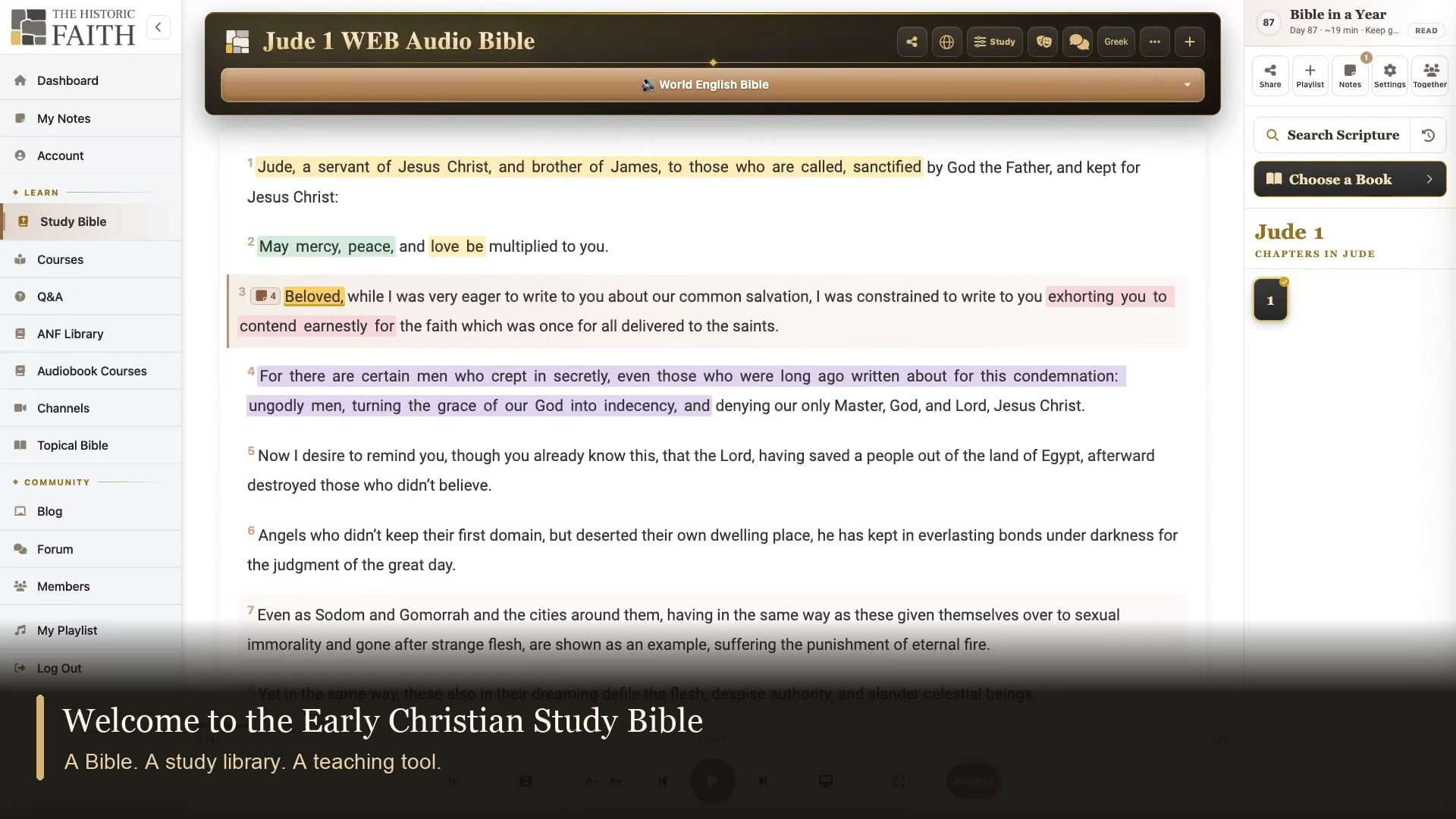 Words. Writings.
Guided tour · 21:50 · Several Bible editions.
See the phone experience · 5:31
Strong's Exhaustive Concordance, first published by James Strong in 1890, indexes every word of the King James Version and assigns each underlying original-language word a number — G1–G5624 for the Greek New Testament and H1–H8674 for the Hebrew Old Testament. Look up any English word, find its Strong's number, and see the Greek or Hebrew word behind it, its definition, and the verses where it occurs. This free online edition covers 14,298 entries with 767,764 indexed occurrences — including the Septuagint, deuterocanonical books, and 1 Enoch, which no print edition of Strong's includes.
These entry points are the quickest way to see how a Strong's number opens into a word, meaning, and Bible usage.
Greek agape, with New Testament and Septuagint usage links where indexed.
Greek kyrios, a major New Testament and Septuagint word-study bridge.
Hebrew reshith, the word behind “beginning” in Genesis 1:1 and other Old Testament usages.
Browse the local Greek and Hebrew Strong's entries in fast pages, open an exact number, or narrow the index by language, range, and usage count.
| Number | Word | Definition | Usages | Range |
|---|---|---|---|---|
|
H77 — Ebets
Hebrew
|
אֶבֶץ (Ebets)
Ebets
|
Ebets (eh'-bets) n/l. 1. conspicuous 2. Ebets, a place in Israel | 1 | H1-H1000 |
|
H78 — Ibtsan
Hebrew
|
אִבצָּן (Ibtsan)
Ibtsan
|
Ibtsan (ib-tsawn') n/p. 1. splendid 2. Ibtsan, an Israelite | 2 | H1-H1000 |
|
H79 — abaq
Hebrew
|
אָבַק (abaq)
abaq
|
abaq (aw-bak') v. 1. to bedust, i.e. grapple [a primitive root, probably to float away (as vapor), but used only as denominative from H80] | 2 | H1-H1000 |
|
H80 — abaq
Hebrew
|
אָבָק (abaq)
abaq
|
abaq (aw-bawk') n-m. 1. light particles (as volatile) [from root of H79] | 6 | H1-H1000 |
|
H81 — abaqah
Hebrew
|
אֲבָקָה (abaqah)
abaqah
|
abaqah (ab-aw-kaw') n-f. 1. powder [feminine of H80] | 1 | H1-H1000 |
|
H82 — abar
Hebrew
|
אָבַר (abar)
abar
|
abar (aw-bar') v. 1. to soar [a primitive root] | 1 | H1-H1000 |
|
H83 — eber
Hebrew
|
אֵבֶר (eber)
eber
|
eber (ay-ber') n-m. 1. a pinion [from H82] | 3 | H1-H1000 |
|
H84 — ebrah
Hebrew
|
אֶברָה (ebrah)
ebrah
|
ebrah (eb-raw') n-f. 1. feather, wing [feminine of H83] | 4 | H1-H1000 |
|
H85 — Abraham
Hebrew
|
אַברָהָם (Abraham)
Abraham
|
Abraham (ab-raw-hawm') n/p. 1. father of a multitude 2. Abraham, the later name of Abram | 159 | H1-H1000 |
|
H86 — abrek
Hebrew
|
אַברֵך (abrek)
abrek
|
abrek (ab-rake') inj. 1. bow the knee [probably an Egyptian word meaning kneel] | 1 | H1-H1000 |
|
H87 — Abram
Hebrew
|
אַברָם (Abram)
Abram
|
Abram (ab-rawm') n/p. 1. high father 2. Abram, the original name of Abraham | 50 | H1-H1000 |
|
H88 — oboth
Hebrew
|
אוֹבוֹת (oboth)
oboth
|
oboth (o-both') n/l. 1. water-skins 2. Oboth, a place in the Desert | 4 | H1-H1000 |
|
H89 — Age'
Hebrew
|
אָגֵא (Age')
Age'
|
Age' (aw-gay') n/p. 1. Age, an Israelite [of uncertain derivation] | 1 | H1-H1000 |
|
H90 — Agag
Hebrew
|
אֲגַג (Agag)
Agag
|
Agag (ag-ag') (or uAgag {Ag-awg'}) n/p. 1. flame 2. Agag, a title of Amalekitish kings | 6 | H1-H1000 |
|
H91 — Agagiy
Hebrew
|
אֲגָגִי (Agagiy)
Agagiy
|
Agagiy (ag-aw-ghee') adj. 1. an Agagite or descendent (subject) of Agag [patrial or patronymic from H90] | 5 | H1-H1000 |
|
H92 — aguddah
Hebrew
|
אֲגֻדָּה (aguddah)
aguddah
|
aguddah (ag-ood-daw') n-f. 1. a band, bundle, knot, or arch [feminine passive participle of an unused root (meaning to bind)] | 4 | H1-H1000 |
|
H93 — egowz
Hebrew
|
אֱגוֹז (egowz)
egowz
|
egowz (eg-oze') n-m. 1. a nut [prob of Persian origin] | 1 | H1-H1000 |
|
H94 — Aguwr
Hebrew
|
אָגוּר (Aguwr)
Aguwr
|
Aguwr (aw-goor') n/p. 1. gathered (i.e. received among the sages) 2. Agur, a fanciful name for Solomon | 1 | H1-H1000 |
|
H95 — agowrah
Hebrew
|
אֲגוֹרָה (agowrah)
agowrah
|
agowrah (ag-o-raw') n-f. 1. (properly) something gathered, i.e. perhaps a grain or berry 2. used only of a small (silver) coin | 1 | H1-H1000 |
|
H96 — egel
Hebrew
|
אֶגֶל (egel)
egel
|
egel (eh'-ghel) n-m. 1. a reservoir [from an unused root (meaning to flow down or together as drops)] | 1 | H1-H1000 |
|
H97 — Eglayim
Hebrew
|
אֶגלַיִם (Eglayim)
Eglayim
|
Eglayim (eg-lah'-yim) n/l. 1. a double pond 2. Eglajim, a place in Moab | 1 | H1-H1000 |
|
H98 — agam
Hebrew
|
אֲגַם (agam)
agam
|
agam (ag-am') n-m. 1. a marsh 2. hence a rush (as growing in swamps) | 9 | H1-H1000 |
|
H99 — agem
Hebrew
|
אָגֵם (agem)
agem
|
agem (aw-game') adj. 1. figuratively, sad [probably from the same as H98 (in the sense of stagnant water)] | 1 | H1-H1000 |
|
H100 — agmown
Hebrew
|
אַגמוֹן (agmown)
agmown
|
agmown (ag-mone') n-m. 1. a marshy pool (others from a different root, a kettle) 2. (by implication) a rush (as growing there) | 5 | H1-H1000 |
|
H101 — aggan
Hebrew
|
אַגָּן (aggan)
aggan
|
aggan (ag-gawn') n-m. 1. a bowl (as pounded out hollow) [probably from H5059] | 3 | H1-H1000 |
|
H102 — aggaph
Hebrew
|
אַגָּף (aggaph)
aggaph
|
aggaph (ag-gawf') n-m. 1. a cover or heap 2. i.e. (only plural) wings of an army, or crowds of troops | 6 | H1-H1000 |
|
H103 — agar
Hebrew
|
אָגַר (agar)
agar
|
agar (aw-gar') v. 1. to harvest [a primitive root] | 3 | H1-H1000 |
|
H104 — iggra'
Hebrew
|
אִגְּרָא (iggra')
iggra'
|
iggra' (ig-er-aw') n-f. 1. an epistle (as carried by a state courier or postman) [(Aramaic) of Persian origin] | 3 | H1-H1000 |
|
H105 — agartal
Hebrew
|
אֲגַרטָּל (agartal)
agartal
|
agartal (ag-ar-tawl') n-m. 1. a basin [of uncertain derivation] | 1 | H1-H1000 |
|
H106 — egroph
Hebrew
|
אֶגרוֹף (egroph)
egroph
|
egroph (eg-rofe') n-m. 1. the clenched hand [from H1640 (in the sense of grasping)] | 2 | H1-H1000 |
|
H107 — iggereth
Hebrew
|
אִגֶּרֶת (iggereth)
iggereth
|
iggereth (ig-eh'-reth) n-f. 1. an epistle [feminine of H104] | 10 | H1-H1000 |
|
H108 — ed
Hebrew
|
אֵד (ed)
ed
|
ed (ade) n-m. 1. a fog [from the same as H181 (in the sense of enveloping)] | 2 | H1-H1000 |
|
H109 — adab
Hebrew
|
אָדַב (adab)
adab
|
adab (aw-dab') v. 1. to languish [a primitive root] | 1 | H1-H1000 |
|
H110 — Adb'el
Hebrew
|
אַדבְּאֵל (Adb'el)
Adb'el
|
Adb'el (ad-beh-ale') n/p. 1. disciplined of God 2. Adbeel, a son of Ishmael | 2 | H1-H1000 |
|
H111 — Adad
Hebrew
|
אֲדַד (Adad)
Adad
|
Adad (ad-ad') n/p. 1. Adad (or Hadad), an Edomite [probably an orthographical variation for H2301] | 1 | H1-H1000 |
|
H112 — Iddow
Hebrew
|
אִדּוֹ (Iddow)
Iddow
|
Iddow (id-do) n/p. 1. Iddo, an Israelite [of uncertain derivation] | 1 | H1-H1000 |
|
H113 — adown
Hebrew
|
אָדוֹן אָדוֹן (adown)
adown
|
adown (aw-done') (or (shortened) adon {aw-done'}) n-m. 1. sovereign, i.e. controller (human or divine) [from an unused root (meaning to rule)] | 287 | H1-H1000 |
|
H114 — Addown
Hebrew
|
אַדּוֹן (Addown)
Addown
|
Addown (ad-done') adj. 1. powerful 2. Addon, apparently an Israelite | 1 | H1-H1000 |
|
H115 — Adowrayim
Hebrew
|
אֲדוֹרַיִם (Adowrayim)
Adowrayim
|
Adowrayim (ad-o-rah'-yim) n/l. 1. double mound 2. Adorajim, a place in Israel | 1 | H1-H1000 |
|
H116 — edayin
Hebrew
|
אֱדַיִן (edayin)
edayin
|
edayin (ed-ah'-yin) adv. 1. then (of time) [(Aramaic) of uncertain derivation] | 53 | H1-H1000 |
|
H117 — addiyr
Hebrew
|
אַדִּיר (addiyr)
addiyr
|
addiyr (ad-deer') adj. 1. wide 2. (generally) large | 25 | H1-H1000 |
|
H118 — Adalya'
Hebrew
|
אֲדַליָא (Adalya')
Adalya'
|
Adalya' (ad-al-yaw') n/p. 1. Adalja, a son of Haman [of Persian derivation] | 1 | H1-H1000 |
|
H119 — adam
Hebrew
|
אָדַם (adam)
adam
|
adam (aw-dam') v. 1. be (dyed, made) red (ruddy) [to show blood (in the face), i.e. flush or turn rosy] | 10 | H1-H1000 |
|
H120 — adam
Hebrew
|
אָדָם (adam)
adam
|
adam (aw-dawm') n-m. 1. ruddy i.e. a human being (an individual or the species, mankind, etc.) [from H119] | 526 | H1-H1000 |
|
H121 — Adam
Hebrew
|
אָדָם (Adam)
Adam
|
Adam (aw-dawm') n/p. 1. Adam the name of the first man, also of a place in Israel [the same as H120] | 11 | H1-H1000 |
|
H122 — adom
Hebrew
|
אָדוֹם (adom)
adom
|
adom (aw-dome') adj. 1. rosy [from H119] | 7 | H1-H1000 |
|
H123 — Edom
Hebrew
|
אֱדוֹם אֱדוֹם (Edom)
Edom
|
Edom (ed-ome') (or (fully) oEdowm {ed-ome'}) n/p. 1. red (see Gen. 25 2. Edom, the elder twin-brother of Jacob | 92 | H1-H1000 |
|
H124 — odem
Hebrew
|
אוֹדֶם (odem)
odem
|
odem (o'-dem) n-f. 1. redness, i.e. the ruby, garnet, or some other red gem [from H119] | 3 | H1-H1000 |
|
H125 — adamdam
Hebrew
|
אֲדַמדָּם (adamdam)
adamdam
|
adamdam (ad-am-dawm') adj. 1. reddish [reduplicated from H119] | 6 | H1-H1000 |
|
H126 — Admah
Hebrew
|
אַדמָה (Admah)
Admah
|
Admah (ad-maw') n/l. 1. earthy 2. Admah, a place near the Dead Sea | 5 | H1-H1000 |
|
H127 — adamah
Hebrew
|
אֲדָמָה (adamah)
adamah
|
adamah (ad-aw-maw') n-f. 1. soil (from its general redness) [from H119] | 211 | H1-H1000 |
|
H128 — Adamah
Hebrew
|
אֲדָמָה (Adamah)
Adamah
|
Adamah (ad-aw-maw') n/l. 1. Adamah, a place in Israel [the same as H127] | 1 | H1-H1000 |
|
H129 — Adamiy
Hebrew
|
אֲדָמִי (Adamiy)
Adamiy
|
Adamiy (ad-aw-mee') n/l. 1. earthy 2. Adami, a place in Israel | 1 | H1-H1000 |
|
H130 — Edomiy
Hebrew
|
אֱדוֹמִי (Edomiy)
Edomiy
|
Edomiy (ed-o-mee') (or (fully) aEdowmiy {ed-o-mee'}) adj. 1. an Edomite, or descendants from (or inhabitants of) Edom [patronymic from H123] | 10 | H1-H1000 |
|
H131 — Adummiym
Hebrew
|
אֲדוּמִּים (Adummiym)
Adummiym
|
Adummiym (ad-oom-meem') n/l. 1. red spots 2. Adummim, a pass in Israel | 2 | H1-H1000 |
|
H132 — admoniy
Hebrew
|
אַדמוֹנִי אַדמוֹנִי (admoniy)
admoniy
|
admoniy (ad-mo-nee') (or (fully) admowniy {ad-mo-nee'}) adj. 1. reddish (of the hair or the complexion) [from H119] | 3 | H1-H1000 |
|
H133 — Admatha'
Hebrew
|
אַדמָתָא (Admatha')
Admatha'
|
Admatha' (ad-maw-thaw') n/p. 1. Admatha [probably of Persian derivation] | 1 | H1-H1000 |
|
H134 — eden
Hebrew
|
אֶדֶן (eden)
eden
|
eden (eh'-den) n-m. 1. a basis (of a building, a column, etc.) [from the same as H113 (in the sense of strength)] | 39 | H1-H1000 |
|
H135 — Addan
Hebrew
|
אַדָּן (Addan)
Addan
|
Addan (ad-dawn') n/l. 1. firm 2. Addan, an Israelite | 1 | H1-H1000 |
|
H136
Hebrew
|
אֲדֹנָ֤י
|
Adonay (ad-o-noy') n-m. 1. the Lord (used as a proper name of God only) [am emphatic form of H113] | 423 | H1-H1000 |
|
H137 — Adoniy-Bezeq
Hebrew
|
אֲדוֹנִי ־ בֶּזֶק (Adoniy-Bezeq)
Adoniy-Bezeq
|
Adoniy-Bezeq (ad-o'-nee-beh'-zek) n/p. 1. lord of Bezek 2. Adoni-Bezek | 3 | H1-H1000 |
|
H138 — Adoniyah
Hebrew
|
אֲדוֹנִיָה אֲדוֹנִיָהוּ (Adoniyah)
Adoniyah
|
Adoniyah (ad-o-nee-yaw') (original (prolonged) dAdoniyahuw {ad-o-nee- yaw'-hoo}) n/p. 1. lord (i.e. worshipper) of Jah 2. Adonijah, the name of three Israelites | 26 | H1-H1000 |
|
H139 — Adoniy-Tsedeq
Hebrew
|
אֲדוֹנִי ־ צֶּדֶק (Adoniy-Tsedeq)
Adoniy-Tsedeq
|
Adoniy-Tsedeq (ad-o'-nee-tseh'-dek) n/p. 1. lord of justice 2. Adoni-Tsedek, a Canaanitish king | 2 | H1-H1000 |
|
H140 — Adoniyqam
Hebrew
|
אֲדוֹנִיקָם (Adoniyqam)
Adoniyqam
|
Adoniyqam (ad-o-nee-kawm') n/p. 1. lord of rising (i.e. high) 2. Adonikam, the name of one or two Israelites | 3 | H1-H1000 |
|
H141 — Adoniyram
Hebrew
|
אֲדוֹנִירָם (Adoniyram)
Adoniyram
|
Adoniyram (ad-o-nee-rawm') n/p. 1. lord of height 2. Adoniram, an Israelite | 2 | H1-H1000 |
|
H142 — adar
Hebrew
|
אָדַר (adar)
adar
|
adar (aw-dar') v. 1. to expand, i.e. be great 2. (figuratively) magnificent | 3 | H1-H1000 |
|
H143 — Adar
Hebrew
|
אֲדָר (Adar)
Adar
|
Adar (ad-awr') n/t. 1. perhaps meaning fire 2. Adar, the 12th Hebrew month | 8 | H1-H1000 |
|
H144 — Adar
Hebrew
|
אֲדָר (Adar)
Adar
|
Adar (ad-awr') n/t. 1. Adar [(Aramaic) corresponding to H143] | 1 | H1-H1000 |
|
H145 — eder
Hebrew
|
אֶדֶר (eder)
eder
|
eder (eh'-der) n-m. 1. amplitude 2. (concretely) a mantle | 2 | H1-H1000 |
|
H146 — Addar
Hebrew
|
אַדָּר (Addar)
Addar
|
Addar (ad-dawr') n/p. 1. ample 2. Addar, a place in Israel | 2 | H1-H1000 |
|
H147 — iddar
Hebrew
|
אִדַּר (iddar)
iddar
|
iddar (id-dar') n-f. 1. ample, i.e. a threshing-floor [(Aramaic) intensive, from a root corresponding to H142] | 1 | H1-H1000 |
|
H148 — adargazer
Hebrew
|
אֲדַרגָּזֵר (adargazer)
adargazer
|
adargazer (ad-ar'-gaw-zare') n-m. 1. a chief diviner, or astrologer [(Aramaic) from the same as H147, and H1505] | 2 | H1-H1000 |
|
H149 — adrazda'
Hebrew
|
אַדרַזדָּא (adrazda')
adrazda'
|
adrazda' (ad-raz-daw') adv. 1. quickly or carefully [(Aramaic) probably of Persian origin] | 1 | H1-H1000 |
|
H150 — adarkon
Hebrew
|
אֲדַרכּוֹן (adarkon)
adarkon
|
adarkon (ad-ar-kone') n-m. 1. a daric or Persian coin [of Persian origin] | 2 | H1-H1000 |
|
H151 — Adoram
Hebrew
|
אֲדוֹרָם (Adoram)
Adoram
|
Adoram (ad-o-rawm') n/p. 1. Adoram (or Adoniram), an Israelite [contracted for H141] | 2 | H1-H1000 |
|
H152 — Adrammelek
Hebrew
|
אַדרַמֶּלֶך (Adrammelek)
Adrammelek
|
Adrammelek (ad-ram-meh'-lek) n/p. 1. splendor of (the) king 2. Adrammelek, the name of an Assyrian idol, also of a son of Sennacherib | 3 | H1-H1000 |
|
H153 — edra`
Hebrew
|
אֶדרָע (edra`)
edra`
|
edra` (ed-raw') n-f. 1. an arm 2. (figuratively) power | 1 | H1-H1000 |
|
H154 — edre`iy
Hebrew
|
אֶדרֶעִי (edre`iy)
edre`iy
|
edre`iy (ed-reh'-ee) n/l. 1. mighty 2. Edrei, the name of two places in Israel | 8 | H1-H1000 |
|
H155 — addereth
Hebrew
|
אַדֶּרֶת (addereth)
addereth
|
addereth (ad-deh'-reth) n-f. 1. something ample (as a large vine, a wide dress) 2. (also) the same as H0145 | 12 | H1-H1000 |
|
H156 — adash
Hebrew
|
אָדַשׁ (adash)
adash
|
adash (aw-dash') v. 1. to tread out (grain) [a primitive root] | 1 | H1-H1000 |
|
H157 — ahab
Hebrew
|
אָהַב אָהֵב (ahab)
ahab
|
ahab (aw-hab') (or raheb {aw-habe'}) v. 1. to have affection for (sexually or otherwise) [a primitive root] | 195 | H1-H1000 |
|
H158 — ahab
Hebrew
|
אַהַב (ahab)
ahab
|
ahab (ah'-hab) n-m. 1. affection (in a good or a bad sense) [from H157] | 2 | H1-H1000 |
|
H159 — ohab
Hebrew
|
אוֹהַב (ohab)
ohab
|
ohab (o'-hab) n-m. 1. meaning the same as H0158 [from H156] | 1 | H1-H1000 |
|
H160 — ahabah
Hebrew
|
אַהֲבָה (ahabah)
ahabah
|
ahabah (a-hab-aw) n-f. 1. love [feminine of H158 and meaning the same] | 37 | H1-H1000 |
|
H161 — Ohad
Hebrew
|
אוֹהַד (Ohad)
Ohad
|
Ohad (o'-had) n/p. 1. unity 2. Ohad, an Israelite | 2 | H1-H1000 |
|
H162 — ahahh
Hebrew
|
אֲהָהּ (ahahh)
ahahh
|
ahahh (a-haw') inj. 1. Oh! [apparently a primitive word expressing pain exclamatorily] | 15 | H1-H1000 |
|
H163 — Ahava'
Hebrew
|
אַהֲוָא (Ahava')
Ahava'
|
Ahava' (a-hav-aw') n/l. 1. Ahava, a river of Babylonia [probably of foreign origin] | 3 | H1-H1000 |
|
H164 — Ehuwd
Hebrew
|
אֵהוּד (Ehuwd)
Ehuwd
|
Ehuwd (ay-hood') n/p. 1. united 2. Ehud, the name of two or three Israelites | 8 | H1-H1000 |
|
H165 — ehiy
Hebrew
|
אֱהִי (ehiy)
ehiy
|
ehiy (e-hee') adv. 1. where [apparently an orthographical variation for H346] | 2 | H1-H1000 |
|
H166 — ahal
Hebrew
|
אָהַל (ahal)
ahal
|
ahal (aw-hal') v. 1. to be clear [a primitive root] | 1 | H1-H1000 |
|
H167 — ahal
Hebrew
|
אָהַל (ahal)
ahal
|
ahal (aw-hal') v. 1. to tent [a denominative from H168] | 3 | H1-H1000 |
|
H168 — ohel
Hebrew
|
אוֹהֶל (ohel)
ohel
|
ohel (o'-hel) n-m. 1. a tent (as clearly conspicuous from a distance) [from H166] | 314 | H1-H1000 |
|
H169 — Ohel
Hebrew
|
אוֹהֶל (Ohel)
Ohel
|
Ohel (o'-hel) n/p. 1. Ohel, an Israelite [the same as H168] | 1 | H1-H1000 |
|
H170 — Oholah
Hebrew
|
אָהֳלָה אָהֳלָהּ (Oholah)
Oholah
|
Oholah (o-hol-aw') (in form a feminine of H168, but in fact for .Oholahh {o-hol-aw'}) n/p. 1. her tent (i.e. idolatrous sanctuary) 2. Oholah, a symbol. name for Samaria | 4 | H1-H1000 |
|
H171 — Oholiy'ab
Hebrew
|
אָהֳלִיאָב (Oholiy'ab)
Oholiy'ab
|
Oholiy'ab (o'-hol-e-awb') n/p. 1. tent of (his) father 2. Oholiab, an Israelite | 5 | H1-H1000 |
|
H172 — Oholiybah
Hebrew
|
אָהֳלִיבָּה אָהֳלִיבָּהּ (Oholiybah)
Oholiybah
|
Oholiybah (o'-hol-ee-baw') ((similarly with H170) for hOholiybahh {o'-hol-e-baw'}) n/p. 1. my tent (is) in her 2. Oholibah, a symbolic name for Judah | 5 | H1-H1000 |
|
H173 — Oholiybamah
Hebrew
|
אָהֳלִיבָּמָה (Oholiybamah)
Oholiybamah
|
Oholiybamah (o'-hol-ee-baw-maw') n/p. 1. tent of (the) height 2. Oholibamah, a wife of Esau | 7 | H1-H1000 |
|
H174 — ahaliym
Hebrew
|
אֲהָלִים אֲהָלוֹת (ahaliym)
ahaliym
|
ahaliym (a-haw-leem') (or (feminine) ahalowth {a-haw-loth'} (only used thus in the plural)) n-m. 1. aloe wood (i.e. sticks) [of foreign origin] | 4 | H1-H1000 |
|
H175 — Aharown
Hebrew
|
אַהֲרוֹן (Aharown)
Aharown
|
Aharown (a-har-one') n/p. 1. Aharon, the brother of Moses [of uncertain derivation] | 328 | H1-H1000 |
|
H176 — ow
Hebrew
|
אוֹ אַו (ow)
ow
|
ow (o) (presumed to be the "constructive" or genitival form of -av {av}) conj. 1. desire (and so probably in Prov. 31 2. hence (by way of alternative) or, also if | 218 | H1-H1000 |
|
H177 — Uw'el
Hebrew
|
אוּאֵל (Uw'el)
Uw'el
|
Uw'el (oo-ale') n/p. 1. wish of God 2. Uel, and Israelite | 1 | H1-H1000 |
|
H178 — owb
Hebrew
|
אוֹב (owb)
owb
|
owb (obe) n-m. 1. (properly) a mumble, i.e. a water skin (from its hollow sound) 2. a necromancer (ventriloquist, as from a jar) | 16 | H1-H1000 |
|
H179 — owbiyl
Hebrew
|
אוֹבִיל (owbiyl)
owbiyl
|
owbiyl (o-beel') n/p. 1. mournful 2. Obil, an Ishmaelite | 1 | H1-H1000 |
|
H180 — uwbal
Hebrew
|
אוּבָל אוּבָל (uwbal)
uwbal
|
uwbal (oo-bawl') (or (shortened) ubal {oo-bawl'}) n-m. 1. a stream [from H2986 (in the sense of H2988)] | 3 | H1-H1000 |
|
H181 — uwd
Hebrew
|
אוּד (uwd)
uwd
|
uwd (ood) n-m. 1. a poker (for turning or gathering embers) [from an unused root meaning to rake together] | 3 | H1-H1000 |
|
H182 — owdowth
Hebrew
|
אוֹדוֹת אוֹדוֹת (owdowth)
owdowth
|
owdowth (o-doth') (or (shortened) rodowth {o-doth'} (only thus in the plural)) n-f. 1. turnings (i.e. occasions) 2. (adverb) on account of | 10 | H1-H1000 |
|
H183 — avah
Hebrew
|
אָוָה (avah)
avah
|
avah (aw-vaw') v. 1. to wish for [a primitive root] | 25 | H1-H1000 |
|
H184 — avah
Hebrew
|
אָוָה (avah)
avah
|
avah (aw-vaw') v. 1. to extend or mark out [a primitive root] | 1 | H1-H1000 |
|
H185 — avvah
Hebrew
|
אַוָּה (avvah)
avvah
|
avvah (av-vaw') n-f. 1. longing [from H183] | 7 | H1-H1000 |
|
H186 — Uwzay
Hebrew
|
אוּזַי (Uwzay)
Uwzay
|
Uwzay (oo-zah'-ee) n/p. 1. Uzai, an Israelite [perhaps by permutation for H5813, strong] | 1 | H1-H1000 |
|
H187 — Uwzal
Hebrew
|
אוּזָל (Uwzal)
Uwzal
|
Uwzal (oo-zawl') n/p. 1. Uzal, a son of Joktan [of uncertain derivation] | 2 | H1-H1000 |
|
H188 — owy
Hebrew
|
אוֹי (owy)
owy
|
owy (o'-ee) inj. 1. lamentation 2. (interjectionally) Oh! | 23 | H1-H1000 |
|
H189 — Eviy
Hebrew
|
אֱוִי (Eviy)
Eviy
|
Eviy (ev-ee') n/p. 1. desirous 2. Evi, a Midianitish chief | 2 | H1-H1000 |
|
H190 — owyah
Hebrew
|
אוֹיָה (owyah)
owyah
|
owyah (o-yaw') inj. 1. woe [feminine of H188] | 1 | H1-H1000 |
|
H191 — eviyl
Hebrew
|
אֱוִיל (eviyl)
eviyl
|
eviyl (ev-eel') adj. 1. (figuratively) silly [from an unused root (meaning to be perverse)] | 25 | H1-H1000 |
|
H192
Hebrew
|
אֱוִיל מְרוֹדַך
|
Eviyl Mrodak (ev-eel' mer-o-dak') n/p. 1. Evil-Merodak, a Babylonian king [of Aramaic derivation and probably meaning soldier of Merodak] | 2 | H1-H1000 |
|
H193 — uwl
Hebrew
|
אוּל (uwl)
uwl
|
uwl (ool) n-m. 1. the body (as being rolled together) 2. (also) powerful | 2 | H1-H1000 |
|
H194 — uwlay
Hebrew
|
אוּלַי אוּלַי (uwlay)
uwlay
|
uwlay (oo-lah'ee) (or (shortened) rulay {oo-lah'ee}) adv. 1. if not 2. hence perhaps | 44 | H1-H1000 |
|
H195 — Uwlay
Hebrew
|
אוּלַי (Uwlay)
Uwlay
|
Uwlay (oo-lah'ee) n/l. 1. the Ulai (or Eulaeus), a river of Persia [of Persian derivation] | 2 | H1-H1000 |
|
H196 — eviliy
Hebrew
|
אֱוִלִי (eviliy)
eviliy
|
eviliy (ev-ee-lee') adj. 1. silly, foolish 2. hence (morally) impious | 2 | H1-H1000 |
|
H197 — uwlam
Hebrew
|
אוּלָם אוּלָם (uwlam)
uwlam
|
uwlam (oo-lawm') (or (shortened) ,ulam {oo-lawm'}) n-m. 1. a vestibule (as bound to the building) [from H481 (in the sense of tying)] | 29 | H1-H1000 |
|
H198 — Uwlam
Hebrew
|
אוּלָם (Uwlam)
Uwlam
|
Uwlam (oo-lawm') n/p. 1. solitary 2. Ulam, the name of two Israelites | 4 | H1-H1000 |
|
H199 — uwlam
Hebrew
|
אוּלָם (uwlam)
uwlam
|
uwlam (oo-lawm') adv. 1. however or on the contrary [apparently a variation of H194] | 19 | H1-H1000 |
|
H200 — ivveleth
Hebrew
|
אִוֶּלֶת (ivveleth)
ivveleth
|
ivveleth (iv-veh'-leth) n-f. 1. silliness [from the same as H191] | 24 | H1-H1000 |
|
H201 — Owmar
Hebrew
|
אוֹמָר (Owmar)
Owmar
|
Owmar (o-mawr') n/p. 1. talkative 2. Omar, a grandson of Esau | 3 | H1-H1000 |
|
H202 — own
Hebrew
|
אוֹן (own)
own
|
own (one) n-m. 1. ability, power, (figuratively) wealth [probably from the same as H205 (in the sense of effort, but successful)] | 12 | H1-H1000 |
|
H203 — Own
Hebrew
|
אוֹן (Own)
Own
|
Own (one) n/p. 1. On, an Israelite [the same as H202] | 1 | H1-H1000 |
|
H204 — Own
Hebrew
|
אוֹן אוֹן (Own)
Own
|
Own (one) (or (shortened) On {one};) n/l. 1. On, a city of Egypt [of Egyptian derivation] | 3 | H1-H1000 |
|
H205 — aven
Hebrew
|
אָוֶן (aven)
aven
|
aven (aw-ven') n-m. 1. (strictly) nothingness 2. (also) trouble, vanity, wickedness | 78 | H1-H1000 |
|
H206 — Aven
Hebrew
|
אָוֶן (Aven)
Aven
|
Aven (aw'-ven) n/l. 1. idolatry 2. Aven, the contemptuous synonym of three places, one in Coele-Syria, one in Egypt (On), and one in Israel (Bethel) | 3 | H1-H1000 |
|
H207 — Ownow
Hebrew
|
אוֹנוֹ אוֹנוֹ (Ownow)
Ownow
|
Ownow (o-no') (or (shortened) Onow {o-no'}) n/l. 1. strong 2. Ono, a place in Israel | 5 | H1-H1000 |
|
H208 — Ownam
Hebrew
|
אוֹנָם (Ownam)
Ownam
|
Ownam (o-nawm') n/p. 1. strong 2. Onam, the name of an Edomite and of an Israelite | 4 | H1-H1000 |
|
H209 — Ownan
Hebrew
|
אוֹנָן (Ownan)
Ownan
|
Ownan (o-nawn') n/p. 1. strong 2. Onan, a son of Judah | 6 | H1-H1000 |
|
H210 — Uwphaz
Hebrew
|
אוּפָז (Uwphaz)
Uwphaz
|
Uwphaz (oo-fawz') n/l. 1. Uphaz, a famous gold region [perhaps a corruption of H211] | 2 | H1-H1000 |
|
H211 — Owphiyr
Hebrew
|
אוֹפִיר אוֹפִיר אוֹפִר (Owphiyr)
Owphiyr
|
Owphiyr (o-feer') (or (shortened) pOphiyr {o-feer'}and fOwphir {o- feer'}) n/p. 1. Ophir, the name of a son of Joktan, and of a gold region in the East [of uncertain derivation] | 12 | H1-H1000 |
|
H212 — owphan
Hebrew
|
אוֹפָן אוֹפָן (owphan)
owphan
|
owphan (o-fawn') (or (shortened) pophan {o-fawn'}) n-m. 1. a wheel [from an unused root meaning to revolve] | 21 | H1-H1000 |
|
H213 — uwts
Hebrew
|
אוּץ (uwts)
uwts
|
uwts (oots) v. 1. to press 2. (by implication) to be close, hurry, withdraw | 10 | H1-H1000 |
|
H214 — owtsar
Hebrew
|
אוֹצָר (owtsar)
owtsar
|
owtsar (o-tsaw') n-m. 1. a depository [from H686] | 70 | H1-H1000 |
|
H215 — owr
Hebrew
|
אוֹר (owr)
owr
|
owr (ore) v. 1. to be (causative, make) luminous (literally and metaphorically) [a primitive root] | 43 | H1-H1000 |
|
H216 — owr
Hebrew
|
אוֹר (owr)
owr
|
owr (ore) n-f. 1. illumination 2. (concretely) luminary (in every sense, including lightning, happiness, etc.) | 110 | H1-H1000 |
|
H217 — uwr
Hebrew
|
אוּר (uwr)
uwr
|
uwr (ore) n-m. 1. flame 2. hence (in the plural) the East (as being the region of light) | 6 | H1-H1000 |
|
H218 — Uwr
Hebrew
|
אוּר (Uwr)
Uwr
|
Uwr (oor) n/l. 1. Ur, a place in Chaldaea 2. (also) an Israelite | 5 | H1-H1000 |
|
H219 — owrah
Hebrew
|
אוֹרָה (owrah)
owrah
|
owrah (o-raw') n-f. 1. luminousness 2. (figuratively) prosperity | 4 | H1-H1000 |
|
H220 — averah
Hebrew
|
אֲוֵרָה (averah)
averah
|
averah (av-ay-raw') n-f. 1. a stall [by transposition for H723] | 1 | H1-H1000 |
|
H221 — Uwriy
Hebrew
|
אוּרִי (Uwriy)
Uwriy
|
Uwriy (oo-ree') n/p. 1. fiery 2. Uri, the name of three Israelites | 7 | H1-H1000 |
|
H222 — Uwriy'el
Hebrew
|
אוּרִיאֵל (Uwriy'el)
Uwriy'el
|
Uwriy'el (oo-ree-ale') n/p. 1. flame of God 2. Uriel, the name of two Israelites | 4 | H1-H1000 |
|
H223 — Uwriyah
Hebrew
|
אוּרִיָה אוּרִיָהוּ (Uwriyah)
Uwriyah
|
Uwriyah (oo-ree-yaw') (or (prolonged) Uwriyahuw {oo-ree-yaw'-hoo}) n/p. 1. flame of Jah 2. Urijah, the name of one Hittite and five Israelites | 33 | H1-H1000 |
|
H224 — Uwriym
Hebrew
|
אוּרִים (Uwriym)
Uwriym
|
Uwriym (oo-reem') n-m. 1. lights 2. Urim, the oracular brilliancy of the figures in the high-priest's breastplate | 7 | H1-H1000 |
|
H225 — uwth
Hebrew
|
אוּת (uwth)
uwth
|
uwth (ooth) v. 1. (properly) to come 2. (implied) to assent | 4 | H1-H1000 |
|
H226 — owth
Hebrew
|
אוֹת (owth)
owth
|
owth (oth) n-f. 1. a signal (literally or figuratively), as a flag, beacon, monument, omen, prodigy, evidence, etc [probably from H225 (in the sense of appearing)] | 77 | H1-H1000 |
No Strong's entries match that search.
Strong's works best when the number, original word, verse, and corpus stay connected.
Open a chapter and move from a word token to its Strong's page, parsing, and linked occurrences.
Greek Strong's entries can include New Testament, Septuagint, deuterocanonical, and 1 Enoch rows where indexed.
Dedicated Strong's pages can expose approved pronunciation audio beside the word-study data.
These are common words readers run into repeatedly, shown with an English meaning so the list is readable without already knowing the original languages.
Look up a word study by its transliteration — these are frequently searched Hebrew and Greek words. Each opens the matching Strong's entry, or lists the options when a spelling maps to several words.