Skip to content

Add your phone number?

Optional. Nothing is sent unless you choose it.

Part of: Anabaptists For the movement’s whole story, see Anabaptism: the full history and theology

Swiss Brethren 24 February 1527 Seven articles

The Schleitheim Confession

The 7 articles, explained in plain words

The short answer

The Schleitheim Confession is a statement of seven articles agreed by Swiss Anabaptists at Schleitheim, Switzerland, on 24 February 1527. Michael Sattler is commonly credited as its main author. The seven articles cover baptism, the ban, the breaking of bread, separation from evil, shepherds of the church, the sword, and the oath.1

It is not a full creed. It sets out the points where these believers parted from both the Catholic and the Protestant churches of their day. Its own title calls it a “Brotherly Union.”2

The 7 Articles that Defined the Peaceful Radical Reformation. Stephen Russell and Dean Taylor unpack what the confession says and why it still matters. Watch with transcript Discussion questions
Agreed
Where
Schleitheim, canton of Schaffhausen, Switzerland
Main author
Michael Sattler (commonly credited)
Its own name
“Brotherly Union” of seven articles

At a glance

What are the 7 articles of the Schleitheim Confession?

Short answer

Baptism only for those who believe; the ban for members who fall into sin; the Lord’s Supper only for the baptized; separation from evil; shepherds chosen by the church; no sword for the Christian; and no oaths. Each one is explained below, with what the first Christians wrote about it.

How we wrote this page. We give each article in our own plain words. We found no public-domain English translation, and the common English text may still be under copyright, so we do not quote it.3 Early Christian lines are copied from our own library, each with a link to where you can read it.

  1. IBaptismOnly for those who repent, believe and ask for it
  2. IIThe banTwo private warnings, then one before the church
  3. IIIThe breaking of breadThe Lord’s Supper is for the baptized
  4. IVSeparation from evilNo fellowship with the works of darkness
  5. VShepherds in the churchPastors of good report, chosen and supported by the church
  6. VIThe swordOrdained for rulers, outside the way of Christ
  7. VIIThe oathYes means yes, no means no

One by one

The 7 articles, with the early church beside them

For each article: what it says, in our words; one line from a Christian who wrote before AD 325; and where to read, listen and watch more. The Anabaptists said they were going back to the church of the apostles. Here you can check for yourself.

Article 1

Baptism: only for those who believe

What it says, in our words

Baptism is for people who have learned to repent and change their lives, who truly believe Christ has taken away their sins, and who ask for it themselves. That rules out baptizing babies.

In 1527: baptizing adults was a crime. Felix Manz had been drowned in Zurich for it seven weeks before the meeting, on 5 January 1527.6

c. AD 200The early church

“Accordingly, all thereafter who became believers used to be baptized.”

Also: What is believer’s baptism in Anabaptist teaching? The Believer’s Baptism (History of the Anabaptists, Part One)

Article 2

The ban: correction inside the church

What it says, in our words

Baptized members who slip into sin are warned twice in private, then once before the church, as Jesus taught in Matthew 18. If they will not turn back, they are put out of fellowship: the ban. This is done before the Lord’s Supper, so the church can break bread with one mind and one love.

Why it matters: the ban, not the sword, is the church’s way of correction. Article 6 comes back to this.

c. AD 248The early church

“And if those who hold different opinions will not be convinced, we observe the injunction laid down for the treatment of such: A man that is a heretic, after the first and second admonition, reject”

Article 3

The breaking of bread: for the baptized

What it says, in our words

All who break the one bread in memory of Christ’s broken body, and drink the cup in memory of his shed blood, must first be joined to his body, the church, by baptism. With Paul (1 Corinthians 10:21), it says no one can share both the Lord’s table and the table of devils.

Today: this is why many Anabaptist churches keep the Lord’s Supper for baptized members.

c. AD 100The early church

“But let no one eat or drink of your Thanksgiving (Eucharist), but they who have been baptized into the name of the Lord;”

Article 4

Separation from evil

What it says, in our words

Believers are to stay apart from the evil the devil has planted in the world. The article sees only two kinds of people, those who obey God and those who do not, and says the two cannot share fellowship. It names what believers leave behind, from the worship and pleasures of the age to its weapons of force.

Today: separation from the world is still a mark of conservative Anabaptist churches, seen in plain dress and simple living.

Early 100sThe early church

“For they loved not this present world, but Him who died for us, and for our sakes was raised again by God from the dead.”

Also: The challenge of simplicity Early Christians on simple living

Article 5

Shepherds in the church

What it says, in our words

Each church chooses a shepherd who has a good name, even with outsiders, as Paul describes. He reads the Scriptures, teaches, warns and corrects, carries out the ban, and leads the prayer and the breaking of bread. The church provides for him when he is in need, and he may be accused only on the word of two or three witnesses.

In 1527: if a shepherd was driven away or killed for the faith, another was to be ordained the same hour, so the flock would not be scattered.

c. AD 197The early church

“The tried men of our elders preside over us, obtaining that honour not by purchase, but by established character.”

Also: Did early Christians support their ministers?

Article 6

The sword: not for the Christian

What it says, in our words

God ordained the sword for rulers, to punish the wicked and protect the good, but it stands outside the way of Christ. In the church only the ban is used. A Christian should not use the sword, even against the wicked, should not judge in worldly quarrels, and should not serve as a magistrate, because Christ refused to be made king (John 6:15) and his people’s weapons are spiritual.

In 1527: within weeks Sattler was on trial, charged with saying the Turks should not be resisted. Read his story.

c. AD 177The early church

“We have learned not only not to return blow for blow, nor to go to law with those who plunder and rob us, but to those who smite us on one side of the face to offer the other side also…”

Also: Is nonresistance the same as pacifism? A Change of Allegiance (free course)

Article 7

The oath: let your yes be yes

What it says, in our words

Christ forbids every oath (Matthew 5:34–37). Let your yes be yes and your no be no. We cannot vouch for what we do not control; we cannot even make one hair white or black (Matthew 5:36). Telling the truth as a witness is not the same as swearing.

In 1527: refusing the oath looked like disloyalty to rulers. Today U.S. courts let a witness affirm instead of swear.

c. AD 155The early church

“And with regard to our not swearing at all, and always speaking the truth, He enjoined as follows: ‘Swear not at all;’”

Also: What did early Christians believe about oaths?

“Passages” on our belief pages are gathered from early Christian writings and the Bible; some are later writers. Each page shows where every passage comes from.4 See more convictions side by side on Anabaptist convictions and the early church.

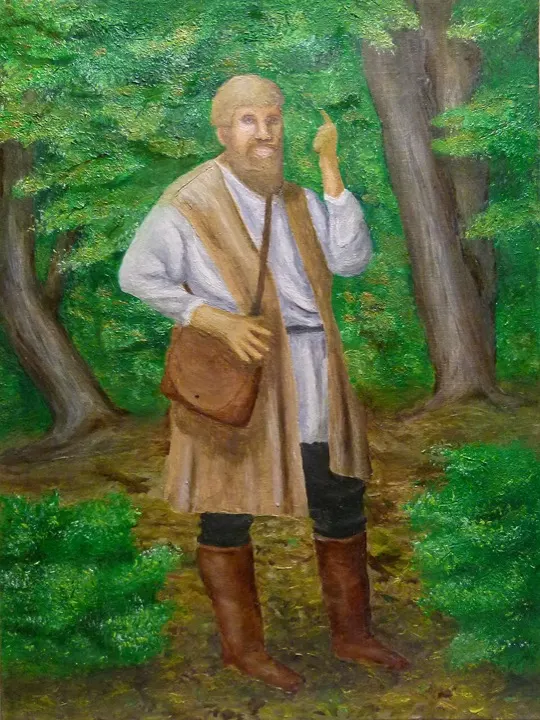
Painting: Michael Sattler preaching to a small group of men and women among the trees.
Michael Sattler preaching in the woods. A modern oil painting by Mike Atnip, an artist’s idea of the scene; released by the artist to the public domain.8

Who wrote it

Michael Sattler and the “Turks” charge

Short answer

Michael Sattler, a former Benedictine monk, led the meeting at Schleitheim and is commonly credited with writing the seven articles. Less than three months later he was tried at Rottenburg am Neckar and burned at the stake, in May 1527.5

From monk to shepherd

Sattler was a monk at St. Peter’s Abbey in the Black Forest, probably its prior. He left around 1525, married a former Beguine named Margaretha, and joined the Swiss Brethren. In February 1527 he led their meeting at Schleitheim.7 Soon after, he was arrested with his wife and several other believers.

The charges match the articles

The Martyrs Mirror lists nine charges read at his trial. Several of them touch the articles of Schleitheim: infant baptism (Article 1), the Lord’s Supper (Article 3), not swearing before the authorities (Article 7), and the ninth, on the sword (Article 6):

“Ninthly, he has said that if the Turks should invade the country, no resistance ought to be offered them”

His answer, in the same account: “If the Turks should come, we ought not to resist them; for it is written: Thou shalt not kill.” His tongue was cut out, his body was torn with hot tongs, and he was burned. The Martyrs Mirror says Margaretha was drowned a few days later.

Next: Why were Anabaptists persecuted?

Read: The Martyrs Mirror

Watch Listen

The Schleitheim Confession, explained on video

Where to start

Start with the 48-minute conversation at the top of this page. For how the movement spread from 1525 to 1527 and the meeting at Schleitheim, watch Part Three of Edsel Burdge’s history series, then Lecture 9 of the free history course.

Shippensburg Christian Fellowship · History of the Anabaptists · Part Three

Early Spread of Anabaptism & The Schleitheim Confession

Edsel Burdge on how Anabaptism spread from 1525 to 1527, and on the confession agreed at Schleitheim. Part Three of his history of the Anabaptists.

Four more to watchSattler, separation, baptism

Two confessions

Schleitheim and Dordrecht: what is the difference?

Schleitheim is short and pointed: seven articles on the places where the Swiss Brethren differed from everyone else. Dordrecht, written by Dutch Mennonites a century later, is a full statement of faith in eighteen articles, from creation to the last judgment. It keeps Schleitheim’s convictions on baptism, the ban, nonresistance and the oath, and adds foot washing and marriage.9

Read the Dordrecht Confession in a public-domain English translation on Wikisource. The Dordrecht Confession · page coming

The Schleitheim and Dordrecht confessions compared
QuestionSchleitheimDordrecht
When15271632
WhereSchleitheim, SwitzerlandDordrecht, the Netherlands
FromSwiss BrethrenDutch Mennonites
Length7 articles18 articles
CoversOnly the points of differenceThe whole faith, from God and creation to the resurrection
TodayStudied as the first shared Anabaptist statementStill taught by many Amish and conservative Mennonites

Questions

Questions people ask about the Schleitheim Confession

Short, plain answers. Tap a question to open it.

What is the Schleitheim Confession?

It is a short statement of seven articles agreed by the Swiss Brethren, the first Anabaptists, at Schleitheim, Switzerland, on 24 February 1527. It does not cover the whole Christian faith. It sets out seven points where these believers parted from both the Catholic and the Protestant churches of their day.

Who wrote the Schleitheim Confession?

Michael Sattler, a former Benedictine monk, is commonly credited as its main author. He led the meeting at Schleitheim, and the articles were agreed by the whole gathering. Less than three months later Sattler was burned at the stake at Rottenburg am Neckar, in May 1527.

What are the 7 articles?

(1) Baptism only for those who repent and believe; (2) the ban, for members who fall into sin; (3) the breaking of bread, only for the baptized; (4) separation from evil; (5) shepherds in the church; (6) the sword, which is not for the Christian; and (7) the oath, which Christ forbids.

Why is it called the “Brotherly Union”?

Its 1527 German title begins Brüderliche vereynigung: the “brotherly union” of a number of children of God concerning seven articles. It records what the brothers and sisters at Schleitheim agreed on together, at a time when the young movement was being scattered and its first leaders jailed or killed.

Is there a PDF or full text of the Schleitheim Confession?

We do not host the text yet. We found no public-domain English translation we could reproduce, and the common English text from 1945 may still be under copyright, so this page gives each article in our own words. The 48-minute Anabaptist Perspectives conversation at the top of the page walks through what it says.

How is it different from the Dordrecht Confession?

Schleitheim (1527) is short: seven articles from the Swiss Brethren on the points where they differed. Dordrecht (1632) comes from Dutch Mennonites and has eighteen articles covering the whole faith, from creation to the last judgment. Many Amish and conservative Mennonites still teach from Dordrecht.

Did the early church believe what Schleitheim teaches?

The Anabaptists believed they were going back to the church of the apostles. Christians who wrote before AD 325 speak of baptism after faith, the Lord’s Supper only for the baptized, refusing oaths, and not returning blow for blow. Each article above links to hundreds of their passages, so you can judge for yourself.

More in Anabaptists

Notes and sources

Lectures, belief pages and library chapters are on The Historic Faith. Outside sources are named with their address.

Show all 10 notessources for every date and quote
  1. Date, place, author and the seven topics: Lecture 9, “The Martyrdom of Michael Sattler and the Schleitheim Confession”; Wikipedia, “Schleitheim Confession”.
  2. German title, 1527: Brüderliche vereynigung etzlicher Kinder Gottes siben Artickel betreffend (“Brotherly Union of a Number of Children of God Concerning Seven Articles”), as given by Wikipedia.
  3. We found no public-domain English text of Schleitheim (Wikisource has none). The common English translation (J. C. Wenger, 1945) may still be under copyright, so every article on this page is our own summary, not a quotation.
  4. Early Christian lines are copied from our pages: believer’s baptism, shunning and church discipline, closed communion, separation from the world, elders, Anabaptist convictions and the early church (Athenagoras) and swearing oaths. Each one links to the passage in our library.
  5. Martyrs Mirror, “Michael Sattler, A.D. 1527”, 1886 English edition, public domain: the nine charges, his answers and the sentence: homecomers.org. It dates the sentence “the 21st day of May, A. D. 1527”; most modern accounts give 20 May.
  6. Felix Manz was drowned in Zurich on 5 January 1527: Wikipedia, “Felix Manz”.
  7. Sattler’s life: Wikipedia, “Michael Sattler”; Lecture 9.
  8. Mike Atnip, “Michael Sattler preaching in the woods”, oil painting, released by the artist to the public domain (CC0): Wikimedia Commons.
  9. Dordrecht Confession of Faith (1632), eighteen articles, public-domain translation: Wikisource. Article XI is on foot washing and Article XII on marriage.
  10. Video facts (titles, speakers, length, dates) are from each video’s page on The Historic Faith, for example The 7 Articles that Defined the Peaceful Radical Reformation (published September 11, 2025, 47:50).

Cite this page: The Historic Faith editorial team, “The Schleitheim Confession (1527): The 7 Articles Explained”, The Historic Faith, reviewed November 6, 2026, https://thehistoricfaith.com/anabaptist/schleitheim-confession.