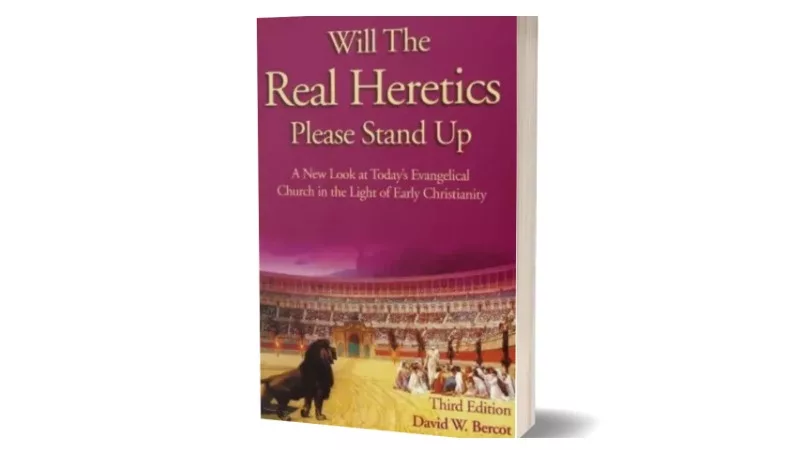
This free audiobook course presents David Bercot’s Will the Real Heretics Please Stand Up, a chapter-by-chapter comparison of early Christianity with later and modern Christian beliefs. Bercot defines “early Christians” mainly as believers from the period after the apostles through the pre-Constantine church, then lets writers such as Polycarp, Justin Martyr, Irenaeus, Clement of Alexandria, Tertullian, Origen, Cyprian, and Lactantius speak at length.
The course explores why early Christians were known for separation from the world, love for enemies, mutual care, moral distinctiveness, and willingness to suffer. It then considers disputed questions about salvation, free will, baptism, wealth, New Testament ethics, war, and the death penalty. Later chapters trace Bercot’s account of how Constantine, church councils, Augustine, the Reformation, and restoration movements affected Christian doctrine and practice.
The final lessons ask students to respond with humility, honesty, and renewed attention to simple holiness, love, and cross-bearing.
Bercot introduces the book and notes that it was written for Bible-believing conservative evangelicals in 1988, while the recording reflects his later reading of it. The chapter recounts Polycarp’s arrest, refusal to curse Christ, and martyrdom as an opening picture of early Christian conviction.
- Why does Bercot begin with Polycarp?
- How did Polycarp respond when pressured to deny Christ?
- What does this martyrdom show about early Christian courage?
This chapter defines the early Christians mainly as believers from about AD 80-90 to 199, while also using later pre-Constantine writers when their teaching agrees with the earlier period. Bercot introduces key writers, explains why he avoids calling them “church fathers,” and says he wants readers to hear them in their own words.
- Who counts as an early Christian in this book?
- Why does Bercot include writers after AD 200 in some places?
- Which early Christian writers will be important witnesses?
Bercot describes early Christians as a people marked by separation from the world, unconditional love, and obedient trust. He emphasizes their care for the needy, love across ethnic lines, refusal to preserve the church by violence, and confidence in God during persecution.
- What marks did Jesus give for his people?
- How did early Christians practice love for one another?
- How did they respond to persecution and threats?
This chapter argues that early Christianity was not merely a reflection of Roman culture but a countercultural movement. Bercot contrasts early Christian practice with Roman norms in areas such as divorce, sexual morality, entertainment, violence, and the church’s tendency to absorb surrounding cultural attitudes.
- Were early Christian morals just the culture of their day?
- How did Christians differ from Roman society on marriage and entertainment?
- Why does Bercot warn against equating conservative attitudes with godly attitudes?
Bercot explains three reasons he believes early Christians lived with such spiritual power: the supportive role of the church, the message of the cross, and the belief that holiness involves both human obedience and God’s help. He contrasts this with softer modern presentations of Christian discipleship.
- Why did early Christians seem able to resist their culture?
- How did the church help individuals grow spiritually?
- What role did cross-bearing play in early Christian discipleship?
- How did they understand cooperation with God in holiness?
This chapter examines early Christian teaching on salvation, faith, grace, works, and obedience. Bercot argues that they saw salvation as God’s gift while also teaching that the gift is conditioned on faith expressed in obedient love.
- Did early Christians teach salvation by faith alone?
- How did they connect faith, grace, works, and obedience?
- Why does Bercot discuss Gnostic teaching in relation to salvation?
Bercot contrasts Reformation predestination with early Christian teaching on free will and God’s foreknowledge. The chapter presents early Christian explanations that distinguish God’s ability to foresee the future from arbitrary predestination.
- How did early Christians understand predestination?
- What is the difference between foreseeing and causing?
- How did Origen explain passages such as Romans 9?
Bercot explains that early Christians connected baptism with remission of sins, new birth, and spiritual illumination, while also insisting that baptism was not an empty ritual separated from faith and repentance. He contrasts baptism with later evangelical altar-call practices.
- How did early Christians read Jesus’ words about being born of water and the Spirit?
- What did they associate with baptism?
- Did they separate baptism from faith and repentance?
- Why does Bercot compare baptism with the altar call?
The supplied transcript does not include this chapter, so only the title is available. From the title, the lesson appears to consider whether prosperity should be viewed as a blessing, a spiritual danger, or both.
- How should Christians think about prosperity?
- When can prosperity become a snare?
Bercot argues that early Christians believed Christ’s moral teachings surpassed the Old Testament standard because they belong to a heavenly kingdom. The chapter focuses especially on literal obedience to Jesus’ teachings, including early Christian views on war, killing, abortion, and capital punishment.
- Did early Christians think New Testament morality differed from Old Testament morality?
- How did they understand Jesus’ commands about enemies and violence?
- What did they believe about war and capital punishment?
This chapter asks whether early Christians or modern Christians are more likely to understand the apostles correctly. Bercot points to the early Christians’ nearness in time, shared language and culture, access to apostolic oral teaching, and connection to churches founded by apostles.
- Whose interpretation of Scripture is more likely to reflect the apostles?
- What advantage did early Christians have because of time and culture?
- What role did apostolic tradition play?
Bercot argues that if early Christianity departed radically from the apostles, the change would have had to be deliberate, not accidental. He says the early church rejected new special revelation, honored apostolic authority, lived consistently with Jesus’ teachings, and was not rebuked by Christ in Revelation for false theology.
- Did early Christians believe the apostles were wrong or outdated?
- Did they claim new doctrinal revelation after the apostles?
- How does Bercot use Revelation’s messages to the seven churches?
Bercot describes four protective walls that he believes preserved apostolic Christianity: rejection of new revelation, separation from the world, referral of questions to apostolic churches, and congregational independence. He argues that Constantine’s favor weakened these protections by making change seem beneficial and by drawing the church toward worldly methods.
- What protected early Christianity from major change?
- Why does Bercot think persecution did not destroy the church?
- How did Constantine’s favor begin to change Christian attitudes?
This lesson focuses on the Council of Nicaea and its aftermath in Bercot’s account. He argues that church-wide councils, imperial involvement, creedal language, and claims of Spirit-guided conciliar authority weakened congregational independence and opened the way for later doctrinal developments.
- Why was the Council of Nicaea significant in Bercot’s account?
- How did church-wide councils affect local congregational independence?
- Why does Bercot criticize later reliance on non-scriptural creedal language?
Bercot identifies Augustine as the most influential teacher in Western Christianity because the West often read the apostles through Augustine’s lens. The chapter describes Augustine’s departures from earlier Christian teaching, especially in relation to predestination, grace, free will, holy war, and the response to Pelagianism.
- Why does Bercot call Augustine so influential?
- How did Augustine differ from earlier Christian writers?
- How did the controversy with Pelagius shape Augustine’s theology?
Bercot evaluates the Reformation as a partial but not complete return to early Christianity. He discusses indulgences, Luther’s reliance on Augustine, Luther’s doctrine of predestination, his statements during the Peasants’ War, and Bercot’s claim that sola Scriptura often functioned through Luther’s interpretation of Scripture.
- Was the Reformation a full return to primitive Christianity?
- How did Luther use Augustine’s theology?
- Why does Bercot criticize Luther’s handling of some biblical books?
This chapter surveys movements that tried to restore primitive Christianity after the Reformation. Bercot discusses the Wesleyan movement, the Campbell-Stone movement, the Oxford movement, and broader efforts to recover early Christian faith, holiness, Scripture reading, and practice.
- What later movements sought to restore early Christianity?
- How did Wesley combine early Christian interest with the work of the Holy Spirit?
- What practices did the Campbell-Stone movement seek to recover?
- How did the Oxford movement make early Christian writings more available?
Bercot presents the Anabaptists as a restoration movement that came especially close to the early Christian ethos of the two kingdoms. He emphasizes their literal reading of Scripture, separation from worldly power, refusal of violence and oaths, simple living, suffering under persecution, and stress on obedience as part of salvation.
- Why does Bercot see the Anabaptists as close to early Christianity?
- How did they understand the two kingdoms?
- Why did they refuse violence, oaths, and retaliation?
- What can be learned from both their zeal and their later weaknesses?
The final chapter calls modern Christians to face the witness of the early Christians rather than ignore it. Bercot urges doctrinal humility, honest use of early Christian sources, unity on essentials, and a return to holiness, love, cross-bearing, and separation from worldly methods.
- How should modern Christians respond to early Christian witness?
- Why does Bercot call for doctrinal humility?
- What does he mean by unity on the essentials?
- What kind of return does he call the church to make?